Pronoun Shift Errors in Long and Multi-Paragraph Texts

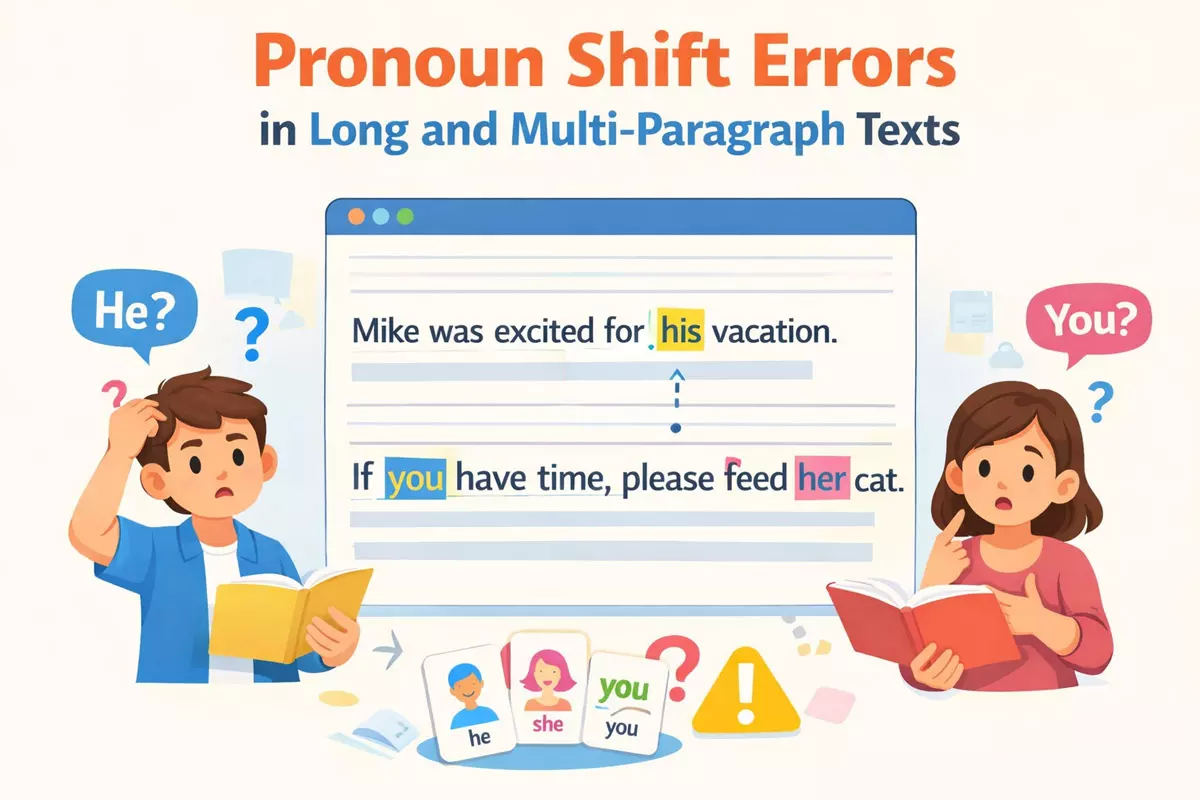 The article defines pronoun shift errors, explains shifts in person, number, and perspective, and shows why long texts make these mistakes more likely.
Navigating lengthy or complex writing can be challenging, especially when it comes to maintaining clear references to people and things throughout the text. Sudden shifts in how subjects or objects are referred to can easily occur, which may confuse readers and disrupt the overall flow of ideas. To improve clarity and coherence, writers should consistently use the same terms or pronouns for each subject and make sure that any changes in reference are intentional and clearly signaled. This careful attention helps readers follow the argument and understand the relationships between different parts of the writing.
What pronoun shift errors are
Pronoun shift errors occur when the pronoun used in a sentence or paragraph changes inappropriately, causing confusion or ambiguity for the reader. These mistakes often happen in longer or multi-paragraph texts, where writers may unintentionally switch between “I,” “you,” “he/she/they,” or “we” without clear reasoning or transition. Such inconsistencies can disrupt the flow of the writing and make it harder for readers to follow who is being referred to at any given point.
Common types of pronoun shifts
In extended writing, the most frequent issues involve shifting between different points of view or mixing singular and plural pronouns. Here are some typical patterns where these mistakes show up:
- Switching from first person (“I”) to second person (“you”) within the same context
- Moving from third person (“he/she/they”) to first person (“we/I”) unexpectedly
- Using “you” generically, then reverting to “one” or vice versa
- Mixing singular and plural forms, such as “a student...they” without clarification
- Shifting between “we” (inclusive) and “they” (exclusive) in group discussions
- Alternating between gendered and gender-neutral pronouns without clear intent
- Introducing “he or she” and switching to “you” later in the passage
- Using “it” for an object, then switching to “they” for the same object later
- Addressing the reader directly, then shifting to a more detached perspective
- Changing from passive to active voice pronouns (e.g., “it was decided” to “we decided”)
- Mixing formal (“one should”) and informal (“you should”) pronoun usage
- Shifting pronouns when writing dialogues or quoted speech without clear attribution
Why do these errors happen?
Unintentional switches in pronoun perspective often result from a writer’s attempt to sound conversational or to vary sentence structure. In longer compositions, it’s easy to lose track of the initial point of view, especially when providing examples, giving instructions, or summarizing information. The result can be sentences that feel disconnected or unclear.
Illustrative comparison of consistent vs. inconsistent pronoun use
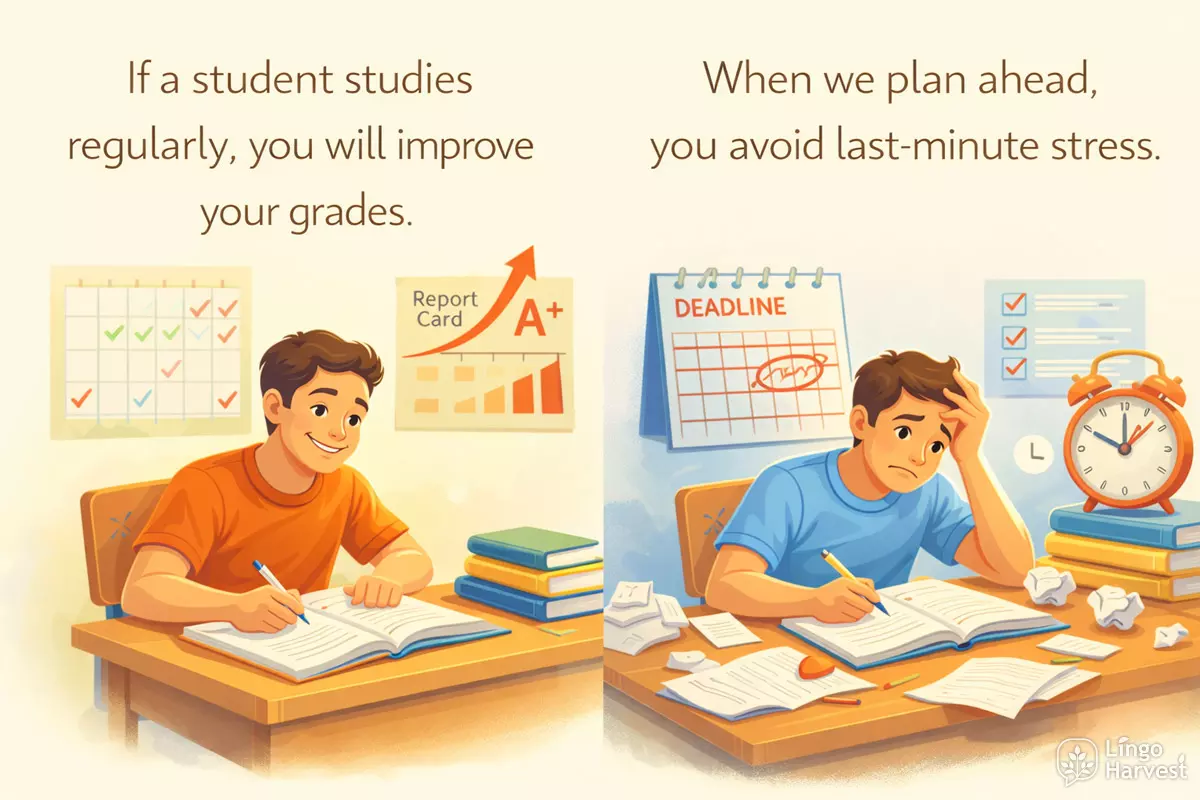
| Consistent Pronoun Use | Inconsistent Pronoun Shift |
|---|---|
| If a student studies regularly, he or she will improve grades. | If a student studies regularly, you will improve your grades. |
| When we plan ahead, we avoid last-minute stress. | When we plan ahead, you avoid last-minute stress. |
| During the experiment, they recorded the results carefully. | During the experiment, he recorded the results carefully, and they analyzed the data. |
| If one wants to succeed, one must practice consistently. | If one wants to succeed, you must practice consistently. |
Understanding these shifts is important for anyone aiming to write clear, cohesive texts. Careful attention to pronoun consistency helps maintain a steady point of view, improving both readability and the writer’s credibility.
Shifts in person, number, and perspective
Maintaining consistent pronoun use is crucial for clarity, especially in longer or multi-paragraph writing. In extended texts, writers often accidentally change from one grammatical person to another (such as from "I" to "you" or "they"), or switch between singular and plural forms mid-discussion. Such shifts can confuse readers or obscure the intended meaning. Recognizing these subtle changes—whether in viewpoint, quantity, or grammatical subject—helps preserve coherence throughout a passage.
Types of Pronoun Shifts
- Person: Moving between first ("I/we"), second ("you"), and third person ("he/she/they") pronouns.
- Number: Switching from singular ("she") to plural pronouns ("they"), or vice versa.
- Perspective: Altering the narrative stance, such as moving from an objective narrator to a subjective participant.
Common Patterns of Inconsistency
- Starting an essay with "one" and later using "you" to refer to the same subject
- Describing a group as "students" and then using "he" instead of "they"
- Switching from "we" (inclusive) to "I" (exclusive) without context
- Moving from a detached, third-person narration to direct address
- Referring to a singular object as plural in subsequent sentences
- Using "he or she" at first, then defaulting to "they"
- Beginning with "you" as an example, then shifting to "one"
- Changing from passive to active voice and altering pronoun viewpoint
- Introducing a hypothetical "someone" and then switching to "you"
- Alternating between "myself" and "ourselves" within the same context
Examples of Consistent vs. Inconsistent Usage
| Consistent Example | Inconsistent Example |
|---|---|
| If a person wants to improve, he or she must practice. | If a person wants to improve, you must practice. |
| Students should submit their papers on time. | Students should submit his paper on time. |
| We enjoyed our trip to the museum. | We enjoyed my trip to the museum. |
| When you read the instructions, you understand the task. | When you read the instructions, one understands the task. |
Writers can avoid these errors by reviewing their drafts for abrupt changes in pronoun reference. Reading passages aloud or using highlighting tools can help spot unnecessary jumps in viewpoint or number. Paying attention to these details ensures that the narrative remains steady and easy to follow, even in complex or lengthy compositions.
Why long texts increase shift risk
As written texts grow longer, writers often face greater challenges maintaining consistent pronoun use. Extended passages, especially those spanning several paragraphs or pages, can introduce new topics, characters, or time frames. Each of these shifts may tempt the writer to unconsciously change pronoun reference or perspective, leading to errors known as pronoun shifts.
How information load affects pronoun consistency
Longer compositions typically involve more details, characters, and ideas to keep track of. The mental effort required to manage all these elements can distract the writer from monitoring pronoun reference. As a result, it becomes easy to slip from one pronoun point of view to another without realizing.
- Switching from "I" to "you" or "we" unintentionally
- Referring to a new subject without clarifying the pronoun
- Shifting from singular to plural pronouns mid-discussion
- Using "they" ambiguously after introducing multiple groups
- Inadvertently alternating between "he/she" and "they"
- Mixing first-person and third-person perspectives
- Introducing new pronouns in dialogue without clear antecedents
- Forgetting the original narrator in multi-paragraph stories
- Shifting from formal ("one") to informal ("you") pronouns
- Confusing possessive forms ("his" vs. "their")
Common scenarios in extended writing
Multi-paragraph essays, reports, and stories often alternate between explanations, examples, and narrative. Each transition is a potential point for unintended pronoun change. For instance, a writer might begin a section describing personal experience (using "I"), then shift to generalized advice ("you" or "we"), and finally revert to the original narrative, causing confusion for readers.
| Section Type | Typical Pronoun Used |
|---|---|
| Personal anecdote | I, my, me |
| General advice | you, your |
| Objective analysis | one, they, he/she |
| Group reflection | we, our, us |
| Describing others | they, their, them |
Memory and reader perspective
Another factor is the reader's ability to track pronoun references over an extended stretch of text. If a pronoun's antecedent is many paragraphs back, readers may lose track, making the writing feel disjointed or ambiguous. This is especially true in academic or technical writing, where clarity is essential.
Writers can reduce these risks by rereading their work, checking pronoun and antecedent agreement, and maintaining a consistent point of view throughout. Awareness of how longer texts increase the likelihood of pronoun shift errors helps writers produce clearer, more coherent writing.
Pronoun consistency across paragraphs
Maintaining clear and logical reference for pronouns is particularly challenging when writing multi-paragraph texts. As the distance between a pronoun and its antecedent increases, the risk of confusion grows. This often happens when the writer assumes the reader remembers the referent from a previous section, but intervening details or new subjects can blur the connection. Ensuring that pronoun references remain unambiguous across longer stretches of text is essential for reader understanding.
Common causes of cross-paragraph pronoun errors
- Introducing multiple characters or entities without clarifying pronoun reference
- Switching topics or perspectives between paragraphs
- Using vague pronouns like “it,” “they,” or “this” after a long gap
- Assuming the reader recalls earlier information without reminders
- Shifting from singular to plural referents (or vice versa) unintentionally
- Changing the grammatical person (e.g., moving from “he” to “you”)
- Relying on context that is no longer clear after several sentences
- Repeating pronouns with different antecedents in a series of paragraphs
- Omitting explicit nouns after introducing new pronouns
- Inconsistent use of gendered pronouns for the same referent
Strategies for maintaining clear references
Writers can minimize ambiguity by reintroducing nouns or proper names when necessary, especially at the start of new paragraphs. Alternating between pronouns and full noun phrases also helps anchor the reader. In longer sections, consider summarizing the main subject before using a pronoun again.
Examples of consistent and inconsistent usage
| Problematic Example | Improved Example |
|---|---|
| Maria finished her report. She sent it to John. He replied quickly. She thanked him. In the next paragraph: She was relieved. |
Maria finished her report. She sent it to John. He replied quickly. Maria thanked John. In the next paragraph: Maria was relieved. |
| The committee reviewed the application. They found several issues. After a discussion, they decided to reject it. In the following paragraph: They informed her. |
The committee reviewed the application. The members found several issues. After a discussion, the committee decided to reject it. In the following paragraph: The committee informed the applicant. |
| Alex and Jamie debated the proposal. He was not convinced. Later: He suggested changes. |
Alex and Jamie debated the proposal. Jamie was not convinced. Later: Jamie suggested changes. |
| The company released its new product. It was well received. It then increased its marketing budget. |
The company released its new product. The product was well received. The company then increased its marketing budget. |
Tips for writers
- Restate important nouns at the start of new paragraphs if pronoun reference might be unclear
- Alternate between pronouns and explicit noun phrases to reinforce clarity
- Review each new paragraph for potential ambiguity in pronoun use
- Ask a peer to read your text and identify confusing references
- When in doubt, prefer clarity over repetition
By carefully monitoring pronoun use across multiple paragraphs, writers can prevent confusion and ensure their texts remain coherent and reader-friendly.
Narrative vs expository writing issues
Writers often encounter different types of pronoun shift errors depending on whether they are crafting a story or explaining a concept. In storytelling, the use of pronouns tends to follow the perspective of the narrator or characters, while explanatory texts require a consistent point of view to avoid confusing the reader. Recognizing how pronoun consistency varies in these genres is key to reducing mistakes in longer texts.
Pronoun consistency in storytelling
In narratives, writers may switch between first-person ("I/we"), second-person ("you"), and third-person ("he/she/they") pronouns for stylistic or structural reasons. However, unintentional shifts can disrupt the flow and clarity, especially across paragraphs or scenes. Common pitfalls include:
- Moving from "I" to "you" within the same sequence of events
- Switching from "he/she" to "they" when referring to the same character
- Using "we" to describe actions of a single character
- Losing track of narrative perspective after dialogue or time jumps
Expository writing: clarity and reader orientation
In expository texts, maintaining a stable pronoun point of view is crucial for reader comprehension. Shifts between "you," "one," and "they" can make instructions or explanations unclear. For instance, starting a process description with "you" and then switching to "one" or "they" may cause confusion about who is performing the actions. This is especially problematic in multi-paragraph essays or technical writing where precision is expected.
| Genre | Common Pronoun Shift Problems |
|---|---|
| Narrative | Switching from "I" to "you" or "he/she" within the same viewpoint |
| Expository | Alternating between "you," "one," and "they" in explanations |
| Narrative | Inconsistent pronouns after dialogue or scene change |
| Expository | Using "we" for general statements, then shifting to "you" or "they" |
Practical strategies to avoid shifts
Writers can reduce errors by choosing a point of view before drafting and sticking to it throughout each section. Reading aloud can also help catch unintended switches. For longer texts, outlining pronoun use per section or chapter keeps references consistent.
- Identify the intended audience and address them directly or indirectly throughout
- Highlight pronouns during revision to spot shifts
- Ask another reader to check for confusing references
- Use editing tools to flag inconsistent pronoun use
- Revisit point of view after major revisions or additions
By recognizing the unique challenges posed by different writing genres, authors can craft clearer, more consistent prose and avoid the most common pitfalls of pronoun use in extended texts.
Editing techniques to spot shifts
Careful proofreading and targeted strategies make it much easier to catch pronoun inconsistencies in extended writing. When reviewing several paragraphs or pages, it's easy to lose track of which noun a pronoun refers to or to accidentally switch between points of view. Editors and writers can use a combination of visual, structural, and language-based methods to catch these errors before the final draft.
Read for consistency in point of view
First, identify the main perspective—first person (I/we), second person (you), or third person (he/she/they)—used throughout the text. Scan each paragraph to see if the pronouns match the established perspective. If the narrative starts in third person but suddenly shifts to first or second person, that's a red flag.
- Highlight all pronouns in a section to visualize patterns.
- Check if the pronouns align with the subject introduced in each paragraph.
- Watch for unintentional jumps between "you" and "he/she/they" or "I" and "we."
- Ask: Does the pronoun refer clearly to a specific noun, or is it ambiguous?
Use a pronoun tracking list
Making a quick list of all pronouns and their antecedents (the nouns they refer to) can clarify potential shifts. This is especially helpful in multi-paragraph essays or stories with several characters.
- Write down each pronoun as it appears.
- Note the noun it replaces directly after.
- Look for any mismatches or unclear references.
- Flag any place where a pronoun could refer to more than one noun.
Compare passages with a table

For longer texts, a structured comparison can help spot pronoun shifts between sections. The following table illustrates how pronoun use may change and where errors can slip through:
| Original Passage | Revised for Consistency |
|---|---|
| When a student studies, you should take breaks. | When a student studies, he or she should take breaks. |
| If we want to succeed, they must work hard. | If we want to succeed, we must work hard. |
| The dog wagged its tail when you called. | The dog wagged its tail when she was called. |
| Everyone should finish their homework before you go outside. | Everyone should finish their homework before they go outside. |
Read aloud or use text-to-speech
Hearing your writing can reveal awkward or inconsistent pronoun references that might be missed when reading silently. Listen for sudden changes in pronoun use or unclear antecedents.
Pause after each paragraph
After reading each paragraph, briefly summarize whose perspective is being used and which nouns the pronouns refer to. If the summary changes unexpectedly, a pronoun shift may have occurred.
Checklist for final review
- Are all pronouns clear in meaning and reference?
- Is the point of view the same throughout the section?
- Do pronouns agree in number and gender with their antecedents?
- Have you avoided switching between "you," "he/she," and "they" unintentionally?
- Is every pronoun necessary, or could a noun make the meaning clearer?
Combining these hands-on techniques makes it much easier to catch and correct pronoun shifts, especially in longer, more complex writing. Consistent editing habits will help ensure clarity and reader understanding.
Before-and-after revision examples
Writers often stumble over pronoun consistency in lengthy passages, especially when shifting between perspectives or describing multiple subjects. Spotting and correcting these errors helps maintain clarity and cohesion throughout the text. Below, you’ll find a range of illustrative revisions showing how careful editing can eliminate confusing pronoun shifts.
Sample pronoun shift corrections
In extended writing, it’s easy to unintentionally switch pronouns, such as moving from "they" to "you," or "he" to "we," without signaling a change in point of view. Here are several typical problem areas and how they can be improved:
- Original: When a student is late, you should apologize to the teacher.
Revised: When a student is late, they should apologize to the teacher. - Original: If someone wants to improve your writing, they must practice daily.
Revised: If someone wants to improve their writing, they must practice daily. - Original: We need to submit the forms by Monday, then you wait for a response.
Revised: We need to submit the forms by Monday, then we wait for a response. - Original: A person should check their schedule before you make appointments.
Revised: A person should check their schedule before they make appointments. - Original: When you drive in winter, drivers should be careful on icy roads.
Revised: When you drive in winter, you should be careful on icy roads. - Original: If employees want to succeed, you must be dedicated.
Revised: If employees want to succeed, they must be dedicated. - Original: If a reader doesn't understand the text, you might lose interest.
Revised: If a reader doesn't understand the text, they might lose interest. - Original: When we enter the museum, visitors should remain quiet.
Revised: When we enter the museum, we should remain quiet. - Original: An athlete must train hard if you want to win.
Revised: An athlete must train hard if they want to win. - Original: If a manager expects results, you need to communicate clearly.
Revised: If a manager expects results, they need to communicate clearly. - Original: We try to help new students, but they may feel lost if you don't guide them.
Revised: We try to help new students, but they may feel lost if we don't guide them. - Original: When children play outside, you should supervise them.
Revised: When children play outside, they should be supervised.
Comparing inconsistent and revised pronoun use
When examining more complex texts, it helps to see longer excerpts side by side. The table below highlights how addressing ambiguous or shifting pronouns can clarify meaning and improve readability in multi-paragraph writing.
| Original Passage | Revised Passage |
|---|---|
| When a manager starts a new job, you face many challenges. They must learn company policies, and you have to adjust to new routines. | When a manager starts a new job, they face many challenges. They must learn company policies, and they have to adjust to new routines. |
| As students progress through college, you encounter more complex material. They need to develop new study habits if you want to succeed. | As students progress through college, they encounter more complex material. They need to develop new study habits if they want to succeed. |
| If a patient feels nervous before surgery, you should reassure them. They might ask questions, and you need to answer honestly. | If a patient feels nervous before surgery, the doctor should reassure them. The patient might ask questions, and the doctor needs to answer honestly. |
| When people travel abroad, you must prepare for cultural differences. They can enjoy their trip more if you learn about local customs. | When people travel abroad, they must prepare for cultural differences. They can enjoy their trip more if they learn about local customs. |
By reviewing these edits, writers can become more aware of subtle shifts in reference and maintain a consistent point of view throughout their work. Regular practice in identifying and revising these inconsistencies strengthens both clarity and reader engagement in longer pieces.
Practice: fix pronoun shifts in extended texts
When writing longer passages, it’s easy to accidentally switch between pronouns such as “you,” “they,” “he,” or “we.” Inconsistent pronoun use can confuse readers and disrupt the flow of your writing, especially in multi-paragraph texts or essays. The following practice activities will help you spot and correct pronoun shifts in extended contexts.
Recognizing Pronoun Shifts in Context
Read the following passage. Identify where the pronoun reference changes inappropriately and consider how to revise the text for clarity.
When a person joins a new company, you must learn the company culture quickly. They often feel nervous at first, but soon you start to make friends. If someone needs help, you can ask your manager for support.
- Underline all pronouns used in the passage above.
- Which pronouns refer to the same person or group?
- Are the pronouns used consistently throughout the passage?
- Identify any unclear or ambiguous pronoun references.
- Explain why inconsistent pronoun use can confuse the reader.
- Rewrite the passage to maintain consistent pronoun use.
- Rewrite the passage using gender-neutral pronouns only.
- Rewrite the passage using a specific noun instead of pronouns where needed.
Show answers
- Pronouns: a person, you, they, you, someone, you, your
- Same reference: All pronouns refer to the new employee.
- Consistency: The pronouns are not consistent.
- Unclear references: "you," "someone," and "they" shift without warning.
- Explanation: Inconsistent pronouns make it unclear who is being discussed.
- Possible revision: When a person joins a new company, they must learn the company culture quickly. They often feel nervous at first, but soon they start to make friends. If they need help, they can ask their manager for support.
- Gender-neutral version: When someone joins a new company, they need time to adapt. They may feel nervous, but they usually gain confidence quickly.
- Noun-based version: When a new employee joins a company, the employee must learn the company culture. The employee can ask the manager for help if needed.
Common Patterns of Pronoun Shift
Writers often make certain types of shifts in longer texts. Here are some frequent patterns to watch for:
- Switching from third person ("students") to second person ("you")
- Starting with "he or she" and moving to "they"
- Beginning with "we" and then using "one" or "people"
- Mixing singular and plural references
- Inconsistent use of gendered pronouns
- Alternating between impersonal ("one") and personal ("you")
- Changing from collective ("they") to individual ("he/she")
- Switching between first person plural ("we") and second person ("you")
- Mixing "someone" with "they" or "you"
- Using "it" ambiguously after a specific noun
Practice: Correcting Extended Texts
Below is a multi-paragraph excerpt containing pronoun shifts. Your task is to rewrite each paragraph so that the pronouns are consistent.
(1) If a student wants to improve your writing, they should practice regularly. One should also read a lot so you can see different styles.
(2) When you write essays, people often struggle with organizing their ideas. He or she might benefit from making an outline before they start.
Show answers
- If a student wants to improve their writing, they should practice regularly. They should also read a lot so they can see different styles.
- When students write essays, they often struggle with organizing their ideas. They might benefit from making an outline before they start.
Quick Reference: Correct and Incorrect Pronoun Consistency
| Incorrect Example | Corrected Version |
|---|---|
| If someone studies hard, you will succeed. | If someone studies hard, they will succeed. |
| When you arrive at the airport, travelers need to check in. | When travelers arrive at the airport, they need to check in. |
| People should take care of his or her belongings. | People should take care of their belongings. |
| We should always try your best in class. | We should always try our best in class. |
| One must finish your work before leaving. | One must finish one's work before leaving. |
Try It Yourself
Revise the following sentences to fix all pronoun consistency errors:
- When someone is late, you should apologize to the group.
- If a person wants to get better at math, they need to practice every day.
- As a teacher, one must prepare your lessons carefully.
- When you drive in the city, people need to pay attention to the traffic signals.
- If someone wants to succeed, you have to stay focused.
- When a student finishes the test, they should check your answers.
- If a person is tired, you should take a break.
- When someone makes a mistake, one should admit it honestly.
Show answers
- When someone is late, they should apologize to the group.
- If a person wants to get better at math, he or she needs to practice every day. Or: If people want to get better at math, they need to practice every day.
- As a teacher, one must prepare one's lessons carefully. Or: As a teacher, you must prepare your lessons carefully.
- When you drive in the city, you need to pay attention to the traffic signals. Or: When people drive in the city, they need to pay attention to the traffic signals.
- If someone wants to succeed, they have to stay focused.
- When a student finishes the test, they should check their answers.
- If a person is tired, they should take a break.
- When someone makes a mistake, they should admit it honestly.
Careful attention to pronoun consistency in extended texts helps ensure your writing remains clear and professional. Practice identifying and correcting such errors to improve overall cohesion in your essays and articles.