Pronoun Pitfalls in AI-Generated Text: What to Watch For

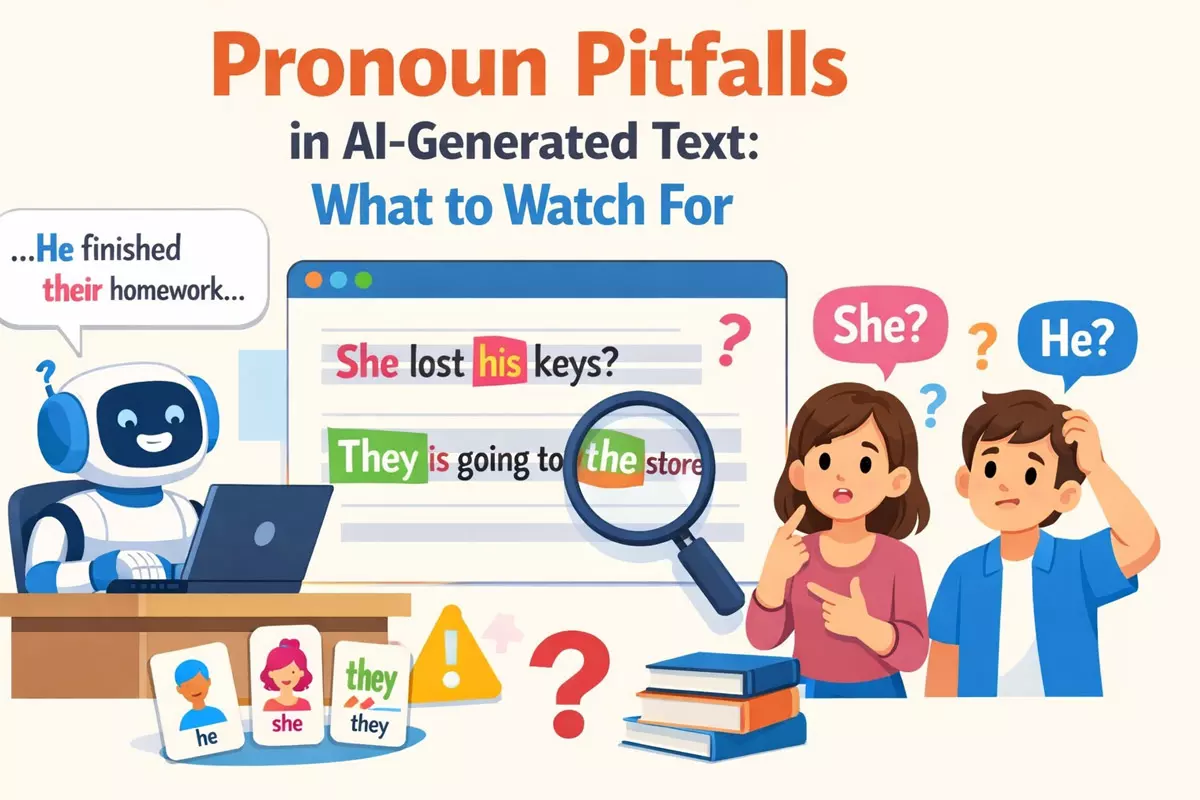 Here we why AI struggles with pronoun references, details common errors such as hallucinated or missing antecedents and vague pronouns, and provides editing tips, prompting strategies, review best practices, and hands-on editing exercises.
As artificial intelligence becomes increasingly common in content creation, subtle mistakes with personal references can slip through, leading to confusion or even unintended bias. Recognizing and addressing these frequent errors in machine-generated writing is essential for maintaining clear, accurate, and trustworthy communication. By paying close attention to how AI handles pronouns and references to individuals, writers and editors can ensure that their content remains both reliable and respectful to all audiences.
Why AI struggles with pronoun reference
Resolving pronouns accurately in text is a notorious challenge for artificial intelligence. Unlike human readers, language models lack true understanding of context, world knowledge, and the subtle cues that guide us in connecting pronouns like “she,” “it,” or “they” to their correct referents. Instead, AI relies on statistical patterns, which can fall short when sentences get complex or ambiguous.
Ambiguity and Context Limitations
Pronouns often point back to something mentioned earlier, but AI systems can miss the mark when multiple possible antecedents exist. For example, in “The cat chased the dog because it was scared,” does “it” refer to the cat or the dog? Humans use context and common sense, but AI may default to frequency or nearby words, which is unreliable.
Challenges Unique to AI
- Lack of real-world experience: AI doesn’t possess intuition or background knowledge to resolve unclear references.
- Sentence boundaries: Models may struggle to track pronoun links across several sentences or paragraphs.
- Complex structures: Nested clauses, long-distance dependencies, and shifting topics confuse automated systems.
- Gender and number agreement: AI can misalign pronouns with their intended singular/plural or masculine/feminine forms.
- Idiomatic usage: Unusual or playful uses of pronouns often stump algorithms.
- Ellipsis and omission: Sometimes, what’s referred to isn’t even stated outright, which is hard for models to infer.
Common Pitfalls in AI-Generated Pronoun Use
- Referring to the wrong entity due to ambiguity
- Switching pronoun references mid-paragraph
- Leaving pronouns without any clear referent
- Repeating or omitting antecedents, causing confusion
- Inconsistent use of gendered pronouns
- Using “it” or “they” for abstract concepts incorrectly
- Failing to update pronoun reference after topic shifts
- Overusing names to avoid pronouns, making text repetitive
- Assigning plural pronouns to singular subjects (and vice versa)
- Misinterpreting collective nouns (e.g., “team” as “they” or “it”)
- Getting lost in lists—using “they” when multiple groups are present
- Neglecting pronoun-antecedent distance, leading to reader confusion
- Mixing up pronouns in dialogue or quoted speech
- Misapplying pronouns to inanimate objects or animals inconsistently
- Ignoring cultural conventions for pronoun use
Comparing Human and AI Pronoun Handling
| Human Approach | AI Approach |
|---|---|
| Uses world knowledge and context clues | Relies on statistical patterns in training data |
| Infers implied subjects or objects | Struggles with omitted or indirect references |
| Handles ambiguity with reasoning or asking clarifying questions | May choose randomly or repeat errors |
| Adapts to shifting topics and conversational cues | Can lose track when context changes quickly |
Ultimately, pronoun resolution reveals both the strengths and the limits of current AI language models. While algorithms can mimic patterns, the nuanced understanding required for seamless reference remains a work in progress.
Common AI-generated pronoun errors
AI writing tools often stumble with pronoun usage, leading to awkward or ambiguous sentences. These mishaps can affect clarity, create confusion about who is being referenced, or even change the intended meaning. Understanding the most frequent missteps helps users spot and fix them more efficiently.
Ambiguous References
One of the most typical issues is unclear antecedents. When it’s not obvious what or whom a pronoun refers to, readers may get lost. For example, using “he” or “they” without a clear subject in the previous sentence can quickly muddle the narrative.
- “She told her friend that she needed help.” (Who needs help?)
- “The company hired John after they reviewed his application.” (Who reviewed it?)
Pronoun–Antecedent Agreement Problems
AI sometimes mismatches pronouns with their antecedents, especially in number or gender. This is common when referring to groups or collective nouns.
- Using “they” for a singular person when context requires “he” or “she”.
- Referring to “the team” with “they” instead of “it” in formal contexts.
- Switching from “someone…they” inconsistently within the same passage.
Gender Assumptions and Neutrality
Automated systems may default to masculine or feminine pronouns incorrectly, especially when gender isn’t specified. This can introduce bias or alienate readers.
- Assigning “he” to a doctor or “she” to a nurse without context.
- Using “his/her” repeatedly instead of “their” for inclusivity.
Pronoun Shifts and Consistency
Maintaining consistent pronoun use throughout a passage is challenging for AI. Shifting between “you,” “one,” and “they” can be jarring.
- Switching from “If you want to win…” to “One must practice…” mid-paragraph.
- Alternating between “they” and “he/she” for the same subject.
Redundant or Unnecessary Pronouns
AI-generated text may insert extra pronouns, making sentences wordy or repetitive. This often happens in complex or compound sentences.
- “The manager, she approved the budget.”
- “The dog, it barked loudly.”
Incorrect Object or Subject Pronoun Forms
Misusing “who” and “whom,” or confusing “me” and “I,” is still a pitfall for automated writing. These slip-ups can make text sound unnatural.
- “Between you and I, this is a secret.” (Should be “me”)
- “Whom is going to the party?” (Should be “who”)
Summary Table: Common Pronoun Mistakes and Examples
| Error Type | Example |
|---|---|
| Ambiguous Antecedent | “Alex gave Sam his book.” (Whose book?) |
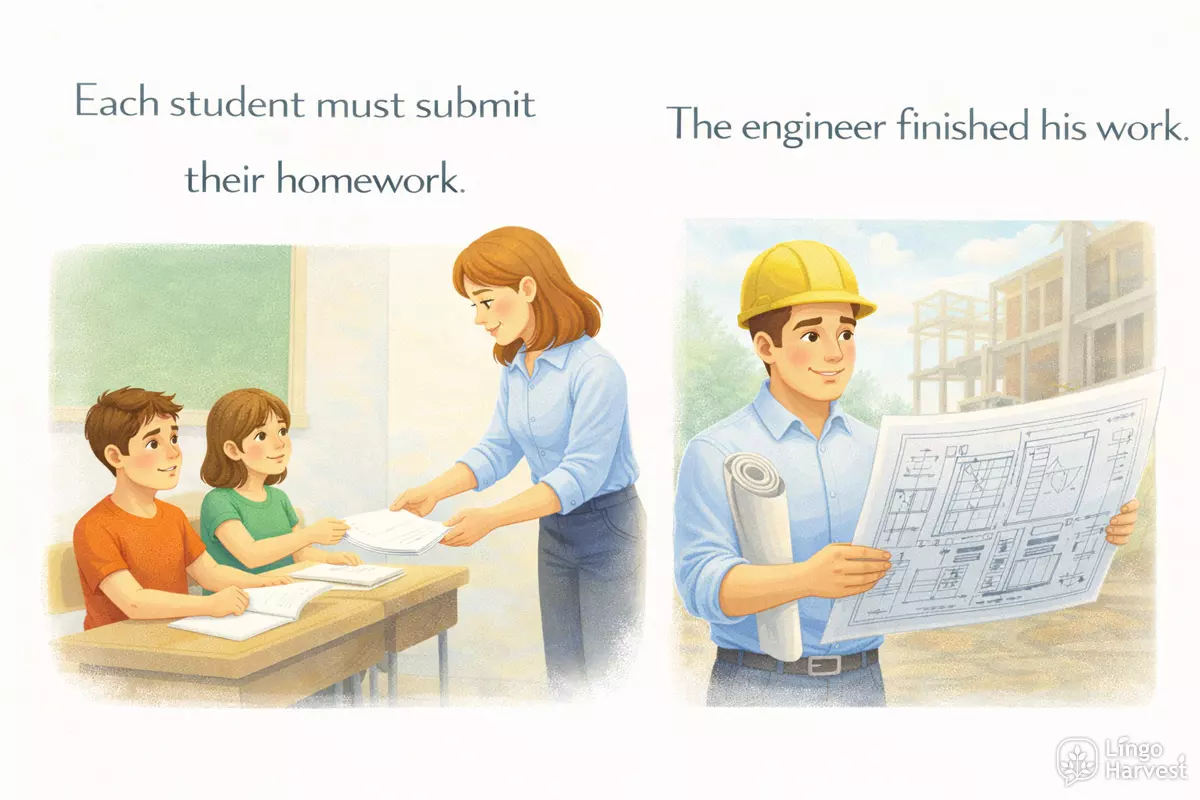
| Agreement Error | “Each student must submit their homework.” (Singular/plural mismatch) |
| Gender Assumption | “The engineer finished his work.” (Gender not specified) |
| Pronoun Shift | “You should save money. One never knows what will happen.” |
| Redundancy | “The cat, it jumped on the table.” |
| Incorrect Form | “Her and me went to the store.” |
Spotting these patterns is essential for anyone editing or reviewing AI-generated drafts. Addressing these common mishaps ensures that the final text is clear, accurate, and inclusive.
Hallucinated or missing antecedents
One of the most frequent sources of confusion in AI-generated text is unclear or absent connections between pronouns and their intended referents. When a system invents a referent that was never previously introduced, or omits the necessary noun altogether, readers are left guessing what—or who—a pronoun actually points to. This often results in misleading or nonsensical statements that undermine the coherence of the text.
Why does this happen?
AI models rely on patterns in data, but they sometimes infer context that isn’t actually present or fail to specify it. This can lead to "phantom" subjects or objects—entities that are assumed without proper introduction. In other cases, the pronoun appears with no clear noun to anchor it, forcing the reader to interpret meaning from thin air.
Common manifestations
- Using he or she without any prior mention of a person
- Switching from a specific noun to it or they without clear linkage
- Referring to a concept or object that was never introduced
- Ambiguous use of this or that at the start of a new paragraph
- Jumping between topics with pronouns, leaving the antecedent unclear
- Assuming prior knowledge that hasn’t been stated in the text
- Mixing singular and plural pronouns inconsistently
- Introducing a pronoun after a string of unrelated sentences
- Using they for an undefined group
- Employing which or who clauses with no obvious subject
- Shifting referents mid-sentence without clarification
- Substituting pronouns for proper nouns too early
Examples in AI-Generated Text
| Problematic Sentence | Issue |
|---|---|
| He was late to the meeting, so everyone was annoyed. | No prior mention of who "he" refers to. |
| The report was submitted. It was confusing. | Unclear if "it" refers to the report or the submission process. |
| This needs to be fixed immediately. | Ambiguous what "this" refers to in context. |
| They decided not to proceed, which surprised everyone. | "They" is undefined—no group was mentioned earlier. |
| If it rains, cancel it. | Unclear what the second "it" stands for—the event, the reservation, etc. |
How to spot and avoid these pitfalls
- Always introduce people, objects, or concepts before using pronouns for them.
- Reread sentences to check if every pronoun has a clear, unambiguous noun nearby.
- Be wary of abrupt topic shifts that might leave antecedents behind.
- Use proper nouns again if there’s any risk of confusion.
- When editing AI-generated content, highlight pronouns and trace them back to their referents.
By being vigilant about these patterns, writers and editors can significantly improve the clarity and reliability of AI-produced text, making it easier for readers to follow the intended meaning without second-guessing or confusion.
Overuse of vague pronouns
One common issue in AI-generated writing is the frequent use of ambiguous references such as it, they, or this without clear antecedents. These unclear pronouns can make text harder to follow, forcing the reader to guess what is being referenced. In longer passages or complex explanations, such imprecision can lead to confusion or misinterpretation.
Why unclear pronoun references are problematic
When an artificial intelligence system substitutes nouns with pronouns too aggressively, it often fails to provide enough context. The reader may lose track of who or what is being discussed, especially when multiple entities are involved. This disrupts the flow of information and undermines the clarity of the writing.
- Readers may struggle to identify the subject or object.
- Key details can be lost or misrepresented.
- Text may appear sloppy or less professional.
- Misunderstandings are more likely in technical or instructional content.
- Chain of logic becomes harder to follow.
Typical vague pronouns and their pitfalls
Certain pronouns are more likely to cause ambiguity in AI-generated content. Here are some that frequently lead to confusion when overused without clear references:
- It – Can refer to almost anything previously mentioned, from objects to abstract ideas.
- They – Ambiguous when multiple groups or people have been referenced.
- This or that – Unclear if the preceding sentence or an earlier idea is meant.
- He/she – Problematic in gender-neutral or multi-person scenarios.
- These/those – Vague when several items or concepts are listed.
- One – Can be interpreted as either a person or an object, depending on context.
- Which – Sometimes unclear what noun is being modified.
- Who – Ambiguous in discussions involving several individuals.
- Where – Unclear if referring to a physical or abstract location.
- Such – Lacks specificity unless the category is clear.
Comparison: Clear vs. vague pronoun use
| Vague Pronoun Example | Revised for Clarity |
|---|---|
| It was difficult to understand. | The explanation was difficult to understand. |
| They said it would be fixed soon. | The engineers said the server issue would be fixed soon. |
| This is important. | Accurate data labeling is important. |
| He reviewed it and approved it. | Dr. Chen reviewed the proposal and approved the budget. |
| These are necessary. | Clear instructions and examples are necessary. |
How to avoid excessive ambiguity
Reducing the reliance on unclear pronouns leads to more precise and accessible writing. When editing AI-generated drafts, try these strategies:
- Replace pronouns with specific nouns, especially after introducing new topics.
- Use pronouns only when the reference is unmistakable.
- Read passages aloud to spot where meaning might be lost.
- Ask a colleague or peer to review and identify unclear references.
- Maintain consistency with terminology throughout the text.
Ultimately, careful handling of references helps ensure that readers can easily follow the intended ideas, reducing the risk of miscommunication.
Editing AI text for pronoun clarity
AI-generated content often stumbles when it comes to making pronoun references clear. This can leave readers unsure about who or what is being discussed, especially in complex sentences or those involving multiple people or entities. To improve readability and avoid confusion, it's important to spot ambiguous pronouns and revise the text for greater specificity.
Common issues with AI-generated pronouns
- Unclear antecedents: The pronoun "he" or "she" appears, but it's not obvious who it refers to.
- Multiple possible referents: Two or more nouns precede a pronoun, making the reference ambiguous.
- Overuse of "it": AI may use "it" to refer to abstract ideas or entire sentences, confusing the reader.
- Switching pronoun genders or numbers mid-paragraph without explanation.
- Inconsistent use of singular "they," which can be unclear in context.
Strategies for improving pronoun clarity
- Replace ambiguous pronouns with the specific noun they refer to.
- Restructure sentences to place the noun closer to its pronoun.
- Break up long sentences with multiple subjects to reduce confusion.
- Use names or descriptive phrases, especially after switching topics.
- When in doubt, repeat the noun for clarity, even at the expense of repetition.
- Check for gender or number mismatches and adjust accordingly.
- Limit the use of "this" or "that" without a clear noun following.
- Watch for pronouns in dialogue—ensure speakers are clearly identified.
- After a list of people or items, restate the specific referent before using a pronoun.
- Consider audience familiarity: use more explicit references for less technical or unfamiliar readers.
Examples: Before and after pronoun edits
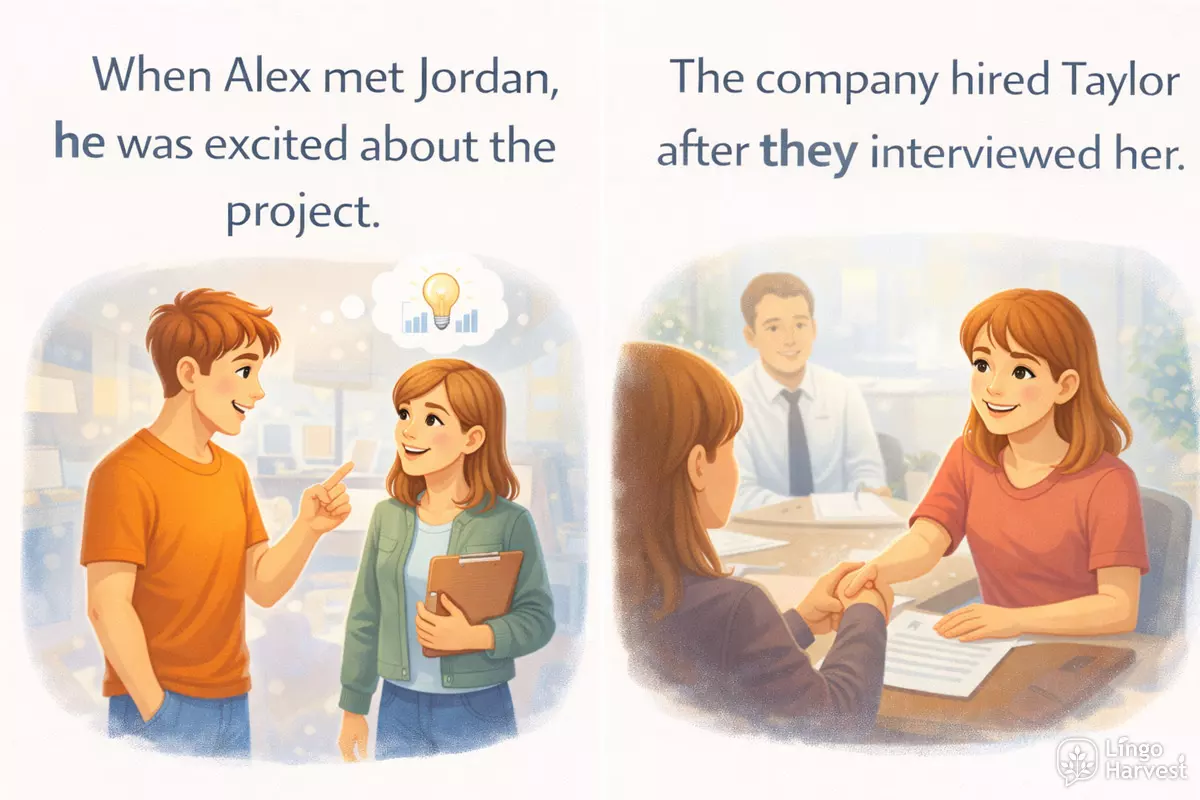
| Original Sentence | Improved for Clarity |
|---|---|
| When Alex met Jordan, he was excited about the project. | When Alex met Jordan, Alex was excited about the project. |
| The company hired Taylor after they interviewed her. | The company hired Taylor after the company interviewed her. |
| The report was sent to Sam, but it was unclear. | The report sent to Sam was unclear. |
| Lisa told Maria she would handle the call. | Lisa told Maria that Lisa would handle the call. |
Checklist for editing AI-generated text
- Identify all pronouns and trace each back to a clear noun.
- Ask: Could this pronoun refer to more than one thing?
- Revise sentences where the reference is not immediately clear.
- Read the text aloud—if you hesitate or reread, a pronoun may be unclear.
- Have another person review for possible ambiguities.
Careful attention to pronoun use transforms AI output from potentially confusing to easily understandable. By applying these editing steps, writers can ensure that automated content remains precise and reader-friendly.
Prompting strategies to reduce errors
AI models often stumble over pronoun use, resulting in ambiguity or mismatches. To help language models generate more accurate and coherent references, tailoring your prompts is essential. The following techniques can improve clarity and reduce mistakes related to pronoun assignment, reference, and consistency in AI-generated text.
Be explicit with antecedents
Always state the subject clearly before introducing a pronoun. Instead of relying on the AI to infer who “she” or “they” refers to, specify names or roles first. This is especially helpful when multiple entities are involved.
Request gender-neutral or specific pronouns
If your context requires consistent use of gender-neutral pronouns or particular forms, specify this in your prompt. For example, ask the model to use “they/them” throughout, or to refer to a person as “Dr. Smith” rather than “he” or “she.”
Encourage rephrasing for clarity
Ask the AI to avoid pronouns when ambiguity might arise. Prompts can include instructions like, “Rephrase any ambiguous sentences to clarify who is being referred to,” or “Avoid using pronouns where multiple people are involved.”
Provide context and examples
Supplying a brief background or sample sentences helps the AI understand the intended pattern. This is particularly useful when the narrative involves several characters or shifting perspectives.
Common prompt modifications to minimize pronoun pitfalls
- “Use full names for each mention instead of pronouns.”
- “After introducing a person, repeat their name in the following sentence.”
- “If a sentence could refer to more than one person, clarify who is meant.”
- “Use gender-neutral pronouns throughout the text.”
- “Check each pronoun’s antecedent for clarity.”
- “Rephrase sentences to avoid pronoun ambiguity.”
- “Ensure consistency in pronoun use for each character.”
- “Highlight any unclear references.”
- “Summarize who each pronoun refers to in parentheses.”
- “Avoid using ‘it’ to refer to people.”
- “Use role titles (e.g., ‘the manager’) instead of pronouns where possible.”
- “Insert a clarification after any pronoun that could be misinterpreted.”
- “Provide a character list at the start and use names consistently.”
- “Edit the text to resolve any pronoun mismatches.”
- “Limit pronoun use to once per paragraph.”
Comparison: Direct vs. clarified prompting
| Prompt Example | Potential Outcome |
|---|---|
| “Write a paragraph about Alex and Taylor. Then say what they did.” | Ambiguous use of “they”; AI may not clearly assign actions to the right person. |
| “Describe Alex and Taylor. In each sentence, specify who did what by name.” | Clear assignment of actions; less risk of pronoun confusion. |
| “Summarize the meeting. Use pronouns naturally.” | Possible mismatches or unclear references if participants aren’t well defined. |
| “Summarize the meeting. When referring to a participant, always use their name.” | References remain unambiguous, even with many participants. |
Iterative refinement and review
After generating text, review pronoun usage and prompt the AI for revisions as needed. Iterative prompting—asking for clarification, simplification, or rewording—can catch remaining errors and further improve reference accuracy.
Ultimately, the most reliable way to prevent pronoun-related mistakes is to combine clear, proactive instructions with careful review. Thoughtful prompt engineering can significantly reduce confusion and lead to more precise, trustworthy AI-generated writing.
Human review best practices
Careful human oversight remains essential for catching pronoun issues that automated tools often overlook. Reviewing AI-generated text for pronoun accuracy ensures clarity, avoids ambiguity, and respects inclusivity. Here are effective strategies for evaluating pronoun usage in machine-written content.
Focus areas for pronoun checking
Reviewers should pay attention to several common trouble spots:
- Ambiguous antecedents: Check if each pronoun clearly refers to one specific noun.
- Pronoun-antecedent agreement: Verify that pronouns match their antecedents in number and gender.
- Shifting pronouns: Watch for inconsistent use of "he," "she," "they," or "it" for the same entity.
- Unintentional bias: Identify gendered pronouns where neutral alternatives may be more appropriate.
- Overuse of pronouns: Replace repetitive pronouns with proper nouns when clarity suffers.
- Incorrect reflexives: Ensure forms like "themselves" or "himself" are used correctly.
- Impersonal constructions: See if "it" or "they" is used vaguely, leading to confusion.
- Respect for stated pronouns: Confirm that the text honors any explicitly mentioned pronouns for people discussed.
- Consistency in context: Evaluate if pronoun usage changes unexpectedly between sentences or paragraphs.
- Non-English influences: Watch for AI translations that may mishandle gendered pronouns or singular/plural forms.
Systematic review process
Adopting a structured approach helps reviewers catch subtle errors. Consider this step-by-step method:
- Read the text once for overall flow and comprehension.
- Highlight every pronoun; check its antecedent is clear and matches in gender/number.
- Scan for repeated references—ensure they remain consistent throughout.
- Replace pronouns with their nouns as a test: does the sentence still make sense?
- Mark any phrase where meaning shifts or becomes unclear due to pronoun choices.
- Note sections where inclusive or gender-neutral language could be improved.
Pronoun ambiguity: sample pitfalls and resolutions
Some pronoun problems are easier to spot than others. The table below presents typical pitfalls and suggested resolutions for each:
| Common Pitfall | Best Practice |
|---|---|
| Unclear "they" (multiple possible antecedents) | Replace with the specific noun or rephrase for clarity |
| Switching from "she" to "they" for the same person | Maintain consistent pronoun choice throughout the passage |
| Using "it" for a person | Use the correct personal pronoun or the individual's name |
| Defaulting to "he" or "she" when gender is unknown | Opt for "they" or rewrite to avoid gendered pronouns |
| Reflexive error: "theirself" instead of "themselves" | Use the correct reflexive form |
Quick self-check questions
After reviewing, ask yourself:
- Can a reader always tell who or what each pronoun refers to?
- Are any pronouns used in a way that could cause offense or exclusion?
- Would swapping in the noun clarify the meaning?
- Is the use of singular "they" appropriate in the context?
Show answers
- If a pronoun is ambiguous, replace it with a specific noun or rephrase the sentence.
- All pronouns should match their antecedents in number and gender; if not, revise for agreement.
- In cases where gender is unknown or irrelevant, "they" is generally accepted as a singular pronoun.
- Review sentences for consistency; do not switch pronouns for the same subject without clear reason.
Checklist for final review
- Each pronoun’s reference is unambiguous.
- Pronouns agree in number and gender with their antecedents.
- Respect for personal pronoun preferences is maintained.
- Inclusive language is prioritized where possible.
- No reflexive or possessive form errors remain.
By applying these principles, reviewers can catch subtle pronoun errors and ensure AI-generated content communicates clearly and respectfully.
Practice: edit AI-generated samples
Reviewing and revising machine-produced writing is an essential skill, especially when it comes to handling pronouns. Automated systems often make subtle errors with reference, ambiguity, or consistency. Below, you’ll find practice activities focused on spotting and correcting these common missteps. Try editing the samples yourself before checking the answers.
Spot the pronoun issues
Read the following sentences. Identify the pronoun-related problem in each, and suggest a clearer alternative.
- When Alex met Jordan, he was excited about the new project.
- The committee submitted their proposal to the manager, but she rejected it because it was unclear.
- Lisa gave her book to Maria after she finished reading it.
- The dog chased the cat until it ran up the tree.
- Sam and Taylor said they would help, but they forgot.
- Emma spoke to Sarah while she was working.
- The teacher called the student after they missed the class.
- Mark told Paul that his idea would not work.
- The company informed the clients that they would delay the launch.
- Julia saw Anna when she was leaving the building.
Show answers
- Ambiguous reference: Who was excited—Alex or Jordan?
Clearer: "When Alex met Jordan, Alex was excited about the new project." - Ambiguous 'it': Does 'it' refer to the proposal or the manager?
Clearer: "The committee submitted their proposal to the manager, but she rejected the proposal because it was unclear." - Ambiguous 'she': Who finished reading—Lisa or Maria?
Clearer: "Lisa gave her book to Maria after Maria finished reading it." - Ambiguous 'it': Which animal ran up the tree?
Clearer: "The dog chased the cat until the cat ran up the tree." - Vague 'they': Who forgot—Sam, Taylor, or both?
Clearer: "Sam and Taylor said they would help, but both forgot." - Ambiguous 'she': Who was working—Emma or Sarah?
Clearer: "Emma spoke to Sarah while Sarah was working." - Unclear 'they': Who missed the class?
Clearer: "The teacher called the student after the student missed the class." - Ambiguous 'his': Whose idea—Mark’s or Paul’s?
Clearer: "Mark told Paul that Paul’s idea would not work." - Vague 'they': Who would delay the launch?
Clearer: "The company informed the clients that the company would delay the launch." - Ambiguous 'she': Who was leaving the building?
Clearer: "Julia saw Anna when Anna was leaving the building."
Common pronoun pitfalls in AI writing
AI-generated content can stumble over several recurring pronoun errors. Here’s a list of issues to look out for when editing:
- Ambiguous antecedents (unclear what the pronoun refers to)
- Pronoun-antecedent disagreement (singular/plural mismatch)
- Overuse of generic pronouns (it, they, this, that)
- Shifting point of view (switching between 'you', 'they', 'one', etc.)
- Unnecessary repetition of names instead of pronouns
- Gender assumptions (assigning 'he' or 'she' without context)
- Omitted pronouns leading to sentence fragments
- Redundant pronouns ("He, he went to the store.")
- Unclear collective references ("They said it was ready.")
- Pronouns too far from their antecedents
- Incorrect case (using 'me' instead of 'I', etc.)
- Switching between singular 'they' and plural 'they' inconsistently
Before-and-after: editing pronoun mistakes
Let’s compare some flawed and improved sentences. Notice how clarity improves with careful pronoun use.
| Original Sentence | Revised Version |
|---|---|
| Pat told Chris that they would arrive late, but they didn’t specify who. | Pat told Chris that Pat would arrive late, but Pat didn’t specify who. |
| The teachers discussed the students’ progress. They were pleased. | The teachers were pleased with the students’ progress. |
| The laptop was given to Alex after he fixed it. | The laptop was given to Alex after Alex fixed it. |
| When Jamie and Morgan finished the puzzle, she celebrated. | When Jamie and Morgan finished the puzzle, Jamie celebrated. |
| Each employee must submit their report by Friday. | Each employee must submit a report by Friday. |
Try editing these AI outputs
Edit the following sentences for pronoun clarity or correctness. Make them as clear and unambiguous as possible.
- Chris called Taylor after they arrived at the airport.
- Jordan told Sam that his idea was interesting.
- The engineers met with the designers, but they didn’t agree.
- The document was sent to Alex and Jamie, and she reviewed it.
- Pat emailed Morgan after they finished the report.
- The manager spoke to the assistant before they left the office.
- Lee asked Robin to update the file, but they forgot.
- The teachers met the parents because they had concerns.
- Alex thanked Jordan when they solved the problem.
- The proposal was shared with Casey and Drew, and he approved it.
Show answers
- Chris called Taylor after Chris arrived at the airport.
- Jordan told Sam that Sam’s idea was interesting.
- The engineers met with the designers, but the two groups didn’t agree.
- The document was sent to Alex and Jamie, and Jamie reviewed it.
- Pat emailed Morgan after Pat finished the report.
- The manager spoke to the assistant before the manager left the office.
- Lee asked Robin to update the file, but Robin forgot.
- The teachers met the parents because the parents had concerns.
- Alex thanked Jordan when Alex solved the problem.
- The proposal was shared with Casey and Drew, and Drew approved it.
Careful editing for pronoun accuracy not only clarifies meaning, but also improves flow and reduces reader confusion. Practicing with real AI samples is the best way to develop an eye for these subtle yet important details.