How Native Speakers Choose Pronouns Instinctively

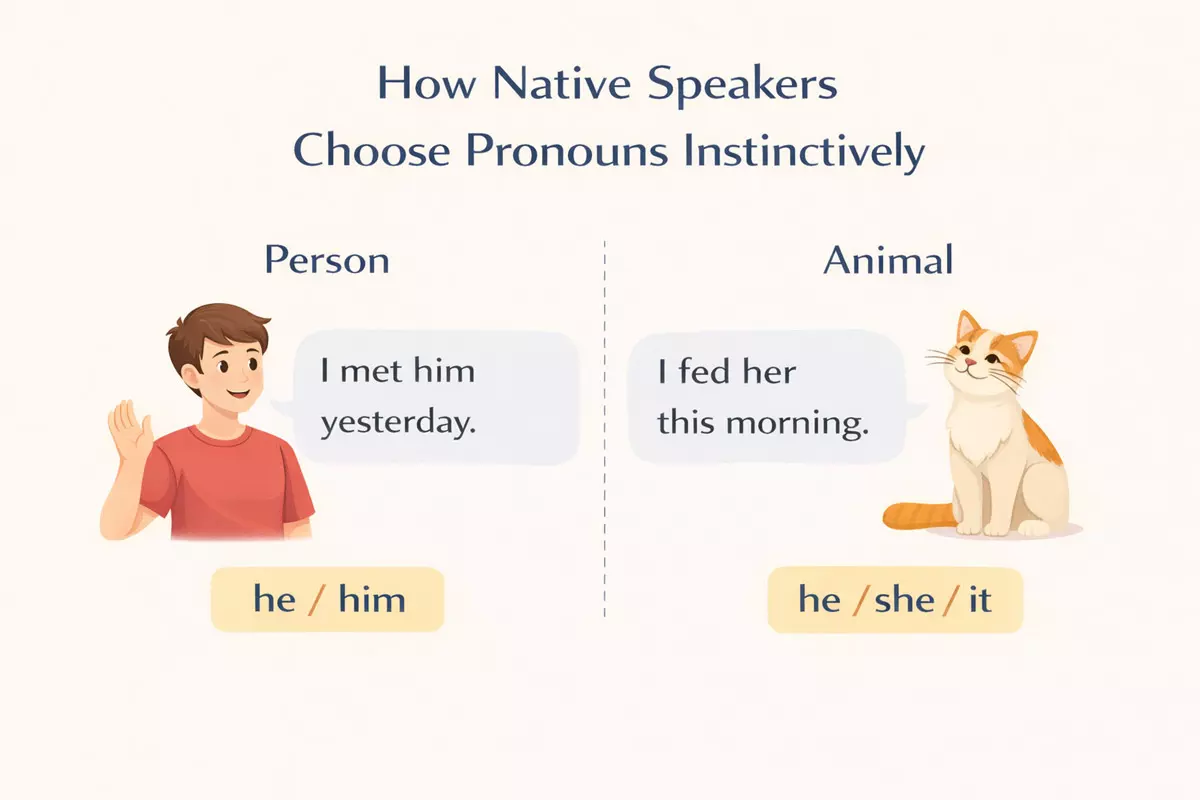 The article explains why native speakers choose pronouns instinctively, how context and shared knowledge guide their choices, and how they avoid ambiguity.
- Why native pronoun choice feels automatic
- Role of context and shared knowledge
- Pronoun choice in fast conversation
- Avoiding ambiguity without thinking
- Differences between learner and native patterns
- Implicit rules native speakers follow
- Developing instinct through exposure
- Practice: predict native pronoun choices
People fluent in a language often select words like he, she, or it without hesitation, demonstrating an intuitive grasp that develops over years of exposure and practice. This skill goes beyond memorizing grammar rules; it reflects a deep familiarity with the patterns and nuances of the language. Through countless conversations, reading, and listening, speakers internalize which pronouns and expressions fit best in different contexts, allowing them to communicate smoothly and naturally without consciously thinking about each choice.
Why native pronoun choice feels automatic
For most native speakers, selecting the right pronoun happens with little conscious thought. This is largely due to deep exposure and repeated practice from early childhood. As children, native speakers absorb pronoun patterns naturally through everyday conversation, stories, and listening to others. Over time, these forms become so ingrained that using them correctly feels as instinctive as breathing.
Unconscious Processing in the Brain
The brain's language centers store pronoun rules and examples in long-term memory. When speaking or writing, native speakers retrieve these forms instantly, without pausing to recall grammar rules. This rapid processing is a hallmark of fluency and explains why errors are rare, even in complex sentences.
Patterns Learned Through Exposure

Exposure to countless examples in context helps speakers internalize the nuances of pronoun use. Consider some of the typical English pronoun patterns that become second nature:
- He gave her the book.
- They saw us at the park.
- She did it herself.
- I told them the news.
- Give it to me, please.
- We finished our homework.
- You can help yourself.
- Who is calling?
- Whom did you see?
- That is theirs.
- This is mine.
- Each of them has his or her own book.
- The dog wagged its tail.
- Someone left their umbrella.
- It was she who called.
- Between you and me, that’s a secret.
- Everyone brought their own lunch.
- Neither of us knew the answer.
Intuitive Grammatical Distinctions
Native speakers also make subtle distinctions between pronoun forms—subjective, objective, possessive—without pausing to analyze. Consider how these forms are selected automatically in conversation:
| Pronoun Type | Example in Context |
|---|---|
| Subjective | She runs every morning. |
| Objective | The coach called him. |
| Possessive | This is their house. |
| Reflexive | He did it himself. |
Social and Contextual Awareness
Beyond grammar, instinctive pronoun selection also reflects awareness of social norms and context. Native speakers adjust their choices based on formality, politeness, and inclusivity, often without conscious planning. This sensitivity is built through years of social interaction and cultural immersion, making pronoun use feel effortless in any setting.
Role of context and shared knowledge
When native speakers decide which pronouns to use, they rarely pause to think about grammar rules. Instead, they rely on their understanding of the situation and their assumptions about what the other person knows. This intuitive process depends heavily on cues like who or what has already been mentioned, the relationship between speakers, and shared background information. Without this mutual understanding, pronouns can quickly become confusing or ambiguous.
How context shapes pronoun choice
Speakers constantly assess the ongoing conversation. If a person or object has been introduced, it becomes the default reference for pronouns such as "he," "she," or "it." But if multiple potential referents exist, speakers instinctively clarify by repeating the noun or choosing a more specific expression. Context also determines whether a pronoun is even needed; sometimes, repeating the noun adds clarity or emphasis.
- Reference to a previously mentioned subject ("Tom arrived. He sat down.")
- Switching pronouns when topics change
- Using demonstratives ("this," "that") for contrast or emphasis
- Omitting pronouns when the subject is obvious from context
- Clarifying with names if multiple people are present
- Adjusting pronouns for politeness or formality
- Choosing "they" for unknown or non-binary gender
- Switching to "we" to signal group identity or inclusion
- Relying on shared physical context (e.g., pointing and saying "that one")
- Using possessive pronouns when ownership is clear
- Employing "it" for weather, time, or abstract situations
- Choosing pronouns based on genre or register (formal/informal)
Shared knowledge: The invisible guide
Native speakers make assumptions about what their listener already knows. This "common ground" allows them to use pronouns efficiently, trusting that the listener can identify the intended referent. When this shared knowledge is lacking—such as in conversations with strangers or in written texts—pronoun choices become more explicit and careful to prevent misunderstanding.
| Situation | Pronoun Strategy |
|---|---|
| Single clear referent | Use pronoun directly ("She left early.") |
| Multiple possible referents | Repeat name or clarify ("Anna told Maria she was late" → "Anna told Maria that Anna was late.") |
| Unknown gender or group | Use "they" or descriptive phrase ("Someone left their bag.") |
| New topic introduction | Use noun first, then pronoun ("A dog appeared. It was barking loudly.") |
In sum, the instinctive use of pronouns by native speakers is a dynamic process, guided by both the immediate context and the intricate web of shared knowledge between participants. Without these foundations, even the simplest pronouns could leave listeners puzzled.
Pronoun choice in fast conversation
When people speak quickly, their selection of pronouns often becomes automatic, guided by intuition and context rather than conscious thought. Native speakers rely on their deep familiarity with grammatical patterns and social cues to pick the right pronoun instantly, even as sentences become more complex or fragmented in rapid exchanges. This instinctive process helps conversations flow smoothly, minimizing interruptions or misunderstandings.
How context drives quick pronoun use
In spontaneous dialogue, the subject or object of a sentence is often obvious from the previous sentence or shared situation. For example, if two friends are talking about a movie, "it" quickly replaces the movie’s title. Likewise, group dynamics influence whether "we," "they," or "you" appears, sometimes shifting mid-conversation as roles change.
- Referring to people just mentioned: "She said she’d call."
- Shifting focus: "You know what I mean?"
- Responding to questions: "They already left."
- Using vague references: "It’s raining."
- Picking up on implied subjects: "Guess so." (implied "I")
- Using “we” for inclusivity: "We should go."
- Defaulting to “you” for general statements: "You never know."
- Switching to “they” for unspecified groups: "They say it’s true."
- Dropping pronouns entirely in fast speech: "Coming?" (instead of "Are you coming?")
- Adapting based on politeness or formality: "Would you mind?" vs. "Mind if I...?"
Common challenges and instinctive solutions
Rapid exchanges can lead to unclear references, especially if several people or things are discussed. Native speakers often resolve this on the fly by adjusting word order, repeating a name, or clarifying with a quick phrase. For instance, they might say, "John, he said he’d help," to specify which "he" is meant.
| Situation | Typical Pronoun Choice |
|---|---|
| Talking about a known subject | he, she, it |
| Including the listener | we, you |
| Referring to a group | they |
| General statements | you, it |
| Unclear reference | repeat noun + pronoun ("The car, it...") |
These strategies demonstrate how native speakers navigate ambiguity and maintain clarity, even when sentences are incomplete or rushed. Their instinct for which pronoun to use is shaped by years of exposure and practice, making the process seem effortless.
Avoiding ambiguity without thinking
Native speakers rarely pause to reflect on which pronoun to use in conversation. Their minds automatically select the right word, often preventing confusion about who or what is being referred to. This almost unconscious process relies on subtle cues from context, grammar, and shared knowledge.
How context guides instinctive pronoun choice
People understand who "he," "she," or "it" refers to thanks to clues in the conversation. Speakers intuitively consider:
- The most recent noun mentioned (recency)
- Grammatical gender or number
- Logical expectations (who is likely to act or be acted upon)
- Shared knowledge between participants
- The topic focus or subject of the sentence
Common sources of confusion—and how they’re avoided
Ambiguous references can occur, but native speakers often sidestep them without effort. When two possible referents exist, speakers may instinctively rephrase, use names, or clarify with extra words.
- Replacing "he" or "she" with the person’s name if two men or women are involved
- Switching to "the teacher" or "the dog" instead of "he/it" when two similar nouns are mentioned
- Adding descriptive phrases, e.g. "the one with the red hat"
- Restructuring the sentence to avoid unclear references
Typical pronoun clarification strategies
Here are some ways native speakers instinctively keep their meaning clear:
- Repeating the noun: "Anna gave Anna’s book to Mark."
- Using appositives: "My brother, Tom, said he’d help."
- Clarifying with context: "The cat chased the dog. It was scared." (Listeners infer "it" means the dog.)
- Pausing or using intonation to signal a shift in topic or referent
- Choosing demonstratives: "this," "that," "these," "those"
- Omitting the pronoun entirely when possible: "Went home early."
- Switching to passive voice: "The book was taken."
- Using possessives: "His coat" vs. "her coat"
- Adding relative clauses: "The girl who won the race"
- Rephrasing for clarity: "After John met Paul, John left."
Examples of natural pronoun selection
| Ambiguous Situation | Instinctive Clarification |
|---|---|
| Two men are mentioned: "Jack spoke to Tom. He smiled." | Use the name: "Jack spoke to Tom. Tom smiled." |
| Multiple objects: "Put it on the table." | Add detail: "Put the book on the table." |
| Unclear subject: "They said it would rain." | Specify: "The weather report said it would rain." |
| Two possible referents: "Lisa gave her sister her bag." | Clarify: "Lisa gave her own bag to her sister." |
These strategies happen so quickly that most people are unaware of them. The result is communication that is usually clear, fluid, and free from misunderstanding—without conscious effort.
Differences between learner and native patterns
When it comes to choosing pronouns, native speakers often rely on intuition developed through years of language exposure, while learners typically apply rules more consciously. This distinction leads to notable differences in usage, especially in ambiguous or complex contexts. Learners may overthink their choices, leading to unnatural phrasing, whereas native users select forms that simply “feel right” in context.
Common Areas of Variation
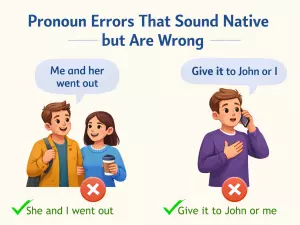
- Subject vs. object pronouns: Learners sometimes confuse “I” and “me,” especially after prepositions or conjunctions.
- Gender agreement: Mistakes with “he,” “she,” and “they” are frequent, especially when the gender of the referent is unknown or unclear.
- Reflexive pronouns: Non-natives may say “myself” instead of “me” (“Please contact myself if you have questions”).
- Generic ‘they’: Native speakers use “they” for singular, gender-neutral references, while learners may avoid it or use “he or she.”
- Omission of pronouns: In some languages, pronouns can be dropped. Learners may transfer this habit into English (“Is raining today” instead of “It is raining”).
- Who vs. whom: Non-natives sometimes misuse “whom” or avoid it entirely, while natives often use “who” even in formal writing.
- Possessive pronouns: Confusion between “his,” “her,” “its,” and “their” is more common among learners.
- Relative pronouns: Errors with “which,” “that,” and “who” can mark learner speech.
- Demonstratives: Overuse of “this” or “that” instead of more specific pronouns can occur.
- Consistency: Switching pronoun reference mid-sentence is a typical learner error (e.g., “If a student studies, you will succeed”).
Typical Patterns: Native Intuition vs. Learner Logic

| Native Speaker Choice | Learner Tendency |
|---|---|
| “Let’s keep it between you and me.” | “Let’s keep it between you and I.” |
| “Someone left their bag.” | “Someone left his or her bag.” |
| “Who did you see?” | “Whom did you see?” (overcorrecting) |
| “She gave it to herself.” | “She gave it to her.” |
| “He’s taller than I am.” | “He’s taller than me.” |
| “It’s raining.” | “Is raining.” |
Underlying Reasons for Differences
Learners often rely on explicit grammar rules or direct translation from their first language, which can result in errors or unnatural choices. Native speakers, by contrast, use context, frequency, and subtle cues picked up from daily interactions. This leads to patterns that may seem illogical but are widely accepted in natural speech.
- Native users adapt pronouns based on real-world context, not just grammar.
- Learners are more likely to apply textbook rules rigidly, sometimes missing exceptions or idiomatic usage.
- Exposure to variations and informal speech gives native speakers flexibility with forms like singular “they.”
- Transfer from a learner’s first language can cause persistent mistakes, especially with pronoun omission or gender.
Recognizing these differences helps both teachers and learners focus on areas where instinctive usage differs from formal instruction, leading to more authentic and fluent communication.
Implicit rules native speakers follow
Most people who grow up speaking a language rarely think about how they choose between words like he, she, they, or it. Yet, there are subtle patterns and expectations guiding each decision. These unwritten guidelines are absorbed naturally, often without formal instruction, and help speakers select the right pronoun in a split second.
Context matters: what’s already known
One major influence is context. If someone or something has already been mentioned, native speakers instinctively use a pronoun to refer back. For example, after introducing "Maria," the next sentence might use "she" instead of repeating the name. This keeps conversations clear and avoids repetition.
Gender, number, and formality
Choosing the right form depends on more than just the subject’s name. English, for instance, sorts pronouns by gender (he/she/they), number (I/we; he/they), and sometimes formality or familiarity. This sorting is so automatic that most native users don’t notice they’re doing it.
- Matching gender: "John lost his keys." ✅ "Mary lost her keys." ✅
- Plurality: "The children finished their homework."
- Neutral reference: "Someone left their bag."
- Object vs. subject: "She saw him." → "He saw her."
- Things and animals: "The dog wagged its tail."
- Non-binary or unknown: "Alex said they would join."
- Reflexive: "He hurt himself."
- Possession: "This is my book."
- Emphasis: "I myself did it."
- Relative pronouns: "The person who called."
Pronoun shifts and ambiguity
When more than one possible reference is present, native users typically pick the closest logical subject. If two people are mentioned, the speaker’s choice of pronoun follows the order in which those people were introduced, or uses names again to avoid confusion.
Quick comparison: English pronouns by type
| Type | Example Pronouns |
|---|---|
| Subject | I, you, he, she, it, we, they |
| Object | me, you, him, her, it, us, them |
| Possessive | my, your, his, her, its, our, their |
| Reflexive | myself, yourself, himself, herself, itself, ourselves, themselves |
These patterns are not consciously memorized but are nevertheless followed with remarkable consistency. Native speakers notice violations of these patterns instantly, even if they can’t always explain the rule. This intuitive process is shaped through years of exposure, correction, and social feedback.
Developing instinct through exposure
Native speakers rarely pause to analyze which pronoun fits a sentence; their choices feel automatic. This seemingly effortless accuracy is the product of countless hours spent immersed in the language, hearing and using pronouns in a wide variety of settings. Exposure to authentic speech and writing helps the brain internalize pronoun patterns, so choices feel intuitive rather than calculated.
How immersion shapes pronoun choice
When children grow up surrounded by a language, they absorb not just vocabulary but also the underlying rules of grammar—including which pronouns to use and when. This process happens gradually, through hearing others speak, reading, and participating in conversations. Over time, repeated exposure to correct forms creates strong mental associations, making certain pronouns "sound right" in specific contexts.
- Listening to family members refer to each other as "he," "she," or "they"
- Reading stories where characters are introduced with pronouns
- Noticing how teachers refer to classmates in group settings
- Watching shows or movies with natural dialogue
- Overhearing casual conversations in public places
- Receiving feedback when a pronoun is used incorrectly
- Observing how pronouns shift with formality or politeness
- Absorbing regional or cultural variations in pronoun use
- Learning to distinguish between gendered and neutral forms
- Picking up on subtle cues about respect and hierarchy
- Recognizing when to use "it" for objects or animals
- Understanding plural forms like "we," "they," or "you all"
- Adapting to singular "they" in modern contexts
- Grasping reflexive forms like "myself," "yourself," "themselves"
- Identifying when to drop pronouns entirely in casual speech
Comparing explicit learning and natural exposure
While classroom instruction can teach the rules of pronoun use, instinctive selection comes from real-world experience. The following table highlights key differences between learning through formal study and acquiring patterns through immersion:
| Formal Instruction | Natural Immersion |
|---|---|
| Memorizing grammar charts | Hearing pronouns used in daily conversation |
| Focusing on rules and exceptions | Picking up patterns unconsciously |
| Practicing with exercises | Noticing what sounds correct |
| Correcting mistakes through teacher feedback | Self-correcting based on exposure and context |
Ultimately, the more one is exposed to authentic language in context, the more instinctive pronoun selection becomes. This is why even fluent non-native speakers often report that certain forms simply "feel right" after sustained immersion, even if they can't always explain the underlying rules.
Practice: predict native pronoun choices
Understanding how fluent speakers select pronouns isn’t just about memorizing grammar rules—it’s about recognizing patterns and context cues. The exercises below will help you develop a feel for instinctive pronoun use, focusing on real-life examples where subtle differences matter.
Quick challenge: Which pronoun fits?
Read each sentence and choose the pronoun a native speaker would naturally use. Consider factors like gender, number, clarity, and style.
- I saw Anna and Maria at the café. ____ were talking about their trip.
- The dog chased ____ tail around the yard.
- Neither John nor Peter remembered ____ had the keys.
- When the teacher arrived, ____ asked everyone to sit down.
- My phone is dead. Can I borrow ____?
- The children finished ____ homework before dinner.
- It was Julia ____ called you yesterday.
- Somebody left ____ umbrella in the hallway.
- Everyone must bring ____ own lunch.
- This is the book ____ I was telling you about.
Show answers
- They
- its
- who
- she/he (context-dependent)
- yours
- their
- who
- their
- their
- that
Common pronoun selection scenarios
Native speakers often make quick choices based on context. Here are some typical situations where picking the right pronoun is key:
- Referring to a group: using they/them for mixed or unknown gender groups.
- Possession: choosing his/her/their/its based on the owner.
- Relative clauses: deciding between who, that, which depending on whether you’re talking about people, things, or animals.
- Indefinite pronouns: using their with someone, everyone, anybody for gender-neutrality.
- Emphasizing the subject: using it was… who/that structures for clarity.
Spot the instinct: Pronoun confusion pairs
Let’s compare some tricky pairs that often confuse learners but not native users:
| Confusing Pair | Typical Native Choice |
|---|---|
| Each student must hand in (his/their) work. | their |
| The team lost (its/their) game. | its (BrE: their also possible) |
| Someone left (his/her/their) bag. | their |
| If (anyone/someone) calls, tell (him/them) I’m out. | them |
| This is the woman (who/that) helped me. | who |
Show answers
- Each student must hand in their work.
- The team lost its game. (British English: their also common.)
- Someone left their bag.
- If anyone/someone calls, tell them I’m out.
- This is the woman who helped me.
Reflect: Why do these choices feel natural?
Notice how native intuition skips awkward or outdated options. For instance, “Each student must hand in his work” now sounds unnatural to many. Practice by reading or listening for these patterns in authentic English, and try mimicking the choices until they become second nature.