When NOT to Use Pronouns: Clarity vs Ambiguity

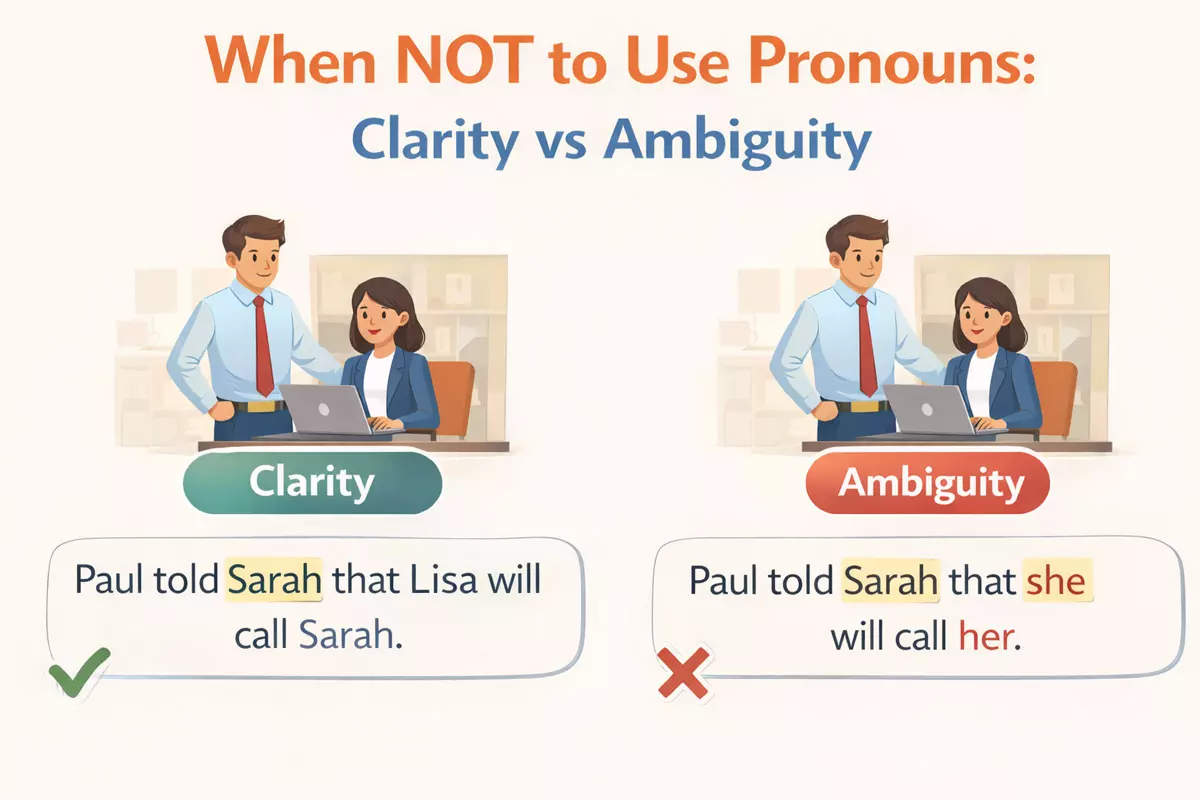 The article explains how pronouns can confuse readers through unclear antecedents, ambiguity, or overuse in dense text. It covers when repeating nouns is clearer, common mistakes, editing tips, examples, and a checklist for pronoun clarity.
- Why pronouns can sometimes confuse readers
- Unclear antecedents and ambiguity traps
- Pronoun overload in dense paragraphs
- When repeating the noun is better
- Pronouns referring to whole ideas incorrectly
- Editing techniques to test clarity
- Examples of unclear vs revised sentences
- Checklist for deciding whether to use a pronoun
Ambiguous language often appears in writing when we use general pronouns such as he, she, or it without clear references. Relying on these vague terms can leave readers uncertain about who or what is being discussed, which may lead to misunderstandings. By choosing more specific nouns or clarifying the subject in each sentence, writers can enhance the clarity of their message and ensure that their intended meaning is easily understood. This extra attention to detail helps create more effective and accessible communication for any audience.
Why pronouns can sometimes confuse readers
Pronouns are meant to make sentences flow more smoothly, but they can backfire when it’s unclear who or what they refer to. This happens especially in complex or crowded sentences, where several nouns compete for attention. Instead of streamlining communication, pronouns may introduce confusion, forcing readers to pause and reread the text to clarify meaning.
Common situations where pronouns trip readers up
- Multiple people or things are mentioned, and “he,” “she,” or “it” could point to more than one possible referent.
- Long gaps between a pronoun and its original noun make it easy to lose track of the connection.
- Switching topics mid-paragraph, so the pronoun unexpectedly points to a new subject.
- Using vague pronouns like “this,” “that,” or “they” without specifying what they replace.
- Introducing several new characters or items in rapid succession.
- Pronouns at the start of a new paragraph, where the antecedent was in the previous one.
- Abstract nouns as antecedents, which aren’t intuitively linked to “it” or “they.”
- Sentences with more than one possible antecedent for a single pronoun.
- Using gender-neutral pronouns (“they/them”) when gender is not clear, or more than one person is involved.
- Changing the grammatical number (singular/plural) without warning.
How ambiguity creeps in
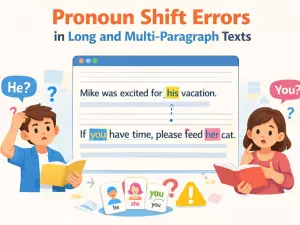
Ambiguity often arises when a pronoun’s antecedent isn’t obvious. For example, in the sentence “Alex told Jordan that he needed to leave,” it’s unclear whether “he” refers to Alex or Jordan. This kind of uncertainty forces readers to guess, which can disrupt comprehension and even alter the intended meaning.
Examples of ambiguous pronoun use
- Lisa gave Sara her book. (Whose book?)
- The dog chased the cat, but it escaped. (Who escaped?)
- Sam and Jamie went to the store because they were hungry. (Who was hungry?)
- After the meeting, the manager spoke to the assistant about her performance. (Whose performance?)
- The box was beside the suitcase, but it was locked. (What was locked?)
Comparison: Clear vs. ambiguous pronoun references
| Ambiguous Usage | Clear Usage |
|---|---|
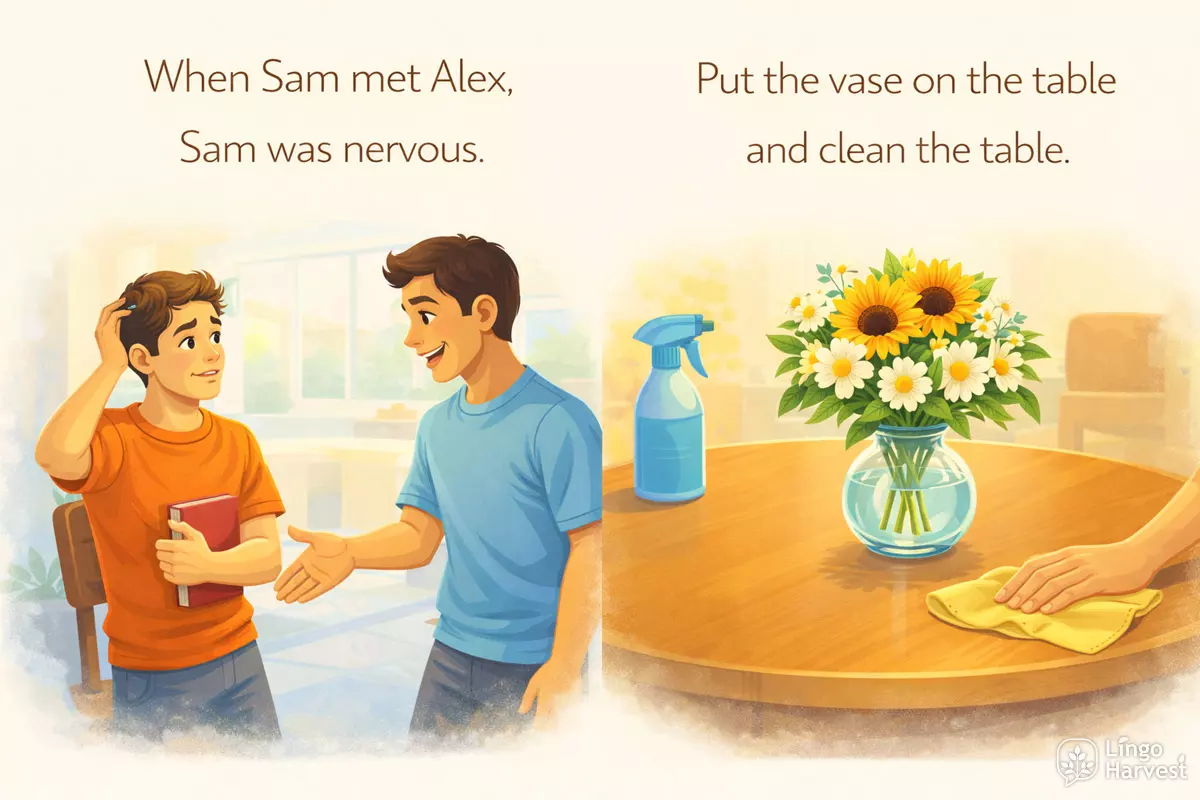
| When Sam met Alex, he was nervous. | When Sam met Alex, Sam was nervous. |
| Put the vase on the table and clean it. | Put the vase on the table and clean the table. |
| Maria told Anna she got the job. | Maria told Anna that Anna got the job. |
| After reading the instructions, John gave them to Sarah. | After reading the instructions, John gave the instructions to Sarah. |
Using pronouns thoughtfully, and only when the reference is unmistakable, helps readers follow your meaning without extra effort. When in doubt, repeating the noun or restructuring the sentence can make your writing clearer and more reader-friendly.
Unclear antecedents and ambiguity traps
When pronouns lack a clear reference, sentences can become confusing or misleading. This often happens when multiple nouns are present, or when context doesn’t make the intended meaning obvious. The result? Readers or listeners may struggle to understand who or what the pronoun is pointing to, which disrupts the flow of communication and can even change the intended message.
How ambiguous pronouns cause confusion
Pronouns like “he,” “she,” “they,” or “it” should always point back to a specific noun—called the antecedent. If that noun isn’t clear, readers have to guess, and mistakes are likely. Consider these scenarios:
- Two or more people are mentioned, and “he” or “she” could refer to either.
- An event or object is introduced, but “it” could refer to several things.
- The pronoun is placed far from its antecedent, so the connection isn’t obvious.
- A sentence starts with “this,” “that,” or “they” without specifying what’s being discussed.
Classic ambiguity traps to watch for
Writers often fall into common traps when using pronouns in complex sentences. Here are some patterns and pitfalls that commonly cause trouble:
- Using “it” after mentioning multiple objects: “The lamp fell on the table and broke it.” (What broke?)
- Switching subjects mid-paragraph: “Maria met with Sarah after she finished her report.” (Who finished?)
- Relying on “they” when several groups or people are in play.
- Introducing “this” or “that” without explicit reference.
- Placing pronouns at the start of a new paragraph without context.
- Vague pronoun use in instructions: “When mixing the ingredients, add them slowly.” (Add which items?)
- Referencing previous sentences with “these” or “those” with multiple possible antecedents.
- Using “he/she” in stories with multiple characters of the same gender.
- Overusing pronouns in technical writing, leading to confusion about which concept is meant.
- Ambiguous “one” or “ones” in comparisons: “I prefer the new ones.” (Which ones?)
- Using “its” or “their” when several items could be referenced.
- Long sentences with multiple nouns before a pronoun is used.
- Pronouns in lists: “Apples, bananas, and oranges are in the basket. They are ripe.” (Which fruit?)
- Unclear reference after a quote: “She told him she was late.” (Who was late?)
- Using “who” or “which” clauses that could attach to more than one noun.
Strategies to avoid ambiguity
To keep your writing clear, replace pronouns with the actual noun when in doubt, or rewrite sentences to make the reference obvious. Repetition may seem awkward, but clarity should come first. Here’s a quick comparison of ambiguous and clear sentences:
| Ambiguous Example | Clear Version |
|---|---|
| Jane gave Lisa her book. | Jane gave her own book to Lisa. |
| The dog chased the cat, and it ran away. | The dog chased the cat, and the cat ran away. |
| When the vase hit the table, it broke. | The vase broke when it hit the table. |
| Alex called Sam because he was late. | Alex called Sam because Sam was late. |
Careful attention to context and sentence structure helps prevent miscommunication. When in doubt, spell it out—your readers will thank you.
Pronoun overload in dense paragraphs
When a paragraph is packed with several people, objects, or ideas, relying too much on words like "he," "she," "it," or "they" can make things confusing fast. Readers may lose track of who or what each pronoun is referring to, especially if multiple similar nouns are in play. This often happens in technical writing, stories with many characters, or explanations involving several steps or components.
How excessive pronoun use leads to confusion
If every sentence swaps out a clear noun for a pronoun, ambiguity creeps in. Instead of clarifying, these stand-ins can force readers to pause, backtrack, and guess at the intended reference. This slows comprehension and can even distort the meaning of your message.
- Multiple actors or objects in a paragraph can make "he," "she," or "it" ambiguous.
- Switching topics or subjects without restating the noun increases the risk of misinterpretation.
- Dense writing amplifies the problem, as readers have to remember more information at once.
Common signs of pronoun overload
- Sentences where "he" or "she" could refer to several people just mentioned
- Strings of "it" or "they" with unclear antecedents
- Readers re-reading passages to figure out who did what
- Feedback indicating confusion or questions about references
Strategies to prevent confusion
One way to avoid muddled writing is to reintroduce the specific noun when necessary, especially after several sentences or when more than one possible antecedent exists. Alternately, restructuring sentences to clarify who or what is acting can make a big difference.
- Restate the noun after a few sentences or when a new subject is introduced.
- Vary sentence structure to avoid repetitive pronoun use.
- Use descriptive phrases (e.g., "the project manager" instead of "she") for clarity.
- Break up long paragraphs into shorter ones focused on a single subject.
Examples: Ambiguous vs. Clear References
| Ambiguous Version | Clear Version |
|---|---|
| When Sarah met Jane, she was late. | When Sarah met Jane, Sarah was late. |
| The laptop was next to the tablet, but it was broken. | The laptop was next to the tablet, but the tablet was broken. |
| John told Mark he would call him later. | John told Mark, "I will call you later." |
| The committee reviewed the proposal and sent it to the board after they approved it. | The committee reviewed the proposal and, after the committee approved the document, sent it to the board. |
Overusing stand-ins for people or things can undermine your writing’s effectiveness. When paragraphs get crowded, a little extra clarity—by repeating key nouns or restructuring sentences—helps readers follow your ideas without getting lost.
When repeating the noun is better
Clarity should always come first in communication. Sometimes, using a pronoun like “it,” “they,” or “this” can cause confusion, especially if several people or things have been mentioned. By restating the specific noun, you remove any doubt about what or whom you’re referring to, making your writing easier to follow.
Situations where noun repetition improves understanding
- Multiple subjects: If a sentence or paragraph refers to more than one possible antecedent, repeating the noun prevents misreading.
- Technical or academic writing: In fields with specialized terms, restating the exact term is often clearer than using “it” or “they.”
- Instructions and steps: When giving directions, using the noun ensures each step is unmistakable.
- Transitions between sentences: When a new sentence starts, mentioning the noun again can anchor the reader.
- Long gaps between references: If there’s a lengthy section between the first mention and the next, repeating the noun refreshes the reader’s memory.
- Complex descriptions: In detailed explanations, using the noun avoids ambiguity.
- Similar items: When discussing multiple similar objects, repeating the name keeps things distinct.
- Non-gendered or unclear pronouns: For nouns where “he,” “she,” or “it” could be misapplied, restating the noun is safer.
- Quoted speech: In dialogue, repeating the noun makes it clear who or what is being discussed.
- Legal or formal writing: Precision is critical, so repeated nouns are standard practice.
Examples: Ambiguous vs. Clear Referencing
| Ambiguous (Pronoun Used) | Clear (Noun Repeated) |
|---|---|
| Maria gave Anna her book. | Maria gave Anna Maria’s book. |
| The report was reviewed by the manager and the assistant. She approved it. | The report was reviewed by the manager and the assistant. The manager approved the report. |
| Place the container near the bowl, then fill it. | Place the container near the bowl, then fill the container. |
| When the battery is low, replace it. | When the battery is low, replace the battery. |
| Jack spoke to Tom after he finished work. | Jack spoke to Tom after Tom finished work. |
When in doubt, ask yourself if someone unfamiliar with your writing could misinterpret the reference. If the answer is yes, repeating the noun is usually the best choice for clear, precise communication.
Pronouns referring to whole ideas incorrectly
When writers use pronouns like "this," "that," "it," or "which" to refer back to an entire statement, event, or situation described earlier, clarity can suffer if the reference isn’t crystal clear. Readers might struggle to determine exactly what the pronoun points to, especially when multiple ideas or actions have just been mentioned. This kind of ambiguity is a common source of confusion in both academic and everyday writing.
Common pitfalls with idea-referencing pronouns
- Using "this" or "that" without a clear noun after it
- Letting "it" refer to an entire situation rather than a single noun
- Placing pronouns too far from the idea they refer to
- Failing to clarify what "which" points to in a complex sentence
- Relying on context when multiple previous ideas could be the referent
Examples of vague or ambiguous references
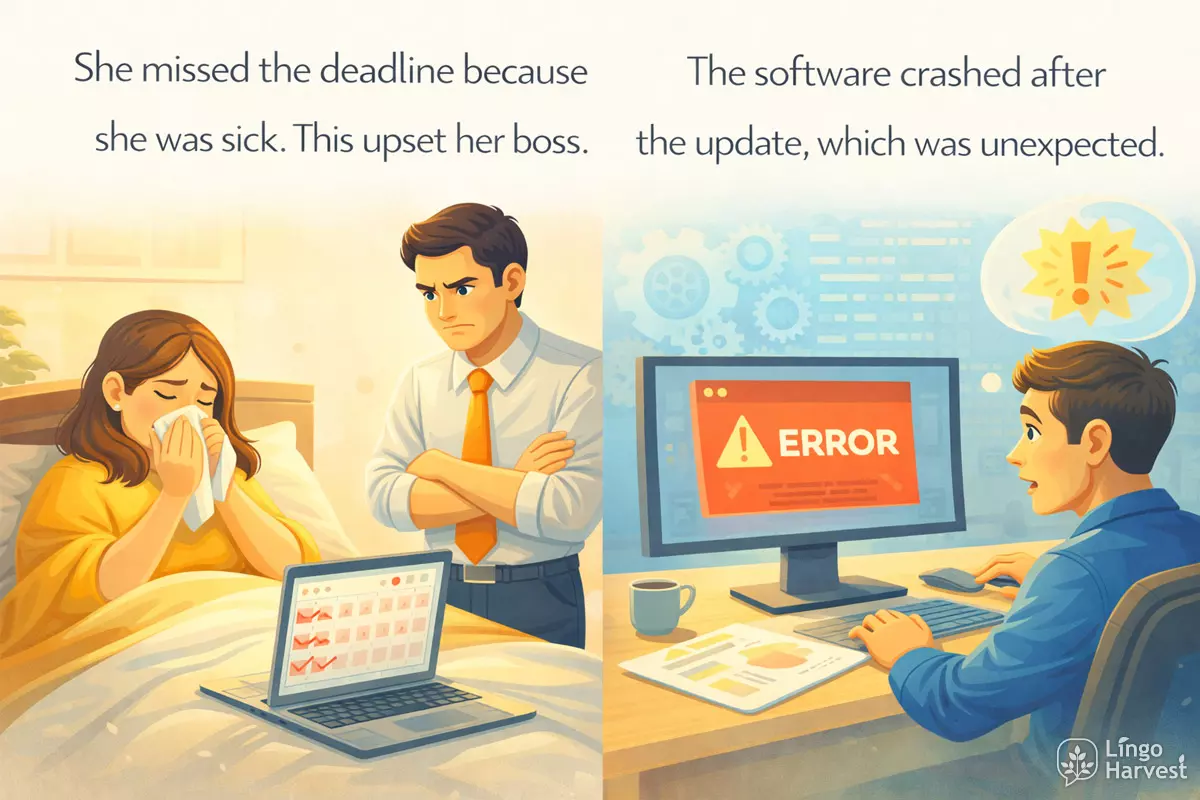
- She missed the deadline because she was sick. This upset her boss.
What does "this" refer to—the missed deadline, being sick, or both? - The software crashed after the update, which was unexpected.
Does "which" refer to the crash, the update, or the sequence of events? - We discussed the budget and the new project. It needs approval.
Is "it" the budget or the new project?
How to avoid unclear references
- Add a specific noun after the pronoun: "This mistake upset her boss."
- Restate the idea briefly: "Missing the deadline upset her boss."
- Use synonyms or descriptive phrases to clarify: "The crash, which happened after the update, was unexpected."
- Restructure sentences to keep pronouns close to their antecedents.
Commonly misused pronouns for ideas
- this → The plan failed, and this caused serious delays.
- that → She missed the deadline, and that upset the team.
- it → The system crashed, and it affected all users.
- which → He ignored the warning, which led to an accident.
- such → The company faced delays and errors, such problems hurt productivity.
- these → The rules were unclear, and these created confusion.
- those → The changes were unexpected, and those worried the staff.
Comparison: Vague vs. Clear Pronoun Reference
| Vague Reference | Improved Clarity |
|---|---|
| The results were surprising. This made us rethink our plan. | The surprising results made us rethink our plan. |
| He apologized for the error, which was appreciated. | His apology was appreciated. |
| The meeting was rescheduled after the conflict was discovered. That was inconvenient. | Rescheduling the meeting was inconvenient. |
| The proposal was rejected. It was unexpected. | The rejection was unexpected. |
Choosing clear, specific references helps readers follow your ideas without having to guess. When in doubt, clarify what your pronoun refers to—especially when summarizing or reacting to entire situations or complex statements.
Editing techniques to test clarity
When reviewing your writing for ambiguous pronoun use, practical strategies help reveal where confusion may arise. Instead of relying on a gut feeling, apply systematic checks to spot unclear references and strengthen your text’s precision.
1. Substitute Pronouns with Nouns
Replace pronouns with their possible noun antecedents. If the sentence remains clear and unambiguous, the pronoun usage is likely safe. If the meaning changes or confusion appears, revise for clarity.
- Original: Jane told Ann that she was late.
- Test: Jane told Ann that Jane was late. (Is Jane or Ann late?)
2. Read Aloud and Pause
Reading the text aloud forces you to process each word and can highlight awkward or unclear constructions. When you encounter a pronoun, pause and consider: “Is it obvious who or what this refers to?”
3. Peer Review or “Fresh Eyes”
Ask a colleague or friend unfamiliar with the draft to identify any unclear references. Others often spot ambiguities you might overlook.
4. Trace Backward for Antecedents
Work backward from each pronoun to its possible noun antecedents. If there’s any chance of more than one possible referent, revise the sentence.
5. Search for Pronoun Clusters
Multiple pronouns in close proximity often signal risk for ambiguity. Scan paragraphs for sequences like “he… she… it…” and clarify as needed.
6. Maintain Consistent Naming
Switching between names and pronouns can confuse readers, especially in complex narratives. Consistency helps readers track who’s who.
Common Problem Patterns
Certain structures are especially prone to unclear pronouns. Watch for these during editing:
- Two or more people/things of the same gender or type
- Long sentences with multiple clauses
- Paragraphs where the subject shifts between sentences
- Use of “it” or “they” without a recent, clear noun
- Generic “this,” “that,” “these,” or “those” referring to ideas, not objects
Clarity Check: Comparison Table
| Unclear Example | Revised for Clarity |
|---|---|
| Sam gave Alex his book. | Sam gave Alex Sam’s book. |
| The bottle was next to the glass, but it was empty. | The bottle was next to the glass, but the glass was empty. |
| After the dog chased the cat, it ran up a tree. | After the dog chased the cat, the cat ran up a tree. |
| Maria met Anna after her meeting. | Maria met Anna after Anna’s meeting. |
Quick Self-Test
Try editing these sentences to remove ambiguity:
- When John spoke to Mark, he was angry.
- The teacher told the student that she would pass the exam.
- Sara gave her sister her jacket.
- Anna called Emma while she was driving.
- Michael emailed David after he finished the report.
- The manager spoke to the assistant because she was upset.
- Paul thanked Alex for his help.
- Laura met with Kate after she left the office.
- The doctor informed the patient that he needed rest.
- Chris borrowed Jordan’s phone because it was broken.
Show answers
- When John spoke to Mark, John was angry. or When John spoke to Mark, Mark was angry. (Specify who was angry.)
- The teacher told the student, “You will pass the exam.” or The teacher told the student that the teacher would pass the exam. (Clarify who “she” is.)
- Sara gave her own jacket to her sister. or Sara gave her sister’s jacket to her. (Clarify whose jacket is meant.)
- Anna called Emma while Anna was driving. or Anna called Emma while Emma was driving. (Clarify who was driving.)
- Michael emailed David after Michael finished the report. or Michael emailed David after David finished the report. (Clarify who finished the report.)
- The manager spoke to the assistant because the manager was upset. or The manager spoke to the assistant because the assistant was upset. (Clarify who was upset.)
- Paul thanked Alex for Paul’s help. or Paul thanked Alex for Alex’s help. (Clarify whose help.)
- Laura met with Kate after Laura left the office. or Laura met with Kate after Kate left the office. (Clarify who left.)
- The doctor informed the patient, “You need rest.” or The doctor informed the patient that the doctor needed rest. (Clarify who “he” refers to.)
- Chris borrowed Jordan’s phone because the phone was broken. (Clarify what “it” refers to.)
Using these editing tools, you can minimize ambiguity and ensure your writing communicates exactly what you intend—without relying on potentially confusing pronouns.
Examples of unclear vs revised sentences
Choosing the right words can make a big difference in how easily your message is understood. Sometimes, using pronouns without clear references leads to confusion or even misinterpretation. To illustrate, let’s look at how vague pronouns create ambiguity—and how rewording for specificity can resolve it.
Ambiguous Pronoun Use in Everyday Writing
Pronouns like “he,” “she,” “it,” or “they” often seem harmless, but when it’s unclear who or what they refer to, readers are left guessing. Below are some frequent trouble spots where pronoun reference becomes an issue:
- Multiple possible antecedents: If two or more nouns are mentioned, a pronoun may refer to either.
- Distant antecedents: When the pronoun’s noun appears far earlier in the text, the link weakens.
- Implied antecedents: The writer assumes the reader knows what the pronoun means, but it isn’t stated.
- Generic pronouns: Words like “it” or “this” are used without specifying what is meant.
Common Vague Sentences and How to Clarify Them
Here are several instances where unclear pronouns can cause problems, along with improved versions that eliminate confusion:
- ❌ When Jim met Tom, he was late.
✅ When Jim met Tom, Jim was late. - ❌ The dog chased the cat, and it ran up a tree.
✅ The dog chased the cat, and the cat ran up a tree. - ❌ Sara gave her sister her book.
✅ Sara gave her own book to her sister. - ❌ Alex told Jamie that they would win.
✅ Alex told Jamie that Jamie would win. - ❌ After putting the pan in the oven, it burned.
✅ After putting the pan in the oven, the food burned. - ❌ She dropped the vase on the table and broke it.
✅ She dropped the vase on the table and broke the vase. - ❌ The team lost to the champions because they were tired.
✅ The team lost to the champions because the team was tired. - ❌ When the teacher spoke to the student, she cried.
✅ When the teacher spoke to the student, the student cried. - ❌ If you find the keys, bring them. (after mentioning both keys and papers)
✅ If you find the keys, bring the keys. - ❌ Put the bowl on the table, then wash it. (unclear what “it” refers to)
✅ Put the bowl on the table, then wash the bowl.
Side-by-Side Comparison
To further clarify how small changes can improve understanding, here’s a table comparing ambiguous statements with their clearer counterparts:
| Unclear Sentence | Revised Sentence |
|---|---|
| The manager told the assistant that he would get a raise. | The manager told the assistant that the assistant would get a raise. |
| When Alice called Maria, she was happy. | When Alice called Maria, Alice was happy. |
| Tom handed Jerry his notebook after class. | Tom handed Jerry Tom’s notebook after class. |
| After the meeting, they decided to leave. | After the meeting, the board members decided to leave. |
Clear, specific language removes guesswork and helps readers follow your meaning with ease. Whenever there’s even a slight risk of misunderstanding, replacing a pronoun with a noun is usually the best solution.
Checklist for deciding whether to use a pronoun
Choosing whether to replace a noun with a pronoun can make or break the clarity of your writing. Before you swap out a specific noun for "he," "she," "they," or another pronoun, it’s worth pausing to consider how it affects the reader’s understanding. The following points can help you decide if a pronoun is the best choice or if sticking with the noun will avoid confusion.
Questions to Ask Yourself
- Is it absolutely clear who or what the pronoun refers to?
- Have you mentioned the noun recently enough that readers will remember it?
- Are there multiple people or things in the sentence or paragraph that could be confused with each other?
- Does the pronoun create ambiguity or force the reader to guess?
- Would repeating the noun actually improve clarity or flow?
- Is the sentence too crowded with pronouns, making it hard to track?
- Are you switching topics or subjects between sentences?
- Is the gender or number of the pronoun obvious from context?
- Is this a formal or technical document where precision is critical?
- Would the sentence sound repetitive or awkward if you avoid pronouns completely?
Common Pitfalls to Watch For
- Using "it," "this," or "that" when the reference isn’t obvious
- Jumping between "he" and "she" without clearly indicating who is who
- Referring to two or more things with the same pronoun in a single sentence
- Introducing a pronoun at the beginning of a new paragraph without a clear noun antecedent
Quick Reference: When to Use or Avoid Pronouns
| Safe to Use Pronouns ✅ | Better to Avoid Pronouns ❌ |
|---|---|
| Only one possible noun matches the pronoun | Multiple possible nouns could be referenced |
| Noun mentioned in the previous sentence | Noun not mentioned for several sentences |
| Pronoun’s gender/number is unmistakable | Gender/number could refer to more than one thing |
| Informal writing or conversational tone | Technical, legal, or highly formal writing |
| Pronoun simplifies a repetitive sentence | Repeating noun adds needed clarity |
Example Scenarios
- Clear: "Maria finished the report. She emailed it to her boss." (Only one person and one report are involved)
- Unclear: "Maria called Anna after she finished the report." (Who finished the report—Maria or Anna?)
- Clear: "The car was washed. It sparkled in the sun." (‘It’ clearly refers to the car)
- Unclear: "The car was washed and the bike was repaired. It sparkled in the sun." (Which vehicle sparkled?)
When in doubt, prioritize the reader’s understanding. If there’s any chance your audience might pause or backtrack to figure out what “it,” “they,” or “he” means, it’s a sign to consider repeating the noun or rephrasing the sentence for clarity.