Gender-Neutral Pronouns in Modern English

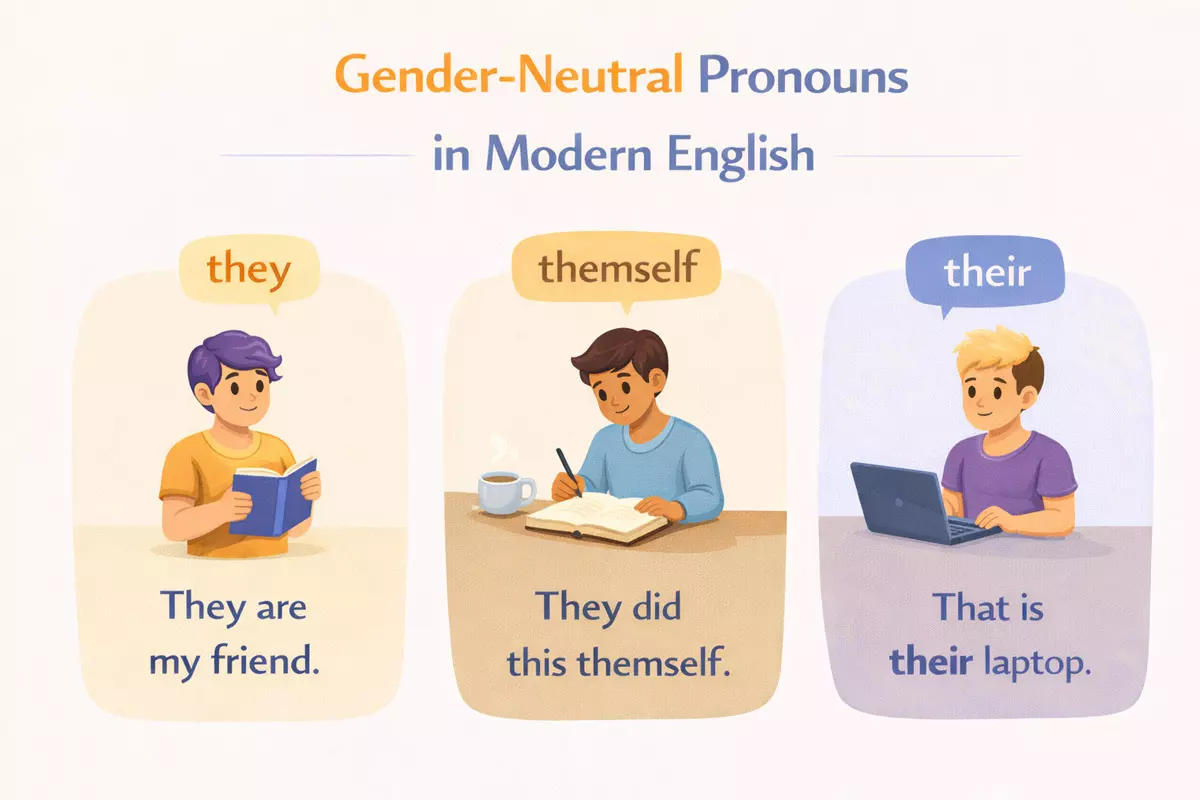 This article explains the importance of gender-neutral pronouns, the rise of singular they, and alternatives to he or she in formal writing. It covers gender-neutral language at work, common concerns, acceptance levels, and practical rewriting tips.
- Why gender-neutral pronouns matter today
- Singular they in modern English
- Alternatives to he or she in formal writing
- Gender-neutral language in professional contexts
- Common concerns and misconceptions
- Formal vs informal acceptance levels
- Avoiding awkward or forced inclusivity
- Practice: rewriting sentences inclusively
As language evolves in response to changing social attitudes, the use of inclusive pronouns has become a significant topic of discussion in English-speaking communities. This development highlights a broader shift in how people perceive identity and seek to ensure that communication respects and acknowledges everyone. Adopting inclusive pronouns is not just about grammar; it represents an effort to foster understanding and acceptance in diverse societies, encouraging dialogue and reflection on how language shapes our interactions and cultural norms.
Why gender-neutral pronouns matter today
Inclusive language helps people feel seen and respected, especially in diverse communities. Using non-gendered pronouns is one way to acknowledge and affirm identities beyond the traditional male/female binary. This shift in language isn’t just about grammar; it’s about making sure everyone can participate comfortably in conversations, workplaces, and digital spaces.
When someone’s pronouns are recognized and used correctly, it can have a profound impact on their sense of belonging and well-being. On the other hand, misgendering—even if unintentional—can lead to feelings of exclusion or distress. That’s why more institutions, schools, and organizations are adopting inclusive language policies.
Benefits of adopting inclusive pronouns
- Creates a welcoming environment for people of all gender identities
- Reduces assumptions and stereotypes based on appearance or names
- Supports mental health by validating personal identity
- Encourages respectful communication in professional and social settings
- Aligns with evolving cultural norms and expectations
- Helps avoid awkward or uncomfortable situations
- Promotes equity and fairness in language use
- Improves clarity when the gender of a person is unknown or irrelevant
- Facilitates smoother communication in international and multicultural contexts
- Sets a positive example for younger generations
Common gender-neutral pronouns in English
Below is a quick reference for some widely-used non-gendered pronouns, illustrating their forms in different grammatical cases:
| Subject | Object | Possessive Adjective | Possessive Pronoun | Reflexive |
|---|---|---|---|---|
| they | them | their | theirs | themself |
| ze | zir | zir | zirs | zirself |
| xe | xim | xir | xirs | ximself |
| ey | em | eir | eirs | emself |
Why respecting pronouns is essential
Choosing the right words signals care and consideration for others. It’s not just about language rules—it’s about real people’s lives and experiences. Making space for everyone, regardless of gender identity, helps build trust and community. Even small changes in daily speech can make a lasting difference.
Singular they in modern English
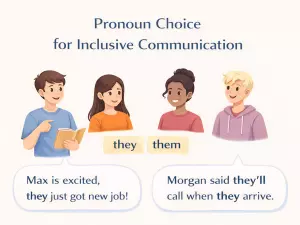
The use of they as a singular pronoun has become increasingly common in everyday English, especially when referring to someone whose gender is unknown or when a person prefers gender-neutral pronouns. This usage helps avoid assumptions about gender and provides an inclusive alternative to traditional pronouns like he or she.
Writers and speakers have been using they in singular form for centuries, although its widespread acceptance in formal writing is a more recent development. Major style guides and dictionaries now recognize singular they as grammatically correct, particularly when discussing individuals whose gender is unspecified or nonbinary.
Common situations for using singular they

- Referring to someone whose gender is unknown: “Someone left their umbrella.”
- Describing a hypothetical person: “If a student needs help, they should ask.”
- Speaking about a nonbinary individual: “Alex said they will arrive soon.”
- Generalizing about people: “Each participant should submit their form.”
- In legal or instructional contexts: “The applicant must provide their signature.”
- When privacy is a concern: “The patient reported they were feeling better.”
- In customer service: “When a caller asks for help, listen to their concerns.”
- Addressing groups with unknown composition: “Whoever left their bag, please claim it.”
- Discussing someone whose pronouns are not known: “The author said they enjoyed the event.”
- Referring to new acquaintances: “If someone joins, welcome them and ask their name.”
Grammatical forms of singular they
The pronoun they shifts seamlessly between singular and plural contexts. The forms remain the same, regardless of number, making it straightforward to use.
| Pronoun Role | Form |
|---|---|
| Subject | they |
| Object | them |
| Possessive Adjective | their |
| Possessive Pronoun | theirs |
| Reflexive | themselves (or themself) |
Acceptance and clarity
Many people now default to singular they in professional, academic, and casual settings. While some may worry about ambiguity, context typically clarifies whether one or more people are being referenced. Using this pronoun respectfully acknowledges individual identities and supports inclusive communication.
Alternatives to he or she in formal writing
Writers often look for ways to avoid gendered pronouns like "he" or "she" when crafting formal documents, research papers, or policies. This not only helps ensure inclusivity but also avoids making assumptions about gender. There are several established strategies for achieving gender-neutral language in academic and professional contexts.
Singular "they"
The singular "they" has grown in acceptance among style guides and editors. It is now widely recognized as an appropriate substitute for situations where a person’s gender is unknown, unspecified, or irrelevant. For example: "If a student wishes to submit late work, they should contact the instructor."
Rewriting to avoid pronouns
Often, sentences can be revised to eliminate the need for any pronoun. This technique is especially useful in documents that need to be universally applicable. For instance, "Each manager must submit their report" can become "All managers must submit reports."
Using plural forms
Switching to plurals is a simple way to avoid gendered language. Instead of referring to "a student," refer to "students" and use "they" as the pronoun. This method works well for general statements and guidelines.
Other gender-neutral pronouns and expressions
While "they" is the most common, there are additional neutral pronouns and constructions, though some are less widely accepted in formal writing. Here are several options that writers may encounter or consider:
- One ("One should always check their work.")
- The individual ("The individual must provide their signature.")
- The person ("If the person is unsure, they should ask.")
- Whoever/Anyone/Someone ("Anyone wishing to participate must register.")
- Ze/hir ("If a participant wants to leave, ze should notify hir supervisor.")
- Per ("If per wishes to continue, per must notify the committee.")
- You (in instructions: "You must submit the form by Friday.")
- The applicant ("The applicant should submit all required documents.")
- The employee ("The employee may request additional leave if needed.")
- The user ("The user should save their progress regularly.")
- The client ("The client must confirm their appointment.")
- The reader ("The reader is encouraged to consider these examples.")
- The participant ("The participant must sign the consent form.")
- The patient ("The patient should take their medication as prescribed.")
- The customer ("The customer may return the item within 30 days.")
Comparison of common approaches
| Method | Example |
|---|---|
| Singular "they" | If a participant has questions, they should ask. |
| Rewriting to plural | Participants who have questions should ask. |
| Generic noun replacement | The applicant must provide their ID. |
| Pronoun avoidance | ID must be provided upon request. |
Choosing the right alternative depends on context, audience, and the formality of the document. Singular "they" is generally accepted, but sometimes rephrasing or using more specific nouns is preferable for clarity or tone. Consistency is key—once a method is chosen, it should be applied throughout the document.
Gender-neutral language in professional contexts
Inclusive communication has become a priority in many workplaces. Using words and pronouns that do not assume a person’s gender is now considered best practice in emails, reports, presentations, and HR documents. This approach helps foster respect, reduces misunderstandings, and supports the diversity of colleagues and clients.
Common practices for inclusive communication
- Addressing groups with “everyone,” “team,” or “colleagues” instead of “ladies and gentlemen.”
- Using “they/them” as singular pronouns when gender is unknown or unspecified.
- Replacing gendered job titles, such as “chairman” or “fireman,” with neutral alternatives like “chairperson” and “firefighter.”
- Encouraging staff to share their pronouns in email signatures or at the start of meetings.
- Rewriting policy documents to avoid phrases like “he/she” in favor of neutral phrasing.
- Opting for “partner” instead of “husband” or “wife” in benefit forms and discussions.
- Referring to roles as “server” instead of “waiter/waitress.”
- Choosing “parent” over “mother/father” in forms and communications.
- Using “first-year student” instead of “freshman.”
- Replacing “manpower” with “workforce” or “staff.”
- Selecting “salesperson” rather than “salesman/saleswoman.”
- Addressing correspondence with “To Whom It May Concern” or “Dear Hiring Manager” instead of gendered salutations.
- Using “they will review your application” in place of “he/she will review your application.”
- Applying “head” or “lead” instead of “foreman.”
- Referring to “flight attendant” instead of “steward/stewardess.”
- Describing “spouse” rather than “wife/husband.”
- Employing “human-made” or “artificial” rather than “man-made.”
Benefits and challenges
Adopting neutral expressions in business settings can make communication clearer and more welcoming. It signals that the company values all identities and reduces the risk of unintentional exclusion. However, adapting to these changes may require staff training and updates to existing materials. Some team members may need time to adjust to new habits, especially when revising language that has been standard for decades.
Examples of gender-neutral pronouns at work
| Traditional Phrase | Gender-Neutral Alternative |
|---|---|
| Each employee must submit his report by Friday. | Each employee must submit their report by Friday. |
| The chairman will announce his decision soon. | The chairperson will announce their decision soon. |
| If a student wishes to appeal, he or she should contact the office. | If a student wishes to appeal, they should contact the office. |
| When a manager hires a new team member, he must provide training. | When a manager hires a new team member, they must provide training. |
| Ask your husband or wife to fill out the form. | Ask your partner to fill out the form. |
Adopting these alternatives helps ensure that all individuals feel seen and respected in professional interactions. As organizations continue to prioritize inclusion, language will evolve to reflect and support this commitment.
Common concerns and misconceptions

Many people have questions or hesitations about using gender-neutral pronouns in English, often due to unfamiliarity or misconceptions about their purpose and practicality. Addressing these points can foster better understanding and more inclusive communication.
Is “they” as a singular pronoun grammatically correct?
One frequent question is whether “they” can refer to a single individual. In fact, singular “they” has been used in English literature for centuries, including by authors like Shakespeare and Jane Austen. Major style guides now recognize it as acceptable when referring to a person whose gender is unknown or unspecified.
Do gender-neutral pronouns make language confusing?
Some worry that introducing more pronouns will make English harder to understand. In practice, most people quickly adapt, just as they do with new vocabulary or names. Consistent usage and context typically clarify meaning, reducing confusion.
- Context usually makes clear who is being referenced.
- Many people already use “they” for unknown individuals without noticing.
- Learning new pronouns is similar to learning names or titles.
Are gender-neutral pronouns only for nonbinary people?
While these pronouns are important for nonbinary and gender-nonconforming individuals, they can also be useful in other contexts, such as when the gender of a person is unknown or irrelevant. Using inclusive language benefits everyone by reducing assumptions.
Common misunderstandings about usage
Below is a comparison of frequent beliefs and the actual facts regarding neutral pronouns:
| Misconception | Reality |
|---|---|
| “They” is always plural | “They” can refer to one person or multiple people, depending on context |
| Using new pronouns is a recent trend | Singular “they” and similar forms have historical precedent in English |
| It’s disrespectful if you make a mistake | Most people appreciate genuine effort and willingness to correct errors |
| Gender-neutral pronouns are hard to remember | Practice and exposure make them as familiar as any name or title |
Examples of gender-neutral pronouns in use
- They / them / theirs
Example: Someone left their umbrella. I hope they come back for it. - Ze / hir / hirs
Example: Ze said hir project was finished, and the result was hirs. - Xe / xem / xyr
Example: Xe brought xyr laptop because xe needed it for work. - Ey / em / eir
Example: Ey forgot eir keys, so I waited for em outside. - Spivak pronouns (e / em / eir)
Example: E shared eir opinion, and everyone listened to em. - Fae / faer / faers
Example: Fae said faer idea was original, and the decision was faers.
Ultimately, embracing neutral pronouns is about showing respect and consideration. Most challenges fade with practice, and making the effort can help create a more welcoming environment for everyone.
Formal vs informal acceptance levels
How gender-neutral pronouns are received and used often depends on the setting. In academic and professional contexts, there is a growing movement toward the explicit use of inclusive language. Many universities, companies, and government agencies now issue guidelines that recommend or require gender-neutral pronouns in official documents, forms, and communications. However, traditional grammar rules and stylistic conventions may still cause hesitation, especially in more conservative or international institutions.
In everyday speech and online communication, adoption tends to be more flexible and rapid. Social media platforms, forums, and casual conversations frequently feature singular “they” and neopronouns. The informality of these environments allows for experimentation and quick normalization of new forms. While some individuals adapt quickly, others may be less familiar or even resistant, depending on regional, generational, or cultural factors.
Differences in usage: settings and expectations
To highlight how acceptance varies, here are some typical patterns observed in different environments:
| Context | Common Gender-Neutral Pronoun Use |
|---|---|
| Official Documents | Singular “they” increasingly standardized; neopronouns rare |
| Academic Writing | Inclusive language encouraged; some journals still cautious |
| Workplace Communication | “They/them” on email signatures and HR forms; gradual adoption |
| Social Media | Wide experimentation with “they,” “ze,” “xe,” etc. |
| Casual Conversation | Flexible use; context and personal preference guide choices |
| Legal Language | Slow, cautious shift; explicit definitions often included |
The willingness to accept and use these pronouns varies not only by formality but also by familiarity and visibility. In more formal settings, established forms like “they” are preferred, while informal spaces may embrace a broader array of options. Ultimately, the evolution of language—and its adoption in different environments—reflects social attitudes, institutional policies, and individual comfort with change.
Avoiding awkward or forced inclusivity
Balancing gender-neutral pronoun use with natural, readable language can be challenging. While it’s important to respect everyone’s identities, sentences that feel unnatural or are overloaded with pronoun substitutions can distract readers. The goal is to integrate inclusive language smoothly, so it feels like a natural part of modern English rather than an imposition.
Strategies for Seamless Integration
- Use "they" as a singular pronoun where possible—it often fits effortlessly and is widely accepted.
- Alternate sentence structure to avoid excessive repetition of any pronoun.
- Reword sentences to use plural forms, especially when addressing groups, to make pronoun use simpler.
- Replace pronouns with nouns or names when clarity is needed.
- Limit the use of invented pronouns (like "ze" or "xe") unless you know someone prefers them.
- Check for ambiguity—make sure your sentence still clearly indicates who is being discussed.
- Avoid inserting pronouns where they aren’t needed; sometimes, you can simply restructure.
- Read your sentences aloud to catch awkward phrasing or forced constructions.
- Use gender-neutral job titles and descriptions (e.g., "firefighter" instead of "fireman").
- Be consistent within a given text or context to avoid confusion.
Common Pitfalls to Watch For
- Overusing a person’s name to avoid pronouns, which can feel unnatural.
- Switching between pronouns too frequently, causing confusion.
- Using unfamiliar neopronouns without explanation or context.
- Creating sentences that are grammatically correct but awkward to read.
- Ignoring clarity for the sake of neutrality—always prioritize understanding.
Examples: Natural vs. Clumsy Usage
| Clumsy Example | Smoother Alternative |
|---|---|
| If a student wants, the student can submit the student’s work by email. | If a student wants, they can submit their work by email. |
| Each employee must report to his or her supervisor or their supervisor or hir supervisor. | All employees must report to their supervisor. |
| When the client arrives, xe should sign in at the desk. | When the client arrives, they should sign in at the desk. |
| The manager said the manager would handle it. The manager was clear. | The manager said they would handle it and was clear. |
Ultimately, the best approach is to use inclusive language that feels authentic to your own writing and speaking style. By focusing on clarity and flow, you can respect people’s identities without making your language feel forced or awkward. Practice and awareness will help you strike the right balance.
Practice: rewriting sentences inclusively
Inclusive writing helps everyone feel represented. In English, one of the most common ways to make language more inclusive is to use gender-neutral pronouns and avoid gendered assumptions. Let’s look at some strategies and work through practical exercises to build your skills.
Common Gendered Sentences and Inclusive Alternatives
Writers and speakers sometimes use “he” or “she” as a default, or mention roles in a way that assumes gender. Here are some typical examples and more inclusive options:
- Each student must hand in his homework. → Each student must hand in their homework.
- The manager should give his or her opinion. → The manager should give their opinion.
- When a doctor arrives, he will start the procedure. → When a doctor arrives, they will start the procedure.
- Every engineer knows his field. → Every engineer knows their field.
- If a customer has a question, he/she can call support. → If a customer has a question, they can call support.
- Ask the chairman if he agrees. → Ask the chair if they agree.
- The fireman saved the cat. → The firefighter saved the cat.
- My brother or sister can take his or her seat. → My sibling can take their seat.
- Each applicant should attach his résumé. → Each applicant should attach their résumé.
- The policeman gave his report. → The police officer gave their report.
- He who hesitates is lost. → Those who hesitate are lost.
- The salesman will answer your questions. → The sales representative will answer your questions.
- When a student finishes, he or she may leave. → When a student finishes, they may leave.
- Let each participant share his or her thoughts. → Let each participant share their thoughts.
Rewrite the Following Sentences Using Gender-Neutral Language
Try changing these sentences so that they use gender-neutral forms. Replace gender-specific nouns and pronouns, and consider non-binary alternatives where suitable:
- Every employee must submit his timesheet by Friday.
- If a customer has a complaint, he should contact the manager.
- The actress thanked her director for his guidance.
- Each participant should bring his or her ID card.
- The chairman called for a vote, and everyone raised his hand.
- When a student forgets his homework, he should see the teacher.
- The fireman climbed the ladder to rescue the kitten.
- Ask your brother or sister if he or she wants to join us.
Show answers
- Every employee must submit their timesheet by Friday.
- If a customer has a complaint, they should contact the manager.
- The actor thanked their director for guidance.
- Each participant should bring their ID card.
- The chair called for a vote, and everyone raised their hand.
- When a student forgets their homework, they should see the teacher.
- The firefighter climbed the ladder to rescue the kitten.
- Ask your sibling if they want to join us.
Quick Reference: Gendered vs. Gender-Neutral Forms
| Gendered Term | Gender-Neutral Equivalent |
|---|---|
| Policeman / Policewoman | Police officer |
| Chairman | Chair / Chairperson |
| Fireman | Firefighter |
| Stewardess / Steward | Flight attendant |
| Businessman | Businessperson |
| Actor / Actress | Actor |
| Salesman | Salesperson / Sales representative |
| He / She | They |
| His / Her | Their |
| Brother / Sister | Sibling |
Practicing these rewrites helps make your communication more welcoming and precise. Over time, using inclusive expressions becomes second nature, benefiting everyone in your audience.