How Pronouns Function in Passive Voice Constructions

 The article explains passive voice structure, pronoun placement, use of agent phrases, agentless passives, get-passives with pronouns, and formal versus informal styles. It also highlights common learner mistakes and offers practice rewriting actives as passives.
Grasping how pronouns such as he, she, or them change roles in sentences that use the passive voice can be more complex than it first appears. When a sentence shifts from active to passive, these pronouns often switch from being the subject to the object or vice versa, which alters both their placement and their grammatical form. Here we these changes in detail, offering clear explanations and examples to help readers understand how the functions and positions of pronouns are affected when the subject and object exchange roles in passive constructions.
Review of passive voice structure
Understanding how passive voice is formed helps clarify why pronouns play a distinct role in these constructions. In English, passive sentences shift the focus from the doer of the action (the agent) to the receiver of the action (the patient). This is often used when the agent is unknown, unimportant, or implied.
Basic passive construction
The passive voice typically uses a form of the verb "to be" followed by the past participle of the main verb. The agent, if mentioned, is introduced with "by." For example:
- The letter was written (by Sarah).
- The cake is being eaten (by the children).
- Our homework has been completed (by us).
Active vs. passive: Structure comparison

To visualize how sentence elements shift between the two voices, see the comparison below:
| Active Voice | Passive Voice |
|---|---|
| John writes the report. | The report is written by John. |
| The chef cooked dinner. | Dinner was cooked by the chef. |
| They will finish the project. | The project will be finished by them. |
| Someone has stolen my bike. | My bike has been stolen (by someone). |
Key elements of passive sentences
- Subject: Receives the action (e.g., "The report").
- Verb: "Be" + past participle (e.g., "is written").
- Agent (optional): Introduced with "by" (e.g., "by John").
Common verbs used in passive forms
Passive constructions are possible with both transitive and some ditransitive verbs. Here are common verbs frequently used in passive voice:
- make → The decision was made yesterday.
- give → The award was given to the winner.
- build → The bridge was built in 2010.
- send → The email was sent this morning.
- write → The report was written by the team.
- find → The solution was found quickly.
- choose → The candidate was chosen for the role.
- take → The photo was taken during the event.
- show → The results were shown on the screen.
- open → The store was opened at noon.
- call → The meeting was called off.
- eat → The cake was eaten before noon.
- prepare → The presentation was prepared in advance.
- offer → The job was offered to her.
- award → The prize was awarded to the artist.
- describe → The process was described in detail.
- invite → All guests were invited to the ceremony.
- deliver → The package was delivered on time.
Passive voice with pronouns
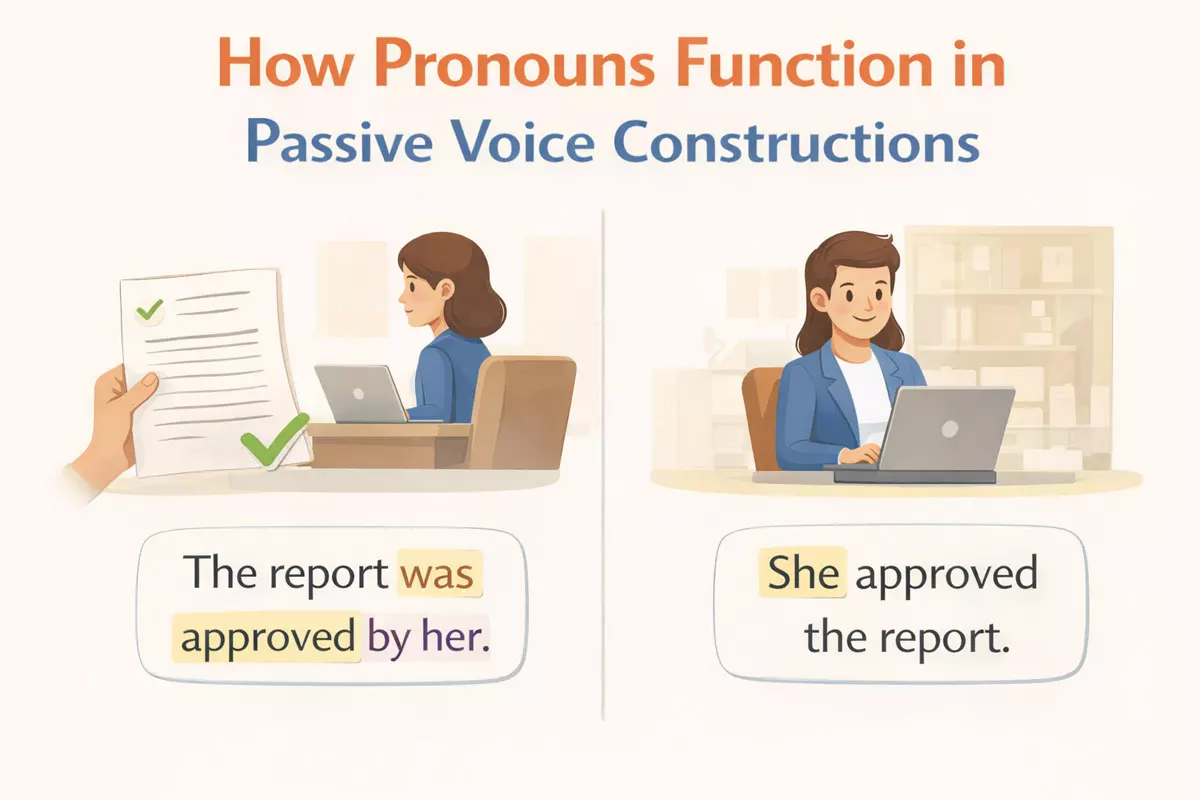
When pronouns appear in passive sentences, they often change form. Object pronouns (me, him, her, us, them) are used after "by," while subject pronouns (I, he, she, we, they) become the new subject if the agent is omitted. For example:
- The decision was made by him.
- The invitation was sent to us.
- We were given the information.
- The book was read by her.
Practice: Identify passive structures
Which of the following sentences are passive? Select all that apply.
- A. The window was broken by the wind.
- B. She paints the wall every summer.
- C. The cookies were eaten.
- D. They are building a new bridge.
- E. The letter was sent yesterday.
- F. He writes reports every week.
- G. The room is cleaned every morning.
- H. They repaired the car last night.
- I. The song was written in 1995.
- J. She is preparing dinner now.
Show answers
- A. Passive
- C. Passive
- E. Passive
- G. Passive
- I. Passive
Pronoun position in passive sentences
Understanding where pronouns appear in passive constructions helps clarify both meaning and emphasis in English sentences. In passive voice, the subject of the sentence is typically the recipient of an action, while the agent (the doer) may be left out or added after the word by. This structure affects how and where pronouns are placed, especially when turning active statements into their passive equivalents.
How pronoun placement shifts in passive voice
When an active sentence is changed to passive, object pronouns from the active sentence (like me, him, us) often become the subject of the passive sentence, changing to their subject forms (I, he, we). Conversely, if the agent is specified in a passive construction, it follows the preposition by and uses the object form of the pronoun.
| Active Voice | Passive Voice |
|---|---|
| They saw her. | She was seen (by them). |
| Someone called me. | I was called (by someone). |
| The teacher praised us. | We were praised (by the teacher). |
| He invited them. | They were invited (by him). |
| She blamed him. | He was blamed (by her). |
Key points for pronouns in passive forms
- Subject pronouns (I, he, we, they) take the subject position in passive sentences.
- Object pronouns (me, him, us, them) follow by if the agent is mentioned.
- Reflexive pronouns (myself, herself) are rare but possible after by in passive voice for emphasis.
- Possessive pronouns (my, their) do not change position in passive structures; only the subject/object forms are affected.
Examples of pronoun transformation
- He helped me → I was helped (by him).
- They will inform us → We will be informed (by them).
- She noticed you → You were noticed (by her).
- Someone stole it → It was stolen (by someone).
- My friend sent me a letter → I was sent a letter (by my friend).
- We chose them → They were chosen (by us).
- The manager promoted her → She was promoted (by the manager).
- People admire him → He is admired (by people).
- You invited me → I was invited (by you).
- They will ask her → She will be asked (by them).
In summary, the form and location of pronouns change to reflect their new grammatical roles in passive sentences. Recognizing how these shifts occur will help ensure clarity and correctness when using passive voice in both writing and speech.
Agent phrases: by him, by them
When we form passive voice sentences, the person or thing performing the action can be introduced using an agent phrase. These are typically structured with the preposition "by" followed by a noun or pronoun. Such phrases clarify who or what is responsible for the action, especially when the agent matters to the meaning or context.
How agent phrases work in passive sentences
In passive constructions, the agent is optional. If the agent is unknown, irrelevant, or obvious, it's often left out. However, when included, pronouns like "him," "her," "them," or "us" are used after "by" to indicate the doer of the action. For example:
- The book was written by her.
- The cookies were eaten by them.
- The decision was made by him.
- The message was sent by us.
Choosing the correct pronoun after "by"
After "by," use object pronouns (me, you, him, her, it, us, them)—not subject pronouns (I, he, she, we, they). This is because these pronouns function as the object of the preposition "by." Using a subject pronoun in this context is incorrect.
| Incorrect | Correct |
|---|---|
| The song was sung by she. | The song was sung by her. |
| The letter was written by we. | The letter was written by us. |
| The package was delivered by they. | The package was delivered by them. |
| The cake was baked by he. | The cake was baked by him. |
Expanded examples of agent phrases with pronouns
Below are more examples showing different pronouns used as agents in passive sentences:
- The invitation was accepted by me.
- The project was completed by us.
- The answer was given by you.
- The song was performed by them.
- The gift was chosen by her.
- The room was cleaned by him.
- The painting was admired by us.
- The mistake was made by me.
- The task was finished by her.
- The document was signed by you.
When to use or omit the agent
Agent phrases are most useful when the identity of the actor adds important information. If it’s already clear or unimportant, the phrase can be left out for brevity. For example, "The window was broken" is often sufficient unless specifying who did it is necessary. Agent phrases with pronouns help clarify actions in passive sentences, ensuring both grammatical accuracy and clear communication.
Passive constructions without agents
Sometimes, sentences in the passive voice do not mention who performed the action; these are called agentless passives. In these structures, the focus shifts entirely onto the recipient or result of the action, rather than the doer. This is especially common in formal writing, scientific contexts, or situations where the agent is unknown, irrelevant, or deliberately omitted.
How pronouns work in agentless passives
When a passive sentence omits the agent, pronouns often take center stage as the subject. For example, "She was given an award" leaves out the person or group who gave the award. Notice how the pronoun "she" becomes the grammatical subject, even though "she" is actually the recipient, not the doer.
- I was told the news yesterday.
- We were invited to the ceremony.
- They were informed of the changes.
- He was promoted last month.
- You will be contacted soon.
- It was discovered by accident.
- She was chosen as the spokesperson.
- They were warned about the risks.
- He was seen leaving the building.
- We were assured of success.
- It was believed to be true.
- You were missed at the meeting.
- I was given a second chance.
- We were shown the results.
- She was offered a new position.
- They were sent an invitation.
- He was told to wait.
- It was made clear to everyone.
Why omit the agent?
Writers or speakers may leave out the agent for various reasons:
- The agent is unknown: "The window was broken."
- The agent is obvious or generic: "English is spoken here."
- The agent is unimportant: "The decision was made."
- To sound more objective or formal: "Mistakes were made."
Comparing active and passive forms with pronouns
Switching between active and passive structures changes the role of pronouns in a sentence. The table below shows some typical transformations where the agent is omitted in the passive version.
| Active Voice | Passive Voice (Agent Omitted) |
|---|---|
| Someone called me. | I was called. |
| They invited us. | We were invited. |
| People saw her. | She was seen. |
| The manager informed them. | They were informed. |
| He gave you advice. | You were given advice. |
| Somebody offered me help. | I was offered help. |
In summary, omitting the agent in passive voice sentences allows pronouns to occupy the subject position, highlighting the experience or state of the referent instead of emphasizing the performer of the action.
Pronouns with get-passives
When using get-passive constructions, pronouns often shift position or form compared to their use in active or be-passive sentences. In these sentences, the subject usually becomes the person or thing experiencing the action, which changes how pronouns function within the structure. Understanding these shifts is important for clear and natural communication, especially when emphasizing the person affected by the action.
How pronouns behave in get-passive sentences

In a get-passive, the subject receives the action, so object pronouns from the active voice become the subject. This can create sentences like "He got hit" or "We got invited." The pronoun now takes the subject position, and the verb "get" combines with the past participle of the main verb. This pattern is common in conversational English, especially when the focus is on personal experience or unexpected events.
- I got chosen for the team.
- She got asked a question.
- They got blamed for the mistake.
- We got caught in the rain.
- He got promoted last year.
- You got mentioned in the meeting.
- It got broken during transport.
- Me got called? ❌ (incorrect; should be "I got called")
- Them got chosen? ❌ (incorrect; should be "They got chosen")
Common pronoun shifts from active to get-passive
The following table shows how pronouns change position and form when moving from active voice to get-passive constructions:
| Active Sentence | Get-Passive Sentence |
|---|---|
| They blamed me. | I got blamed. |
| Someone invited us. | We got invited. |
| The teacher called him. | He got called. |
| The rain soaked them. | They got soaked. |
| The movers broke it. | It got broken. |
Key points to remember
- Use subject pronouns (I, you, he, she, it, we, they) in get-passive constructions.
- Object pronouns (me, him, her, us, them) are not used as subjects in these sentences.
- Get-passives often highlight an unexpected or negative event involving the pronoun subject.
- First- and second-person pronouns (I, we, you) are especially common in conversational get-passives.
By paying attention to these patterns, you can use pronouns accurately and naturally in sentences with get-passive forms.
Formal vs informal passive usage
How pronouns behave in passive voice often depends on the situation's level of formality. In academic writing, business communication, or official documents, the passive is frequently used to shift focus or present information objectively. Here, pronouns like it, they, and one commonly appear as grammatical placeholders or agents. By contrast, everyday speech and informal writing tend to rely less on the passive, and when it is used, personal pronouns like you and we are more likely to appear, sometimes making the construction sound less stiff.
Common patterns in formal settings
- Impersonal constructions: "It is believed that..." or "It was decided..."
- Agent omitted: "The results were analyzed."
- Third-person pronouns as agents: "They were informed..."
- Nominalization: "The proposal was approved by the committee."
- Rare use of first/second person: "Mistakes were made," rather than "We made mistakes."
Features in conversational or informal use
- Direct reference with personal pronouns: "You were given the instructions."
- Omission of the agent, but with context making it clear: "It got broken."
- Use of 'we' or 'they' for inclusivity or vagueness: "We were told to wait."
- Shorter, simpler forms: "It was done."
- More frequent contractions and colloquialisms: "You're being watched."
| Context | Typical Pronoun Usage | Example Passive Construction |
|---|---|---|
| Academic/formal writing | Impersonal pronouns (it, they), agent omission | It was concluded that the theory holds. |
| Official documents | Third-person or nominalized agents | The application was reviewed by the board. |
| Emails/business | Occasional first-person plural (we) | We were informed of the changes. |
| Informal conversation | Personal pronouns (you, we), agent often implied | You were sent the invite, right? |
| Everyday speech | Colloquial 'it' or 'they' | It got lost somewhere. |
Summary of differences
In summary, formal passive voice tends to avoid explicit agents and leans on impersonal or third-person pronouns. Informal contexts are more flexible, often featuring personal pronouns and straightforward phrasing. Understanding these tendencies can help you choose the right style for your audience and purpose.
Common learner errors
Grasping how pronouns work in passive voice can be tricky for many students. One frequent issue is confusion about which pronoun form to use—subject or object—after the verb changes to passive. In some cases, learners also forget to adjust verb agreement or accidentally keep the original sentence's word order, leading to awkward or incorrect constructions.
Frequent mistakes with pronoun use in the passive
Missteps often involve mixing up "he" and "him," "they" and "them," or using "me" where "I" is needed. The following list highlights several patterns that tend to cause trouble:
- Using a subject pronoun instead of an object pronoun (e.g., "by she" instead of "by her").
- Leaving out the agent ("by...") when it adds important information.
- Forgetting to change the verb to the appropriate passive form.
- Maintaining the original active sentence order, which leads to confusion.
- Incorrect verb agreement with plural or singular pronouns.
- Using reflexive pronouns incorrectly (e.g., "by myself" instead of "by me").
- Omitting the pronoun entirely after "by," resulting in incomplete sentences.
- Overusing "by" with pronouns when the agent is not needed.
- Misplacing pronouns, causing ambiguity about who performed the action.
- Translating directly from the learner’s first language, resulting in unnatural phrasing.
- Confusing the roles of "it" and "they" in impersonal passive constructions.
- Switching tense incorrectly when forming the passive.
- Forgetting to use "be" as the auxiliary verb in the passive.
- Using double subjects (e.g., "He was sent by he").
- Placing pronouns too far from the verb, causing misunderstanding.
- Using the wrong case for compound pronouns (e.g., "by you and I" instead of "by you and me").
- Failing to match pronoun gender or number to the intended meaning.
- Using possessive pronouns incorrectly in agent phrases.
Comparing active and passive pronoun forms
Learners often mix up which pronoun should appear after "by" in the passive. The following table shows the correct object pronoun forms that are used in passive constructions, compared with their subject forms:
| Subject Pronoun (Active) | Object Pronoun (Passive Agent) | Example (Passive with “by”) |
|---|---|---|
| I | me | The email was sent by me. |
| he | him | The report was written by him. |
| she | her | The project was managed by her. |
| we | us | The meeting was organized by us. |
| they | them | The decision was approved by them. |
| you | you | The form was completed by you. |
| it | it | The process was controlled by it. |
Tips to avoid typical pitfalls
To minimize errors, double-check which pronoun case is needed after "by," make sure verbs are in the correct passive form, and avoid direct translations from your native language. Practice rewriting sentences from active to passive, paying close attention to pronoun changes and sentence structure. This approach helps reinforce the correct patterns and builds confidence in using pronouns in passive constructions.
Practice: rewrite active sentences as passive
Understanding how to convert statements from the active to the passive voice is essential for mastering pronoun use in English passive constructions. Below, you'll find a variety of practice activities designed to help you recognize how subjects, objects, and pronouns shift when an active sentence is rewritten in the passive voice.
Instructions
Read each active sentence carefully. Identify the subject, verb, and object. Then, rewrite the sentence in the passive voice, focusing on how pronouns change their position and form. Pay attention to subject-object swaps and the use of "by" phrases when needed.
Active Sentences for Conversion
- She writes the reports.
- They invited me to the meeting.
- We will finish the project next week.
- Someone has stolen your bicycle.
- The teacher praises him every day.
- People speak English worldwide.
- The committee chose her as the leader.
- My friend sent us a postcard.
- He is cleaning the kitchen.
- They had already informed you.
Common Pronoun Shifts in Passive Voice
When transforming active sentences with pronouns, note these typical changes:
- I (active subject) becomes me (passive agent) — e.g., "by me"
- He/She becomes him/her — e.g., "by him"
- We becomes us"
- They becomes them"
- You remains you in both roles
Active vs. Passive with Pronouns: Examples
| Active Sentence | Passive Sentence |
|---|---|
| They invited me. | I was invited by them. |
| She helps us. | We are helped by her. |
| He will call you. | You will be called by him. |
| We saw her. | She was seen by us. |
| Someone blamed him. | He was blamed (by someone). |
Try it Yourself
Choose a few sentences from the list above and practice converting them. Focus on the pronoun changes and the verb forms.
Show answers
- The reports are written by her.
- I was invited to the meeting by them.
- The project will be finished next week by us.
- Your bicycle has been stolen (by someone).
- He is praised every day by the teacher.
- English is spoken worldwide (by people).
- She was chosen as the leader by the committee.
- A postcard was sent to us by my friend.
- The kitchen is being cleaned by him.
- You had already been informed by them.
Tips for Success
- Always move the object of the active sentence to the subject position in the passive sentence.
- Adjust the verb form: use the correct tense of “to be” + past participle.
- Change pronouns appropriately (e.g., "me" → "I", "us" → "we", etc.).
- Include "by" + agent only when it adds important information.
Practice regularly to build confidence in using pronouns accurately within passive constructions.