Using Possessive Pronouns Before Gerunds in English

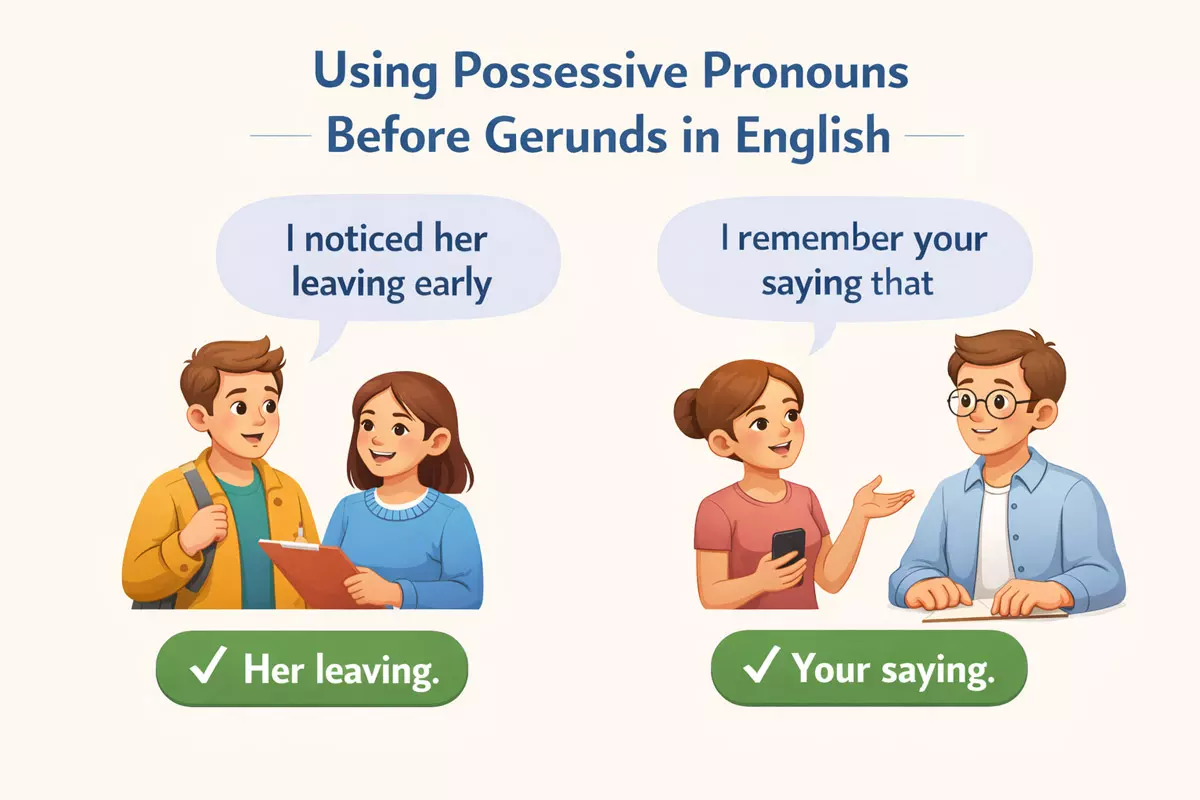 This article explains gerunds, the use of possessive pronouns before -ing forms, and the difference between my doing and me doing. It covers formal rules, modern style, common mistakes, context differences, and includes practice exercises.
Mastering the nuances of English grammar can be tricky, particularly when it comes to showing possession before verbs ending in "-ing." In these situations, it is generally correct to use the possessive form, such as "my," "your," or "John’s," before the "-ing" word, as in "I appreciate your helping me." Using the possessive clarifies that the action belongs to someone, making your sentences more precise and your writing more professional. Developing this habit will help you communicate your ideas more effectively.
What gerunds are and how they function
Gerunds are words formed by adding -ing to a verb, turning the action into a noun. For example, “running,” “reading,” or “singing” all act as nouns in a sentence, even though their roots are verbs. Because of this transformation, gerunds can perform many of the same roles as other nouns: they can be subjects, objects, or complements within a sentence.
Roles of Gerunds in Sentences
When you use a gerund, you’re often describing an activity, process, or general action. Here are some common ways these verbal nouns fit into English sentences:
- Subject: Swimming is excellent exercise.
- Object: I enjoy painting.
- Object of a preposition: She’s interested in learning Spanish.
- Subject complement: His favorite hobby is gardening.
- After certain verbs: They suggested waiting until tomorrow.
How Gerunds Differ from Present Participles
It’s easy to confuse gerunds with present participles, since both use the -ing form. The key difference is function: gerunds act as nouns, while present participles describe ongoing actions or modify nouns as adjectives.
- Gerund (noun): Jogging helps me relax.
- Present participle (adjective): The jogging man waved hello.
Common Verbs Followed by Gerunds

Some verbs are commonly followed by a gerund instead of an infinitive. Here are several examples:
- admit → She admitted making a mistake.
- avoid → He avoided answering the question.
- consider → They are considering moving abroad.
- deny → The company denied breaking the rules.
- enjoy → I enjoy learning new languages.
- finish → She finished writing the report.
- imagine → Can you imagine living without the internet?
- keep → He keeps forgetting his password.
- mind → Do you mind opening the window?
- miss → I miss working with that team.
- practice → She practices speaking English every day.
- recommend → The doctor recommends exercising regularly.
- suggest → He suggested taking a short break.
- risk → They risk losing valuable data.
- quit → He quit smoking last year.
- postpone → We postponed meeting until next week.
- prefer → I prefer working in the morning.
- discuss → They discussed changing the schedule.
Examples: Gerunds in Context
Notice how the following sentences use gerunds in different ways:
- Subject: Traveling broadens your perspective.
- Object: She dislikes waking up early.
- After a preposition: He’s good at drawing.
Understanding the function of gerunds is essential when learning about possessive pronouns before gerunds, since the pronoun must match the noun-like role of the gerund.
Possessive pronouns before -ing forms
Often in English, we use possessive pronouns to clarify who is performing the action described by an -ing form (also called a gerund). This structure helps make sentences clear and grammatically correct, especially in formal writing and speech. Instead of using an object pronoun (like "me" or "him") before a gerund, the possessive form (such as "my" or "his") is usually preferred.
Why use possessive forms with gerunds?
Using a possessive pronoun before a gerund emphasizes that the action belongs to or is done by a specific person. This distinction can affect both the meaning and the fluency of your sentence. For example, "I appreciate your coming early" is more precise than "I appreciate you coming early," especially in formal contexts.
Common Possessive Pronouns Paired with Gerunds
Possessive forms are often used before gerunds to clearly indicate who performs the action.
- my arriving late → My arriving late caused some confusion.
- your asking questions → Your asking questions helped clarify the issue.
- his forgetting the appointment → His forgetting the appointment delayed the meeting.
- her singing loudly → Her singing loudly disturbed the neighbors.
- its working properly → Its working properly depends on regular maintenance.
- our meeting running long → Our meeting running long affected the schedule.
- their leaving early → Their leaving early surprised the organizers.
- John’s winning the prize → John’s winning the prize made everyone proud.
- Mary’s traveling abroad → Mary’s traveling abroad required careful planning.
- the cat’s sleeping on the bed → The cat’s sleeping on the bed annoyed the owner.
- the company’s expanding operations → The company’s expanding operations created new jobs.
Comparing possessive vs. object pronouns before -ing forms
It’s helpful to see the difference between using a possessive and an object pronoun before a gerund. The possessive is generally more formal and focuses on the action, while using an object pronoun often shifts the focus to the person. Here’s a comparison:
| Possessive Pronoun + Gerund | Object Pronoun + Gerund |
|---|---|
| I appreciate your coming early. | I appreciate you coming early. |
| She didn't like his interrupting her. | She didn't like him interrupting her. |
| We were surprised by their winning the award. | We were surprised by them winning the award. |
| They objected to our leaving so soon. | They objected to us leaving so soon. |
When to use this structure
You’ll most often see possessive pronouns before gerunds in academic or professional writing, formal emails, and careful speech. In casual conversation, object pronouns with gerunds are increasingly common and generally accepted, but understanding the traditional pattern is helpful for clear and precise communication.
- ✅ Preferred in formal writing: "We appreciate your joining us."
- ❌ Less formal/colloquial: "We appreciate you joining us."
Mastering this small detail can help you sound more natural and polished in English, especially when clarity and correctness matter.
Formal rule vs spoken English usage
Traditionally, English grammar guides recommend using the possessive form before a gerund. This means that when a noun or pronoun comes before a gerund (a verb ending in -ing used as a noun), it should take the possessive case. For example, “I appreciate your coming early” is considered more correct in formal writing than “I appreciate you coming early.”
However, in everyday conversation, native speakers often use the object or subject pronoun instead of the possessive, especially in informal settings. This relaxed approach is widely accepted in speech and even in less formal writing, though it is still frowned upon in academic or professional contexts. The difference is subtle, but it can affect the tone and perceived correctness of your English.
Typical patterns: formal vs informal
- Formal/written: I object to his leaving early.
- Informal/spoken: I object to him leaving early.
- Formal/written: We were surprised by their winning the award.
- Informal/spoken: We were surprised by them winning the award.
- Formal/written: She didn’t mind my interrupting.
- Informal/spoken: She didn’t mind me interrupting.
- Formal/written: Do you approve of our joining the team?
- Informal/spoken: Do you approve of us joining the team?
- Formal/written: There’s no chance of your passing the test without studying.
- Informal/spoken: There’s no chance of you passing the test without studying.
Comparison of possessive vs object pronoun before gerunds
| Possessive Pronoun + Gerund ✅ Formal/Standard |
Object Pronoun + Gerund ❌ Informal/Conversational |
|---|---|
| your coming | you coming |
| his leaving | him leaving |
| their winning | them winning |
| our joining | us joining |
| my interrupting | me interrupting |
| her singing | her singing (identical) |
| its working | it working |
Notice that for “her,” both the possessive and object forms are “her,” so the distinction is only clear from context. In summary, while formal English expects the possessive form before gerunds, everyday usage often relaxes this rule. Being aware of the difference lets you adjust your language to fit the situation—more formal for essays and reports, more relaxed for conversation.
My doing vs me doing: meaning difference
Understanding the difference between using a possessive pronoun (like my) before a gerund versus using an object pronoun (like me) is key for clarity and formality in English. Both constructions can appear before a gerund (the -ing form of a verb used as a noun), but they often carry slightly different implications and follow different conventions.
Possessive pronoun before a gerund
When a possessive pronoun modifies a gerund, it treats the action as something belonging to the person. This structure is typically more formal and is preferred in written English. It emphasizes the action itself as being performed by the possessor.
- My arriving late caused confusion.
- Her singing impressed the judges.
- Our leaving early surprised everyone.
Object pronoun before a gerund
Using an object pronoun before a gerund is less formal and more common in spoken English. Here, the pronoun is less connected to “owning” the action and instead focuses on the person themselves as the subject of the verb. Some grammarians consider this less correct in formal writing, but it’s widely accepted in conversation.
- Me arriving late caused confusion.
- Her singing impressed the judges. (This example works with both forms, but "her" here is ambiguous.)
- Them leaving early surprised everyone.
Comparing meaning and style
While both forms are often understood the same way in casual speech, the possessive form is clearer and more standard in writing, especially when the action needs to be highlighted as a noun phrase. In rare cases, the choice can subtly shift the focus from the action to the person.
| Form | Example | Use/Implication |
|---|---|---|
| Possessive + gerund | My forgetting your birthday upset her. | Focuses on the act of forgetting as my action |
| Object pronoun + gerund | Me forgetting your birthday upset her. | Focuses more on me as the person who forgot |
| Possessive + gerund | His interrupting was annoying. | Emphasizes the behavior (interrupting) as his |
| Object pronoun + gerund | Him interrupting was annoying. | Emphasizes him (the person), less formal |
Summary of when to use each form
- For formal writing, prefer possessive pronouns before gerunds.
- In conversation, object pronouns are widely accepted and natural.
- If clarity about who is acting is important, the possessive form is safest.
- Certain expressions only sound correct with the possessive (e.g. your being here).
The distinction is subtle, but mastering these forms helps you sound both natural and precise in English, whether you’re writing or speaking.
Style preferences in modern English
Contemporary English usage shows a noticeable shift in how possessive pronouns are used before gerunds. While many traditional grammar guides insist on the possessive form (such as "my" in "my going"), actual patterns in published writing and everyday speech often diverge. This section explores current tendencies, practical considerations, and common exceptions.
Formal vs. Informal Contexts
Writers and speakers tend to follow stricter rules in formal contexts, using possessive forms before gerunds to clarify ownership or agency. In contrast, informal speech and casual writing often favor object pronouns or even omit the pronoun entirely. For example, "I appreciated his helping" is more formal, while "I appreciated him helping" is frequently heard informally.
- Formal: "We discussed her joining the team."
- Informal: "We discussed her joining the team." / "We discussed her joining the team."
- Conversational: "We talked about her joining."
Common Usage Preferences

Native speakers often make choices based on flow and clarity, rather than strict adherence to rules. Some verbs tend to attract the possessive form, while others sound more natural with object pronouns.
| Preferred in Modern Formal English | Often Used in Informal Speech |
|---|---|
| I object to your leaving early. | I object to you leaving early. |
| She appreciated his helping out. | She appreciated him helping out. |
| They insisted on our arriving on time. | They insisted on us arriving on time. |
| We were surprised by their winning the prize. | We were surprised by them winning the prize. |
Factors Influencing Style Choice
- The level of formality required
- Whether the pronoun is singular or plural
- How natural or awkward the possessive sounds in context
- Regional and generational preferences
- Clarity—especially if confusion about the subject is possible
- Editorial guidelines (academic, journalistic, etc.)
Ultimately, both possessive and object pronoun forms are widely accepted in speech, and the choice often depends on audience, context, and clarity. For formal writing, the possessive is generally safer, but in conversation or informal prose, the object form is common and rarely misunderstood.
Common learner mistakes
Many English learners struggle with using possessive pronouns before gerunds. This often leads to sentences that sound unnatural or are grammatically incorrect. The confusion usually comes from not recognizing when a gerund (the -ing form of a verb used as a noun) should be preceded by a possessive rather than a personal pronoun or noun.
Mixing up possessive and object pronouns
A frequent error is placing an object pronoun (like “me,” “him,” “her”) in front of a gerund, when the possessive form is needed. For example, saying “I appreciate you helping me” instead of the more formal “I appreciate your helping me.” While the object pronoun is sometimes accepted in informal speech, it is not standard in formal writing.
- Incorrect: She didn’t like him coming late.
- Correct: She didn’t like his coming late.
- Incorrect: They were surprised by us leaving early.
- Correct: They were surprised by our leaving early.
Forgetting the possessive with nouns
Learners sometimes omit the possessive form when the noun before the gerund is not a pronoun. For instance, “I object to John smoking here” is common, but “I object to John’s smoking here” is more precise, especially in formal contexts. The possessive clarifies that it is John’s action being discussed.
- Incorrect: I didn’t like Mary interrupting.
- Correct: I didn’t like Mary’s interrupting.
- Incorrect: The teacher noticed the student talking.
- Correct: The teacher noticed the student’s talking.
Confusing gerunds with participles
Another pitfall is misunderstanding when the -ing form is acting as a gerund (noun) versus a participle (adjective). Only gerunds require a possessive. For example:
- I appreciated her singing. (gerund; “her” should be possessive: “her singing”)
- I saw her singing. (participle; “her” is the object of “saw”)
This distinction can be tricky, but it’s important for clear communication.
Summary of correct forms
To help clarify, here is a comparison of common mistakes and their correct forms:
| Incorrect Form | Correct Form |
|---|---|
| me forgetting | my forgetting |
| them arriving | their arriving |
| us missing the bus | our missing the bus |
| John missing class | John’s missing class |
| her complaining | her complaining |
| you being late | your being late |
Paying attention to these patterns will help avoid typical errors and make sentences clearer and more accurate. Remember, while informal English sometimes allows the object pronoun, using the possessive is generally preferred, especially in writing and formal situations.
Academic vs conversational contexts
How possessive pronouns are used before gerunds often depends on the setting—whether it’s a formal academic paper or everyday speech. In more scholarly writing and professional communication, you’re likely to see possessive forms like “my,” “your,” or “their” preceding gerunds for clarity and correctness. For instance, “We appreciate your coming to the meeting” is preferred in essays or reports. In contrast, informal conversations often drop the possessive, leading to sentences like “We appreciate you coming to the meeting.” Both forms are common, but expectations shift with context.
Common Patterns in Each Context
When deciding whether to use a possessive pronoun before a gerund, it helps to be aware of the expectations in different situations. Here’s how the patterns typically break down:
- Formal/Academic: “I object to his leaving early.”
- Informal/Conversational: “I object to him leaving early.”
- “We appreciate your helping us.” (preferred in writing)
- “We appreciate you helping us.” (common in speech)
- “There’s no point in their arguing.” (formal)
- “There’s no point in them arguing.” (casual)
- “She was annoyed by my interrupting.” (academic)
- “She was annoyed by me interrupting.” (spoken)
- “Do you mind my asking a question?” (formal)
- “Do you mind me asking a question?” (informal)
Guidelines for Choosing the Form
Here are some practical tips to help you decide which form to use:
- Use the possessive + gerund in formal writing, academic assignments, and professional emails.
- Expect the object pronoun + gerund in friendly conversation, text messages, or informal online posts.
- Listen to your audience: teachers and editors may expect the more traditional structure, while friends won’t mind the casual alternative.
- Some verbs and phrases almost always take the possessive in writing (e.g., “the likelihood of his succeeding”).
- Regional differences exist, but the distinction is recognized in both American and British English.
Side-by-Side Comparison
| Formal/Academic Example | Informal/Conversational Example |
|---|---|
| I appreciate your helping me. | I appreciate you helping me. |
| He didn’t like their arriving late. | He didn’t like them arriving late. |
| We were surprised by her winning the prize. | We were surprised by her winning the prize. (both forms sometimes used) |
| There’s no chance of my finishing on time. | There’s no chance of me finishing on time. |
Ultimately, adjusting your use of possessive pronouns before gerunds helps your language sound natural and appropriate for the situation. Recognizing the difference can boost your confidence in both academic and everyday communication.
Practice: choose possessive or object forms
It's common to feel uncertain about whether to use a possessive pronoun or object pronoun before a gerund in English. This section provides a range of exercises to help you distinguish between these two forms and use them accurately. Read the sentences carefully and decide which form best completes each one.
Exercise 1: Fill in the blanks
Choose the correct form (possessive or object) to complete each sentence. Write your answer in the space provided.
- I appreciate ____ helping me with the project. (he/his)
- They didn't like ____ arriving late. (us/our)
- We were surprised by ____ winning the award. (she/her)
- Would you mind ____ calling back later? (me/my)
- He was annoyed at ____ interrupting him. (them/their)
- She insisted on ____ taking notes during the meeting. (him/his)
- Do you remember ____ leaving the keys here? (you/your)
- The teacher noticed ____ talking during the lesson. (we/our)
- I don't recall ____ saying that. (her/she)
- We appreciate ____ supporting our decision. (you/your)
Show answers
- his
- our
- her
- my
- their
- his
- your
- our
- her
- your
Comparison Table: Possessive vs Object Pronouns Before Gerunds
The table below summarizes the most common forms. Use this as a quick guide when deciding which pronoun to use with gerunds.
| Subject | Possessive Pronoun + Gerund | Object Pronoun + Gerund | Example with Gerund |
|---|---|---|---|
| I | my | me | my/ me leaving |
| you | your | you | your/ you arriving |
| he | his | him | his/ him helping |
| she | her | her | her helping |
| we | our | us | our/ us participating |
| they | their | them | their/ them joining |
Quick Practice: Identify the Correct Usage
For each sentence, select whether the underlined pronoun is correct or should be replaced with the other form.
- I appreciate him helping me.
- We were surprised by her winning.
- They didn't enjoy us singing.
- Would you mind my calling later?
- She objected to them arriving so late.
- The manager disliked him questioning the decision.
- Do you remember me telling you about this?
- Everyone praised her speaking so confidently.
- We discussed him taking over the project.
- They were annoyed by us interrupting the meeting.
Show answers
- Incorrect; should be his
- Correct
- Incorrect; should be our
- Correct
- Incorrect; should be their
- Incorrect; should be his
- Incorrect; should be my
- Correct
- Incorrect; should be his
- Incorrect; should be our
Practicing with these examples will help you notice patterns and feel more confident choosing between possessive and object forms in real situations. For more challenge, try creating your own sentences following the patterns above.