Using Demonstratives to Reference Entire Ideas

 Here we how demonstratives like this and that refer to clauses or ideas, when to use each for previous statements, avoiding vague references, differences in spoken and written English, common ambiguities, editing for clarity, and includes revision practice.
- How demonstratives refer to clauses and ideas
- This vs that when referencing previous statements
- Avoiding vague reference with demonstratives
- Demonstratives in explanation and argumentation
- Spoken vs written preferences
- Common ambiguity problems
- Editing strategies for clarity
- Practice: revise sentences with clearer reference
Using a single word to refer back to an earlier idea or statement can make your writing more concise and easier to follow. This technique, known as using referents, helps avoid repetition and maintains a smooth flow in your communication. By mastering this skill, you can guide your readers clearly through your points and ensure they stay engaged with your message. Effective use of referents strengthens coherence and clarity, making your writing both efficient and reader-friendly.
How demonstratives refer to clauses and ideas
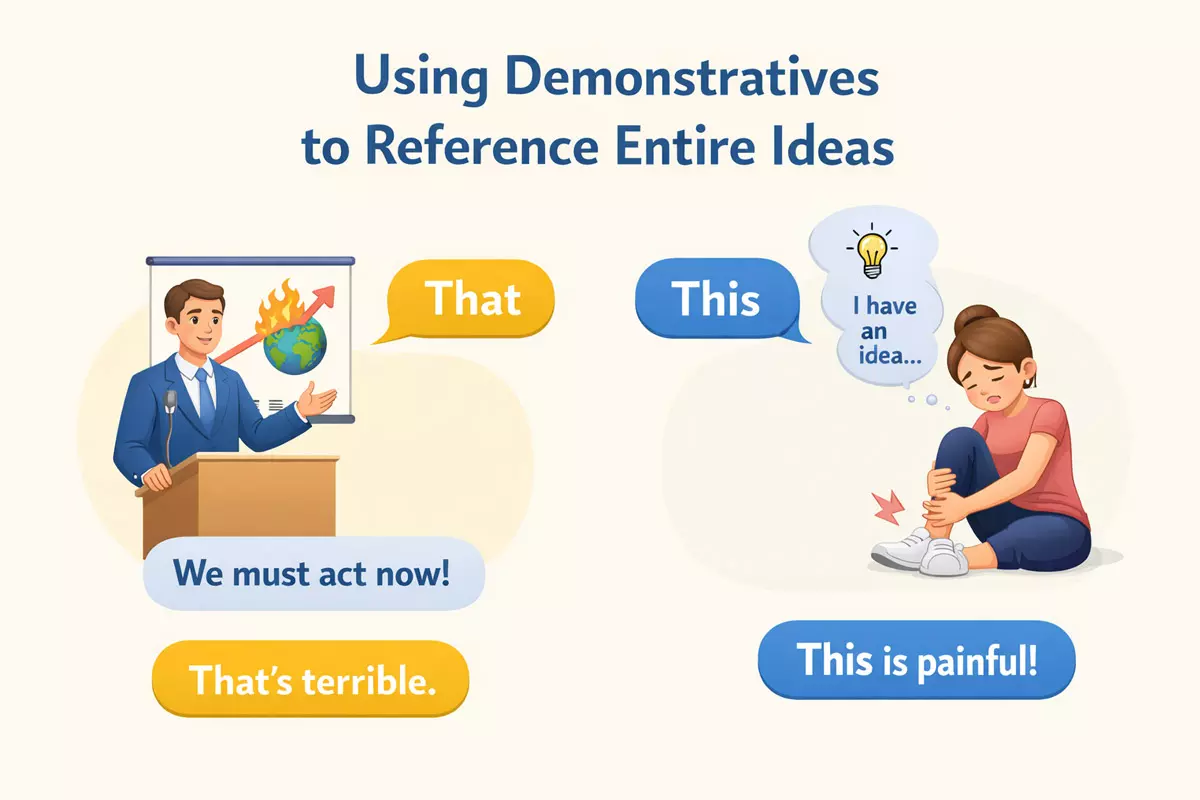
Demonstrative words like this, that, these, and those are often used to point not only to physical objects but also to entire statements, actions, or arguments. Instead of referencing a visible noun, they can stand in for a whole thought, clause, or previously mentioned concept. This usage streamlines communication, helping writers and speakers avoid repetition and maintain clarity in complex discussions.
Referring back to previous statements
In many cases, demonstratives summarize or encapsulate an idea that was just expressed. For example, after explaining a complicated process, someone might say, “This is why the system works.” Here, this doesn’t refer to a specific object, but to the entire explanation that came before.
- This can point to the most recent idea or argument.
- That often refers to something mentioned earlier, or to indicate distance (conceptual or emotional).
- These and those are used for multiple ideas or arguments.
- Sometimes, demonstratives anticipate a following clause (cataphoric reference), as in, “This is what I mean: you should arrive early.”
Examples of demonstratives referencing ideas
Below are common patterns where demonstrative terms refer to entire clauses or concepts rather than concrete nouns:
- “I forgot to lock the door. That was careless of me.”
- “She passed every exam. This surprised her teachers.”
- “They argued for hours. That didn’t solve anything.”
- “You didn’t reply to my message. This made me worried.”
- “We have three options: A, B, and C. These are all viable.”
- “He quit his job without notice. That shocked everyone.”
- “You promised to help. This matters a lot.”
- “The results were inconclusive. That means more tests are needed.”
- “We missed the train. This put us behind schedule.”
- “She ignored my advice. That is her choice.”
- “There are several reasons for concern. Those include safety and cost.”
- “He apologized. This was unexpected.”
Choosing the right demonstrative
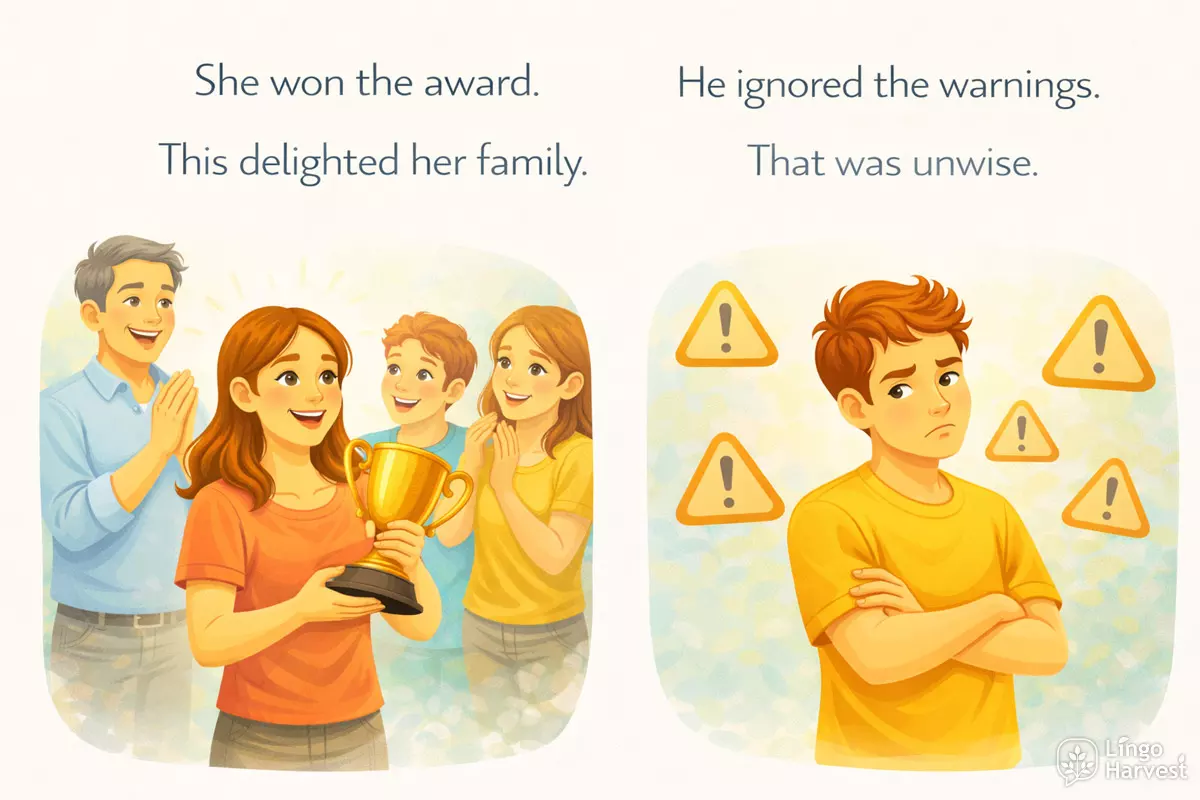
Writers select between this and that based on proximity—both in the flow of ideas and sometimes in emotional involvement. This typically feels closer or more immediate, while that suggests a bit more distance. Plural forms refer to groups of points or arguments.
| Demonstrative | Typical Use with Ideas | Example Sentence |
|---|---|---|
| This | Refers to a recent or immediately preceding idea | “She won the award. This delighted her family.” |
| That | Refers to an earlier point or to create distance | “He ignored the warnings. That was unwise.” |
| These | Refers to a group of recent points or arguments | “We discussed cost, time, and safety. These are critical factors.” |
| Those | Refers to a group of points mentioned further back or with distance | “Earlier, you made several claims. Those need evidence.” |
Summary: Why use demonstratives for ideas?
Using demonstratives to reference entire statements or arguments helps avoid repetition and keeps writing concise. This method also guides readers or listeners, making it clear which point is being discussed or evaluated. In both conversation and formal writing, this approach improves cohesion and flow, ensuring that complex discussions remain accessible and understandable.
This vs that when referencing previous statements
Writers and speakers often need to refer back to entire sentences, ideas, or arguments. Demonstratives like this and that help point to previously mentioned statements, but choosing between them isn’t always straightforward. Understanding the subtle differences between these two words can make your writing clearer and more precise.
How this and that function
Both terms act as pointers, but they convey different relationships to the information being referenced. This usually draws attention to something immediate, recent, or closely connected, while that signals a bit more distance—something further away, less recent, or emotionally removed.
Choosing between this and that for whole ideas
When referencing an entire preceding idea or statement, consider the context and your intent:
- This is often used when you wish to emphasize or elaborate on what was just said, keeping the reader or listener’s attention focused on the current thread.
- That is preferred when you want to signal a shift, create contrast, or refer to something previously mentioned but no longer the immediate focus.
Common usage patterns
- This shows that the initial assumption was not entirely accurate.
- This means the process will take longer than originally planned.
- This suggests further research is required before drawing conclusions.
- This is why careful planning is essential at every stage.
- This leads to a significant improvement in overall performance.
- That explains why the results differed from earlier expectations.
- That was unexpected. The outcome surprised even experienced analysts.
- That’s not what I meant. My intention was misunderstood in the discussion.
- That contradicts the earlier claim. The two statements cannot both be correct.
- That would be problematic. It could create delays and additional costs.
- This raises another question. We need to examine the issue more closely.
- That brings us to the next point. The following section addresses this concern.
- This is important because it directly affects the final decision.
- That could be improved. A clearer explanation would help readers.
- This implies a change is needed. The current approach is no longer effective.
- That aligns with our previous findings. The data confirms earlier conclusions.
Comparison: this vs that in context
| Usage | Example |
|---|---|
| Referring to the immediately preceding idea | We just discussed the new policy. This will affect all employees. |
| Referring to a less immediate or earlier idea | The proposal was controversial. That made further discussion necessary. |
| Signaling emphasis or continuation | The results were surprising. This suggests we need more research. |
| Signaling contrast or emotional distance | The new rule was unpopular. That didn’t stop it from being enforced. |
Summary tips
- Use this for statements you want to keep in focus or elaborate on directly.
- Choose that when referencing something further away in the discourse or to create contrast.
- Both help avoid repetition and clarify which idea you mean.
Mastering these choices improves flow and coherence, especially in complex or formal writing.
Avoiding vague reference with demonstratives
Clarity in writing often depends on how well your references connect to ideas already introduced. Demonstrative pronouns and adjectives—such as this, that, these, and those—can refer back to entire statements or arguments. However, if the connection between the demonstrative and its antecedent is not clear, readers may become confused about what idea is being referenced. To prevent this confusion, writers should be explicit about what their demonstratives point to, especially when referencing whole ideas rather than single nouns.
Common causes of unclear reference
- Using a demonstrative without a noun (This is important), leaving the reader to guess what "this" refers to.
- Referring to multiple possible ideas in the previous sentence, making it unclear which one is meant.
- Placing the demonstrative too far from its intended antecedent, especially after lengthy explanations.
- Switching topics quickly, which can make demonstratives ambiguous.
- Relying on context that is not explicit in the writing.
Effective strategies for precise reference
To make your writing more precise, combine demonstratives with summary nouns or phrases that capture the idea you want to reference. This approach makes the connection explicit, helping readers follow your line of thought.
- This result shows the importance of careful planning.
- That argument overlooks a key factor.
- These findings support our hypothesis.
- Those concerns were addressed in the next section.
- This approach can be applied to other problems.
- That statement may not be accurate.
- This idea has several implications.
- These examples illustrate the point clearly.
- Those assumptions should be questioned.
- That explanation clarifies the confusion.
- This solution reduces complexity.
- These issues need further discussion.
Comparing vague and clear demonstrative uses
| Vague Example | Clear Example |
|---|---|
| This is confusing. | This explanation is confusing. |
| That was unexpected. | That result was unexpected. |
| These are important. | These findings are important. |
| Those were not considered. | Those factors were not considered. |
Whenever you use a demonstrative to refer to an entire idea, ask yourself if the connection is obvious to someone who is not you. If there’s any chance of ambiguity, add a summary noun or phrase. This small adjustment can greatly improve the coherence and readability of your writing.
Demonstratives in explanation and argumentation
When clarifying complex points or building a persuasive case, words like "this," "that," "these," and "those" serve as more than simple pointers. They allow speakers and writers to refer back to entire arguments, summaries, or explanations without restating everything. This referencing function streamlines communication and helps keep discussions cohesive, especially when multiple ideas are being weighed against each other.
How Demonstratives Guide the Reader or Listener
In explanations, demonstratives often highlight a previously mentioned theory, claim, or example. Instead of repeating an entire paragraph, a speaker might say, "This shows the importance of context," where "this" encapsulates the preceding idea. In arguments, demonstratives can signal agreement, contrast, or evaluation of earlier points, helping to clarify the flow of reasoning.
- “This demonstrates the main principle.”
- “That raises an important objection.”
- “These support our initial hypothesis.”
- “Those examples illustrate the exception.”
- “This suggests a need for further research.”
- “That argument overlooks a key factor.”
- “These findings challenge common assumptions.”
- “Those concerns are addressed in section three.”
- “This leads us to the next point.”
- “That conclusion follows from the data.”
- “These patterns are consistent across cases.”
- “Those criticisms highlight potential weaknesses.”
- “This perspective aligns with recent studies.”
- “That scenario is unlikely under current conditions.”
- “These arguments reinforce each other.”
- “Those proposals require more evidence.”
Comparing Demonstrative Usage in Explanations vs. Arguments
| Context | Typical Demonstrative Role | Example Phrase |
|---|---|---|
| Explanation | Summarizing prior information | This clarifies the mechanism. |
| Argumentation | Evaluating or countering a point | That argument is unconvincing. |
| Transition | Linking to the next idea | These results lead us forward. |
| Contrast | Highlighting differences | Those findings differ significantly. |
Choosing the right demonstrative depends on what is being referenced and the intended focus—whether it’s something just mentioned, a distant idea, or a group of related points. Using these words carefully helps maintain clarity, especially when discussing abstract concepts or when several arguments are presented in succession.
Spoken vs written preferences
How we use demonstratives to reference whole ideas can shift dramatically depending on whether we’re speaking or writing. In spontaneous conversation, pointing back to previous statements with words like “this” or “that” feels natural and often relies on shared context or gestures. In contrast, written language demands more precision, as readers lack the advantage of tone, facial expression, or physical cues.
Demonstratives in Conversation
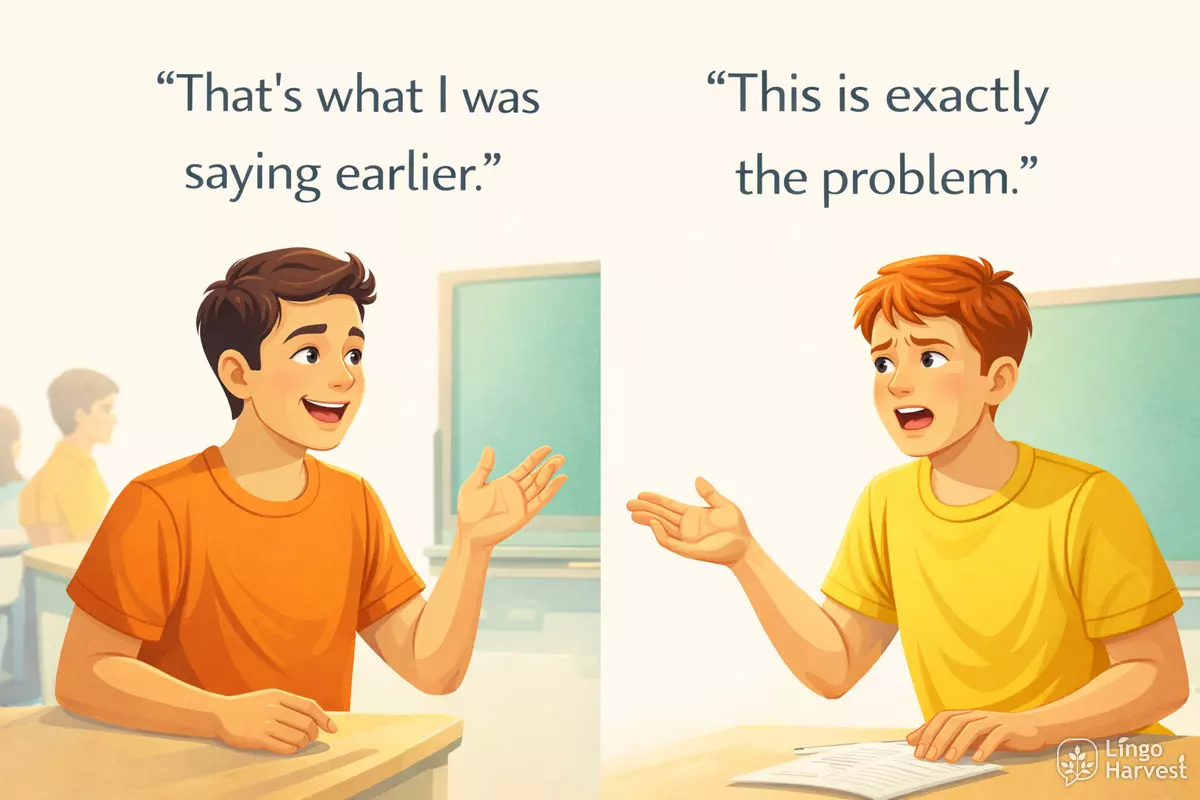
Oral communication often features demonstratives referring to broad or vague concepts—sometimes entire stories or arguments. People rely on intonation, pauses, and even gestures to clarify what “this” or “that” refers to. For example, after a lengthy explanation, someone might say, “So that’s why I chose this approach.” The listener typically understands the referent thanks to the immediate context and nonverbal signals.
- “That’s what I was saying earlier.”
- “This is exactly the problem.”
- “See? That’s what happens.”
- “This makes sense now, right?”
- “That’s why I’m concerned.”
- “Now, this is interesting.”
- “That’s the idea.”
- “This is what I meant.”
- “That’s how it works.”
- “So, this is the result.”
Written Language Nuances
In writing, demonstratives like “this” or “that” often need explicit clarification. Since readers can’t ask for immediate feedback, writers usually follow these words with a summary noun or phrase (“this decision,” “that argument”). This practice reduces ambiguity and guides the reader through complex ideas.
- “This reasoning leads to a new conclusion.”
- “That explanation clarifies the issue.”
- “This approach simplifies the process.”
- “That concern remains unresolved.”
- “This evidence supports the claim.”
- “That assumption deserves scrutiny.”
- “This result confirms our hypothesis.”
- “That point contradicts earlier findings.”
- “This perspective is compelling.”
- “That pattern emerges repeatedly.”
Comparing Spoken and Written Usage
| Spoken Examples | Written Examples |
|---|---|
| “That’s what I mean.” | “That conclusion follows from the data.” |
| “This is what happens.” | “This outcome illustrates the trend.” |
| “See? That’s it.” | “That result highlights the issue.” |
| “Now, this is key.” | “This principle underlies the argument.” |
Ultimately, the choice of demonstrative and the way it references an entire idea depends on the mode of communication. While speech often relies on context and immediacy, writing favors clarity and explicitness, especially when referring to abstract concepts or previous statements.
Common ambiguity problems
Referring to whole ideas with demonstratives like "this," "that," "these," or "those" can easily lead to misunderstandings, especially in complex or multi-part discussions. The challenge often lies in the pronoun’s imprecision: is "this" pointing to the previous sentence, the entire argument, or just a specific detail? Without clear context, readers may interpret demonstratives in unintended ways, causing confusion or miscommunication.
Typical sources of confusion
- Using "this" or "that" immediately after a long paragraph, making it unclear what is being referenced.
- Placing a demonstrative at the start of a new section without explicit linkage to the prior idea.
- Switching topics rapidly, so the demonstrative could refer to multiple possible antecedents.
- Employing demonstratives after lists or examples, leaving it vague whether the reference is to the last item, the list as a whole, or something else.
- Using plural demonstratives ("these," "those") when only a single concept is meant, or vice versa.
- Ambiguous demonstratives in spoken language, where gestures or intonation are absent in written form.
- Assuming the reader will infer the correct referent from context, especially in technical or academic texts.
- Using demonstratives to stand in for abstract concepts, which may not have been clearly named earlier.
- Failing to restate or clarify the idea, especially when several points have just been discussed.
- Relying on demonstratives after a quote or citation, obscuring whether the reference is to the source, the quote, or the argument surrounding it.
Ambiguity in context: Examples
Let’s look at some sample sentences to illustrate how referencing entire ideas with demonstratives can cause uncertainty:
- "The policy was updated last year to include remote work options. This has changed employee satisfaction." (Does "this" refer to the update, the inclusion of remote work, or something else?)
- "Several factors affect climate change, including emissions, deforestation, and industrialization. These must be addressed quickly." (Are "these" the factors, their effects, or the processes?)
- "After reviewing the data and completing the interviews, the team made recommendations. That was a comprehensive process." (Is "that" the review, the recommendations, or both steps?)
- "The software update failed to resolve the issue. This disappointed many users." (Does "this" mean the failure, the update, or the ongoing issue?)
- "She outlined her objections in detail. That surprised everyone." (Is "that" the act of outlining, the objections themselves, or their level of detail?)
Common demonstrative pitfalls: Comparison
| Ambiguous Usage | Potential Interpretations |
|---|---|
| "This shows the problem." | Refers to a chart, the preceding argument, or an outcome? |
| "That led to the error." | Points to a previous step, a decision, or an entire process? |
| "These are unacceptable." | Is it the listed reasons, suggestions, or actions? |
| "Those were the results." | References data points, findings, or interpretations? |
| "This changed everything." | Indicates a specific event, a gradual shift, or a policy? |
How to reduce uncertainty
To avoid such confusion, writers should clarify what each demonstrative refers to—either by restating the idea or by providing a clear noun after the demonstrative (e.g., "this change," "that decision"). Whenever possible, ensure that the context makes the reference unambiguous, especially when summarizing or synthesizing multiple points. Being explicit helps readers follow your argument and reduces the chance of misinterpretation.
Editing strategies for clarity
Ensuring that demonstratives such as this, that, these, and those clearly refer to entire ideas, rather than single nouns, is important for reader understanding. Ambiguity often arises when it's unclear what a demonstrative is referencing, especially in complex or multi-sentence explanations. Careful revision can make these references more transparent and prevent confusion.
Key approaches for revising demonstrative references
- Expand the reference: Instead of a bare demonstrative, add a summarizing noun (this situation, that argument) to clarify what idea is meant.
- Restate or paraphrase: Briefly restate the main point or idea before using the demonstrative, especially after a long or complex explanation.
- Check proximity: Ensure the demonstrative appears close to the idea it references. If too many sentences intervene, the connection may be lost.
- Vary sentence openings: Avoid starting multiple sentences in a row with demonstratives, as this can create monotony and confusion about what each one refers to.
- Use parallel structure: When referencing several ideas, maintain a consistent pattern so that each demonstrative’s reference remains clear.
- Rephrase for emphasis: When an important idea is referenced, explicitly name it again for emphasis.
- Eliminate unnecessary demonstratives: If a demonstrative adds no clarity, consider removing or replacing it with a direct noun or phrase.
- Watch for vague “this” or “that” at paragraph openings: Start new paragraphs with a clear subject or restatement, not just a lone demonstrative.
- Read aloud: Hearing the text can reveal unclear references that are easy to miss when reading silently.
- Ask a peer: Have someone unfamiliar with the draft identify what each demonstrative refers to, highlighting any ambiguous spots.
Common edits for clearer demonstrative reference
Below is a set of before-and-after examples that illustrate common revision techniques for making demonstrative references to whole ideas more explicit:
| Unclear Reference | Clearer Revision |
|---|---|
| He forgot to submit the report. This made the team miss the deadline. | He forgot to submit the report. This oversight made the team miss the deadline. |
| The experiment failed to produce results. That was unexpected. | The experiment failed to produce results. That outcome was unexpected. |
| The new policy increased productivity. This surprised many employees. | The new policy increased productivity. This improvement surprised many employees. |
| She argued for a longer break. This seemed reasonable. | She argued for a longer break. This suggestion seemed reasonable. |
| The software crashed repeatedly. That caused frustration. | The software crashed repeatedly. That problem caused frustration. |
Checklist for final review
- Does every demonstrative refer to a specific idea or summary, not just a general feeling?
- Is the idea being referenced recent enough in the text for readers to recall?
- Could adding a summarizing word after the demonstrative reduce ambiguity?
- Are transitions between ideas smooth and clear?
Applying these techniques during editing will make references to entire ideas using demonstratives much easier for readers to follow. Consistently clarifying what “this” or “that” points to helps maintain coherence and flow in your writing.
Practice: revise sentences with clearer reference
When using demonstratives like "this," "that," "these," and "those" to refer to entire ideas or previous statements, clarity is crucial. Ambiguous references can confuse readers, especially when multiple ideas are close together. This exercise will help you identify and revise sentences so that your demonstrative pronouns clearly point to the intended idea.
Common Problems with Demonstrative References
Writers sometimes use demonstratives to refer to a whole idea, but the reference is unclear because:
- More than one possible idea or event has just been mentioned.
- The demonstrative is used without a noun, so the reader is unsure what is being referenced.
- The sentence is too far from the idea it refers to, creating confusion.
Examples: Identifying and Revising Ambiguous Demonstrative References
Below are sentences with unclear references. Your task is to revise each sentence for clarity by specifying the idea or using a demonstrative plus a summary noun ("this fact," "that situation," etc.).
- The company announced record profits, and several employees were promoted. This surprised many analysts.
- The weather was terrible during the event. That made everyone leave early.
- The team missed several deadlines. This resulted in client complaints.
- The instructions were confusing, and the product was missing parts. That frustrated many customers.
- The new policy was implemented without warning. This caused confusion among staff.
- She worked late every night last week. That affected her health.
- The presentation covered several topics in depth. This was appreciated by the audience.
- The meal was cold, and the service was slow. That led to poor reviews.
- He forgot his umbrella and was caught in the rain. This taught him to check the weather.
- The software update introduced new features but also several bugs. That annoyed users.
Show answers
- The company announced record profits, and several employees were promoted. This combination of events surprised many analysts.
- The weather was terrible during the event. This bad weather made everyone leave early.
- The team missed several deadlines. This failure to meet deadlines resulted in client complaints.
- The instructions were confusing, and the product was missing parts. These issues frustrated many customers.
- The new policy was implemented without warning. This sudden implementation caused confusion among staff.
- She worked late every night last week. This overwork affected her health.
- The presentation covered several topics in depth. This thorough coverage was appreciated by the audience.
- The meal was cold, and the service was slow. These problems led to poor reviews.
- He forgot his umbrella and was caught in the rain. This experience taught him to check the weather.
- The software update introduced new features but also several bugs. This situation annoyed users.
Patterns for Clearer Demonstrative Reference
To improve clarity, combine the demonstrative with a summary word or phrase. Here are useful patterns:
- this/that fact
- this/that situation
- this/that decision
- this/that result
- this/that problem
- this/that approach
- this/that outcome
- this/that event
- this/that change
- this/that issue
- these/those challenges
- these/those circumstances
- these/those mistakes
- these/those actions
- this/that move
- this/that trend
- this/that development
- this/that choice
Quick Reference: Demonstrative + Summary Noun
| Unclear Demonstrative | Clearer Reference |
|---|---|
| This surprised everyone. | This unexpected result surprised everyone. |
| That caused problems. | That decision caused problems. |
| These annoyed customers. | These delays annoyed customers. |
| Those led to complaints. | Those mistakes led to complaints. |
By using demonstratives with summary nouns, you help readers track which idea you are referencing, making your writing clearer and more effective.