How Indefinite Pronouns Affect Singular Verb Agreement

 Here we why indefinite pronouns such as everyone and nobody generally take singular verbs, when plural agreement is possible, how meaning influences verb choice, British and American differences, common learner errors, and includes practice exercises.
- Why some indefinite pronouns take singular verbs
- Common singular forms: everyone, someone, nobody
- When plural agreement is also possible
- Meaning-based agreement vs grammatical rules
- Formal vs informal usage preferences
- Typical learner mistakes with verb agreement
- British vs American tendencies
- Practice: choose correct verb forms
Selecting the correct verb form can be challenging when using pronouns such as someone, everyone, or nobody. These words are singular indefinite pronouns, which means they always take a singular verb, despite referring to groups or unspecified individuals. For example, you should write "Everyone is welcome" or "Nobody knows the answer," not "Everyone are" or "Nobody know." Remembering this rule will help you maintain proper subject-verb agreement and ensure your writing remains clear and grammatically accurate.
Why some indefinite pronouns take singular verbs
Certain indefinite pronouns are paired with singular verbs because they refer to a single, non-specific entity or concept—even if the group they reference seems plural. This agreement follows the logic that words like everyone, somebody, and each point to individuals within a group, but always one at a time, not collectively. The verb matches the implied singular subject, not the group as a whole.
Understanding the logic behind singular agreement
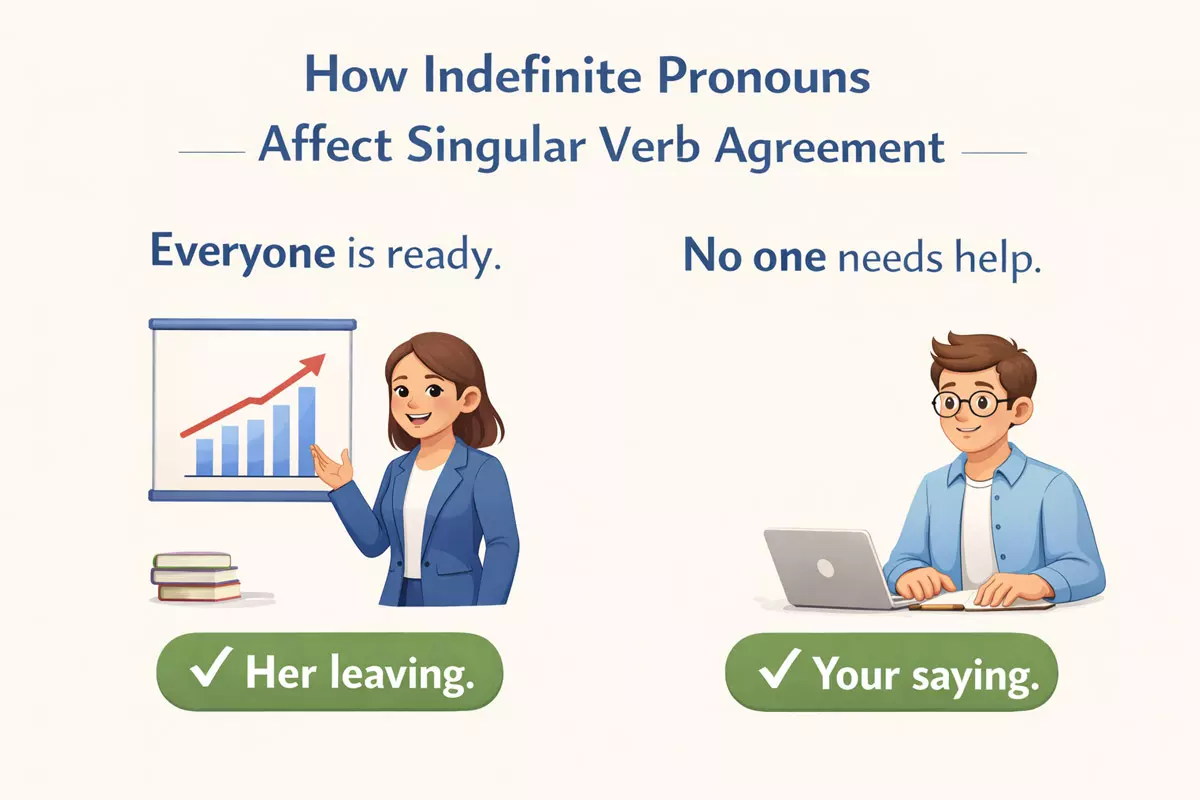
When you use pronouns such as each or everybody, the idea is that you are considering one person or thing at a time, even though you might be talking about a group. For example, in the sentence “Everyone is ready,” the subject everyone refers to all people, but the verb is remains singular because the action applies to each person individually.
Common Indefinite Pronouns That Use Singular Verbs
The following examples illustrate advanced, formal usage of indefinite pronouns with singular verb agreement.
- Anyone → Anyone is expected to comply with the revised regulations.
- Anybody → Anybody who wishes to participate must submit a formal request.
- Anything → Anything that undermines transparency is considered unacceptable.
- Everyone → Everyone involved in the process has a legal obligation to respond.
- Everybody → Everybody present was informed of the policy change in advance.
- Everything → Everything outlined in the agreement is subject to periodic review.
- Someone → Someone with sufficient authority is required to approve the decision.
- Somebody → Somebody familiar with the protocol is needed to oversee the procedure.
- Something → Something about the proposal raises serious ethical concerns.
- No one → No one is exempt from the compliance requirements.
- Nobody → Nobody who reviewed the data disputes the final conclusion.
- Nothing → Nothing in the report suggests deliberate misconduct.
- Each → Each of the submitted applications is evaluated independently.
- Either → Either option is acceptable under the current guidelines.
- Neither → Neither approach adequately addresses the underlying issue.
- One → One must consider the long-term implications before acting.
This pattern can seem counterintuitive because these pronouns often refer to groups. However, English treats them as singular for verb agreement. The logic is rooted in how the language breaks down the group into single units when using these words.
Some indefinite pronouns may seem plural, but their traditional use is singular. The verb agreement reflects this, even if the meaning implies more than one person or thing. The table below compares several indefinite pronouns and their correct verb forms:
Remember, this rule helps maintain clarity and consistency in English writing. When in doubt, check whether the pronoun refers to individuals considered separately—if so, a singular verb is almost always correct.
Common singular forms: everyone, someone, nobody
Indefinite pronouns like “everyone,” “someone,” and “nobody” are frequently used in English, and they always take singular verb forms. These words refer to people in a non-specific way, yet grammatically, they are treated as singular subjects. This is why you’ll hear, “Everyone is here,” not “Everyone are here.” The singular agreement rule applies regardless of the implied number of people.
How Singular Verb Agreement Works

When forming sentences, it’s helpful to remember that these pronouns act as singular nouns. Here are a few sample sentences:
- Someone is waiting outside.
- Nobody knows the answer.
- Everybody wants to help.
- Each has a unique perspective.
Notice that the verbs (“is,” “knows,” “wants,” “has”) are all singular.
Quick Reference: Indefinite Pronouns and Singular Verb Forms
| Indefinite Pronoun | Correct Verb Agreement |
|---|---|
| Everyone | Everyone is responsible. |
| Someone | Someone has arrived. |
| Nobody | Nobody knows the truth. |
| Anybody | Anybody can join. |
| Each | Each needs a ticket. |
| Everybody | Everybody enjoys the show. |
Common Pitfalls
A frequent mistake is to use a plural verb with one of these pronouns, especially in casual speech. For example, saying “Everyone are ready” is incorrect. Always double-check your verb to maintain proper agreement. Understanding how these indefinite pronouns interact with singular verbs helps keep your sentences clear and grammatically correct. Use this pattern for all similar words, and you’ll avoid one of the most common agreement errors in English.
When plural agreement is also possible
In some cases, indefinite pronouns can take either singular or plural verbs depending on context, emphasis, or meaning. This flexibility often arises when the pronoun refers to individuals within a group rather than the group as a single entity. Writers and speakers may choose plural agreement to highlight multiple people or items, especially in informal or conversational English.
Indefinite pronouns that allow plural verbs
Several indefinite pronouns are commonly used with plural verbs, particularly when they refer to more than one person or thing. These include:
- All → All of the evidence supports the proposed theory.
- Any → Any of these solutions is acceptable under the current regulations.
- None → None of the participants was aware of the change in procedure.
- Some → Some of the data has been excluded due to reliability concerns.
- Most → Most of the research focuses on short-term outcomes.
- More → More of the responsibility now rests with senior management.
- Half → Half of the budget has already been allocated to preliminary testing.
- Few → Few of the proposed revisions address the core issue.
- Both → Both of the approaches have significant methodological limitations.
- Several → Several of the assumptions require further justification.
- Many → Many of the studies highlight similar patterns of behavior.
- Fewer → Fewer of the applicants meet the revised eligibility criteria.
- Others → Others have argued that the evidence is inconclusive.
- Plenty → Plenty of time remains to refine the analytical framework.
- Enough → Enough evidence has been gathered to support a preliminary conclusion.
These pronouns are often paired with countable nouns or when the context makes a plural sense clear.
Context determines verb agreement
The choice between singular and plural often depends on what the pronoun refers to. For example, "All of the cake is gone" (cake is uncountable, so singular), but "All of the cookies are gone" (cookies are countable and plural). When the noun following the pronoun is plural or refers to multiple items, plural agreement is expected.
| Pronoun + Noun | Correct Verb Form | Example Sentence |
|---|---|---|
| All of the students | Plural | All of the students are ready. |
| All of the water | Singular | All of the water is cold. |
| None of the answers | Plural | None of the answers were correct. |
| None of the information | Singular | None of the information is useful. |
| Some of the people | Plural | Some of the people have arrived. |
| Some of the furniture | Singular | Some of the furniture has been delivered. |
Special cases and stylistic choices
Some indefinite pronouns—like "none"—are especially flexible. In formal writing, "none" is often treated as singular, but plural usage is widely accepted, especially when referring to countable nouns. For example: "None of the students have finished" is just as common as "None of the work is finished." Similarly, "any" and "some" can go either way based on whether the noun is countable or uncountable.
- Both always takes a plural verb: "Both are invited."
- Few, many, several, others always take plural verbs: "Few know the answer."
- When "all" or "some" refer to a singular, uncountable noun, use a singular verb: "Some of the milk is spoiled."
- When they refer to a plural, countable noun, use a plural verb: "Some of the books are missing."
Understanding the specific noun or idea the pronoun refers to is key. Context and meaning drive the choice of verb agreement, with plural forms helping to clarify when more than one individual or item is involved.
Meaning-based agreement vs grammatical rules
When choosing the right verb form with indefinite pronouns, context can sometimes matter as much as grammar. Traditional rules dictate that most indefinite pronouns—like everyone, someone, and nobody—take a singular verb. However, real-life usage sometimes bends these conventions, especially when the meaning of the group feels plural or the speaker is emphasizing individuals within a collective.
Grammatical expectations with indefinite pronouns
Standard grammar guides usually recommend singular agreement for indefinite pronouns. For example, we say, “Everyone is welcome,” not “Everyone are welcome.” This rule aims to ensure clarity and consistency, especially in formal writing. Yet, the sense of the subject—whether it feels like a group or a collection of individuals—can influence what sounds natural.
When meaning overrides the rules
In spoken English and some informal writing, speakers may prefer a plural verb, especially when thinking of the indefinite pronoun as referring to multiple people. For instance, “None of them are ready” feels more natural to many than “None of them is ready.” This tension between strict grammar and intuitive meaning leads to variation, especially with pronouns like all and none, which can refer to both singular and plural ideas.
| Indefinite Pronoun | Singular Example | Plural Example | Typical Usage |
|---|---|---|---|
| Everyone | Everyone is here. | ❌ Everyone are here. | Always singular |
| None | None is missing. | None are missing. | Both (meaning-dependent) |
| All | All is lost. | All are present. | Both (context-dependent) |
| Some | Some is left. | Some are left. | Both (context-dependent) |
| Somebody | Somebody knows. | ❌ Somebody know. | Always singular |
| Each | Each has arrived. | ❌ Each have arrived. | Always singular |
| Few | ❌ Few is ready. | Few are ready. | Always plural |
| Neither | Neither is correct. | ❌ Neither are correct. | Always singular |
| Many | ❌ Many is late. | Many are late. | Always plural |
| Anybody | Anybody wants coffee? | ❌ Anybody want coffee? | Always singular |
Common patterns in natural usage
- Formal writing sticks more closely to grammatical rules.
- Spoken English often reflects how “group” or “individual” the pronoun feels.
- Pronouns like none, some, and all are especially flexible.
- “Everybody has” and “nobody wants” are rarely questioned, but “none have” can sound just as normal as “none has.”
- Collective sense can lead to plural agreement, especially in questions or negative statements.
Ultimately, both meaning and grammar play a role. For indefinite pronouns, native speakers often choose the verb form that matches not just the rules, but also the sense of number and context. This balance is what makes agreement with these pronouns both interesting and occasionally tricky.
Formal vs informal usage preferences
Language registers often influence how indefinite pronouns and singular verb forms are paired. In academic writing, business correspondence, and official documents, there is a strong tendency to follow prescriptive grammar rules. This means indefinite pronouns like everyone, each, or nobody are almost always matched with singular verbs, as in “Everyone is welcome.”
Patterns in spoken and casual language
Conversational English, on the other hand, may relax these rules. In everyday speech, it’s not unusual to encounter plural verbs used with indefinite pronouns, especially when speakers are thinking of a group rather than an individual. For example, “None of them are ready” is frequently heard, even though the formal guideline would suggest “None of them is ready.”
Common indefinite pronouns and their agreement tendencies

- Everyone (formal: is) → Everyone is expected to follow the new guidelines.
- Somebody (formal: is) → Somebody is responsible for approving the final version.
- Anybody (formal: is) → Anybody is welcome to submit a proposal.
- Each (formal: is) → Each is evaluated according to the same criteria.
- No one (formal: is) → No one is exempt from the reporting requirements.
- Neither (formal: is) → Neither is suitable for large-scale implementation.
- None (formal: is/are, context-dependent) → None of the evidence is conclusive.
- All (can be is or are, context-dependent) → All of the data is stored securely.
- Some (is/are, context-dependent) → Some of the information is confidential.
- Many (are) → Many are unaware of the revised procedure.
- Few (are) → Few are willing to challenge the decision.
- Much (is) → Much is still unknown about the long-term effects.
- Somebody (is) → Somebody is likely to question this assumption.
- Everybody (is) → Everybody is required to attend the briefing.
- Some of the cake (is) → Some of the cake is left in the kitchen.
- Some of the students (are) → Some of the students are preparing for the exam.
Comparing preferences in different contexts
| Context | Typical Agreement with Indefinite Pronouns |
|---|---|
| Academic writing | Strictly singular (e.g., “Everyone is…”) |
| Business/professional | Usually singular, but some tolerance for plural in informal memos |
| Casual conversation | Frequent use of plural, especially with “none,” “all,” and “some” |
| Online/social media | Highly variable; plural agreement often accepted |
| Legal/official documents | Always singular for clarity and precision |
Summary of register-based tendencies
To sum up, the more formal the setting, the more likely it is that indefinite pronouns will be paired with singular verbs. Informal usage allows more flexibility, and speakers often let context and meaning guide their choices. While prescriptive rules still dominate in formal environments, real-world usage shows a growing acceptance of plural agreement, particularly in spoken and digital communication.
Typical learner mistakes with verb agreement
Many English learners struggle when using indefinite pronouns like everyone, someone, and none with the right verb forms. This is especially tricky because some pronouns look plural but actually require a singular verb. Understanding these patterns helps avoid common errors in both writing and speech.
Common confusion points
Misunderstandings often arise due to the mismatch between the pronoun’s appearance and its grammatical function. For example, words ending in -one or -body may seem plural, but they are grammatically singular. Here are frequent mistake patterns:
- Assuming everyone and everybody need a plural verb: ❌ Everyone are happy. ✅ Everyone is happy.
- Using plural verbs with someone, anyone, or nobody: ❌ Nobody know the answer. ✅ Nobody knows the answer.
- Confusing none as always singular or always plural. Context matters: ✅ None of the money is missing. ✅ None of the students are absent.
- Mixing up both, few, many (which are plural) with singular verbs.
- Overgeneralizing the rule and using singular verbs with actually plural indefinite pronouns like several or many.
- Forgetting that each and every always take singular verbs, even when followed by a plural noun: ❌ Each of the students are present. ✅ Each of the students is present.
- Using a singular verb after all when it refers to plural nouns: ❌ All of the cookies is gone. ✅ All of the cookies are gone.
- Attempting to “match” the verb to the nearest noun instead of the indefinite pronoun: ❌ Some of the books is missing. ✅ Some of the books are missing.
- Applying spoken habits (“None are…”) to formal writing, where singular agreement may be expected.
- Uncertainty with collective nouns used as indefinite pronouns (e.g. all, most) and their agreement, depending on context.
Indefinite pronouns and verb agreement overview
To clarify these patterns, here’s a quick reference guide showing typical indefinite pronouns and the correct verb form to use with each:
| Indefinite Pronoun | Correct Verb Agreement |
|---|---|
| Everyone / Everybody | Singular (e.g., is, has) |
| Someone / Somebody | Singular |
| No one / Nobody | Singular |
| Each / Every | Singular |
| Both / Few / Many / Several | Plural (e.g., are, have) |
| None / All / Some / Most | Depends on noun following (“None of the money is,” “None of the cookies are”) |
Tips for avoiding mistakes
- Always identify the indefinite pronoun and check if it’s typically singular or plural.
- Remember that words ending in -one, -body, and -thing are almost always singular.
- Be careful with words like none and all; agreement depends on the noun that follows.
- Practice with example sentences to build confidence in choosing the right verb forms.
Grasping these patterns helps learners write and speak with more accuracy and confidence, especially when indefinite pronouns are involved in subject–verb agreement.
British vs American tendencies
When it comes to indefinite pronouns and their verb agreement, regional differences between UK and US English can be quite noticeable. While both varieties share the same basic grammar rules, their treatment of agreement with words like everyone, none, or each can diverge, especially in formal writing and edited texts.
Common patterns in verb agreement
In American English, indefinite pronouns such as somebody, nobody, and everyone almost always take singular verbs. For example, Americans would write, "Everyone is ready," or "None of the cake is left." British English, however, sometimes allows plural verbs with certain pronouns, particularly when the group nature is emphasized or when the pronoun refers to people.
- American: "None of the students has finished."
- British: "None of the students have finished."
- American: "Each of them is responsible."
- British: "Each of them is responsible." (singular preferred, but plural occasionally found)
- American: "Everybody knows the answer."
- British: "Everybody knows the answer." (rarely "know")
- American: "None is available."
- British: "None are available." (if referring to people or plural countable things)
- American: "No one has arrived."
- British: "No one has arrived."
- American: "Somebody is coming."
- British: "Somebody is coming."
- American: "Neither is correct."
- British: "Neither is correct." (but "Neither of them are correct" is sometimes heard)
- American: "All of the information is accurate."
- British: "All of the information is accurate." (same as US)
Summary of differences
| Indefinite Pronoun Example | Typical US Usage | Typical UK Usage |
|---|---|---|
| None of the team | is playing well | are playing well |
| Everyone | is here | is here |
| None (with plural noun) | None of the books is missing | None of the books are missing |
| Each of the players | is ready | is ready |
| Neither of the answers | is correct | are correct (sometimes) |
Overall, American English tends to enforce singular verb agreement with indefinite pronouns more strictly, while British English allows for plural verbs in some cases, especially when referring to groups of people. However, both varieties generally use singular verbs for most indefinite pronouns, and plural agreement in British usage is more common in informal contexts or speech.
Practice: choose correct verb forms
Mastering subject-verb agreement with indefinite pronouns can be tricky, since words like everyone, nobody, and each may sound plural but actually require a singular verb. The following exercises will help you test and reinforce your understanding of these rules. Read the sentences and select the correct verb form in each case.
Choose the correct verb form
- Everyone (is / are) welcome to join the meeting.
- Neither of the answers (seems / seem) correct.
- Each of the students (has / have) submitted the assignment.
- All of the cake (was / were) eaten.
- Somebody (knows / know) the answer to this question.
- Both of the options (is / are) acceptable.
- None of the money (has / have) been spent.
- Few of the guests (has / have) arrived.
- Anything (is / are) possible if you try.
- Many of the applicants (was / were) qualified.
- Some of the information (is / are) outdated.
- Everything (seems / seem) fine so far.
Show answers
- is
- seems
- has
- was
- knows
- are
- has
- have
- is
- were
- is
- seems
Common indefinite pronouns and their verb agreement
Here’s a quick reference showing which indefinite pronouns typically take singular or plural verbs. Use this as a guide when making decisions about verb forms.
| Indefinite Pronoun | Verb Agreement | Example |
|---|---|---|
| Everyone | Singular | Everyone is here. |
| Each | Singular | Each has a ticket. |
| None (of the cake) | Singular | None of the cake was left. |
| Few | Plural | Few have arrived. |
| Many | Plural | Many were chosen. |
| Some (of the books) | Plural | Some of the books are missing. |
| Some (of the water) | Singular | Some of the water is cold. |
| All (of the students) | Plural | All of the students are present. |
| All (of the bread) | Singular | All of the bread is fresh. |
| Somebody | Singular | Somebody knows the answer. |
| Both | Plural | Both are correct. |
| Everything | Singular | Everything seems fine. |
Spot the mistake
In each sentence below, decide if the verb agrees correctly with the indefinite pronoun. If not, identify the error and suggest the correct form.
- None of the students was late.
- Everybody know the rules.
- Both is available at the counter.
- Some of the cheese were eaten.
- Everyone have finished the assignment.
- Many of the information is outdated.
- Neither of the options are acceptable.
- Few of the participants was informed.
- All of the data are reliable.
- Each of the reports were reviewed.
Show answers
- ✅ Correct
- ❌ Incorrect. Correct form: Everybody knows the rules.
- ❌ Incorrect. Correct form: Both are available at the counter.
- ❌ Incorrect. Correct form: Some of the cheese was eaten.
- ❌ Incorrect. Correct form: Everyone has finished the assignment.
- ❌ Incorrect. Correct form: Much of the information is outdated.
- ❌ Incorrect. Correct form: Neither of the options is acceptable.
- ❌ Incorrect. Correct form: Few of the participants were informed.
- ❌ Incorrect. Correct form: All of the data is reliable.
- ❌ Incorrect. Correct form: Each of the reports was reviewed.