Relative Pronouns After Prepositions in Formal English

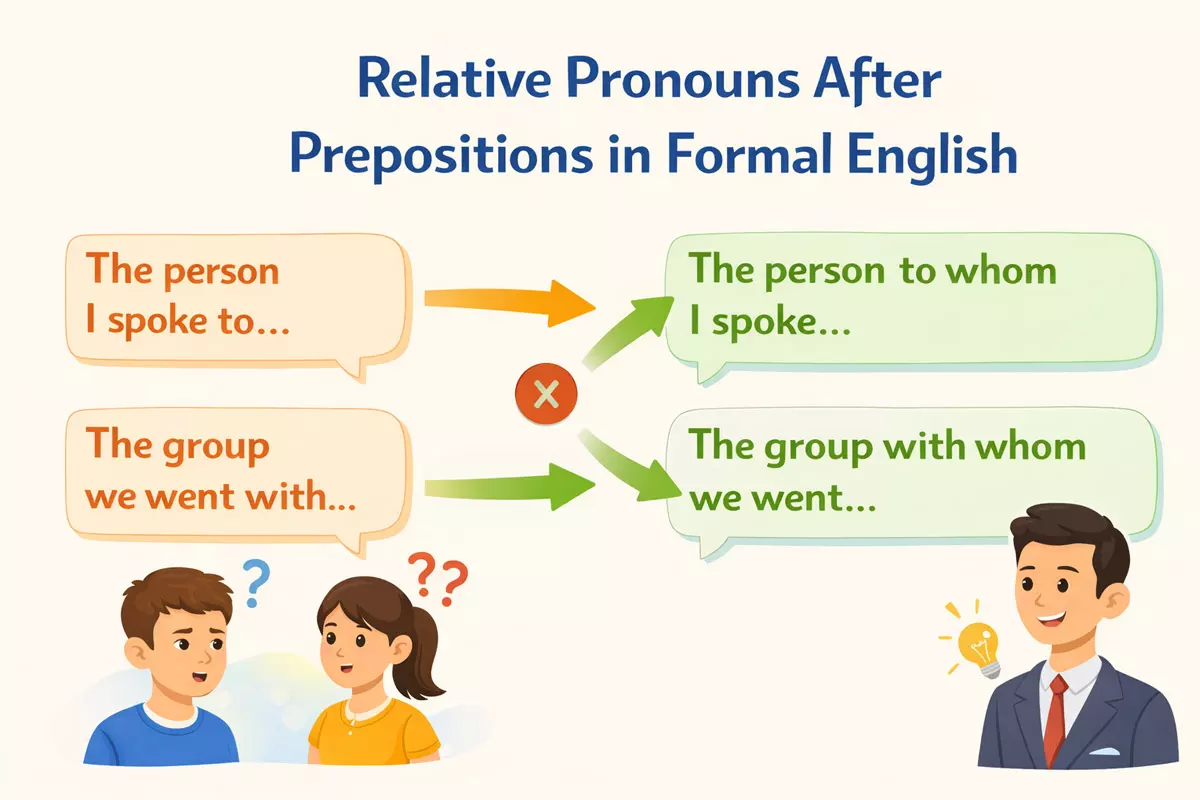 Here we how prepositions affect the choice of relative pronouns such as whom and which, differences between preposition fronting and stranding, formal writing norms, and offers practice restructuring sentences using examples from academic texts.
Mastering formal English often involves understanding how to correctly use prepositions with words that connect clauses, such as conjunctions and relative pronouns. This skill is crucial for constructing clear, polished sentences in both academic and professional contexts. By learning these structures, writers can express complex ideas more effectively and ensure their work meets high standards of clarity and sophistication, which is especially important in environments where precise communication is valued.
Why prepositions affect relative pronoun choice
When a preposition appears before a relative pronoun, it has a direct impact on which pronoun is acceptable, especially in formal English. This is because certain pronouns can function as the object of a preposition, while others cannot. For example, whom is traditionally used after prepositions, but who is not. The structure of the sentence, as well as the level of formality, guides the selection.
The link between prepositions and pronoun formality
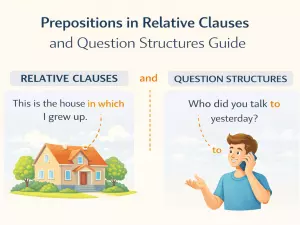
Putting the preposition before the relative pronoun is often seen in more formal styles. This position restricts your choice of pronoun. For example, in "the person to whom I spoke," whom fits because it's the object of "to." However, "the person to who I spoke" is not standard. In less formal English, it's common to move the preposition to the end ("the person who I spoke to"), which allows "who" or "that." Formal contexts, however, usually require the preposition to come first and the use of whom (for people) or which (for things).
Restrictions on pronoun choices after prepositions
- Whom: Used for people when the preposition comes first ("the colleague with whom I worked").
- Which: Used for things/animals when the preposition comes first ("the house in which they lived").
- That: Rarely used after a preposition in formal writing ("the project to that I contributed" ❌).
- Who: Not used after a preposition ("the manager to who I reported" ❌).
- Where, when, whose: These have special uses and often do not require a preposition before them.
Comparison of relative pronouns after prepositions
| Relative Pronoun | Acceptable After Preposition? | Example |
|---|---|---|
| whom | ✅ Yes | The person to whom I spoke |
| which | ✅ Yes | The house in which they lived |
| who | ❌ No | The manager to who I reported |
| that | ❌ No | The company for that I worked |
| where/when/whose | Depends | The year when I graduated |
Common prepositions and relative pronouns
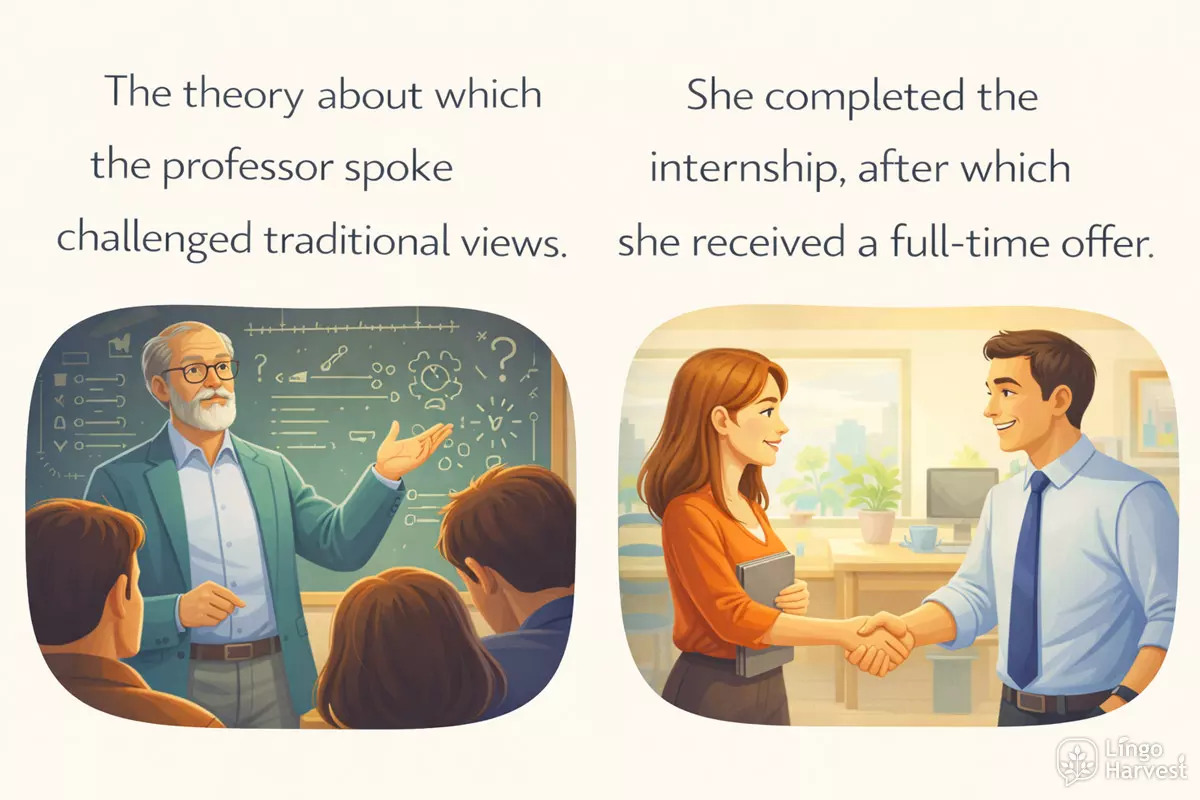
Here are some typical preposition + relative pronoun pairings found in formal writing:
- about which → The theory about which the professor spoke challenged traditional views.
- after which → She completed the internship, after which she received a full-time offer.
- at which → The conference at which the agreement was signed drew international attention.
- by whom → The novel, by whom it was originally translated, remains unclear.
- for which → The grant for which the team applied was finally approved.
- from which → The archive from which the data were retrieved is restricted.
- in whom → He found a mentor in whom he placed complete trust.
- of which → The device, the reliability of which has been questioned, was recalled.
- on which → The platform on which the service depends experienced an outage.
- to whom → She addressed the complaint to whom the decision ultimately belonged.
- with whom → The colleague with whom she collaborated later became a partner.
- upon which → He reached a conclusion upon which further research will be based.
- within which → The framework within which the policy operates is outdated.
- without which → Trust, without which no team can function, must be earned.
Using the correct pronoun after a preposition helps maintain clarity and formality in your writing. Understanding these patterns ensures your sentences sound natural and are grammatically correct in formal contexts.
Whom and which after prepositions
In formal English, it is common to place prepositions directly before the relative pronouns whom and which when forming relative clauses. This construction is often used in written or professional contexts, especially when clarity and precision are important. Instead of ending a clause with a preposition, the preposition comes before the pronoun, resulting in a more traditional and polished sentence structure.
Why put the preposition before the pronoun?
Preposing the preposition (putting it before the relative pronoun) creates a formal tone and avoids ending sentences with a preposition, which some consider less elegant in writing. This structure is especially preferred in academic, legal, and official documents.
Examples of formal patterns
- The colleague with whom I worked was promoted.
- The topic about which she spoke was fascinating.
- The project for which funding was requested has started.
- The house in which they live is historic.
- The conditions under which the contract was signed changed later.
- The person to whom you should address your letter is unavailable.
- The document from which this data comes is confidential.
- The system through which information is processed is complex.
- The event during which the announcement was made was televised.
- The policy against which they protested was revised.
- The reason for which the meeting was cancelled remains unclear.
- The artist by whom this painting was created is well-known.
- The organization to which he belongs is international.
- The room into which they entered was empty.
- The case on which the lawyer worked was complicated.
- The team with whom we collaborated was efficient.
- The process through which the application is reviewed is strict.
- The situation in which we found ourselves was unexpected.
Comparing formal and informal usage
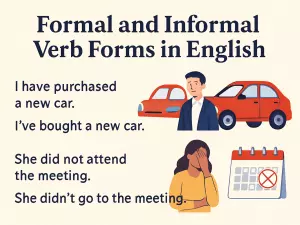
In everyday conversation, it’s more common to place the preposition at the end of the clause. However, formal English prefers the preposition before the pronoun. See the comparison below:
| Informal (preposition at end) | Formal (preposition before pronoun) |
|---|---|
| The person I spoke with | The person with whom I spoke |
| The topic she is interested in | The topic in which she is interested |
| The report you referred to | The report to which you referred |
| The company he works for | The company for which he works |
When to use whom vs. which
- Use whom for people (e.g., "the person to whom you spoke").
- Use which for things, animals, or abstract ideas (e.g., "the method by which it was done").
While these forms may sound overly formal in casual speech, they are preferred in writing where formality or clarity is required. Using the correct structure helps convey your message precisely and demonstrates command of formal English.
Preposition fronting vs stranding
When using relative pronouns after prepositions in formal English, the position of the preposition can vary. The preposition may appear before the relative pronoun (known as preposition fronting), or it may remain at the end of the clause (known as preposition stranding). Each approach has distinct stylistic and grammatical implications, especially in written and spoken registers.
Preposition fronting: formal style
Placing the preposition before the relative pronoun is considered more formal and is often found in academic or literary contexts. In this structure, the relative pronoun is typically which or whom, not that or who. For example: "The colleague with whom I worked was very helpful." This construction avoids ending the clause with a preposition.
Preposition stranding: informal and common in speech
Leaving the preposition at the end of the clause is called stranding. This pattern is natural in everyday conversation and is widely accepted in less formal writing. In these cases, the relative pronoun can be who, whom, which, or even omitted in some contexts: "The colleague who I worked with was very helpful."
Comparison of fronting and stranding
| Preposition Fronting | Preposition Stranding |
|---|---|
| The person to whom you spoke is my friend. | The person who you spoke to is my friend. |
| The house in which they live is old. | The house that they live in is old. |
| The reason for which she left is unclear. | The reason she left for is unclear. |
| The company with which we partnered succeeded. | The company we partnered with succeeded. |
Key points to remember
- Fronting is preferred in formal writing; stranding is natural in speech.
- Use whom or which after a fronted preposition; who and that do not follow prepositions in formal English.
- Preposition stranding is common in everyday English and rarely sounds awkward to native speakers.
- Omitting the relative pronoun is possible with stranding, but not with fronting (e.g., "The book I told you about").
- Some prepositions sound awkward when fronted, especially in informal contexts.
Choosing between these constructions depends on formality, clarity, and audience expectations. Understanding both helps you adapt your style for different contexts.
Formal writing norms and expectations
In formal English, the placement of relative pronouns after prepositions follows distinct conventions. These guidelines are especially important in academic, legal, and professional writing, where clarity and correctness are valued. Writers are generally expected to position the preposition before the relative pronoun, rather than at the end of the clause, for a more polished and precise style.
Preposition placement with relative pronouns
Instead of letting the preposition "dangle" at the end, formal English prefers it directly before the relative pronoun. This structure may sound less conversational but is widely regarded as correct in official documents and scholarly texts. For example, instead of writing "the topic which we talked about," a formal version would be "the topic about which we talked."
- Prepositions typically precede which and whom in formal style.
- Using that after a preposition is generally considered incorrect in formal registers.
- Some relative pronouns (like who) are rarely used after prepositions.
- Omitting the relative pronoun entirely (as in "the person I spoke to") is informal and should be avoided.
Common patterns in formal writing
The following table illustrates frequent patterns for prepositions and relative pronouns in formal English, showing both preferred and less formal alternatives.
| Formal Pattern | Less Formal Equivalent |
|---|---|
| The colleague to whom I referred | The colleague who I referred to |
| The contract under which we operate | The contract which we operate under |
| The reasons for which the policy was changed | The reasons which the policy was changed for |
| The city in which he was born | The city which he was born in |
| The evidence on which the claim rests | The evidence which the claim rests on |
Additional points to consider
- Which and whom are favored after prepositions in formal structures.
- Using that after a preposition is nonstandard: the theory to that I subscribe ❌ → the theory to which I subscribe ✅
- Preposition + whom is required when referring to people: the professor to whom you spoke.
- Preposition + which is used for things or abstract concepts: the report on which I relied.
- In highly formal contexts, avoid ending a clause with a preposition whenever possible.
Writers aiming for a polished and authoritative tone should use these structures consistently. Mastery of these conventions not only demonstrates grammatical competence but also signals respect for established standards in formal English.
Avoiding incorrect pronoun forms
When using relative pronouns after prepositions in formal English, it's easy to slip into common mistakes—especially with the choice between "who," "whom," "which," and "that." Selecting the correct form depends on whether the pronoun is the object of the preposition and on the formality of the context. In formal writing, prepositions often come before the relative pronoun, and "whom" or "which" is expected, not "who" or "that."
Common pitfalls with relative pronouns after prepositions
Writers often use the wrong pronoun form or incorrect word order when combining prepositions and relative clauses. The following list highlights frequent errors and how to avoid them:
- Using "who" instead of "whom" after a preposition (e.g., the person to who I spoke ❌)
- Placing the preposition at the end in formal sentences (e.g., the project which I worked on instead of the project on which I worked)
- Using "that" after a preposition (e.g., the topic about that we talked ❌)
- Omitting the relative pronoun entirely (e.g., the person I spoke to is informal; use to whom I spoke in formal contexts)
- Mixing "who" with things (e.g., the device with who I connected ❌)
- Using "which" for people (e.g., the manager for which I work ❌)
- Repeating the object (e.g., the book which I read it ❌)
- Using "whom" as a subject (e.g., the person whom called me ❌)
- Using "whose" with inanimate objects incorrectly (e.g., the car whose it is blue ❌)
- Forgetting to match the pronoun to the noun’s role (person vs. thing, subject vs. object)
Correct forms after prepositions: quick reference
The following table summarizes the correct pronoun forms to use after prepositions in formal English, depending on whether you refer to people or things:
| Context | Correct Pronoun Form |
|---|---|
| People (object of preposition) | whom the colleague with whom I worked |
| Things (object of preposition) | which the document to which she referred |
| Possession (people/things) | whose the author whose book won the prize |
| Informal alternative (spoken/writing) | ending preposition + who/which/that (less formal) the team that I played with |
Tips for accurate usage
- In formal writing, always place the preposition before the relative pronoun.
- Use "whom" after prepositions when referring to people as the object.
- Choose "which" after prepositions for things or ideas.
- Avoid "that" after prepositions in formal English.
- Double-check whether the noun being replaced is a person or a thing to select the right pronoun.
Careful attention to these patterns helps ensure clarity and correctness in formal contexts. Remember, using the right relative pronoun after a preposition is a hallmark of polished English.
Spoken vs written differences
When analyzing how prepositions interact with relative pronouns, the contrast between everyday conversation and formal writing becomes quite clear. In casual speech, native speakers often prioritize ease and flow, sometimes bending strict grammar rules for the sake of naturalness. On the other hand, formal English—especially in academic or professional texts—tends to favor more structured patterns, particularly when positioning prepositions with relative clauses.
Preposition placement: everyday use vs. formal contexts
In spoken language, it is common to move the preposition to the end of the clause, a structure known as "preposition stranding." This approach sounds more natural in conversation and is readily accepted. In contrast, formal writing usually places the preposition before the relative pronoun, a construction called "preposition fronting." This distinction signals the level of formality and can affect how polished or casual a sentence appears.
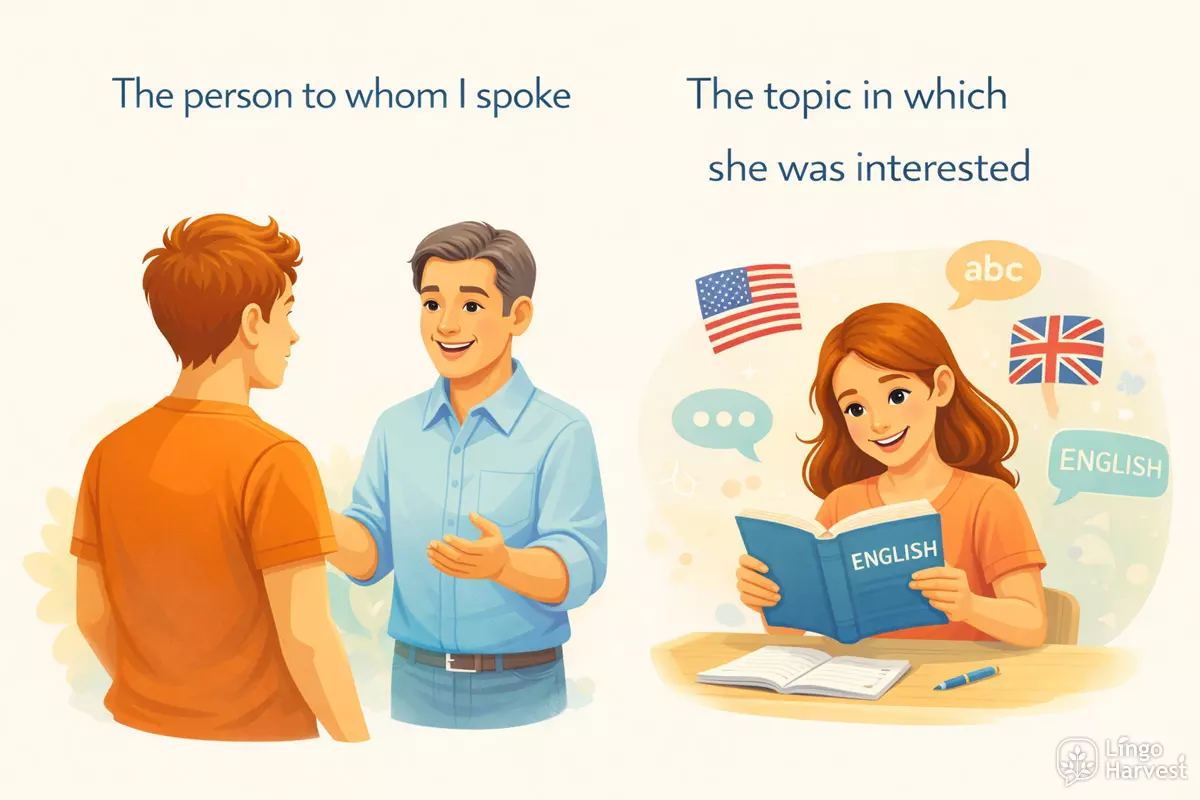
| Spoken English | Formal Written English |
|---|---|
| The person who I spoke to | The person to whom I spoke |
| The topic that she was interested in | The topic in which she was interested |
| The house which they moved into | The house into which they moved |
| The colleague you work with | The colleague with whom you work |
Other notable contrasts
- Omitting the relative pronoun ("the person I spoke to") is more acceptable in speech, but less so in formal writing.
- Who/whom distinction is often ignored in conversation, while formal texts maintain it.
- Relative pronouns like "that" are common in spoken English but avoided after prepositions in formal writing.
- Complex prepositional phrases may be simplified or reordered in everyday conversation for clarity.
- Redundancy is more tolerated in speech (e.g., "the place where I'm at"), but is discouraged in formal contexts.
- Some prepositions (like "about") are rarely fronted in modern usage, even in formal writing.
- Formal writing may use more precise or varied relative pronouns for clarity and style.
- Intonation and pauses in speech can clarify meaning, while punctuation serves this role in writing.
- In spoken English, contractions and informal vocabulary often accompany stranded prepositions.
- Written English values consistency and parallelism, so prepositions are more carefully placed.
Ultimately, the placement of prepositions with relative clauses is shaped by the context and the expectations of the audience. While relaxed forms dominate conversation, mastering both patterns is useful for effective and appropriate communication in diverse situations.
Examples from academic texts
Writers in formal settings often place prepositions before relative pronouns to achieve a more polished or academic tone. This structure is especially common in research papers, scholarly articles, and formal reports. Below, you'll find a range of authentic sentence patterns and examples drawn from academic writing, highlighting how prepositions interact with relative clauses. Notice how these constructions often differ from everyday spoken English, where the preposition is usually left at the end.
Common patterns in formal writing
- The theory on which this study is based...
- The process through which data were collected...
- The criteria by which participants were selected...
- The framework within which these issues are analyzed...
- The methods with which the results were obtained...
- The standard to which all applicants must adhere...
- The context in which these phenomena occur...
- The circumstances under which the agreement was signed...
- The questions for which no answers were provided...
- The system from which the data were extracted...
- The period during which the experiment was conducted...
- The agreement to which both parties consented...
- The institution at which the research was carried out...
- The procedure by which the chemicals were tested...
- The policy against which the proposal was evaluated...
Comparison: Formal vs. Informal Structures
| Formal Academic English | Informal / Conversational English |
|---|---|
| The data on which the analysis relies are extensive. | The data that the analysis relies on are extensive. |
| The framework within which this argument is constructed is robust. | The framework that this argument is constructed within is robust. |
| The standards to which the product must conform are strict. | The standards that the product must conform to are strict. |
| The criteria by which success is measured vary greatly. | The criteria that success is measured by vary greatly. |
Key observations
- Preposition-fronted relative clauses signal formality and are favored in academic prose.
- Such phrases are typically followed by which or whom, not that.
- While grammatically correct, these structures may sound stilted in conversation.
- Writers use these forms to clarify relationships between ideas and maintain a formal register.
By reviewing these real-world scholarly sentences and comparing them to their informal equivalents, you can see how relative pronouns after prepositions contribute to the tone and clarity of formal English. This awareness helps in recognizing and applying the appropriate structure depending on the context.
Practice: restructure sentences with prepositions
In formal written English, relative pronouns often follow prepositions rather than ending the clause. This section gives you a chance to transform sentences into a more formal structure by moving the preposition before the relative pronoun. Practicing this will help you recognize and use formal patterns, especially in academic or professional contexts.
Task: Rewrite These Sentences
Change each sentence so that the preposition comes before the relative pronoun, creating a more formal structure. Use whom or which as needed.
- This is the colleague I was talking to.
- That is the topic we are interested in.
- The house she lives in is very old.
- He is the person I spoke with yesterday.
- Here is the book you asked for.
- The company I applied to has responded.
- The reason I came here is something I will explain.
- This is the man I have heard so much about.
- There are several issues we must deal with.
- The project you contributed to was successful.
Show answers
- This is the colleague to whom I was talking.
- That is the topic in which we are interested.
- The house in which she lives is very old.
- He is the person with whom I spoke yesterday.
- Here is the book for which you asked.
- The company to which I applied has responded.
- The reason for which I came here is something I will explain.
- This is the man about whom I have heard so much.
- There are several issues with which we must deal.
- The project to which you contributed was successful.
Common Prepositions Used Before Relative Pronouns
Here are some prepositions frequently used before whom or which in formal English:
- to → The person to whom I spoke was very helpful.
- with → The colleague with whom she worked later became a partner.
- for → The grant for which the team applied was approved.
- about → The issue about which they argued remains unresolved.
- in → The candidate in whom we placed our trust succeeded.
- on → The report on which the decision was based is confidential.
- at → The conference at which the treaty was signed drew attention.
- by → The author by whom the book was written is unknown.
- from → The source from which the data were obtained is reliable.
- under → The conditions under which the experiment was conducted changed.
- through → The process through which the request was approved is complex.
- over → The period over which the study was conducted spans a decade.
Quick Comparison: Informal vs. Formal Structure
| Informal Sentence | Formal (Preposition + Relative Pronoun) |
|---|---|
| The person I spoke to | The person to whom I spoke |
| The topic we talked about | The topic about which we talked |
| The house she lives in | The house in which she lives |
| The book you asked for | The book for which you asked |
| The company I applied to | The company to which I applied |
When restructuring, remember that whom is used for people, while which is used for things or ideas. These patterns are especially useful in writing essays, formal emails, or academic papers.