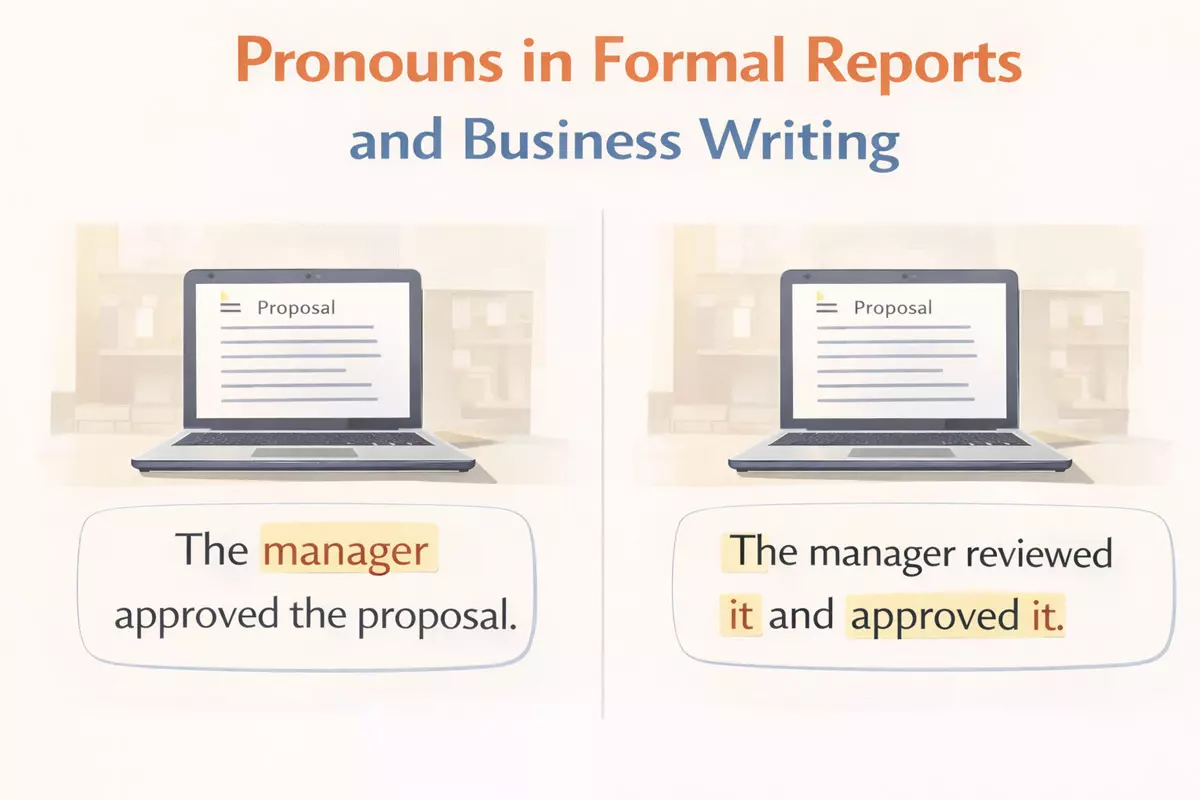
Pronouns in Formal Reports and Business Writing

 This article explains how to choose pronouns and set the right tone in business writing. It covers first-person versus impersonal forms, consistency across sections, typical errors, formal examples, and practice revising informal text.
- Tone expectations in reports and business texts
- First-person vs impersonal pronoun choices
- Pronouns in executive summaries and conclusions
- Avoiding conversational pronouns in business writing
- Consistency in reference across sections
- Common mistakes in professional contexts
- Examples from formal documents
- Practice: rewrite informal text professionally
Selecting appropriate ways to refer to people and things is crucial in workplace documents, as it significantly affects clarity, tone, and credibility. The language you use to address your audience and describe actions not only shapes how your message is interpreted but also impacts the level of professionalism and trust your writing conveys. By carefully considering word choice and phrasing, you can ensure your communication is both effective and respectful, ultimately leading to better understanding and stronger workplace relationships.
Tone expectations in reports and business texts
When preparing formal reports or business writing, the overall style should project professionalism, clarity, and objectivity. Readers expect communication that is direct yet respectful, free from emotional language or personal bias. The tone should support the intended purpose—whether it's to inform, persuade, or recommend—without distracting from the message with unnecessary informality or verbosity.
Key elements of professional tone
- Impartial language: Avoid subjective opinions and focus on evidence-based statements.
- Clarity: Use straightforward vocabulary and sentence structure to ensure your message is easily understood.
- Formality: Maintain a degree of distance by limiting casual expressions and slang.
- Consistency: Stick to a chosen level of formality throughout the document.
- Respect: Express ideas with consideration for all parties, avoiding language that could be interpreted as dismissive or confrontational.
- Conciseness: Present information efficiently, removing redundant words or unnecessary filler.
- Objectivity: Focus on facts, data, and logical reasoning rather than personal beliefs.
- Precision: Choose words that accurately reflect your intended meaning, especially when discussing data or actions.
- Appropriate pronoun use: Select pronouns carefully to suit the context, audience, and desired level of formality.
- Constructive suggestions: When making recommendations, use language that is both positive and actionable.
Comparing tones: Formal vs. Informal business writing
| Formal Business Tone | Informal Business Tone |
|---|---|
| Passive or third-person phrasing ("The report indicates...") | First or second person ("I think...", "You should...") |
| Objective, fact-based statements | Subjective opinions or personal anecdotes |
| Limited use of contractions ("do not", "cannot") | Frequent contractions ("don't", "can't") |
| Neutral, non-emotional vocabulary | Colloquial language or emotive words |
| Structured organization and headings | Less structured, possibly conversational flow |
Common pitfalls to avoid in business writing
- Overusing personal pronouns (e.g., "I", "we") in highly formal documents
- Allowing emotional or biased statements to influence the message
- Using ambiguous language or jargon that may confuse readers
- Switching tone or level of formality mid-document
- Neglecting the audience’s expectations and context
Ultimately, aligning your language style with the expectations of formal business communication helps build credibility and ensures your message is received as intended. Thoughtful attention to tone, including how pronouns are used, reinforces both professionalism and clarity in any report or business document.
First-person vs impersonal pronoun choices
Deciding whether to use first-person pronouns (such as I or we) or more impersonal forms is a common challenge in formal reports and business writing. The choice affects tone, clarity, and the perceived objectivity of your message. In some professional contexts, direct references to the writer or organization can make communication more relatable or transparent. In others, a neutral style is preferred to maintain formality and focus on the subject matter rather than the author.
When first-person pronouns are appropriate
Using I or we is sometimes suitable, especially when:
- Describing actions your team or organization has taken
- Clarifying responsibility for decisions or recommendations
- Writing executive summaries or cover letters
- Addressing the reader directly in correspondence
- Explaining your own analysis or interpretation of data
Why impersonal language is often preferred
Impersonal pronouns and passive structures help shift focus away from the writer and place emphasis on the findings, processes, or outcomes. This style is especially common in technical, scientific, and many business documents because it:
- Projects objectivity and professionalism
- Reduces the risk of sounding subjective or self-centered
- Facilitates a formal, authoritative tone
- Makes reports easier to reuse or update by others
Common forms and alternatives

Writers often need alternatives to first-person statements. Here are typical pairs of first-person and impersonal constructions:
| First-person Construction | Impersonal Alternative |
|---|---|
| We recommend updating the system regularly. | It is recommended that the system be updated regularly. |
| I found that the results were inconsistent. | The analysis showed that the results were inconsistent. |
| We conducted a survey among university students. | A survey was conducted among university students. |
| We will implement the new policy next year. | Implementation of the new policy will occur next year. |
| I suggest revising the current guidelines. | It is suggested that the current guidelines be revised. |
| We observed a significant increase in productivity. | Observations indicate a significant increase in productivity. |
| We decided to postpone the launch. | The decision was made to postpone the launch. |
| I conclude that further research is necessary. | It can be concluded that further research is necessary. |
| We believe the method is effective. | It is believed that the method is effective. |
| We analyzed the data collected during the experiment. | The data collected during the experiment were analyzed. |
Tips for choosing the right approach
- Check your organization's style guide or industry standards
- Use impersonal forms for technical or highly formal documents
- Prefer first-person pronouns for clarity when accountability matters
- Maintain consistency throughout the document
- When in doubt, favor clarity and reader understanding over rigid rules
Careful selection between direct and impersonal references shapes both the professionalism and the accessibility of your business writing. The right choice depends on your audience, purpose, and the expectations of your field.
Pronouns in executive summaries and conclusions
Using pronouns thoughtfully in executive summaries and closing sections can shape the tone and clarity of a formal report or business document. These sections often distill the main findings and recommendations, so pronoun choices can affect both professionalism and reader engagement.
Typical pronoun usage
In executive summaries, writers often avoid first-person forms like "I" or "we" to maintain objectivity and formality. Instead, passive voice or third-person structures are common, especially in highly formal contexts. However, some organizations prefer a more direct style, using "we" to signal collective responsibility or "you" to engage the audience. Conclusions may allow slightly more flexibility, especially when addressing next steps or summarizing commitments.
Common pronoun patterns
- Impersonal: "It is recommended that..."
- Passive: "The following actions are proposed..."
- Collective: "We suggest the adoption of..."
- Direct address: "You will benefit from..."
- Third-person: "The organization should implement..."
- Omitted: "Implementation recommended."
- Inclusive: "Our team identified..."
- Neutral: "The results indicate..."
- Active: "We conclude that..."
- Objective: "This report finds..."
- Instructional: "Readers are advised to..."
- Referential: "As discussed above,..."
- General: "One may observe that..."
- Conditional: "If adopted, these measures will..."
- Summary: "In summary, it can be seen that..."
- Future focus: "Future reports will address..."
- Responsibility: "Management should consider..."
- Authority: "The committee recommends..."
- Evidence-based: "Data supports the conclusion that..."
Comparing pronoun choices in summary and conclusion writing
| Pronoun Approach | Effect on Tone |
|---|---|
| Impersonal/Passive ("It is recommended that...") | Formal, objective, sometimes distant |
| First-person plural ("We recommend...") | Inclusive, collaborative, direct |
| Second-person ("You will benefit...") | Engaging, audience-focused, potentially informal |
| Third-person ("The team recommends...") | Neutral, professional, clear attribution |
Choosing between these forms depends on the organization's style guide, the document's purpose, and the intended audience. In general, clarity and consistency are more important than rigid adherence to a single approach. When in doubt, review previous reports or consult internal guidelines to match the preferred tone and pronoun usage in key summary and conclusion sections.
Avoiding conversational pronouns in business writing
Business writing often calls for a tone that is objective, clear, and professional. One common pitfall is the overuse of conversational pronouns such as "I," "you," "we," and "our." While these pronouns can create a friendly tone in casual communication, they may undermine the formality and neutrality expected in formal documents like reports, proposals, or executive summaries. Replacing them with more formal alternatives helps maintain credibility and ensures the message focuses on facts, actions, and outcomes rather than individuals.
Why limit conversational pronouns?
Using personal or direct address pronouns can make business documents sound subjective or overly informal. For example, saying "You should submit your report by Friday" may seem too direct or even prescriptive, while "The report should be submitted by Friday" sounds more neutral and professional. Limiting conversational language also helps avoid ambiguity when addressing multiple readers or stakeholders.
Common conversational pronouns and formal alternatives
Writers can strengthen formal communication by substituting conversational pronouns with more objective phrasing. Here are some frequent substitutions:
- I recommend → It is recommended
- We found → The analysis found
- You will notice → It should be noted
- Our team decided → The team decided
- We suggest → This report suggests
- Your feedback → Feedback from stakeholders
- I believe → It is believed
- We will address → The following issues will be addressed
- You can see → As shown
- We conclude → In conclusion
- We are pleased to announce → It is announced
- Our results show → The results show
- We have implemented → The following measures have been implemented
- Your request → The request
- We acknowledge → Acknowledgement is given
- We noticed → It was observed
- We advise → It is advised
- You must → It is required
- I have attached → Attached is
- We appreciate → Appreciation is extended
Strategies for neutral phrasing
To maintain a formal tone, consider these approaches:
- Use passive voice where appropriate (e.g., "The decision was made" instead of "We decided").
- Refer to roles or departments rather than individuals ("The finance team recommends…").
- Focus on actions, results, or processes instead of personal involvement.
- Employ impersonal constructions such as "It is expected that…" or "The data indicates…".
- Specify stakeholders or groups instead of "you" or "we" ("Clients should submit forms…").
Comparison of conversational vs. formal phrasing
| Conversational Pronoun Example | Formal Alternative |
|---|---|
| We think this approach works best. | This approach is considered most effective. |
| You will receive your invoice next week. | The invoice will be sent next week. |
| I have included the data below. | The data is included below. |
| Our analysis shows an increase in sales. | The analysis shows an increase in sales. |
| We recommend reviewing the policy. | Review of the policy is recommended. |
Adopting these techniques ensures business documents remain focused, precise, and appropriately formal. This not only enhances clarity but also fosters a sense of professionalism and impartiality in all business communications.
Consistency in reference across sections
Maintaining a uniform approach to pronoun use is essential when writing formal reports or business documents. Shifting between “we,” “the company,” and “one” can confuse readers and suggest a lack of editorial control. A consistent reference style helps readers track who is responsible for actions, decisions, or recommendations throughout the document.
Why Consistency Matters
Consistency in pronoun usage reduces ambiguity. For example, if one section refers to the organization as “the team” and another as “we,” readers might wonder if the same group is being discussed. This is especially important in collaborative documents or those reviewed by external stakeholders.
Common Reference Forms in Business Writing

Writers often choose from several reference styles, depending on company standards and document purpose. Below is a comparison of typical approaches:
| Reference Form | Example |
|---|---|
| First-person plural | We recommend implementing the new policy. |
| Third-person singular (company name) | Acme Corp. recommends implementing the new policy. |
| Impersonal/Passive | The new policy is recommended for implementation. |
| Second-person (rare in formal reports) | You should implement the new policy. |
Tips for Achieving Consistency
- Choose a reference form at the outset: Decide whether to use “we,” the company name, or passive voice, and apply this choice throughout.
- Align with organizational standards: Refer to your company’s style guide for preferred pronoun practices.
- Check transitions between sections: When multiple authors contribute, ensure the reference remains the same from section to section.
- Revise for clarity: If you find inconsistent pronouns during editing, revise to match your chosen style.
Examples of Inconsistent vs. Consistent Reference
- Inconsistent: “We analyzed the data. The company then implemented changes. I recommend further review.”
- Consistent: “We analyzed the data. We then implemented changes. We recommend further review.”
Consistency with pronouns and references not only improves readability but also projects professionalism. Clear, steady reference points help readers navigate complex information and reinforce the authority of the document.
Common mistakes in professional contexts
Writers frequently encounter pitfalls when using pronouns in business documents and formal reports. These errors can lead to confusion, ambiguity, or a lack of professionalism. Recognizing these issues is the first step toward producing clearer, more effective workplace communication.
Ambiguous Pronoun Reference
One of the most frequent mistakes is unclear pronoun reference. When it’s not obvious what a pronoun such as “it,” “they,” or “this” refers to, readers may misinterpret the message. Always ensure that the noun a pronoun replaces is clear and unambiguous.
- “They” used after several possible antecedents
- “It” referring to abstract ideas or entire sentences
- “This” or “that” without a clear subject
Inappropriate Use of First or Second Person
Formal reports and business writing typically avoid first person (“I,” “we,” “us”) and second person (“you”) pronouns unless the document is intended to be conversational or directly addresses the reader. Overusing these forms can undermine objectivity.
- “I think the results are significant.” ❌ → “The results are considered significant.” ✔️
- “We believe that the proposal will succeed.” ❌ → “The proposal is expected to succeed.” ✔️
- “You should submit the form by Friday.” ❌ → “The form should be submitted by Friday.” ✔️
Inconsistent Pronoun Usage
Switching between singular and plural forms or between formal and informal tone can make a document feel disjointed. Consistency is key for both professionalism and readability.
- Switching from “he or she” to “they” mid-document
- Alternating between “the company” and “we” to refer to the same entity
Gendered Pronouns for Generic Subjects
Using “he” or “she” to refer to an unspecified person is increasingly viewed as outdated and exclusionary. Inclusive language is preferred in modern business contexts.
- “Each manager must submit his report.” ❌
- “A customer should provide his or her feedback.” (awkward/repetitive)
- “Each manager must submit their report.” ✅ (singular “they” is widely accepted)
Pronoun Agreement Errors
Ensuring that pronouns agree in number and gender with the nouns they replace is essential. Mistakes in agreement can distract or confuse the reader.
| Error | Correct Form |
|---|---|
| Each employee must submit their timesheets. (Traditionalists object) | All employees must submit their timesheets. |
| The committee made their decision. | The committee made its decision. |
| Neither manager finished their review. | Neither manager finished his or her review. (Or: their review, if using singular “they”) |
| Everyone must bring their laptop. | Everyone must bring his or her laptop. (Or: their laptop, for inclusivity) |
Overuse of Pronouns
Relying too heavily on pronouns can make business writing vague or repetitive. Balance pronoun use with specific nouns to maintain clarity.
- “It was decided that it would be implemented by them.” (Who decided? What will be implemented?)
- “The team will review the plan and submit it to management.” (Clarify what “it” refers to if multiple items are discussed)
Summary
By being mindful of these common pitfalls—unclear references, inconsistent or inappropriate forms, and agreement mistakes—professionals can ensure their reports and business documents are precise, inclusive, and easy to follow.
Examples from formal documents
Writers preparing business reports or official correspondence often encounter questions about which pronouns are suitable. Choices depend on the document’s purpose, the organization’s style, and the intended audience. Below, you’ll find practical illustrations of how pronouns appear in typical corporate, academic, and technical writing. These examples highlight both preferred usage and common pitfalls.
Common pronoun patterns in formal writing
- Passive voice to avoid first-person: "The report was submitted on time."
- Third-person references: "The company will review its procedures."
- Impersonal constructions: "It is recommended that all staff attend."
- Use of "we" in collaborative documents: "We have analyzed the data as follows."
- Direct address avoided: Instead of "You should complete the form," use "The form must be completed."
- Gender-neutral pronouns: "Each employee must submit their timesheet."
- Omitting pronouns altogether: "Approval required before purchase."
- Referring to organizations as "it": "Acme Corp. announced its quarterly results."
- Pronoun consistency: Avoid switching between "he/she/they" for a single entity.
- Restricting "I" to author’s statements in academic reports: "I conclude that..." (rare in business documents).
- Clarifying antecedents: "The manager informed her team..." (ensure "her" clearly refers to the manager).
Comparing pronoun choices in real samples
| Less Formal | More Formal |
|---|---|
| We recommend you review the attached file. | It is recommended that the attached file be reviewed. |
| I believe this proposal will benefit our team. | This proposal is expected to benefit the team. |
| You must complete the training by Friday. | All training must be completed by Friday. |
| Our company will address your concerns. | The company will address any concerns raised. |
| They should submit their reports soon. | Reports should be submitted promptly. |
Key takeaways for professional documents
- Favor clarity and precision: ambiguous pronouns can confuse readers.
- Passive voice and third-person references often increase formality.
- Choose pronouns that match the organization’s tone and audience expectations.
- Gender-neutral language is increasingly standard in business contexts.
- Review each use of "we," "our," or "I" to ensure it’s appropriate for the document type.
Practice: rewrite informal text professionally
Improving the tone and clarity of business documents often means transforming casual language into precise, objective statements. This skill is especially important when handling pronouns and personal references, which can affect both the tone and professionalism of your writing. Below, you’ll find practice activities and guidance to help you revise informal sentences into suitable language for reports and business contexts.
Task: Revise Informal Sentences
Review the following informal sentences. Rewrite each one so it sounds appropriate for a formal report or business document. Focus on removing conversational pronouns (like "you," "we," and "I") and making the statements more objective or passive when necessary.
- We think the results are pretty good.
- You can see the error in Figure 2.
- I checked the numbers and they look fine.
- We need to fix this before the deadline.
- If you want more details, let me know.
- We believe this approach will work.
- You should consider an alternative solution.
- I noticed several minor issues in the report.
- We plan to update the system soon.
- You can find the full explanation in the appendix.
Show answers
- The results appear satisfactory.
- The error is shown in Figure 2.
- The numbers have been reviewed and appear accurate.
- This must be corrected before the deadline.
- Further details are available upon request.
- This approach is expected to be effective.
- An alternative solution should be considered.
- Several minor issues were identified in the report.
- The system is scheduled to be updated soon.
- The full explanation is provided in the appendix.
Common Informal vs. Formal Pronoun Usage
The following table contrasts informal sentences with their formal equivalents, focusing on pronoun use and tone. Review these examples to recognize patterns and apply them in your own writing.
| Informal Example | Professional Revision |
|---|---|
| We found out that sales dropped. | It was determined that sales declined. |
| You should submit the form by Friday. | The form should be submitted by Friday. |
| I think this solution works best. | This solution is considered optimal. |
| We looked at several options. | Several options were evaluated. |
| If you have questions, ask me. | Questions may be directed to the appropriate department. |
| We need to update our records. | Records require updating. |
| You can find the summary below. | The summary is provided below. |
| I noticed a discrepancy in the data. | A discrepancy was identified in the data. |
| We plan to start next week. | The project is scheduled to begin next week. |
| If you need help, let us know. | Assistance is available upon request. |
Checklist: Strategies for Formal Rewriting
- Avoid personal pronouns unless required for clarity.
- Use passive voice where appropriate to focus on the action or result.
- Replace "you," "we," and "I" with neutral phrases or passive constructions.
- Prefer precise verbs over vague expressions (e.g., "analyzed" instead of "looked at").
- Eliminate casual words like "pretty," "really," or "just."
- State facts directly, without unnecessary qualifiers.
- Use formal vocabulary and avoid contractions.
Consistent practice in transforming casual language into formal statements will enhance your ability to produce polished business writing and reports. Use the examples and strategies above as a reference when reviewing your own work.