Impersonal Style: Pronouns vs Passive Voice

 The article defines impersonal style in formal writing, compares passive voice and impersonal pronouns, gives guidance on choosing the clearest option, warns about overusing passive voice, provides examples, and offers editing tips plus practice exercises.
- What impersonal style means in formal writing
- Using passive voice to avoid personal reference
- Impersonal pronouns vs passive constructions
- Choosing the clearer option by context
- Overusing passive voice problems
- Academic and professional examples
- Editing strategies for impersonal tone
- Practice: convert sentences to impersonal style
Objective writing involves using neutral language and often minimizing personal references or direct focus on the writer. Achieving a neutral tone can be accomplished by employing passive constructions, which shift attention away from the subject and toward the action or result. This approach is valuable in academic and professional contexts, where clarity and impartiality are essential. By consistently applying these techniques, writers can present information in a balanced manner, enhancing credibility and maintaining the reader’s trust throughout their work.
What impersonal style means in formal writing
In academic and professional contexts, an impersonal style is used to create a sense of objectivity and formality. This approach minimizes the author's personal presence and avoids direct reference to individuals, focusing instead on facts, evidence, and analysis. By reducing the use of first-person pronouns like “I” or “we,” writers help their arguments appear unbiased and grounded in research rather than personal opinion.
Key Features of Impersonal Writing
- Avoidance of personal pronouns such as “I,” “me,” “we,” or “us.”
- Preference for passive voice, especially when the actor is unknown or unimportant.
- Emphasis on the subject matter or process, rather than the person performing the action.
- Use of generalizations and formal vocabulary.
- Frequent use of nouns instead of verbs (nominalization), e.g., “analysis was conducted” instead of “we analyzed.”
- References to researchers or studies rather than the writer’s own views.
- Objective tone, avoiding emotional or subjective language.
- Third-person perspective, such as “the results indicate…” rather than “I found…”
- Impersonal expressions like “it is believed,” “it has been shown,” or “one might argue.”
- Formal connectors and transition phrases (e.g., “Furthermore,” “In addition,” “Consequently”).
Why Use Impersonal Style?
The main reason for adopting this manner of writing is to strengthen credibility. When the focus is on evidence and reasoning rather than the writer, the work is more likely to be taken seriously by academic and professional audiences. It also allows for broader applicability—statements are presented as generally valid, not just personal viewpoints.
Common Ways to Achieve Impersonality

| Technique | Example |
|---|---|
| Passive Voice | The experiment was completed successfully. |
| Nominalization | An investigation was conducted. |
| Third-Person Reference | The study suggests that... |
| Impersonal Expressions | It is generally accepted that... |
| Avoidance of Direct Address | One must consider all variables. |
| Generalization | Results indicate a significant trend. |
| Formal Vocabulary | Subsequent analysis revealed... |
| Reference to Research | Previous research demonstrates... |
When Is Impersonal Style Appropriate?
This style is especially common in scientific papers, technical reports, and formal business documents. It helps ensure that the message is clear, professional, and focused on the topic rather than the author. However, some disciplines or genres may allow limited use of personal pronouns if it aids clarity.
Using passive voice to avoid personal reference
Academic and formal writing often requires an impersonal tone. Instead of stating "I conducted the experiment," writers may prefer "The experiment was conducted." This approach shifts the focus away from the individual and centers it on the action or the result. Such usage is especially common in scientific reports, manuals, and objective analyses where personal pronouns might seem subjective or informal.
Why passive voice helps maintain objectivity
By removing direct reference to people, passive constructions create a sense of neutrality. This allows the information to stand on its own, which can be important when the process or outcome is more relevant than the actor. In research and technical writing, this technique helps ensure that the findings, not the researcher, are highlighted.
Common passive structures used to avoid personal reference
- The process was completed within the expected timeframe.
- It is believed that the results are significant.
- Data were analyzed using standard procedures.
- The solution was heated to 80°C.
- Several factors were taken into account.
- The hypothesis was tested under controlled conditions.
- It has been suggested that further research is needed.
- The samples were collected from various locations.
- The error was identified and corrected.
- Measurements were recorded at regular intervals.
- The equipment was calibrated before use.
- Approval was granted by the ethics committee.
- Observations were made over a two-week period.
- The method was chosen for its reliability.
- All results were double-checked for accuracy.
Passive voice vs. personal pronouns: A comparison
| Personal Pronoun Example | Passive Voice Equivalent |
|---|---|
| I measured the temperature. | The temperature was measured. |
| We observed an increase in pressure. | An increase in pressure was observed. |
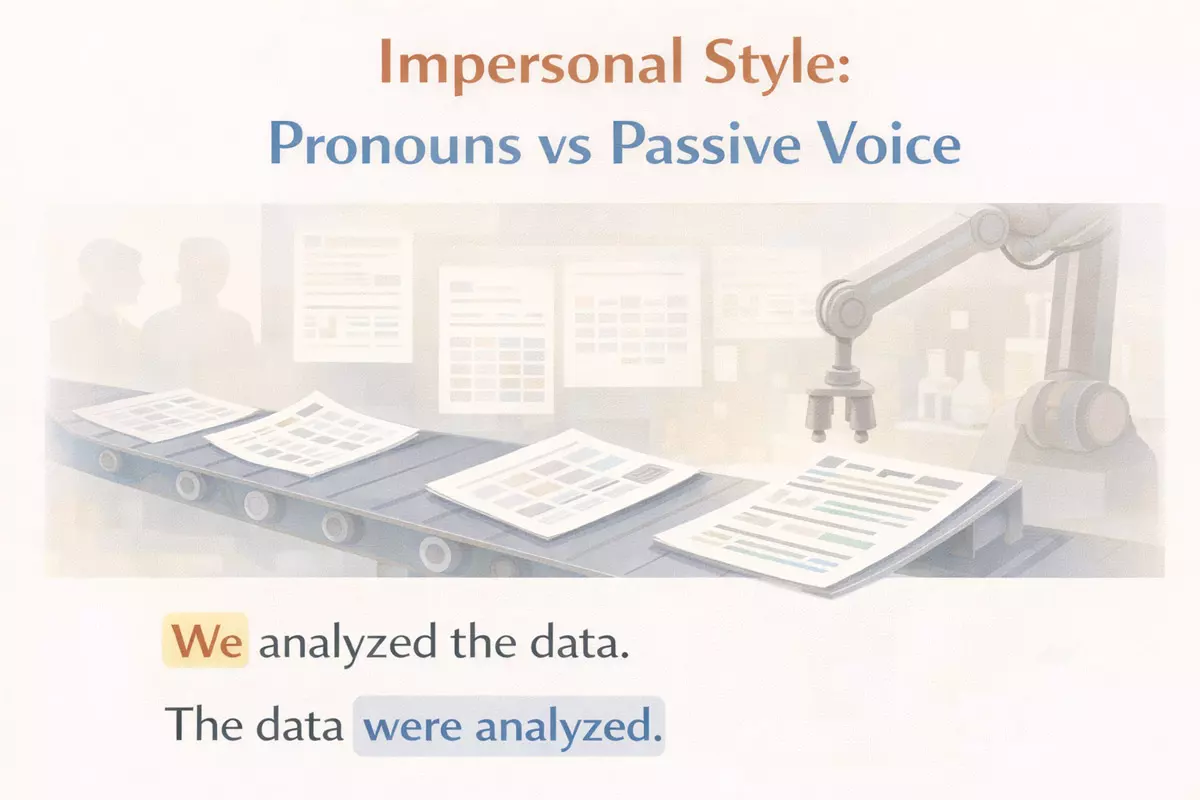
| We analyzed the data using SPSS. | The data were analyzed using SPSS. |
| I identified three key trends. | Three key trends were identified. |
| We collected samples every hour. | Samples were collected every hour. |
Choosing between passive voice and personal pronouns depends on context and the desired tone. While passive forms can depersonalize statements and enhance formality, overuse may make writing vague or less engaging. A balanced approach, using passive constructions for objectivity and active voice for clarity, often works best in impersonal writing.
Impersonal pronouns vs passive constructions
Writers often choose between impersonal pronouns and passive voice to create distance from the subject or avoid specifying who is responsible for an action. Both strategies shift focus away from the agent, but they do so in distinct ways. Understanding which form to use can help achieve the right level of formality and clarity in academic, technical, or objective writing.
Impersonal pronouns: Broad reference
Impersonal pronouns like one, you, they, and people refer to general or unspecified subjects. These words can make statements feel universal or detached from the speaker. For instance, using one sounds formal and is common in academic discourse, while you can make instructions feel more direct but still impersonal. Here are common choices:
- One should always check their work.
- You can see the effect in the results.
- They say practice makes perfect.
- People often forget this step.
- Someone must have left the door open.
- Everybody knows the answer.
- Anyone can participate.
- No one expected the outcome.
- It is believed that the method is reliable.
- Everybody needs to contribute.
Passive voice: Hiding the agent
The passive voice removes or downplays the person or thing performing the action by shifting focus to the object. This is especially useful when the agent is unknown, irrelevant, or obvious. In scientific writing, for example, passives help emphasize the process or result rather than the researcher. Examples include:
- The experiment was conducted at room temperature.
- The error was detected late.
- The data were analyzed using standard methods.
- The decision was made to postpone the meeting.
- The results have been published.
- It has been suggested that further research is needed.
- The issue was resolved quickly.
- The samples were collected last month.
- The solution was mixed thoroughly.
- The report was submitted on time.
Comparing impersonal pronouns and passive voice
Choosing between these two forms depends on tone, clarity, and the need to specify responsibility. The table below highlights key differences and typical uses.
| Impersonal Pronouns | Passive Constructions |
|---|---|
| Generalizes; often informal or conversational | More formal; common in academic/scientific texts |
| Agent is implied (e.g., "One can see...") | Agent omitted or backgrounded (e.g., "It can be seen...") |
| May sound vague or too broad in technical contexts | Highlights results or processes over the doer |
| Examples: one, you, they, people, someone | Formed with "be" + past participle (e.g., "was done") |
While both approaches help avoid direct references, impersonal pronouns can make writing more relatable but sometimes less precise. Passives, on the other hand, are valued for neutrality and objectivity, especially when the agent is less important than the action or outcome. Picking the right strategy depends on the context and the effect you want to achieve.
Choosing the clearer option by context
Selecting between impersonal pronouns and the passive voice depends on your audience, purpose, and the type of writing. In some contexts, one form will make your meaning easier to grasp, while in others, it might sound awkward or overly formal. Understanding when to use each option helps keep your writing both precise and natural.
When to use impersonal pronouns
Impersonal pronouns like one, you, we, or they can generalize actions or experiences. They’re especially useful in instructions, advice, or when you want to involve the reader without direct address. However, overusing them may make your writing sound vague or informal in highly academic settings.
- Instructions: “You should always check your work.”
- General statements: “One can see the difference easily.”
- Shared responsibility: “We often overlook minor details.”
- Common knowledge: “They say practice makes perfect.”
When to choose passive voice
Passive constructions work well when the action matters more than who performs it, or when the actor is unknown or irrelevant. Academic, scientific, or formal business writing often favors the passive to maintain objectivity and focus on results.
- Unknown agent: “The window was broken.”
- Scientific writing: “The solution was heated to 80°C.”
- Emphasizing the action: “Mistakes were made.”
- Formal tone: “It is recommended that the policy be reviewed.”
Comparing clarity: pronouns vs. passive voice
Each approach has strengths and potential drawbacks. The table below summarizes typical scenarios, showing which option often results in clearer communication:
| Situation | Clearer Option | Example | Notes |
|---|---|---|---|
| General advice | Impersonal pronoun | You should save your work frequently. | Directly involves the reader; easy to follow. |
| Describing scientific results | Passive voice | The samples were analyzed using X-ray imaging. | Keeps focus on procedure/results, not researcher. |
| Policy or guideline | Passive voice | All forms must be submitted by Friday. | Emphasizes rule, not the enforcer. |
| Everyday instructions | Impersonal pronoun | You can reset the device by holding the button. | Simple, conversational tone. |
| Unclear or irrelevant agent | Passive voice | The error was corrected overnight. | Agent not specified; action highlighted. |
Tips for making the right choice
- Consider your audience: Academic or technical readers may prefer passive voice, while general audiences may respond better to impersonal pronouns.
- Check for ambiguity: Passive voice can obscure responsibility, so use it when the agent is truly unimportant.
- Vary your style: Too much of either structure can make writing monotonous. Mix both for clarity and tone.
- Read aloud: Sentences that sound awkward or unclear may need rephrasing.
By reflecting on context and intent, you can select the construction that delivers your message most clearly and effectively.
Overusing passive voice problems
Relying too much on passive constructions can lead to several issues in both academic and everyday writing. While passive voice has its place—such as when the actor is unknown or irrelevant—excessive use tends to create unclear, wordy, or impersonal prose that can distance readers from the message. Instead of highlighting agency and responsibility, repeated passive forms may obscure who is taking action, resulting in vagueness or even confusion.
Clarity and Engagement Issues
Passive voice can make sentences harder to follow. Readers often need to work harder to find out who did what, which slows down comprehension. In contrast, active voice usually presents information more directly, promoting engagement and transparency.
- Sentences become unnecessarily long or complex.
- Key actors or agents might disappear from the text.
- Statements can sound evasive or indirect.
- Readers may lose interest due to lack of vividness.
- Important details risk being buried at the end of sentences.
Examples: Passive vs. Active Constructions
| Passive Voice Example | Active Voice Example |
|---|---|
| The results were analyzed by the team. | The team analyzed the results. |
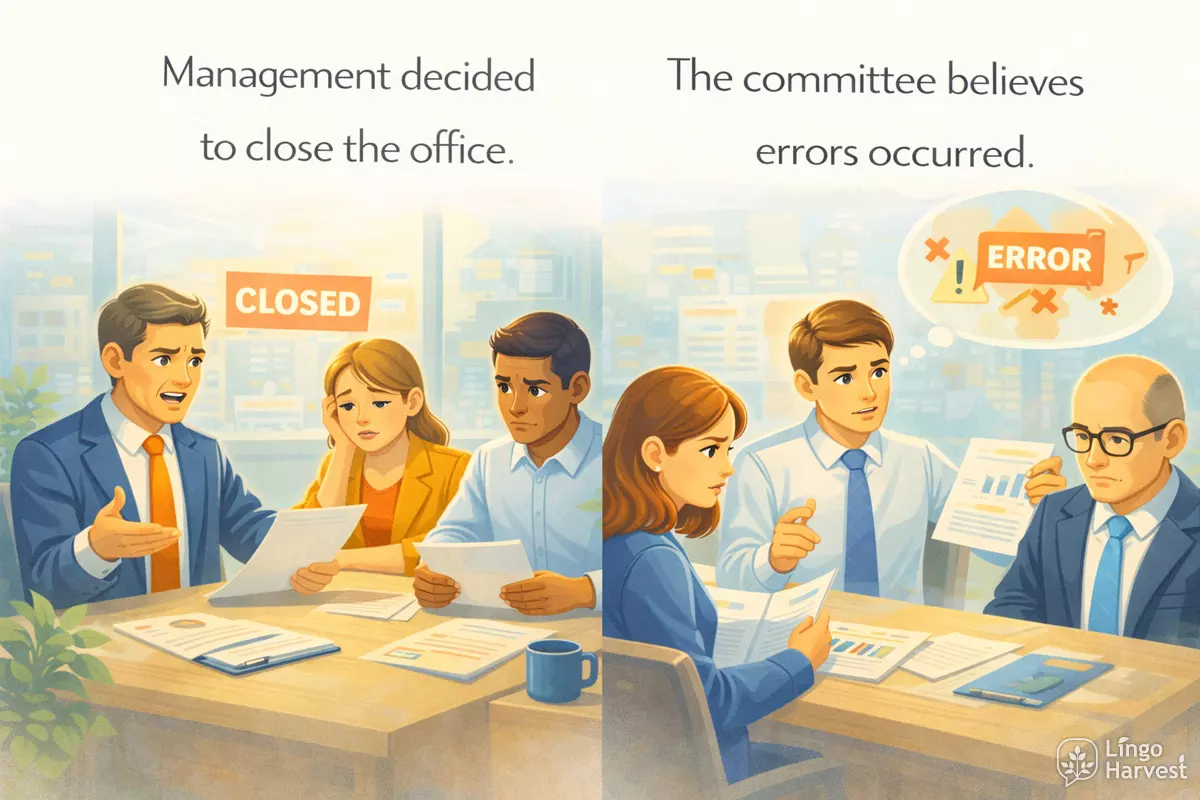
| The decision was made to close the office. | Management decided to close the office. |
| It is believed that errors were made. | The committee believes errors occurred. |
| The experiment was conducted over two weeks. | The researchers conducted the experiment over two weeks. |
| The proposal was rejected. | The board rejected the proposal. |
When Passive Voice Undermines Impact
Sometimes writers use passive forms to avoid assigning responsibility, whether intentionally or not. For example, "Mistakes were made" leaves the actor anonymous, which can weaken accountability. In professional or academic contexts, this may reduce the credibility of the writing and frustrate readers seeking clear information.
- Accountability may be blurred or avoided.
- Repetitive structures make text monotonous.
- Instructions or procedures lose directness.
- Academic arguments may sound less persuasive.
- Readers have to infer who is responsible for actions.
Summary: Striking the Right Balance
Using passive voice occasionally is not a problem, especially when the doer is unknown or unimportant. However, frequent reliance on impersonal constructions can make writing less clear, less concise, and less engaging. To improve readability and effectiveness, writers should consider whether active forms or pronouns can better serve their purpose in each sentence.
Academic and professional examples
Writers in research, business, and technical fields often choose between passive voice and impersonal pronouns to convey objectivity. Both approaches can minimize the author's presence, but they function differently and suit distinct contexts. Below, you'll find practical examples and patterns that highlight how these styles operate in real-world settings.
Passive voice in scholarly and workplace writing
- The experiment was conducted over a period of six weeks.
- It is believed that the new policy will improve efficiency.
- Data were analyzed using standard statistical methods.
- Samples were collected according to established protocols.
- The report was submitted to the review committee.
- Results were interpreted in light of previous studies.
- The application was processed within two business days.
- The hypothesis was confirmed by the findings.
- Errors were detected during the final review.
- Recommendations have been implemented across departments.
Impersonal pronouns and alternatives
- One can observe a clear trend in the data.
- It is necessary to ensure compliance with regulations.
- This suggests that further research is warranted.
- It appears that the results support the initial hypothesis.
- There are several factors to consider in this analysis.
- One should avoid drawing premature conclusions.
- It is recommended that all steps be documented.
- There is evidence to support this approach.
- It remains unclear whether the changes are effective.
- One might argue that the sample size is sufficient.
Comparing usage: Passive voice vs impersonal pronouns
| Passive Voice Example | Impersonal Pronoun Example |
|---|---|
| The procedure was followed exactly as described. | It is important to follow the procedure exactly as described. |
| The solution was heated to 80°C. | One should heat the solution to 80°C. |
| The results were not consistent with expectations. | It appears that the results did not meet expectations. |
| All relevant data were included in the analysis. | There is a need to include all relevant data in the analysis. |
| The proposal was rejected by the committee. | It was decided that the proposal would not be accepted. |
In academic and professional documents, the passive voice is often preferred in scientific reports, technical manuals, and process descriptions where the doer is less important than the action or result. Impersonal pronouns (like “one” or “it”) or impersonal constructions (“there is/are”) are more common in introductions, recommendations, and where general statements or opinions are presented without attributing them to a specific person.
Choosing between these strategies depends on convention, discipline, and the intended degree of formality or detachment. Understanding their distinct uses helps writers achieve clarity, neutrality, and professionalism in their communication.
Editing strategies for impersonal tone
Maintaining a neutral, objective voice in writing can be challenging, especially when shifting from personal pronouns to less direct forms such as passive constructions. Careful revision helps ensure consistency and clarity while keeping the text detached from personal perspective. Below are practical ways to adjust language and structure for a more impersonal effect.
Identify and Replace Personal Pronouns
Scan your draft for words like "I," "we," "you," "my," or "our." These pronouns often signal a personal stance. To revise, swap out these references for more general terms or rephrase sentences to eliminate the need for a subject altogether.
- Change "We found that..." to "It was found that..."
- Replace "You can see..." with "It can be seen..."
- Transform "Our results show..." to "The results show..."
Utilize Passive Voice Thoughtfully
Passive constructions can remove the actor from the sentence, but overuse may lead to vague or awkward phrasing. Aim for balance—employ passives to de-emphasize the agent, but maintain clarity about the action.
- "The experiment was conducted" instead of "We conducted the experiment."
- "The results were analyzed" rather than "I analyzed the results."
Substitute with Noun Phrases
Turning verbs or clauses into noun phrases can help make statements more impersonal and formal.
- "The assessment of data" instead of "We assessed the data."
- "The recommendation is..." rather than "I recommend..."
Compare Common Editing Approaches
| Personal Expression | Impersonal Alternative |
|---|---|
| I believe that the solution is effective. | The solution is considered effective. |
| We observed significant changes. | Significant changes were observed. |
| You can interpret the data as follows. | The data may be interpreted as follows. |
| Our study confirms the hypothesis. | The hypothesis is confirmed by the study. |
| I recommend further research. | Further research is recommended. |
Checklist for Impersonal Editing
- Eliminate first and second person pronouns wherever possible.
- Convert active sentences to passive only when the agent is unimportant or unknown.
- Use noun phrases to generalize actions or findings.
- Check for consistency in tone throughout the document.
- Ensure that meaning remains clear even when the subject is omitted.
- Avoid awkward or overly complex passives that hinder readability.
- Review verb choices for neutrality and objectivity.
- Rephrase direct advice or instructions into general statements.
- Look for opportunities to use formal, academic vocabulary.
- Balance impersonal voice with sentence variety to maintain reader engagement.
Adopting these revision techniques can help writers produce work that is suitably detached, objective, and professional, especially in academic or formal contexts where an impersonal style is preferred.
Practice: convert sentences to impersonal style
Working with impersonal language often means rephrasing sentences to avoid first-person or second-person pronouns. This can be achieved by using passive voice, impersonal phrases, or structures like “It is believed…” or “One can see…”. Below are some activities to help you transform sentences into an impersonal style, focusing on removing direct references to people and emphasizing actions or general statements.
Rewriting Exercise: Transform to Impersonal Style
Change each sentence to an impersonal form. Use passive voice or other impersonal constructions as appropriate.
- We found the results surprising.
- You should consider the alternatives.
- People say that the weather is changing.
- They completed the project on time.
- I noticed an error in the report.
- Experts recommend regular exercise.
- Someone left the door open.
- Researchers discovered a new species.
- People believe the policy will succeed.
- We expect the shipment to arrive tomorrow.
Show answers
- The results were found to be surprising.
- The alternatives should be considered.
- It is said that the weather is changing.
- The project was completed on time.
- An error was noticed in the report.
- Regular exercise is recommended.
- The door was left open.
- A new species was discovered.
- The policy is believed to be likely to succeed.
- The shipment is expected to arrive tomorrow.
Common Patterns for Impersonal Style
Impersonal language in English often uses certain structures. Here are some useful patterns and phrases:
- It is believed that the findings reflect a broader underlying pattern.
- It has been shown that sustained practice leads to measurable improvements in performance.
- It is considered a valid approach within the current methodological framework.
- It is expected that the project will be completed within the specified timeframe.
- The results are thought to provide support for the initial hypothesis.
- The process is known to require systematic monitoring and evaluation.
- Several patterns have been found to significantly influence user behavior.
- The changes are reported to have a measurable impact on overall efficiency.
- This phenomenon can be observed across comparable empirical studies.
- It should be noted that external variables may affect the observed outcomes.
- Additional resources are required to ensure successful completion of the task.
- These measures are recommended to enhance the accuracy of the results.
- Further investigation is suggested to substantiate the preliminary findings.
- Several issues have been identified during the course of the review process.
- One can observe that the results diverge from earlier estimates.
- It appears that the system is operating within acceptable parameters.
- No evidence was found to support the proposed alternative explanation.
- The data indicate that the proposed model demonstrates a high degree of reliability.
Compare: Personal vs. Impersonal Constructions
This table contrasts personal and impersonal versions of common sentences, highlighting typical changes:
| Personal Sentence | Impersonal Version |
|---|---|
| I think the solution is effective. | It is thought that the solution is effective. |
| You can see the difference here. | The difference can be seen here. |
| We tested the hypothesis last week. | The hypothesis was tested last week. |
| People expect prices to rise. | Prices are expected to rise. |
| They reported several errors. | Several errors were reported. |
Tips for Practicing Impersonal Style
- Identify pronouns such as “I”, “we”, “you”, and “they” as targets for replacement.
- Use passive voice where possible, but keep clarity and conciseness.
- Apply impersonal phrases for general statements.
- Check for verbs that signal personal involvement and rephrase with general or passive structures.
- Practice by rewriting everyday statements without referencing people directly.