How Pronouns Refer to Unclear or Abstract Antecedents

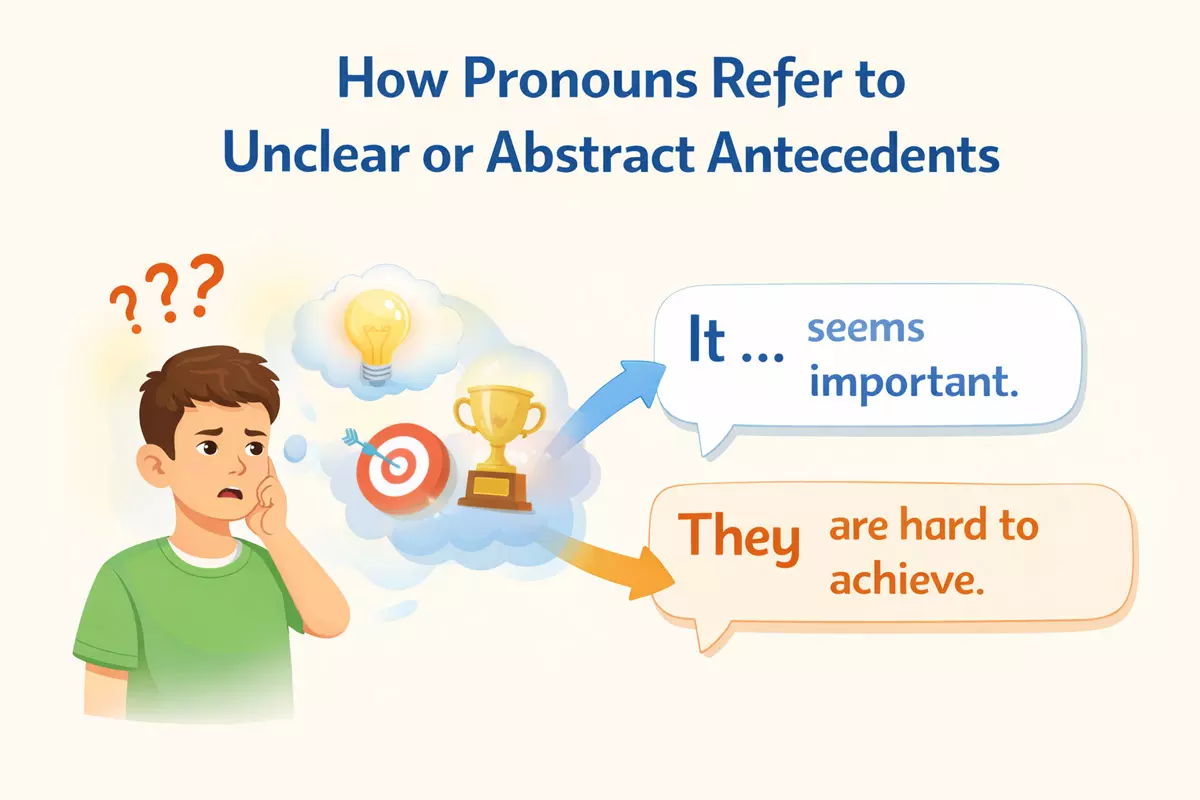 Here we what abstract and unclear antecedents are, why pronouns can be ambiguous without clear nouns, how pronouns refer to ideas or actions, patterns of ambiguity, and practical editing strategies to ensure pronoun clarity in writing.
- What abstract and unclear antecedents are
- Why pronouns lose clarity without concrete nouns
- Pronouns referring to ideas, actions, or situations
- Common ambiguity patterns in complex sentences
- This, that, it, and which with abstract reference
- When to restate the noun for clarity
- Editing strategies to test reference
- Practice: clarify abstract pronoun usage
Have you ever found yourself puzzled by sentences where it’s unclear what a pronoun refers to? Pronouns can sometimes point back to something ambiguous or not clearly stated, which can make the intended meaning harder to grasp. Paying close attention to how pronouns connect to earlier ideas, especially when those ideas are abstract or not explicitly mentioned, helps prevent confusion and strengthens your writing and communication. Clear pronoun references ensure your message is easily understood by your readers or listeners.
What abstract and unclear antecedents are
In English, pronouns are usually expected to refer back to clear, concrete nouns—people, objects, or places mentioned earlier in a sentence or paragraph. However, sometimes a pronoun refers to something less tangible or not explicitly named. These less obvious references are called abstract or unclear antecedents. They can make sentences harder to interpret because the reader must infer what the pronoun stands for, relying on context or general understanding rather than a direct noun.
Types of abstract and unclear antecedents
Abstract antecedents often refer to ideas, events, or situations instead of specific nouns. Unclear antecedents arise when it’s ambiguous what a pronoun points to, either because multiple nouns could be the target or because the reference is to a whole statement or concept. Here are some common scenarios:
- Referring to entire clauses or sentences: "She lost her keys, which was frustrating." (Which refers to the whole event, not just 'keys')
- Pointing to general ideas: "They promised to help, but it never happened." (It refers to the promise or act of helping)
- Ambiguous references: "Alex told Jordan that he would win." (Unclear if he is Alex or Jordan)
- Pronouns replacing implied concepts: "If you finish early, do it." (It stands for 'the task' or 'what you’re doing')
- Reference to actions: "She apologized, which surprised everyone."
- Vague use of 'this' or 'that': "This is why we left early." (This could refer to a situation just described)
- Reference to situations or conditions: "It’s raining." (It does not refer to a specific noun)
- Use of 'one' or 'ones' without a clear noun: "I’ll take the blue one." (If no blue object was mentioned, it’s unclear)
- When the antecedent is a whole idea: "He quit his job, which shocked his friends."
- Implied or unstated actions: "They did it again." (It refers to a previous action or event)
- Overuse of generic pronouns: "You never know what it means."
How abstract and unclear references affect understanding
When pronouns refer to abstract concepts or lack a clear antecedent, readers may need to pause and interpret the intended meaning. This can slow down comprehension or even cause confusion, especially in complex sentences or technical writing. Writers can minimize ambiguity by rephrasing sentences, repeating specific nouns, or clarifying the reference in context.
Comparison: Concrete vs. Abstract/Unclear Antecedents
| Concrete Antecedent | Abstract/Unclear Antecedent |
|---|---|
| Maria found the book. She read it. | Maria arrived late, which surprised everyone. |
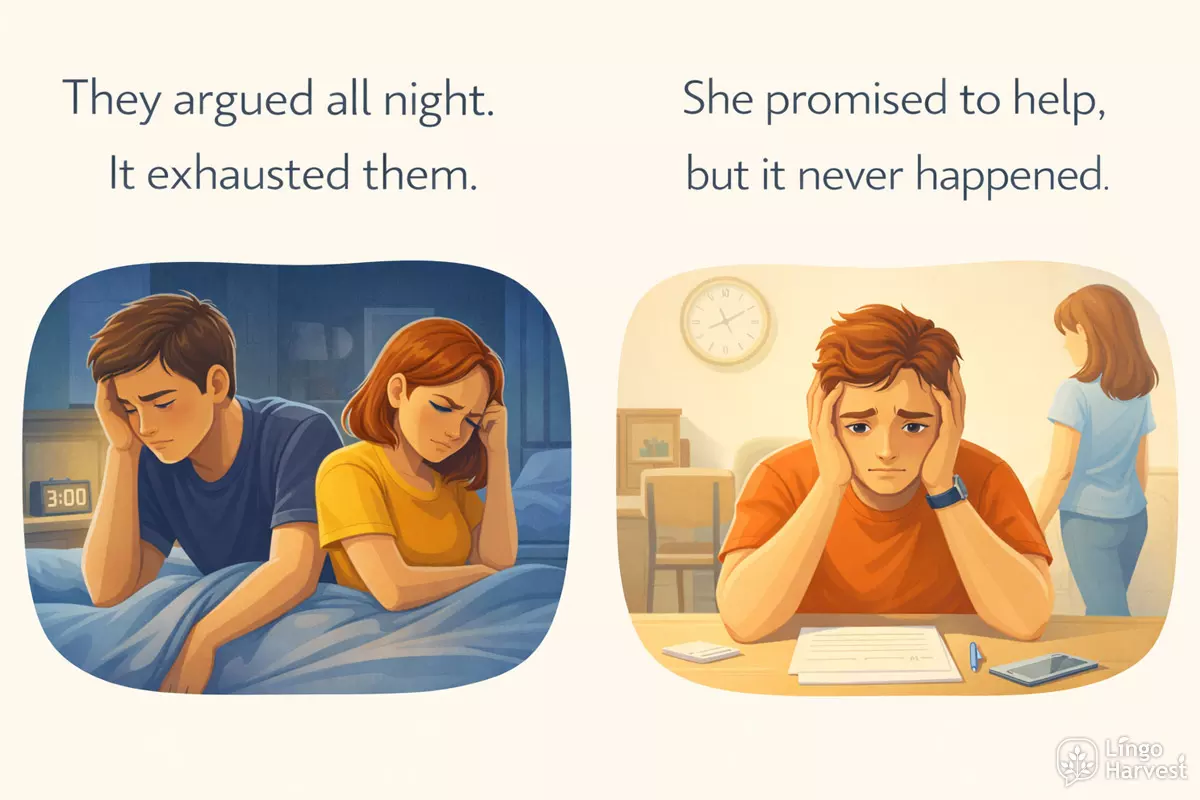
| The dog barked. It was loud. | They argued all night. It exhausted them. |
| Tom fixed the car. He did it quickly. | She promised to help, but it never happened. |
| The cake was delicious. Everyone loved it. | He lost his wallet, which was upsetting. |
Understanding how pronouns can refer to less concrete ideas or ambiguous references is vital for clear communication. Recognizing these patterns helps both writers and readers avoid confusion and interpret sentences more accurately.
Why pronouns lose clarity without concrete nouns
Pronouns work best when their referents are specific and easily identifiable. When a sentence lacks a concrete noun for a pronoun to point back to, readers can become confused or uncertain about what is being referenced. This is especially true in longer passages or when multiple potential antecedents are present.
The importance of specificity
Concrete nouns provide a clear anchor for pronouns. When that anchor is missing or abstract, the link between the pronoun and its intended meaning weakens. For example, in the sentence “He did it,” both “he” and “it” are ambiguous without previous context. If the nouns are vague or not explicitly stated, the pronoun’s meaning may be lost or misinterpreted.
Common problems when antecedents are unclear or abstract
- Readers must guess who or what the pronoun refers to.
- The sentence may be interpreted in multiple ways.
- Communication can break down, especially in complex or technical writing.
- Pronouns may refer to entire ideas, actions, or situations rather than a single noun, increasing ambiguity.
- Abstract antecedents (such as “this” or “that” referring to a previous statement) often require extra context to be understood.
Examples of pronoun ambiguity
- “They said it would rain.” (Who are ‘they’? What is ‘it’?)
- “This is important.” (What specifically is ‘this’?)
- “She finished before he did.” (Who are ‘she’ and ‘he’?)
- “It changed everything.” (What does ‘it’ refer to?)
- “That was unexpected.” (Which event or idea was ‘that’?)
- “He loves it here.” (Who is ‘he’? Where is ‘here’?)
- “They improved it.” (Who are ‘they’? What was improved?)
- “She thought so.” (What did she think?)
- “This made it worse.” (What is ‘this’? What is ‘it’?)
- “You can do that.” (Do what?)
Concrete vs. abstract antecedents
| Type of Antecedent | Example with Pronoun |
|---|---|
| Concrete noun | The cat slept. It purred softly. |
| Abstract noun/idea | She suggested a new approach. It was controversial. |
| Unstated/unclear | It was surprising. (What was?) |
| Multiple possible referents | Mary told Sue that she won. (Who won?) |
When pronouns refer back to specific, tangible nouns, understanding is almost automatic. If they instead point to ideas, actions, or are left without a clear referent, confusion often results. Writers can improve clarity by ensuring every pronoun has an unmistakable antecedent, especially in complex texts or when multiple subjects are present.
Pronouns referring to ideas, actions, or situations
When pronouns stand in for something less concrete—like a previous statement, an action, or an entire scenario—they often refer to abstract or unclear antecedents. Instead of linking back to a specific noun, these pronouns summarize or encapsulate what was mentioned earlier in the conversation or text. This usage is especially common in both spoken and written English, where avoiding repetition and maintaining flow takes priority.
Common pronouns for abstract reference
Certain pronouns are frequently used to refer to ideas, events, or situations instead of tangible objects or people. These include:
- it – often stands for a statement, fact, or situation (“It surprised me that he left early.”)
- this and that – can highlight a recent point or summarize a previous action (“This is what I mean.”)
- which – used in non-restrictive clauses to refer back to an entire idea (“He failed the test, which was unexpected.”)
- such – refers to a previously described type or situation (“Such is life.”)
- what – introduces or refers back to a prior idea (“What happened next was incredible.”)
How context clarifies meaning
The meaning of these pronouns depends heavily on context. Unlike pronouns with clear, singular nouns as antecedents, abstract references can sometimes lead to confusion if the previous idea or action isn’t clear. Writers and speakers often use extra cues or explanatory phrases to make sure the reference is understood.
Examples of pronouns with abstract antecedents
Below are examples of how pronouns can refer to whole ideas, actions, or situations rather than specific nouns:
- “She apologized, but it didn’t make him feel better.” (it = the apology)
- “We might be late. This worries me.” (This = the possibility of being late)
- “He missed the deadline, which caused problems for the team.” (which = missing the deadline)
- “You forgot your keys again. That always happens!” (That = the act of forgetting keys)
- “They said they’d help, but they didn’t. Such is often the case.” (Such = situations like this)
- “He finally confessed, and it was a relief.” (it = the confession)
- “We had to cancel the trip, which was disappointing.” (which = canceling the trip)
- “She was promoted, which surprised everyone.” (which = her promotion)
- “I heard what you said. That makes sense.” (That = your explanation)
- “He lost his wallet, and this upset him.” (This = losing his wallet)
Comparing pronouns: referring to things vs. ideas
| Pronoun | Refers to a Thing | Refers to an Idea/Action/Situation |
|---|---|---|
| it | The cake was delicious. It was gone quickly. |
He apologized. It didn’t help. |
| this | This book is interesting. | We’re late. This is a problem. |
| that | That car is new. | You lied. That hurt me. |
| which | The dog, which is brown, barked. | He quit, which surprised us. |
Understanding when a pronoun refers to a broader concept, rather than a specific noun, helps you interpret meaning and avoid ambiguity. Context, sentence structure, and sometimes additional explanation make these references clearer for the reader or listener.
Common ambiguity patterns in complex sentences
When sentences become more intricate, the links between pronouns and their referents often get muddled. This is especially true when multiple people, ideas, or events are introduced before a pronoun appears. In these scenarios, the reader may be left guessing which noun a pronoun like it, they, or this actually refers to. The confusion increases when the possible antecedents are abstract (such as actions or concepts) or when the sentence structure introduces more than one plausible candidate.
Frequent sources of unclear pronoun reference
- Multiple noun phrases: When two or more nouns precede a pronoun, it can be unclear which one is meant.
Example: "Sarah told Emma that she would win the prize." (Who is "she"?) - Abstract or implied antecedents: Sometimes, pronouns refer to a whole idea or previous statement rather than a specific noun.
Example: "The solution was difficult to find, but it was worth the effort." ("It" could refer to the solution or the act of finding it.) - Long-distance reference: If the antecedent is far from the pronoun, readers may forget or misidentify it.
- Ellipsis and omitted information: When context is left out, the pronoun’s target can be ambiguous.
- Generic pronouns: Words like "this," "that," "which," or "one" often refer to non-specific or abstract concepts.
- Parallel structures: Sentences with two actions or clauses can leave the pronoun’s reference unclear.
Example: "Alex met Jordan after he finished work." (Who finished work?) - Pronouns with unclear gender or number: "They" or "it" may refer to singular or plural, animate or inanimate nouns.
- Ambiguous modifiers: When adjectives or phrases modify more than one noun, pronoun reference can blur.
- Use of "it" for weather, time, or dummy subjects: Sometimes "it" doesn't refer to anything specific, adding to confusion.
- Chain references: A pronoun refers to another pronoun, making the ultimate antecedent hard to trace.
- Passive constructions: The agent is hidden or unclear, so pronouns lack a clear anchor.
- Unclear group membership: "They" or "them" can refer to different groups already mentioned.
- Shifts in topic: When the subject changes quickly, pronouns may seem to refer to the wrong noun.
- Compound sentences: Multiple independent clauses can each introduce new possible antecedents.
- Impersonal or expletive constructions: "It is said..." or "There are..." structures obscure the reference.
Comparison of ambiguous pronoun scenarios
| Sentence | Potential Ambiguity |
|---|---|
| Maria spoke to Julia after she arrived. | Does "she" refer to Maria or Julia? |
| The committee rejected the proposal, which surprised everyone. | Does "which" refer to the rejection or the proposal? |
| Tom lent his book to David because he trusted him. | Who trusted whom? |
| When the dog chased the cat, it ran under the car. | Did the dog or the cat run under the car? |
| The report was submitted late, and this caused problems. | Does "this" refer to the report, the lateness, or the act of submitting? |
Writers can reduce misinterpretation by rephrasing sentences, repeating key nouns, or restructuring clauses. Recognizing these patterns is the first step toward clearer, more precise communication.
This, that, it, and which with abstract reference
Referring to ideas, actions, or situations—rather than concrete nouns—often requires flexible use of pronouns. English speakers frequently rely on words like “this,” “that,” “it,” and “which” to point to something abstract, such as a previous statement, an entire event, or a general concept. These references can sometimes feel ambiguous, so understanding their patterns helps avoid confusion.
How abstract reference works
Rather than pointing to a single noun, these pronouns often refer back to a whole idea or clause. For example, in “He forgot her birthday. That upset her,” the word “that” refers to the entire situation of forgetting the birthday—not just a single word. Similarly, “It surprised me that she left early” uses “it” as a placeholder for the entire following clause.
Common patterns for each pronoun
- This: Used to highlight a recent action, idea, or situation, often with a sense of emphasis or closeness. Example: “We lost the game. This was unexpected.”
- That: Refers to something mentioned earlier, usually with more distance or detachment. Example: “He quit his job. That surprised everyone.”
- It: Functions as a general reference to a statement, action, or concept, commonly as a subject or object. Example: “It is clear that the decision was difficult.”
- Which: Often used in relative clauses to refer back to an idea or a whole previous sentence. Example: “She missed the meeting, which caused confusion.”
Typical abstract reference examples
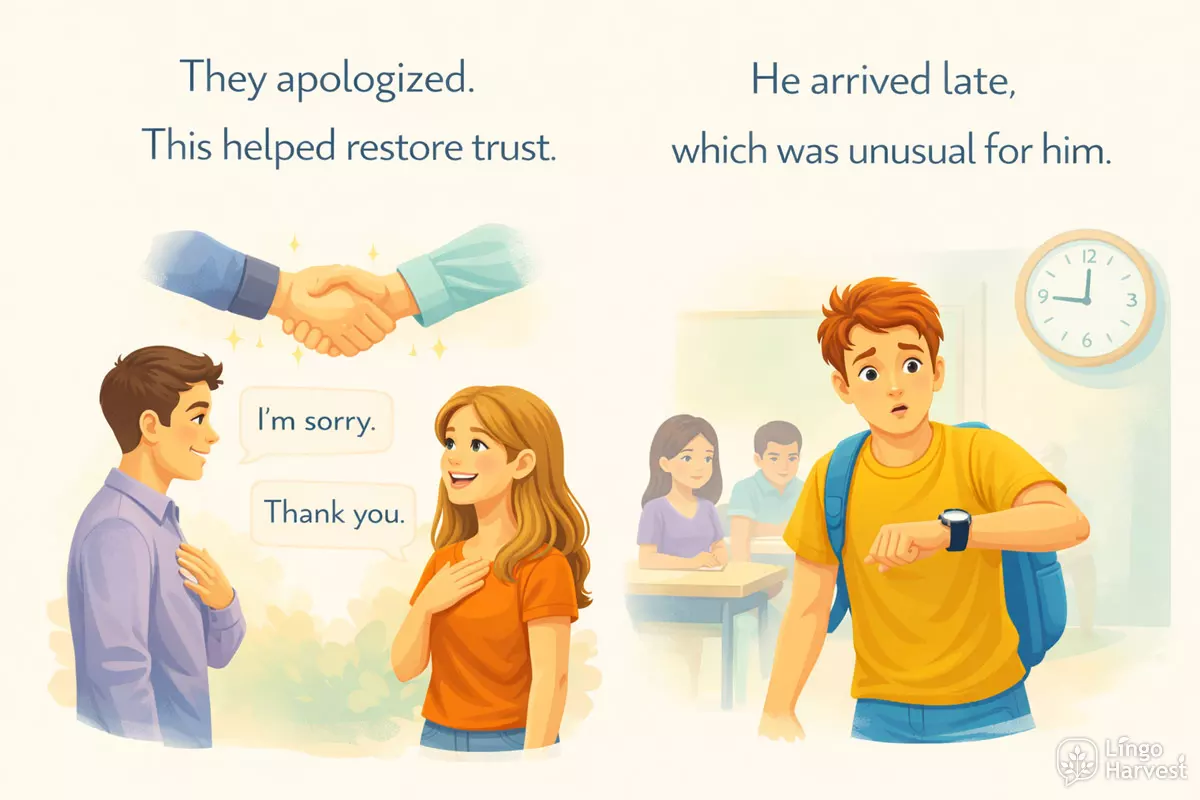
- They apologized. This helped restore trust.
- The meeting was canceled. That annoyed several people.
- It seems the rules have changed.
- He arrived late, which was unusual for him.
- She ignored the warning. This resulted in a fine.
- We finished the project early. That impressed our manager.
- It is obvious that something went wrong.
- The test was postponed, which was a relief to many.
- He forgot his umbrella. This made him get wet.
- They argued for hours. That was exhausting.
- It turns out the rumors were true.
- She changed her mind, which surprised us.
Choosing between “this,” “that,” “it,” and “which”
Selecting the right pronoun depends on emphasis, distance, and sentence structure. “This” and “that” both point to ideas but differ in closeness. “It” is often neutral and fits best in formal or impersonal contexts. “Which” links back to a previous statement, often adding explanatory detail.
| Pronoun | Typical Use with Abstract Reference |
|---|---|
| This | Highlights a recent, emphasized idea or event “They disagreed. This surprised no one.” |
| That | Refers back to a more distant or less personal idea “He resigned. That shocked the team.” |
| It | Acts as a neutral subject/object for clauses or situations “It is unfortunate that plans changed.” |
| Which | Links a previous clause to an explanation or result “She declined the offer, which made things awkward.” |
Tips for clarity
- Make sure the pronoun clearly refers to the intended idea, especially if several possible antecedents appear nearby.
- Use “this” or “that” for emphasis when you want to draw attention to a specific event or result.
- “It” is safest for general or impersonal references, especially at the start of sentences.
- Reserve “which” for connecting statements, particularly in written English.
Understanding these patterns makes your writing clearer and helps your readers follow abstract references with less confusion.
When to restate the noun for clarity
Sometimes, using a pronoun like it, this, or they can make your sentence ambiguous, especially when the reference is unclear or abstract. In these cases, repeating the original noun (the antecedent) helps your reader understand exactly what you mean. This is particularly important when several nouns are mentioned close together, or when the pronoun could refer to more than one possible thing.
Common situations that benefit from repeating the noun
- When two or more nouns appear in the same sentence or paragraph, and a pronoun could refer to any of them.
- If the antecedent is a broad idea (such as "this" referring to an entire previous statement).
- When the noun is far from the pronoun, making the connection less obvious.
- In technical or academic writing, where precision is critical.
- If the pronoun could logically refer to something other than what you intended.
- When introducing a new topic, and you want to ensure readers know exactly what you mean.
- In instructions, where clarity prevents confusion or mistakes.
- When discussing abstract concepts that might not have a concrete referent.
- If the sentence structure is complex, increasing the risk of misreading.
- In dialogue, to avoid misunderstandings between speakers.
Examples: Ambiguous vs. Clear Reference
Compare these pairs of sentences. Notice how repeating the noun removes doubt about what the pronoun refers to:
| Unclear Pronoun Reference | Restated Noun for Clarity |
|---|---|
| When Sam gave Alex the book, he thanked him. | When Sam gave Alex the book, Sam thanked Alex. |
| She put the vase on the table and broke it. | She put the vase on the table and broke the vase. |
| The experiment failed, which surprised the team. | The failure of the experiment surprised the team. |
| They said it would rain, but it didn’t. | The weather forecast predicted rain, but the rain didn’t come. |
| Make sure the pan is hot before adding it. | Make sure the pan is hot before adding the oil. |
| He told his father he was wrong. | He told his father that his father was wrong. |
| The committee reviewed the proposal and rejected it. | The committee reviewed the proposal and rejected the proposal. |
| She found the keys in her purse, which was surprising. | She found the keys in her purse, which surprised her. |
| After the meeting, the manager called him. | After the meeting, the manager called the employee. |
| The solution was heated and stirred until it changed color. | The solution was heated and stirred until the solution changed color. |
Guidelines for deciding when to repeat the noun
- Ask yourself: could a reader misunderstand what the pronoun refers to?
- If there’s any doubt, restate the specific noun instead of using a pronoun.
- In longer passages, remind the reader of the topic by repeating the key noun occasionally.
- When dealing with abstract or broad references (like "this" or "that"), clarify by naming the idea.
Clear writing often means choosing clarity over brevity. When in doubt, don’t hesitate to repeat the noun—your readers will thank you for it.
Editing strategies to test reference
Careful editing is essential when dealing with pronouns that refer back to abstract or unclear antecedents. Ambiguous references can confuse readers, so it's important to develop habits that help clarify what each pronoun points to. Editors can use a combination of practical checks and revision techniques to make sure every pronoun has a clear, unambiguous referent.
Techniques for Identifying Unclear Pronoun References
- Read sentences aloud: Hearing the text can reveal confusion that’s missed visually.
- Isolate pronouns: Circle or highlight each pronoun, then identify its antecedent. If you hesitate or find multiple options, the reference may be unclear.
- Ask “What does this mean?”: For every “it,” “they,” “this,” or “which,” ask yourself what the word specifically points to.
- Check for distant antecedents: If the pronoun’s referent is more than one sentence away, consider rewording.
- Look for vague referents: Pronouns referring to entire ideas, situations, or clauses may require rephrasing for clarity.
Revision Strategies for Clarifying Reference
- Replace the pronoun with a noun: If the meaning improves, keep the noun or rephrase the sentence.
- Recast sentences: Split long or complex sentences so each pronoun has an unmistakable referent.
- Use demonstratives with nouns: Instead of “this,” use “this idea,” “this situation,” etc.
- Add context: Provide enough detail before the pronoun so its reference is clear.
- Avoid chains of pronouns: Multiple pronouns in a row can confuse readers; clarify or reduce them.
Common Pronoun Reference Issues and Solutions
| Issue | How to Fix |
|---|---|
| Vague “it” or “this” after a complex idea | Replace with a summary noun (“this problem,” “that result”) |
| Pronoun with multiple possible antecedents | Reword for specificity (“John gave Bob his book” → “John gave Bob John’s book”) |
| Pronoun referring to a whole sentence or clause | Use a noun phrase to summarize (“This means the process is flawed”) |
| Pronoun too far from antecedent | Move the pronoun closer or restate the noun |
Practice: Spot and Revise Ambiguous Pronouns
For each sentence, identify the unclear pronoun and suggest a revision:
- The manager spoke to the assistant, and she was upset.
- When the glass hit the table, it broke.
- John met Mike after he finished work.
- The company announced new rules, and they caused confusion.
- Lisa texted Anna while she was driving.
- The teacher spoke to the student because he was late.
- The car passed the truck, and it was damaged.
- Sarah borrowed Emma’s jacket because she was cold.
- The computer replaced the server, which caused problems.
- The team lost the match, and this disappointed the fans.
Show answers
- “She” is unclear (manager or assistant). Revision: “The manager spoke to the assistant, and the assistant was upset.”
- “It” is unclear (glass or table). Revision: “When the glass hit the table, the glass broke.”
- “He” is ambiguous (John or Mike). Revision: “John met Mike after John finished work.”
- “They” is unclear (rules or announcement). Revision: “The company announced new rules, and the rules caused confusion.”
- “She” is ambiguous (Lisa or Anna). Revision: “Lisa texted Anna while Lisa was driving.”
- “He” is unclear (teacher or student). Revision: “The teacher spoke to the student because the student was late.”
- “It” is ambiguous (car or truck). Revision: “The car passed the truck, and the car was damaged.”
- “She” is unclear (Sarah or Emma). Revision: “Sarah borrowed Emma’s jacket because Sarah was cold.”
- “Which” refers to the whole situation. Revision: “The computer replaced the server. This change caused problems.”
- “This” refers to the whole idea, not a clear noun. Revision: “The team lost the match. The loss disappointed the fans.”
Quick Checklist for Editors
- Does every pronoun have a clear, nearby noun or idea as its referent?
- Are there any sentences where a pronoun could refer to more than one thing?
- Have you replaced vague “this” or “it” with more precise terms where needed?
- Do demonstrative pronouns (“this,” “that,” “these,” “those”) always refer to something concrete?
- Did you test by reading aloud or asking a colleague for feedback if a passage seems unclear?
By systematically applying these editing methods, writers and editors can ensure that pronoun references are clear, even when antecedents are abstract or complex. This leads to writing that’s both precise and reader-friendly.
Practice: clarify abstract pronoun usage
Understanding how to make pronoun references clear, especially with abstract or vague antecedents, is an essential skill in writing. Unclear pronouns can confuse readers, so it's important to practice identifying and correcting them. Below, you'll find exercises and examples to help you spot and revise ambiguous pronoun use.
Spotting Ambiguous Pronoun References
Read the following sentences and identify which pronoun has an unclear or abstract antecedent. Consider what the pronoun could refer to, and think about how you might revise the sentence for clarity.
- After reading the article, it made me rethink my opinion.
- They believe that early mornings are more productive.
- The policy was updated last week, which caused concern.
- When the report was submitted, it felt like a huge relief.
- She mentioned the issue during the meeting, but it changed nothing.
- Walking through the park, it suddenly started to rain.
- He lost the keys near the office, but it was never found.
- The manager approved the request, which surprised the team.
- After finishing the course, it helped her confidence a lot.
- They decided to cancel the event because it seemed risky.
Show answers
- “It” is unclear (article, reading, or idea). Revision: “After reading the article, I rethought my opinion.”
- “They” is vague (who exactly?). Revision: “Many experts believe that early mornings are more productive.”
- “Which” has an unclear reference (policy, update, or action). Revision: “The policy update caused concern.”
- “It” is unclear (report or submission). Revision: “Submitting the report felt like a huge relief.”
- “It” is ambiguous (issue, mention, or result). Revision: “She mentioned the issue during the meeting, but the discussion changed nothing.”
- Dangling “it” with no clear subject. Revision: “While I was walking through the park, it suddenly started to rain.”
- “It” is unclear (keys or situation). Revision: “He lost the keys near the office, and the keys were never found.”
- “Which” refers to the whole situation. Revision: “The manager approved the request. This decision surprised the team.”
- “It” is unclear (course or completion). Revision: “Finishing the course greatly improved her confidence.”
- “They” is vague, and “it” is unclear. Revision: “The organizers decided to cancel the event because the plan seemed risky.”
Rewriting for Clarity
Try revising the following sentences so the pronoun’s reference is explicit. Replace vague pronouns with clear nouns or restructure the sentence as needed.
- It was difficult to understand, so I read it twice.
- They believe it’s best to start early, but not everyone agrees.
- When the results came in, they surprised everyone.
- Although he apologized, it didn’t fix things.
- It was exciting to finally finish, so it felt rewarding.
- She explained the situation, but it still wasn’t clear.
- They decided to postpone the meeting, which annoyed people.
- After the movie ended, it stayed in my mind.
- He promised to help, but it never happened.
- When the news broke, it caused panic.
Show answers
- Revision: “The article was difficult to understand, so I read the article twice.”
- Revision: “Some experts believe starting early is best, but not everyone agrees.”
- Revision: “The results surprised everyone when they came in.”
- Revision: “Although he apologized, his apology didn’t fix things.”
- Revision: “Finishing the task was exciting, and the completion felt rewarding.”
- Revision: “She explained the situation, but her explanation still wasn’t clear.”
- Revision: “They decided to postpone the meeting. This decision annoyed people.”
- Revision: “After the movie ended, the story stayed in my mind.”
- Revision: “He promised to help, but his promise was never fulfilled.”
- Revision: “When the news broke, the announcement caused panic.”
Common Abstract Pronoun Problems and Solutions
Writers often struggle with pronouns referring to whole ideas, actions, or situations. Here are common patterns and clearer alternatives:
- Using "it" to refer to an entire previous statement: Replace "it" with a summary noun (e.g., "this situation," "that decision").
- Using "they" or "them" without a clear group: Specify the group (e.g., "scientists," "critics").
- Using "which" after a clause: Clarify the noun or rephrase the sentence.
- Referring to actions or results with "this" or "that": Add a descriptive noun ("this outcome," "that action").
Examples: Abstract Antecedents and Clearer Alternatives
| Vague Pronoun Usage | Clear Revision |
|---|---|
| It was unexpected, and it surprised us all. | The announcement was unexpected, and the news surprised us all. |
| They decided to postpone, which disappointed many. | The organizers decided to postpone the event, a decision that disappointed many. |
| After the meeting ended, it became quiet. | After the meeting ended, the office became quiet. |
| This is why it matters. | This issue is why the decision matters. |
| He made a promise, but it was broken. | He made a promise, but the promise was broken. |
| She completed the task, which impressed everyone. | She completed the task, and her achievement impressed everyone. |
| They say it will rain tomorrow. | The weather forecast predicts rain tomorrow. |
| It is important to communicate clearly. | Clear communication is important. |
| He apologized, but it wasn’t enough. | He apologized, but his apology wasn’t enough. |
| After the discussion, it was obvious. | After the discussion, the solution was obvious. |
Quick Tips for Clear Pronoun Reference
- Replace "it," "this," "that," or "they" with a specific noun when possible.
- Restate or summarize the idea you want the pronoun to reference.
- Be especially careful after long or complex sentences—clarify the antecedent.
- When referring to entire actions or situations, name the action or situation directly.