Quantifiers: some, any, a lot of, much, many, a few, a little

 The article reviews countable and uncountable nouns, discusses how word choice changes meaning and tone, and explains using some and any for offers or requests. It covers comparing amounts, typical beginner mistakes, and includes practice exercises.
Selecting the appropriate words to express quantity can significantly improve the clarity and natural flow of your English, whether you are speaking or writing. Understanding and using a range of quantity expressions, such as much, many, a few, several, or a lot, allows you to convey your ideas with greater accuracy and confidence. By mastering these terms, you ensure that your communication is precise and easily understood, which is essential for effective interaction in both casual and formal situations. Expanding your vocabulary in this area also helps you avoid repetition and makes your language skills more versatile.
Countable vs Uncountable Review
Understanding whether a noun is countable or uncountable is essential when using quantifiers like some, any, a lot of, much, many, a few, and a little. These categories affect which quantifiers are correct in a sentence. Countable nouns refer to things you can count individually, while uncountable nouns represent substances or concepts that are not separated into individual elements.
What Are Countable Nouns?
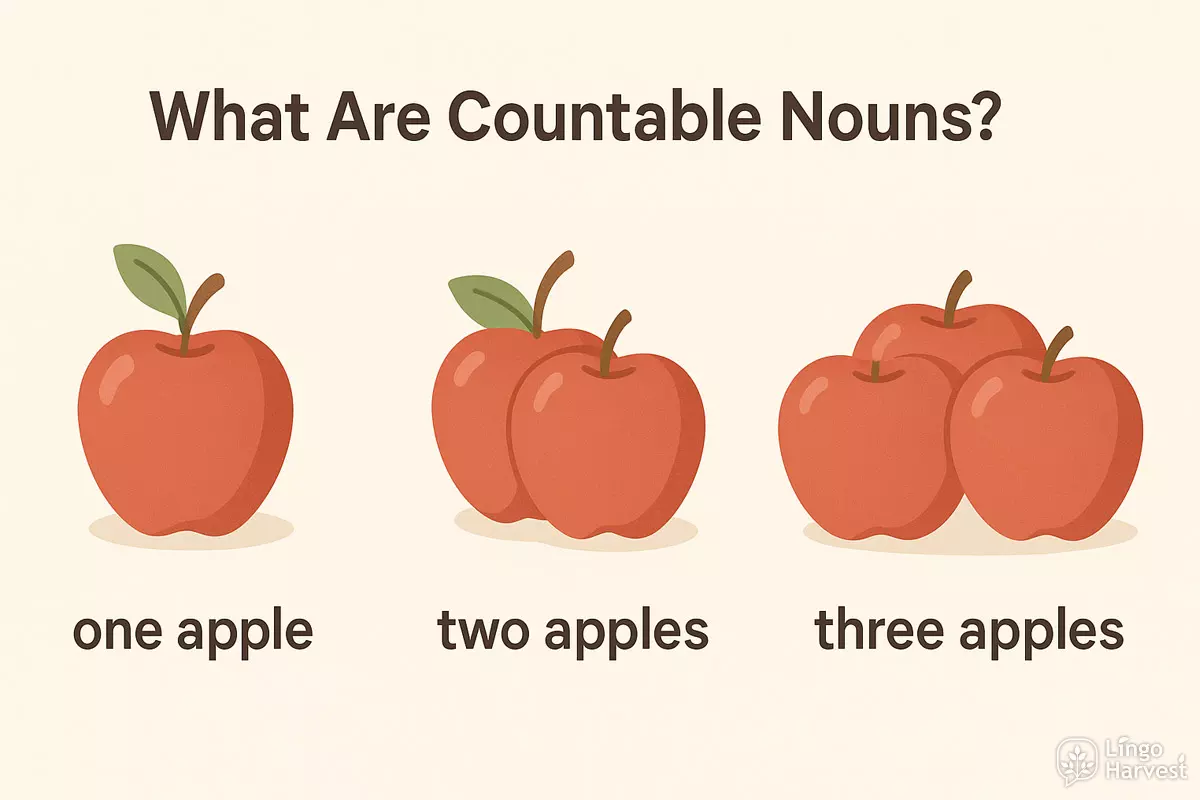
Countable nouns have both singular and plural forms. You can use numbers directly before them. For example, you can say "one apple," "two apples," or "three apples." Here are some examples:
- book, books
- car, cars
- idea, ideas
- child, children
- dog, dogs
- chair, chairs
- pen, pens
- student, students
- city, cities
- apple, apples
What Are Uncountable Nouns?
Uncountable nouns do not have a plural form and cannot be counted individually. They often refer to substances, qualities, or abstract concepts. You cannot use a number directly before them without a unit of measurement. Some common examples include:
- water
- rice
- information
- advice
- money
- furniture
- music
- bread
- news
- milk
How Quantifiers Match These Noun Types
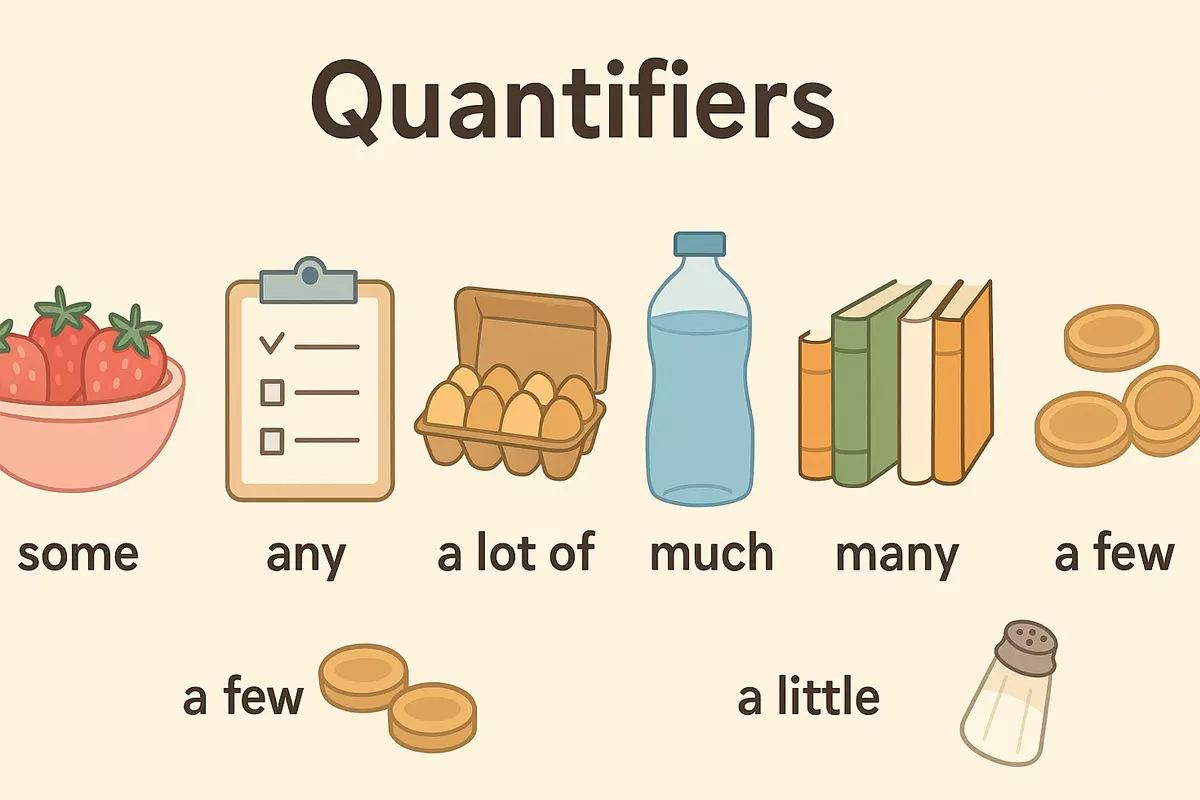
Some quantifiers are only used with countable nouns, others with uncountable, and a few work with both. The table below shows which quantifiers pair with each noun type.
| Quantifier | Used with… |
|---|---|
| many | Countable nouns (e.g., many apples) |
| much | Uncountable nouns (e.g., much water) |
| a few | Countable nouns (e.g., a few books) |
| a little | Uncountable nouns (e.g., a little sugar) |
| some / any | Both (e.g., some eggs, some milk; any pens, any information) |
| a lot of | Both (e.g., a lot of cars, a lot of rice) |
Practice: Choose the Correct Quantifier
Choose the right quantifier for each sentence.
- There isn’t ________ milk left in the fridge.
- Do you have ________ friends in this city?
- I bought ________ apples at the market.
- She gave me ________ advice about studying.
- We don’t have ________ information yet.
Show answers
- much
- many
- a few
- some
- any
Meaning and Tone Differences
English quantifiers like some, any, a lot of, much, many, a few, and a little often look similar, but each brings its own nuance and subtlety. Choosing the correct one depends not only on the quantity you want to express, but also on whether you want to sound formal or casual, positive or negative, precise or vague.
Positive vs. Negative Tone
- Some and a few generally sound positive or neutral. For example, “I have some ideas” suggests a helpful, optimistic view.
- Any is often used in questions or negatives: “Do you have any questions?” or “I don’t have any money.” It can sound more open-ended or less certain.
- A little and a few imply a small but sufficient amount: “We have a little time” means it’s not much, but it’s enough.
- Few (without “a”) or little (without “a”) can sound negative: “Few people came” (almost no one) or “There is little hope” (almost none).
Formality and Emphasis
Some quantifiers are more common in formal contexts. For example, much and many are typical in questions and negatives, and can sound formal if used in statements (“Much has changed”). A lot of and lots of feel more informal and conversational (“We have a lot of options”).
| Quantifier | Typical Use & Tone |
|---|---|
| some | Positive or neutral; used in offers, requests, and statements. “Would you like some tea?” |
| any | Neutral; common in questions and negatives. “Do you have any advice?” |
| a lot of / lots of | Informal, emphasizes large quantity. “There are a lot of people here.” |
| much | Formal; mostly in negatives/questions with uncountable nouns. “We don’t have much time.” |
| many | Formal; used with countable nouns, often in negatives/questions. “Are there many choices?” |
| a few | Positive, small but enough; used with countable nouns. “A few friends helped me.” |
| few | Negative, not enough. “Few people understood.” |
| a little | Positive, small but sufficient; uncountable nouns. “There’s a little milk left.” |
| little | Negative, hardly any. “Little hope remains.” |
Quick Reference Patterns
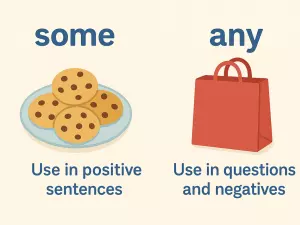
- Some = positive statements, offers, requests (affirmative, polite)
- Any = questions, negatives, conditional sentences (neutral, open-ended)
- A lot of / lots of = informal, friendly, large quantity
- Much / Many = formal, usually negatives/questions
- A few / a little = small amount, but enough (optimistic)
- Few / little = small amount, not enough (pessimistic)
Choosing between these words helps set the mood of your sentence—whether you want to sound encouraging, formal, casual, or realistic. Paying attention to these details makes your English more natural and nuanced.
Offers and Requests with some/any
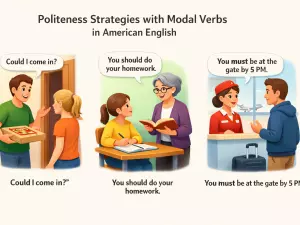
When making offers or requests in English, choosing between "some" and "any" depends on formality, expectation, and sentence structure. Typically, "some" appears in polite offers and requests, especially when the speaker expects a positive response or wants to sound friendly. On the other hand, "any" is more common in questions where the outcome is uncertain, or in negative sentences.
How "some" is used in offers and requests
"Some" adds a friendly, inviting tone to offers and suggestions. It implies the speaker thinks the listener might accept or agree. For example:
- Would you like some tea?
- Can I get you some water?
- Shall I bring some snacks for the meeting?
- Do you want some help with your bags?
These sentences are warm and suggest the speaker expects a "yes."
Using "any" in questions and negative requests
"Any" is used when the speaker is less certain about the answer, or when forming negative requests and questions. It’s neutral, and often appears in more formal or general queries:
- Do you have any questions?
- Is there any milk left?
- Are there any seats available?
- I don’t need any more coffee, thank you.
Here, "any" shows uncertainty or the possibility of no response.
Common patterns and useful phrases
The following table compares typical ways to use "some" and "any" when speaking politely or making inquiries:
| Offer / Request | Example Sentence |
|---|---|
| Polite offer with "some" | Would you like some cake? |
| Request with "some" | Could I have some information? |
| General question with "any" | Is there any news? |
| Negative statement with "any" | Sorry, we don’t have any left. |
| Formal request with "any" | Do you need any assistance? |
| Offer with "some" (expecting 'yes') | Can I offer you some advice? |
Quick tips for learners
- Use "some" for positive and friendly offers or requests (especially when you expect agreement).
- Choose "any" in questions and negative statements, or when you are unsure of the answer.
- Both words are used with uncountable and plural countable nouns.
- Politeness can depend on context, not just word choice.
Mastering the difference helps conversations feel more natural and polite, whether you’re inviting someone to share a meal or asking for assistance yourself.
Comparing Amounts Clearly
Understanding how to express different quantities in English helps you be precise and natural when talking about things you have, need, or want. Choosing the right quantifier depends on whether the noun is countable or uncountable, as well as the context—are you talking about a small number, a large amount, or something indefinite?
Quantifiers for Countable and Uncountable Nouns
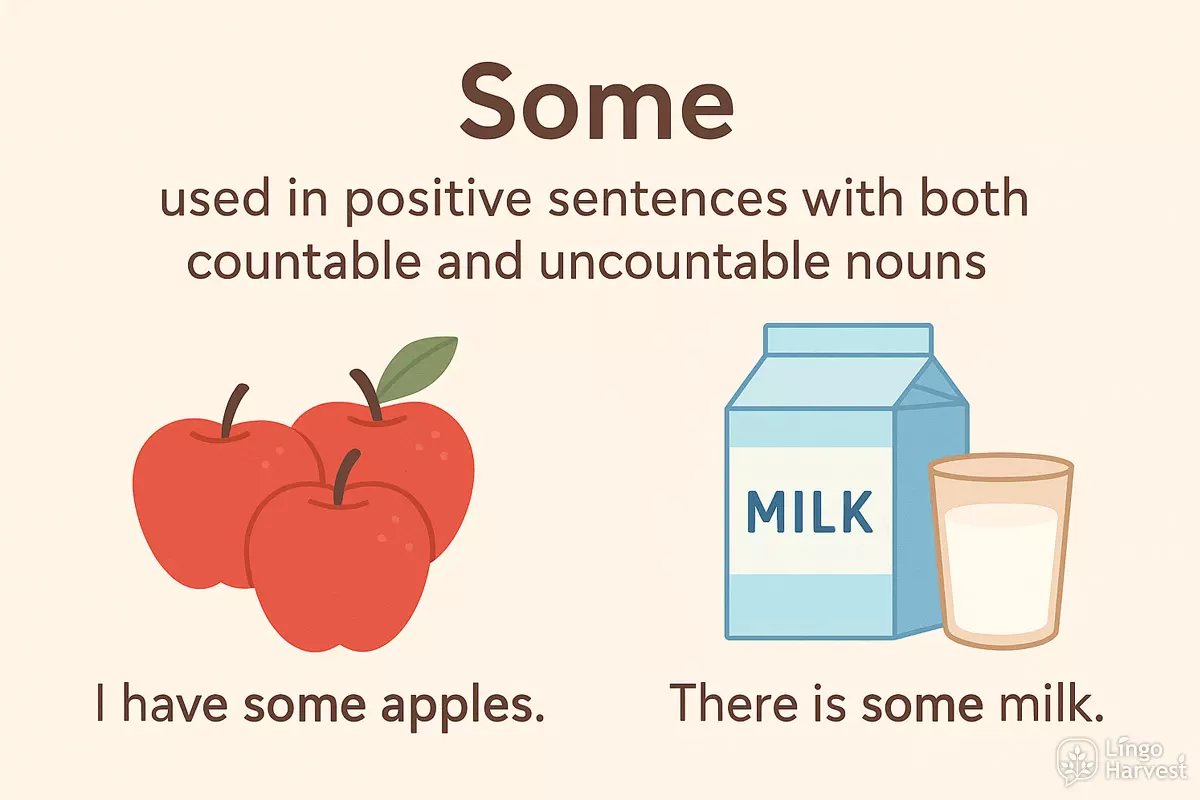
Some words work with both types of nouns, while others are more restricted. Here’s a quick overview:
- Some: used in positive sentences with both countable and uncountable nouns ("I have some apples." / "There is some milk.")
- Any: often used in questions and negatives ("Do you have any bread?" / "There aren’t any chairs.")
- Much: for uncountable nouns, especially in questions and negatives ("Is there much water left?")
- Many: for countable nouns, especially in questions and negatives ("Are there many books?")
- A lot of: works for both, and is more informal ("We have a lot of time." / "She has a lot of friends.")
- A few: a small number of countable items ("I have a few coins.")
- A little: a small amount of something uncountable ("There’s a little sugar left.")
Side-by-Side Comparison
The following table shows how different quantifiers are used with countable and uncountable nouns, including example sentences for clarity.
| Quantifier | Countable Nouns | Uncountable Nouns |
|---|---|---|
| Some | Some apples | Some water |
| Any | Any books | Any rice |
| Much | ❌ (not used) | Much information |
| Many | Many students | ❌ (not used) |
| A lot of | A lot of cars | A lot of money |
| A few | A few pencils | ❌ (not used) |
| A little | ❌ (not used) | A little milk |
Helpful Examples for Everyday Use
Here are more practical phrases showing how these quantifiers fit into real conversations:
- Do you have any questions?
- There isn’t much time left.
- She only has a few close friends.
- We need a little more salt.
- He bought a lot of books last year.
- Is there any coffee in the pot?
- I have some ideas to share.
- Not many people attended the meeting.
- Can I have a little advice?
- There are a few cookies left.
- We don’t have much sugar.
- They saw many birds in the park.
Mastering these expressions lets you communicate amounts in English with confidence, whether you’re talking about groceries, time, or abstract ideas.
Typical Beginner Errors
Learners often confuse when and how to use words like "some," "any," "much," "many," "a few," and "a little." These small words seem simple, but their usage depends on countability, sentence type (positive, negative, question), and context. Misplacing these quantifiers can make sentences sound unnatural or even change their meaning.
Common Confusions and Missteps
- Using “much” in positive sentences with countable nouns: “I have much books.” (Incorrect: use “many” for countable nouns, “much” for uncountable.)
- Putting “some” in negative sentences: “I don’t have some water.” (It should be “any.”)
- Mixing up “a few” and “few”: “I have few friends” (means almost none), vs. “I have a few friends” (means some, a small number).
- Using “a little” with countable nouns: “I have a little apples.” (Should be “a few apples.”)
- Forgetting that “many” and “much” are usually used in questions or negatives, not positives: “I have many money.”
- Trying to use “any” in positive statements: “I have any ideas.” (It should be “some ideas.”)
- Using “a lot of” only with countable or only with uncountable nouns—when it actually works for both.
- Overusing “some” in questions: “Do you have some milk?” (Usually “any,” unless offering or expecting “yes.”)
- Confusing “much” and “many” with plural nouns: “How much apples?” (“How many apples?” is correct.)
- Not recognizing that “few” and “little” are negative in meaning (almost none), while “a few” and “a little” are positive (some).
Quick Reference: Typical Mistakes and Corrections
| Incorrect Example | Correction |
|---|---|
| I don’t have some money. | I don’t have any money. |
| How much books do you have? | How many books do you have? |
| He has a little friends. | He has a few friends. |
| We have much apples. | We have many apples. |
| Do you have some paper? | Do you have any paper? |
| There are a lot of information here. | There is a lot of information here. |
| I have few money. | I have little money. |
| She doesn’t have many water. | She doesn’t have much water. |
Tips to Avoid Frequent Problems
Remember these guidelines:
- Use “many” with plural countable nouns (books, apples).
- Use “much” with uncountable nouns (money, water).
- Choose “any” in negatives and most questions.
- Reserve “some” for positives and polite offers/requests.
- “A few” and “a little” mean a small amount (positive); “few” and “little” mean almost none (negative).
- “A lot of” works for both countable and uncountable nouns.
Practice and attention to these details will help make your sentences sound natural and accurate.
Practice: Describe Your Room/Day
Describing your surroundings or daily routine is a great way to practice using quantifiers. Try to notice when you need to talk about amounts or quantities—this is where words like some, any, a lot of, much, many, a few, and a little are most useful. Consider the following activities and examples to help you get started.
Words and Patterns for Describing Amounts
- There are some books on my desk.
- I don’t have any posters on my walls.
- There is a lot of sunlight in my room.
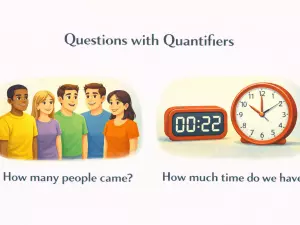
- How much time do you spend in your room?
- How many pillows are on your bed?
- I have a few plants near the window.
- There is a little dust on the shelves.
- Do you have any snacks on your table?
- There aren’t many clothes in my wardrobe.
- I drink a lot of water every day.
- She spends a little time reading before bed.
- He has a few friends who visit his room.
- We don’t have much homework tonight.
- Are there any messages on your phone?
- I only have a little free time in the morning.
- There are many pictures on the walls.
- My backpack has a lot of books inside.
- There isn’t much noise in the evening.
Try It Yourself: Writing Tasks
- Write five sentences about your room using different quantifiers.
- Describe your typical day. Use at least four quantifiers in your description.
- Ask and answer two questions about the amount of things or activities in your day.
Show answers
- Sample sentences about a room:
- There are some chairs near the window.
- I don’t have any posters on my door.
- There is a little mess on my desk.
- I have a few souvenirs on my shelf.
- There isn’t much space under my bed.
- Sample daily description: I drink a lot of tea in the morning. I don’t have much time for breakfast. There are a few emails to read. I don’t get any phone calls before lunch.
- Sample Q&A:
- Q: How many books do you read every week? A: I read a few books every month.
- Q: Do you get much homework? A: No, I don’t get much homework.
Quick Check: Which Quantifier?
Choose the correct word to complete each sentence:
- There isn’t _____ milk left in the fridge. (much/many)
- I have _____ friends in my neighborhood. (a little/a few)
- Are there _____ messages for me? (some/any)
- She spends _____ time doing her homework. (a lot of/many)
Show answers
- much
- a few
- any
- a lot of