Various vs Several vs Different: Quantity or Variety Explained

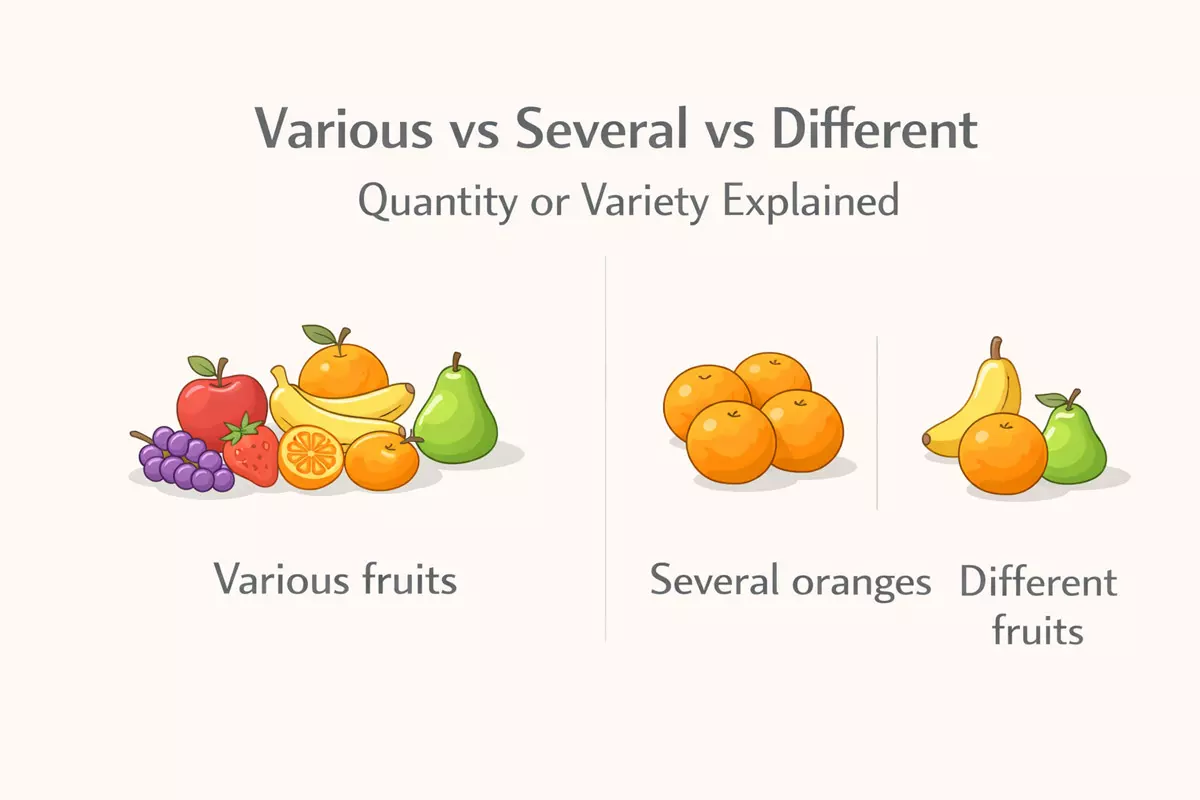 Here we the core meanings of various, several, and different, compares their focus on number versus diversity, shows typical nouns and sentence patterns, explains subtle meaning shifts, common learner confusion, and gives clear examples and practice.
Choosing the right word when discussing numbers or diversity is important for clear communication. English offers a range of terms to express quantity, such as number, amount, and total, as well as words to describe variety, like diversity, range, or assortment. Understanding these differences helps you convey your message more precisely. For example, use number for countable items and amount for uncountable ones, while words like diversity or range highlight the variety within a group or set.
Core meaning focus of each word
Each of the words “various,” “several,” and “different” highlights a unique nuance in how we express number and diversity. Let’s break down the central idea behind each term to make it easier to choose the right one in context.
What does "various" mean?
"Various" points to a range or collection of items, often suggesting diversity within a group. When you say there are various options, you imply there is a selection, and those items aren’t all the same. The emphasis is on variety, not just quantity. For example, "various colors" means a mix of colors, not just a few.
How is "several" different?
"Several" focuses on an unspecified but countable number—more than two, but not a large amount. It doesn’t stress diversity; it simply means more than a couple. For instance, saying "several books" just tells us there are more than two books, but doesn’t hint at whether they are alike or different.
Understanding "different"
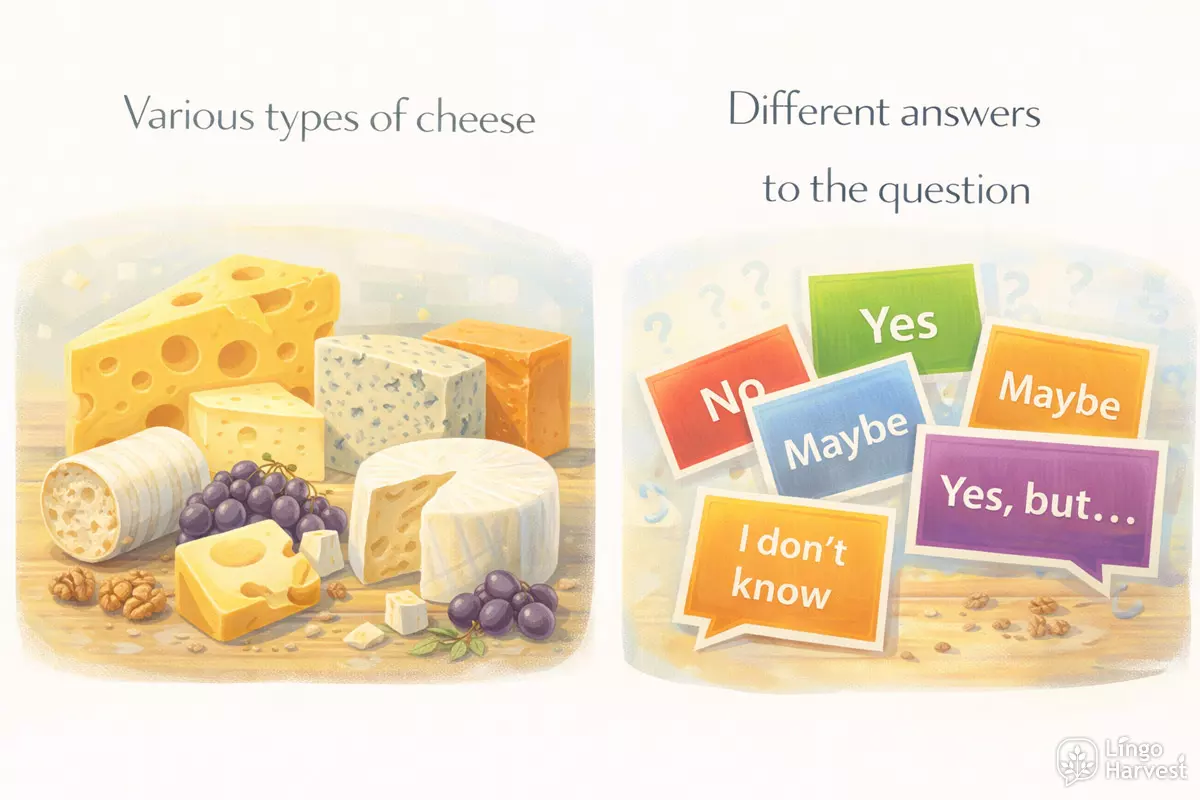
"Different" highlights contrast or distinction between items. If you say “different opinions,” you are stressing that the opinions are not the same. This word is all about the lack of similarity, not about how many items there are or whether there is a variety.
| Word | Main Emphasis | Typical Usage | Example |
|---|---|---|---|
| Various | Variety within a group | Highlighting diversity or a mix | Various types of cheese |
| Several | Indefinite quantity (more than two) | Stressing number, not kind | Several people attended |
| Different | Contrast or distinction | Emphasizing non-similarity | Different answers to the question |
Quick reference list
- Various: Suggests diversity (e.g., various flavors, various styles, various opinions)
- Several: Indicates a number (e.g., several students, several reasons, several days)
- Different: Stresses contrast (e.g., different outcomes, different ideas, different routes)
In summary, choosing between these words depends on whether you want to highlight variety, quantity, or contrast. Noticing these subtle differences will help you sound more precise in both writing and conversation.
Difference between number and diversity
Understanding the distinction between quantity and variety helps clarify how words like "various," "several," and "different" are used in English. While both concepts relate to groups of things, they focus on separate aspects: one on how many, the other on how unlike or distinct the items are.
Number: Counting How Many
When we talk about "number," we're interested in the total count of items. Words like "several" and "many" refer to how numerous something is, regardless of whether the items are alike or not. For example, "several apples" simply means more than two apples, but they could all be the same type.
- Several: more than two, but not a large number
- Many: a large quantity
- Few: a small number
- Number of: the count of items
Diversity: Emphasizing Variety
On the other hand, "diversity" is about the range of differences among items. Words like "various" and "different" highlight that the items are not all the same. For instance, "various fruits" means you have apples, oranges, bananas, and so on—each item is distinct in kind.
- Various: of different kinds or types
- Different: not the same as another or each other
- Diverse: showing a great deal of variety
- Assorted: of mixed types
Comparing Quantity and Variety
To make this clearer, here’s a comparison of how "number" and "diversity" appear in real-life examples:
| Focus | Example Phrase | What It Means |
|---|---|---|
| Number | Several books | More than two books, type not specified |
| Diversity | Various books | Books of different genres, authors, or types |
| Number | Many colors | A large quantity of colors, variety not emphasized |
| Diversity | Different colors | Colors that are not the same as each other |
Quick Reference: Recognizing the Focus
- If you want to highlight the amount, use words like "several," "many," or "few."
- If your point is about distinctions or types, choose "various," "different," or "diverse."
- Sometimes, both quantity and variety matter—"many different options" combines both ideas.
Being aware of whether you’re discussing how much or how varied something is will help you select the right word and avoid confusion.
Typical noun types used with each quantifier
Understanding which nouns commonly follow "various," "several," and "different" helps you choose the right quantifier for both quantity and variety. Each word tends to pair with plural countable nouns, but the nuance and typical usage can vary quite a bit.
1. "Various"
"Various" is generally used to highlight diversity or a range of types. It almost always precedes plural countable nouns and suggests a selection from a larger set. For example, you might encounter:
- various options — We considered various options before making a decision.
- various reasons — There are various reasons for the delay.
- various methods — The team tested various methods to improve accuracy.
- various countries — Students come here from various countries.
- various styles — The store sells furniture in various styles.
- various topics — The podcast covers various topics each week.
- various people — Various people offered helpful feedback.
- various factors — Various factors can affect the final result.
- various viewpoints — The discussion included various viewpoints.
- various ingredients — The soup is made with various ingredients.
- various tasks — She handles various tasks during the day.
- various solutions — We explored various solutions to the problem.
- various teams — Various teams worked on the project.
- various devices — The app works on various devices.
- various materials — The jacket is available in various materials.
The focus is on diversity, not just number.
2. "Several"
"Several" emphasizes quantity—more than a couple, but not a large number. It is also used with plural countable nouns, but the emphasis is not on variety. Typical collocations include:
- several days — It took several days to finish the work.
- several people — Several people asked the same question.
- several problems — We ran into several problems during testing.
- several books — She borrowed several books from the library.
- several reasons — There are several reasons to choose this plan.
- several opportunities — He had several opportunities to explain himself.
- several attempts — It took several attempts to solve it.
- several occasions — I’ve met her on several occasions.
- several students — Several students stayed after class.
- several options — We have several options available.
- several challenges — The job comes with several challenges.
- several questions — I still have several questions.
Here, the main idea is a moderate number, not necessarily different types.
3. "Different"
"Different" is used to contrast items, showing that they are not the same. Like the others, it pairs with plural countable nouns. Common examples are:
- different people — Different people react in different ways.
- different approaches — We tried different approaches to fix the issue.
- different places — They’ve lived in different places over the years.
- different colors — The bags come in different colors.
- different ideas — Everyone brought different ideas to the meeting.
- different times — We arrived at different times.
- different opinions — People have different opinions about the policy.
- different styles — The designers work in different styles.
- different methods — Different methods produce different results.
- different countries — The survey compared results from different countries.
- different experiences — They had different experiences at the same school.
- different versions — There are different versions of the app.
The focus is on contrast and distinction rather than number or range.
| Quantifier | Common Noun Types | Main Emphasis |
|---|---|---|
| Various | options, reasons, styles, topics, people | Range/diversity |
| Several | days, people, books, reasons, questions | Quantity (moderate number) |
| Different | people, approaches, places, ideas, colors | Contrast/distinction |
In summary, all three quantifiers are most natural before plural, countable nouns, but their choice changes the message: "various" implies a range, "several" signals a moderate amount, and "different" draws attention to distinctions between items. Picking the right one depends on whether you mean quantity, variety, or difference.
Sentence patterns and placement
Understanding how to use "various," "several," and "different" depends on their typical positions in sentences and the structures they create. Each word has preferred spots and combinations, which can make your meaning much clearer.
Common patterns with "various," "several," and "different"
All three words act as determiners or adjectives modifying nouns, but their placement and the nuance they convey can differ. Here are some typical sentence structures:
- Various + plural noun (e.g., "various options")
- Several + plural noun (e.g., "several reasons")
- Different + plural noun (e.g., "different solutions")
- Plural noun + from various sources
- Plural noun + for several purposes
- Plural noun + in different ways
- There are various/several/different + plural noun
- Choose from various/several/different + plural noun
- People have different/several/various + opinions/views/preferences
- These + plural noun + are different from + those
Placement notes and nuances
- Various is most often used before a plural noun to suggest diversity or a range of types. It rarely appears after the noun.
- Several is always followed by a plural noun and refers to a number (more than two, but not many). It is not used after the noun.
- Different can be used before a plural noun to highlight contrast, or after a linking verb (e.g., "The results are different").
- For emphasis on contrast, "different from" or "different than" is common: "Her ideas are different from mine."
- Do not use "several" or "various" with uncountable nouns (❌ "several information").
Comparing sentence structures
| Word | Typical Example | Function |
|---|---|---|
| Various | She has visited various countries. | Emphasizes diversity or a range |
| Several | He suggested several solutions. | Highlights a number (more than two, not many) |
| Different | We took different routes. | Focuses on contrast or distinction |
Additional usage tips
- Use "various" when you want to stress a range or assortment without specifying a number.
- Choose "several" when counting matters, but you do not need to be exact.
- Pick "different" when you mean "not the same" or to draw attention to contrast.
- It's possible to combine these with other modifiers, but avoid redundancy (❌ "several different kinds of various books").
By paying attention to these patterns, you can ensure your sentences are both accurate and natural when expressing quantity or variety.
Subtle meaning changes in context
The words various, several, and different often seem interchangeable, but their meanings shift depending on how they're used in sentences. The context—such as what is being counted, compared, or described—can subtly alter the impression each word gives. Recognizing these shifts is key to choosing the most precise term.
How context influences meaning
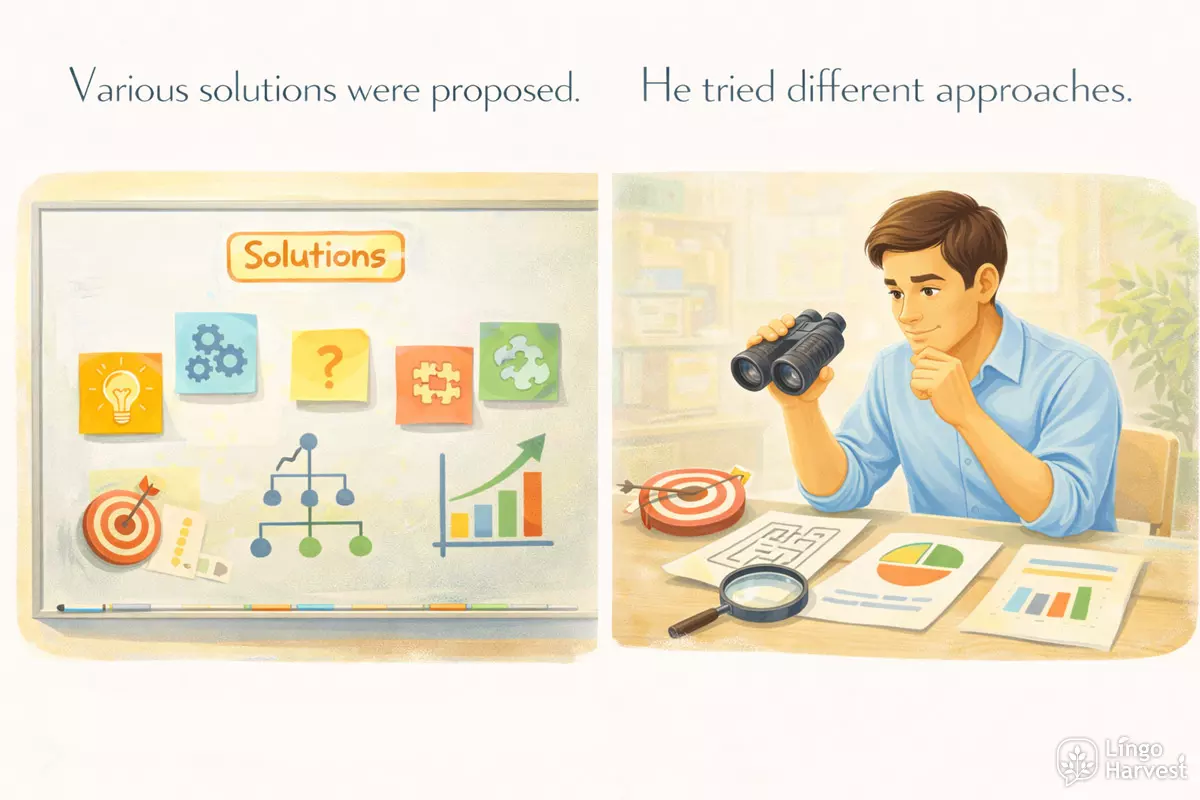
Consider how each word hints at either number, diversity, or distinctness. Several usually points to a moderate quantity, generally more than two but not a large set. Various emphasizes a range or assortment, suggesting diversity among the items. Different highlights contrast or distinction, often comparing items to show they’re not the same.
| Word | Typical Emphasis | Sample Sentence | Implied Meaning |
|---|---|---|---|
| Several | Quantity (3–7, usually) | Several students volunteered. | More than a couple, but not many |
| Various | Variety, assortment | Various solutions were proposed. | Diverse kinds, not just multiple |
| Different | Distinction, contrast | He tried different approaches. | Not the same as each other |
Nuanced usage examples
- Several implies a limited count: "She has visited several countries." (Probably 3–7 countries, not dozens.)
- Various spotlights diversity: "Various experts attended the meeting." (Experts from different fields or backgrounds.)
- Different is about contrast: "They have different opinions." (Not the same, possibly even opposing.)
- “Several times” means a few occasions; “various times” suggests times that are not the same; “different times” means separate, non-overlapping occasions.
- “Several flavors” = a handful of options; “various flavors” = a mix, possibly unusual or wide-ranging; “different flavors” = not all the same, but number unspecified.
- “Several problems” = a moderate number; “various problems” = a range of types; “different problems” = problems that are not alike.
- “Several reasons” = a few reasons; “various reasons” = many and diverse reasons; “different reasons” = not the same explanations.
- “Several people” = more than two, less than many; “various people” = people from different groups or backgrounds; “different people” = not the same individuals.
- “Several methods” = a small set; “various methods” = a wide array; “different methods” = not identical approaches.
- “Several answers” = a handful of responses; “various answers” = responses of multiple kinds; “different answers” = not matching answers.
Key takeaways
- Choose several to highlight a modest number.
- Pick various when emphasizing diversity or assortment.
- Use different to underscore dissimilarity or contrast.
- Let the sentence purpose and context guide your selection for clarity and nuance.
Common learner confusion between the three
English learners often find themselves unsure about when to use “various,” “several,” or “different.” The confusion usually comes from their overlapping sense of “more than one,” but each word serves a unique function in describing either quantity or variety. Let’s break down the most frequent misunderstandings and clarify how these words should be used in context.
Mixing up quantity and variety
One of the most frequent mistakes is using these terms interchangeably. While all three can refer to more than one thing, their focus changes:
- Various stresses diversity (different kinds or types).
- Several simply means “more than two but not a large number”—it’s about quantity, not type.
- Different compares items to show they are not the same.
Common usage errors
- “I have various friends in Spain.” (Correct if you mean friends of different backgrounds; incorrect if you only mean ‘a few friends’.)
- “He tried several flavors of ice cream.” (Correct for number; if you want to stress the flavors are not the same, “different flavors” is better.)
- “She wore different dresses to the party.” (Correct if you mean each dress was not the same; if you just mean ‘many dresses,’ use “various” or “several.”)
Side-by-side comparison
To help clarify, here’s a comparison of their typical meanings and usage:
| Word | Main Focus | Example |
|---|---|---|
| Various | Variety (types/kinds) | She has lived in various countries. |
| Several | Quantity (number) | He bought several books. |
| Different | Dissimilarity (not the same) | We chose different seats. |
Situations that cause confusion
- Describing a group: “Several students” (number), “Various students” (types/backgrounds), “Different students” (not the same students as before).
- Talking about objects: “He owns several cars” (a few cars), “He owns various cars” (cars of different types), “He owns different cars” (not the same cars as someone else or as before).
- Explaining choices: “We tried several options” (number), “We tried various options” (options of different kinds), “We tried different options” (options that are not the same as previous ones).
Quick tips to remember
- If you want to stress numbers, pick “several.”
- If you want to emphasize diversity, use “various.”
- If you’re pointing out things are not the same, choose “different.”
Examples showing contrast clearly
Understanding how "various," "several," and "different" function in real sentences can clarify their unique roles. Below, you'll find practical examples that highlight the distinctions between these words, focusing on both quantity and diversity.
Comparing Usage in Everyday Sentences
Each word signals something slightly unique about groups or numbers. Here are sentences where the meaning shifts depending on which term is used:
- Various: The museum displays various paintings from local artists. (Emphasizes a range or assortment, possibly differing in style or origin.)
- Several: She visited several museums during her trip. (Highlights more than a few, but not a huge number.)
- Different: The two museums offered different experiences. (Focuses on contrast or distinction, not number.)
- He tried various cuisines while traveling. → Suggests diversity in the types of food.
- He tried several cuisines while traveling. → Indicates he tasted more than two or three, but the emphasis is on quantity, not type.
- He tried different cuisines while traveling. → Stresses that the cuisines were not the same; they contrasted with each other.
- We have various options for tonight's dinner. (Multiple, possibly diverse choices.)
- We have several options for tonight's dinner. (A handful of choices; focus on number.)
- We have different options for tonight's dinner. (Each choice is distinct from the others.)
- She wore different dresses to each event. (A new, unique dress every time, highlighting no repetition.)
- She wore various dresses throughout the week. (A range of dresses, perhaps emphasizing variety in style or color.)
- She wore several dresses this week. (She wore more than two, but the focus is on the number, not their uniqueness.)
Table: Nuances at a Glance
| Word | Main Emphasis | Example |
|---|---|---|
| Various | Diversity/Range | He owns various books on history, science, and art. |
| Several | Quantity (More than two, not many) | He owns several books on history. |
| Different | Contrast/Distinctiveness | He owns different books than his sister. |
| Various vs. Several | Variety vs. Number | Various sports (range), several sports (number) |
| Different vs. Various | Distinctness vs. Range | Different solutions (not the same), various solutions (a range of possible answers) |
Quick Tips for Choosing the Right Word
- Use various when you want to stress a mix or assortment.
- Pick several to highlight that there are more than a couple, but not a large number.
- Choose different when the focus is on contrast or uniqueness between items.
These examples and comparisons should help you select the most precise word depending on whether you want to accent quantity, range, or contrast.
Practice: selecting the correct word
Understanding when to use "various," "several," or "different" can be tricky. Let’s work through some practical exercises to build your confidence. In each sentence, choose the word that best fits the context. Pay close attention to whether the sentence is emphasizing quantity, diversity, or distinction.
Choose the right word
- She has visited _______ countries in Europe, including France, Germany, and Italy.
- The store offers _______ brands of chocolate, so there’s something for everyone.
- There are _______ ways to solve this math problem; pick whichever suits you best.
- I saw _______ styles of shoes on sale, but I only liked a few of them.
- They invited _______ people from the office, but not the entire staff.
- He wore a _______ tie to each meeting last week.
- The museum has _______ exhibits, ranging from ancient to modern art.
- We tried _______ restaurants during our trip to the city.
- She brought _______ types of fruit for the picnic.
- There are _______ options available for your project.
Show answers
- several
- various
- different
- various
- several
- different
- various
- several
- different
- various
Quick reference: how to choose
Here’s a summary table for when to use each term:
| Word | When to Use |
|---|---|
| Various | Emphasizes a range or variety within a group. |
| Several | Focuses on a number (more than two, not many), often without emphasizing difference. |
| Different | Highlights distinction or contrast between items. |
Identify the error
Some sentences below use the wrong word. Find the mistake and suggest the correct choice.
- I tried several cakes at the bakery, each with a unique flavor.
- We met various colleagues from the same department.
- There are several models of this phone, but all look the same.
- The teacher assigned different books to each student.
- The store offers several styles of jackets, all made from the same material.
- She explained the issue using various examples that showed clear contrasts.
- The company tested various solutions, but only two were actually implemented.
- They visited several cities during the trip, all located in the same region.
- The report discusses different reasons for the decline.
- He completed various tasks, most of which were routine.
Show answers
- Should be various cakes (emphasizing variety), not "several cakes".
- Should be several colleagues (emphasizing number), not "various colleagues".
- Should be different models (emphasizing distinction), not "several models".
- Correct as written.
- Should be various styles (emphasizing variety), not "several styles".
- Correct as written.
- Correct as written.
- Correct as written.
- Correct as written.
- Should be several tasks (emphasizing number), not "various tasks".
Exploring these examples and reviewing the explanations will help you recognize patterns and choose the most accurate word based on context. Practice with your own sentences to reinforce your understanding.