A Number of vs The Number of: Grammar and Meaning Differences

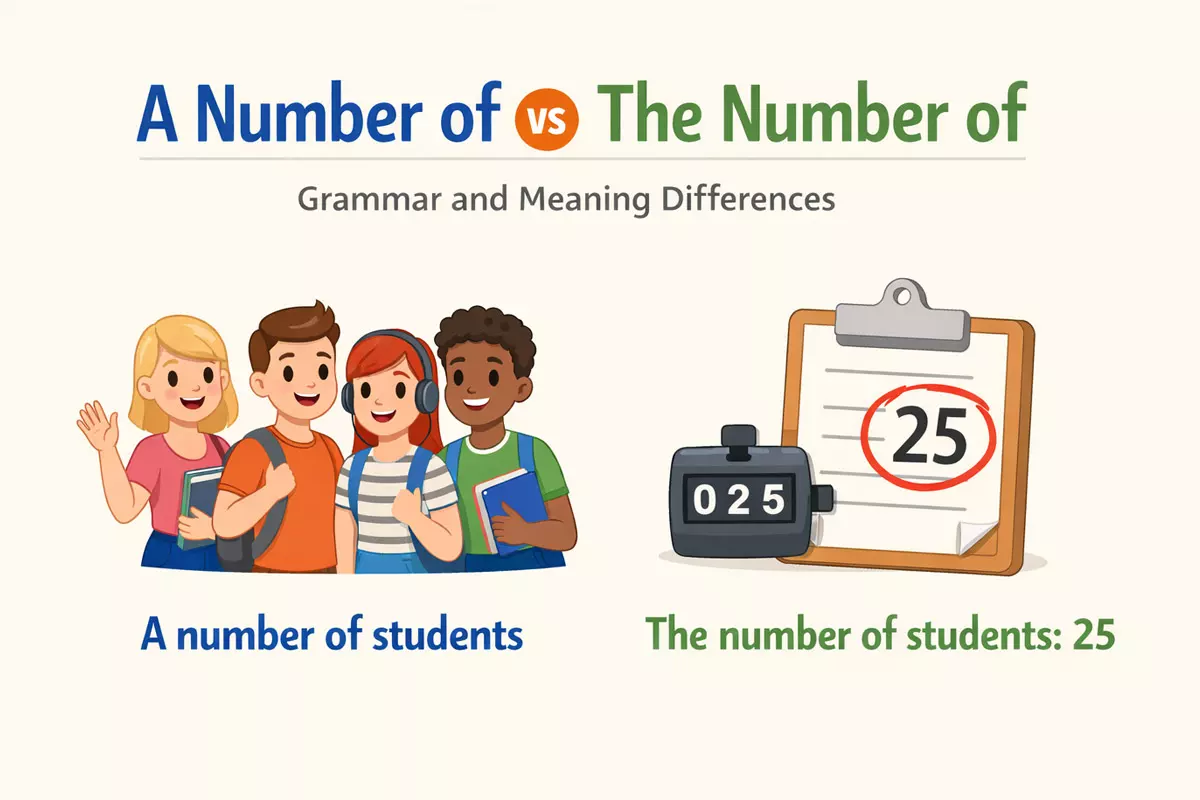 The article compares a number of and the number of, showing how each affects verb agreement and meaning. It covers their use in writing, common patterns, typical mistakes, and includes practice to help learners choose the correct phrase.
- Difference between quantity focus and numerical reference
- Effect on verb agreement
- Use in formal and informational writing
- Common sentence patterns with each phrase
- Why meaning changes with the article
- Typical learner confusion points
- Examples contrasting both structures
- Practice: choosing the correct form
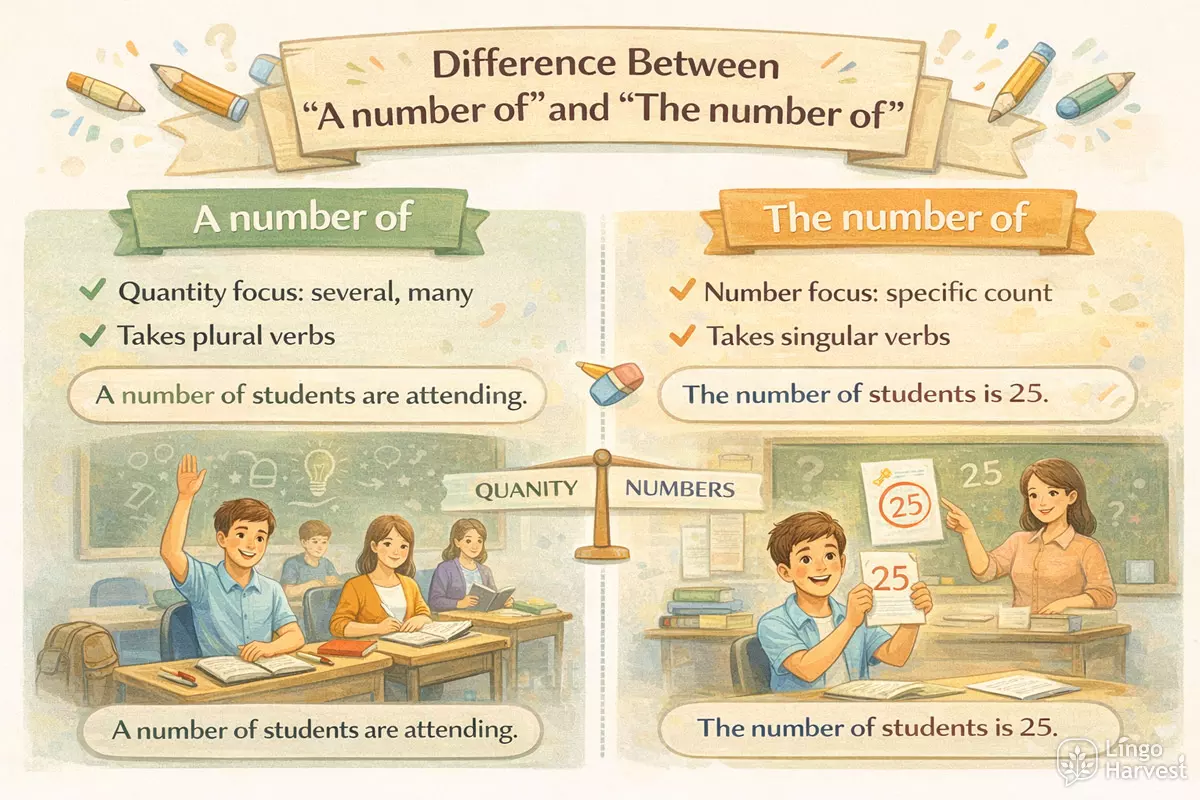
Many English learners struggle to choose between phrases such as "a number of" and "the number of," which appear similar but have distinct meanings and grammatical uses. "A number of" means several or many and is followed by a plural noun and verb, as in "A number of students are attending." In contrast, "the number of" refers to the total count and is followed by a singular verb, as in "The number of students is increasing." Understanding these differences helps avoid common mistakes and improves both writing and speaking accuracy.
Difference between quantity focus and numerical reference
Understanding the distinction between expressions that highlight quantity and those that indicate specific numbers is crucial for accurate communication in English. When comparing "a number of" and "the number of," the choice affects both grammar and meaning.
Quantity Emphasis vs. Exact Figures
"A number of" emphasizes an unspecified amount, often suggesting several or many items but never a precise count. In contrast, "the number of" draws attention to the exact count or total, making the statement more factual and specific.
- "A number of" is used when the focus is on a general amount: A number of students were absent. (We know several students were missing, but not exactly how many.)
- "The number of" is used to reference a particular total: The number of students absent was five. (Here, the exact figure is important.)
Grammar and Verb Agreement
The grammatical structure also changes based on whether you are focusing on quantity or a numerical reference:
- "A number of" takes a plural verb: A number of books are missing.
- "The number of" takes a singular verb: The number of books is surprising.
Quick Comparison
| Expression | Main Focus | Verb Agreement | Example |
|---|---|---|---|
| A number of | General quantity (several/many) | Plural | A number of issues have arisen. |
| The number of | Specific count or total | Singular | The number of issues has increased. |
Key Usage Patterns
- A number of = some, several, many (not specific)
- The number of = the exact total, a particular figure
- Use a number of when the exact figure is unimportant
- Use the number of when reporting statistics or facts
- A number of people are waiting outside.
- The number of people waiting outside is twenty.
- With a number of, verbs agree with a plural noun (are, have, were)
- With the number of, verbs agree with "number" (is, has, was)
- A number of reasons were discussed.
- The number of reasons discussed was surprising.
- A number of can be replaced with "several" or "many" in most contexts
- The number of can often be replaced with "the total of" or "the count of"
In summary, choosing between these expressions depends on whether you want to highlight an indefinite amount or a precise numerical value. This subtle difference changes both the grammar and the nuance of your sentence.
Effect on verb agreement
Choosing between “a number of” and “the number of” directly impacts which verb form you use. While both phrases refer to quantities, they differ in whether they emphasize the group as a whole or its individual members, which in turn changes how the verb should agree. When you use “a number of,” the focus is on the individuals within the group. In this case, the noun phrase is treated as plural, so you should use a plural verb. For example, “A number of students are attending the seminar.” Here, the verb “are” matches the plural idea of “students.” In contrast, “the number of” treats the group as a single entity—a specific total. With this structure, the phrase acts as a singular subject, requiring a singular verb. For example, “The number of students is increasing.” The verb “is” reflects that “the number” refers to a single collective amount.
Common patterns and examples
- A number of books have been published.
- The number of books has increased.
- A number of people were late to the meeting.
- The number of people was surprising.
- A number of errors occur each year.
- The number of errors is decreasing.
- A number of candidates have applied.
- The number of candidates has doubled.
- A number of reports are missing.
- The number of reports is unknown.
- A number of reasons exist for the decision.
- The number of reasons is limited.
Summary table: Choosing the correct verb
| Phrase | Verb Form | Example Sentence |
|---|---|---|
| A number of + plural noun | Plural | A number of issues have arisen. |
| The number of + plural noun | Singular | The number of issues has decreased. |
| A number of students | Plural | A number of students are waiting. |
| The number of students | Singular | The number of students is impressive. |
Quick tips
- Use a plural verb with “a number of” (think: many individuals).
- Use a singular verb with “the number of” (think: one total amount).
- To double-check, substitute “many” for “a number of”—if the sentence still works with a plural verb, you’re on the right track.
Understanding how these expressions affect verb choice helps you write clear, grammatically correct sentences—especially when dealing with groups or quantities.
Use in formal and informational writing
Writers often need to distinguish between "a number of" and "the number of" in academic, business, and technical documents. The choice between these phrases impacts both the grammatical structure and the clarity of information. "A number of" typically introduces a plural subject, emphasizing quantity without specifying an exact figure, while "the number of" focuses on the specific count or statistic, which is treated as a singular subject.
Common usage patterns
In formal reports, research papers, and news articles, both expressions appear frequently, but they serve different purposes. Understanding their roles helps avoid ambiguity and ensures grammatical accuracy. Here are some typical contexts:
- General statements: "A number of studies suggest..." (plural verb)
- Presenting statistics: "The number of participants was 200." (singular verb)
- Describing trends: "The number of applications has increased." (singular verb)
- Reporting observations: "A number of issues remain unresolved." (plural verb)
- Highlighting changes: "The number of complaints dropped last year."
- Summarizing findings: "A number of factors influence the outcome."
- Comparing dаta: "The number of visitors is higher this month."
- Discussing limitations: "A number of limitations exist in the current study."
- Stating facts: "The number of accidents is concerning."
- Expressing uncertainty: "A number of reasons could explain this trend."
Verb agreement and sentence structure
One of the main points of confusion is subject-verb agreement. In formal and informational writing, matching the verb with the correct form of the subject is essential for clarity and professionalism. The following table summarizes the main differences:
| Expression | Verb Agreement | Usage Example |
|---|---|---|
| A number of | Plural | A number of students are absent. |
| The number of | Singular | The number of students is increasing. |
| A number of | Plural | A number of proposals have been submitted. |
| The number of | Singular | The number of proposals has decreased. |
Tips for precise writing
- Use "a number of" when referring to several, but not all, items or people; always pair with plural verbs.
- Choose "the number of" when you want to emphasize a specific count or statistic; use singular verbs.
- Double-check subject-verb agreement, especially in complex sentences.
- In data-driven writing, "the number of" is often clearer for reporting exact figures.
- Reserve "a number of" for generalizations or when the exact quantity is not the main focus.
Mastering this distinction helps writers communicate data and generalizations more effectively, which is critical in professional and academic contexts.
Common sentence patterns with each phrase
Understanding how “a number of” and “the number of” typically appear in sentences helps you use them correctly. Each phrase has its own structure, verb agreement, and nuance. Let’s explore frequent patterns and highlight the key differences.
Patterns with “a number of”
The phrase “a number of” is used to indicate several or many, and it always takes a plural noun and a plural verb. Here are the most common structures:
A number of + plural noun + plural verb
Examples:
- A number of students are absent today.
- A number of books have been donated.
- A number of reasons exist for this change.
- A number of people support the proposal.
- A number of issues remain unresolved.
- A number of mistakes were found.
- A number of complaints have been received.
- A number of opportunities are available.
- A number of candidates have applied.
- A number of factors contribute to success.
Patterns with “the number of”
“The number of” refers to the total count and is always followed by a plural noun but uses a singular verb. This is because the focus is on the single quantity, not the items themselves.
The number of + plural noun + singular verb
Examples:
- The number of students is increasing.
- The number of cases has doubled.
- The number of employees remains stable.
- The number of visitors was impressive.
- The number of errors has decreased.
- The number of applicants is surprising.
- The number of questions is limited.
- The number of entries has grown quickly.
- The number of complaints is concerning.
- The number of participants has increased.
Quick Comparison Table
| Phrase | Typical Structure | Verb Agreement | Example Sentence |
|---|---|---|---|
| A number of | A number of + plural noun + plural verb | Plural | A number of students are absent. |
| The number of | The number of + plural noun + singular verb | Singular | The number of students is increasing. |
In summary, “a number of” highlights multiple items and always uses a plural verb, while “the number of” emphasizes the total count and takes a singular verb. Recognizing these patterns makes your writing clearer and avoids common subject-verb agreement mistakes.
Why meaning changes with the article
The choice between "a" and "the" before "number of" has a significant impact on both grammar and meaning in English sentences. This difference comes down to whether you want to talk about an unspecified quantity or a specific, identified total. The article you use changes not just the meaning, but also the verb agreement and focus of your sentence.
General vs. Specific Reference
When "a number of" is used, it refers to an unspecified, often indeterminate, quantity that is more than one but less than many. This phrase functions much like "some" or "several," and the exact count isn’t important. On the other hand, "the number of" points to a precise, definite total—often one that has already been mentioned or is understood in context.
- "A number of" = some, several, a group (quantity is not exact)
- "The number of" = one specific total (exact figure or count)
Verb Agreement Differences
Another key reason the meaning changes is that the grammatical subject shifts depending on the phrase. With "a number of," the noun after "of" is the focus, so the verb is plural. With "the number of," the subject is the singular noun "number," so the verb is singular.
| Phrase | Verb Agreement | Meaning | Example |
|---|---|---|---|
| A number of + plural noun | Plural verb | Several, some (not exact) | A number of students are attending. |
| The number of + plural noun | Singular verb | Exact total (specific count) | The number of students is increasing. |
Examples of Usage

- A number of books were missing from the shelf. (Some books, unspecified number)
- The number of books was surprising. (Exact total, specific number)
- A number of people have called today. (Several people, not a fixed total)
- The number of people has doubled. (Exact total, specific count)
- A number of reasons exist for this outcome.
- The number of reasons is small.
- A number of candidates were interviewed.
- The number of candidates was limited.
- A number of errors were found.
- The number of errors is decreasing.
Meaning in Context
Ultimately, the article signals whether you are being general or specific. "A number of" leaves room for flexibility and generality, appropriate for most informal discussions. "The number of" is precise and often used in statistical or factual statements. Being aware of this distinction allows for more accurate and natural English communication.
Typical learner confusion points
Many English learners find it challenging to distinguish between expressions like "a number of" and "the number of." This confusion often arises because both phrases mention "number" and relate to counting, but they function quite differently in sentences. Understanding these differences is crucial for using them accurately and avoiding errors, especially in formal writing or exams.
Common areas of misunderstanding
- Verb agreement: Learners often struggle with whether to use a singular or plural verb after each phrase.
- Meaning and focus: There is frequent uncertainty about whether the phrase refers to quantity in general or to a specific total.
- Subtlety in usage: The distinction between speaking about some (unspecified) vs. a precise total can be unclear.
- Translation pitfalls: Direct translation from other languages may not work, leading to awkward or incorrect phrasing.
- Sentence role: Some find it hard to decide which phrase fits better in context—especially in reports or descriptions.
Examples of common mistakes
- A number of student is absent today. ❌ (Should be: A number of students are absent today.)
- The number of students are increasing. ❌ (Should be: The number of students is increasing.)
- Using "the number of" when the speaker means "some" or "several."
- Assuming both phrases can be used interchangeably in all situations.
Quick comparison
| Phrase | Typical Meaning & Verb Form |
|---|---|
| A number of + plural noun | Means "several" or "some"; takes a plural verb. Example: A number of books are missing. |
| The number of + plural noun | Refers to a specific total count; takes a singular verb. Example: The number of books is surprising. |
Tips to avoid confusion
- Remember: "A number of" = "several" → use plural verbs.
- Remember: "The number of" = "total count" → use a singular verb.
- Check the context to decide if you are talking about quantity in general or a specific total.
- Practice with example sentences to reinforce the difference.
- Be careful with subject-verb agreement—this is a frequent source of mistakes.
Examples contrasting both structures
Grasping the difference between “a number of” and “the number of” is much easier with clear side-by-side examples. Both forms appear similar at first glance, but their grammar and meaning differ significantly. In context, these phrases affect verb agreement and the overall message of the sentence.
Sample Sentences Using Each Structure
- A number of students are absent today. (Refers to several students; "are" is plural.)
- The number of students is increasing each year. (Focuses on the total count; "is" is singular.)
- A number of books were missing from the shelf.
- The number of books on the shelf is surprising.
- A number of people have already left.
- The number of people attending has doubled.
- A number of issues remain unresolved.
- The number of issues is decreasing.
- A number of cars are parked outside.
- The number of cars allowed in the lot is limited.
- A number of employees were promoted.
- The number of employees in the department is small.
- A number of questions were asked.
- The number of questions on the exam is fixed.
- A number of restaurants have closed recently.
- The number of restaurants opening is increasing.
Direct Comparison Table
| Phrase | Usage Example | Verb Agreement | Meaning |
|---|---|---|---|
| A number of | A number of teachers are attending. | Plural | Several; refers to multiple individuals/items. |
| The number of | The number of teachers is rising. | Singular | Total count; focuses on the sum. |
| A number of | A number of errors were found. | Plural | Several errors, not the exact total. |
| The number of | The number of errors is concerning. | Singular | How many errors in total. |
Quick Tips for Usage
- Use a number of with a plural verb when you mean “several” or “many.”
- Use the number of with a singular verb to highlight the total count.
- Check whether your sentence is about the quantity itself (use “the number of”) or about the members of a group (use “a number of”).
Understanding these distinctions helps you choose the right structure in both writing and speech. Practice with real examples improves confidence and accuracy.
Practice: choosing the correct form
Understanding when to use "a number of" versus "the number of" is essential for accurate grammar and clear meaning. Let's work through some exercises and example sentences to strengthen your grasp of these phrases.
Fill in the blanks
Decide whether "a number of" or "the number of" is correct in each sentence:
- ________ students were absent from class today.
- ________ people attending the event has increased this year.
- ________ emails I receive every day is overwhelming.
- ________ cars on the street are electric.
- ________ participants in the competition is surprising.
- ________ complaints have been filed about the noise.
- ________ books on this topic is limited.
- ________ applicants for the job was higher than expected.
- ________ tourists visit this museum each month.
- ________ errors in the report was concerning.
Show answers
- A number of
- The number of
- The number of
- A number of
- The number of
- A number of
- The number of
- The number of
- A number of
- The number of
Quick reference: usage comparison
| Phrase | Typical verb form | Meaning |
|---|---|---|
| A number of | Plural (are, have, etc.) | Several; some (emphasizes quantity, not exact count) |
| The number of | Singular (is, has, etc.) | Exact quantity or count (focuses on the total) |
Identify and correct
Read each sentence below. If the form is incorrect, rewrite it with the correct phrase:
- The number of students have finished their homework.
- A number of people is waiting outside.
- The number of complaints have decreased.
- A number of reasons were discussed.
- The number of employees are increasing every month.
- A number of new products has launched this year.
- The number of visitors have doubled since last year.
- A number of students is absent today.
- The number of errors were higher than expected.
- A number of customers was asking for a refund.
Show answers
- The number of students has finished their homework. (Use singular verb with "the number of")
- A number of people are waiting outside. (Use plural verb with "a number of")
- The number of complaints has decreased. (Use singular verb with "the number of")
- Correct as written. (Plural verb for "a number of")
- The number of employees is increasing every month. (Use singular verb with "the number of")
- A number of new products have launched this year. (Use plural verb with "a number of")
- The number of visitors has doubled since last year. (Use singular verb with "the number of")
- A number of students are absent today. (Use plural verb with "a number of")
- The number of errors was higher than expected. (Use singular verb with "the number of")
- A number of customers were asking for a refund. (Use plural verb with "a number of")
Practice making your own sentences
Try creating original sentences using both expressions. Here are some ideas to get you started:
- A number of friends are coming to dinner tonight.
- The number of confirmed reservations is increasing.
- A number of issues were resolved yesterday.
- The number of available seats is limited.
Notice how the choice affects both the verb form and the overall meaning of the sentence.