Loads of and Tons of: Informal Quantity Expressions Explained

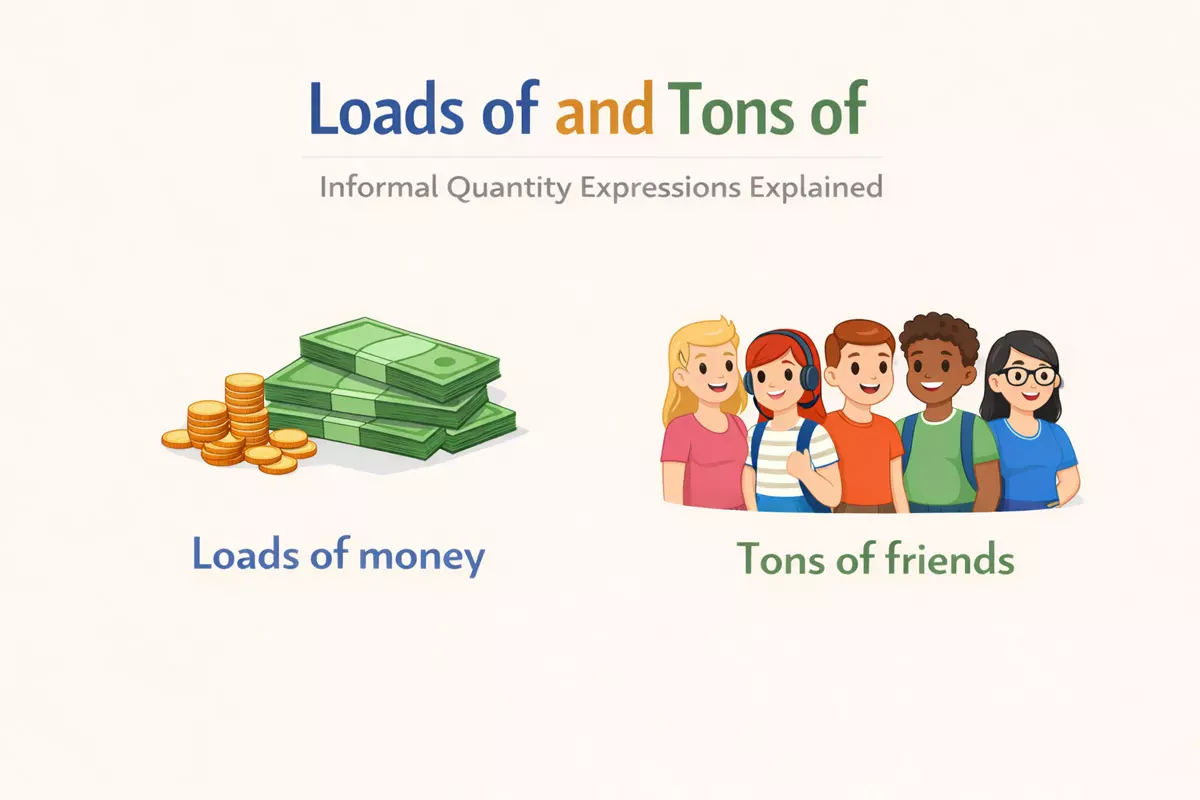 Here we the informal phrases loads of and tons of, their subtle differences, typical nouns they pair with, and how they're used in speech and writing. It also addresses when not to use them, common learner mistakes, and includes practice examples.
- Overall meaning and shared informal tone
- Subtle differences in emphasis and strength
- Nouns commonly used with loads of
- Nouns commonly used with tons of
- Spoken English vs casual written contexts
- Situations where informal tone is inappropriate
- Common learner overuse and stylistic issues
- Examples from everyday conversation
- Practice: choosing the more natural expression
People often use phrases like heaps or masses instead of giving precise numbers when talking about large quantities, making their language sound more casual and expressive. These colorful expressions are a common feature of English, helping speakers convey a sense of abundance without specifying exact figures. Learning to understand and use such informal ways of describing amounts can make your conversations feel more natural, engaging, and connected to everyday speech, especially in friendly or relaxed settings.
Overall meaning and shared informal tone
When people say “loads of” or “tons of,” they’re simply using playful, informal ways to talk about large amounts. Both expressions are common in everyday conversations, especially among friends or in relaxed settings. They don’t refer to exact numbers, but rather give a sense of abundance—whether it’s food, work, friends, or just stuff in general. These phrases help speakers sound approachable and casual, steering away from stiff or overly precise language.
Key features of these quantity phrases
- Emphasis on abundance: Both “loads of” and “tons of” exaggerate the amount, often for effect.
- Informal register: They’re rarely used in formal writing or professional reports.
- Flexible application: Suitable for countable and uncountable nouns (e.g., “loads of friends,” “tons of water”).
- Emotion and tone: These expressions can convey excitement, annoyance, or surprise, depending on context.
Examples in conversation
- We have loads of homework tonight.
- She brought tons of cookies to the party.
- There’s loads of information online.
- I have tons of reasons to be grateful.
- They made loads of mistakes in the test.
- He owns tons of video games.
- We got loads of rain last week.
- There are tons of people at the concert.
- She has loads of experience in this field.
- I received tons of messages after the announcement.
Comparison of “loads of” and “tons of”
| Expression | Common Contexts | Typical Tone | Example |
|---|---|---|---|
| Loads of | Casual, friendly chats; British and American English | Warm, lighthearted, sometimes enthusiastic | “There are loads of options.” |
| Tons of | Conversational, often American English | Emphatic, energetic, sometimes overwhelming | “We have tons of work to do.” |
Ultimately, these expressions are shortcuts for making speech more vivid and relatable. They help speakers connect with listeners in a relaxed, friendly way, making even ordinary topics sound more colorful or interesting.
Subtle differences in emphasis and strength
When people use expressions like “loads of” and “tons of,” they’re not just talking about quantity—they’re also hinting at how much they want to stress the amount involved. These phrases both mean “a lot,” but their nuance and intensity can shift depending on context, tone, and even the speaker’s personality.
Comparing “loads of” and “tons of” in daily conversation
While both terms are informal ways to indicate abundance, “tons of” tends to sound slightly more emphatic or exaggerated than “loads of.” For instance, someone might say, “I have loads of homework,” to express a significant but manageable amount, whereas “I have tons of homework” often signals feeling overwhelmed.
- Loads of – Suggests plenty, but can feel more casual or less extreme.
- Tons of – Implies an even larger quantity, sometimes almost humorously excessive.
- Both phrases are countable and uncountable-friendly: “loads of friends” or “tons of trouble.”
- Regional and personal habits affect which phrase feels more natural in speech.
- They’re often interchangeable, but “tons of” is stronger in tone.
Contextual Examples
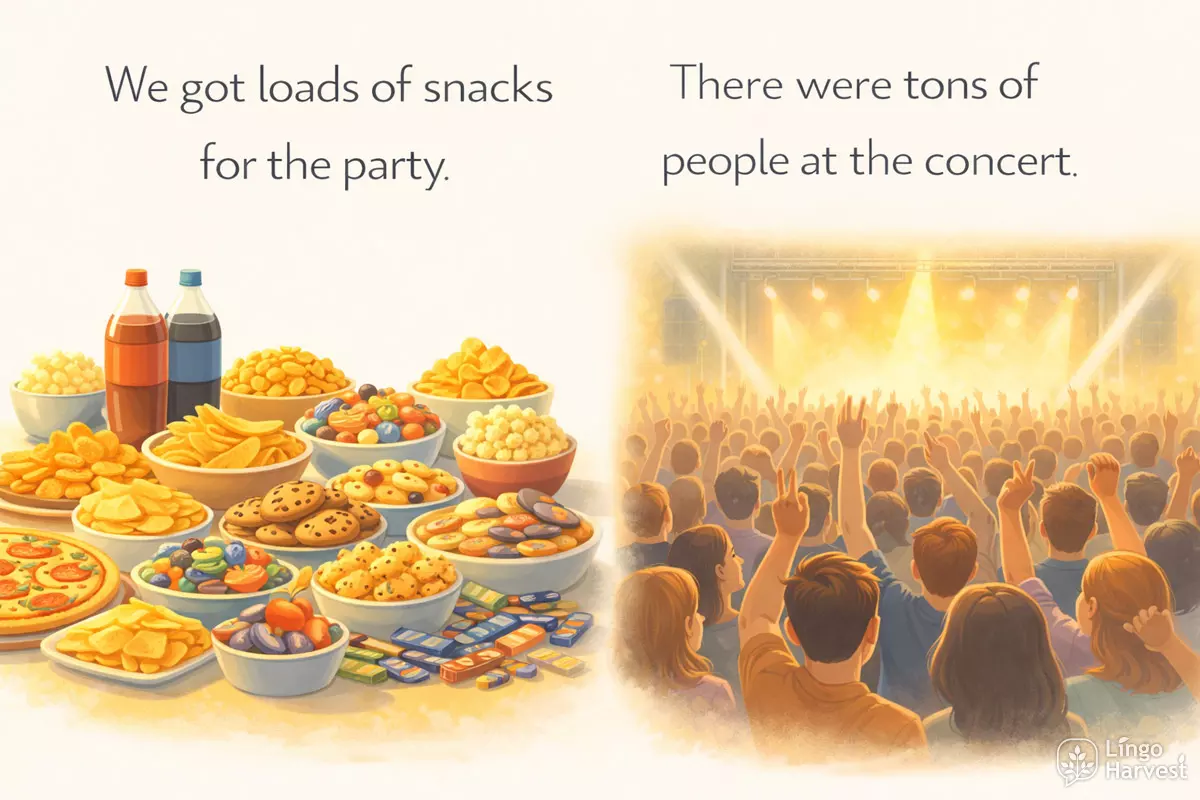
Here are some scenarios to illustrate how these expressions can differ in emphasis:
- “We got loads of snacks for the party.” → Ample, but not necessarily excessive.
- “There were tons of people at the concert.” → Suggests a massive crowd.
- “She has loads of experience.” → A respectable or impressive amount.
- “I made tons of mistakes.” → Implies a feeling of being overwhelmed by errors.
- “The team received loads of support.” → Plenty of encouragement, but not dramatic.
- “He earned tons of money last year.” → Stresses a remarkable or surprising sum.
- “We have loads of time.” → Enough time, no rush implied.
- “There are tons of options.” → So many options, it may feel hard to choose.
- “She brought loads of books.” → A big stack, but not overwhelming.
- “I’ve eaten tons of pizza today.” → Maybe more than is reasonable!
Common Substitutes and Their Force
If you want to vary your language, here are other informal quantity phrases and their perceived strength:
- Heaps of — She has heaps of work to finish before Friday.
- Plenty of — There’s plenty of time to catch the train.
- Masses of — Masses of people gathered in the square.
- Oodles of — The kids had oodles of fun at the party.
- A bunch of — I met a bunch of interesting people at the conference.
- A pile of — He left a pile of papers on my desk.
- A mountain of — She has a mountain of emails to reply to.
- A ton of (singular) — We learned a ton of useful information.
- Scads of — They made scads of mistakes during the rehearsal.
- Barrels of — The job brings barrels of opportunities for growth.
Side-by-Side Comparison
| Expression | Typical Emphasis |
|---|---|
| Loads of | Moderate, casual abundance |
| Tons of | Strong, sometimes exaggerated |
| Heaps of | Similar to “loads,” often used in British English |
| Masses of | Very strong, often used for people or things |
| Oodles of | Playful, informal, less common |
| A pile of | Moderate, sometimes physical objects |
| A mountain of | Very strong, dramatic |
| A bunch of | Mild, common, not as strong as “loads” |
Choosing between these expressions depends on how much you want to stress the amount. If you want to sound more dramatic or humorous, “tons of” or “a mountain of” might be your pick. For a more neutral or casual tone, “loads of” or “a bunch of” work well. Adjusting your expression can help convey not just quantity, but also your attitude toward it.
Nouns commonly used with loads of
The phrase “loads of” is a highly flexible informal expression, often paired with both countable and uncountable nouns to suggest a large quantity. It’s especially common in conversational English when speakers want to emphasize abundance or variety without being specific about the number or amount. While you can use it with many nouns, some are much more typical and sound natural to native speakers.
Popular pairings with “loads of”
Everyday speech features “loads of” with words related to objects, people, and abstract concepts. Here are some of the most frequent combinations:
- people — There were loads of people at the concert.
- money — They spent loads of money on the renovation.
- fun — We had loads of fun at the party.
- work — She has loads of work to finish today.
- food — There was loads of food at the buffet.
- friends — He’s made loads of friends at his new job.
- time — We still have loads of time before the deadline.
- problems — The update caused loads of problems.
- stuff — I’ve got loads of stuff to pack.
- choices — You’ve got loads of choices here.
- energy — The kids have loads of energy this morning.
- ideas — She came up with loads of ideas.
- information — There’s loads of information online.
- homework — He has loads of homework tonight.
- questions — The audience asked loads of questions.
- opportunities — The city offers loads of opportunities.
- books — She owns loads of books.
- clothes — She bought loads of clothes on sale.
- traffic — There was loads of traffic on the highway.
- noise — The construction site made loads of noise.
Countable and uncountable noun usage
“Loads of” works with both countable nouns (like friends or books) and uncountable nouns (such as money or information). This versatility helps make it a go-to phrase in informal contexts. For example, you might hear someone say, “We’ve got loads of homework tonight,” or “There’s loads of noise outside.”
Comparison: “loads of” vs. “tons of”
Both “loads of” and “tons of” carry a similar meaning, but there can be slight differences in tone or regional preference. Here’s a comparison of how these phrases pair with common nouns:
| Noun | Example with “loads of” | Example with “tons of” |
|---|---|---|
| work | I've got loads of work to do. | I've got tons of work to do. |
| fun | We had loads of fun at the party. | We had tons of fun at the party. |
| people | There were loads of people there. | There were tons of people there. |
| ideas | She came up with loads of ideas. | She came up with tons of ideas. |
| food | They brought loads of food. | They brought tons of food. |
In summary, “loads of” is a friendly, everyday way to talk about large amounts or numbers, making it easy to sound natural and relaxed in conversation. Try pairing it with nouns from the lists above for authentic, informal English.
Nouns commonly used with tons of
The phrase "tons of" is often paired with a variety of nouns to express an overwhelming amount or a large number of things. It’s widely used in informal speech and writing to add emphasis, especially when talking about things that are numerous, abundant, or heavy in quantity. While it’s frequently used with countable nouns, it can also appear with uncountable ones, depending on the context.
Popular categories and typical examples
People often use "tons of" when talking about daily life, emotions, work, or even abstract concepts. Here are some of the most common groups and examples:
- Food and drink: chocolate, snacks, coffee, water, candy
- Work and tasks: homework, paperwork, chores, projects, emails
- Physical objects: clothes, books, toys, boxes, furniture
- People and animals: friends, fans, visitors, pets, customers
- Feelings and emotions: energy, patience, love, stress, excitement
- Information and communication: advice, questions, ideas, messages, feedback
- Opportunities and activities: options, chances, activities, events, places
- Miscellaneous: problems, reasons, examples, evidence, support
Usage patterns and nuances
Pairing "tons of" with certain nouns can subtly change the emphasis. For example, saying "tons of homework" conveys a sense of being overwhelmed, while "tons of friends" highlights abundance in a positive way. It’s less common to use "tons of" with things that are abstract and not easily imagined as numerous or heavy.
| Countable Noun Example | Uncountable Noun Example |
|---|---|
| tons of books | tons of water |
| tons of emails | tons of advice |
| tons of toys | tons of love |
| tons of friends | tons of support |
In summary, this informal expression is highly versatile and can be used with a wide range of nouns to highlight quantity or intensity. When choosing which noun to use with "tons of," consider whether you want to stress the sheer number, the overwhelming feeling, or the impressive amount of something.
Spoken English vs casual written contexts
Everyday English often relies on expressions like "loads of" and "tons of" to describe large quantities in a relaxed, friendly way. These phrases are especially common in speech, but you’ll frequently spot them in informal writing too, such as texts, social media posts, and casual emails. However, the way these expressions are used can shift depending on whether you’re talking or typing.
Where do "loads of" and "tons of" appear most?

In conversation, people use these quantity phrases for emphasis or exaggeration, making statements sound more colorful and engaging. In casual writing, the same expressions help keep the tone light and relatable, but they may appear slightly less often or be replaced with alternatives depending on the context or audience.
- I have loads of homework tonight.
- We got tons of rain last week.
- There are loads of reasons to try this.
- She brought tons of snacks to the party.
- They’ve got loads of experience in this field.
- We made tons of mistakes, but learned a lot.
- He has loads of energy in the mornings.
- I’ve received tons of messages today.
- There are loads of options to choose from.
- She found tons of interesting articles online.
- We had loads of fun at the festival.
- He got tons of support from his friends.
- There were loads of people at the concert.
- My phone has tons of photos from the trip.
- They brought loads of enthusiasm to the project.
- I’ve got tons of things to do before noon.
How do use and tone differ?
When speaking, these informal quantity phrases are often delivered with expressive intonation or gestures, adding nuance that’s sometimes lost in writing. In text, people might use exclamation points or emojis to convey a similar feeling. Also, while both spoken and casual written English accept these expressions, they are generally unsuitable for formal documents, academic writing, or professional emails.
| Spoken Context | Casual Written Context |
|---|---|
| Used with expressive tone or emphasis ✅ "We have loads of options!" |
Often paired with exclamation marks or emojis ✅ "Tons of fun! 😊" |
| Common in everyday conversation ✅ "I’ve got tons of work." |
Seen in texts, DMs, and social media ✅ "Loads of people liked your post." |
| May be accompanied by gestures | May use extra punctuation for emphasis |
| Rare in formal speech | Rare in business emails or academic writing |
In summary, "loads of" and "tons of" are flexible, informal ways to talk about quantity, thriving in spoken English and relaxed writing. Choosing when and how to use these phrases depends on the situation and the impression you want to make.
Situations where informal tone is inappropriate
While phrases like "loads of" and "tons of" add a relaxed, conversational style to your language, there are many settings where such informality can undermine your message or make you appear unprofessional. Recognizing when to switch to more precise, formal language is essential for effective communication.
Professional and Academic Contexts
Business environments, academic writing, and official correspondence expect clarity and accuracy. Using informal quantity expressions in these situations can make your statements seem vague or careless. Instead, opt for exact figures or more formal alternatives.
- Research papers
- Resumes and cover letters
- Business proposals
- Client reports
- Official emails
- Meeting minutes
- Legal documents
- Academic essays
- Grant applications
- Technical manuals
Cross-Cultural and International Communication
Not all audiences interpret informal expressions the same way. In global or multicultural exchanges, casual language can introduce confusion or even appear disrespectful. Aim for universally understood, formal wording when clarity is crucial.
Public Speaking and Media
When addressing a broad or unfamiliar audience—such as during presentations, news broadcasts, or press releases—informal expressions can reduce your credibility. Listeners may question your authority or the accuracy of your information.
Comparing Formal and Informal Usage
| Informal Expression | Preferred Formal Alternative |
|---|---|
| We have loads of data on this topic. | We have a substantial amount of data on this topic. |
| There were tons of people at the event. | There were a large number of people at the event. |
| The project has loads of potential. | The project has significant potential. |
| We received tons of feedback. | We received extensive feedback. |
Summary: When to Avoid Informal Quantity Expressions
- When accuracy and precision are needed
- In formal writing or presentations
- When addressing authority figures or clients
- During job applications or interviews
- In academic submissions and research
- For legal, medical, or technical contexts
- When clarity is a priority for diverse audiences
Choosing the right level of formality supports your credibility and ensures your message is understood as intended.
Common learner overuse and stylistic issues
Learners of English often gravitate toward expressions like "loads of" and "tons of" because they sound casual and easy to use. However, relying too heavily on these informal quantity phrases can make speech or writing sound repetitive or lacking in variety. Additionally, these expressions are sometimes used in contexts where a more formal or precise term would be more suitable.
Frequent overuse in place of alternatives
Instead of repeating "loads of" or "tons of," it's helpful to become familiar with a range of similar phrases and more precise quantifiers. Overusing just one or two informal expressions can give your English a monotonous or overly casual tone. Here are some alternatives learners can use:
- plenty of — There is plenty of time to finish the assignment.
- a lot of — She has a lot of experience in customer service.
- dozens of — Dozens of emails arrived overnight.
- heaps of — They made heaps of mistakes during the first test run.
- a great deal of — The project required a great deal of effort.
- numerous — Numerous studies support this conclusion.
- a huge number of — A huge number of people attended the event.
- scores of — Scores of fans waited outside the venue.
- an abundance of — The region has an abundance of natural resources.
- countless — She has made countless contributions to the field.
- a large amount of — The repair involved a large amount of work.
- masses of — Masses of data were collected during the experiment.
- a considerable amount of — He invested a considerable amount of money.
- oodles of (very informal) — The kids had oodles of fun at the park.
- myriad — The job comes with myriad challenges.
- plentiful — Fresh water is plentiful in this area.
- copious — She took copious notes during the lecture.
- innumerable — The city offers innumerable opportunities.
Register and appropriateness
"Tons of" and "loads of" are best reserved for informal conversations, friendly emails, or casual messages. Using these in academic essays, business correspondence, or formal speeches can seem out of place. Instead, opt for more neutral or formal alternatives when the situation calls for it.
| Context | Recommended Expression |
|---|---|
| Informal conversation | loads of, tons of, heaps of |
| Academic writing | a large number of, numerous, a significant amount of |
| Business email | a great deal of, considerable, substantial |
| Describing data/statistics | the majority of, a substantial proportion of |
Common mistakes and pitfalls
- Using "loads of" or "tons of" with uncountable nouns that don’t fit the context (e.g., tons of information is fine, but tons of advices ❌ is not correct).
- Repeating these phrases multiple times in the same paragraph or conversation.
- Overusing them when a more specific or formal term is needed.
- Mixing register, such as pairing "tons of" with very formal vocabulary in the same sentence.
To sound more natural and versatile, try to match your quantity expressions to the situation and vary your vocabulary. This not only improves clarity but also demonstrates a wider command of English style.
Examples from everyday conversation
When people want to talk about large amounts of something in a casual way, they often use expressions like "loads of" or "tons of." These phrases are especially common in spoken English, where precision isn't always important, and the goal is to sound friendly or relatable. You might hear them when chatting with friends, describing a busy day, or talking about food, work, or even feelings.
Common ways these expressions appear
- "I've got loads of homework to do tonight."
- "There were tons of people at the concert."
- "She brought loads of snacks for the trip."
- "We have tons of time before the movie starts."
- "He has loads of experience in this field."
- "There are tons of reasons to visit that city."
- "I've received loads of messages since this morning."
- "They made tons of mistakes on that project."
- "We have loads of options to choose from."
- "There were tons of problems with the software update."
- "You gave me loads of good advice."
- "We ate tons of pizza at the party."
- "I've got loads of things on my mind lately."
- "There are tons of different flavors to try."
- "She has loads of friends at school."
Comparing usage: "loads of" vs. "tons of"
Both "loads of" and "tons of" can be used in very similar situations, often with no significant difference in meaning. However, some speakers may feel that "tons of" sounds a bit more emphatic or exaggerated, while "loads of" can feel slightly more neutral or everyday. The context usually determines which sounds more natural.
| Expression | Sample Situation |
|---|---|
| loads of | Describing a large amount of work: "I've got loads of reports to finish." |
| tons of | Talking about a crowded event: "There were tons of people at the parade." |
| loads of | Referring to variety: "There are loads of choices on the menu." |
| tons of | Emphasizing abundance: "She made tons of cookies for the bake sale." |
Tips for natural use
- Use these phrases with both countable and uncountable nouns (e.g., "loads of apples," "tons of water").
- They are best suited for informal situations, such as chatting with friends or family.
- For formal writing, it’s better to choose more precise quantifiers ("a large number of," "a great deal of").
- Adding enthusiasm to your voice when saying "tons of" can help convey excitement or surprise.
Expressions like "loads of" and "tons of" make speech sound more vivid and relaxed. Using them can help you fit in with native speakers' everyday language, whether you are describing your busy schedule, talking about a favorite activity, or just making small talk.
Practice: choosing the more natural expression
Understanding when to use informal quantity phrases like "loads of" and "tons of" helps you sound more natural in everyday English. Let’s put this into action with some practical tasks. Below, you'll find a mix of sentences and situations. Your goal is to select the phrase that feels most appropriate for each context. Think about the tone, the noun that follows, and whether the sentence would sound strange or exaggerated with one option over the other.
Choose the best fit: Loads of or Tons of?
For each sentence, decide which informal phrase is more natural. Sometimes either might work, but one usually feels more typical in spoken English. Consider the context and what native speakers might say.
- There were _____ people at the concert last night.
- I have _____ homework to finish before tomorrow.
- She brought _____ cookies to the party.
- We got _____ rain this weekend.
- He has _____ experience in this field.
- They found _____ excuses for being late.
- My phone has _____ photos from my vacation.
- We spent _____ time looking for the keys.
- The internet has _____ information on this topic.
- After the sale, there were still _____ clothes left on the racks.
Show answers
- tons of
- loads of
- loads of
- tons of
- tons of
- loads of
- loads of
- tons of
- loads of
- loads of
Comparing "loads of" and "tons of"
Both expressions are frequently used, but their usage can feel slightly different depending on what you’re describing. Here’s a comparison of common situations:
| Situation | More Natural Phrase |
|---|---|
| Talking about a huge crowd | tons of people |
| Describing a large amount of work | loads of homework |
| Referring to snacks at a party | loads of snacks |
| Speaking about rainfall | tons of rain |
| Talking about information online | loads of information |
| Describing physical objects (boxes, equipment) | tons of boxes |
| Expressing experience or skills | tons of experience |
| Discussing leftover items after an event | loads of leftovers |
Quick Practice: Make it Natural
Rewrite these sentences using either "loads of" or "tons of" to make them sound more casual and conversational:
- I have a very large number of emails to answer.
- There is a huge amount of snow outside.
- We brought a big quantity of snacks for the trip.
- She has a lot of experience in teaching.
- The company received a large number of applications.
- There was a considerable amount of traffic this morning.
- He spent a great deal of time preparing the report.
- The project required a large amount of effort.
- They have a very large number of questions.
- The kids have a lot of energy today.
Show answers
- I have loads of emails to answer.
- There’s tons of snow outside.
- We brought loads of snacks for the trip.
- She has tons of experience in teaching.
- The company received loads of applications.
- There was tons of traffic this morning.
- He spent loads of time preparing the report.
- The project required tons of effort.
- They have loads of questions.
- The kids have tons of energy today.
By practicing with real examples and paying attention to what sounds most natural, you’ll become more confident using these informal expressions in your conversations and writing.