A Large Amount of vs A Large Number of Explained

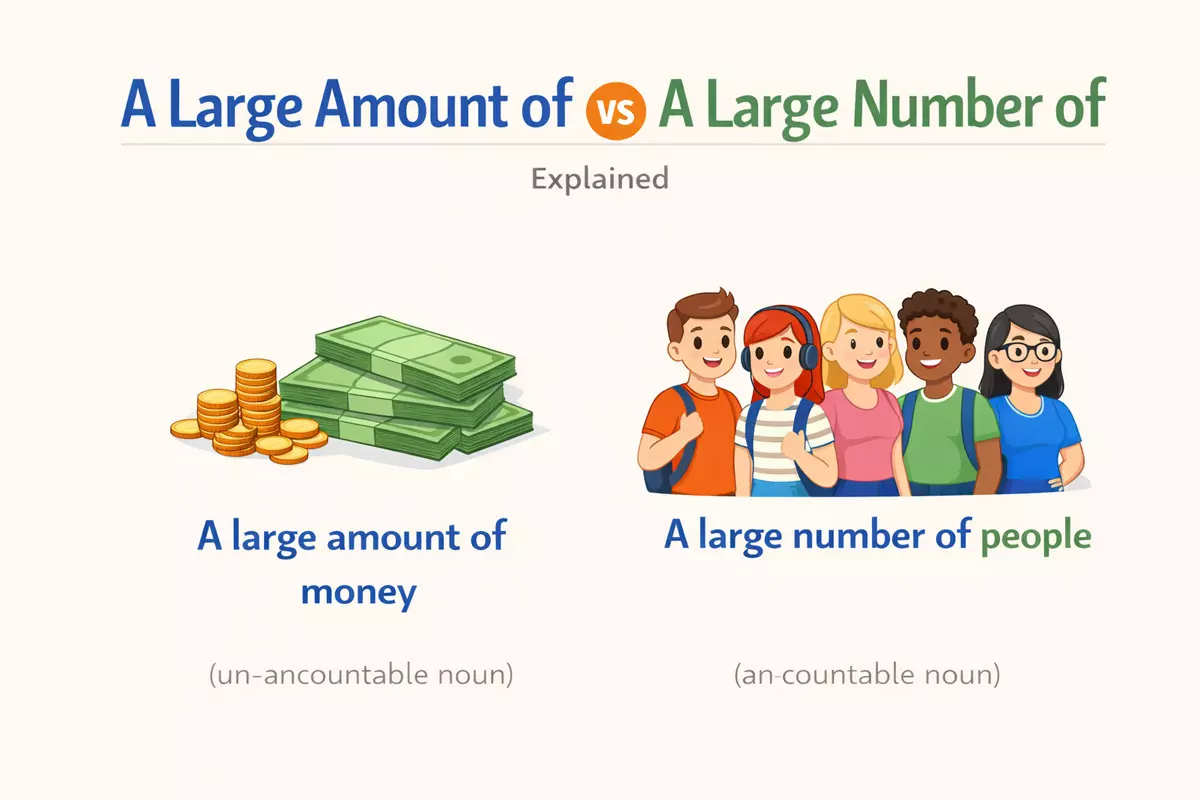 This article explains the key difference between 'a large amount of' for uncountable nouns and 'a large number of' for countable nouns. It covers usage, common errors, sentence structure, verb agreement, and practice choosing the correct form.
- Core distinction between amount and number
- Use with uncountable vs countable nouns
- Common nouns used with each phrase
- Sentence structure and verb agreement
- Why confusion is common among learners
- Examples showing clear contrast
- Typical errors and how to avoid them
- Practice: selecting the correct expression
Choosing the right expression when referring to amounts can make your English sound more accurate and fluent. While both significant quantity and considerable count are used to describe large amounts, significant quantity is more common and natural when discussing measurable amounts of something, such as materials or data. On the other hand, considerable count is less frequently used and usually refers specifically to numbers of individual items. Being aware of these nuances helps you communicate with greater clarity and confidence.
Core distinction between amount and number
Understanding when to use "amount" versus "number" hinges on the type of noun you’re describing. "Amount" is typically reserved for things that can't be counted individually—these are called uncountable or mass nouns. In contrast, "number" is used with items that can be counted one by one, known as countable nouns. This difference is not just about preference; it reflects a fundamental grammatical rule in English.
Countable vs. Uncountable Nouns
If you can break something into individual units and count them, "number" is your go-to word. For items you measure but don’t count individually, "amount" fits best. Here are some common examples:
- Countable (use "number"): books, apples, cars, people, chairs, coins, emails, pens, ideas, tickets
- Uncountable (use "amount"): water, sand, information, traffic, advice, furniture, sugar, money, patience, rice
Key Usage Patterns
A handy way to decide which word to use is to try making the noun plural or asking "how many?". If it works, "number" is correct. If not, "amount" is appropriate.
- We say "a large number of students" because "students" can be counted. ✅
- We say "a large amount of water" because "water" isn’t countable in individual units. ✅
- "A large number of information" ❌ (incorrect—information is uncountable)
- "A large amount of apples" ❌ (incorrect—apples are countable)
Comparison Table
| Use "A large number of" | Use "A large amount of" |
|---|---|
| books | water |
| errors | advice |
| students | traffic |
| messages | furniture |
| questions | money |
| cars | information |
| emails | sugar |
| ideas | rice |
Choosing between these phrases is about accuracy and clarity. Remember: use "number" for things you can count, and "amount" for things measured in bulk or mass. This distinction helps your writing sound more natural and precise.
Use with uncountable vs countable nouns
When deciding between “a large amount of” and “a large number of,” it’s important to focus on the type of noun you’re describing. One expression fits naturally with nouns you can count individually, while the other pairs with things you measure or think of as a whole or mass.
“A large amount of” — for uncountable nouns

“A large amount of” is used with nouns that cannot be counted as separate units. These are known as uncountable or mass nouns. Examples include substances, qualities, and abstract concepts. You wouldn’t say “three informations” or “five traffics,” for instance.
- a large amount of water — The factory uses a large amount of water every day.
- a large amount of information — The database stores a large amount of information.
- a large amount of money — They invested a large amount of money in the project.
- a large amount of rice — The recipe requires a large amount of rice.
- a large amount of patience — Dealing with complaints takes a large amount of patience.
- a large amount of time — Completing the task will take a large amount of time.
- a large amount of energy — The system consumes a large amount of energy.
- a large amount of pollution — The city produces a large amount of pollution each year.
- a large amount of research — The theory is supported by a large amount of research.
- a large amount of sugar — This drink contains a large amount of sugar.
“A large number of” — for countable nouns
On the other hand, “a large number of” matches with nouns you can count one by one—these are countable nouns. In these cases, the noun usually appears in its plural form.
- a large number of people — A large number of people attended the concert.
- a large number of books — A large number of books were donated to the library.
- a large number of cars — A large number of cars were parked outside the stadium.
- a large number of emails — She received a large number of emails after the announcement.
- a large number of students — A large number of students passed the exam.
- a large number of mistakes — He made a large number of mistakes in the report.
- a large number of opportunities — The city offers a large number of opportunities for graduates.
- a large number of visitors — A large number of visitors come here every summer.
- a large number of animals — A large number of animals were rescued from the shelter.
- a large number of questions — The audience asked a large number of questions at the end.
Quick Comparison Table
| Expression | Used with | Example |
|---|---|---|
| a large amount of | Uncountable nouns | a large amount of sugar |
| a large number of | Countable nouns (plural) | a large number of books |
How to Decide Which to Use?
Ask yourself: can you count the items individually? If yes, use “a large number of.” If not, and you’re referring to something as a whole or a mass, “a large amount of” is correct. Remember, using the wrong phrase can sound unnatural to native speakers. For example, “a large number of water” ❌ is incorrect, while “a large amount of water” ✅ is correct. Choosing the right phrase helps your English sound clear and accurate, especially in writing or formal speech.
Common nouns used with each phrase
Understanding which nouns typically follow "a large amount of" and "a large number of" helps you use these phrases correctly in English writing and conversation. The main distinction lies in countability: "a large amount of" is used with uncountable nouns, while "a large number of" pairs with countable nouns. This pattern is consistent and easy to remember once you’ve seen a few examples.
Typical nouns with "a large amount of"
You’ll notice that this phrase usually appears with things that can’t be counted individually, but exist as a mass or concept. Here are some common examples:
- water — The plant requires a large amount of water to survive.
- information — The report contains a large amount of information.
- money — They spent a large amount of money on renovations.
- effort — Completing the project took a large amount of effort.
- time — Fixing the issue will take a large amount of time.
- rice — The recipe uses a large amount of rice.
- equipment — The lab needs a large amount of equipment.
- energy — The system consumes a large amount of energy.
- patience — Teaching beginners requires a large amount of patience.
- traffic — There is a large amount of traffic during rush hour.
- sand — A large amount of sand was removed from the beach.
- work — Finishing the assignment involved a large amount of work.
- furniture — They moved a large amount of furniture into the house.
- advice — She gave me a large amount of advice.
- noise — The construction created a large amount of noise.
These nouns are not counted as individual units, so "amount" is the right choice.
Typical nouns with "a large number of"
This phrase fits best with nouns you can count—discrete items or people. Here are some typical choices:
- people — A large number of people attended the meeting.
- students — A large number of students passed the final exam.
- books — A large number of books were donated to the library.
- cars — A large number of cars were parked near the stadium.
- mistakes — A large number of mistakes were found in the report.
- questions — The speaker received a large number of questions.
- ideas — The team generated a large number of ideas.
- animals — A large number of animals were rescued after the flood.
- emails — She received a large number of emails in one day.
- opportunities — The city offers a large number of opportunities for graduates.
- trees — A large number of trees were planted last year.
- buildings — A large number of buildings were damaged in the storm.
- problems — The update caused a large number of problems.
- countries — A large number of countries signed the agreement.
- projects — The company manages a large number of projects.
Each of these can be counted individually, which is why "number" is the natural fit.
Side-by-side comparison
To make the distinction even clearer, here’s a quick reference chart showing how each phrase matches with different types of nouns:
| Noun Type | Example Phrase |
|---|---|
| Uncountable (mass) | a large amount of information |
| Uncountable (abstract) | a large amount of effort |
| Countable (people) | a large number of students |
| Countable (objects) | a large number of cars |
| Countable (ideas) | a large number of questions |
Remember: "amount" for things you can’t count one by one, "number" for things you can. This distinction keeps your English both correct and natural.
Sentence structure and verb agreement
When using "a large amount of" and "a large number of," it’s important to consider the type of noun each phrase modifies, as this affects the choice of verb and overall sentence structure. "A large amount of" is typically paired with uncountable (mass) nouns, while "a large number of" is used with countable nouns. This distinction guides whether you use singular or plural verbs and helps your sentences sound natural and correct.
How the noun affects the verb form
With mass nouns (like "water," "information," or "money"), the verb is singular because the noun represents a whole or a substance that can't be counted individually. In contrast, countable nouns (like "books," "students," or "cars") take plural verbs.
- A large amount of water is needed for the experiment. ✅
- A large number of students are attending the seminar. ✅
- A large amount of people is waiting outside. ❌ (incorrect, because "people" is countable)
- A large number of information are available. ❌ (incorrect, because "information" is uncountable)
Common sentence patterns
Here are some typical ways these phrases appear in sentences, showing correct agreement:
- A large amount of sugar was spilled on the floor.
- A large number of emails have arrived this morning.
- A large amount of support is required for the project.
- A large number of errors were found in the report.
- A large amount of patience is necessary when working with children.
- A large number of tourists visit the museum each year.
- A large amount of time was invested in research.
- A large number of options are available.
- A large amount of energy is consumed by air conditioners.
- A large number of complaints have been received.
Quick comparison: countable vs. uncountable
| Phrase | Correct Example |
|---|---|
| A large amount of | A large amount of traffic is expected. |
| A large number of | A large number of drivers are expected. |
| A large amount of | A large amount of equipment was delivered. |
| A large number of | A large number of packages were delivered. |
| A large amount of | A large amount of rain has fallen. |
| A large number of | A large number of storms have occurred. |
Tips for getting it right
- Check if the noun can be counted. If yes, use "a large number of" with a plural verb.
- If the noun is a substance or abstract concept, use "a large amount of" with a singular verb.
- Watch out for common mistakes, like pairing "a large amount of" with plural, countable nouns.
- Remember: the verb agrees with the noun, not with "amount" or "number."
Following these patterns helps ensure clarity and correctness in your writing, especially when describing quantities or groups. Getting the agreement right not only avoids errors but also makes your English sound more natural to native speakers.
Why confusion is common among learners
Many students find it tricky to decide when to use "a large amount of" versus "a large number of." The main reason is that both expressions refer to quantity, but they apply to different types of nouns. In everyday conversation, people sometimes use them interchangeably, which adds to the uncertainty for those learning English.
Countable vs. Uncountable Nouns
The distinction between countable and uncountable nouns is central to understanding the difference. "A large number of" is used with countable nouns—things you can count individually, like "books" or "apples." On the other hand, "a large amount of" is paired with uncountable nouns, such as "water" or "information." This rule can be confusing, especially since some nouns are used differently in different contexts.
Similar Meanings, Different Structures
Because both phrases express the idea of "a lot," learners may not immediately notice the grammatical rules behind their usage. The overlap in meaning makes it easy to overlook the noun type, resulting in common mistakes. Additionally, everyday speech and informal writing sometimes bend the rules, which can mislead those still mastering the basics.
Examples That Cause Uncertainty
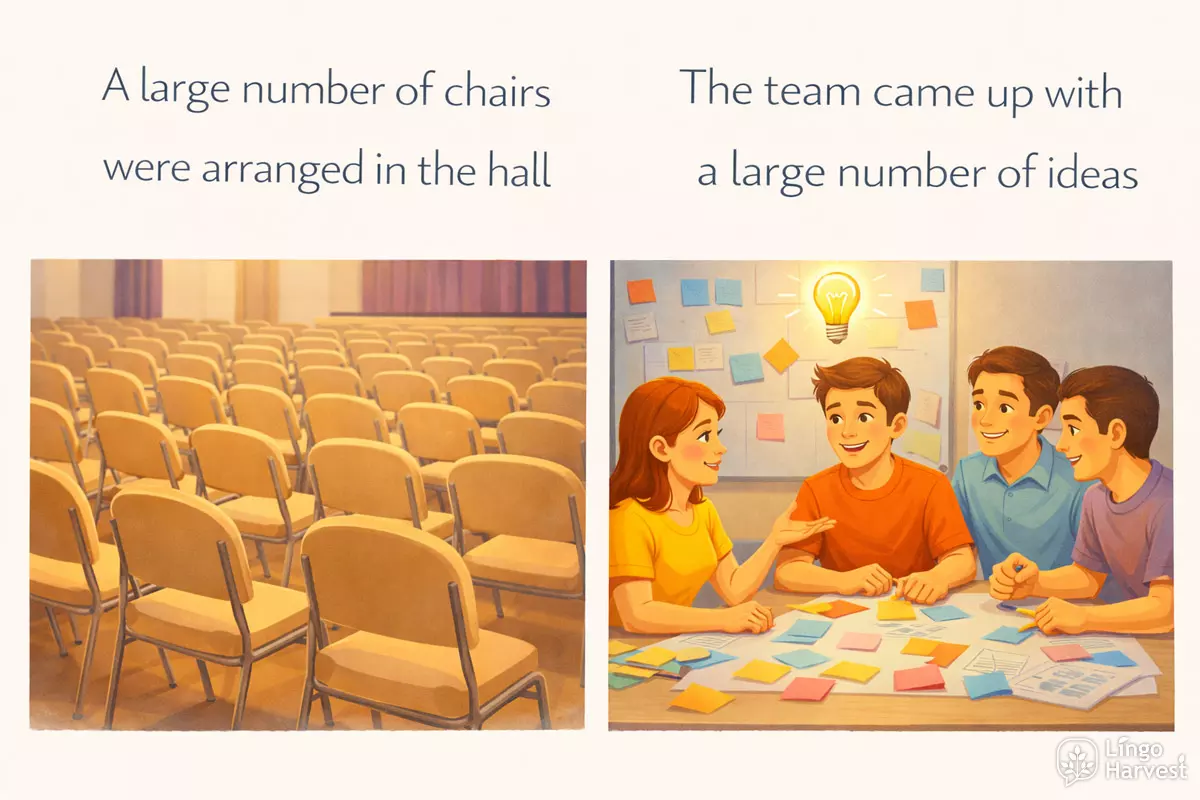
Here are some examples of nouns that often cause hesitation:
- Advice (uncountable) — She gave me a great deal of advice before the interview.
- Chairs (countable) — A large number of chairs were arranged in the hall.
- Equipment (uncountable) — The lab purchased a large amount of new equipment.
- Ideas (countable) — The team came up with a large number of ideas.
- Furniture (uncountable) — They moved a large amount of furniture into the apartment.
- Friends (countable) — A large number of friends came to support her.
- News (uncountable) — There was a large amount of news to discuss.
- Cars (countable) — A large number of cars were stuck in traffic.
- Sand (uncountable) — A large amount of sand covered the road.
- People (countable) — A large number of people gathered outside.
- Information (uncountable) — The website provides a large amount of information.
- Errors (countable) — A large number of errors were found in the document.
- Time (uncountable, but "times" is countable in some contexts) — Fixing the issue took a large amount of time.
- Apples (countable) — A large number of apples were sold that day.
- Traffic (uncountable) — There is a large amount of traffic during rush hour.
- Tasks (countable) — She completed a large number of tasks before noon.
Quick Comparison
To help clarify the differences, here is a summary of how each phrase is typically used:
| Phrase | Used With | Example |
|---|---|---|
| A large number of | Countable nouns | A large number of students attended the lecture. |
| A large amount of | Uncountable nouns | A large amount of information was collected. |
In summary, the confusion stems from similarities in meaning, subtle grammar rules, and inconsistent usage in casual English. By paying close attention to whether a noun can be counted, learners can avoid common mistakes with these expressions.
Examples showing clear contrast
Understanding when to use "a large amount of" versus "a large number of" is all about whether the noun is countable or uncountable. These expressions are not interchangeable, and the difference becomes clear in practical sentences. Below, you'll find real-world examples that highlight when each phrase is appropriate, helping you avoid common mistakes.
Correct Usage in Everyday Contexts
- A large number of students attended the seminar. (students can be counted)
- A large amount of information was shared during the presentation. (information cannot be counted individually)
- A large number of emails flooded her inbox.
- A large amount of water was wasted.
- A large number of cars were parked outside.
- A large amount of energy is required to heat the building.
- A large number of books lined the shelves.
- A large amount of patience is needed for this task.
- A large number of errors were found in the document.
- A large amount of dust collected on the furniture.
Common Mistakes to Avoid
- A large amount of people attended the event. ❌ (incorrect: "people" is countable)
- A large number of sugar was added. ❌ (incorrect: "sugar" is uncountable)
Side-by-Side Comparison
| Countable Noun (Use "a large number of") | Uncountable Noun (Use "a large amount of") |
|---|---|
| A large number of chairs were stacked in the corner. | A large amount of furniture was delivered yesterday. |
| A large number of ideas were discussed. | A large amount of creativity is needed for this project. |
| A large number of tourists visited the city. | A large amount of traffic delayed our arrival. |
| A large number of questions were asked. | A large amount of interest was shown in the topic. |
By comparing these examples, you can see that "a large number of" fits with things you can count individually, while "a large amount of" pairs with mass nouns. Keeping this distinction in mind will help make your English sound more natural and precise.
Typical errors and how to avoid them
Misusing "a large amount of" and "a large number of" is common, especially for English learners. The confusion usually comes from not recognizing whether the noun is countable or uncountable. Let's look at some frequent mistakes, how they happen, and what you can do to use these phrases correctly.
Common mix-ups
Many people swap these expressions without checking the noun type. "A large amount of" should be used with uncountable nouns (like water, information, or money), while "a large number of" fits countable nouns (like books, people, or ideas). Using the wrong phrase can make sentences sound awkward or incorrect.
- Incorrect: A large amount of cars were parked outside.
- Correct: A large number of cars were parked outside.
- Incorrect: A large number of information is available online.
- Correct: A large amount of information is available online.
How to tell countable from uncountable nouns
If you can count the items (one apple, two apples), use "a large number of." If you can’t count it without a unit (like water, advice, or furniture), "a large amount of" is the right choice.
| Phrase | Use With | Example |
|---|---|---|
| A large amount of | Uncountable nouns | A large amount of sugar was needed. |
| A large number of | Countable nouns | A large number of students attended. |
| A large amount of | Uncountable nouns | A large amount of patience is required. |
| A large number of | Countable nouns | A large number of emails were sent. |
Tips to avoid mistakes
- Ask yourself: Can I count the noun one by one? If yes, use "number."
- Look for plural forms. Countable nouns have plurals (cats, ideas), uncountable do not (milk, knowledge).
- If you need a unit (a piece of, a bit of), it’s probably uncountable.
- Practice with common examples to build confidence.
Other related pitfalls
Sometimes, people mix these expressions with similar phrases like "much" or "many." Remember, "much" goes with uncountable nouns, and "many" with countable ones. This rule works the same for "amount" and "number" in these expressions.
- Never say: Much people or many information.
- Use: Much information and many people.
By checking whether your noun is countable or uncountable and practicing with real examples, you can avoid these typical mix-ups and write more naturally.
Practice: selecting the correct expression
Understanding when to use "a large amount of" versus "a large number of" is essential for clear and accurate communication. The right choice depends on whether the noun is countable or uncountable. Let’s test your understanding with some practical exercises and examples.
Countable vs. uncountable nouns review
Before you try the exercises, remember:
- A large number of is used with countable nouns (things you can count individually).
- A large amount of is used with uncountable nouns (things you cannot count individually).
Choose the correct option
For each sentence, choose the appropriate phrase to complete it: "a large amount of" or "a large number of".
- There was ____________ traffic on the highway this morning.
- He received ____________ emails after the meeting.
- We need ____________ information before making a decision.
- She owns ____________ books on history.
- The chef used ____________ sugar in the recipe.
- They encountered ____________ problems during the project.
- Our office produces ____________ paperwork every week.
- The classroom has ____________ chairs.
- We collected ____________ data for the experiment.
- There is ____________ water in the bottle.
Show answers
- a large amount of (traffic is uncountable)
- a large number of (emails are countable)
- a large amount of (information is uncountable)
- a large number of (books are countable)
- a large amount of (sugar is uncountable)
- a large number of (problems are countable)
- a large amount of (paperwork is uncountable)
- a large number of (chairs are countable)
- a large amount of (data is usually treated as uncountable in modern English)
- a large amount of (water is uncountable)
Common nouns for each expression
It can be helpful to memorize typical nouns that follow each phrase. Here is a table with common examples:
| Used with "a large amount of" | Used with "a large number of" |
|---|---|
| water | people |
| money | students |
| information | questions |
| work | cars |
| furniture | ideas |
| traffic | emails |
| sugar | problems |
| time | books |
| data | chairs |
| paperwork | tasks |
Self-check: Choose the Correct Phrase
Below is a mixed list of countable and uncountable nouns. For each item, decide whether it should be used with a large amount of or a large number of.
- Rice
- Meetings
- Advice
- Cars
- Equipment
- Errors
- Information
- Students
- Furniture
- Questions
Show answers
- Rice — a large amount of
- Meetings — a large number of
- Advice — a large amount of
- Cars — a large number of
- Equipment — a large amount of
- Errors — a large number of
- Information — a large amount of
- Students — a large number of
- Furniture — a large amount of
- Questions — a large number of
Practicing these distinctions will help you use both expressions confidently and correctly in your writing and speaking.