A Bit of: Informal Quantifier in Spoken English Usage

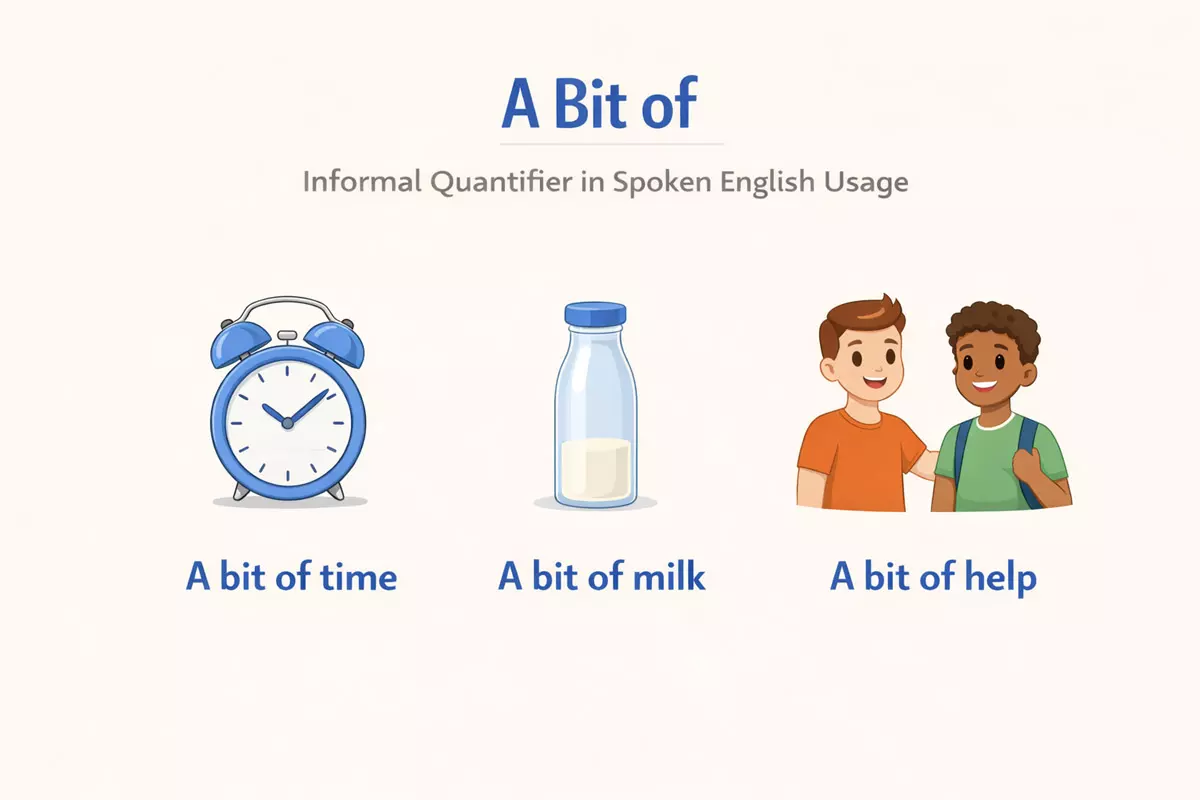 This article explains the meaning of a bit of, its casual tone, and how it’s used with uncountable or abstract nouns. It covers common collocations, differences from a little, sentence placement, and tips for natural, everyday use.
- Meaning and implied small quantity
- Informal tone and conversational use
- Use with uncountable and abstract nouns
- Common collocations and expressions
- Difference between a bit of and a little
- Sentence position and natural patterns
- Typical learner overuse
- Examples from everyday speech
- Practice: using a bit of naturally
People often use informal expressions like a little or a touch when talking about amounts in everyday conversation. These casual ways of describing quantity appear frequently in English and help make communication feel more natural and relatable. By using such phrases, speakers can convey subtle differences in meaning and create a more relaxed and friendly atmosphere. This approach not only shapes how ideas are shared but also helps people connect more easily in daily interactions.
Meaning and implied small quantity
When English speakers use the phrase “a bit of,” they typically want to refer to a small, often unspecified amount of something. This informal quantifier can relate to both physical objects and abstract ideas, such as time or emotion. In conversation, it helps soften requests, express modesty, or simply indicate that only a slight amount is involved.
Typical uses and nuances
“A bit of” is flexible, working with both countable and uncountable nouns. It can signal a truly tiny amount or just a moderate, manageable portion—much less than “a lot of” or even “some.” The listener usually understands the intended size from context, tone, or accompanying gestures. When used in polite requests, it often makes the speaker sound less demanding.
- “Could I have a bit of sugar in my tea?”
- “There’s a bit of confusion about the schedule.”
- “She needs a bit of advice.”
- “Let’s wait a bit before we go.”
- “Do you want a bit of cake?”
- “He gave me a bit of help.”
- “We need a bit of patience.”
- “Just a bit of rain is expected.”
- “Can I borrow a bit of your time?”
- “There’s a bit of dust on the table.”
- “She felt a bit of relief after the news.”
- “Add a bit of salt to the soup.”
- “He’s in a bit of trouble.”
- “I have a bit of work left.”
- “The movie had a bit of humor.”
Implied quantity: how small is “a bit”?
The size or extent suggested by “a bit of” is almost always less than “some,” “a little,” or “a few.” However, the actual amount can shift based on the noun and situation. For example, “a bit of cake” might mean a single bite, while “a bit of advice” could be a quick suggestion rather than a detailed explanation.
| Expression | Implied Quantity | Typical Context |
|---|---|---|
| a bit of sugar | a small spoonful | Adding to drinks or food |
| a bit of help | minimal assistance | Offering support |
| a bit of time | a short period | Scheduling, appointments |
| a bit of advice | a quick suggestion | Guidance, conversation |
| a bit of trouble | minor problem | Describing situations |
| a bit of rain | light rainfall | Weather reports |
In summary, “a bit of” is a subtle, informal way to refer to a small amount, often with a gentle or polite tone. The exact measure is rarely specified, leaving room for interpretation based on the situation and the speaker’s intent.
Informal tone and conversational use
When chatting with friends or telling stories, native English speakers often reach for “a bit of” to soften statements, sound more relaxed, or add nuance. This phrase is a classic marker of casual, everyday conversation. It helps make speech less direct or formal, which can be especially handy when you want to sound friendly or avoid coming across as too blunt.
How “a bit of” functions in everyday talk
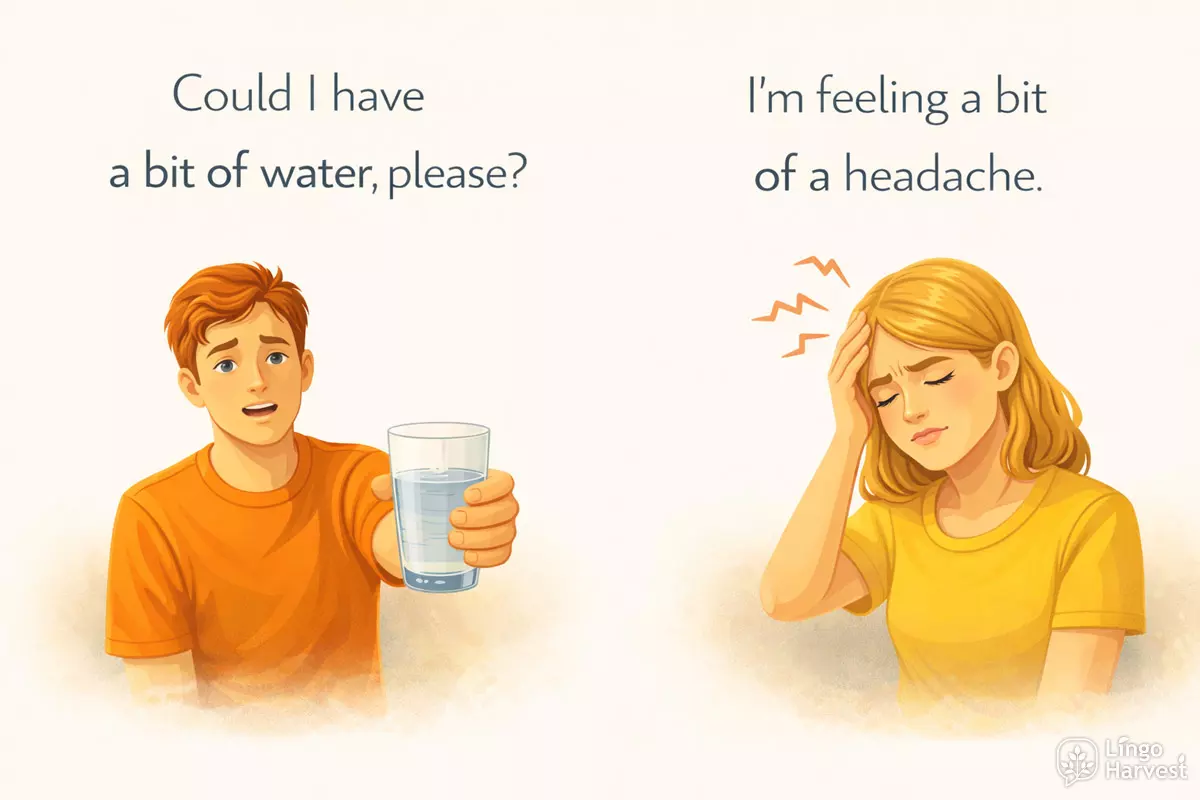
In spoken English, “a bit of” works as a gentle quantifier—meaning “a small amount”—and is especially common with uncountable nouns or when mentioning something in passing. People use it to keep things light, whether discussing food, feelings, or advice.
- Politeness: “Could I have a bit of water, please?” (softer than simply asking for “water”)
- Downplaying: “I’m feeling a bit of a headache.” (less dramatic than “I have a headache”)
- Hesitation: “There’s a bit of a problem.” (introduces an issue gently)
- Vagueness: “He’s got a bit of talent.” (implies some, but not a lot)
Common situations where “a bit of” pops up
You’ll hear this phrase in a range of everyday scenarios. Here are some typical examples:
- Requesting small amounts: “Can I get a bit of help here?”
- Offering something: “Would you like a bit of cake?”
- Describing mood: “She’s in a bit of a hurry.”
- Giving advice: “Try adding a bit of salt.”
- Talking about time: “Let’s wait a bit.”
- Explaining situations: “There’s a bit of confusion about the time.”
- Expressing uncertainty: “I’m a bit of a novice at this.”
- Soften feedback: “It was a bit of a mess.”
- Show modesty: “I did a bit of research.”
- Lightening criticism: “That’s a bit of an exaggeration.”
- Downplaying success: “It was a bit of luck, really.”
- General understatement: “It’s a bit of a challenge.”
Comparison: “a bit of” vs. similar informal quantifiers
| Expression | Typical Use | Register | Example |
|---|---|---|---|
| a bit of | Small, vague amount; softening | Informal, spoken | “I need a bit of advice.” |
| a little | Slight quantity; similar meaning | Neutral, spoken/written | “Can I have a little milk?” |
| some | Non-specific quantity | All registers | “Would you like some tea?” |
| a touch of | Very small, often poetic | Informal, creative | “Just a touch of salt.” |
Why speakers choose “a bit of”
Opting for “a bit of” often signals friendliness or a desire to avoid being too forceful. It’s a go-to phrase for sounding approachable and lessening the impact of what’s being said. You’ll notice it especially when people want to be polite, modest, or just keep things lighthearted. In summary, “a bit of” is a versatile and subtle tool in spoken English, especially when the goal is to sound natural and easygoing. Whether you’re making requests, giving feedback, or just chatting, this phrase helps keep things informal and friendly.
Use with uncountable and abstract nouns
In everyday English, "a bit of" is frequently paired with nouns that describe materials, concepts, or qualities that can't be counted individually. This phrase helps speakers refer to an indefinite, small amount of something that is not easily separated into units. For example, when talking about substances like "water" or feelings such as "hope," using "a bit of" makes the language more natural and less formal in conversation.
Common contexts and meanings
"A bit of" often softens requests, offers, or statements, making them sound more polite or less direct. It also conveys modesty or understatement, especially with things that are difficult to quantify. Here are some frequent situations where this phrase comes in handy:
- Describing food or drink: "a bit of milk," "a bit of sugar"
- Talking about emotions: "a bit of happiness," "a bit of sadness"
- Referring to substances: "a bit of rain," "a bit of sand"
- Expressing time or abstract ideas: "a bit of patience," "a bit of luck"
- Offering help or advice gently: "Would you like a bit of help?"
Examples with uncountable and abstract nouns
To illustrate the range of uses, here are some typical nouns that work well with "a bit of" in spoken English:
- advice — She gave me a bit of advice before the interview.
- information — I found a bit of information about the course online.
- news — We finally got a bit of news about the project.
- money — I only need a bit of money to cover the ticket.
- music — Let’s play a bit of music while we work.
- progress — He has made a bit of progress this week.
- peace — I just want a bit of peace after a long day.
- trouble — The delay caused a bit of trouble for everyone.
- energy — I still have a bit of energy left.
- noise — There was a bit of noise coming from the street.
- courage — It took a bit of courage to speak up.
- work — I have a bit of work to finish tonight.
- fun — We had a bit of fun at the party.
- relief — Hearing the results brought a bit of relief.
- rest — Take a bit of rest before continuing.
- change — A bit of change can improve the situation.
- support — She needed a bit of support during the transition.
- research — The conclusion is based on a bit of research.
Comparing "a bit of" with other quantifiers
While "a bit of" is informal and common in speech, other quantifiers like "some," "a little," or "a piece of" can sometimes be used instead—though with subtle differences in nuance and usage. Here’s a comparison:
| Quantifier | Typical Use | Example |
|---|---|---|
| a bit of | Informal, small amount, often with uncountable/abstract nouns | a bit of advice |
| a little | Small quantity, slightly more formal, often interchangeable with "a bit of" | a little patience |
| some | Neutral, any quantity, broader use | some information |
| a piece of | Unit of something abstract or uncountable (less common in casual speech) | a piece of news |
Choosing "a bit of" adds a friendly, relaxed tone, which is especially helpful in speech or informal writing. It’s particularly useful when you want to avoid sounding too direct or absolute about an uncountable or abstract concept.
Common collocations and expressions
When speakers use "a bit of" in everyday English, it tends to combine naturally with certain nouns and verbs, especially in informal contexts. This phrase is often employed when people want to soften a statement, express modesty, or talk about small quantities or degrees. It’s especially common in British English, but you’ll also hear it in many varieties of spoken English worldwide.
Typical nouns that follow "a bit of"
The phrase "a bit of" pairs especially well with uncountable nouns, but it can also appear before certain countable ones. Here are some of the most frequent combinations:
- a bit of luck — With a bit of luck, we’ll arrive on time.
- a bit of help — I could use a bit of help with this task.
- a bit of advice — She gave me a bit of advice before the interview.
- a bit of trouble — We ran into a bit of trouble on the way.
- a bit of time — Give me a bit of time to finish this.
- a bit of money — I only need a bit of money to pay for the ticket.
- a bit of noise — There was a bit of noise outside the window.
- a bit of work — I still have a bit of work to do tonight.
- a bit of rest — He needs a bit of rest after the long trip.
- a bit of excitement — The announcement added a bit of excitement to the day.
- a bit of a headache — This problem is becoming a bit of a headache.
- a bit of information — I found a bit of information online.
- a bit of bread — Can I have a bit of bread with the soup?
- a bit of a shock — The news came as a bit of a shock.
- a bit of chocolate — She treated herself to a bit of chocolate.
- a bit of a mess — The room is a bit of a mess right now.
Common expressions and sentence patterns
Besides single nouns, "a bit of" often appears in idiomatic phrases and set expressions. Here are some typical patterns and their uses:
- Can I have a bit of your time?
- He gave me a bit of advice.
- There's a bit of a problem here.
- We need a bit of space.
- She’s feeling a bit of a cold coming on.
- I could do with a bit of help.
- Let’s have a bit of fun.
- It was a bit of a disaster.
- He’s in a bit of trouble.
- Want a bit of chocolate?
Subtle variations in meaning
Adding "a bit of" can make a statement sound more tentative or polite. For example, saying "a bit of help" instead of just "help" can make a request softer. It’s also used to downplay the seriousness or intensity of something: "a bit of a headache" suggests something minor, while "a headache" could sound more severe. This phrase is also useful for expressing understatement, which is a common feature of conversational English.
Comparison with similar quantifiers
| Expression | Typical Use |
|---|---|
| a bit of | Informal, small quantity/degree, often softening or understating |
| a little | Neutral, small quantity, can be countable or uncountable nouns |
| some | General, any quantity not specified, slightly more formal or neutral |
| a piece of | Specifies a part or portion, often for tangible items |
Choosing "a bit of" over alternatives often signals a relaxed, friendly tone and can make requests or statements sound less direct or demanding. This subtlety is part of what makes it a staple in natural spoken English.
Difference between a bit of and a little
Native speakers often use both “a bit of” and “a little” to talk about small amounts, but there are subtle differences in tone, context, and frequency. Both phrases are used with uncountable nouns and tend to sound informal, but their usage patterns and nuances may not be identical in every situation.
Usage Contexts
- “A bit of” is especially common in British English and in casual conversation. It often suggests a slightly smaller, more casual amount, and sometimes adds a relaxed or understated tone.
- “A little” is more neutral and works well in both spoken and written English. It can be used in both formal and informal contexts, and generally doesn’t carry the same informal vibe as “a bit of.”
Subtle Differences in Meaning
- “A bit of” can sometimes soften a request or statement, making it less direct or more polite. For example, “Could I have a bit of water?” sounds slightly less insistent than “Could I have a little water?”
- “A little” may be preferred when you want to emphasize that the quantity is small but still significant.
- In some cases, “a little” can be used before adjectives or adverbs (“a little tired,” “a little slowly”), while “a bit of” is not used in this way.
Common Patterns and Examples

- a bit of sugar — Add a bit of sugar to balance the taste.
- a bit of luck — With a bit of luck, we’ll finish on time.
- a bit of advice — He offered me a bit of advice before the interview.
- a little milk — Pour a little milk into the coffee.
- a little time — Give me a little time to think it over.
- a little patience — This task requires a little patience.
- “I need a bit of help.” — She said she needed a bit of help with the report.
- “There’s a little confusion.” — There’s a little confusion about the schedule.
- “Can I get a bit of cheese?” — He asked if he could get a bit of cheese.
- “Add a little salt.” — Add a little salt to enhance the flavor.
- “She showed a bit of interest.” — She showed a bit of interest during the discussion.
- “He has a little experience.” — He has a little experience in project management.
Comparison Table
| Feature | a bit of | a little |
|---|---|---|
| Formality | Informal | Neutral |
| Typical Context | Spoken, casual, British English | Spoken & written, global English |
| Used with Adjectives/Adverbs | ❌ (not used) | ✅ (e.g., “a little tired”) |
| Politeness/Tone | Softer, less direct | More neutral |
| Examples | a bit of luck, a bit of cheese | a little milk, a little patience |
In summary, while both “a bit of” and “a little” express small amounts and are often interchangeable, their tone, context, and flexibility differ. Choosing between them depends on how formal you want to sound, the specific noun you’re using, and whether you’re aiming for a relaxed, conversational feel or a more neutral statement.
Sentence position and natural patterns
Where “a bit of” appears in a statement often affects the tone and meaning. In everyday speech, this informal quantifier usually precedes uncountable nouns, signaling a small quantity or a casual, friendly attitude. For example, “a bit of help” sounds less formal and more approachable than “some help.” This phrase is rarely used in the middle or end of a sentence as a standalone element; instead, it typically comes just before the noun it modifies.
Common placements and variations
Speakers tend to place “a bit of” directly before the noun, especially when referring to substances, abstract concepts, or when softening requests. Its placement rarely shifts unless used for emphasis or in idiomatic expressions. Here are some typical examples:
- Could I have a bit of sugar in my tea?
- She needs a bit of advice.
- There’s a bit of noise outside.
- I’d like a bit of quiet, please.
- He added a bit of salt to the soup.
- We had a bit of trouble finding your house.
- Take a bit of time to think.
- They showed a bit of interest.
- Let’s have a bit of fun tonight.
- She’s going through a bit of a hard time.
- It needs a bit of work.
- I felt a bit of relief.
- Can I get a bit of feedback?
- There’s a bit of confusion about the schedule.
- Give me a bit of space.
Patterns in natural conversation
Native speakers often use “a bit of” to soften statements, requests, or even criticisms. This creates a less direct, more polite tone, which is particularly common in British English. The phrase is not typically used with plural countable nouns (e.g., a bit of apples ❌), but works well with uncountable nouns and certain singular abstract nouns (e.g., a bit of luck).
Here’s a quick comparison of “a bit of” with other informal quantifiers in spoken English:
| Quantifier | Typical Use |
|---|---|
| a bit of | Uncountable nouns (e.g., “a bit of cheese”) |
| a little | Uncountable nouns, often interchangeable with “a bit of” |
| a few | Countable plural nouns (e.g., “a few minutes”) |
| some | Both countable and uncountable nouns, more general |
Notice that “a bit of” is especially frequent in requests, offers, and when downplaying or softening a statement. This helps maintain a relaxed and cooperative tone in everyday English.
Typical learner overuse
Language learners often rely heavily on "a bit of" when speaking English, especially in informal settings. This phrase feels safe and easy to use, so it becomes a default for expressing small amounts or minor degrees. However, this habit can lead to awkward or unnatural sentences, since native speakers tend to use a wider variety of expressions or sometimes omit quantifiers entirely.
Common patterns of excessive use
Students sometimes insert "a bit of" where native speakers would choose a different quantifier, a bare noun, or no phrase at all. Overuse is most noticeable with abstract nouns, uncountable items, or when describing feelings and experiences. The result is English that sounds overly tentative or repetitive.
- "I need a bit of help with this."
- "Can I have a bit of water?"
- "She gave me a bit of advice."
- "I’m feeling a bit of tired today."
- "There’s a bit of noise outside."
- "Could you move a bit of to the left?"
- "He made a bit of mistake."
- "We have a bit of rain this evening."
- "The soup needs a bit of salt."
- "I’m in a bit of hurry."
- "She has a bit of cold."
- "Just give me a bit of minute."
- "There’s a bit of problem with the printer."
- "Let’s wait a bit of before starting."
- "He took a bit of risk."
Why it happens
This trend emerges for several reasons. "A bit of" is simple and seems to fit many situations, so learners grab it rather than searching for context-appropriate alternatives. It also appears frequently in textbooks and listening materials, which can reinforce the impression that it’s universally correct. In reality, English speakers often choose from a range of quantifiers, such as "some," "a little," or just the noun itself, depending on what sounds most natural.
Better alternatives and natural usage
To sound more fluent, it’s important to vary your language. Consider these alternatives:
- A little (for uncountable nouns): "I need a little help."
- Some: "Can I have some water?"
- Just (before adjectives): "I’m just tired today."
- No quantifier: "She gave me advice."
- A few (for countable nouns): "I have a few questions."
- Slightly: "Move slightly to the left."
- A little bit: "The soup needs a little bit of salt."
- Minor (for problems): "There’s a minor problem."
- Brief: "Wait a moment."
- Just a minute: "Give me a minute."
Comparing learner and native speaker choices
| Learner Example | More Natural English |
|---|---|
| I’m in a bit of hurry. | I’m in a hurry. |
| She has a bit of cold. | She has a cold. |
| He made a bit of mistake. | He made a mistake. |
| Just give me a bit of minute. | Just give me a minute. |
| Let’s wait a bit of before starting. | Let’s wait a bit before starting. |
| There’s a bit of problem. | There’s a problem. |
By becoming aware of these patterns and alternatives, learners can avoid sounding repetitive and make their spoken English more natural and expressive. Expanding your range of quantifiers and sometimes omitting them altogether results in smoother, more authentic communication.
Examples from everyday speech
The phrase “a bit of” often appears in informal conversations to indicate a small quantity or a slight degree of something. Its flexible use helps speakers sound more casual and approachable, especially when talking about food, feelings, or everyday activities. Below are some common patterns and situations where this informal quantifier naturally slips into spoken English.
Typical contexts for "a bit of"
- Describing a small amount of food or drink: “Would you like a bit of cake?”
- Talking about feelings or moods: “I’m feeling a bit of stress today.”
- Offering or requesting help in a modest way: “Could you give me a bit of advice?”
- Softening criticism: “There’s a bit of a mess in the kitchen.”
- Expressing uncertainty or understatement: “It’s a bit of a challenge, but I’ll try.”
- Referring to time: “Let’s wait a bit of time before we leave.”
- Describing weather: “We had a bit of rain this morning.”
- Downplaying a problem: “It’s just a bit of bad luck.”
- Making polite requests: “Could I have a bit of quiet, please?”
- Indicating part of a whole: “I’ve read a bit of the book.”
- Talking about physical sensations: “I have a bit of a headache.”
- Discussing tasks or chores: “There’s a bit of cleaning left to do.”
- Signaling a preference: “I prefer a bit of sugar in my tea.”
- Describing change: “There’s been a bit of improvement.”
- Referring to experience: “I have a bit of experience with this software.”
- Expressing caution: “That movie is a bit of a risk for kids.”
- Talking about behavior: “He has a bit of a temper.”
Comparing "a bit of" with other quantifiers
| Expression | Example Use |
|---|---|
| a bit of | “Can I have a bit of water?” |
| a little | “She needs a little help.” |
| a few | “There are a few cookies left.” |
| some | “Would you like some advice?” |
The phrase is especially useful when speakers want to sound less direct or more polite. Instead of stating that something is a problem, saying there’s “a bit of an issue” softens the tone. This subtlety is a hallmark of everyday English conversation, helping people navigate social situations with ease.
Practice: using a bit of naturally
Getting comfortable with "a bit of" in conversation means knowing when it sounds natural and how it fits into everyday speech. This phrase often signals a small quantity or a mild degree and is more common in informal settings. Let’s explore how native speakers weave it into real situations and how you can, too.
Common patterns and examples
Here are some typical ways "a bit of" appears in spoken English. Notice how it can describe both tangible things and more abstract ideas:
- Would you like a bit of cake?
- He needs a bit of help with his homework.
- Let’s have a bit of quiet, please.
- I’m feeling a bit of pressure at work.
- She showed a bit of interest in the project.
- Could you give me a bit of advice?
- There’s a bit of milk left in the fridge.
- We had a bit of rain last night.
- He’s got a bit of a cold.
- I’d like a bit of time to think.
- There was a bit of confusion at the start.
- Can I have a bit of sugar in my tea?
- She added a bit of color to the room.
- We need a bit of patience here.
- It might take a bit of effort to fix this.
- He’s in a bit of trouble.
- I need a bit of space right now.
- They had a bit of luck on their side.
- Just a bit of salt, please.
- The movie had a bit of humor.
Comparing "a bit of" with similar phrases
To help you distinguish "a bit of" from other informal quantifiers, here’s how it compares to similar expressions in everyday English:
| Expression | Typical Use | Example Sentence |
|---|---|---|
| a bit of | Small amount, informal | She needs a bit of help. |
| a little | Small amount, neutral | Could I have a little water? |
| some | Unspecified amount, neutral | We have some bread left. |
| a touch of | Very small amount, often creative or descriptive | Add a touch of lemon. |
Quick practice: choose the best option
Decide which phrase fits best in each blank. Use: a bit of, a little, some, or a touch of.
- Can I have ________ sugar in my coffee?
- We need ________ patience with this process.
- The chef added ________ spice to the dish.
- There’s ________ confusion about the schedule.
- I just need ________ help with this report.
- He showed ________ interest in the proposal.
- Add ________ salt before serving.
- She has ________ experience in customer support.
- There was ________ noise coming from the hallway.
- Give me ________ time to finish this task.
Show answers
- a bit of / a little / some (all possible, but “a bit of” is very natural in informal speech)
- a bit of
- a touch of
- a bit of
- a bit of
- a bit of
- a little / a bit of
- a little
- a bit of
- a little / a bit of
Personalize: try your own sentences
Think of situations from your life where you might use "a bit of" naturally. For example, what would you say if you were slightly hungry, needed a small favor, or wanted to describe a subtle feeling? Try creating three sentences of your own.
Show answers
- I’d like a bit of lunch before we leave.
- Could you give me a bit of help with this box?
- I’m feeling a bit of excitement about tomorrow.