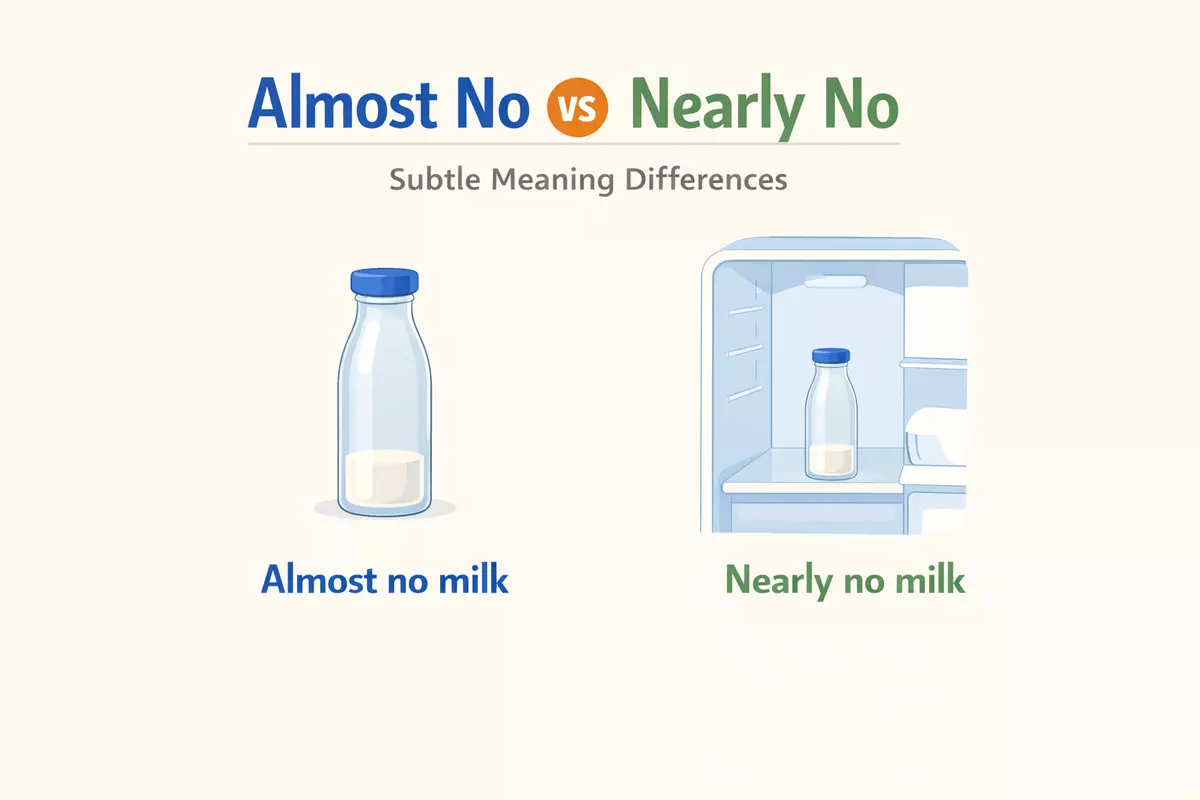
Almost No vs Nearly No: Subtle Meaning Differences

 Here we the core meaning of near-zero quantity, differences in emphasis and tone between almost no and nearly no, their sentence position, usage with countable and uncountable nouns, frequent learner mistakes, clear contrasting examples, and practice…
Have you ever wondered whether there is a genuine difference between expressions such as “almost none” and “nearly none”? While these phrases are often used interchangeably in everyday language, they can carry subtle distinctions in tone and emphasis. For instance, “almost none” may suggest a slightly more definitive sense of scarcity, while “nearly none” can imply that something is just short of being absent. Recognizing these nuances enables you to communicate your ideas more precisely and effectively in both writing and conversation.
Core meaning of near-zero quantity
When we talk about expressions like "almost no" and "nearly no," we're describing situations where the amount of something is so small it’s barely present. Both phrases convey the idea that what’s being discussed is close to nonexistent, yet not entirely absent. This subtlety is important in English, as it allows speakers to indicate an amount that isn’t absolutely zero but is insignificant.
How "almost no" and "nearly no" function
Both terms act as quantifiers, setting expectations about the scale of what follows. They’re commonly used with countable and uncountable nouns to stress the minimal presence of people, objects, or substances. For instance, saying "almost no rain" suggests there was a tiny amount of rain—enough to notice, but not enough to matter.
- There’s almost no sugar left in the jar.
- Nearly no one attended the early meeting.
- The recipe calls for almost no salt.
- There were nearly no clouds in the sky.
- He has almost no experience in programming.
- We found nearly no evidence at the scene.
- Almost no light made it through the curtains.
- Nearly no traffic on the roads this morning.
- The team made almost no mistakes.
- There’s nearly no difference between the two samples.
- Almost no sound could be heard at night.
- Nearly no progress was made.
- There was almost no time left to finish.
- Nearly no resources were allocated.
- The email received almost no replies.
- Nearly no improvement was noticed.
Implied meaning and nuance
Using these phrases, speakers imply that what’s being discussed is functionally absent, but technically present to the smallest degree. This is softer than stating "no" or "none," leaving room for exceptions or traces. The subtle difference often lies in context or tone rather than strict grammar.
| Expression | Implication | Example | Typical Context |
|---|---|---|---|
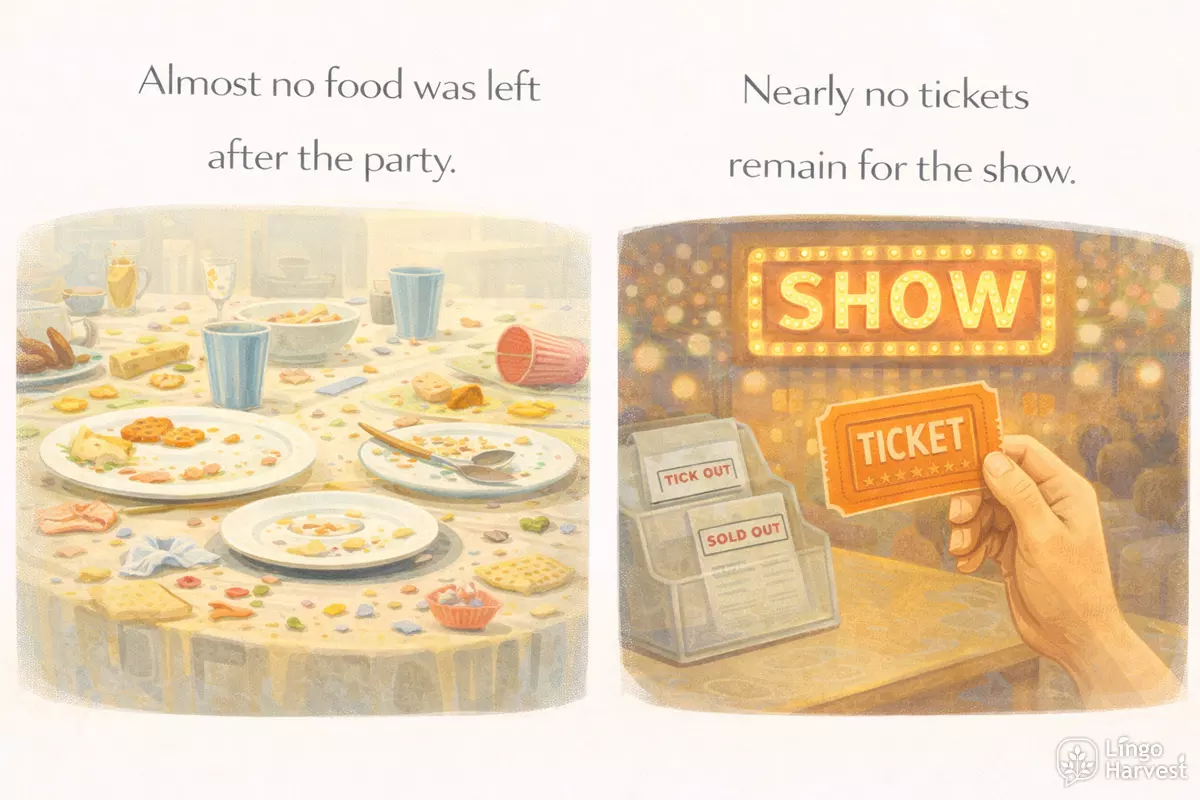
| Almost no | Extremely small amount; barely present | Almost no food was left after the party. | Describing leftovers, resources, options |
| Nearly no | Very close to none; not quite zero | Nearly no tickets remain for the show. | Emphasizing scarcity, attendance, quantities |
| No | Zero; none at all | No errors were found. | Absolute absence |
| Hardly any | Just a trace; almost not worth mentioning | Hardly any rain fell this month. | Natural phenomena, supplies, attendance |
In summary, these expressions help speakers convey the idea that something exists in such a tiny quantity that, for practical purposes, it can be ignored—while still not being completely absent.
Degree of emphasis and implication
When comparing "almost no" and "nearly no," the nuance comes down to how strongly each phrase suggests scarcity or lack. Both can indicate a very small quantity, but the tone and subtle message they convey may differ depending on context. Understanding these differences helps you choose the right phrase for the mood or precision you want.
Strength of Suggestion
"Almost no" often feels slightly more emphatic, giving the impression that the amount is so small it’s barely worth mentioning. "Nearly no," in contrast, can come across as a bit softer or more tentative, suggesting a small amount, but perhaps leaving open the possibility of some presence. This distinction becomes more apparent in negative or critical contexts, where "almost no" might sound more absolute.
| Expression | Implication | Sample Context |
|---|---|---|
| Almost no | Emphasizes a near-total lack; sounds more final or absolute | There was almost no food left after the event. |
| Nearly no | Suggests a very small amount, but a trace or exception is possible | There was nearly no traffic this morning. |
| Almost no | Implies an expectation that something should be present, but isn’t | The instructions provided almost no help. |
| Nearly no | Might hint at a gradual decrease or a rare occurrence | Nearly no one attended the meeting. |
When Subtlety Matters
Writers and speakers sometimes prefer "nearly no" to soften a statement, making it less blunt or critical. "Almost no" is chosen when you want to underscore the lack or highlight a shortfall. This distinction can affect the emotional tone or politeness of your sentence.
- "Almost no" can feel more dramatic or urgent.
- "Nearly no" may sound more measured or factual.
- In technical writing, "almost no" is often used to stress negligible quantities.
- In everyday conversation, "nearly no" can help avoid sounding too harsh.
- For negative feedback, "almost no" may seem more direct.
- For describing trends, "nearly no" can imply a softer decline.
- Both phrases are rarely used for exact figures, favoring general impressions.
- Context and intent determine which is more appropriate.
- Formality levels are similar, but "nearly no" fits better in diplomatic contexts.
- Regional preferences may slightly influence usage but are generally interchangeable.
Choosing between these expressions shapes how your message is received—whether it feels categorical, gentle, or somewhere in between.
Tone differences in neutral contexts
When comparing “almost no” and “nearly no” in statements without emotional charge or dramatic emphasis, subtle distinctions in tone can emerge. Both phrases convey a very small quantity, but their connotations and naturalness can shift depending on the setting and what the speaker wants to suggest.
Naturalness and Formality
In everyday speech, “almost no” is more common and tends to sound slightly more conversational. “Nearly no” appears less frequently and can feel a touch more formal or measured. The difference is minor, but it can influence how a sentence is received.
- “There was almost no traffic this morning.” (casual, straightforward)
- “There was nearly no traffic this morning.” (slightly more reserved)
Implied Precision and Subjectivity
“Nearly no” sometimes hints at a more deliberate assessment, as if the speaker has weighed the situation carefully. “Almost no” can sound a bit more spontaneous or offhand.
- “Almost no errors were found in the report.” (general observation)
- “Nearly no errors were found in the report.” (mildly emphasizes thoroughness)
Comparative Overview
For a clearer look at the nuanced differences in tone and usage, see the table below:
| Phrase | Typical Tone in Neutral Statements | Example |
|---|---|---|
| almost no | Casual, common, slightly more relaxed | “There’s almost no sugar left.” |
| nearly no | More formal, careful, sometimes slightly distant | “There’s nearly no sugar left.” |
| almost no | Neutral, used in both speech and writing | “Almost no changes were made.” |
| nearly no | Subtle emphasis on precision or rarity | “Nearly no changes were made.” |
Summary of Subtle Effects
- “Almost no” feels accessible and direct in most settings.
- “Nearly no” may suggest careful measurement or a more formal register.
- Both are correct, but one may fit more naturally depending on the context and the speaker’s intent.
Choosing between these expressions rarely changes the factual meaning, but it can shape the nuance and perceived tone of a neutral statement.
Sentence position and structure
Writers and speakers often choose between "almost no" and "nearly no" based on where the phrase appears in a sentence and how it interacts with other elements. Both expressions usually function as quantifiers before nouns, but subtle differences can emerge depending on syntax, emphasis, and rhythm.
Typical placements and flexibility
Most commonly, these phrases come directly before a noun to indicate scarcity or minimal quantity. However, their placement can influence the tone or clarity of a statement. For example:
- Almost no students attended the meeting.
- There were nearly no complaints after the event.
- She has almost no free time these days.
- We encountered nearly no resistance during the process.
Both phrases tend to precede the noun, but "almost no" is slightly more flexible and can appear in more casual or spoken contexts, whereas "nearly no" often sounds a bit more formal or literary.
Comparing structures: flexibility and nuance
The choice between these two expressions can subtly shift the sentence's rhythm or emphasis. In some cases, "almost no" allows for split constructions or parenthetical insertions, while "nearly no" is usually kept together for clarity. Consider the following comparison:
| Pattern | Example |
|---|---|
| Direct quantifier + noun | Almost no rain fell last month. |
| Quantifier after subject/verb | There were nearly no errors in the report. |
| Split by adverbial/parenthetical | She has, honestly, almost no patience left. |
| Used in negative emphasis | They showed nearly no interest at all. |
Common usage patterns
Writers may choose one phrase over the other for stylistic reasons or to fit a particular sentence model. Here are some common patterns:
- Subject + "has" + [quantifier] + noun: She has almost no friends here.
- "There is/are" + [quantifier] + noun: There are nearly no options left.
- Object + [quantifier] + noun: We faced almost no problems.
- Adverbial placement for emphasis: Almost no one understood the instructions.
- Formal report style: Nearly no data supports this claim.
- With adjectives: Almost no visible difference.
- Negative reinforcement: Nearly no improvement was seen.
- Comparative contexts: This year, almost no snow compared to last year.
- Highlighting rarity: There are almost no cases like this.
- Colloquial speech: I have almost no idea what happened.
Summary of structural tendencies
Both "almost no" and "nearly no" typically appear before nouns, acting as quantifiers of near-zero amount. "Almost no" is slightly more adaptable to informal speech and can be used in a wider variety of sentence structures, while "nearly no" often feels more measured or precise. The choice of phrase and its position can subtly adjust the nuance and flow of your sentences.
Use with countable and uncountable nouns
Both "almost no" and "nearly no" can be used to express scarcity, but their application varies slightly depending on whether the noun is countable or uncountable. The choice can subtly affect the nuance of your sentence, so it's helpful to understand how each functions in these contexts.
Countable nouns
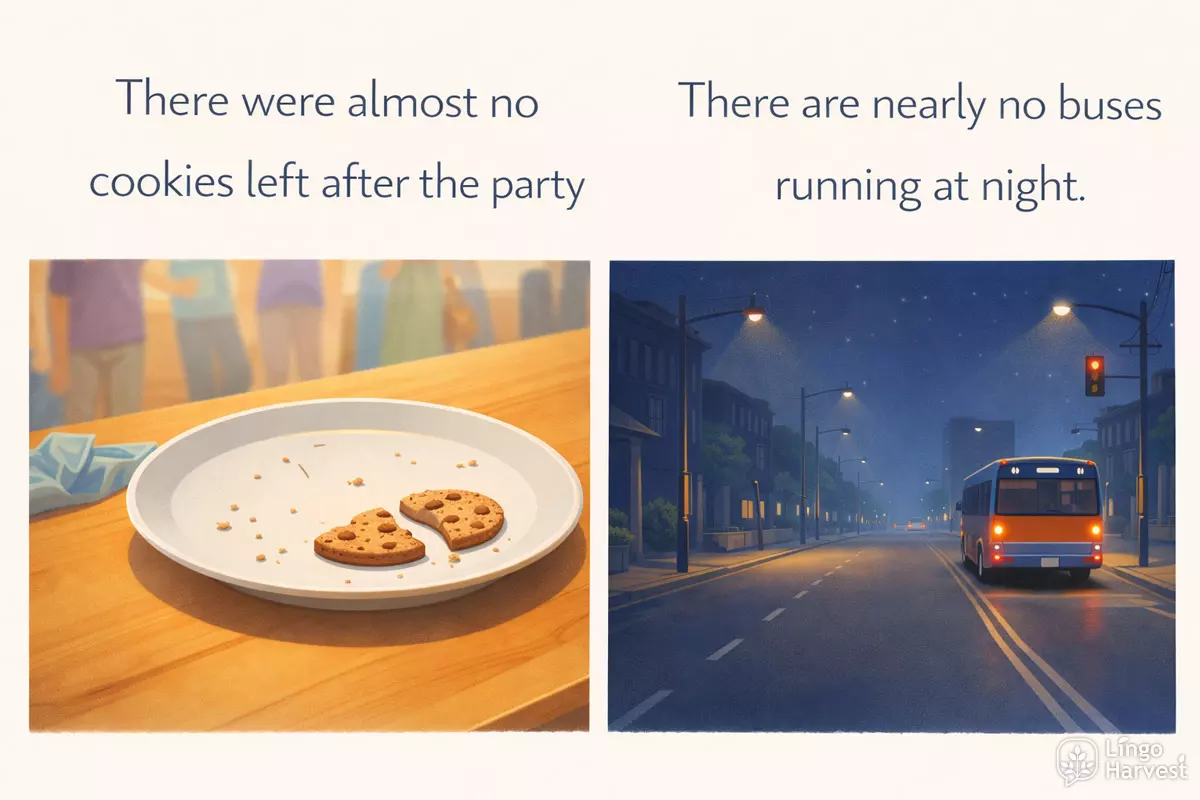
When referring to things that can be counted individually, such as "books," "people," or "cars," both phrases are grammatically correct. They both emphasize a very small number — often to the point of being negligible. However, "almost no" is more common and sounds more natural in everyday speech.
- There were almost no cookies left after the party.
- There are nearly no buses running at night.
- He has almost no friends in this city.
- She made nearly no mistakes on the test.
Uncountable nouns
For substances or concepts that cannot be counted individually, like "water," "money," or "hope," both "almost no" and "nearly no" can be used. Again, "almost no" tends to sound more natural. These expressions stress an extreme lack or near absence of the thing mentioned.
- There is almost no sugar in this tea.
- We have nearly no information about the event.
- She showed almost no interest in the topic.
- They had nearly no time to prepare.
Comparison overview
To clarify the usage patterns, here’s a summary of how each phrase typically pairs with different types of nouns:
| Phrase | Example with Countable | Example with Uncountable |
|---|---|---|
| almost no | almost no chairs | almost no water |
| nearly no | nearly no options | nearly no evidence |
Quick tips
- Both forms are correct with both noun types, but "almost no" is more idiomatic in most situations.
- If you want extra emphasis on scarcity, either phrase works, but "almost no" tends to sound slightly stronger or more definite.
- Choose based on what sounds natural in your sentence and context.
Common learner confusion points
Navigating the subtle distinctions between "almost no" and "nearly no" often leads to uncertainty for English learners. Many wonder whether these phrases are always interchangeable, and which sounds more natural in different contexts. Others struggle to sense the slight differences in emphasis or tone, especially when dealing with negative statements or quantifying small amounts.
When are they interchangeable?
Both expressions generally mean "hardly any" or "very little," but not always. In many everyday sentences, you can swap them without changing the core meaning. However, nuances in formality, frequency, and collocation can create confusion.
| Expression | Typical usage & nuance |
|---|---|
| Almost no | Neutral, slightly more common in both spoken and written English; can feel more definite or emphatic. |
| Nearly no | Used less often, sometimes sounds a bit more formal or tentative; can feel slightly softer. |
| Almost no difference | Emphasizes the lack of distinction; common in comparisons. |
| Nearly no time | Highlights a scarcity of time; "almost no time" is more frequent, but both are possible. |
| Almost no one | Very common to refer to people; "nearly no one" is possible but less natural. |
| Nearly no evidence | Often used in formal contexts; "almost no evidence" is also used, but "nearly" can soften the statement. |
Frequent learner questions
- Is "almost no" always stronger than "nearly no"? Not always; the difference is subtle and context-dependent.
- Can both be used with countable and uncountable nouns? ✅ Yes, but "almost no one" is much more common than "nearly no one."
- Are there situations where only one sounds natural? ✅ Yes, collocations matter. For example, "almost no one" is preferred over "nearly no one."
- Does "nearly no" sound more polite or less direct? Sometimes, especially in formal writing.
- Can both be used in questions? Rarely—these phrases are typically used in statements.
Typical confusion patterns
Learners often overuse one phrase, assuming it fits every situation, or avoid "nearly no" because it feels less familiar. Another common issue is not recognizing when native speakers favor one over the other due to collocation preferences. For example, "almost no reason" is much more idiomatic than "nearly no reason."
- "Almost no water was left." (natural)
- "Nearly no water was left." (acceptable, but less frequent)
- "Almost no students attended." (very common)
- "Nearly no students attended." (possible, but less idiomatic)
- "Almost no hope remained." (preferred)
- "Nearly no hope remained." (less common)
- "Almost no mistakes." (frequent)
- "Nearly no mistakes." (also possible, but slightly less usual)
- "Almost no traffic." (natural)
- "Nearly no traffic." (less used, but correct)
- "Almost no light." (idiomatic)
- "Nearly no light." (less common)
These subtle preferences are not strict rules, but they do affect how natural your English sounds. Listening to native usage and reading widely will help you internalize the typical patterns over time.
Examples showing contrast clearly
Understanding the subtle distinctions between "almost no" and "nearly no" often comes down to their nuance in real sentences. Both phrases express minimal quantity, but their connotations and use can shift slightly depending on context. Exploring authentic examples helps make these differences tangible.
Comparing "Almost No" and "Nearly No" in Sentences
When used in context, "almost no" can sometimes feel more absolute or final, while "nearly no" may sound slightly softer or less categorical. Let's look at how each phrase appears in everyday language:
- There was almost no food left after the party. (Suggests the food was practically gone.)
- There was nearly no food left after the party. (Implies very little remained, but perhaps a tiny bit more than "almost no".)
- He showed almost no interest in the topic. (His interest was close to zero.)
- She paid nearly no attention during the meeting. (Her attention was minimal, but maybe not quite zero.)
- There is almost no traffic at this hour. (The roads are essentially empty.)
- There is nearly no difference between the two products. (The difference is extremely small, but might exist.)
- Almost no students attended the optional workshop. (Attendance was very low, likely only one or two present.)
- We have nearly no time left to finish the project. (Time is extremely limited, but not fully gone.)
- The solution had almost no effect on the outcome. (It did not change much at all.)
- The team had nearly no hope of winning after halftime. (Hope was very low, but maybe not completely lost.)
Side-by-Side Comparison
For clarity, here's a structured look at how these phrases can subtly shift meaning depending on the sentence:
| With "Almost No" | With "Nearly No" |
|---|---|
| There was almost no rain this month. | There was nearly no rain this month. |
| The recipe needs almost no sugar. | The recipe needs nearly no sugar. |
| She has almost no experience in coding. | She has nearly no experience in coding. |
| The device requires almost no maintenance. | The device requires nearly no maintenance. |
Key Takeaways from the Examples
- "Almost no" often sounds more definitive, as if what follows is at the very edge of nonexistence.
- "Nearly no" may leave room for a tiny exception or trace, suggesting the quantity or degree is minuscule but not quite zero.
- In many cases, the two can be swapped with little change in meaning, but in sensitive contexts (like scientific writing or emotional statements), the nuance can affect interpretation.
These patterns help speakers and writers choose the phrase that best fits the intended level of emphasis or precision.
Practice: selecting the correct form
Understanding when to use "almost no" versus "nearly no" can be tricky, especially since the difference is subtle and often nuanced by context or tone. This section provides practical exercises to help you choose the correct expression depending on the sentence and meaning you wish to convey.
Read each sentence below and decide whether "almost no" or "nearly no" fits best. Consider the level of formality, naturalness, and the slight difference in emphasis. Sometimes, both forms are possible, but one may sound more idiomatic.
Fill in the Blank
- There were ________ cookies left when I arrived at the party.
- The teacher gave ________ homework over the holiday break.
- After the long drought, there was ________ water in the lake.
- ________ one noticed the mistake in the report.
- On Sunday morning, there are ________ cars on the road.
- She had ________ time to prepare for the presentation.
- The factory produced ________ waste after the upgrade.
- There was ________ traffic during the early hours.
- ________ students failed the final exam.
- The meeting generated ________ interest among employees.
Show answers
- almost no
- almost no
- nearly no
- Almost no
- nearly no
- almost no
- almost no
- nearly no
- almost no
- nearly no
Choose the Most Natural Option
For each pair, select the sentence that sounds more natural in everyday English.
-
- A) There are almost no seats left in the theater.
- B) There are nearly no seats left in the theater.
-
- A) She has almost no experience in this field.
- B) She has nearly no experience in this field.
-
- A) We have nearly no time to finish the project.
- B) We have almost no time to finish the project.
-
- A) After midnight, there are almost no buses.
- B) After midnight, there are nearly no buses.
-
- A) He showed almost no interest in the discussion.
- B) He showed nearly no interest in the discussion.
-
- A) There was nearly no noise in the library.
- B) There was almost no noise in the library.
-
- A) The town has almost no public transport.
- B) The town has nearly no public transport.
-
- A) She made almost no progress this semester.
- B) She made nearly no progress this semester.
-
- A) There are nearly no job openings right now.
- B) There are almost no job openings right now.
-
- A) He has almost no patience with delays.
- B) He has nearly no patience with delays.
Show answers
- A
- A
- B
- A
- A
- B
- A
- A
- B
- A
Common Usage Patterns
Here are some typical contexts where one form is usually preferred over the other:
- Almost no is more common in negative statements about quantities, especially in informal speech.
- Nearly no may appear in more formal or written contexts, or when emphasizing approximation.
- Both can often substitute for each other, but "almost no" tends to sound more natural in everyday conversation.
| Context | Preferred Form | Example |
|---|---|---|
| Casual conversation | almost no | There was almost no milk left. |
| Formal writing | nearly no | The experiment yielded nearly no results. |
| Emphasizing scarcity | almost no | We had almost no hope of finishing on time. |
| Describing absence in reports | nearly no | There were nearly no errors detected. |
Practice Sentences
Try rephrasing the following sentences using the appropriate form ("almost no" or "nearly no").
- There are very few options available.
- The team made very little progress.
- Hardly anyone attended the event.
- Scarcely any light entered the room.
- Very few students passed the exam.
- There was very little interest in the proposal.
- Hardly any information was shared.
- Scarcely any money was left after the trip.
- Very few people noticed the change.
- There was very little time to react.
Show answers
- There are almost no options available.
- The team made almost no progress.
- Almost no one attended the event.
- Nearly no light entered the room.
- Almost no students passed the exam.
- There was almost no interest in the proposal.
- Almost no information was shared.
- Nearly no money was left after the trip.
- Almost no one noticed the change.
- There was almost no time to react.