Quantifiers Used Without Nouns: Pronoun Usage Explained

 Here we how quantifiers can fully replace nouns, distinguishes between their pronoun and determiner uses, lists common standalone quantifiers, discusses context and clarity, explains singular and plural meanings, highlights common learner mistakes, and…
- When quantifiers replace nouns entirely
- Difference between pronoun and determiner use
- Common standalone quantifiers in English
- Context requirements for clarity
- Singular and plural reference interpretation
- Typical learner mistakes with missing nouns
- Examples of natural standalone usage
- Practice: rewriting sentences using quantifiers alone
Have you ever noticed that we often use words like many or some to indicate amounts or quantities without actually naming the things we’re referring to? This interesting feature of English allows us to communicate efficiently and clearly, especially when the context makes the meaning obvious. Words such as many, some, few, and several can function as pronouns, standing in for nouns that have already been mentioned or are easily understood. Understanding how these expressions work can help you use English more naturally and effectively in everyday conversation.
When quantifiers replace nouns entirely
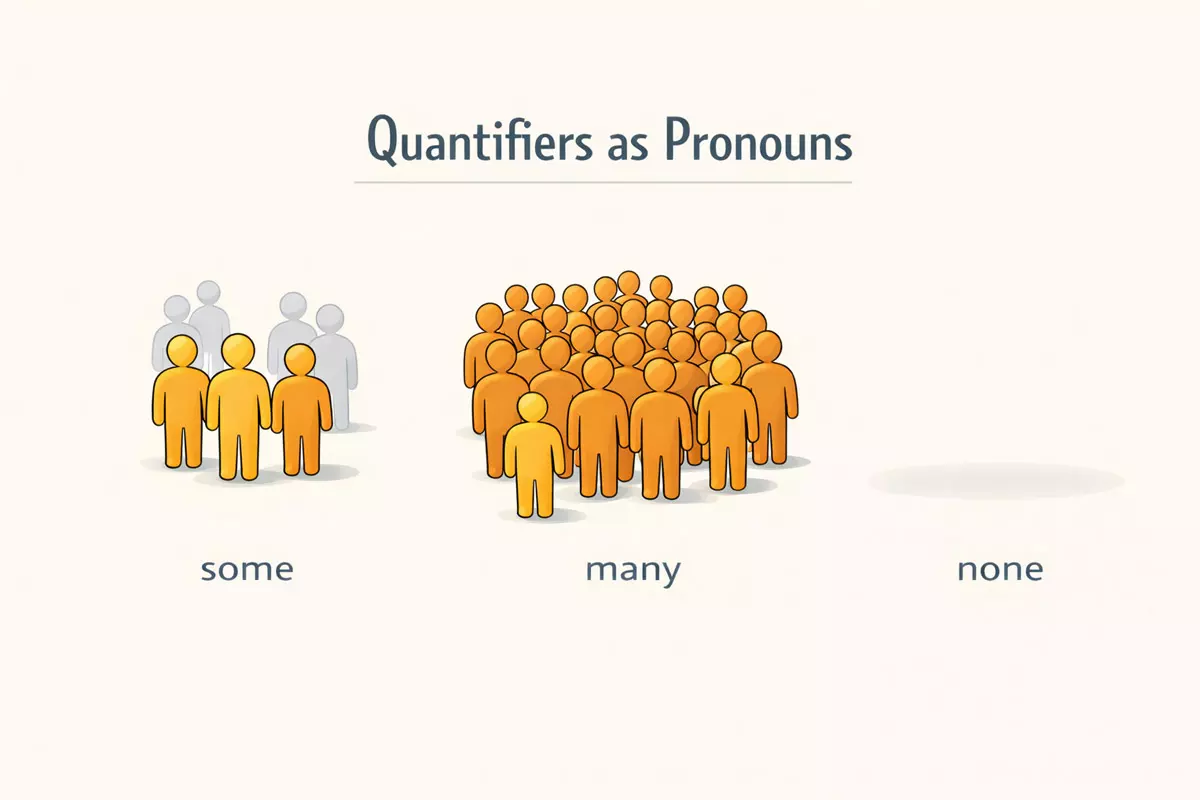
Sometimes, quantifiers do more than just describe a noun—they stand in for the noun itself. In these cases, words like some, many, all, none, and others act as pronouns, making the sentence shorter and avoiding repetition. This usage is especially common when the noun has already been mentioned or is clear from context.
How quantifiers function as pronouns
When quantifiers are used alone, they refer back to a previously mentioned group or item. For example, after talking about "books," you might say, "Many were interesting," where "many" stands in for "many books." This helps keep language concise and avoids unnecessary repetition.
- Some (referring to a previously mentioned group): "Some arrived early."
- Most: "Most left before sunset."
- None: "None passed the test."
- All: "All agreed with the decision."
- Both: "Both were delicious."
- Few: "Few understood the instructions."
- Several: "Several volunteered to help."
- Many: "Many disagreed."
- Much (generally for uncountable nouns): "Much was left unsaid."
- Each: "Each responded differently."
- Either: "Either will do."
- Neither: "Neither was correct."
- One: "One stayed behind."
- Another: "Another joined later."
- Others: "Others continued working."
Common patterns and considerations

The meaning of the quantifier remains tied to the original noun, even when the noun is omitted. Context is key—without it, the listener or reader may not know what group or thing the quantifier refers to. This pattern is especially useful in conversation and writing for avoiding repetition.
| Quantifier as Pronoun | Refers to… | Example Sentence |
|---|---|---|
| Some | People/Things previously mentioned | Some were missing. |
| None | All of the group | None passed the test. |
| All | Entire group | All are welcome. |
| Both | Two specific items/people | Both were delicious. |
| Several | A number of items/people | Several agreed. |
| Many | Large number | Many have tried. |
| Each | Every individual in a set | Each was unique. |
| Either | One of two | Either is fine. |
| Neither | Not one of two | Neither was correct. |
| Other/Others | Remaining people/things | Others continued working. |
When using quantifiers alone, be mindful of the noun's number and whether it is countable or uncountable. For example, "many" is for countable nouns, while "much" is for uncountable ones. In summary, this pattern streamlines communication and is a natural part of fluent English.
Difference between pronoun and determiner use
Understanding how quantifiers work as pronouns versus determiners helps clarify English sentence structure. When a quantifier stands alone and replaces a noun, it acts as a pronoun. In contrast, when it sits before a noun and modifies it, it functions as a determiner. The distinction relies on whether the noun is present or implied.
Quantifiers as Pronouns
Quantifiers like some, many, all, few, and none can replace nouns entirely. In these cases, the noun is omitted because it’s clear from context. For example, in "Many were missing," many stands alone and refers to people or things previously mentioned.
- Some arrived early. (pronoun: refers to people)
- None remained. (pronoun: refers to items/people)
- Few understood. (pronoun: refers to listeners/readers)
- Several left quickly. (pronoun: refers to a known group)
- Most agreed. (pronoun: refers to participants)
- Much was lost. (pronoun: refers to an unspecified amount)
Quantifiers as Determiners
When quantifiers appear directly before nouns, they’re acting as determiners. They specify or limit the noun’s meaning but do not replace it. For instance, "Many students were missing" uses many as a determiner modifying students.
- Some people arrived early. (determiner + noun)
- None of the answers were correct. (determiner + noun phrase)
- Few listeners understood. (determiner + noun)
- Several options remain. (determiner + noun)
- Most participants agreed. (determiner + noun)
- Much information was lost. (determiner + noun)
Side-by-Side Comparison
| Role | Example | Explanation |
|---|---|---|
| Pronoun | Few stayed. | “Few” replaces a noun (people) and stands alone. |
| Determiner | Few guests stayed. | “Few” modifies the noun “guests.” |
| Pronoun | All left. | “All” stands in for a group already mentioned. |
| Determiner | All members left. | “All” describes which members. |
| Pronoun | Some were late. | “Some” replaces a previously referenced group. |
| Determiner | Some students were late. | “Some” specifies which students. |
Key Takeaways
- Quantifier pronouns stand alone and refer to something already known from context.
- Quantifier determiners always come before nouns and modify them directly.
- Some words, like all, some, and none, can be used in both roles depending on the presence of a noun.
- Context usually makes it clear whether a quantifier is acting as a pronoun or a determiner.
Common standalone quantifiers in English
When quantifiers stand alone—without a following noun—they often act as pronouns, replacing a noun phrase entirely. This makes conversation and writing more concise, especially when the noun is already understood from context. For example, instead of repeating "books," one might simply say "some" or "none."
Typical examples of standalone quantifiers
Many quantifiers can function in this way. Here's a list of some of the most frequently used forms:
- all → All students passed the exam.
- some → Some people are waiting outside.
- none → None of the answers were correct.
- many → Many students like this class.
- much → There isn’t much time left.
- most → Most days are busy for me.
- few → Few people understood the question.
- a few → I have a few minutes to talk.
- several → She made several mistakes.
- both → Both options are possible.
- each → Each student has an ID card.
- either → Either answer is acceptable.
- neither → Neither option is correct.
- one → One problem remains.
- another → Can I have another example?
- others → Some people stayed, others left.
- enough → We have enough food for everyone.
- plenty → There is plenty of time.
These words often appear in responses, short answers, or when it's clear what group or item is being discussed. For instance: "Do you want any cookies?" — "Just a few, thanks."
Usage patterns and meaning
Standalone quantifiers can refer to people, objects, or abstract items, depending on context. They help avoid repetition and keep sentences flowing smoothly. For example:
- "Many have tried, but few have succeeded."
- "Would you like some?"
- "Most agreed with the proposal."
- "Neither was available."
Notice how the noun is omitted, but the meaning remains clear due to the shared context.
Comparing quantifier meanings
To clarify how these pronoun-like quantifiers differ in meaning and usage, see the table below:
| Quantifier | Typical Meaning/Usage |
|---|---|
| all | Every person or thing in a group (e.g., "All were invited.") |
| some | An unspecified part of a group (e.g., "Some arrived late.") |
| none | Not any; zero (e.g., "None were suitable.") |
| most | The majority (e.g., "Most agreed.") |
| few | Not many; a small number (e.g., "Few understood the question.") |
| either | One or the other (e.g., "Either is fine.") |
| neither | Not one and not the other (e.g., "Neither was correct.") |
| enough | Sufficient quantity (e.g., "Enough were present.") |
Special notes on usage
Some quantifiers, such as "each," "either," and "neither," are mostly used when referring to two items or people. Others, like "much" and "many," depend on whether the implied noun is countable or uncountable. Context is always key: the listener or reader must be able to infer what is being referenced for the standalone quantifier to make sense. In summary, using quantifiers as pronouns streamlines communication and avoids unnecessary repetition, provided the context is clear.
Context requirements for clarity
When quantifiers like "some," "many," "few," or "none" are used without a following noun, their meaning often depends on surrounding information. Readers or listeners rely on context to determine exactly what is being referenced. Without clear context, these pronoun-like uses can lead to ambiguity or confusion.
How context shapes understanding
Imagine hearing, "I took some," or "She has many." Unless you know what was available to take or what she has in abundance, the statements are incomplete. English speakers expect the missing noun to be clear from previous sentences or shared knowledge. This is why these quantifiers function almost like pronouns—they stand in for something already identified or easily inferred.
Common scenarios needing context
- After a noun has been mentioned: "We have apples and oranges. I prefer the red ones, but she wants some."
- In answers to questions: "How many cookies are left?" "A few."
- When referring back to a visible or shared situation: "There are several options. I’ll take any."
- During instructions or offers: "Would you like more?" "No, I already have enough."
- In comparisons: "Some are bigger than others."
- With negatives: "None are missing."
- When expressing preference: "I like both."
- Describing availability: "Many are sold out."
- In summaries: "Most are easy to understand."
- With totals or parts: "All are accounted for."
Potential pitfalls without clear context
If the referent is not obvious, listeners may have to guess or ask for clarification. For instance, saying "I want more" in a room with both cake and juice leaves your audience unsure which you mean. Similarly, "None were chosen" requires the reader to know what group or items are being discussed.
Quantifiers as pronouns: summary table
| Quantifier | Context needed to clarify meaning |
|---|---|
| Some | What items or people are being referred to? |
| None | Which group is excluded? |
| Many | How large or which set is implied? |
| Few | Few of what? Clarifies the subject or object. |
| All | Specifies the totality—what is included? |
| Both | Which two things, people, or groups? |
| Any | What options or possibilities are open? |
| Several | Which specific items in a larger set? |
| Much | Amount of what? Needs a reference point. |
| Most | The majority of which group or things? |
In summary, using quantifiers without explicit nouns is natural in conversation, but always requires enough information in the surrounding text or speech for the audience to understand what is meant. When in doubt, add a clarifying phrase or restate the noun to ensure your meaning is unmistakable.
Singular and plural reference interpretation
Understanding how quantifiers without explicit nouns connect to singular or plural ideas is key to using them naturally. When a quantifier stands alone (as in “many,” “each,” “several,” or “none”), its meaning and the pronoun it refers to depend on context, number, and the implied noun. This impacts whether we use singular or plural verbs and pronouns in the sentence.
How context shapes number interpretation
Often, the quantity implied by a standalone quantifier is understood from earlier conversation or writing. For example, “Many arrived early” suggests “many people,” while “Each was given a ticket” refers to “each person.” The verb form and any following pronoun (“they,” “it,” etc.) should match the implied number.
Common quantifiers and their reference patterns
- All – usually plural: “All were present.” (implies people/things)
- Some – can be singular or plural, but often plural: “Some have left.”
- None – can be singular or plural, depending on context: “None is missing” (if referring to a singular noun), “None are missing” (if plural)
- Each – always singular: “Each was ready.”
- Every – always singular: “Every is welcome” (rare without a noun, but possible in poetic or informal use)
- Few – plural: “Few remain.”
- Several – plural: “Several have agreed.”
- Many – plural: “Many know the answer.”
- Much – singular, non-count: “Much has changed.”
- Little – singular, non-count: “Little is known.”
- Neither – singular: “Neither was chosen.”
- Both – plural: “Both are correct.”
- Any – can be singular or plural: “Any is fine” (singular, non-count), “Any are fine” (plural, countable, rare)
Reference agreement with pronouns and verbs

Pronoun choice should align with the implied number. For instance, after “few,” use “they”; after “each,” use “he/she/it” or “their” (in singular ‘they’ contexts). Verb agreement follows the same logic: “None was found” vs. “None were found.”
| Quantifier (no noun) | Typical Reference | Example Sentence |
|---|---|---|
| Few | Plural (countable) | Few know the answer. |
| Much | Singular (non-count) | Much has changed. |
| Each | Singular (countable) | Each was invited. |
| All | Plural (usually) | All were present. |
| None | Singular or plural (depends) | None is/are missing. |
| Both | Plural | Both have arrived. |
| Neither | Singular | Neither was accepted. |
| Some | Plural (usually) | Some have left. |
| Several | Plural | Several agreed. |
| Little | Singular (non-count) | Little is known. |
Summary tips
- Match the verb and pronoun with the implied number of the quantifier.
- Listen for context to decide if a quantifier refers to a singular or plural idea.
- When in doubt, consider what noun the quantifier is standing in for.
By following these patterns, you can use quantifiers without nouns accurately and naturally in both speech and writing.
Typical learner mistakes with missing nouns
Learners often struggle when using quantifiers without including the noun they describe. This usually happens when speakers forget that not all quantifiers can stand alone as pronouns, or they apply the rules inconsistently. The result can be awkward, incomplete, or incorrect sentences.
Confusing quantifiers and pronouns
One common issue is using quantifiers like many, few, some, or several without a noun, even though these words usually need one unless they are acting as pronouns. For example, saying "I have many" without context is confusing, unless it is clear what "many" refers to from the previous conversation.
- Incorrect: "She bought several."
- Correct: "She bought several books."
- Incorrect: "Did you see many?"
- Correct: "Did you see many people?"
When quantifiers can stand alone
Some quantifiers can act as pronouns and replace nouns, but not all. Words like some, all, none, both, and each often work this way. However, learners may overgeneralize and use other quantifiers without nouns where it is ungrammatical.
| Quantifier Used Correctly as Pronoun | Quantifier Requiring a Noun |
|---|---|
| Some arrived early. ✅ | Several arrived early. ❌ (should be "Several people arrived early.") |
| None were missing. ✅ | Much were missing. ❌ (should be "Much food was missing.") |
| Both are correct. ✅ | Few are correct. ❌ (should be "A few answers are correct.") |
| All went home. ✅ | Many went home. ❌ (should be "Many students went home.") |
Omitting the noun when context is unclear
Another pitfall is dropping the noun when the listener or reader does not know what is being referred to. This often leads to confusion, especially in written communication where context may not be obvious.
- Unclear: "I want some."
- Clear: "I want some water."
- Unclear: "Few were chosen."
- Clear: "Few candidates were chosen."
Summary of patterns to watch for
- Using quantifiers alone when a noun is needed
- Forgetting that not all quantifiers can function as pronouns
- Assuming context is always clear when it may not be
- Overusing pronoun forms in formal writing
- Mixing up singular and plural forms after quantifiers
- Using quantifiers with uncountable nouns incorrectly
- Adding unnecessary nouns after pronoun quantifiers
- Relying on spoken context in written text
- Translating directly from other languages with different rules
- Confusing quantifiers with determiners
Paying close attention to when a noun is needed after a quantifier—and when it can be left out—will help learners avoid these frequent errors and communicate more clearly.
Examples of natural standalone usage
In everyday English, certain quantifiers like some, many, none, and all can function independently, taking the place of nouns. This happens most often when the noun is clear from context or has already been mentioned. Using quantifiers as pronouns streamlines conversation and writing, letting speakers avoid unnecessary repetition.
Common standalone quantifiers in context
Here are some of the most frequently used quantifiers that appear without a following noun, along with sample sentences:
- Some: "Would you like some?"
- Many: "Many have tried, few have succeeded."
- Few: "Few know the real story."
- None: "None were left after the sale."
- All: "All are welcome to attend."
- Several: "Several disagreed with the decision."
- Most: "Most prefer coffee over tea."
- Both: "Both enjoyed the concert."
- Each: "Each was given a chance to speak."
- Either: "Either will work for me."
- Neither: "Neither was correct."
- Much: "Much remains to be done."
- More: "More is needed for the project."
- Less: "Less is sometimes more."
- Plenty: "Plenty were available."
Comparison: Quantifiers as pronouns vs. with nouns
When quantifiers are used alone, they often act as pronouns, standing in for a previously mentioned or understood group or amount. The table below contrasts their standalone use with their typical noun-paired forms:
| With Noun | Standalone (Pronoun) |
|---|---|
| Many students arrived early. | Many arrived early. |
| All the cookies are gone. | All are gone. |
| None of the answers were correct. | None were correct. |
| Several people volunteered. | Several volunteered. |
| Each participant spoke. | Each spoke. |
| Few options remain. | Few remain. |
Notice how the meaning stays clear even when the noun is omitted, as long as the context is established. Using quantifiers in this way is especially common in conversation, instructions, and summarizing statements.
Practice: rewriting sentences using quantifiers alone
When quantifiers stand in for nouns, they act like pronouns—helping us avoid repetition and keeping sentences concise. This exercise focuses on transforming sentences that use explicit nouns into sentences where quantifiers replace those nouns entirely. The aim is to become comfortable using expressions like "many," "some," "none," "all," "most," and similar words without repeating the noun each time.
Instructions
Read each original sentence below and then rewrite it using only a quantifier (with no noun after it). This helps you practice using quantifiers as pronouns in everyday English.
- Many students passed the exam.
- Some books are missing from the shelf.
- None of the cookies are left.
- All the tickets were sold out.
- Most people enjoyed the concert.
- Several chairs were broken.
- Few answers were correct.
- Each child received a gift.
- Both options are available.
- Little water remained in the glass.
- Much information was provided.
- Every student finished the test.
- No apples remained in the basket.
- Half the team arrived late.
- Any questions can be asked at the end.
Show answers
- Many passed.
- Some are missing.
- None are left.
- All were sold out.
- Most enjoyed the concert.
- Several were broken.
- Few were correct.
- Each received a gift.
- Both are available.
- Little remained in the glass.
- Much was provided.
- Everyone finished.
- None remained.
- Half arrived late.
- Any can be asked at the end.
Common Quantifiers as Pronouns: Quick Reference
Here’s a reference table showing how typical quantifiers can function without a noun, along with example sentences for clarity.
| Quantifier | Example (with noun) | Example (without noun) |
|---|---|---|
| Some | Some students are absent. | Some are absent. |
| None | None of the answers are correct. | None are correct. |
| All | All the cookies are gone. | All are gone. |
| Most | Most people like music. | Most do. |
| Several | Several books are missing. | Several are missing. |
| Few | Few answers were correct. | Few were correct. |
| Both | Both options are good. | Both are good. |
| Either | Either solution is fine. | Either is fine. |
| Neither | Neither proposal was accepted. | Neither was accepted. |
| Much | Much information was lost. | Much was lost. |
| Little | Little water remained. | Little remained. |
| Any | Any questions can be asked. | Any can be asked. |
Tips for Using Quantifiers Alone
- Ensure the meaning is clear from context; avoid ambiguity when dropping the noun.
- Use quantifiers as pronouns mostly in informal or conversational contexts, unless the referent is obvious.
- Some quantifiers work better than others as stand-alone pronouns ("many" and "much" often need a clear context).
- Review the sentence to be sure the quantifier matches the noun in number and meaning.
Practicing these transformations helps you write and speak more naturally, reducing repetition and making your language smoother.