Food Nouns: Countable or Uncountable? Explained with Examples

 Here we the basics of countable and uncountable food nouns, gives typical examples, explains portion words like a slice or a cup, discusses using much and many with food, points out common mistakes, and includes a noun-labeling practice.
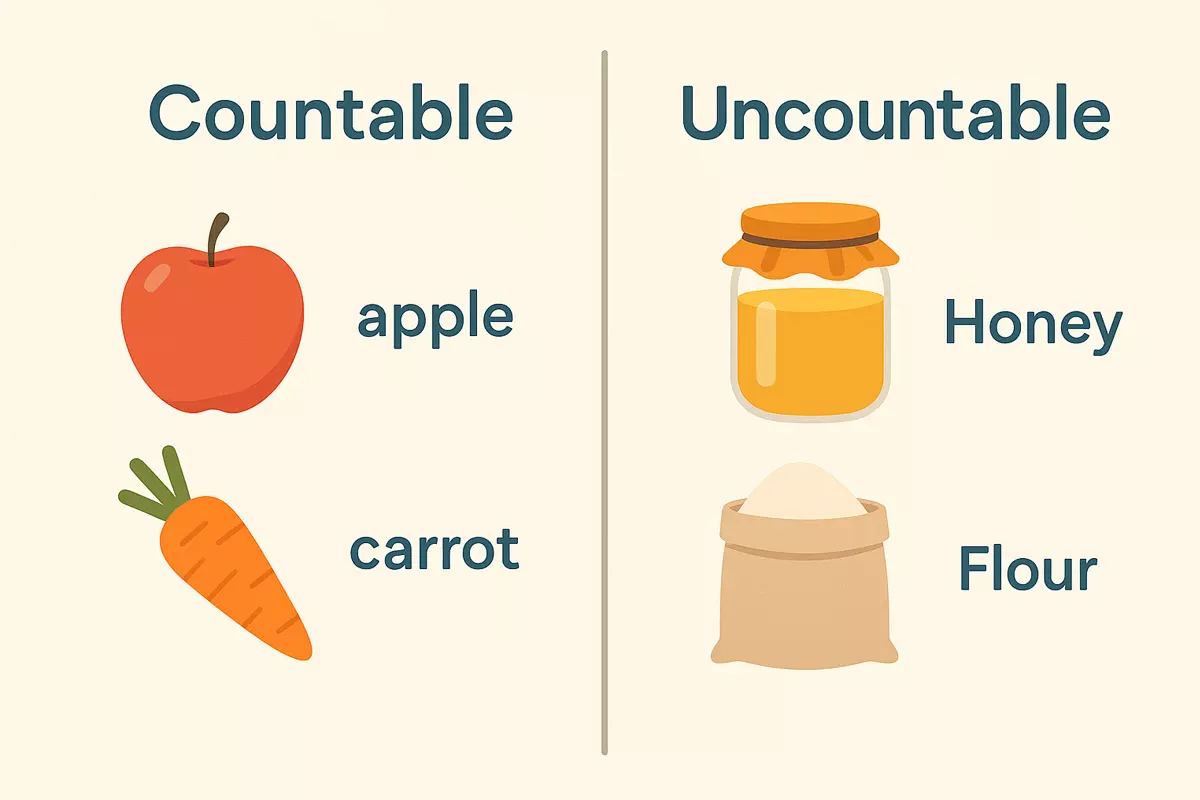
Have you ever noticed that we say a slice of bread but three apples? This difference comes from how English treats countable and uncountable nouns. Countable nouns, like apples or carrots, can be counted individually, so we use numbers directly with them. Uncountable nouns, such as bread, cheese, or rice, refer to things we usually do not count one by one, so we use words like a slice of bread or a piece of cheese to describe amounts. Understanding this distinction helps us talk about food more clearly and naturally in English.
Count vs Noncount Basics
When talking about food in English, some words can be counted as separate units, while others refer to substances or concepts that can’t be divided easily. This distinction affects grammar: for example, whether you use "many" or "much," or if you add an "s" for plurals. Understanding which food nouns are countable or uncountable helps you sound natural and avoid common mistakes.
What Are Countable Food Nouns?
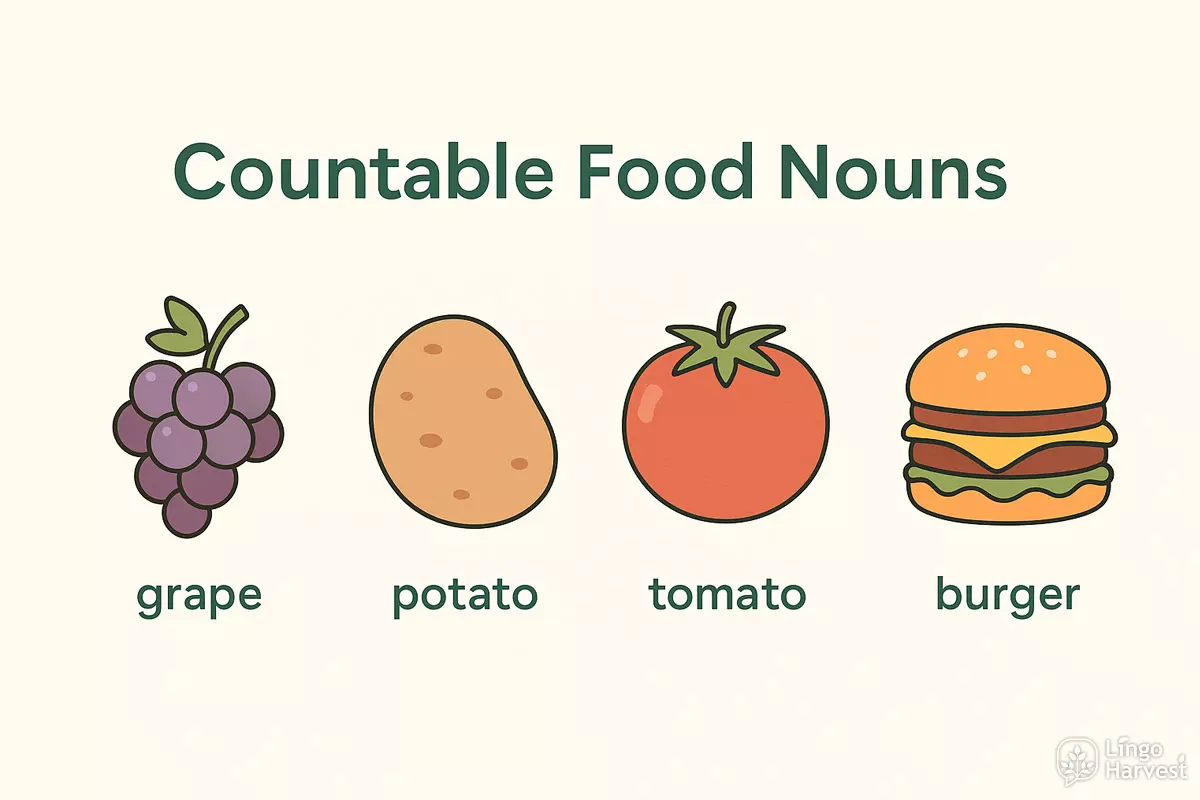
Countable nouns are items you can separate and count individually. You can say "one apple," "three sandwiches," or "ten eggs." These words have both singular and plural forms, and you can use numbers or "a/an" in front of them. Here are some typical examples:
- apple
- carrot
- cookie
- egg
- sandwich
- banana
- bottle (of water/juice)
- grape
- potato
- tomato
- burger
- slice (of bread/pizza)
What Are Noncount (Uncountable) Food Nouns?
Uncountable food nouns refer to substances or concepts that you typically don’t count as separate items. For these, you can’t use "a/an" or add an "s" for plural. Instead, you often use words like "some," "a little," or a container/measure word (e.g., "a glass of water"). Here are some common uncountable food nouns:
- bread
- rice
- cheese
- butter
- milk
- flour
- meat
- water
- coffee
- tea
- honey
- soup
- sugar
- salt
Key Differences: Quick Comparison
| Countable Nouns | Uncountable Nouns |
|---|---|
| Have singular & plural forms (apple/apples) | Usually only singular form (milk, not milks) |
| Use numbers: two eggs, five carrots | Use quantity words: some bread, a little rice |
| Can use "a/an": an orange, a sandwich | Use containers or measures: a glass of water, a slice of cheese |
| Ask "How many...?": How many apples? | Ask "How much...?": How much cheese? |
Some food words can be either, depending on context. For example, "chicken" is uncountable when talking about the meat, but countable when referring to the animal. Similarly, "coffee" is generally uncountable, but you might order "two coffees" in a café, meaning "two cups of coffee." Context and meaning determine which form is correct.
Typical Countable Foods
Many foods in English can be counted as individual units, which means we use numbers and plural forms with them. These are items you can easily separate and count one by one, making them countable nouns. Recognizing these types of foods is essential when using correct grammar, especially with quantifiers like “many,” “a few,” or specific numbers.
Common Examples of Countable Food Nouns
- apple
- egg
- carrot
- sandwich
- cookie
- banana
- grape
- potato
- tomato
- pepper
- sausage
- biscuit
- cherry
- onion
- roll (bread roll)
- shrimp
- muffin
- eggplant
- olive
- steak
These nouns can take an “-s” or “-es” ending for the plural form, as in “apples” or “tomatoes.” You can also use numbers in front: “three eggs,” “six cookies,” or “ten grapes.” This makes it easy to specify exact quantities or ask, “How many muffins are left?”
Patterns and Usage
When talking about these foods, you’ll notice some natural language patterns:
- How many + plural noun: How many sandwiches do you want?
- There are + number + plural noun: There are five carrots in the fridge.
- A few or several + plural noun: We bought a few onions.
| Singular Form | Plural Form |
|---|---|
| apple | apples |
| egg | eggs |
| carrot | carrots |
| cookie | cookies |
| tomato | tomatoes |
| cherry | cherries |
| banana | bananas |
| sausage | sausages |
Understanding which foods are countable helps you avoid mistakes like “much bananas” (❌) and use the correct “many bananas” (✅). With these nouns, you can confidently discuss portions, recipes, and shopping lists in English.
Typical Uncountable Foods
When learning English, it’s important to know that some food words are naturally treated as uncountable. This means you don’t usually put “a” or “an” in front of them, and you can’t make them plural. These items are usually substances, masses, or categories that aren’t seen as individual units.
Common Examples of Uncountable Food Nouns
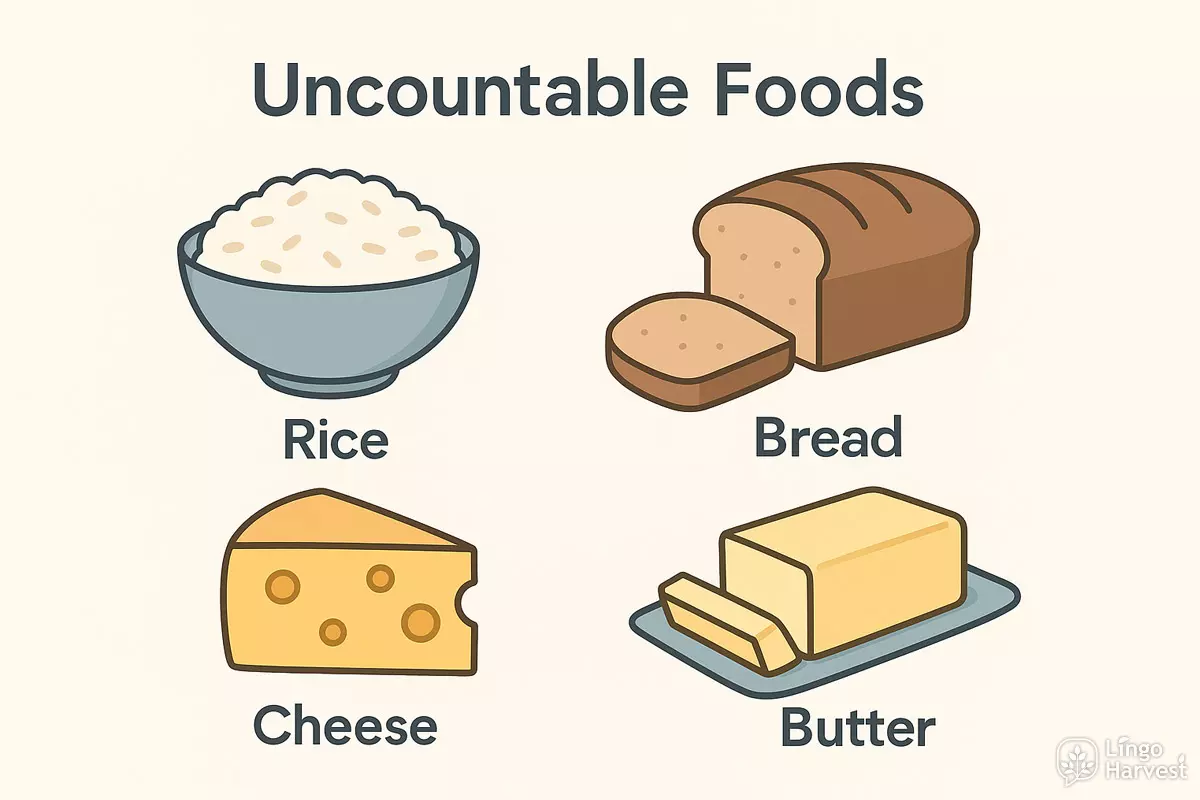
Many foods fall into this group because they refer to general substances or materials, rather than separate things you can count. Here are some of the most frequent examples:
- Rice
- Bread
- Cheese
- Butter
- Milk
- Water
- Tea
- Coffee
- Meat
- Fish
- Fruit (as a category, not individual pieces)
- Salt
- Sugar
- Honey
- Flour
- Oil
- Pepper
- Chocolate (as a substance, not individual bars)
- Soup
- Jam
How to Use Uncountable Food Nouns in Sentences
Uncountable nouns don’t use “a” or “an.” Instead, you can use quantifiers or containers if you want to specify an amount. For example, you would say “some cheese,” “a glass of water,” or “a piece of bread.” If you want to ask about quantity, use “how much” instead of “how many”: How much rice do you need?
Countable vs. Uncountable: Food Examples
Some foods can be both countable and uncountable depending on context. Here’s a comparison:
| Uncountable Form ✅ | Countable Form ✅ |
|---|---|
| Bread (general substance) | A loaf of bread, a slice of bread |
| Cheese (as a mass) | A piece of cheese, different cheeses (types) |
| Chicken (meat) | A chicken (the whole animal) |
| Fruit (as a category) | A fruit (one apple, one orange, etc.) |
| Chocolate (as a substance) | A chocolate (a piece or a candy) |
Notes on Usage
Remember, when you want to refer to a specific amount of these foods, use words like “piece,” “slice,” “glass,” “cup,” or “bottle.” For example: “two slices of bread,” “a cup of tea,” or “three bottles of water.” This helps you talk about quantities without making the food noun itself plural. Understanding how food nouns work in English helps you sound more natural and avoid common mistakes, especially when talking about what you eat or drink.
Portion Words (a slice, a cup)
When talking about food nouns that are not naturally countable, we often use specific words to describe a portion or serving. These measure words help us refer to a certain quantity of something uncountable, making it easy to express amounts clearly. For example, instead of saying “two breads,” which isn’t correct in standard English, we can say “two slices of bread.”
Why Use Portion Words?
Many foods, like rice, butter, or cheese, are considered uncountable in English. To talk about a specific amount, we combine the food noun with an appropriate measure word. This method is useful in recipes, at restaurants, or in daily conversation when you want to be precise about how much of something you need or want.
Common Portion Words with Food
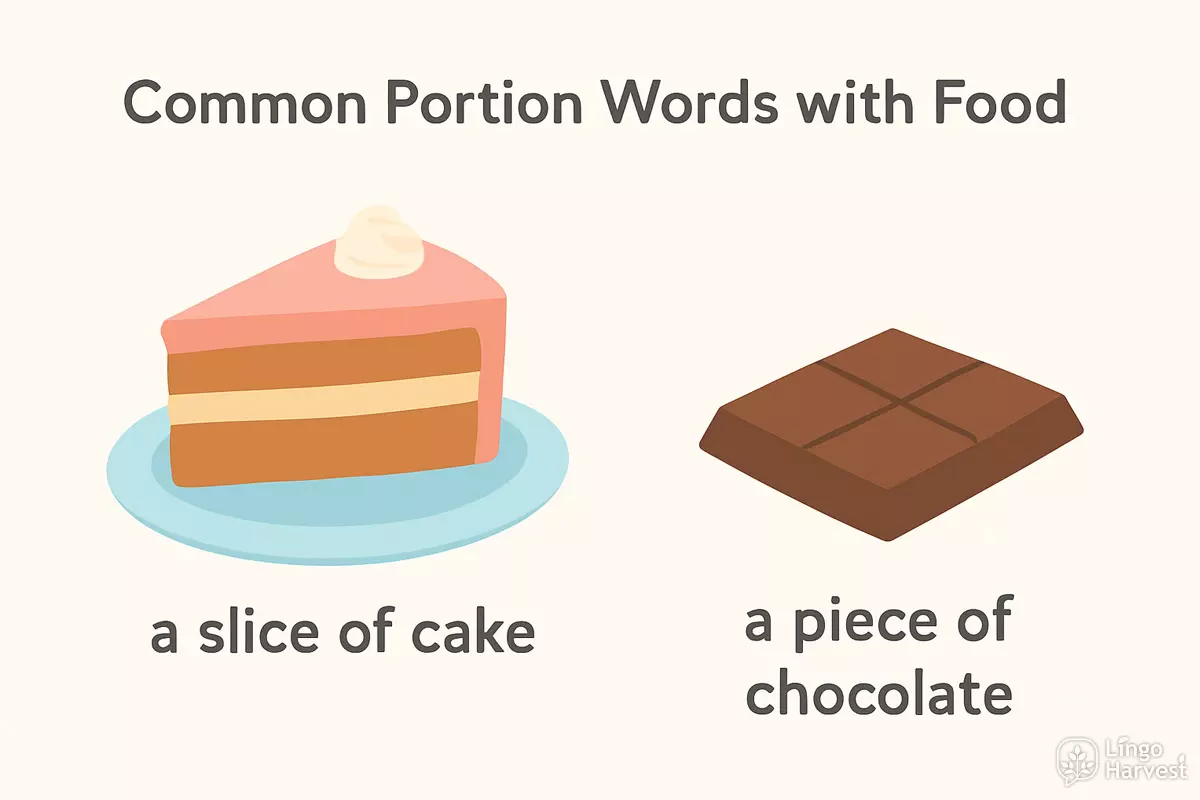
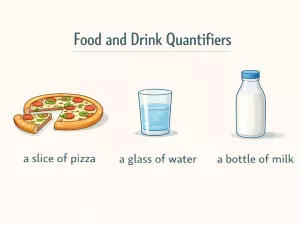
- a slice of cake, cheese, bread, pizza
- a piece of chicken, chocolate, pie, fruit
- a cup of coffee, tea, milk, rice
- a glass of juice, water, wine, soda
- a bottle of water, wine, oil, milk
- a can of soda, beans, soup, tuna
- a bowl of soup, salad, cereal, noodles
- a loaf of bread
- a bar of chocolate, soap (non-food, but structure is similar)
- a packet of sugar, crisps, biscuits
- a teaspoon of sugar, salt, honey
- a handful of nuts, berries, chips
- a stick of butter
- a drop of oil, vinegar, lemon juice
- a scoop of ice cream
- a sheet of pasta (for lasagna, for example)
- a clove of garlic
- a head of lettuce, cabbage
- a bunch of grapes, bananas, parsley
How Portion Words Change Meaning
Choosing the right measure word can clarify what you mean, especially with foods that can be prepared or served in different forms. For instance, “a cup of rice” usually refers to the amount before or after cooking, depending on context, while “a bowl of rice” is more likely the served portion. The word you use can also change the image: “a slice of pizza” versus “a whole pizza.”
| Uncountable Food | Example with Portion Word | Incorrect (without Portion Word) |
|---|---|---|
| Bread | a slice of bread | ❌ two breads |
| Cake | a piece of cake | ❌ three cakes (unless meaning whole cakes) |
| Water | a glass of water | ❌ many waters |
| Rice | a bowl of rice | ❌ two rices |
| Chocolate | a bar of chocolate | ❌ several chocolates (unless meaning candies) |
Tips for Using Portion Words
- Use a measure word when the food item is uncountable and you want to specify an amount.
- Some foods can be both countable and uncountable, depending on meaning (e.g., “ice creams” can mean types or servings, but “ice cream” as a substance is uncountable).
- Choose the portion word that matches the food’s typical form (e.g., “slice” for bread, “glass” for liquids).
In summary, these measure words let you talk about quantities of uncountable foods naturally and precisely. They’re essential for clear communication about food in English.
Much vs Many with Food
Understanding when to use "much" or "many" with food words depends on whether the noun is countable or uncountable. In English, "many" is used with items you can count individually, while "much" is used with substances or foods you cannot count as separate units. This distinction is especially important when talking about quantities, recipes, shopping, or eating habits.
Countable vs Uncountable Food Nouns
Many foods in English are uncountable: you can't count "rice" or "cheese" as one, two, three rices or cheeses. On the other hand, items like "apples" or "eggs" are countable. This affects which word you use to talk about quantity.
- Countable (use "many"): apples, oranges, sandwiches, cookies, carrots, bananas, potatoes, eggs, tomatoes, grapes, candies
- Uncountable (use "much"): rice, water, milk, cheese, bread, sugar, salt, butter, flour, soup, meat
Common Questions and Patterns
When asking about or describing amounts, use the correct term with each type of noun. Here are typical patterns:
- How many strawberries do you want?
- How much juice is left?
- There aren’t many cookies in the box.
- We don’t have much bread.
- Did you buy many eggs?
- She doesn’t eat much cheese.
- How many pieces of pizza did you eat?
- How much coffee do you drink?
- Are there many tomatoes in the salad?
- There isn’t much salt in this soup.
Quick Reference: When to Use Each
| Use "many" with | Use "much" with |
|---|---|
| Countable food nouns: apples, eggs, sandwiches, grapes |
Uncountable food nouns: rice, bread, milk, cheese |
| Questions: How many cookies do you want? |
Questions: How much sugar do you need? |
| Negatives: We don’t have many carrots. |
Negatives: We don’t have much butter. |
| Affirmatives (less common): There are many bananas here. |
Affirmatives (less common): There is much interest in wine tasting. |
Tips for Everyday English
In everyday conversation, "much" is often used in questions and negatives with uncountable foods, while "many" is more common with countable items. For positive statements about large amounts, native speakers often prefer "a lot of" for both types ("a lot of milk," "a lot of apples"), but understanding the difference between "much" and "many" helps you build accurate sentences, especially in formal or careful English.
Common Mistakes
Understanding which food words are countable or uncountable can be tricky, especially for those learning English. Many errors happen because some foods seem like they should be countable, but English treats them differently. Let’s look at some pitfalls to avoid and how to make your sentences more natural.
Mixing Up Countable and Uncountable Forms
Learners often use the wrong article or quantifier with certain food items. Words like "bread" and "rice" are uncountable, while "apple" and "sandwich" are countable. Using "a bread" or "two rices" sounds unnatural in English.
Incorrect Use of Quantifiers
Some quantifiers only work with uncountable food names, while others are for countable ones. For example, "many" is for countable items, and "much" is for uncountable ones. This confusion often leads to awkward sentences.
| Incorrect Usage | Correct Form |
|---|---|
| I have a cheese. | I have some cheese. |
| There are many bread on the table. | There is much bread on the table. |
| Can I have two waters? | Can I have two bottles of water? |
| She bought three milks. | She bought three cartons of milk. |
Forgetting Containers and Portions
Uncountable food nouns often become countable when you talk about portions or containers. For example, "a slice of bread" or "a cup of rice" is correct, but saying "a bread" or "a rice" is not.
- a glass of juice ✅
- a juice ❌
- three pieces of chicken ✅
- three chickens (means whole birds, not pieces) ❌
- a bowl of soup ✅
- a soup (unless referring to a type or serving) ❌
- two slices of pizza ✅
- two pizzas (means two whole pizzas) ✅
- a cup of coffee ✅
- a coffee (means a cup/serving in cafes, but not the substance) → context matters
Pluralizing Uncountable Food Nouns
Adding “-s” to words like "rice," "bread," or "butter" is a frequent error. These foods do not have plural forms unless you are talking about types (e.g., "different cheeses" for varieties).
Confusing Types and Quantities
Sometimes, food nouns can be countable when referring to types or varieties, but uncountable when talking about the food in general. For example:
- We tried several wines at the festival. (types)
- Would you like some wine? (the drink in general)
- The shop offers many cheeses. (types)
- There is some cheese in the fridge. (the substance)
Paying attention to these patterns will help you use food vocabulary more naturally and avoid awkward phrases. Practice with real examples, and remember to use containers or portions for uncountable foods when you need to count them.
Practice: Label the Nouns
Understanding whether a food noun is countable or uncountable can help you use correct grammar in English. Let’s put this into practice with some everyday words and sentences. Below, you’ll find exercises where you can identify and label nouns as countable or uncountable. This will help reinforce your ability to recognize the difference.
Identify Each Food Noun
Read the following list. For each item, decide if it is a countable or uncountable noun:
- apple
- cheese
- rice
- egg
- bread
- banana
- milk
- carrot
- water
- sandwich
- butter
- chicken (as meat)
- grape
- meat
- potato
- tea
- salad
- soup
- orange
- jam
Show answers
- apple – countable
- cheese – uncountable
- rice – uncountable
- egg – countable
- bread – uncountable
- banana – countable
- milk – uncountable
- carrot – countable
- water – uncountable
- sandwich – countable
- butter – uncountable
- chicken (meat) – uncountable
- grape – countable
- meat – uncountable
- potato – countable
- tea – uncountable
- salad – countable
- soup – uncountable
- orange – countable
- jam – uncountable
Label the Nouns in Sentences
Now, look at the food nouns in these sentences. Write if they are countable or uncountable.
- There is some bread on the table.
- I have three apples in my bag.
- Would you like a cup of tea?
- She bought two sandwiches for lunch.
- We need more rice.
Show answers
- bread – uncountable
- apples – countable
- tea – uncountable
- sandwiches – countable
- rice – uncountable
Quick Reference Table: Countable vs Uncountable Food Nouns
Here’s a comparison of some common food words to help you review:
| Countable Nouns | Uncountable Nouns |
|---|---|
| apple | cheese |
| egg | rice |
| banana | milk |
| sandwich | bread |
| carrot | butter |
| grape | meat |
| potato | water |
| orange | jam |
| salad | tea |
| sandwich | soup |
Review these examples to strengthen your understanding. Notice that many foods in their natural, whole form are countable (like “apple” or “egg”), while foods that are liquids, powders, or masses tend to be uncountable (such as “milk” or “rice”).