Quantifiers in Academic and Formal Writing: Style and Precision

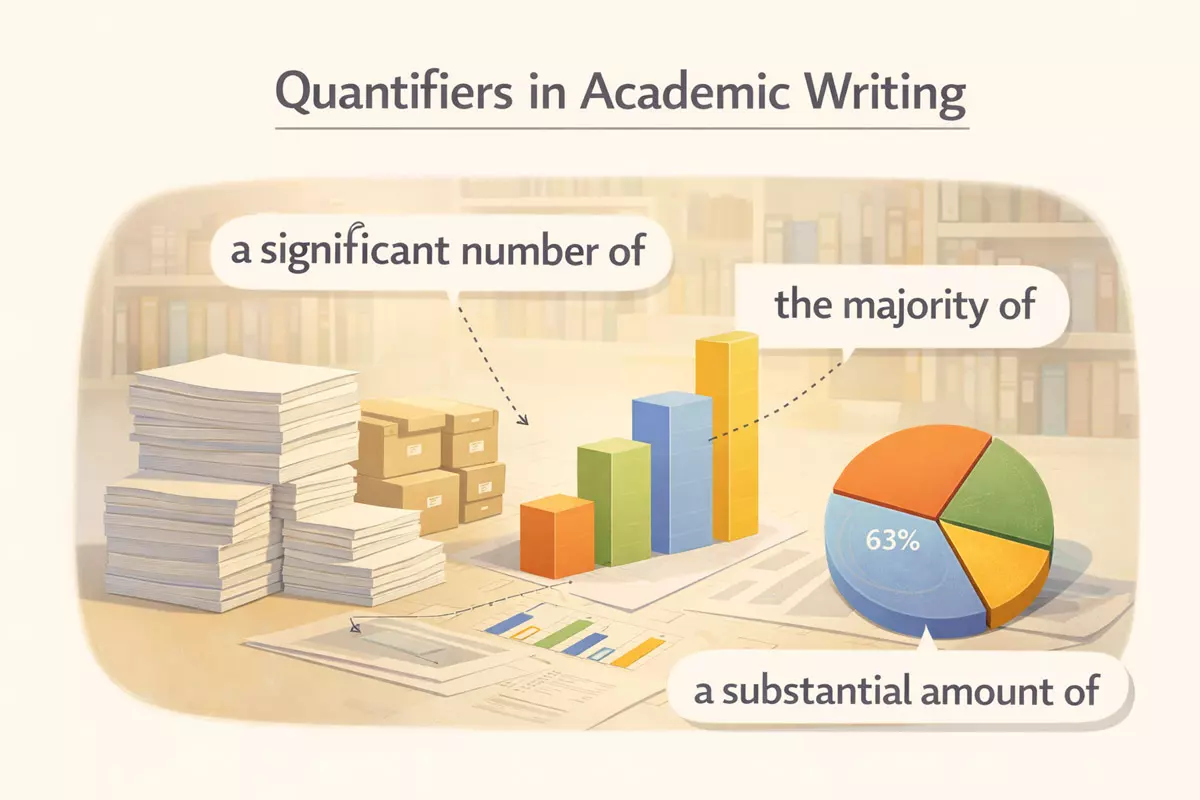 Here we the importance of precise quantification in academic writing, outlines preferred and inappropriate quantifiers, and explains how to balance clarity with caution.
- Why precise quantification matters in academic texts
- Preferred quantifiers in formal writing
- Avoiding vague or informal quantity expressions
- Balancing caution and clarity in claims
- Typical structures used in research writing
- Common overstatements and how to soften them
- Examples from academic-style sentences
- Practice: revising sentences for formal tone
Selecting precise language to convey quantities and degrees is crucial for enhancing the clarity and reliability of your academic writing. Achieving a balance between accuracy and readability ensures that your ideas are communicated effectively to your audience. Careful word choice not only strengthens your arguments but also demonstrates your attention to detail and commitment to scholarly standards. By thoughtfully considering how you express amounts and degrees, you contribute to the overall quality and impact of your formal or scholarly work.
Why precise quantification matters in academic texts
Accurate use of quantifiers is essential for clarity and credibility in research and scholarly writing. When authors specify quantities, frequencies, or degrees, they help readers understand the exact scope of claims and findings. Vague or ambiguous quantification can lead to misinterpretation, weaken arguments, or even obscure significant results. In peer-reviewed contexts, imprecise language may cause reviewers to question the reliability or validity of a study.
Supporting evidence and transparency
Scholarly discourse encourages transparency. By choosing precise quantifiers, writers make it easier for readers to assess evidence and compare results across studies. For example, stating "a majority of participants" is less informative than specifying "68% of participants." This level of detail enhances reproducibility and allows for more effective meta-analyses.
Common quantifiers and their impact
Writers often rely on a range of quantifying terms, but their meanings can be subjective or context-dependent. Consider the following quantifiers and how they can influence interpretation:
- All → All participants completed the survey.
- Most → Most students prefer online learning.
- Some → Some people arrived late.
- Many → Many employees work remotely.
- Several → Several issues were discussed.
- Few → Few customers complained.
- Almost all → Almost all seats were taken.
- About half → About half of the class passed the exam.
- A minority → A minority of voters opposed the change.
- Approximately → Approximately 200 people attended the event.
- At least → At least three options are available.
- No → No evidence supports this claim.
- Each → Each student received feedback.
- More than → More than 50 applications were submitted.
- Less than → Less than 10 minutes remained.
- Numerous → Numerous studies confirm this result.
- Various → Various approaches were tested.
- Occasionally → He occasionally works late.
- Rarely → She rarely eats fast food.
- Consistently → The team consistently meets deadlines.
These terms, while common, can be interpreted differently by readers from diverse backgrounds or disciplines. Whenever possible, replacing subjective quantifiers with explicit data (e.g., percentages, counts, or ranges) strengthens the text’s authority.
Potential pitfalls of imprecise quantification
Ambiguous quantifiers can introduce bias or uncertainty. For instance, describing results as "many participants agreed" does not convey whether this means 60% or 95%. This vagueness can undermine the trustworthiness of the work and may lead to flawed conclusions if readers interpret the language differently than the author intended.
| Imprecise Quantifier | Precise Alternative |
|---|---|
| Many students | 78% of students |
| Some cases | 12 out of 50 cases |
| Most respondents | 43 of 50 respondents |
| Few occurrences | 3 occurrences in total |
| About half | 49% |
| Almost all | 95% |
Enhancing academic rigor
Using precise quantification not only sharpens argumentation but also signals methodological rigor to the academic community. Clear, data-driven quantifiers facilitate replication, foster scholarly dialogue, and contribute to the overall reliability of published work. In sum, careful attention to quantifier choice is a hallmark of effective and responsible academic writing.
Preferred quantifiers in formal writing
Academic and professional texts favor quantifiers that convey information with clarity and precision. Rather than using vague or overly casual terms, writers are encouraged to select expressions that accurately reflect amounts, degrees, or frequencies. This approach not only strengthens arguments but also helps avoid misunderstandings.
Commonly accepted quantifiers in academic prose

Writers often rely on a core set of quantifiers to describe quantities, frequencies, and degrees. These words and phrases are valued for their specificity and appropriateness in scholarly contexts. Some of the most frequently used include:
- Several → Several students asked the same question.
- Many → Many people prefer working from home.
- Much → There isn’t much time left.
- Few → Few mistakes were found in the final draft.
- Little → There is little evidence to support the claim.
- Some → Some participants left early.
- Most → Most customers pay online.
- Majority of → The majority of employees supported the change.
- Minority of → A minority of voters opposed the proposal.
- Numerous → Numerous studies confirm these results.
- Various → Various solutions were considered.
- All → All documents must be submitted today.
- None → None of the files were saved correctly.
- Each → Each student received a certificate.
- Every → Every detail was carefully checked.
- Almost all → Almost all seats were taken.
- Nearly half → Nearly half of the class missed the quiz.
- Approximately → Approximately 300 people attended the event.
- At least → At least two options are available.
- At most → The task will take at most ten minutes.
Comparing formal and informal quantifiers
Certain quantifiers are better suited to formal writing, while others are considered too conversational or imprecise for scholarly work. The table below contrasts some typical choices:
| Formal Quantifier | Less Formal Alternative |
|---|---|
| Several | A bunch of |
| Numerous | A lot of |
| Majority of | Most of |
| Approximately | About |
| Minority of | A few of |
| Each | Every single |
| None | Not any |
| Almost all | Pretty much all |
Tips for selecting precise quantifiers
- Choose quantifiers that match the data or evidence available.
- Avoid exaggeration—use “some,” “a minority,” or “a few” instead of “most” unless justified.
- When possible, provide exact numbers or percentages alongside the quantifier for greater precision.
- Be consistent—do not switch between informal and formal quantifiers within the same section.
- Remember that academic readers expect accuracy and reserve for claims; select quantifiers that reflect this expectation.
In summary, clear and accurate quantification is a hallmark of strong scholarly writing. By favoring specific, formal quantifiers over vague alternatives, writers enhance both the credibility and readability of their work.
Avoiding vague or informal quantity expressions
Academic and formal writing often requires precise expression of amounts and quantities. Relying on non-specific or colloquial wording can undermine clarity and weaken an argument. Instead, writers should select quantifiers and numerical descriptors that communicate exact or appropriately estimated values. This practice improves both the professionalism and reliability of the text.
Common vague expressions to avoid
Certain terms and phrases are frequently used in everyday conversation, but they lack the precision demanded in scholarly contexts. Replacing these with more specific alternatives is a key step toward rigorous writing.
- a lot → I have a lot to do today.
- lots of → She has lots of friends in the city.
- tons of → We got tons of messages after the update.
- plenty of → There’s plenty of time before the deadline.
- a bunch of → I bought a bunch of bananas at the store.
- a handful of → Only a handful of people showed up.
- loads of → He has loads of experience in sales.
- quite a few → Quite a few students missed the bus.
- some → Some customers asked for a refund.
- a couple of → Give me a couple of minutes.
- numerous (when not quantified) → Numerous complaints were reported that week.
- several (if a more exact number is available) → Several employees (about six) volunteered.
- a bit of → Add a bit of salt to the soup.
- various → Various reasons were given for the delay.
- many (if the exact number is known) → Many people (over 300) attended the event.
- few (if context requires specificity) → Few participants (only three) completed the survey.
Choosing precise quantifiers
Whenever possible, use numbers, percentages, or well-defined quantifiers. Consider the context: for statistical data, report the actual figures; for generalizations, clarify the range or proportion. Replacing informal words with specific language not only enhances clarity but also demonstrates careful analysis.
| Vague/Informal Expression | Precise Alternative |
|---|---|
| a lot of students | over 200 students |
| quite a few samples | 18 samples |
| some improvement | a 12% improvement |
| many cases | approximately 40% of cases |
| a couple of errors | 2 errors |
| loads of data | over 1 terabyte of data |
| several participants | 7 participants |
| few respondents | only 3 respondents |
Strategies for greater precision
- Use exact numbers and units whenever available (e.g., 75%, 15 grams, 12 respondents).
- Quantify ranges if precise figures are unavailable (e.g., between 10 and 15 samples).
- For estimates, indicate uncertainty transparently (e.g., approximately, about, nearly).
- Replace subjective terms with objective measures (e.g., “a significant proportion” → “68% of participants”).
- Consult data or sources to support any numerical claims.
By making these adjustments, writers can ensure their arguments are well-supported and easily understood by their audience. Precision in quantity expressions is an essential component of effective formal communication.
Balancing caution and clarity in claims
Writers in academic and formal contexts often walk a fine line between making careful statements and ensuring their points remain clear and persuasive. Overly cautious phrasing can make arguments sound weak or indecisive, while too much certainty may oversimplify or misrepresent complex issues. The strategic use of quantifiers—such as "some," "many," "few," or "most"—plays a crucial role in striking the right balance between hedging and directness.
Why moderation matters
Precision in quantification helps readers understand both the scope and the limitations of your claims. Using vague or absolute terms can mislead or undermine your credibility, while nuanced quantifiers demonstrate critical thinking. Consider the difference between "All studies support this theory" and "Several studies support this theory"—the latter is both more accurate and less likely to be challenged.
Common quantifiers and their typical effects
Choosing the right quantifier is not just about accuracy, but also about how your statements are perceived. Here is a breakdown of commonly used quantifiers and the degree of certainty or caution they convey:
| Quantifier | Effect on Statement |
|---|---|
| All | Expresses absolute certainty; rarely justified in academic writing |
| Most | Indicates a strong generalization, but allows for exceptions |
| Many | Suggests a significant number without implying a majority |
| Some | Implies a non-specific, limited subset; cautious and non-committal |
| Few | Highlights rarity or exceptionality within the context |
| Several | More than a couple, but not a large number; moderately cautious |
| Numerous | Emphasizes abundance without exact quantification |
| Almost all | Very strong, but acknowledges rare exceptions |
| A minority of | Draws attention to a small, specific group |
| Occasionally | Describes infrequent occurrence |
| Rarely | Stresses scarcity or exceptionality |
| Typically | Points to common patterns, while allowing for outliers |
Guidelines for effective quantification
- Match your quantifier to the available evidence. Use stronger terms only when data fully support them.
- Avoid unnecessary hedging ("It may be possible that…") unless the uncertainty is genuine and relevant.
- Combine quantifiers with supporting details for clarity, e.g., "Most participants (67%) reported improvement."
- Be aware of discipline-specific expectations: some fields prefer more cautious language than others.
- Revise for consistency—ensure your quantifiers do not contradict each other within the same argument.
Finding the right level of caution helps you present your research responsibly while still making your point clear and compelling. Thoughtful quantifier choice signals both intellectual honesty and command of academic style.
Typical structures used in research writing
Understanding how quantifiers fit into academic sentence patterns is essential for clear and precise communication. Research texts often use well-established grammatical structures to present findings, describe trends, and discuss limitations. These patterns help writers hedge claims, express degrees of certainty, and maintain objectivity.
Common sentence patterns with quantifiers
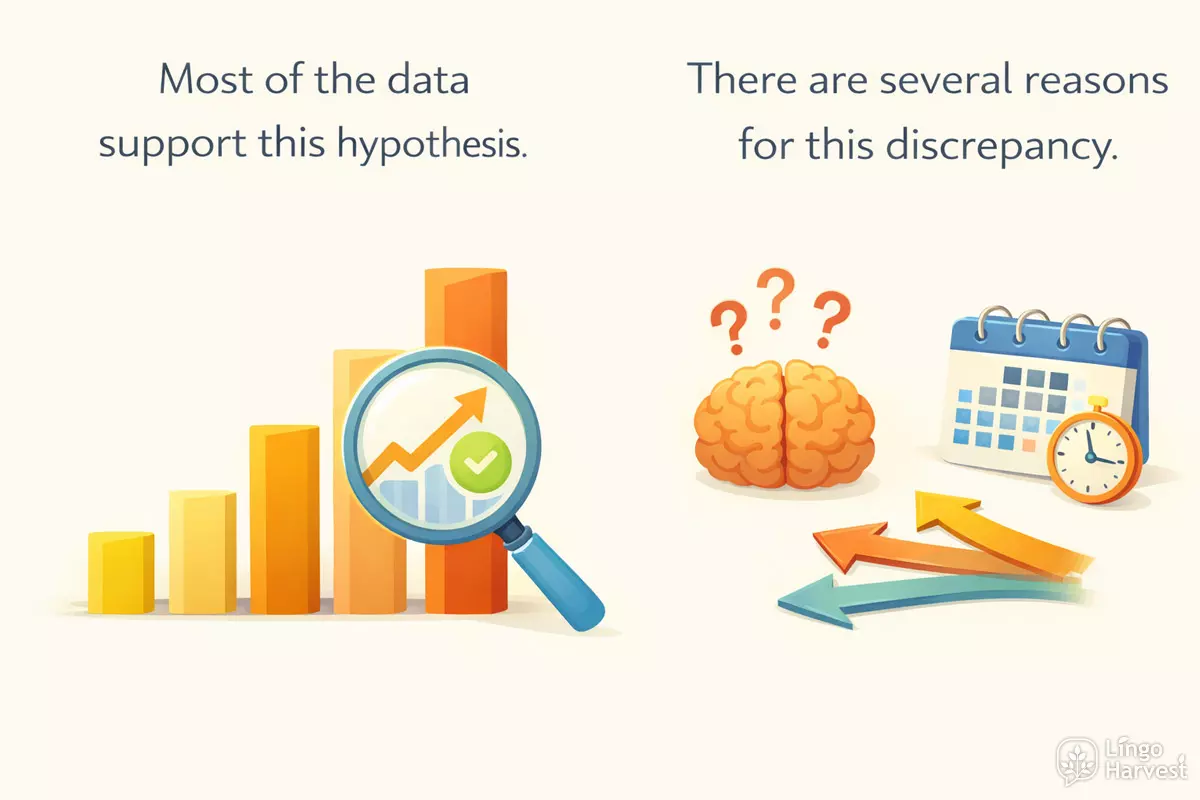
Writers frequently rely on certain structures to introduce quantifiers effectively. Here are several widely used forms:
- Quantifier + noun + verb: “Many participants reported positive outcomes.”
- Quantifier + of + the + noun: “Most of the data support this hypothesis.”
- There + be + quantifier + noun: “There are several reasons for this discrepancy.”
- Quantifier + adjective + noun: “A considerable number of studies address this issue.”
- Quantifier + of + pronoun: “Some of them disagreed with the proposal.”
- Only a few + noun + verb: “Only a few respondents answered the question.”
- Very few / very little: “Very few articles mention this limitation.”
- Quantifier + plural noun + verb: “Several factors influence the outcome.”
- Quantifier + uncountable noun: “Much research has been conducted on this topic.”
- Quantifier in comparative statements: “More evidence is needed.”
- All / none / both / neither: “Neither approach was effective.”
- Each / every: “Each participant completed the survey.”
- Quantifier + modal verb: “Most researchers would agree.”
- Quantifier + passive construction: “A number of cases were identified.”
- Quantifier in negative statements: “Few studies have addressed this gap.”
Comparing quantifiers in context
Writers select quantifiers for accuracy and nuance. The table below compares some common quantifiers, their grammatical usage, and sample sentences.
| Quantifier | Example in Research Writing |
|---|---|
| Many | Many studies support this conclusion. |
| Much | Much evidence remains inconclusive. |
| Several | Several factors affect the outcome. |
| Few | Few authors have explored this aspect. |
| Some | Some participants expressed concerns. |
| All | All results were statistically significant. |
| None | None of the hypotheses were rejected. |
| Most | Most respondents agreed with the statement. |
| Each | Each variable was tested individually. |
| No | No significant difference was found. |
Positioning and emphasis
The placement of quantifiers can subtly change meaning or emphasis. For example, “Only some participants agreed” differs from “Some participants only agreed,” the former restricting agreement to a subset, the latter focusing on agreement as the sole action. Mastery of these structures allows writers to communicate results with the desired level of precision and caution.
Common overstatements and how to soften them
Writers in academic and formal contexts often reach for strong quantifiers to emphasize a point, but this can easily result in exaggerated claims. Overstatements can make arguments less credible or open to challenge. Instead, precision and nuance are valued, and this often means moderating absolutes with softer, more accurate language.
Recognizing Exaggerated Quantifiers
Absolute terms such as "always," "never," "everyone," "no one," and "completely" may seem convincing, but they rarely reflect the complexity of most academic subjects. Using these words can imply a universality that is difficult to defend with evidence. Recognizing when you are leaning on these strong quantifiers is the first step to more precise writing.
Strategies for Softening Absolutes
Refining your language to reflect uncertainty, exceptions, or degrees of probability can make your writing more persuasive and credible. Here are some common overstatements and ways to moderate them:
- Replace "always" with "often," "frequently," or "in many cases."
- Change "never" to "rarely," "seldom," or "in few instances."
- Soften "everyone" to "many people," "most individuals," or "the majority."
- Adjust "no one" to "few people," "hardly anyone," or "almost no one."
- Modify "completely" to "largely," "to a great extent," or "predominantly."
- Use "may," "might," or "can" to introduce possibility instead of certainty.
- Swap "all" for "most," "the majority of," or "a significant number of."
- Change "none" to "few," "very few," or "hardly any."
- For "prove," consider "suggest," "indicate," or "provide evidence for."
- Instead of "undeniable," try "persuasive," "compelling," or "strong."
- Soften "every time" to "in many instances" or "often."
- Alter "impossible" to "unlikely" or "rarely feasible."
- Refine "must" to "should," "is likely to," or "tends to."
- Instead of "entirely," use "mostly" or "for the most part."
- Change "without exception" to "in most cases" or "with few exceptions."
- Soften "never fails" to "often succeeds" or "is generally effective."
- Modify "the only" to "one of the few" or "among the only."
- Instead of "no doubt," use "it is likely" or "it appears."
- Use "typically," "generally," or "commonly" in place of universal statements.
Examples: Before and After
To illustrate the difference that softening quantifiers can make, compare the following pairs:
| Overstated Form | Moderated Alternative |
|---|---|
| All students benefit from online learning. | Most students benefit from online learning. |
| This method always produces accurate results. | This method often produces accurate results. |
| No one disagrees with this conclusion. | Few people disagree with this conclusion. |
| The theory is completely invalid. | The theory is largely unsupported. |
| Research proves that... | Research suggests that... |
| It is impossible to achieve this outcome. | It is unlikely to achieve this outcome. |
| Every time this occurs, failure follows. | In many instances, this leads to failure. |
| The results are undeniable. | The results are compelling. |
Why Precision Matters
Moderating language not only guards against overgeneralization but also demonstrates critical thinking. Readers are more likely to trust arguments that acknowledge complexity and exceptions. Careful use of quantifiers enhances both the clarity and the authority of your writing.
Examples from academic-style sentences
Academic writing often relies on quantifiers to convey precise meaning, manage generalizations, and avoid overstatements. These expressions help writers indicate amounts, frequencies, or degrees of certainty without introducing ambiguity. Below, you'll find a range of example sentences and common patterns illustrating how quantifying language shapes arguments and explanations in scholarly contexts.
Common quantifiers in scholarly sentences
- Many researchers have supported this hypothesis.
- Several studies indicate a correlation between the variables.
- Few participants reported negative side effects.
- Most respondents agreed with the proposed solution.
- Some evidence suggests an alternative explanation.
- Each sample was analyzed independently.
- Every effort was made to minimize bias.
- All data were collected in accordance with ethical guidelines.
- None of the control group exhibited symptoms.
- A majority of participants completed the survey.
- A minority of cases showed improvement.
- Much of the literature focuses on urban populations.
- Little attention has been paid to rural contexts.
- Any deviation from the protocol was documented.
- Several factors may contribute to this outcome.
- Only a handful of examples exist in the current corpus.
Comparing quantifiers: nuance and precision
Choosing the right quantifier can significantly affect the strength and credibility of an academic claim. The table below demonstrates how similar statements shift in meaning based on the quantifier used.
| Quantifier | Example Sentence |
|---|---|
| All | All experiments yielded consistent results. |
| Most | Most experiments yielded consistent results. |
| Some | Some experiments yielded consistent results. |
| Few | Few experiments yielded consistent results. |
Key observations
- Quantifiers help writers avoid absolute claims unless fully justified by evidence.
- Subtle shifts (such as from "most" to "some") can change the academic tone from assertive to cautious.
- Writers often combine quantifiers with hedging language (e.g., "may," "appears to") to further refine their statements.
In summary, selecting appropriate quantifying expressions is essential in academic and formal writing to convey accuracy, nuance, and reliability.
Practice: revising sentences for formal tone
Understanding how to revise sentences for a more academic or formal register is essential when using quantifiers in scholarly writing. Everyday language often relies on vague or colloquial quantifiers (like "a lot of" or "tons of"), but formal contexts require precision and clarity. Let's explore some practical ways to refine sentence structure and select appropriate quantifiers to strengthen the tone and accuracy of academic writing.
Common informal quantifiers and their formal alternatives
Writers frequently use casual quantifiers without realizing that more precise or nuanced options are available. Below is a table contrasting informal expressions with their formal counterparts to help you identify and revise less precise language.
| Informal Expression | Formal Alternative |
|---|---|
| a lot of | many / numerous / a significant number of |
| lots of | several / various / a considerable amount of |
| tons of | a large quantity of / a substantial amount of |
| a bunch of | multiple / a variety of / several |
| a bit of | a small amount of / a minor portion of |
| loads of | an abundance of / a great deal of |
| some | a certain number of / several / a few |
| pretty much all | almost all / nearly all / the majority of |
| a couple of | two / a few / several |
| plenty of | an ample amount of / sufficient / a considerable number of |
Practice: Improve formal tone by revising quantifiers
Try revising the following sentences to make them more suitable for academic or professional contexts. Focus on replacing informal quantifiers with more precise and formal alternatives.
- There are a lot of studies that show this effect.
- The experiment used tons of materials.
- Pretty much all the participants agreed with the statement.
- We found a bunch of errors in the data set.
- Some students struggled with the assignment.
- The survey collected loads of responses.
- A bit of variation was observed in the results.
- Plenty of resources were available for the project.
- A couple of issues remain unresolved.
- The team faced lots of challenges during testing.
Show answers
- There are numerous studies that demonstrate this effect.
- The experiment used a large quantity of materials.
- Almost all the participants agreed with the statement.
- We found several errors in the data set.
- A number of students struggled with the assignment.
- The survey collected a large number of responses.
- A small degree of variation was observed in the results.
- A considerable number of resources were available for the project.
- Several issues remain unresolved.
- The team faced numerous challenges during testing.
Quick self-check: Spot the informal quantifier
Identify the informal quantifier in each sentence below. Replace it with a more formal option.
- He provided loads of evidence to support his claim.
- A couple of limitations were noted in the research.
- There is a bit of uncertainty in the results.
- Plenty of examples illustrate this concept.
- The report mentions tons of data points.
- We received a bunch of feedback from reviewers.
- The method caused lots of confusion initially.
- She has quite a few publications in this field.
- The trial produced a lot of unexpected results.
- There was a bit of delay in processing the samples.
Show answers
- loads of → an abundance of / a great deal of
- a couple of → several / two
- a bit of → a small amount of / minor
- plenty of → a considerable number of / numerous
- tons of → a large amount of / a substantial quantity of
- a bunch of → a number of / several
- lots of → significant / considerable
- quite a few → several / numerous
- a lot of → a large number of / substantial
- a bit of → a slight / a minor
By practicing these revisions, you will become more comfortable selecting precise quantifiers and maintaining a consistent formal tone throughout your academic writing.