Natural Quantifier Collocations in Modern English Usage

 This article explains what collocations are, why they’re important, and highlights common quantifier–noun pairings. It covers usage patterns, fixed versus flexible collocations, typical learner mistakes, and gives practical examples and tips.
- What collocations are and why they matter
- Common quantifier–noun pairings
- Why some combinations sound unnatural
- Frequency and usage patterns
- Differences between fixed and flexible collocations
- Typical learner errors with collocations
- Contextual examples in modern usage
- Practice: building natural-sounding combinations
Examining how quantity words combine with other terms reveals subtle patterns in modern English usage. By exploring these common pairings, we can better understand how speakers effectively express amounts with precision and nuance. These combinations, known as collocations, help language users communicate more clearly and naturally. Recognizing such patterns not only enhances comprehension but also improves our ability to use English accurately in both spoken and written contexts.
What collocations are and why they matter
Collocations are combinations of words that frequently appear together in natural speech and writing. In the context of English quantifiers, these pairings—like “a little bit of” or “a large number of”—reflect established patterns that feel natural to native speakers. Understanding these habitual word partnerships is essential for anyone aiming to communicate fluently and accurately. When used correctly, they make language sound more authentic and less awkward or forced.
Understanding natural quantifier pairings
Quantifiers such as “much,” “many,” “few,” and “several” rarely appear alone; they typically team up with specific nouns or modifiers. These recurring word combinations help convey quantity or amount more effectively. For instance, English speakers say “a few people” but rarely “a few furniture.” Recognizing which nouns fit with which quantifiers helps learners avoid errors and misunderstandings.
- a piece of advice → Here’s a piece of advice: double-check the instructions before you start.
- a bit of luck → With a bit of luck, we’ll finish ahead of schedule.
- a large amount of money → They spent a large amount of money on the renovation.
- plenty of time → We still have plenty of time to catch the train.
- a handful of nuts → She grabbed a handful of nuts for a quick snack.
- a great deal of interest → The announcement generated a great deal of interest online.
- a little patience → A little patience will make this process much easier.
- a number of reasons → There are a number of reasons why the plan won’t work.
- a couple of days → I’ll be back in a couple of days.
- an abundance of caution → Out of an abundance of caution, the event was postponed.
- tons of work → We still have tons of work to do before the deadline.
- loads of fun → The trip was loads of fun.
- heaps of praise → The new restaurant received heaps of praise from locals.
- a gallon of milk → He bought a gallon of milk at the grocery store.
- an ounce of truth → There isn’t an ounce of truth in that rumor.
- dozens of eggs → The bakery uses dozens of eggs every morning.
- a stack of books → A stack of books was waiting on her desk.
- a drop of water → There wasn’t a drop of water left in the bottle.
- a slice of cake → Would you like a slice of cake?
- a pinch of salt → Add a pinch of salt to balance the sweetness.
Why habitual pairings matter in English
Selecting the right quantifier-noun combination is not just about grammatical accuracy—it profoundly affects how natural and clear your English sounds. Native speakers instantly notice when a phrase sounds “off,” even if they can still understand it. Misused combinations can distract, confuse, or even change the intended meaning. Mastering these collocations helps both learners and proficient users convey thoughts smoothly and intuitively.
| Common Quantifier | Typical Noun Partners |
|---|---|
| a piece of | advice, information, cake, furniture |
| a bit of | luck, news, help, trouble |
| a handful of | people, nuts, coins, problems |
| a large number of | students, cases, reasons, opportunities |
| a great deal of | interest, effort, work, money |
| plenty of | time, space, food, options |
| an abundance of | caution, resources, evidence, opportunities |
| loads of | fun, work, money, friends |
In summary, recognizing and using established quantifier pairings is a cornerstone of natural English usage. Whether you’re writing, speaking, or simply trying to understand others, familiarity with these patterns streamlines communication and minimizes confusion.
Common quantifier–noun pairings
English speakers regularly combine quantifying words with specific nouns, creating set expressions that feel natural and idiomatic. Some combinations sound intuitive, while others may seem awkward to native ears. Recognizing which quantifiers typically pair with which types of nouns helps writers and learners produce fluent, authentic sentences.
Frequent patterns in quantifier usage
Quantifiers can be countable (like “many” or “few”) or uncountable (such as “much” or “little”), and their pairing depends on the noun’s grammatical number and countability. For example, “many apples” is standard, while “much apples” is not. Context and convention both play roles in determining which word combinations are most accepted.
- Much water, much information, much patience
- Many books, many people, many ideas
- Few opportunities, few complaints, few cars
- Little time, little hope, little progress
- A lot of money, a lot of friends, a lot of work
- Some advice, some apples, some noise
- Several reasons, several attempts, several students
- A piece of cake, a piece of news, a piece of furniture
- Plenty of options, plenty of food, plenty of reasons
- No evidence, no cookies, no interest
- Each child, each answer, each opportunity
- Every morning, every member, every detail
Extra examples: frequent quantifier patterns

- Much time was wasted in traffic, but we still arrived on time.
- There isn’t much information available yet, so we can’t confirm the details.
- Many people prefer short lessons, especially on busy weekdays.
- We reviewed several options before choosing the simplest plan.
- Few students finished the quiz early, because the last section was tricky.
- There is little hope of a quick fix unless we change the process.
- She has a lot of work this week, but she still studies every evening.
- No evidence supports that claim, so we need better data.
Comparison of quantifiers with countable and uncountable nouns
| Quantifier | Countable Nouns | Uncountable Nouns |
|---|---|---|
| Much | ❌ (Not used) | much water, much time |
| Many | many books, many ideas | ❌ (Not used) |
| Few / A few | few friends, a few coins | ❌ (Not used) |
| Little / A little | ❌ (Not used) | little sugar, a little hope |
| Some / Any | some apples, any answers | some milk, any advice |
| Plenty of | plenty of chairs | plenty of sand |
| All | all tickets | all information |
These established groupings not only improve clarity but also make speech and writing sound more natural. For learners, focusing on these habitual combinations is often more effective than memorizing abstract grammar rules alone. Native speakers rarely stop to analyze why “many opportunities” is correct but “much opportunities” is not—they simply rely on these well-worn patterns.
Why some combinations sound unnatural
English speakers intuitively sense when a phrase like “a little chairs” or “much apples” doesn’t sound right, even if the meaning is clear. This feeling comes from established patterns—called collocations—where certain quantifiers naturally combine with specific types of nouns. These patterns have evolved over time and are reinforced by repeated exposure in everyday language. When a combination breaks these conventions, it can feel awkward or even confusing to native speakers.
Common reasons for awkward quantifier-noun pairings
- Count vs. non-count mismatch: Some quantifiers are strictly used with countable nouns (“many books”) while others pair with uncountable nouns (“much water”). Using the wrong quantifier disrupts the expected structure.
- Register and frequency: Certain pairings are rare or only appear in formal or archaic English, making them sound odd in everyday conversation.
- Idiomatic usage: Some combinations are set phrases that don’t translate directly, even if grammatically possible (“a piece of advice,” not “an advice”).
- Semantic compatibility: The meaning of a quantifier may clash with the noun, making the phrase illogical or implausible (“a few sand”).
Examples: Acceptable vs. Unnatural Combinations
| Natural Collocation ✅ | Unnatural Pairing ❌ |
|---|---|
| many cars | much cars |
| a little time | a little apples |
| few problems | few water |
| some money | many money |
| a piece of information | an information |
| several options | several sugar |
| a bit of luck | a bit of ideas |
| much effort | many effort |
| plenty of chairs | plenty of bread (in most contexts) |
| lots of advice | many advices |
How to recognize natural combinations
Learning which quantifiers pair with which nouns comes with exposure and practice. Reading and listening to authentic English—rather than relying solely on rules—helps internalize these patterns. Consulting dictionaries or reference guides can also clarify doubtful pairings. Over time, the distinction between natural and awkward collocations becomes second nature.
Frequency and usage patterns
Patterns of natural quantifier collocations reflect both common usage and subtle stylistic choices in contemporary English. Everyday speech and writing tend to favor certain quantifier-noun pairings, while other combinations appear less frequently or sound unnatural to native speakers. The prevalence of these combinations often depends on context, register, and even regional variation.
Common quantifier collocations
Writers and speakers regularly rely on a core set of quantifier collocations to express quantity, degree, or frequency. Some quantifiers are nearly fixed with particular nouns, while others offer more flexibility. Here are several high-frequency pairings found in modern English:
- many people → Many people choose online courses because they can study at their own pace.
- much time → We don’t have much time left before the deadline.
- a little patience → A little patience is needed when learning new grammar rules.
- a few opportunities → She had a few opportunities to practice speaking with native speakers.
- several reasons → There are several reasons why this method works well.
- plenty of space → The classroom has plenty of space for group activities.
- some information → I need some information before I can make a decision.
- no evidence → There is no evidence that the rule has changed.
- all students → All students must complete the assignment by Friday.
- each member → Each member of the team has a specific role.
- both options → Both options seem reasonable, so it depends on your goal.
- every effort → She made every effort to improve her pronunciation.
- enough resources → We finally have enough resources to start the project.
- most days → He practices English most days after work.
- few complaints → There were few complaints about the new course format.
- little doubt → There is little doubt that regular practice helps.
- lots of questions → Beginners often have lots of questions about verb tenses.
- half the story → This explanation tells only half the story.
- another chance → She asked for another chance to retake the test.
- any help → If you need any help, just ask the instructor.
Distribution in different registers
Informal conversation often features quantifiers like "lots of" or "plenty of," whereas formal writing might prefer "much," "many," or "several." Some quantifiers, such as "a few" and "few," can subtly shift meaning based on emphasis or context. For example, "a few problems" suggests a small, manageable number, while "few problems" implies scarcity.
Naturalness and acceptability
Not all possible pairings are equally acceptable. For instance, "much people" or "many information" are generally ungrammatical. Native speakers quickly recognize which combinations sound right and which do not. The following table shows some typical and atypical quantifier-noun pairings:
| Quantifier | Common Collocations | Unusual/Incorrect Collocations |
|---|---|---|
| much | much time, much effort, much interest | much people, much cars |
| many | many people, many books, many ideas | many advice, many equipment |
| little | little hope, little water, little chance | little people, little chairs |
| few | few options, few friends, few mistakes | few information, few money |
Contextual variation
Collocational preferences can shift with topic, tone, or audience. Academic texts might favor "a considerable amount of evidence," while casual speech leans toward "lots of proof." Regional differences may also affect quantifier choices, with British and American English sometimes preferring different forms. In summary, understanding how quantifiers naturally combine with nouns is key to sounding fluent and idiomatic. Awareness of these patterns helps avoid awkward or incorrect expressions, enhancing both clarity and style in communication.
Differences between fixed and flexible collocations
When examining natural quantifier collocations in modern English, it’s crucial to distinguish between patterns that are set and those that allow variation. Fixed combinations are often memorized as single units, while flexible ones permit elements to shift or substitute according to context and meaning. This distinction impacts how learners acquire fluency and how native speakers intuitively construct phrases with quantifiers.
What are fixed collocations?

Fixed collocations are word groupings that remain unchanged in form and are generally accepted as standard expressions. Their structure is stable, and substitutions are rarely possible without sounding unnatural or changing the meaning. For example, the phrase a large amount of is commonly used with uncountable nouns, and switching any element (like saying a big amount of) feels awkward. These combinations are often idiomatic or conventionalized through repeated use.
- a great deal of → She showed a great deal of interest in improving her writing skills.
- a bit of → We need a bit of extra time to review these examples.
- a large number of → A large number of students use apps to practice vocabulary.
- the vast majority of → The vast majority of learners find this rule easy to remember.
- no fewer than → No fewer than ten mistakes were corrected during the lesson.
- not a single → Not a single answer was left blank on the test.
- every single → Every single example illustrates the same grammar pattern.
- the whole lot → He reviewed the whole lot before submitting his work.
- a handful of → Only a handful of words in this text are unfamiliar.
- no end of → Beginners often have no end of questions about articles.
What makes a collocation flexible?
Flexible collocations provide more options for substitution or reordering. They enable speakers to adapt the phrase to fit different contexts, often by varying the quantifier, noun, or modifier. For example, you can say some of the people, many of the people, or most of the people, adjusting the quantifier to suit your meaning. These constructions are productive and can be extended to new situations without sounding unnatural.
- some of the students → Some of the students preferred working in small groups.
- most of the time → He understands the rules most of the time.
- many of the questions → Many of the questions focused on verb tenses.
- several of the options → Several of the options looked equally effective.
- few of the answers → Few of the answers were completely correct.
- none of the above → The correct choice was none of the above.
- plenty of opportunities → Online courses offer plenty of opportunities for practice.
- lots of reasons → There are lots of reasons to revise regularly.
- little of the evidence → Little of the evidence supports that assumption.
- all of the participants → All of the participants completed the final task.
Key contrasts at a glance
| Fixed Collocations | Flexible Collocations |
|---|---|
| Form is rigid; substitutions are rare | Allow for substitutions or modification |
| Often idiomatic or conventional | Productive and adaptable to context |
| Examples: a large number of, not a single | Examples: many of the, some of the |
| Learned as set phrases | Learned as patterns with variable elements |
Recognizing whether a quantifier phrase is fixed or flexible helps with both comprehension and production in English. Fixed groupings are best memorized as whole expressions, while flexible patterns can be creatively recombined. This awareness supports more natural and accurate language use, especially in academic or formal writing where quantifiers often play a central role.
Typical learner errors with collocations
Learners of English frequently struggle with natural-sounding combinations of quantifiers and nouns. Even advanced students may unintentionally create odd or incorrect pairings that sound unnatural to native speakers. These issues often arise from direct translation, overgeneralization, or simply not being exposed to authentic usage patterns.
Common Sources of Mistakes
- Literal translation: Using quantifier combinations from their first language that do not exist in English.
- Overuse of generic quantifiers: Relying on "many," "much," or "a lot of" instead of more precise alternatives.
- Confusing countable and uncountable nouns: Applying quantifiers like "few" or "much" incorrectly.
- Misplacing quantifiers: Using word order that doesn’t match standard English patterns.
- Neglecting collocational restrictions: Pairing quantifiers with nouns that they rarely or never combine with.
Frequent Collocational Errors
Some quantifier-noun pairings are especially prone to mistakes. Here are several examples where non-native speakers often go wrong:
- Much informations ❌ (should be much information)
- Many advice ❌ (should be much advice or many pieces of advice)
- A few money ❌ (should be a little money)
- Less people ❌ (should be fewer people)
- Few furniture ❌ (should be little furniture)
- Much cats ❌ (should be many cats)
- Several equipment ❌ (should be pieces of equipment or some equipment)
- A number of water ❌ (should be a quantity of water or some water)
- Too much people ❌ (should be too many people)
- Plenty informations ❌ (should be plenty of information)
- Each children ❌ (should be each child or all children)
- Every students ❌ (should be every student or all students)
Comparing Correct and Incorrect Collocations
| Incorrect Example | Natural English Collocation |
|---|---|
| Much advices | Much advice / Many pieces of advice |
| A few informations | A little information / Some information |
| Less cars | Fewer cars |
| Many furniture | Much furniture / Many pieces of furniture |
| Several water | Some water / Several bottles of water |
| Each people | Each person |
Tips for Avoiding Collocational Pitfalls
- Learn which nouns are countable and uncountable—this affects quantifier choice.
- Pay attention to authentic materials (books, articles, conversations) for natural pairings.
- Consult reliable dictionaries that list common collocations.
- Practice with exercises focused on natural quantifier-noun combinations.
- Notice patterns: for example, "a piece of advice" is standard, not "an advice."
By becoming more aware of these frequent issues and practicing with real examples, learners can steadily improve their command of natural-sounding quantifier collocations in English.
Contextual examples in modern usage
Understanding how quantifiers naturally combine with nouns and verbs is crucial for fluent English. In everyday writing and conversation, certain word pairs—like “a bit of,” “dozens of,” or “plenty of”—appear far more frequently than others. These pairings, known as natural quantifier collocations, help speakers sound both idiomatic and precise.
Common patterns in context
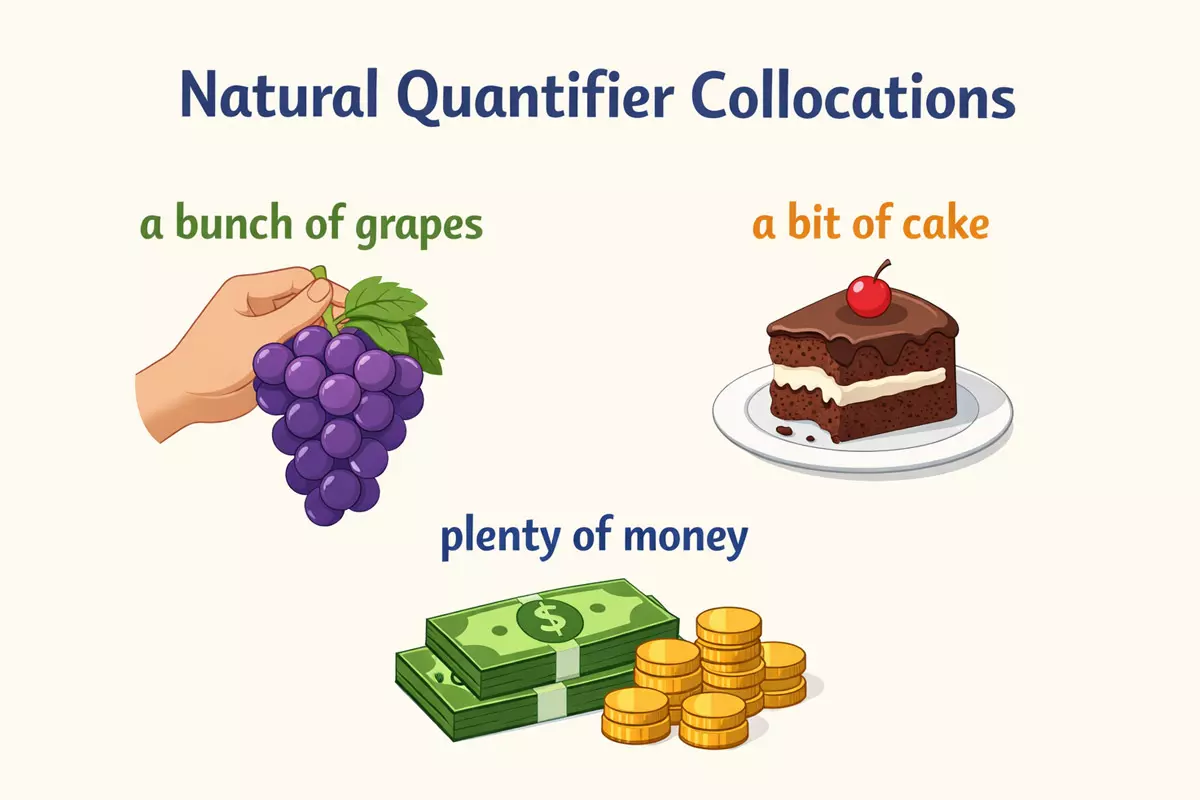
Natural quantifier combinations are often linked to specific nouns or noun groups. For example, we say “a piece of advice” but not “a slice of advice,” or “a bunch of grapes” rather than “a group of grapes.” These patterns develop through usage and are recognized by native speakers as standard.
- A piece of advice, information, furniture
- A bit of luck, help, news
- A loaf of bread
- A flock of birds, sheep
- A cup of tea, coffee, water
- A handful of people, nuts
- A drop of water, oil
- A grain of rice, sand, truth
- A sheet of paper, glass, metal
- A slice of bread, cake, cheese
- A bunch of flowers, grapes, keys
- A set of rules, tools, instructions
- A pair of shoes, scissors, trousers
- A touch of irony, class, color
- A series of events, lectures, questions
- A cluster of stars, buildings
- A string of pearls, questions
- A crowd of spectators, fans
- A swarm of bees, insects
Subtle distinctions in selection
Some quantifier collocations carry subtle distinctions. For instance, “a bit of” often softens the tone (“a bit of trouble” sounds less serious than “a lot of trouble”). Similarly, “a touch of” implies a small, often positive addition, as in “a touch of humor.” These nuances can change the impression a sentence gives.
Collocation comparisons
For learners and advanced speakers alike, recognizing when a quantifier collocation is natural—or awkward—matters. The table below highlights a few commonly confused combinations, showing which are standard and which are best avoided:
| Natural Collocation ✅ | Unnatural/Nonstandard ❌ |
|---|---|
| a piece of advice | a slice of advice |
| a bunch of keys | a group of keys |
| a flock of sheep | a crowd of sheep |
| a grain of truth | a drop of truth |
Mastering these collocations not only improves clarity but also helps your English sound more natural. The most effective way to internalize them is through exposure and practice—reading, listening, and, importantly, using them in your own speech and writing.
Practice: building natural-sounding combinations
Mastering the most frequent and idiomatic pairings of quantifiers with nouns and verbs is a core skill for fluent English. Below, you’ll find targeted activities and examples to boost your confidence with these authentic collocations. Pay attention to context and register, as not all combinations work in every situation.
Common Quantifier + Noun Collocations
Certain quantifiers naturally pair with particular nouns, forming expressions that sound smooth and native-like. Consider the following selection:
- She gave me a piece of advice that completely changed how I study grammar.
- With a bit of luck, you will remember these collocations during the test.
- He bought a loaf of bread on his way home from work.
- She arrived with a bunch of flowers to celebrate the occasion.
- Not a drop of water was left in the bottle after the hike.
- He offered me a slice of cake after dinner.
- Please write your answer on a sheet of paper.
- There wasn’t a grain of sand inside the clean room.
- We saw a herd of cattle grazing near the road.
- I can’t leave without a set of keys.
- She treated herself to a bar of chocolate after finishing the task.
- There was a pile of books on his desk waiting to be read.
- A swarm of bees suddenly flew out of the tree.
- Add a pinch of salt to improve the flavor.
- She went on vacation with a group of friends.
- I need a pair of shoes suitable for walking long distances.
- A crowd of people gathered to watch the performance.
- We admired a cluster of stars in the night sky.
Choosing the Right Quantifier: Subtle Differences
Some quantifiers may seem interchangeable, but native usage often favors specific pairings. Compare these combinations:
| Natural Collocation | Unusual/Incorrect Pairing |
|---|---|
| a piece of information | ~an information |
| a glass of water | ~a cup of water (less common) |
| a flock of sheep | ~a group of sheep (possible, but less idiomatic) |
| a blade of grass | ~a stick of grass |
Mini-Quiz: Collocation Selection
Choose the most natural quantifier to complete each phrase:
- ________ of bread
- ________ of rain
- ________ of paper
- ________ of bees
- ________ of advice
- ________ of cattle
- ________ of chocolate
- ________ of salt
- ________ of keys
- ________ of flowers
Show answers
- loaf
- drop
- sheet
- swarm
- piece
- herd
- bar
- pinch
- set
- bunch
Short Transformation Task
Rewrite the following using a more natural-sounding quantifier + noun collocation:
- He gave me some good advices.
- I saw many cows in the field.
- She ate a chocolate.
- There was a lot of sands on the floor.
- Can you give me an advice?
- We bought two breads at the bakery.
- The room was full of furnitures.
- I drank two waters after the run.
- There were many luggages at the airport.
- She added too much salts to the soup.
Show answers
- He gave me a piece of good advice.
- I saw a herd of cows in the field.
- She ate a bar of chocolate.
- There was a lot of sand on the floor. / There were grains of sand on the floor.
- Can you give me a piece of advice?
- We bought two loaves of bread at the bakery.
- The room was full of furniture.
- I drank two bottles of water after the run.
- There was a lot of luggage at the airport.
- She added too much salt to the soup.
Tips for Developing Collocational Awareness
- Read widely and pay attention to how quantifiers are used with different nouns in authentic texts.
- Practice combining quantifiers with new nouns you encounter; check a trusted dictionary or corpus if unsure.
- Listen for natural pairings in spoken English, especially in films, podcasts, or conversations.
- Keep a personal list of useful collocations to review and expand.
Building an ear for natural groupings takes time, but consistent practice will make your English sound more authentic and fluent.