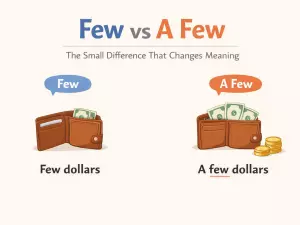
a few vs a little: Small Quantities Made Simple

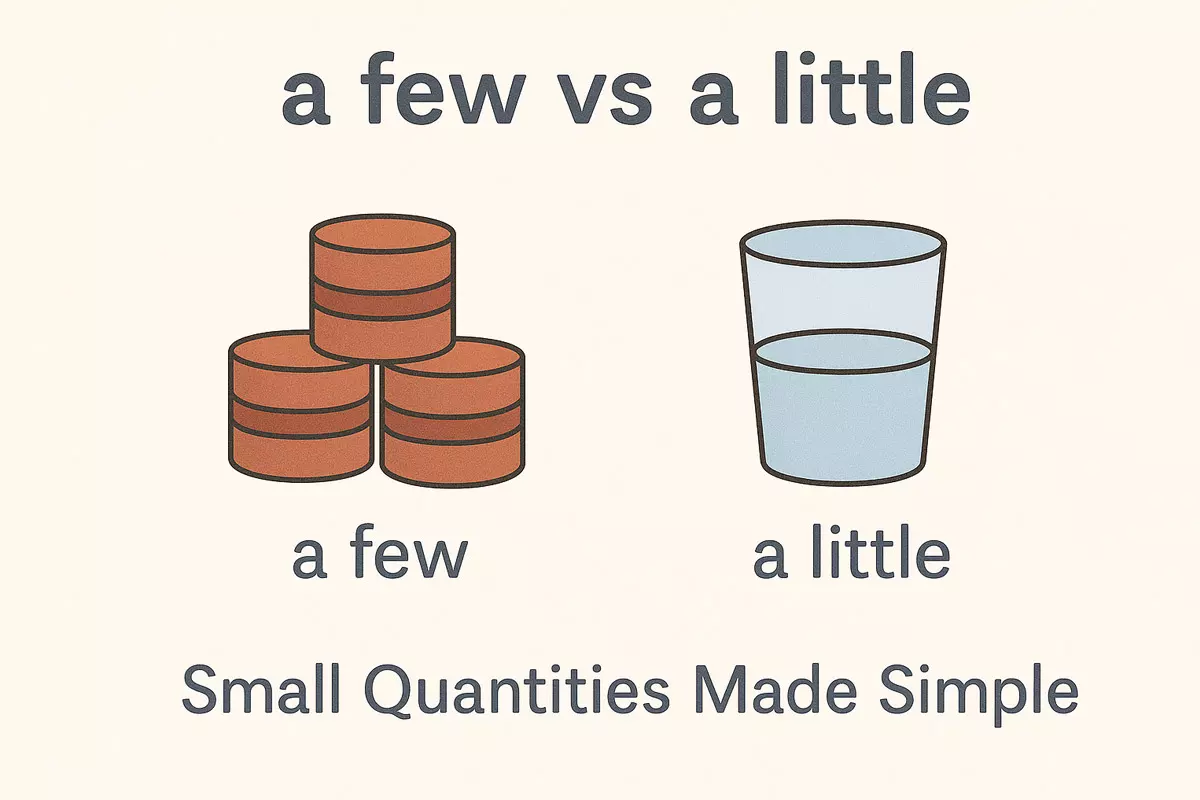 Here we how to use a few and a little, focusing on their meanings, tone, and differences for countable and uncountable nouns. It also explains common phrases, frequent errors with fixes, and provides practice through short dialogues.
Navigating the subtle differences between expressing small amounts in English can be tricky, especially when choosing between words like few and little. The key distinction is that few is used with countable nouns, such as apples or books, while little is used with uncountable nouns, like water or time. For example, you would say few friends if you are referring to people you can count, and little patience when talking about something you cannot count individually. Mastering these differences will help you communicate more naturally and confidently in English.
Meanings and Tone (positive/limiting)
The expressions “a few” and “a little” both refer to small amounts, but they differ in what they describe and the feeling they add to a sentence. “A few” is used with countable nouns, such as “books” or “coins,” while “a little” goes with uncountable nouns, like “water” or “time.” Beyond grammar, each phrase carries a subtle tone—sometimes positive, sometimes limiting—depending on context.
Positive vs. Limiting Nuances
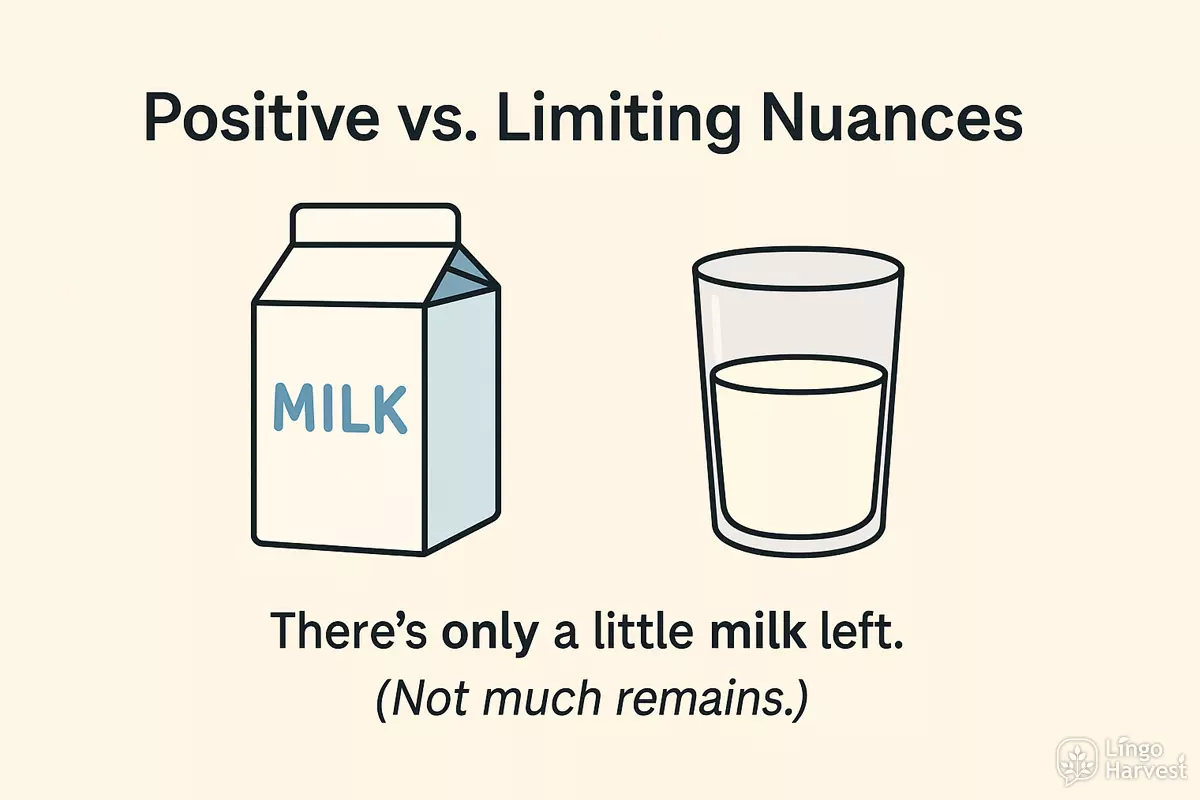
When people say “a few” or “a little,” they often want to emphasize that there is at least some quantity, which can feel positive (“I have a few friends” suggests you’re not alone). But the same phrase can also sound limiting, especially if you expected more (“Only a few people came to the event”). The tone depends on context and intention.
- Positive: “We still have a little hope.” (There’s some hope left.)
- Limiting: “There’s only a little milk left.” (Not much remains.)
- Positive: “A few cookies are left for you.” (Some are waiting.)
- Limiting: “A few candidates passed the test.” (Most did not.)
Typical Contexts and Subtle Differences
Choosing between these expressions isn’t just about grammar. The words can subtly shift how optimistic or restrictive a statement sounds. Here are some common scenarios, with their usual undertones:
| Phrase | Typical Tone / Example Context |
|---|---|
| A few |
|
| A little |
|
Quick Reference: When and How to Use Each
- “A few” is for countable items: apples, ideas, people, chances
- “A little” is for uncountable things: advice, patience, water, time
- Adding “only” or “just” before these phrases usually makes the tone more limiting
- Without “only” or “just,” they often sound more hopeful or sufficient
- Both can be neutral, but context and emphasis shift their feeling
In everyday English, these small words do more than measure quantity—they hint at attitudes and expectations. The difference is subtle, but mastering it adds nuance to your communication.
Countable (a few) vs Uncountable (a little)
Understanding the difference between “a few” and “a little” helps you be precise when talking about small quantities. The key is knowing whether the noun you’re describing is countable or uncountable. In English, we use “a few” for things you can count individually (like apples or coins) and “a little” for things measured in bulk or mass (like water or sugar).
How to Tell Countable from Uncountable Nouns
Countable nouns are items you can list one by one. They have a singular and plural form. Uncountable nouns, on the other hand, refer to substances or concepts that can’t be separated into individual elements, and they do not have a plural form.
- Countable: books, chairs, pencils, emails, cars, friends, bottles, ideas, cookies, pens
- Uncountable: milk, information, rice, advice, bread, furniture, money, sand, cheese, time
Usage Patterns
Use “a few” before plural countable nouns to show a small number:
- I have a few questions.
- She bought a few oranges.
- We saw a few movies last week.
Use “a little” before uncountable nouns to indicate a small amount:
- Could I have a little milk?
- There is a little hope left.
- He needs a little advice.
Comparison Table
| Expression | When to Use |
|---|---|
| a few | With plural, countable nouns (e.g., a few books, a few friends) |
| a little | With uncountable nouns (e.g., a little water, a little patience) |
| few (without “a”) | Emphasizes scarcity or a very small number (e.g., few options remain) |
| little (without “a”) | Emphasizes a very small amount, often with a negative feeling (e.g., little time left) |
Quick Tips ✅
- If you can make the noun plural, use “a few”.
- If the noun doesn’t have a plural form, use “a little”.
- “A few” and “a little” are both positive: they mean there’s at least some.
- Dropping “a” (“few”/“little”) often makes the meaning more negative.
- Practice with examples to get comfortable with the difference!
Only a few vs Only a little: nuance
Choosing between "only a few" and "only a little" can subtly shift the meaning of your sentence. Both express small amounts, but they’re not interchangeable. The difference lies in the type of noun they modify and the emotional impact they carry. "Only a few" is used with countable nouns, while "only a little" matches uncountable nouns. Beyond grammar, these phrases can add a layer of emphasis, sometimes suggesting disappointment, limitation, or even relief, depending on context.
When to use each phrase
- Only a few — for things you can count: apples, friends, books.
- Only a little — for things you measure, not count: water, time, patience.
Emotional connotations
Adding "only" before "a few" or "a little" often emphasizes scarcity. It can imply that the quantity is less than expected, or less than desired. Compare:
- We have a few options. (Some, possibly enough.)
- We have only a few options. (Not many at all; perhaps too few.)
- There’s a little hope left. (Some hope remains.)
- There’s only a little hope left. (Almost none; situation is dire.)
Common usage patterns
Here are some typical contexts where each phrase appears:
- Only a few minutes remained before the deadline.
- Only a little sugar was left in the bowl.
- Only a few people attended the meeting.
- Only a little information was available.
- Only a few seats are still free.
- Only a little rain fell overnight.
- Only a few mistakes were found.
- Only a little progress has been made.
- Only a few students passed the test.
- Only a little energy was required.
- Only a few chances remain.
- Only a little patience is needed.
- Only a few hours to go.
- Only a little effort can make a difference.
- Only a few coins in my pocket.
- Only a little milk in the fridge.
Quick reference comparison
| Expression | Type of Noun | Example | Possible Implication |
|---|---|---|---|
| Only a few | Countable | Only a few chairs were available. | Not enough chairs; could be disappointing. |
| Only a little | Uncountable | Only a little juice remains. | Scarcity; less than hoped for. |
| Only a few | Countable | Only a few days left. | Time is running out; urgency. |
| Only a little | Uncountable | Only a little patience is required. | Minimal effort needed; possibly reassuring. |
Understanding the subtle distinctions between these phrases will help you communicate more precisely, whether you’re describing quantities or expressing emotional nuance.
With Of-Phrases (a few of the…)
When you want to refer to a small part of a specific group, English often uses “a few of the” or “a little of the” followed by a noun phrase. This pattern helps clarify that you’re talking about only some members or a portion of a clearly identified set, rather than just any amount. The choice between “a few” and “a little” depends on whether the noun is countable or uncountable.
How These Constructions Work

Use “a few of the” for countable nouns and “a little of the” for uncountable nouns. Both structures highlight that you’re selecting from a particular, often previously mentioned, group or quantity.
- a few of the students (some individuals from a known group of students)
- a little of the water (a small quantity from a specific supply of water)
- a few of the emails (some messages from a particular set)
- a little of the milk (part of a specific carton or bottle)
This construction is especially common when you want to be precise about which items or amount you mean. For example, saying “a few of the cookies” makes it clear you’re talking about some cookies from a specific plate or batch, not just cookies in general.
Common Patterns and Examples
The structure usually follows this formula:
a few/a little + of + the/my/these/those/possessive + noun Here are some more examples to illustrate the pattern:
- a few of the answers
- a little of the sugar
- a few of my friends
- a little of their patience
- a few of those books
- a little of his advice
- a few of these apples
- a little of our time
- a few of the opportunities
- a little of that information
- a few of her ideas
- a little of the music
- a few of the comments
- a little of its charm
- a few of the problems
Quick Reference: Countable vs Uncountable
| Countable (a few of the…) | Uncountable (a little of the…) |
|---|---|
| a few of the cookies | a little of the soup |
| a few of the tickets | a little of the information |
| a few of my pencils | a little of the patience |
| a few of those ideas | a little of the water |
| a few of the guests | a little of the advice |
This distinction is important for sounding natural in English. Remember, “a few of the…” is always for things you can count, while “a little of the…” is for things you measure but don’t count individually. Using these patterns correctly will make your speech and writing clearer and more precise.
Common Collocations and Phrases
Understanding how "a few" and "a little" are used with other words can make speaking and writing in English more natural. These expressions often appear in everyday situations, paired with specific nouns and verbs. Here’s how they typically combine with other words and phrases.
Typical Pairings with "a few" and "a little"
"A few" is mainly used with countable nouns, while "a little" is reserved for uncountable nouns. This distinction shapes which words they commonly accompany. Below are some classic pairings:
- a few minutes
- a few friends
- a few questions
- a few apples
- a few ideas
- a little time
- a little water
- a little money
- a little information
- a little patience
Frequent Phrase Patterns
These quantifiers often appear in set phrases and everyday requests. Recognizing these patterns can help you sound more fluent:
- Can I have a little help?
- She has a few suggestions.
- I need a little advice.
- We have a few options.
- Just a little salt, please.
- He brought a few books.
- There’s a little noise outside.
- We spent a few days there.
- A little bit of luck goes a long way.
- I only have a few minutes.
Comparison Table: "a few" vs "a little" in Context
| "a few" (Countable Nouns) | "a little" (Uncountable Nouns) |
|---|---|
| She bought a few oranges. | He drank a little juice. |
| We have a few problems to solve. | We need a little time to finish. |
| There are a few cars outside. | There is a little traffic today. |
| I met a few colleagues at lunch. | I have a little energy left. |
Usage Notes and Tips
Use "a few" when you can count the items individually, such as "a few tickets" or "a few emails." Opt for "a little" when referring to something you cannot count separately, like "a little happiness" or "a little milk." Remember, adding "only" before these phrases can make the quantity seem smaller: "only a few" or "only a little." This helps you express small amounts naturally in conversation.
Frequent Errors and Fix Strategy
Understanding how to use “a few” and “a little” correctly often trips up learners, especially since both refer to small amounts but are used with different types of nouns. Mixing these up can lead to sentences that sound odd or incorrect to native speakers. Let’s explore where confusion happens most, and how to avoid common pitfalls.
Typical Mistakes with “a few” and “a little”
Learners frequently use these quantifiers with the wrong kinds of nouns. “A few” is meant for countable nouns (things you can count: books, apples, friends), while “a little” is for uncountable nouns (things you cannot count individually: water, time, money). Using the wrong form can confuse your listener or reader.
- ❌ I have a few money. ❌ (Incorrect: “money” is uncountable)
- ✅ I have a little money. ✅
- ❌ She needs a little eggs. ❌ (Incorrect: “eggs” is countable)
- ✅ She needs a few eggs. ✅
- ❌ There are a little chairs in the room. ❌
- ✅ There are a few chairs in the room. ✅
- ❌ Can I have a few advice? ❌
- ✅ Can I have a little advice? ✅
- ❌ I drank a few milk. ❌
- ✅ I drank a little milk. ✅
- ❌ He brought a little apples. ❌
- ✅ He brought a few apples. ✅
- ❌ There are a little problems. ❌
- ✅ There are a few problems. ✅
- ❌ I need a little pens. ❌
- ✅ I need a few pens. ✅
- ❌ We have a few rice. ❌
- ✅ We have a little rice. ✅
- ❌ She gave me a few information. ❌
- ✅ She gave me a little information. ✅
How to Fix These Mistakes
The best way to avoid these errors is to remember the simple rule about countability. When you want to describe a small number of things you can count one by one, use “a few.” For substances or concepts you can’t count individually, use “a little.” To reinforce this, here’s a comparison of typical nouns and which quantifier to use:
| Type of Noun | Use “a few” or “a little”? |
|---|---|
| apples, friends, coins, books | a few |
| water, advice, rice, music | a little |
| chairs, emails, problems, pens | a few |
| time, money, sugar, information | a little |
Quick Tips to Remember
- Ask yourself: Can I count it one by one? If yes, use “a few.”
- If it’s a substance or an idea (not individually countable), use “a little.”
- Practice by making your own sentences with both quantifiers and check with a teacher or language app.
- Notice real-life usage in books, movies, or conversations to reinforce correct patterns.
By keeping these strategies in mind, you can confidently express small quantities in English without common mistakes.
Practice: Complete Short Dialogues
Let's put your understanding of how to use "a few" and "a little" to the test. In the following mini-conversations, you'll need to choose the correct phrase for each blank. Consider whether the noun is countable or uncountable, and think about the subtle difference in meaning each phrase brings.
Fill in the Blanks
-
A: Do you have ____ coins for the vending machine?
B: Yes, I have ____ in my pocket. -
A: Would you like ____ milk in your tea?
B: Just ____, please. -
A: Are there ____ seats left at the front?
B: Yes, there are ____ available. -
A: Can you lend me ____ sugar?
B: Of course, I have ____ left in the jar. -
A: Did you meet ____ new people at the event?
B: Yes, I talked to ____ interesting guests. -
A: There's only ____ time before the movie starts.
B: Let's hurry! -
A: How many apples do we have?
B: We just have ____ left. -
A: Is there ____ juice in the fridge?
B: Yes, there's ____ in the bottle. -
A: Do you need ____ help with your homework?
B: Maybe just ____ explanations. -
A: Did you bring ____ pens for the meeting?
B: Yes, I brought ____ extras.
Quick Reference: Countable vs. Uncountable
Not sure which to use? Here's a handy comparison:
| Phrase | Used With |
|---|---|
| a few | Countable nouns (books, coins, apples) |
| a little | Uncountable nouns (milk, time, sugar, juice) |
Show answers
- a few / a few
- a little / a little
- a few / a few
- a little / a little
- a few / a few
- a little
- a few
- a little / a little
- a little / a few
- a few / a few