Both vs All: Choosing the Right Quantifier for Two or More Items

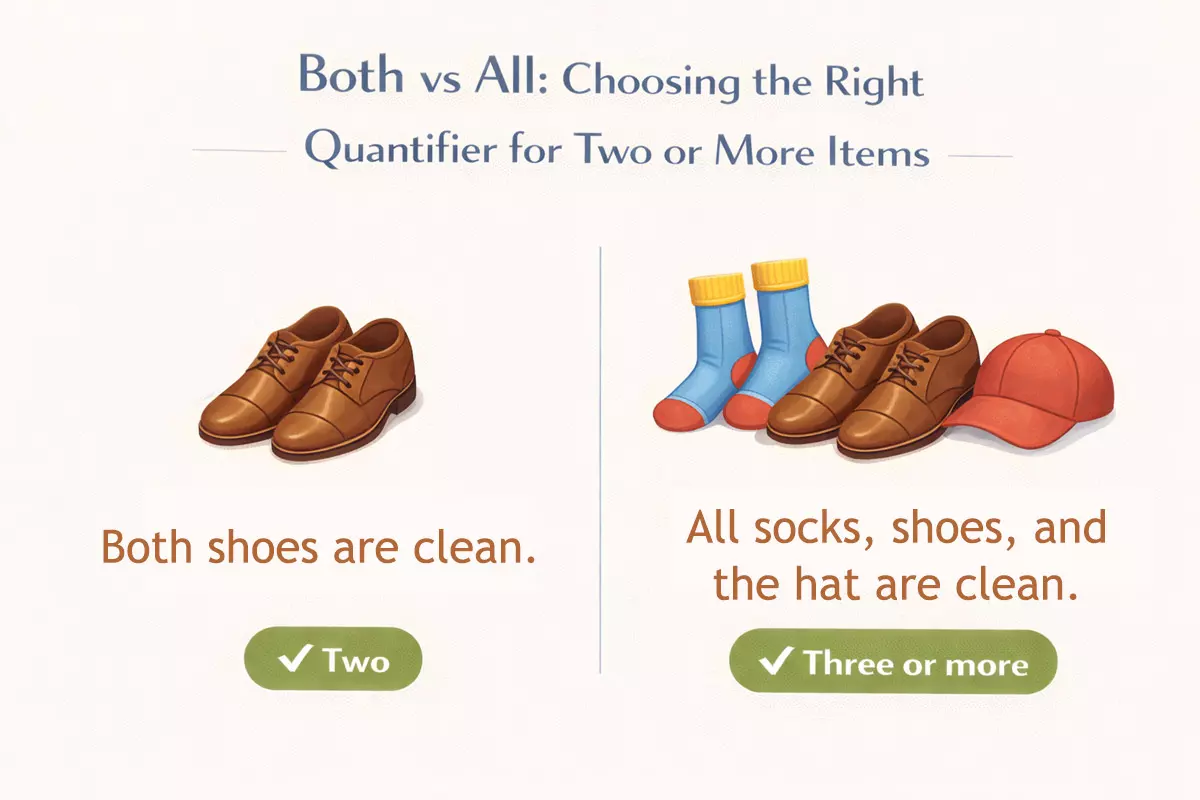 This article explains the difference between both and all, covering when to use them with two items or larger sets. It also discusses agreement with verbs and pronouns, word order, common mistakes, real examples, usage differences, and practice tips.
Choosing whether to refer to a pair or a larger group can be challenging, particularly in English, where subtle distinctions in quantifiers can significantly alter a sentence's meaning. Understanding and using the correct terms for groups of two or more helps maintain clarity and precision in both spoken and written communication. This attention to detail not only prevents misunderstandings but also demonstrates a strong command of language, allowing you to express ideas more effectively and accurately in various contexts.
Exact number focus vs general grouping
Choosing between “both” and “all” often comes down to whether you want to highlight a specific quantity or refer to a broader collection. “Both” is precise and only applies when you are talking about two items. In contrast, “all” is used for three or more, or sometimes even for two when the emphasis is on the group as a whole rather than the exact count. Understanding the nuance helps make your meaning clearer and prevents ambiguity.
When to use “both”
- Use “both” when referring to exactly two items or people.
- It emphasizes that each of the two is included without exception.
- It’s useful when the number two is important to your point.
Examples:
- Both keys are on the table. (There are exactly two keys.)
- She invited both her parents. (Not more, not less.)
- Both options are valid. (Only two options exist.)
When to use “all”
- Use “all” for groups of three or more.
- It refers to every item in a set, regardless of the exact quantity.
- It can be used with two items if you want to stress the group as a unit, but this is less common.
Examples:
- All students must submit the form. (The group could be any size.)
- All three answers are correct.
- All the books are on the shelf.
Comparison: Focus and grouping

| Quantifier | Typical Use | Number of Items | Example Sentence |
|---|---|---|---|
| Both | Highlights each member of a pair | Exactly 2 | Both brothers attended the reunion. |
| All | Refers to a group as a whole | 2 (rare), 3 or more (common) | All cookies were eaten. |
Common mistakes and tips
- Don’t use “both” when there are more than two items. ❌ Both students, teachers, and parents attended.
- “All” is correct for two items only if you’re talking about them as a single unit, but “both” is usually clearer. ✅ All (both) windows are closed.
- Double-check the number of items before choosing your quantifier.
Quick reference: Typical patterns
- Both of them are ready.
- All of us agree.
- Both answers are correct.
- All three options are good.
- Both shoes are missing.
- All the lights are out.
- Both cats are sleeping.
- All the ingredients are fresh.
- Both sides need to compromise.
- All five participants finished the race.
In summary, “both” points to an exact pair, while “all” gathers every item in a set, regardless of size. Matching your quantifier to your intended focus avoids confusion and makes your communication more precise.
Use with two items versus larger sets
Choosing between both and all depends on the exact number of things being discussed. When you’re talking about a pair, both is the natural fit. For any group larger than two, all becomes the standard quantifier. This distinction is key for clear and precise communication, especially in writing and formal speech.
When to Use "Both"
Both is reserved for situations involving exactly two entities. It treats the pair as a unit, emphasizing their inclusion together. Typical contexts include:
- Choosing between two options ("Both answers are correct.")
- Referring to two people ("Both students passed the test.")
- Describing two objects ("Both doors are open.")
- Making comparisons ("Both methods are effective.")
- Expressing agreement ("Both of us agree.")
- Listing two features or qualities ("Both fast and reliable.")
- Stating mutual actions ("Both teams played well.")
- Highlighting shared experiences ("Both have visited Paris.")
- Indicating dual ownership ("Both parents attended.")
- Summing up paired results ("Both results were positive.")
Using "All" for More Than Two
As soon as you refer to three or more items, all becomes the correct choice. All groups every member of a set, emphasizing totality. Here are some common scenarios:
- Talking about a group ("All employees must attend.")
- Describing a collection ("All the books are new.")
- Giving instructions ("All steps must be completed.")
- Discussing teams or participants ("All players are ready.")
- Referring to multiple options ("All answers are acceptable.")
- Summing up results ("All tests were positive.")
- Making universal statements ("All roads lead to Rome.")
- Expressing inclusivity ("All of us agree.")
- Listing shared characteristics ("All students are diligent.")
- Highlighting comprehensive coverage ("All areas are covered.")
Side-by-Side Comparison
| Situation | Correct Quantifier |
|---|---|
| Exactly two items/people | Both |
| Three or more items/people | All |
| Pair of choices | Both |
| Complete group (more than two) | All |
| Referring to a duo | Both |
| Referring to a set (three or more) | All |
In summary, both is exclusive to pairs, while all applies to any set larger than two. Using the right quantifier helps your meaning stay sharp and avoids confusion, especially in instructions, descriptions, or lists.
Agreement with verbs and pronouns
When choosing between "both" and "all," it’s important to know how each affects the form of verbs and pronouns that follow. "Both" is always used for exactly two items, while "all" refers to three or more. This distinction influences whether you use singular or plural verbs and which pronouns are appropriate.
Verbs: Singular or Plural?
With "both," always use plural verbs because you’re referring to two items as a group. For example, "Both are ready" is correct, not "Both is ready." The same rule applies to "all," which also takes plural verbs: "All are invited." There is no situation where "both" or "all" takes a singular verb.
Pronoun Choices
The pronouns you use must match the quantifier. "Both" is typically followed by "they," "them," or "their," since you’re talking about two people or things. "All" can be followed by "they," "them," or "their" as well, but only when referring to plural nouns. If "all" refers to something uncountable (like "all the water"), use "it."
- Both of them are here. ✅
- All of them are finished. ✅
- Both is here. ❌
- All is finished. (correct only for uncountable nouns: "All is lost.")
- Both has arrived. ❌
- All have arrived. ✅
- Both their answers are correct. ✅
- All their answers are correct. ✅
- All its water evaporated. ✅ (for uncountable noun)
- Both of you are welcome. ✅
- All of you are welcome. ✅
- Both themselves/each other (reflexive for two)
- All themselves/one another (reflexive for three or more)
Comparing Patterns
Below is a quick overview of how "both" and "all" interact with verbs and pronouns in typical sentences:
| Quantifier | Example with Verb | Example with Pronoun |
|---|---|---|
| Both | Both are arriving. | Both of them have tickets. |
| All (countable) | All are waiting. | All of us agree. |
| All (uncountable) | All is lost. | All its flavor is gone. |
| Neither | Neither is available. | Neither of them knows. |
Common Mistakes to Avoid
- Using "both" with a singular verb: Incorrect: Both is ready.
- Using "all" for two items: Incorrect: All of my shoes (when you have only two).
- Using "them" for uncountable nouns: Incorrect: All of them is water.
- Using "it" for countable plural nouns: Incorrect: Both of it are here.
Remember, matching the quantifier to the correct verb and pronoun keeps your sentences clear and grammatically correct. Whether you are talking about pairs or groups, the right agreement makes all the difference.
Position before nouns and pronouns
Understanding where to place both and all is key to sounding natural in English. These quantifiers usually come directly before the noun or pronoun they modify, but there are some differences in usage, especially when dealing with pronouns or definite articles. Let's break down how each is used.
Before nouns
When modifying nouns, both is used only for two items, while all is used for three or more. Both words typically appear before the noun and any article or determiner:
- both books (for exactly two books)
- all books (for three or more books)
- both the answers
- all the answers
Note how both and all can come before "the," "these," "those," or possessives like "my" or "their":
- both my friends
- all our options
- both these chairs
- all those children
Before pronouns
The placement rules change a little with pronouns. Both and all can come before the pronoun, but often they appear after an auxiliary verb or the main verb in a sentence:
- We both agree. / We agree both.
- They all left early. / They left early all.
However, the most natural position is usually after the subject and before the main verb or after an auxiliary verb:
- We both have tickets. (not: Both we have tickets.)
- They all were invited. (not: All they were invited.)
- You can all come. (not: All you can come.)
Quick reference: Usage patterns
| Quantifier | Common Placement Examples |
|---|---|
| both | both hands both the students both of them they both agree we have both finished |
| all | all questions all the tickets all of us they all arrived you are all welcome |
In summary, both and all usually come before nouns and determiners, but when used with pronouns, they are most often placed after the subject or after an auxiliary verb. Remember, both is only for pairs, and all is for groups of three or more.
Common mistakes with small numbers
Choosing between “both” and “all” can be surprisingly tricky when you’re dealing with just a couple of things. The main pitfall is using “all” to refer to exactly two items, which sounds odd to native speakers. “Both” is specifically for pairs, while “all” is for three or more. Mixing them up can lead to awkward or even confusing sentences, especially in formal writing or exams.
Typical errors with pairs

When you have two items, “both” is almost always the right choice. Using “all” for two is a common slip, especially for learners. Here are some examples of mistakes and their corrections:
- ❌ All of my shoes are wet. (if you only have two pairs) → ✅ Both of my shoes are wet.
- ❌ She invited all her parents. → ✅ She invited both her parents.
- ❌ All twins look alike. → ✅ Both twins look alike.
- ❌ The teacher called all the students to the front. (if there are only two students) → ✅ The teacher called both students to the front.
Misplaced “both” with more than two items
Another frequent error is using “both” for groups larger than two. Remember, “both” is strictly for two. For three or more, switch to “all.”
- ❌ Both my sisters and brother are here. → ✅ All my sisters and brother are here.
- ❌ Both the books, pens, and notebooks are on the desk. → ✅ All the books, pens, and notebooks are on the desk.
Comparing “both” and “all” for clarity
To help clarify which quantifier to use, here’s a quick reference:
| Situation | Correct Quantifier |
|---|---|
| Exactly two items | both |
| Three or more items | all |
| Unclear or mixed groups | all (if more than two); never “both” |
| Negative forms (neither, none) | neither (for two); none (for more than two) |
Quick reminders
- Use “both” only for pairs.
- Switch to “all” when the group is three or more.
- Don’t use “all” or “both” with singular nouns.
- In negative sentences, use “neither” for two, “none” for more.
Knowing these patterns helps you avoid awkward constructions and ensures your meaning is always clear.
Contrastive examples in real contexts
Choosing between "both" and "all" is a subtle but important aspect of clear communication, especially when specifying the number of items or people involved. The right quantifier depends not only on grammar but also on the real-world situation. Here, we’ll look at how each term is actually used in daily speech, writing, and common scenarios.
Everyday situations: when to use "both" or "all"
- Both is precise for exactly two: "Both keys are missing."
- All is for three or more: "All the windows are open."
- If you have two friends at a party, say: "Both of my friends are here."
- If you have five friends at a party: "All of my friends are here."
- When discussing options: "You can choose both dessert and coffee." (two options), versus "You can choose all the available drinks." (three or more).
- For pairs of items: "Both shoes are dirty."
- For groups: "All shoes must be removed before entering."
- With negative sentences: "Neither of the answers is correct." (two), "None of the answers are correct." (three or more).
- In instructions: "Wash both hands." vs. "Wash all utensils."
- When talking about siblings: "Both sisters live abroad." (two), "All siblings live abroad." (three or more).
Comparative overview
| Context | Correct Quantifier | Example |
|---|---|---|
| Two items | Both | Both doors are locked. |
| Three or more items | All | All chairs are taken. |
| Pair relationships | Both | Both parents attended the meeting. |
| Group relationships (3+) | All | All students passed the exam. |
Common pitfalls and tips
- Don’t use "both" for more than two: "Both of my three cats" ❌ (incorrect). Instead, use "All of my three cats".
- Using "all" for two is technically possible in some contexts (e.g., "All is forgiven" when referring to two issues), but "both" is clearer and preferred when you mean exactly two.
- For emphasis, "all" can sometimes work with two, but it often sounds odd: "All hands on deck" (could be two or more, but "both hands" is specific).
In summary, the distinction between these quantifiers helps listeners or readers immediately grasp the number involved, reducing ambiguity. Using "both" for exactly two and "all" for three or more is a straightforward rule, but context can occasionally create exceptions—especially in idioms or set phrases.
Spoken and written usage differences
When people choose between “both” and “all,” their decision often depends on whether they’re speaking or writing. In everyday conversations, speakers tend to use simpler structures and may rely more on context for clarity. Written language, on the other hand, usually demands more precision and explicitness, especially in formal documents.
How usage shifts in conversation
In spoken English, “both” and “all” are sometimes used more flexibly, especially when the number of items is obvious from context. For example, in casual speech, someone might say, “All of you come here,” even if there are only two people, whereas in writing, “Both of you come here” would be preferred for accuracy when addressing exactly two.
Written communication: clarity and formality
Writers are generally expected to match quantifiers to the exact number of items. Using “all” for two items in a formal letter or report can seem imprecise or careless. “Both” is typically reserved for precisely two, while “all” implies three or more.
Common usage patterns
Here are examples of how these quantifiers appear in everyday language:
- Both doors were locked. (Exactly two doors)
- All doors were locked. (Three or more doors, or an unspecified total)
- Both candidates gave speeches. (Two candidates)
- All candidates gave speeches. (More than two)
- Both of my parents are teachers.
- All of my friends liked the movie.
- Both teams scored in the first half.
- All teams must register by Friday.
- We both agree on this issue.
- We all enjoyed the concert.
- Both options are available.
- All options are available.
- She invited both sisters.
- She invited all her sisters.
- Both of them arrived early.
- All of them arrived early.
Comparison of spoken and written forms
| Spoken Example | Written Example |
|---|---|
| All of you need to sign this. (to two people) | Both of you need to sign this. (for clarity) |
| We all saw the movie. (group context, number vague) | Both of us saw the movie. (specifies two viewers) |
| All my shoes are wet. (could mean two or more) | Both shoes are wet. (if exactly two) |
| All kids should come inside. (applies to any group size) | Both kids should come inside. (if there are only two) |
Key takeaways
- Spoken English is often more flexible with quantifiers, relying on shared context.
- Written language favors precision—“both” for two, “all” for three or more.
- Misusing these quantifiers in formal writing can lead to confusion or appear imprecise.
- When in doubt, match the quantifier to the exact number of items, especially in writing.
Practice: selecting both or all accurately
Understanding when to use "both" or "all" can be tricky, especially in sentences with more than two items or when context is unclear. Let’s work through some practical exercises and examples to help solidify your grasp of these quantifiers.
Common usage patterns
- Both is used for exactly two people or things.
- All is used for three or more, or for groups in general.
- With uncountable nouns, use all (e.g., "all the water").
- With plural countable nouns, use all for three or more (e.g., "all the students"), and both for two (e.g., "both students").
Spot the correct quantifier
Choose the correct word for each blank: "both" or "all".
- ______ of my parents are teachers.
- ______ the cookies were eaten at the party.
- She invited ______ her friends to the concert.
- ______ brothers play soccer on weekends.
- ______ of these options are acceptable.
- He has visited ______ countries in South America.
- ______ of the answers were correct.
- ______ twins have blue eyes.
- ______ of the students passed the final exam.
- ______ children were present at the meeting.
- ______ of the information was verified.
- ______ solutions worked as expected.
Show answers
- Both
- All
- All
- Both
- Both (if there are two options); All (if three or more)
- All
- All
- Both
- All
- Both
- All
- All
Comparison table: when to use "both" vs "all"
| Situation | Correct Quantifier |
|---|---|
| Exactly two people/things | Both |
| Three or more people/things | All |
| Referring to a group as a whole (countable or uncountable) | All |
| Two specific items from a group | Both |
Rewrite practice
Rewrite each sentence using the correct quantifier.
- Lisa and Tom went to the museum. (Use a quantifier)
- There are three new books on the table. (Start with a quantifier)
- My eyes are blue. (Begin with a quantifier)
- Five children entered the classroom. (Use a quantifier)
- Anna and Mark agreed with the decision. (Use a quantifier)
- There are four chairs in the room. (Start with a quantifier)
- My hands were cold. (Begin with a quantifier)
- Ten questions were answered correctly. (Use a quantifier)
- Sarah and Emma finished the project. (Use a quantifier)
- Six students passed the exam. (Start with a quantifier)
Show answers
- Both Lisa and Tom went to the museum.
- All three new books are on the table.
- Both my eyes are blue.
- All five children entered the classroom.
- Both Anna and Mark agreed with the decision.
- All four chairs are in the room.
- Both my hands were cold.
- All ten questions were answered correctly.
- Both Sarah and Emma finished the project.
- All six students passed the exam.
Quick self-check
- Are you talking about two? Use both.
- Are there three or more? Use all.
- Is it a mass or uncountable noun? Use all.
Practice with real sentences helps you internalize the distinction between these quantifiers. Try making your own examples for everyday situations to reinforce these patterns.