Several: Meaning, Usage, and Typical Contexts Explained

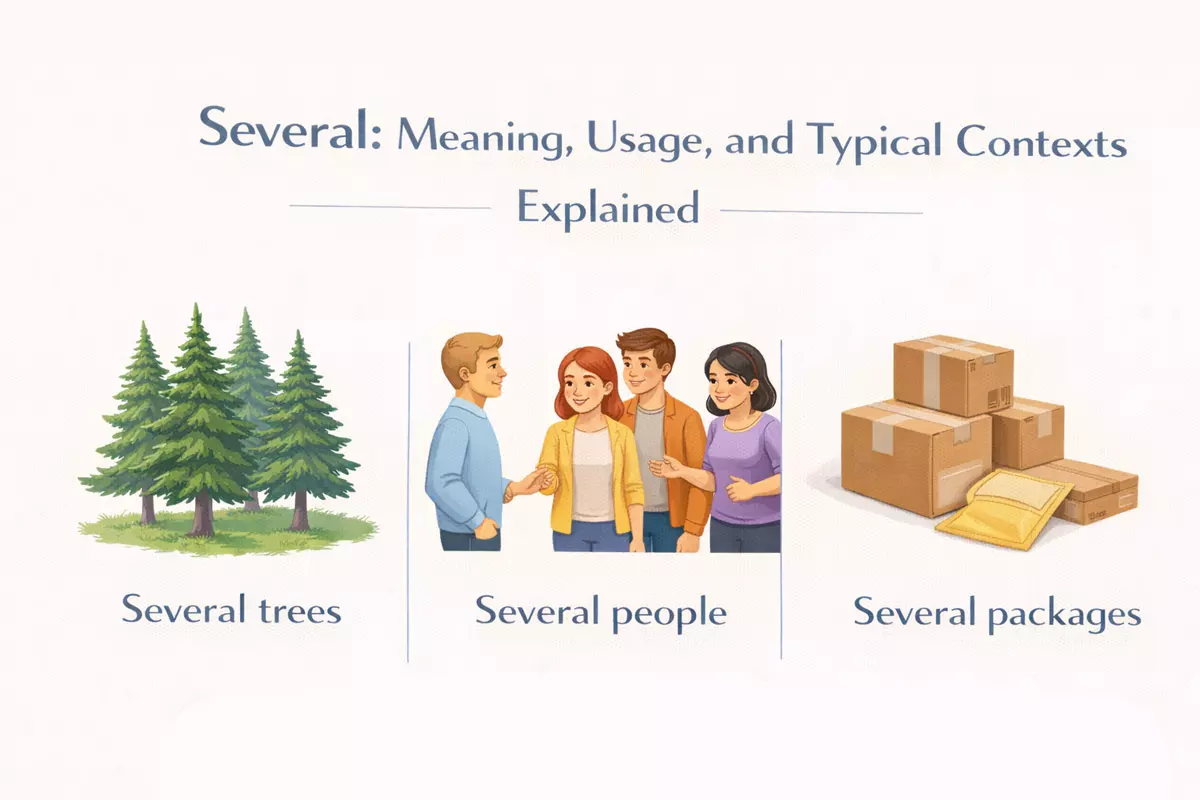 Here we how to use several in English, including its approximate amount, how it differs from a few, and which nouns it matches. It also covers sentence placement, tone in neutral writing, common misconceptions, examples, and practice tips.
- Approximate quantity and implied range
- Difference between several and a few
- Nouns commonly used with several
- Sentence position and grammatical behavior
- Register and tone in neutral writing
- Common misconceptions about exact number
- Examples in spoken and written contexts
- Practice: using several naturally
The English language provides the term "several" to describe a quantity that is more than a couple but not a large number, and its usage can sometimes be confusing. Typically, "several" refers to more than two but fewer than many, often interpreted as three to seven items or people, depending on the context. Knowing when to use "several" instead of words like "few" or "many" helps you convey your meaning more precisely and avoid misunderstandings in both written and spoken communication.
Approximate quantity and implied range
When people use the word "several," they usually mean more than just a couple or a few, but not so many that it becomes a large group. The exact number can feel slippery, because "several" is a relative term shaped by context, speaker intent, and even regional habits. Most English speakers agree that it suggests a small plural amount, but how many is that really?
Typical numeric interpretations
In daily conversation, "several" tends to imply a quantity between three and seven. It is rarely used for two (that’s "a couple") or for numbers higher than about seven or eight (which might be described as "many" or "numerous"). Here’s how it usually breaks down:
- Three: The lowest number commonly accepted as "several"
- Four or five: The most frequent usage range
- Six or seven: Still plausible, but starting to feel like "many"
If someone says, "I have several books on that topic," listeners infer more than two, but probably not more than seven or eight.
Comparisons with other quantifiers
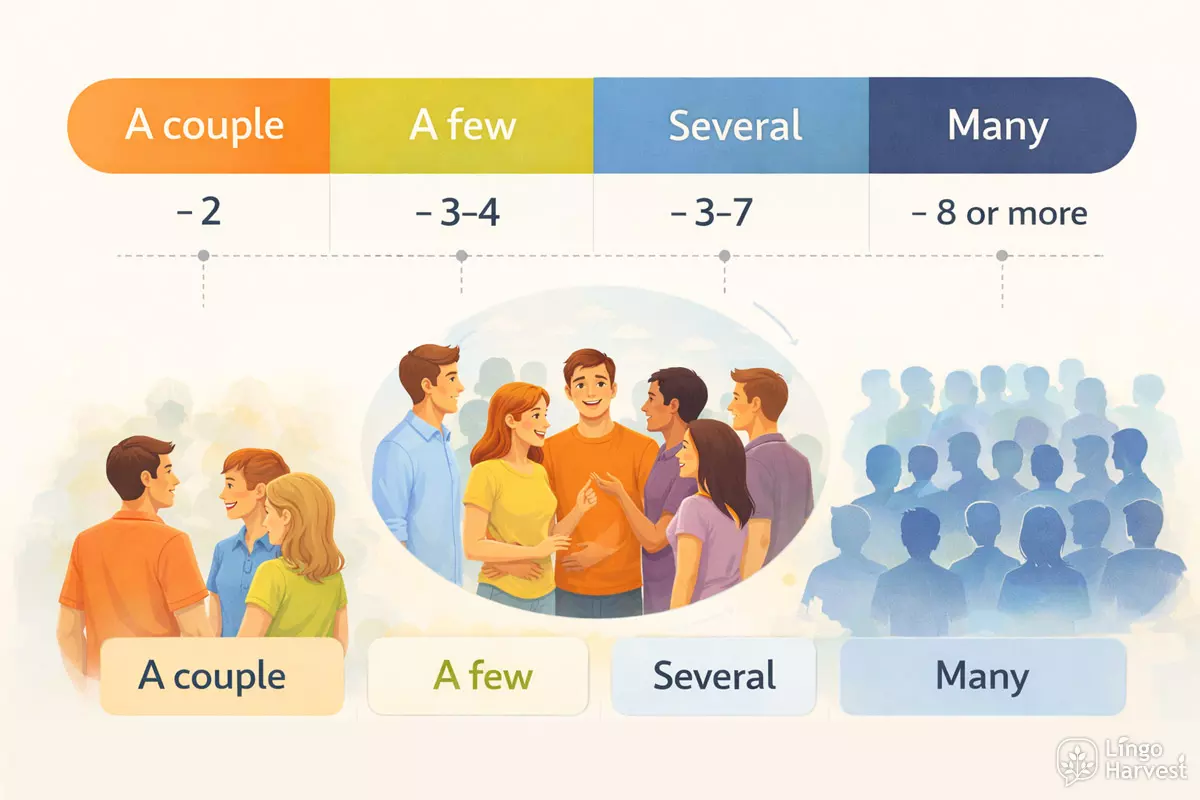
To better understand where "several" fits, let’s compare it to similar terms that describe quantity:
| Quantifier | Typical Implied Range |
|---|---|
| A couple | 2 |
| A few | 3–4 |
| Several | 3–7 |
| Many | 8 or more |
| Numerous | Large, often 10+ |
Context matters
The size of the group or set in question can change the feeling of "several." For example, "several grains of sand" could mean dozens, while "several cars" probably means three to five. Always consider the subject: the same word implies different amounts depending on what’s being counted.
Summary points
- "Several" is less precise than a specific number.
- It usually refers to more than two, but fewer than eight.
- Context, speaker, and subject all shape its implied range.
- For larger groups, terms like "many" or "numerous" are more accurate.
- For exactness, it’s better to use a number or a more specific word.
Difference between several and a few
When deciding between "several" and "a few," the main distinction lies in the sense of quantity each word conveys. Both terms refer to an unspecified, small number of items, but they are not interchangeable in all situations. "A few" generally implies a smaller number, often considered to be around three to five, while "several" suggests a slightly larger, but still limited, quantity—typically more than "a few" but less than "many." Context, speaker intent, and the subject matter can all influence which term feels most natural.
Typical Usage and Nuance
"A few" is often used when referring to a modest number of items or people, and it tends to sound more informal or casual. "Several," on the other hand, carries a sense of a greater count and can suggest a more significant quantity, though it still keeps the idea of limitation. The difference can be subtle, but it often matters in precise communication.
- A few: Implies a small, limited number. Example: "I have a few friends coming over."
- Several: Indicates more than a few, but not a large number. Example: "Several students handed in their assignments early."
Comparative Overview
To highlight the distinctions, the table below summarizes the main points of comparison:
| Aspect | A Few | Several |
|---|---|---|
| Approximate Quantity | 3–5 items/people | More than a few, usually 4–7 |
| Implied Limitation | Small, minimal amount | Still limited, but greater than "a few" |
| Common Contexts | Informal, everyday speech | Formal/informal, when emphasizing a larger small group |
| Example Sentences | "She waited a few minutes." | "Several options were available." |
Sample Scenarios and Tips
Choosing the right term depends on what you want to communicate. Here are some examples to clarify usage:
- If you want to downplay the number, use "a few." (e.g., "Only a few tickets remain.")
- To suggest that the number is notable but not large, use "several." (e.g., "Several guests have already arrived.")
- For very small counts (two or three), "a couple" might be more accurate.
- When precision is important, consider using exact numbers instead of vague quantifiers.
In summary, while both "a few" and "several" refer to small groups or quantities, "several" usually means more than "a few." Context and intent are key to choosing the most appropriate term.
Nouns commonly used with several
When people use the word "several," it's most often paired with countable nouns. This is because "several" indicates more than two but not a large number, making it a natural fit for things you can count individually. Commonly, these are concrete items, people, or time units, but abstract concepts sometimes appear as well. Understanding which nouns are typically matched with "several" can help you sound more natural and precise in speech and writing.
Typical categories of nouns
You’ll notice "several" works best with plural nouns that refer to discrete entities. Here are some broad categories and examples:
- People: friends, students, teachers, workers, guests
- Objects: books, chairs, cars, pens, computers
- Time periods: days, weeks, months, hours, years
- Events: meetings, occasions, trips, calls, attempts
- Places: cities, countries, locations, houses, offices
- Animals: birds, cats, dogs, horses, insects
- Abstract items: reasons, options, possibilities, opportunities, examples
- Quantities: pieces, types, kinds, sets, pairs
Examples in context
Pairing "several" with the right noun can clarify your meaning. Consider these sample phrases:
- She visited several countries last year.
- We have several options to consider.
- There are several reasons for the delay.
- He tried several times before succeeding.
- The teacher assigned several books for the course.
- They made several attempts to fix the issue.
- We saw several birds in the garden.
- She called several friends for advice.
- The team held several meetings this week.
- I've been to several offices in this building.
Common patterns and usage notes
"Several" is rarely used with uncountable nouns (like "water" or "information"). It’s also less common with nouns that naturally come in a pair or set, unless referring to multiples (for example, "several pairs of shoes"). In more formal or technical contexts, "several" may be replaced with exact numbers for clarity, but in everyday conversation, it’s perfect for expressing an approximate amount.
| Noun Category | Example Phrase with "Several" |
|---|---|
| People | several students |
| Objects | several books |
| Events | several meetings |
| Time Periods | several days |
| Abstract Items | several reasons |
Choosing the appropriate noun to follow "several" helps ensure your message is clear and idiomatic. If you’re ever unsure, try substituting with "a few" or a specific number to see if the phrase still makes sense—if so, "several" is likely a good fit.
Sentence position and grammatical behavior
Understanding how "several" fits into sentence structure and interacts with other words helps clarify its use. As a determiner and pronoun, "several" usually appears before plural countable nouns or stands alone, depending on the context. It does not combine with articles like "the" or "a," and it cannot be used with uncountable nouns.
Typical placements in sentences
"Several" most often comes at the beginning or middle of a noun phrase, directly before the noun it describes. It cannot follow the noun, nor can it be used with singular nouns. Here are some common positions:
- Before a plural noun: Several books were missing from the shelf.
- As a pronoun, replacing a noun: Several arrived late to the meeting.
- With adjectives before the noun: Several important issues were discussed.
- With prepositional phrases: Several of the students volunteered.
Grammatical restrictions and patterns
There are specific rules about how "several" can be used:
- It cannot be used with singular nouns: ❌ several chair → ✅ several chairs
- It does not take an article: ❌ the several books → ✅ several books
- It cannot be used with uncountable nouns: ❌ several information
- It can be followed by "of" plus a determiner: several of the candidates
- Not used with possessive pronouns: ❌ several my friends
Comparison with similar determiners
To better understand how "several" differs from related words, consider the following table:
| Word | Typical Use | Plural/Singular | Example |
|---|---|---|---|
| Several | Indicates more than two but not many | Plural only | Several students |
| Few | Small number, often with a negative nuance | Plural only | Few opportunities |
| Some | Unspecified number or amount | Plural or uncountable | Some apples / Some water |
| Many | Large number | Plural only | Many reasons |
Common sentence patterns
Writers and speakers often use "several" in the following ways:
- Several students participated.
- Several of them were absent.
- She has visited several countries.
- Several important details were overlooked.
- We received several complaints.
- Several members voted in favor.
- Several of those options are suitable.
- They made several attempts.
- Several reports have been submitted.
- He owns several properties.
In summary, "several" functions as a plural-only determiner or pronoun, is never used with singular or uncountable nouns, and cannot be paired with articles or possessives. Recognizing these patterns makes it easier to use the word accurately in a range of contexts.
Register and tone in neutral writing
Choosing the right level of formality is essential when using terms like "several" in neutral or objective writing. Neutral language avoids emotional coloring or personal bias, making it suitable for academic, professional, and informational contexts. In such settings, "several" is often preferred because it conveys a vague quantity without exaggeration or imprecision. This helps maintain clarity and avoids the risk of overstatement.
How "several" fits neutral contexts
Writers often rely on "several" to indicate more than a couple, but not a large number. Unlike more precise quantifiers, it leaves room for interpretation, which can be useful when exact numbers are unavailable or unnecessary. In reports, technical documents, or instructions, this term signals a moderate amount without implying extremes. The result is communication that is both clear and diplomatic.
Examples of neutral usage
- Several studies indicate a correlation between exercise and improved mood.
- The committee reviewed several proposals before making a decision.
- We received several requests for clarification on the policy.
- Several steps must be completed before the application can be processed.
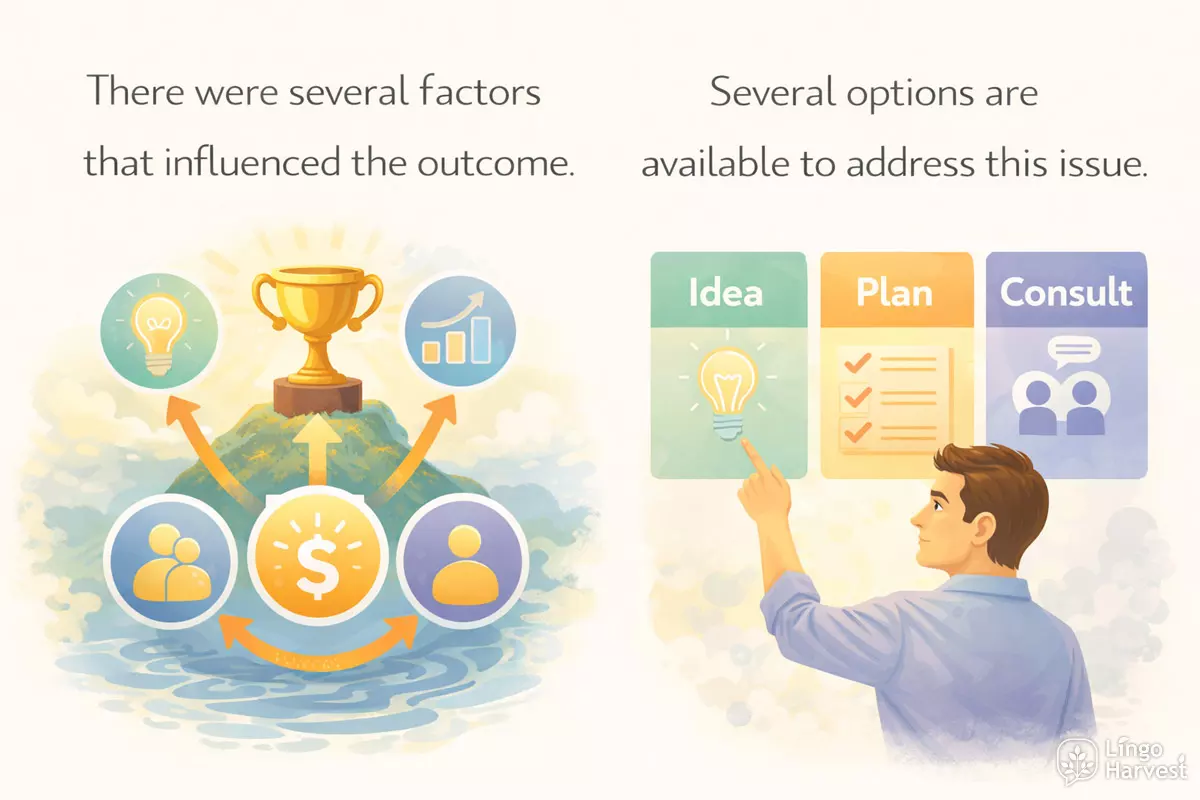
- There were several factors that influenced the outcome.
- Several options are available to address this issue.
- The project encountered several challenges during implementation.
- Several participants withdrew from the study.
- The data was collected over several months.
- We identified several areas for improvement.
Comparing neutral alternatives
Writers sometimes need to choose between "several" and similar words like "some," "a few," or "many." Each has a slightly different nuance and level of specificity. "Several" tends to be more formal and less ambiguous than "some," but it is less precise than using a specific number.
| Word/Phrase | Typical Use in Neutral Contexts |
|---|---|
| Several | Moderate quantity; more than two but not a large number; avoids exactness. |
| Some | Indefinite, could be a small or large amount; often less formal and more ambiguous. |
| A few | Small quantity; generally understood as 2–3, rarely more than 4–5. |
| Many | Large number; used for emphasis or when quantity is clearly substantial. |
| Numerous | Very large quantity; formal, often used in reports or technical writing. |
Best practices for neutral writing
- Use "several" when you want to convey a moderate, unspecified quantity.
- Pair with objective verbs and nouns for clarity (e.g., "several factors," "several suggestions").
- Avoid emotional or subjective modifiers that could bias the statement.
- When possible, clarify with additional details or context for precision.
- Reserve more precise quantifiers for when exact numbers matter to your audience.
In summary, using "several" in neutral writing supports clear, unbiased communication by indicating a moderate amount without unnecessary specificity or emotional undertones. This makes it a valuable choice in many professional and academic situations.
Common misconceptions about exact number
When people see words like "several," it's easy to assume they refer to an exact or universally agreed-upon quantity. In reality, such terms are intentionally imprecise and flexible, depending on context, speaker, and cultural expectations. This flexibility often leads to confusion or disagreements about what is meant when someone uses a word that suggests a count, but not a fixed one.
Assuming precision where there is none
A frequent misunderstanding is believing that terms like "several" specify a set number. Unlike "three" or "seven," these expressions are deliberately vague. For example, "several" can mean anything from three to seven in many English-speaking contexts, but this isn't a hard rule. Expecting a precise value from such language often leads to miscommunication.
Ignoring context and intent
The meaning behind vague quantifiers like "several" often depends on the subject matter or the expectations of the audience. For instance, "several cookies" might mean five, but "several years" could mean three or more, depending on the context. Rigidly applying a single standard to every situation leads to misunderstandings.
- Assuming every speaker uses these words the same way
- Believing dictionaries always agree on a fixed range
- Expecting that these words are interchangeable with precise numerals
- Overlooking cultural or regional variations in usage
- Forgetting that tone and emphasis can change the intended meaning
Summary
Words like "several" serve as useful tools for expressing uncertainty or generality, rather than pinpointing a specific total. Recognizing the flexibility and nuance in such language helps prevent confusion and encourages clearer communication, especially in situations where exactness isn't possible or necessary.
Examples in spoken and written contexts
Understanding how "several" is used in everyday language can help clarify its meaning and range. The word often indicates more than two but not a large number, and its interpretation can shift based on tone, context, and formality. Below are sample sentences and situations to demonstrate this term in both conversation and writing.
Common Patterns in Conversation
- "I have several books to return to the library."
- "There were several people waiting in line."
- "Can you give me several reasons for your decision?"
- "She called several times but didn't leave a message."
- "They visited several countries during their trip."
- "The teacher gave us several examples to help us understand."
- "I tried several different approaches before finding a solution."
- "We need to consider several factors before making a choice."
- "After several attempts, he finally succeeded."
- "There are several options available."
Usage in Formal and Informal Writing
In more formal texts, "several" is frequently used to refer to a handful of items, studies, or points, without specifying an exact number. In informal writing or emails, it often emphasizes that the number is not just a couple, but also not many.
- "The committee reviewed several proposals before making a decision."
- "Researchers have identified several key trends in the data."
- "There are several advantages to this approach."
- "We encountered several challenges during the project."
Comparison with Other Quantifiers
| Expression | Typical Range/Implication |
|---|---|
| A couple of | Two (sometimes loosely up to three) |
| Several | More than two or three, but not many (often 3–7) |
| Many | A large number (no specific upper limit) |
| Few | A small number, usually less than "several" |
Contextual Nuances
The exact number implied by "several" can vary based on context and speaker intention. For example, when scheduling meetings, "several options" might mean three or four, but when discussing scientific studies, it could refer to five or six. Always consider the surrounding information to interpret the intended quantity.
Practice: using several naturally
Getting comfortable with the word "several" means learning how it fits into sentences and situations, especially compared to similar quantifiers like "a few" or "many." In English, "several" typically refers to more than two but not a large number—often three to seven items or people. Below, you'll find a mix of examples, tips, and exercises to help you use this word accurately and confidently.
Common sentence patterns with "several"
- There are several reasons why this method works.
- I have several friends who enjoy hiking.
- She found several errors in the report.
- We visited several museums during our trip.
- Several students volunteered to help.
- They offered several solutions to the problem.
- The package contains several different items.
- He called several times but didn’t get an answer.
- Several attempts were needed before success.
- The author has written several books on the subject.
- Several changes have been made since last year.
- I’ll need several hours to finish this project.
- After several tries, she finally succeeded.
- We have several options to consider.
- Several of my colleagues agreed with me.
- The meeting was postponed several times.
- He brought several samples to show us.
- The storm caused several delays.
- Several questions remain unanswered.
- There are several ways to approach this issue.
Quick practice: choose the best quantifier
Decide which word fits best: a few, several, or many?
- ______ students raised their hands to answer the question.
- I only need ______ minutes to finish this task.
- There are ______ reasons to visit this city in the spring.
- ______ people attended the concert—over 10,000!
- He made ______ attempts before succeeding.
- ______ employees expressed concerns about the new policy.
- She asked ______ questions during the discussion.
- ______ books on the list are already out of print.
- We received ______ responses to the survey.
- The project required ______ adjustments before approval.
Show answers
- Several students raised their hands to answer the question.
- A few minutes to finish this task.
- Several reasons to visit this city in the spring.
- Many people attended the concert—over 10,000!
- Several attempts before succeeding.
- Several employees expressed concerns about the new policy.
- A few questions during the discussion.
- Several books on the list are already out of print.
- Many responses to the survey.
- Several adjustments before approval.
Write your own examples
Try creating sentences using "several" to describe:
- Things you did last weekend
- Topics you’re interested in
- Places you’d like to visit
Practicing in this way will help you develop a natural sense for when and how to use this useful quantifier in everyday English.