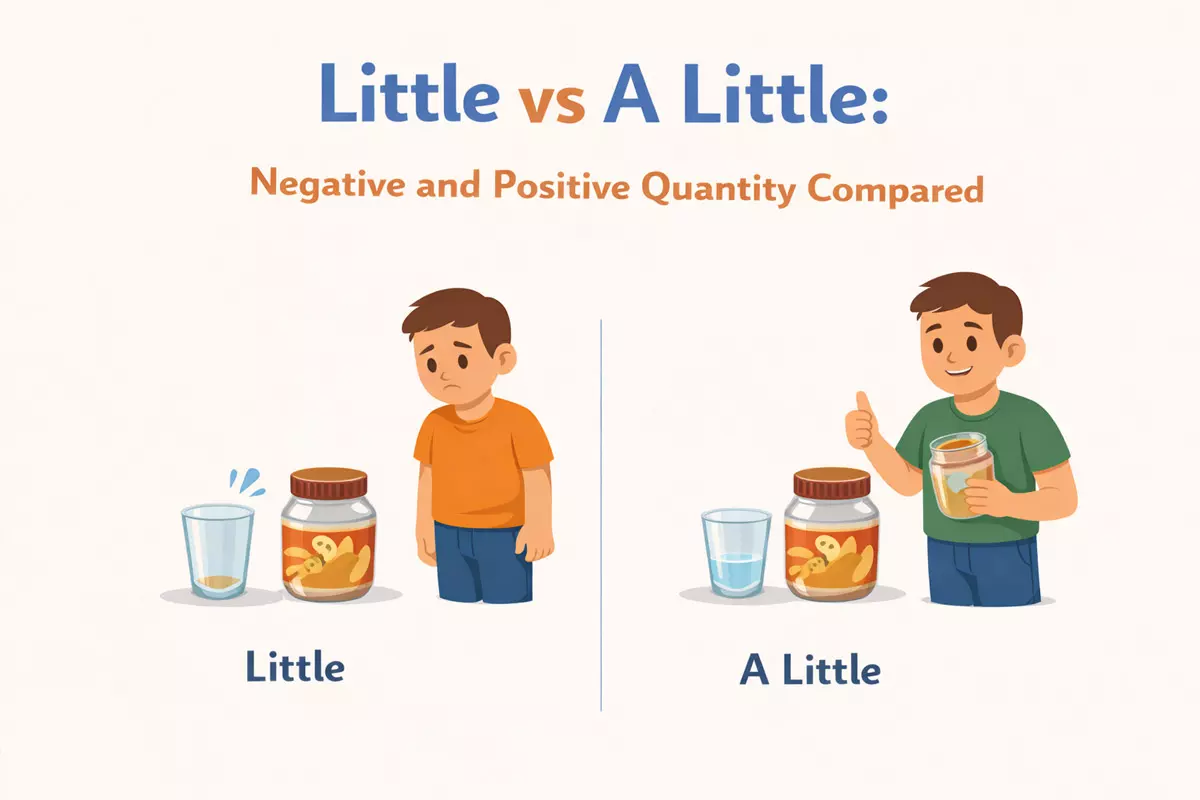
Little vs A Little: Negative and Positive Quantity Compared

 Here we the main difference between little and a little, their positive or negative meanings, correct use with uncountable nouns, sentence patterns, how speaker attitude affects meaning, frequent learner mistakes, real-life examples, and practice exercises.
- Core meaning difference between little and a little
- Negative vs positive implication in context
- Use with uncountable nouns only
- Sentence position and structure patterns
- Meaning changes based on speaker attitude
- Common learner mistakes and confusion
- Examples from everyday situations
- Practice: selecting little or a little accurately
Selecting the right expression to convey small amounts can be challenging, as subtle differences often shift the tone from negative to positive. Mastering the appropriate use of such phrases is essential for clear and effective communication, allowing you to express your thoughts with greater accuracy and nuance. By paying attention to these distinctions, you can ensure your language sounds both natural and precise, which is especially important in both written and spoken English. This skill not only helps avoid misunderstandings but also enhances your overall communication abilities.
Core meaning difference between little and a little
The words little and a little both refer to small quantities, but they differ in the attitude or implication they carry. Little is typically used to suggest that the amount is not enough—often highlighting a sense of lack or insufficiency. In contrast, a little indicates that there is some amount present, which, while not large, is at least enough for a purpose, or at least not entirely absent. This creates a subtle but important contrast in tone: one is more negative, the other more positive.
Implications and Attitude
When choosing between these two, consider the message you want to send. If you wish to stress scarcity or disappointment, little is the right choice. If you want to suggest at least some presence or possibility, a little is better. The difference often comes down to whether you are focusing on what is missing or on what is available.
- Little often implies "hardly any at all" or "not sufficient":
There is little hope of success. ❌ (Almost no hope, negative outlook) - A little suggests "some, though not much":
There is a little hope of success. ✅ (Some hope remains, positive outlook)
Usage in Context

Both expressions are used with uncountable nouns. The choice between them can change the entire meaning of a sentence. Here are more examples to illustrate the contrast:
- She has little patience for delays. ❌
- She has a little patience for delays. ✅
- We have little time left. ❌
- We have a little time left. ✅
- They showed little interest in the project. ❌
- They showed a little interest in the project. ✅
- He received little help from his friends. ❌
- He received a little help from his friends. ✅
- There is little milk in the fridge. ❌
- There is a little milk in the fridge. ✅
Summary Table: Negative vs Positive Quantity
| Expression | Implication | Example |
|---|---|---|
| Little | Negative / Not enough | There is little hope. |
| A little | Positive / Some, enough for a purpose | There is a little hope. |
| Little | Almost none | We have little time. |
| A little | At least some | We have a little time. |
To sum up, the distinction between these two small phrases is all about the speaker’s perspective: one looks at the glass as nearly empty, the other as not quite full—but not empty either.
Negative vs positive implication in context
Understanding how “little” and “a little” change the tone and meaning of a sentence is essential for clear communication. Both phrases refer to small quantities, but they differ sharply in the feeling and implication they convey. “Little” often suggests a negative outlook—emphasizing scarcity or insufficiency—while “a little” brings a more optimistic or positive spin, implying that there is at least some amount available, even if it’s not much.
How usage affects meaning
The choice between these two expressions can alter the listener’s or reader’s expectations. “Little” tends to highlight a lack or absence, sometimes causing concern or disappointment. In contrast, “a little” can reassure or suggest possibility, even if the quantity is limited. This subtle distinction is especially important in everyday conversation, writing, and formal communication.
| Phrase | Implication | Example Sentence |
|---|---|---|
| Little | Negative, insufficient, almost none | There is little hope of success. |
| A little | Positive, some exists, at least a bit | There is a little hope of success. |
| Little time | Not enough time; rushed or pressured | We have little time to finish the project. |
| A little time | Some time available; possible to do something | We have a little time before the meeting starts. |
| Little money | Almost no money; financial difficulty | They had little money left after the trip. |
| A little money | Some money; enough for something small | She saved a little money for emergencies. |
Common situations and subtle shifts
Even minor changes in phrasing can shift the meaning. Consider these practical examples where the nuance matters:
- “He has little patience.” → He is easily annoyed (negative)
- “He has a little patience.” → He can tolerate some things (positive)
- “There was little food at the party.” → Not enough for guests (problematic)
- “There was a little food at the party.” → At least something was served (reassuring)
- “She showed little interest.” → She was mostly indifferent
- “She showed a little interest.” → She was at least somewhat interested
- “Little progress was made.” → The outcome was disappointing
- “A little progress was made.” → Some, even if modest, improvement occurred
- “Little energy left.” → Almost exhausted
- “A little energy left.” → Still able to continue briefly
- “Little chance of rain.” → Very unlikely to rain
- “A little chance of rain.” → Rain is possible, though not likely
The difference often lies in whether the speaker wants to stress limitation or possibility. Recognizing these subtle cues helps both speakers and listeners interpret messages more accurately and respond appropriately.
Use with uncountable nouns only
When talking about “little” and “a little,” it’s important to remember they are only suitable for uncountable nouns. Words like “water,” “money,” and “information” don’t have a plural form and can’t be counted one by one. That’s why you won’t hear “a little apples” or “little chairs”—those are countable items and need different quantifiers. Uncountable nouns often represent substances, concepts, or collective categories that can’t be split into individual elements. Here are some common examples of uncountable nouns used with “little” or “a little”:
- advice → I need a little advice.
- bread → There is little bread left.
- coffee → I drink a little coffee in the morning.
- energy → I have little energy today.
- equipment → We have a little equipment for the job.
- furniture → They bought a little furniture for the new apartment.
- information → I have little information about it.
- luggage → She has little luggage.
- luck → I had a little luck today.
- money → I have little money right now.
- music → I listen to a little music before bed.
- news → I have a little news for you.
- patience → I have little patience for delays.
- progress → We made a little progress.
- rain → There was a little rain this morning.
- salt → Add a little salt.
- space → We have little space in this room.
- time → I have a little time to talk.
- water → There is little water in the glass.
- wisdom → He has a little wisdom to share.
Why not with countable nouns?
“Little” and “a little” don’t work with things you can count individually, like “books” or “cars.” For those, English uses “few” and “a few.” Using the wrong quantifier sounds unnatural and can confuse your listener. For example:
- ❌ I have a little apples.
- ✅ I have a few apples.
- ✅ I have a little water.
Comparing usage
The difference in usage becomes clear when you look at parallel sentences:
| Uncountable noun example | Countable noun example |
|---|---|
| We have a little milk left in the fridge. | We have a few bottles left in the fridge. |
| She has little hope of finding her keys. | She has few options left. |
| There’s a little information on the topic. | There are a few articles on the topic. |
| He had little patience for delays. | He had few complaints. |
Remember, the right quantifier helps your English sound more natural and precise. If you’re unsure whether a noun is countable, try to see if it has a plural form or if you can count it individually. If not, “little” and “a little” are the go-to choices.
Sentence position and structure patterns
Understanding where and how to use "little" and "a little" in English sentences is essential for expressing negative and positive amounts clearly. Both expressions typically appear before uncountable nouns, but their placement and the sentence structure around them can subtly affect meaning and tone.
Typical placement in sentences
- Both "little" and "a little" usually come directly before an uncountable noun: She has little hope, He has a little time.
- Modifiers such as "very" or "only" can precede them: Very little water remained, Only a little patience is needed.
- In negative sentences, "little" often emphasizes scarcity: There is little chance of rain.
- "A little" introduces a positive nuance, suggesting that some amount exists: I have a little information to share.
Sentence structure patterns
- Affirmative: "A little" is used to indicate a small but sufficient quantity. She brought a little food for the trip.
- Negative: "Little" emphasizes a lack or insufficiency. There is little interest in the proposal.
- Questions often use "any" instead, but can use these forms for nuance: Do you have a little money?
- Comparisons may involve both: I have a little experience, but he has little knowledge.
- Adverbial use is possible: He spoke little during the meeting.
- With adjectives: She has little practical experience.
- With "too" or "so": There is too little time to finish.
- With "just": Just a little sugar, please.
- With quantifiers: Very little progress was made.
- In formal or literary contexts: Little did he know what awaited him.
Comparing usage: negative vs positive quantity
| Pattern | Example Sentence |
|---|---|
| Negative sense ("little") | He has little interest in sports. ❌ |
| Positive sense ("a little") | She has a little money saved. ✅ |
| With modifiers ("very little", "only a little") | There was only a little cake left. |
| Adverbial use ("spoke little") | The child spoke little during class. |
| Emphasizing sufficiency ("just a little") | Just a little help would be enough. |
By observing these structures, you can better choose between "little" and "a little" to match the intended meaning and tone—whether to highlight a lack or to suggest at least some presence of what you’re discussing.
Meaning changes based on speaker attitude
Understanding how "little" and "a little" are used goes beyond simple quantity—they also reflect how the speaker feels about the amount. The choice of phrase often reveals whether the speaker sees the quantity as sufficient or inadequate, which can completely change the impression given to the listener. When someone uses "little" without an article, it typically signals a negative view—there’s not enough of something, or it’s almost gone. In contrast, "a little" suggests a more positive or at least neutral stance, implying that while the quantity isn’t large, it’s enough for some purpose.
How attitude affects meaning
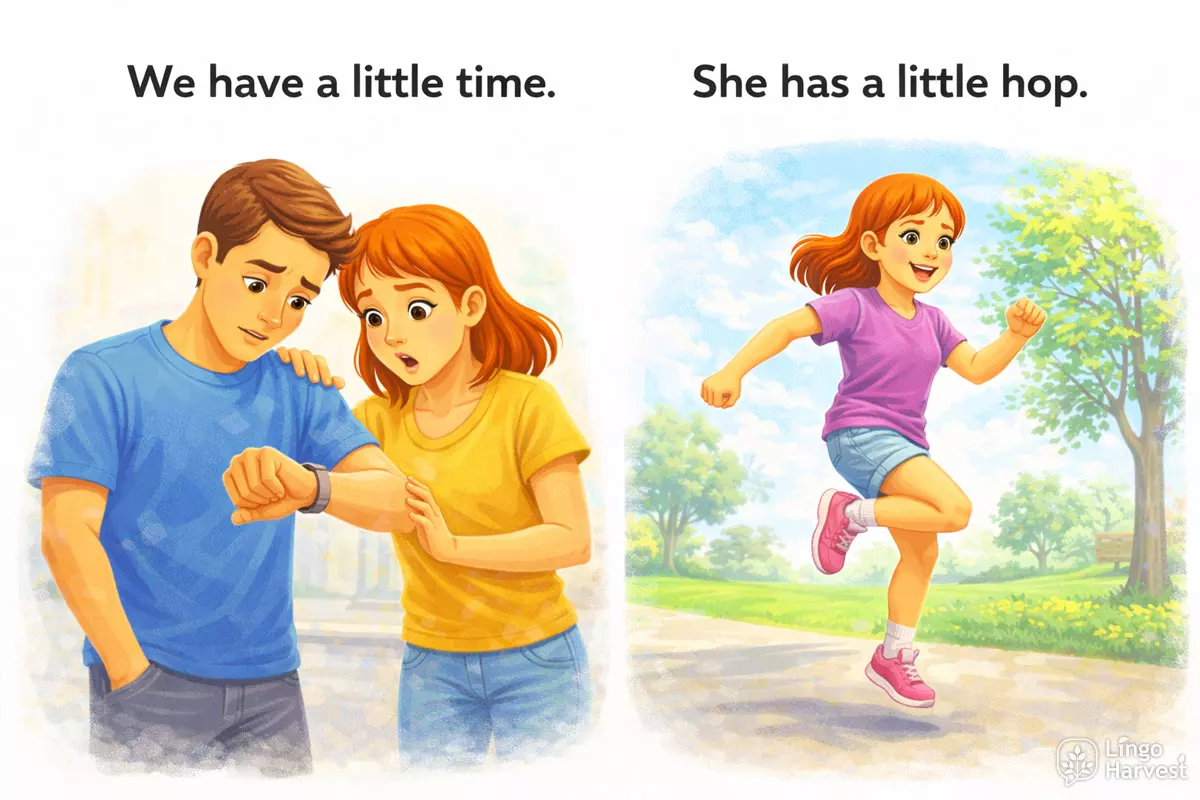
Consider the subtle differences in these sentences:
- We have little time. (Not enough time, possibly worried or disappointed)
- We have a little time. (There is some time, enough for something small or brief)
- She has little hope. (Almost no hope, pessimistic)
- She has a little hope. (Some hope remains, optimistic or at least not hopeless)
Common examples: Attitude in action
Here are more examples showing how the speaker’s view is communicated simply by adding or omitting "a":
- There’s little milk left. (Probably not enough for what’s needed)
- There’s a little milk left. (Enough for a cup of tea, for example)
- He showed little interest. (Almost none; negative impression)
- He showed a little interest. (Some; at least he noticed)
- I have little money. (Not enough for most things)
- I have a little money. (Enough for something small)
- They offered little help. (Almost none; speaker likely dissatisfied)
- They offered a little help. (Some help, better than nothing)
- There’s little hope of success. (Chances are very slim)
- There’s a little hope of success. (Not much, but not zero)
- The patient has little energy. (Very weak)
- The patient has a little energy. (Enough to do a bit)
- I see little reason to continue. (Speaker is discouraged)
- I see a little reason to continue. (Some motivation remains)
- We have little choice. (Almost no options)
- We have a little choice. (At least one option)
- She has little patience. (Easily frustrated)
- She has a little patience. (Can manage waiting for a short time)
Side-by-side comparison
To make the contrast clearer, see these pairs:
| Expression | Speaker’s Attitude |
|---|---|
| little chance | Negative (almost none, pessimistic) |
| a little chance | Positive/Neutral (some chance, hopeful) |
| little progress | Negative (unsatisfactory, not enough) |
| a little progress | Positive/Neutral (some improvement) |
| little food | Negative (insufficient, possibly worried) |
| a little food | Positive/Neutral (enough for now) |
| little understanding | Negative (lack of comprehension) |
| a little understanding | Positive/Neutral (some grasp of the topic) |
The distinction is subtle but important. Paying attention to whether "little" or "a little" is used can help you interpret the speaker’s perspective—whether they are satisfied, hopeful, or dissatisfied with the amount in question. This awareness is key to both understanding and using these expressions naturally in English.
Common learner mistakes and confusion
Many English learners struggle with the subtle differences between “little” and “a little,” especially when talking about quantity in negative and positive contexts. Confusion often arises because these words look similar but can completely change the meaning of a sentence. Below are some of the most frequent areas where mistakes happen, along with explanations and examples to clarify the differences.
Mixing up negative and positive meanings
Learners often use “little” and “a little” interchangeably, not realizing that “little” expresses a negative or insufficient amount, while “a little” suggests something is present, even if only in a small quantity. This can lead to misunderstandings in both spoken and written English.
| Phrase | Meaning |
|---|---|
| I have little money. | Almost no money (negative, not enough). |
| I have a little money. | Some money (positive, enough for something small). |
| There is little hope. | Almost no hope (negative outlook). |
| There is a little hope. | Some hope still exists (positive outlook). |
Forgetting countable vs. uncountable rules
Another frequent error is using “little” or “a little” with countable nouns. These expressions should only be used for uncountable nouns (like money, time, water, information). For countable nouns, “few” and “a few” are correct alternatives.
- Incorrect: I have a little friends.
- Correct: I have a few friends.
- Incorrect: She has little apples.
- Correct: She has few apples.
Misplacing articles or omitting them
Learners sometimes forget to use the article “a” with “a little,” which changes the meaning or makes the sentence sound unnatural. Omitting the article can unintentionally shift the meaning from positive to negative.
- Incorrect: I have little sugar for the cake. → (Negative: not enough sugar)
- Correct: I have a little sugar for the cake. → (Positive: some sugar, enough for use)
Examples of common learner errors
- Using “a little” with countable nouns: “There are a little chairs in the room.”
- Switching “little” and “a little” in negative/positive contexts: “We have little time, so let’s relax.” (should be “a little time” if relaxation is possible)
- Assuming “little” always means “small” in size: “He has little shoes.” (should be “small shoes” for physical size)
- Forgetting that “little” can express disappointment: “There’s little interest in the project.”
- Adding extra words: “I have a very little money.” (should be “very little money” or “a little money” but not both together)
- Incorrect word order: “Little I know about this.” (should be “I know little about this.”)
- Using “little” or “a little” with plural nouns: “A little pens are on the table.”
- Not recognizing tone: “There’s a little chance he’ll come.” (positive: some chance, not hopeless)
- Using both “a” and “few”/“little” together with countables: “A few little apples.” (confusing; use one quantifier)
- Mistaking “a little” for “a bit” in formal writing: “I need a little information.” (acceptable, but “a bit of” is less formal)
Summary
Understanding the difference between “little” and “a little” is crucial for expressing the right amount and tone. Paying attention to whether you need a positive or negative meaning, and checking if the noun is countable or uncountable, will help you avoid the most common errors.
Examples from everyday situations
Understanding how to use "little" and "a little" can make your conversations much clearer, especially when talking about amounts or availability. These expressions often appear when people discuss time, money, food, or patience. The difference is subtle but important: "little" often signals an insufficient or negative amount, while "a little" suggests a small but positive, acceptable quantity.
Common Scenarios
- Money: "I have little money left this month." (Not enough to buy what I need) vs. "I have a little money left." (Enough for something small, like a coffee)
- Time: "There's little time before the train leaves." (Almost none, you might miss it) vs. "There's a little time before the train leaves." (Enough to grab a snack)
- Patience: "She has little patience with noisy crowds." (She gets annoyed quickly) vs. "She has a little patience." (She can wait, but not for long)
- Food: "There's little milk in the fridge." (Probably not enough for a cup of tea) vs. "There's a little milk in the fridge." (Enough for one cup)
- Energy: "I have little energy after work." (Very tired) vs. "I have a little energy left." (Can do one more task)
- Hope: "They have little hope of winning." (It's unlikely) vs. "They have a little hope." (Not much, but still possible)
- Information: "We have little information about the event." (Almost nothing is known) vs. "We have a little information." (Some facts are available)
- Sleep: "He got little sleep last night." (Almost none) vs. "He got a little sleep." (A short nap, at least)
- Help: "There is little help available." (Almost no support) vs. "There is a little help." (Some assistance is possible)
- Progress: "The project made little progress." (Almost stuck) vs. "The project made a little progress." (Some steps forward)
Quick Comparison Table
| Situation | Negative (little) | Positive (a little) |
|---|---|---|
| Money | There's little money in my wallet. ❌ | There's a little money in my wallet. ✅ |
| Time | I have little time to finish. ❌ | I have a little time to finish. ✅ |
| Food | We have little food left. ❌ | We have a little food left. ✅ |
| Energy | You have little energy today. ❌ | You have a little energy today. ✅ |
| Patience | She has little patience. ❌ | She has a little patience. ✅ |
By paying attention to these patterns, you can express whether a resource or quality is nearly absent or just enough for your needs. This distinction helps your listener understand your situation more precisely, whether you’re talking about daily routines, challenges, or opportunities.
Practice: selecting little or a little accurately
Knowing when to use "little" versus "a little" with uncountable nouns is essential for expressing negative or positive quantity. To build confidence, try the following exercises that focus on choosing the correct option for different contexts.
Choose the correct word: "little" or "a little"
Read each sentence and decide which word best completes the meaning. Remember: "little" often emphasizes a negative or insufficient amount, while "a little" suggests a small but sufficient or positive amount.
- We have ________ milk left, enough for one cup of coffee.
- He showed ________ interest in the project, so he was not chosen for the team.
- There is ________ hope for improvement, so let’s not give up yet.
- She had ________ money and couldn’t buy the ticket.
- Could I have ________ more time to finish my work?
- They felt ________ sympathy for the rude neighbor.
- After the rain, there was ________ water on the ground, but it dried quickly.
- We have ________ information about the event, so it’s hard to make plans.
- He put ________ effort into his studies and passed the exam.
- There's ________ chance that it will snow tonight, so be prepared.
Show answers
- a little
- little
- a little
- little
- a little
- little
- a little
- little
- a little
- little
Comparing meanings: "little" vs "a little"
To clarify the subtle difference in meaning, examine these example sentences. Notice how the choice changes the tone from negative to positive.
| With "little" | With "a little" |
|---|---|
| She has little patience for delays. (almost no patience; negative) |
She has a little patience for delays. (some patience; positive) |
| There is little water in the glass. (not enough; nearly empty) |
There is a little water in the glass. (some remains; enough for a sip) |
| I have little time to help you. (not enough time; regretful) |
I have a little time to help you. (enough time; willing) |
| She felt little joy at the news. (almost none; negative) |
She felt a little joy at the news. (some happiness; positive) |
Quick practice: fill in the blank
- He has ________ experience with computers, so he can help us. (positive)
- There is ________ sugar in my tea, I can barely taste it. (negative)
- We have ________ time before the meeting starts, let’s get coffee. (positive)
- They showed ________ enthusiasm for the plan, so it was canceled. (negative)
- I have ________ money left, but it’s enough for lunch. (positive)
- She has ________ patience today, so don’t ask her now. (negative)
- There is ________ information online about this topic. (negative)
- We made ________ progress this week, so things are improving. (positive)
- He drinks ________ water during the day, which is not healthy. (negative)
- I need ________ help with this task. (positive)
Show answers
- a little
- little
- a little
- little
- a little
- little
- little
- a little
- little
- a little
Pay attention to context when choosing between these two phrases. "A little" can create a more optimistic or encouraging tone, while "little" highlights a lack or insufficiency. Practice regularly to make the distinction automatic in your writing and speech.