Plenty of vs A Lot of: Natural Usage in Modern English

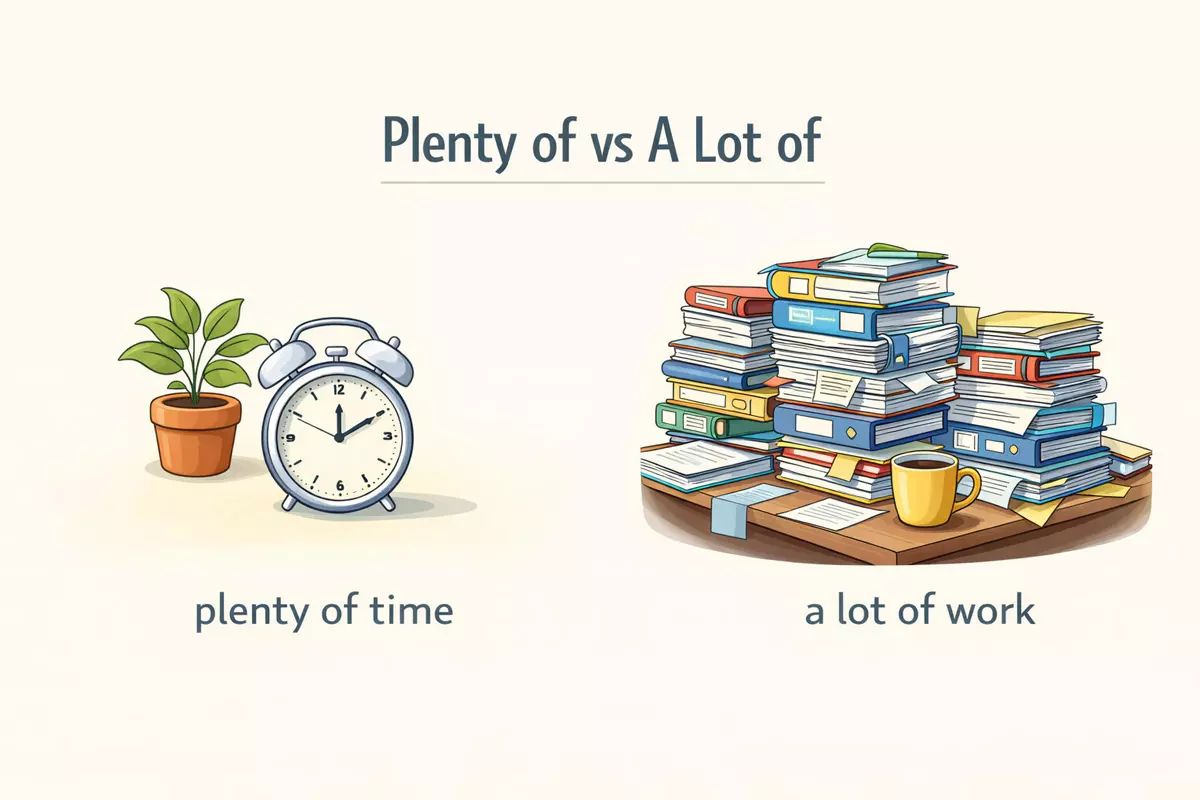 The article compares plenty of and a lot of, covering their meanings, tone, and usage in different contexts. It explains which is more positive or neutral, how they fit spoken and written English, and offers practice choosing the most natural option.
- Overall meaning and shared usage
- Differences in tone and nuance
- Contexts where plenty of sounds more positive
- Contexts where a lot of is more neutral
- Use in spoken vs written English
- Compatibility with countable and uncountable nouns
- Common learner overuse and stylistic issues
- Practice: choosing the more natural option
Deciding whether to use “plenty of” or “a lot of” can be tricky, even for advanced English speakers, because these phrases have subtle differences in meaning and tone. “Plenty of” often suggests there is more than enough of something, sometimes with a reassuring or positive connotation, while “a lot of” simply indicates a large quantity without additional nuance. Recognizing these distinctions allows you to express yourself with greater accuracy and sound more natural in everyday conversation.
Overall meaning and shared usage
Both “plenty of” and “a lot of” function as informal quantifiers in English, indicating a large amount or number of something. They are commonly used in everyday speech and writing, often with countable and uncountable nouns. Although their meanings overlap significantly, there are subtle differences in nuance and context that can influence which one sounds more natural in a given sentence.
General Use and Flexibility
These expressions are remarkably flexible, appearing before nouns to describe abundance. For example, you might say, “There are plenty of apples on the tree,” or “She has a lot of homework tonight.” In most cases, either phrase can be substituted for the other without a major change in meaning. However, “plenty of” often carries a slight implication that the amount is not just large, but also sufficient for a purpose—sometimes with a reassuring tone. In contrast, “a lot of” is a more neutral way to state that there is a large quantity.
Typical Noun Pairings
Both quantifiers work with a wide range of nouns. Here are some typical examples:
- plenty of time / a lot of time
- plenty of food / a lot of food
- plenty of friends / a lot of friends
- plenty of water / a lot of water
- plenty of opportunities / a lot of opportunities
- plenty of problems / a lot of problems
- plenty of money / a lot of money
- plenty of questions / a lot of questions
- plenty of reasons / a lot of reasons
- plenty of support / a lot of support
- plenty of energy / a lot of energy
- plenty of options / a lot of options
- plenty of work / a lot of work
- plenty of ideas / a lot of ideas
- plenty of space / a lot of space
Shared Grammatical Patterns
Both phrases are followed by a noun (countable or uncountable), but never by a verb directly. They do not change form for singular or plural nouns. Here’s a quick comparison:
| Usage | Example |
|---|---|
| With countable nouns | Plenty of books / A lot of books |
| With uncountable nouns | Plenty of sugar / A lot of sugar |
| Informal conversation | We have a lot of fun! / There’s plenty of time! |
| Positive/neutral statements | There are plenty of reasons. / She has a lot of support. |
Key Takeaways
- Both phrases are interchangeable in most contexts.
- “Plenty of” may suggest sufficiency or reassurance, while “a lot of” is more neutral.
- They are informal and best suited for everyday conversation and casual writing.
- Used with both countable and uncountable nouns, without changing form.
Understanding these similarities helps learners use both expressions naturally in modern English.
Differences in tone and nuance
Choosing between "plenty of" and "a lot of" often depends on subtle differences in emphasis, style, and the impression you want to create. While both expressions indicate a large quantity, their connotations and typical usage contexts can set them apart in everyday English.
General feel and register
"A lot of" is common in casual conversation and frequently appears in both spoken and informal written English. It sounds neutral, friendly, and direct—perfect for everyday situations. In contrast, "plenty of" can suggest not just abundance but sufficiency or even reassurance. It’s often used to calm concerns or highlight that there is more than enough of something, adding a slightly more positive or assuring undertone.
Implied meaning and subtle cues
- Reassurance: "Plenty of" often implies there is enough for everyone, or more than needed. For example, "There’s plenty of food" reassures that no one will go hungry.
- Neutral abundance: "A lot of" simply points out a large amount, without implying whether it’s sufficient or excessive. "There are a lot of people here" just states the fact.
- Politeness: "Plenty of" can sound more gentle or polite, especially when declining offers or setting limits ("No thanks, I’ve had plenty of cake").
- Intensity: "A lot of" is sometimes perceived as less emphatic than "plenty of," which can sound more vivid or expressive.
Typical contexts and collocations

Some situations naturally favor one expression over the other. Here are common scenarios where each phrase is likely to appear:
- Offering assurance: "Don’t worry, there’s plenty of time."
- Describing quantity: "We have a lot of homework tonight."
- Encouraging participation: "There’s plenty of room for everyone."
- Talking about experiences: "She has a lot of friends."
- Suggesting sufficiency: "You’ll find plenty of options on the menu."
- Expressing simple abundance: "A lot of people enjoy this movie."
- Downplaying excess: "No need to rush, there’s plenty of space."
- Highlighting variety: "He has a lot of hobbies."
- Offering comfort: "There’s plenty of time to finish."
- Casual statements: "A lot of kids like chocolate."
- Implying extra: "She brought plenty of snacks for the trip."
- General observation: "A lot of tourists visit in summer."
Side-by-side comparison
| Expression | Implied Tone/Nuance | Typical Use |
|---|---|---|
| Plenty of | Reassuring, positive, suggests sufficiency or more than needed | "There’s plenty of cake left." |
| A lot of | Neutral, factual, focuses on quantity without extra meaning | "There are a lot of people here." |
| Plenty of | Encouraging, sometimes polite or gentle | "Don’t worry, you have plenty of time." |
| A lot of | Casual, common in conversation, sometimes less emphatic | "A lot of students passed the exam." |
In summary, while both phrases point to a large quantity, your choice can shape the mood of your message—whether you want to reassure, simply state a fact, or sound especially encouraging. Being aware of these nuances helps your English sound more natural and precise.
Contexts where plenty of sounds more positive
In many everyday situations, "plenty of" carries a more upbeat or generous feeling than "a lot of." This phrase often suggests sufficiency, abundance, or even an element of reassurance. When speakers want to encourage, comfort, or emphasize that there’s more than enough, "plenty of" is a natural choice. It can make an offer sound warmer or underline that resources won’t run out, which is especially useful in hospitality or supportive conversations.
Typical contexts where "plenty of" feels more encouraging
- Reassuring someone there’s enough food: “Don’t worry, there’s plenty of cake for everyone.”
- Offering help or resources: “We have plenty of time to finish the project.”
- Inviting people to take more: “Please, take more—there are plenty of sandwiches left.”
- Soothing worries about scarcity: “There’s plenty of space for all the guests.”
- Encouraging participation: “There are plenty of opportunities to get involved.”
- Highlighting options: “You’ll find plenty of shops nearby.”
- Talking about positive qualities: “She has plenty of energy.”
- Implying generosity: “We’ve got plenty of chairs, so invite your friends.”
- Describing a positive environment: “There’s plenty of sunshine in this room.”
- Encouraging exploration: “There are plenty of things to see in the city.”
Comparing tone: "plenty of" vs. "a lot of"
When choosing between these two expressions, the nuance often lies in attitude. "A lot of" is generally neutral—simply referring to quantity—while "plenty of" tends to sound more inviting or reassuring. This difference becomes more noticeable in offers, reassurances, or when emphasizing the idea that something is more than adequate.
| Scenario | More Positive Expression |
|---|---|
| Offering food at a party | “There’s plenty of pizza—help yourself!” |
| Encouraging someone to join | “We have plenty of room for you.” |
| Reassuring about resources | “There’s plenty of time to finish.” |
| Inviting someone to take more | “Take another cookie, there are plenty of them.” |
In summary, choosing "plenty of" over "a lot of" can subtly shift the mood toward encouragement and warmth. In both spoken and written English, this choice helps convey not just quantity, but also a sense of generosity and positivity.
Contexts where a lot of is more neutral
When choosing between “plenty of” and “a lot of,” it’s helpful to know that “a lot of” generally carries a more neutral tone. This means it fits comfortably into many types of conversation and writing without implying abundance, excess, or any particular emotion. In contrast, “plenty of” can sometimes suggest sufficiency or even surplus, and may sound slightly more informal or expressive.
Everyday Communication and Writing
In daily speech and general writing, “a lot of” is often the default for indicating a large quantity. It doesn’t add extra nuance, so it works well when you want to state facts or observations without suggesting any judgment. For example, in academic contexts, business reports, or straightforward descriptions, “a lot of” is less likely to distract from your main message.
- There are a lot of options on the menu.
- She has a lot of experience in marketing.
- A lot of people attended the event.
- The project requires a lot of resources.
- We received a lot of feedback.
- They made a lot of mistakes early on.
- A lot of students found the exam difficult.
- He owns a lot of books.
- The company has a lot of clients overseas.
- There’s a lot of information to process.
- We spent a lot of time on research.
- A lot of animals live in this forest.
Comparing Usage: “A lot of” vs. “Plenty of”
To clarify the distinction, here’s a quick comparison of situations where one phrase is more neutral or appropriate than the other.
| Context | Preferred Expression |
|---|---|
| Objective description (facts, statistics) | a lot of |
| Emphasizing abundance or sufficiency | plenty of |
| Casual conversation (neutral statements) | a lot of |
| Reassuring someone there is enough | plenty of |
| Formal writing or reporting | a lot of |
| Expressing reassurance or comfort | plenty of |
Summary
In summary, “a lot of” is the go-to choice for most neutral, objective, or factual statements about quantity, especially in situations where you want to avoid suggesting positive or negative connotations. It’s widely accepted in both spoken and written English, making it a safe and natural option for a broad range of uses.
Use in spoken vs written English
When comparing “plenty of” and “a lot of,” it’s helpful to look at where each phrase naturally appears in conversation and writing. Both expressions are used to indicate a large quantity, but their tone and frequency can differ depending on the context.
Common contexts and tone
“A lot of” is extremely common in everyday speech. It sounds informal and is often used in friendly or casual conversations. People tend to choose this phrase when chatting with friends, giving opinions, or telling stories. On the other hand, “plenty of” is also widely used in spoken English but can sometimes feel a little more reassuring or emphatic, especially when encouraging someone (“Don’t worry, there’s plenty of time!”).
In formal writing, such as academic articles, reports, or business correspondence, both phrases are generally replaced by more precise or less colloquial alternatives like “numerous,” “many,” or “a great deal of.” Still, “plenty of” might appear in written English when the writer wants to sound friendly, persuasive, or reassuring.
Frequency in speech and writing
Native speakers tend to use “a lot of” more often in conversation, while “plenty of” is chosen for emphasis or to express sufficiency and reassurance. In writing, both can appear in emails, blogs, or informal texts, but are less likely in academic or technical documents.
| Context | Typical Usage |
|---|---|
| Casual conversation | “a lot of” is much more frequent (“We have a lot of snacks.”) |
| Reassurance or encouragement | “plenty of” is often chosen (“There’s plenty of room!”) |
| Informal writing (emails, texts) | Both used, but “a lot of” is still more common |
| Formal writing | Neither is preferred; more formal alternatives are used |
| Instructions or advice | “plenty of” is used to stress sufficiency (“Drink plenty of water.”) |
Example phrases in context

- We have a lot of work to do.
- There’s plenty of food for everyone.
- She reads a lot of books every month.
- Make sure you get plenty of rest before the exam.
- They brought a lot of friends to the party.
- There’s plenty of parking outside.
- He spends a lot of time on his phone.
- You’ll find plenty of information online.
- We saw a lot of birds at the park.
- There’s plenty of space in the car.
In summary, “a lot of” dominates informal speech and writing, while “plenty of” is used to emphasize adequacy or reassurance, especially when encouraging or advising. In formal contexts, both are generally avoided in favor of more precise vocabulary.
Compatibility with countable and uncountable nouns
Both plenty of and a lot of are versatile phrases that can refer to large quantities, but their use with countable and uncountable nouns follows some clear patterns. Understanding which type of noun is involved helps you choose the right form and maintain natural, idiomatic English.
How they work with different noun types
In everyday English, these expressions are used with both countable (things you can count, like "apples" or "books") and uncountable nouns (things you can't count individually, like "water" or "information"). The structure stays the same, but the noun itself changes.
| Expression | Example with Countable Noun | Example with Uncountable Noun |
|---|---|---|
| plenty of | plenty of chairs | plenty of sugar |
| a lot of | a lot of friends | a lot of time |
Typical usage patterns
- Countable nouns: "plenty of ideas," "a lot of cars," "plenty of opportunities," "a lot of cookies," "plenty of reasons," "a lot of books"
- Uncountable nouns: "plenty of advice," "a lot of information," "plenty of milk," "a lot of patience," "plenty of space," "a lot of furniture"
It's important to match the verb to the noun. For example, "There are plenty of apples" (countable, plural) versus "There is plenty of water" (uncountable, singular). Both plenty of and a lot of follow this rule, so the main difference is not grammatical but stylistic or tonal. In spoken English, a lot of is more common, while plenty of can sound a bit more emphatic or reassuring.
To sum up, you can use either phrase with almost any noun that expresses a large quantity, as long as you keep the noun’s countability and verb agreement in mind.
Common learner overuse and stylistic issues
English learners often fall into patterns of overusing certain quantifiers, especially when speaking or writing quickly. "Plenty of" and "a lot of" are both casual ways to indicate a large quantity, but they aren’t always fully interchangeable. This section highlights frequent pitfalls, awkward phrasing, and subtle stylistic choices that can make a phrase sound unnatural to native speakers.
Typical overuse patterns
Relying too heavily on either "plenty of" or "a lot of" can make speech or writing sound repetitive or informal. For example, repeatedly starting sentences with these expressions may reduce the variety and nuance in your English. It's also common to see learners use them where a more precise quantifier (such as "many," "much," or a specific number) would be clearer.
- Using "plenty of" in negative sentences where "enough" is more natural.
- Applying "a lot of" in formal writing where "numerous" or "a great deal of" fits better.
- Repeating "a lot of" several times within a short paragraph.
- Choosing "plenty of" with uncountable nouns when "much" would be more concise.
- Combining both phrases in one sentence (e.g., "There are a lot of plenty of reasons...").
- Using them with nouns that do not logically take large quantities (e.g., "plenty of happinesses").
- Overusing in questions (e.g., "Do you have a lot of...?" repeatedly in an interview).
- Misplacing in formal contexts (e.g., academic essays).
- Using with singular nouns ("a lot of apple" instead of "a lot of apples" or "a lot of apple juice").
- Stacking quantifiers ("a lot of many problems").
- Using "plenty of" when the meaning is closer to "some" or "a few".
- Forgetting subject-verb agreement ("a lot of people is").
Stylistic nuances and register
Both "plenty of" and "a lot of" are usually considered informal, and overuse in academic or professional writing can weaken your tone. In contrast, spoken English tolerates these phrases more, but mixing them with more formal alternatives enriches communication. Consider the register and purpose of your message before choosing which quantifier to use.
Comparing usage: native vs. learner style
| Native-like Usage | Common Learner Mistake |
|---|---|
| We have plenty of time, so let's relax. ✅ | We have a lot of time, so let's relax. (Acceptable, but less natural in this context.) |
| There isn’t much sugar left. ✅ | There isn’t plenty of sugar left. (Incorrect negative.) ❌ |
| She has a lot of friends at university. ✅ | She has plenty of friends at university. (Possible, but "a lot of" is more typical.) |
| Many issues were discussed in the meeting. ✅ | A lot of issues were discussed in the meeting. (Too informal for business writing.) |
Tips for natural usage
- Vary your vocabulary: use alternatives such as "many," "several," "numerous," or "a great deal of" when appropriate.
- Check if the context is formal or informal before deciding on a quantifier.
- Review your writing for repeated patterns and swap out overused phrases.
- Listen to native speakers and note their preferences in different situations.
- Be mindful of noun types (countable vs. uncountable) when choosing between "plenty of" and "a lot of."
By staying aware of these tendencies and adjusting your usage, your English will sound more varied and natural.
Practice: choosing the more natural option
Understanding when to use "plenty of" versus "a lot of" can make your English sound much more natural. Both expressions are common, but their usage can depend on context, tone, and even the formality of the situation. Below, you'll find several practical exercises and examples to help you develop an instinct for which phrase feels right in everyday conversation and writing.
Quick Choice Exercises
Read each sentence and decide which option—"plenty of" or "a lot of"—sounds more natural.
- There are ________ reasons to visit Paris in the spring.
- We have ________ time before the movie starts.
- She brought ________ cookies to the party.
- He didn't have ________ experience with computers.
- I've read ________ books about history.
- Don't worry, there are ________ seats available.
- They gave us ________ advice before the trip.
- There isn't ________ sugar left in the jar.
- My friends have ________ ideas for the project.
- We saw ________ interesting animals at the zoo.
Show answers
- a lot of
- plenty of
- plenty of
- a lot of
- a lot of
- plenty of
- a lot of
- plenty of
- a lot of
- a lot of
Patterns and Usage: At a Glance
Here’s a structured comparison of how these two phrases typically appear in natural English, along with the contexts where one is preferred over the other.
| Phrase | More Natural In... | Example Sentence | Notes |
|---|---|---|---|
| plenty of | Reassurance, emphasizing sufficiency | Don't rush, there's plenty of time. | Often used to comfort or reassure |
| a lot of | General quantity, neutral tone | She has a lot of friends. | Very common in casual speech |
| plenty of | Positive emphasis on abundance | We have plenty of food for everyone. | Implies more than enough |
| a lot of | Talking about large amounts (neutral/negative) | There’s a lot of traffic today. | Does not suggest sufficiency, just quantity |
Spot the Difference: Mini Quiz
Decide if the use of "plenty of" or "a lot of" is correct in the following sentences. If not, suggest the more natural alternative.
- We have a lot of water left for the hike. ✅
- There’s plenty of noise coming from the street. ❌
- She received plenty of messages after winning the award. ✅
- He didn't get a lot of sleep last night. ✅
- They have plenty of time to finish the project. ✅
- There was a lot of informations in the report. ❌
- I heard plenty of good news today. ✅
- We don’t have plenty of chairs for everyone. ❌
- She spends a lot of time practicing English. ✅
- There is plenty of money problems in that company. ❌
Show answers
- Correct as is.
- More natural: “a lot of noise”.
- Correct as is.
- Correct as is.
- Correct as is.
- Should be “a lot of information” (information = uncountable).
- Correct as is.
- More natural: “We don’t have enough chairs for everyone.”
- Correct as is.
- Should be “a lot of money problems” or more naturally “many money problems”.
Tips for Natural Usage
- Use plenty of when you want to emphasize that there is more than enough of something.
- Choose a lot of for a simple, neutral statement about a large number or amount, especially in casual contexts.
- Both can be used with countable and uncountable nouns, but "plenty of" often carries a positive, reassuring tone.
- In negative sentences, "a lot of" is more commonly used ("There isn't a lot of milk left.").
- For polite offers or reassurances, "plenty of" is preferred ("There's plenty of cake—help yourself!").
By practicing these distinctions, you’ll develop a better feel for which phrase fits best in different real-life scenarios.