How to Form Questions in the Present Simple Tense

 This article explains present simple question structure, when to use do or does, how to form yes/no and WH-questions, and the difference between using be and other verbs. It also covers adverbs, common mistakes, and offers practice exercises.
Learning to ask straightforward questions in everyday English is important for effective communication, especially when discussing what is happening right now. By using simple structures like “Are you…?” or “Is it…?” you can easily inquire about current situations. Practicing these forms helps you gain confidence and makes your conversations smoother and more natural. Remember, clear questions invite clear answers, making daily interactions more productive and enjoyable for everyone involved.
Present Simple Question Structure
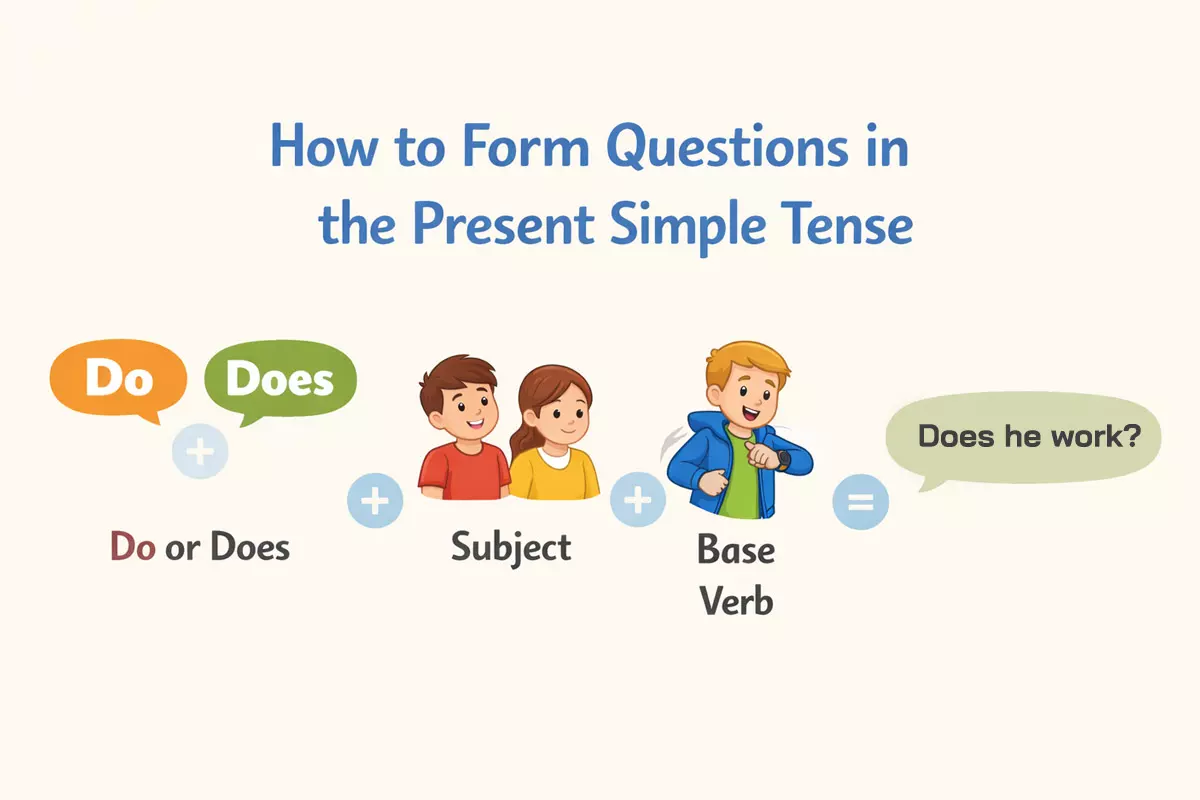
To ask questions in the present simple tense, English uses a specific word order and auxiliary verbs. The structure changes slightly depending on whether the subject is he, she, it or another pronoun. Typically, questions begin with "do" or "does," followed by the subject and the base form of the main verb. This pattern helps signal a question right from the start, making it clear to listeners or readers.
Basic Structure for Yes/No Questions
For most subjects, the formula is straightforward: use "do" with I, you, we, they, and "does" with he, she, it. The main verb always stays in its base form, regardless of the subject.
| Subject | Auxiliary | Example Question |
|---|---|---|
| I/You/We/They | do | Do you like pizza? |
| He/She/It | does | Does she play tennis? |
| Plural Nouns | do | Do birds sing? |
| Singular Nouns | does | Does the cat sleep here? |
Forming Wh- Questions
When you want more information than a simple yes or no, start your question with a question word (who, what, where, when, why, or how), then follow the same "do/does + subject + base verb" pattern. For example:
- Where do you live? → I live in the city center.
- What does he eat for breakfast? → He eats cereal.
- Why do they study English? → Because they need it for work.
- How does it work? → It works automatically.
- When do we start? → We start at nine.
- Who do you see every day? → I see my colleagues.
- Which book does she want? → She wants the blue one.
- How often do you exercise? → I exercise three times a week.
- What time does the train leave? → It leaves at 7:30.
- Where does your friend work? → He works in an office.
Key Points to Remember
- Never add -s to the main verb in questions, even with "he/she/it".
- If the question word is the subject (e.g., "Who knows the answer?"), do not use "do/does".
- Use "do/does" only for present simple questions, not for other tenses.
- The auxiliary verb comes before the subject in all present simple questions.
Mastering these patterns will help you ask clear, correct questions about routines, facts, and general truths in everyday English conversations.
Do vs Does Usage
When forming questions in the present simple tense, it’s important to choose between “do” and “does” based on the subject of the sentence. Both “do” and “does” act as auxiliary verbs, but they are not interchangeable. The choice depends on whether the subject is singular or plural, as well as whether it is first, second, or third person.
Subjects for "do" and "does"

“Do” is used with plural subjects and with “I” and “you,” while “does” is used with third-person singular subjects (he, she, it). Knowing which to use helps your questions sound natural and correct in English.
| Subject | Auxiliary Verb | Example Question |
|---|---|---|
| I | do | Do I need a ticket? |
| you | do | Do you like coffee? |
| we | do | Do we have homework? |
| they | do | Do they play soccer? |
| he | does | Does he drive? |
| she | does | Does she work here? |
| it | does | Does it rain often? |
Key Points to Remember
- Use “does” only with third-person singular subjects: he, she, it.
- Use “do” with I, you, we, and they.
- The main verb in the question always stays in its base form—never add “-s” or “-es” after “does” or “do.”
- Word order for questions is: auxiliary verb + subject + base verb (e.g., “Do you understand?”).
Common Mistakes to Avoid
- Don’t use “does” with plural subjects: ❌ Does they like music? → ✅ Do they like music?
- Don’t add “-s” to the main verb after “does”: ❌ Does he likes pizza? → ✅ Does he like pizza?
- Remember that “do” can also be used for emphasis in statements, but in questions, it is always placed before the subject.
By paying attention to these patterns, you can form present simple questions correctly and confidently. Practice with various subjects to reinforce which auxiliary verb to use in each situation.
Yes/No Questions in Present Simple
Forming questions that require a simple "yes" or "no" answer involves a specific word order in English. These questions are common in everyday conversation and are built using auxiliary verbs ("do" or "does") followed by the subject and the base form of the main verb.
Basic Structure
The standard format for these questions is:
- Do/Does + subject + base verb + (rest of sentence)?
"Do" is used for plural subjects and "I/you/we/they," while "does" is used with singular third-person subjects ("he/she/it"). The main verb always stays in its base form, regardless of the subject.
Examples of Yes/No Questions
Here are some sample questions formed in the present simple tense:
- Do you play tennis? → Yes, I do.
- Does she like coffee? → Yes, she does.
- Do they work here? → Yes, they do.
- Does it rain often? → Yes, it does.
- Do we have class today? → Yes, we do.
- Does John speak French? → Yes, he does.
- Do cats sleep a lot? → Yes, they do.
- Does your phone work? → Yes, it does.
- Do I need a ticket? → Yes, you do.
- Does he drive to work? → Yes, he does.
- Do you understand? → Yes, I do.
- Does Anna live nearby? → Yes, she does.
- Do children enjoy cartoons? → Yes, they do.
- Does the bus stop here? → Yes, it does.
- Do birds sing in the morning? → Yes, they do.
Forming Negative Yes/No Questions
To ask a negative question, simply add "not" after the auxiliary verb. This is often contracted in conversation.
- Don't you like pizza? → Yes, I do.
- Doesn't he work here? → Yes, he does.
- Don't they know the answer? → No, they don't.
- Doesn't it look nice? → Yes, it does.
Comparison Table: Statements vs. Yes/No Questions
| Statement | Yes/No Question |
|---|---|
| You play the guitar. | Do you play the guitar? |
| She watches TV. | Does she watch TV? |
| They eat breakfast at 7. | Do they eat breakfast at 7? |
| He likes chocolate. | Does he like chocolate? |
| We read every day. | Do we read every day? |
Quick Tips
- Remember to use "do" with I, you, we, and they; "does" with he, she, and it.
- The main verb never changes form in questions—no "s" or "es" endings.
- Short answers often repeat the auxiliary: "Yes, I do." / "No, she doesn't."
By following these patterns, you can easily make questions that invite a simple "yes" or "no" response in the present simple tense.
WH-Questions in Present Simple
To ask for specific information in everyday situations, we use WH-words like what, where, when, why, who, which, whose, how, and their combinations. These question words usually come at the beginning of the sentence and are followed by the auxiliary verb do or does (except for questions with who as the subject). The main verb follows the auxiliary, and the subject comes after the auxiliary verb.
Basic Structure
The typical structure for these questions is: WH-word + do/does + subject + base verb + (rest)? For example: "Where do you live?" or "What does she eat for breakfast?" If who is the subject, you do not use do or does: "Who plays the piano?"
Common WH-Words and Examples
- What – What do you do?
- Where – Where does he work?
- When – When do they arrive?
- Why – Why do we study English?
- Who (subject) – Who visits you on Sundays?
- Who (object) – Who do you meet after class?
- Which – Which book do you recommend?
- Whose – Whose bag does she carry?
- How – How do you spell your name?
- How many – How many languages do you speak?
- How much – How much does it cost?
- How often – How often do you travel?
- How long – How long does the class last?
- How old – How old is your brother?
- How far – How far do you walk to school?
Forming Questions: Do vs. Does
Use do with I, you, we, they, and does with he, she, it. The main verb always stays in the base form, regardless of the subject.
| WH-Word | Example with "do" | Example with "does" |
|---|---|---|
| What | What do they eat? | What does he eat? |
| Where | Where do you go? | Where does she go? |
| Why | Why do we wait? | Why does it rain? |
| How | How do you study? | How does she study? |
| When | When do they meet? | When does he meet? |
Special Cases: "Who" as Subject
If who is the subject, there is no need for do or does. For example: "Who calls you every day?" Here, who replaces the subject of the sentence. But if who is asking about the object, use the normal auxiliary: "Who do you call every day?"
Tips for Natural Questions
- Remember to use the base form of the verb after do or does.
- Don’t add -s to the main verb, even with he/she/it.
- Use a rising intonation at the end when speaking.
- Practice with different WH-words to become comfortable with the pattern.
Mastering these patterns helps you get clear information and hold better conversations in English. Try forming your own questions using different WH-words to build confidence and fluency.
Questions with Be vs Other Verbs
Forming present simple questions depends on which verb you use. The verb "be" (am/is/are) behaves differently from other verbs, so it's helpful to see how their question forms compare. With "be," you switch the subject and the verb. For all other verbs, you need an auxiliary verb ("do/does") before the subject, followed by the base form of the main verb.
How to Form Questions with "Be"
When asking about identity, status, or descriptions, use "am," "is," or "are" before the subject. No extra helping verb is necessary. Here are some examples:
- Are you ready? → Yes, I am.
- Is he your brother? → Yes, he is.
- Am I late? → No, you aren’t.
- Are they students? → Yes, they are.
- Is it cold outside? → Yes, it is.
- Are we finished? → Yes, we are.
- Is she at home? → Yes, she is.
- Am I correct? → Yes, you are.
- Are the books new? → Yes, they are.
- Is this your pen? → Yes, it is.
How to Form Questions with Other Verbs
For most other verbs (like "play," "have," "work," "know"), you must add "do" or "does" at the start. "Do" is used with I/you/we/they, and "does" with he/she/it. The main verb always stays in its base form, no matter the subject.
- Do you like pizza? → Yes, I do.
- Does he play football? → Yes, he does.
- Do they work here? → Yes, they do.
- Does it rain often? → Yes, it does.
- Do we have homework? → Yes, we do.
- Does she speak Spanish? → Yes, she does.
- Do I need a ticket? → Yes, you do.
- Do the children understand? → Yes, they do.
- Does your dog bark? → Yes, it does.
- Do my keys fit? → Yes, they do.
Side-by-Side Comparison
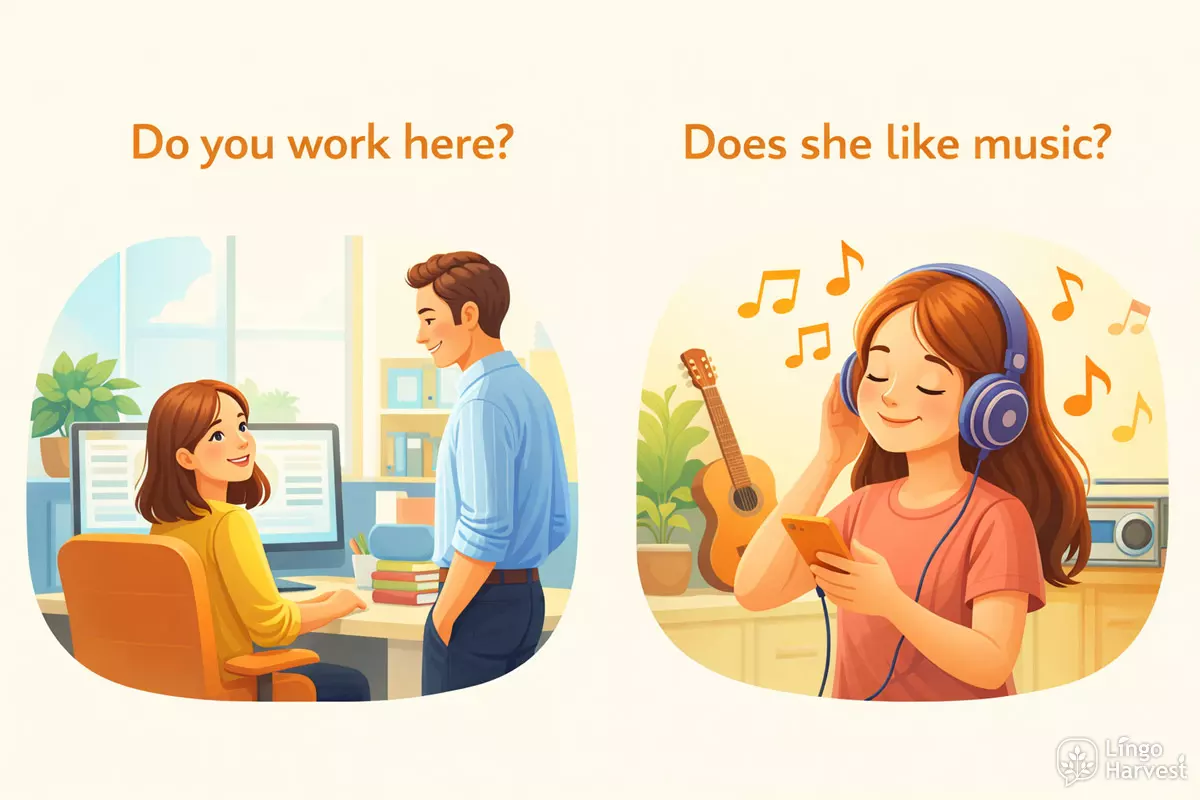
To make the differences clearer, check the table below. It shows how question forms change depending on whether "be" or another verb is used.
| With "Be" | With Other Verbs |
|---|---|
| Are you tired? | Do you work here? |
| Is she a teacher? | Does she like music? |
| Are they ready? | Do they play chess? |
| Am I late? | Do I need help? |
| Is it cold? | Does it rain here? |
Remember: if you’re using "be," just put it before the subject. For all other verbs, start with "do" or "does" and use the main verb in its simplest form. This pattern helps keep your present simple questions clear and correct.
Adverbs in Present Simple Questions
When forming questions in the present simple tense, adverbs play a crucial role in expressing frequency, manner, time, or degree. Placing these words correctly helps your questions sound natural and clear. Most commonly, adverbs such as “always,” “often,” “sometimes,” “never,” and “usually” appear after the subject but before the main verb.
Common Adverbs Used in Present Simple Questions
Some adverbs are especially frequent in present simple questions, helping to clarify how often, when, or in what way an action occurs. Here are some examples:
- always → Do you always wake up early?
- usually → Does she usually work from home?
- often → Do they often travel for work?
- sometimes → Do you sometimes forget your keys?
- rarely → Does he rarely eat fast food?
- never → Do you never watch TV?
- ever → Have you ever been to New York?
- hardly ever → Do they hardly ever go out on weekdays?
- already → Do you already know the answer?
- still → Does she still live in this area?
- just → Did you just finish your work?
- soon → Do you leave soon?
- yet → Do you understand it yet?
- sometimes → Does he sometimes work late?
- frequently → Do customers frequently ask this question?
- occasionally → Do you occasionally meet your colleagues?
- every day → Do you exercise every day?
- once a week → Do they meet once a week?
- in the morning → Do you check your email in the morning?
- at night → Does it get cold at night?
Word Order with Adverbs in Present Simple Questions
The position of adverbs in present simple interrogative sentences depends on the type of adverb. Frequency adverbs (like “often” or “usually”) usually come after the subject and before the main verb, but after “do/does.” Time adverbs often appear at the end of the question.
| Question Pattern | Example |
|---|---|
| Do/Does + subject + frequency adverb + verb…? | Do you often read at night? |
| Question word + do/does + subject + verb + adverb of time…? | When do they play tennis on weekends? |
| Do/Does + subject + verb + adverb of manner…? | Does she sing beautifully? |
| Do/Does + subject + ever + verb…? | Do you ever travel abroad? |
Tips for Using Adverbs in Questions
- For frequency, place the adverb before the main verb: “Do you usually eat breakfast?”
- Never put frequency adverbs between “do/does” and the subject.
- Adverbs of time (like “every morning,” “at night”) usually go at the end: “Do you exercise every morning?”
- With “ever” and “never,” use “ever” in questions, but “never” in statements: “Have you ever been there?” (question), “I never go there.” (statement)
- Don’t overuse adverbs; choose the one that gives the most useful information for your question.
Adverbs help you ask more specific and meaningful questions in the present simple tense. Mastering their placement and usage will make your English sound more natural and precise.
Common Learner Mistakes
Students often face challenges when trying to form questions in the present simple tense, especially if their first language uses different word order or question structures. Misunderstandings can lead to awkward phrasing or incorrect grammar, reducing clarity in communication. Recognizing these pitfalls can help you avoid them and form correct, natural questions more confidently.
Typical Errors When Making Present Simple Questions
- Forgetting to use "do" or "does" for questions (e.g., “You like pizza?” instead of “Do you like pizza?”).
- Using "does" with "s" on the main verb (e.g., “Does she works here?” instead of “Does she work here?”).
- Placing the subject before the auxiliary verb (e.g., “You do like coffee?” instead of “Do you like coffee?”).
- Omitting the auxiliary verb entirely (e.g., “What you eat for breakfast?” instead of “What do you eat for breakfast?”).
- Confusing "do/does" with "am/is/are" in present simple (e.g., “Are you play football?” instead of “Do you play football?”).
- Putting question words at the end (e.g., “You live where?” instead of “Where do you live?”).
- Repeating the auxiliary verb (e.g., “Do do you like music?”).
- Using the wrong question word (e.g., “Who do you like pizza?” instead of “Why do you like pizza?”).
- Mixing up short answers (e.g., “Yes, I do like.” instead of “Yes, I do.”).
- Incorrectly forming negative questions (e.g., “Don’t you likes coffee?” instead of “Don’t you like coffee?”).
- Using "do/does" with the verb “to be” (e.g., “Does she is happy?” instead of “Is she happy?”).
- Leaving out the subject (e.g., “Do like ice cream?” instead of “Do you like ice cream?”).
- Confusing present simple with present continuous patterns (e.g., “Are you go to school?” instead of “Do you go to school?”).
- Using "do" or "does" with modal verbs (e.g., “Do can you help me?” instead of “Can you help me?”).
- Incorrect word order in wh- questions (e.g., “Where you do live?” instead of “Where do you live?”).
Comparison: Correct vs. Incorrect Forms
| ❌ Incorrect | ✅ Correct |
|---|---|
| You like coffee? | Do you like coffee? |
| Does he plays tennis? | Does he play tennis? |
| She do go to school? | Does she go to school? |
| Where you live? | Where do you live? |
| Are you like chocolate? | Do you like chocolate? |
| Does she is happy? | Is she happy? |
Paying close attention to auxiliary verbs, subject-verb agreement, and word order will help you ask questions smoothly and accurately. Practice identifying these issues in your own speaking and writing to build more confidence with the present simple tense.
Practice Exercises and Self-Check
Understanding how to create questions in the present simple tense is best achieved through active practice. Below, you'll find a range of exercises designed to reinforce your grasp of question forms, including yes/no questions, wh- questions, and the correct use of auxiliary verbs.
Transform Statements into Questions
Try changing each statement into a present simple question. Focus on correct word order and appropriate use of "do" or "does."
- She plays the piano.
- You like coffee.
- They work on Saturdays.
- He goes to school by bus.
- The shop opens at 9 am.
- We live near the station.
- Anna studies English.
- They watch TV in the evening.
- He needs help.
- The children play outside.
Show answers
- Does she play the piano?
- Do you like coffee?
- Do they work on Saturdays?
- Does he go to school by bus?
- Does the shop open at 9 am?
- Do we live near the station?
- Does Anna study English?
- Do they watch TV in the evening?
- Does he need help?
- Do the children play outside?
Complete the Questions
Fill in the blanks with the correct auxiliary verb ("do" or "does") and, if needed, the appropriate subject.
- ______ you speak Spanish?
- ______ your brother play football?
- Where ______ they live?
- What time ______ the train leave?
- Why ______ Anna study every day?
- ______ we need to hurry?
- How often ______ he exercise?
- ______ your parents work on weekends?
- When ______ the movie start?
- ______ this bus go downtown?
Show answers
- Do you speak Spanish?
- Does your brother play football?
- Where do they live?
- What time does the train leave?
- Why does Anna study every day?
- Do we need to hurry?
- How often does he exercise?
- Do your parents work on weekends?
- When does the movie start?
- Does this bus go downtown?
Identify the Correct Question Form
Choose which of the following question forms is correct. Mark with ✅ for correct and ❌ for incorrect.
- Does he likes pizza?
- Do you work here?
- Does they come early?
- Where do you live?
- Does she drive to work?
- Do he understand the rules?
- Does it work properly?
- Do we needs more time?
- Where does your friend live?
- Does the shop open on Sundays?
Show answers
- Does he likes pizza? ❌
- Do you work here? ✅
- Does they come early? ❌
- Where do you live? ✅
- Does she drive to work? ✅
- Do he understand the rules? ❌
- Does it work properly? ✅
- Do we needs more time? ❌
- Where does your friend live? ✅
- Does the shop open on Sundays? ✅
Present Simple Question Patterns
Review common structures for present simple questions. This table summarizes the patterns for yes/no and wh- questions with different subjects.
| Type | Pattern Example |
|---|---|
| Yes/No Question (I/you/we/they) | Do + subject + base verb? (Do you like tea?) |
| Yes/No Question (he/she/it) | Does + subject + base verb? (Does he play tennis?) |
| Wh- Question (I/you/we/they) | Wh- + do + subject + base verb? (Where do they live?) |
| Wh- Question (he/she/it) | Wh- + does + subject + base verb? (What does she do?) |
Ask Your Own Questions
Think of three things you do every day. Now, write a present simple question for each activity you listed. This helps you personalize your practice and check that you understand the word order and auxiliary use.
Show answers
Sample questions:
- Do you brush your teeth every morning?
- Do you eat breakfast at home?
- Do you read before bed?
Regular practice with these exercises will help you become more confident in forming questions in everyday conversation.