How to Form Questions in the Present Continuous Tense

 Here we how to form present continuous questions, including am/is/are with -ing verbs, yes/no and WH-questions, and time expressions. It also compares present simple and continuous questions, highlights common mistakes, and offers practice.
Want to know how to ask about what’s happening at the moment? Learning to form questions with the present progressive tense is essential for everyday English conversations. This guide explains the structure clearly and offers practical tips to help you use the present progressive naturally. With these insights, you’ll feel more confident asking questions about ongoing actions and participating in real-life conversations. Start practicing now and improve your English communication skills.
Present Continuous Question Structure
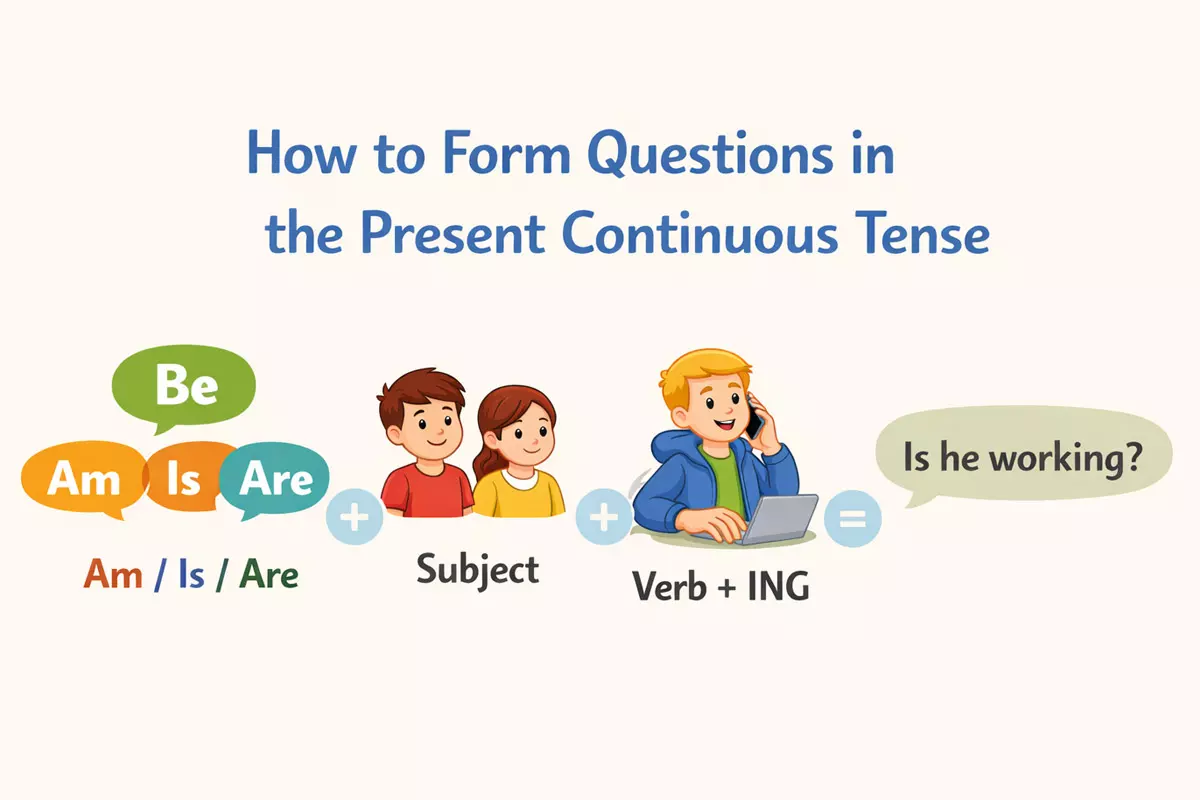
To ask questions using the present continuous tense, you need to change the word order from a statement. Instead of starting with the subject, questions begin with the correct form of the verb “to be” (am, is, are), followed by the subject, and then the main verb in its -ing form. This order signals that you’re asking about something happening right now or around the present time.
Basic Word Order for Yes/No Questions
The most common way to form a yes/no question in this tense is:
- Am/Is/Are + subject + verb-ing + (rest of sentence)?
For example:
- Are you watching TV?
- Is she studying for her exam?
- Am I disturbing you?
Forming Wh- Questions
When you want more information, start with a question word (who, what, where, when, why, how), then follow the same structure:
- Wh- word + am/is/are + subject + verb-ing + (rest)?
Examples include:
- What are you doing?
- Where is he going?
- Why are they laughing?
- How am I helping?
Full Pattern and Examples
Here is a table showing the main patterns for present continuous questions with different subjects:
| Subject | Question Example |
|---|---|
| I | Am I speaking too fast? |
| You | Are you coming to the party? |
| He/She/It | Is he working late tonight? |
| We/They | Are they making dinner now? |
Common Question Starters
Some useful ways to begin questions in this tense include:
- What are you doing right now? → I’m studying.
- Where is she working these days? → She’s working at a hospital.
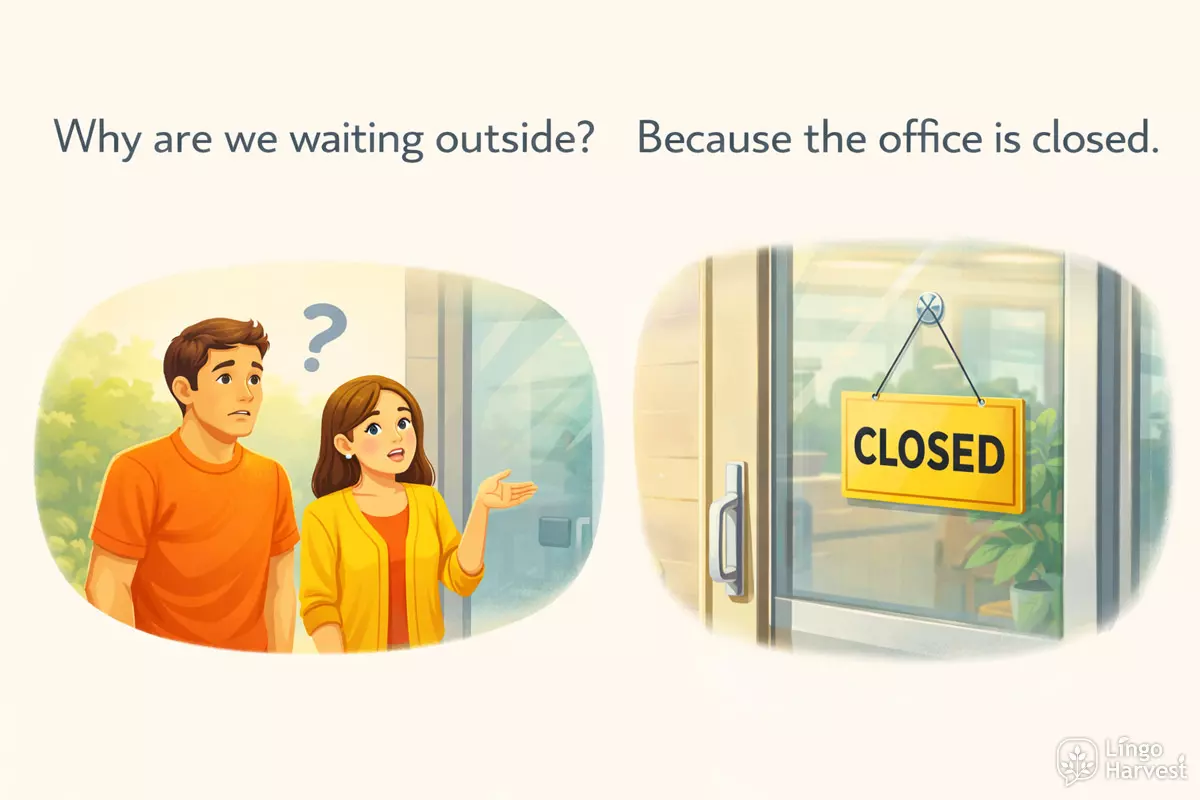
- Why are we waiting outside? → Because the office is closed.
- Who is coming with you tonight? → My brother is.
- Is it raining at the moment? → Yes, it is.
- Are they waiting for the bus? → Yes, they are.
- How am I doing so far? → You’re doing great.
- When are you leaving for the airport? → I’m leaving at six.
- Am I missing something important? → No, you aren’t.
- Are we meeting at the usual place? → Yes, we are.
- Is he playing football this weekend? → Yes, he is.
- Are you listening to me right now? → Yes, I am.
- What is happening over there? → There’s an accident.
- Who are you calling so late? → I’m calling my manager.
- Why is she leaving early today? → Because she feels sick.
- Where are they staying during the trip? → They’re staying at a hotel.
Key Points to Remember
- Always use the correct form of “to be” with the subject.
- The main verb always ends in -ing.
- For negative questions, add “not” after the subject (e.g., Are you not coming?).
- When speaking, contractions like “Aren’t you coming?” are common.
This approach makes it easy to construct clear, natural questions about ongoing actions or situations.
Am/Is/Are + Verb-ing
Forming questions in the present continuous tense involves rearranging the subject and the auxiliary verb. Instead of the subject coming first, the correct form of "be" (am, is, or are) begins the question, followed by the subject and the main verb in its -ing form. This structure helps indicate that the action is happening right now or around the present moment.
General Structure for Questions
The basic pattern for forming present continuous questions is:
- Auxiliary verb (am, is, are) + subject + verb-ing + (rest of question)?
For example:
- Are you studying?
- Is she coming to the meeting?
- Am I interrupting?
This order signals that you are asking about an action in progress.
Choosing the Correct Auxiliary Verb
The choice between "am," "is," and "are" depends on the subject:
- Am is used with "I": Am I making sense?
- Is is used with singular third-person subjects: Is he working?
- Are is used with you, we, they, and plural nouns: Are they waiting?
Common Examples of Present Continuous Questions
Here are some typical questions you might hear or use in everyday conversation:
- Are you listening? → Yes, I am.
- Is it raining outside? → Yes, it is.
- Are we meeting at noon? → Yes, we are.
- Is the dog barking? → Yes, it is.
- Am I speaking too fast? → No, you aren’t.
- Are they playing football? → Yes, they are.
- Is your friend coming over? → Yes, he is.
- Are the children sleeping? → Yes, they are.
- Is she wearing her new dress? → Yes, she is.
- Are you feeling okay? → Yes, I am.
- Is he driving to work today? → Yes, he is.
- Are we still going to the cinema? → Yes, we are.
- Is the train arriving soon? → Yes, it is.
- Am I missing something? → No, you aren’t.
- Are you studying for the test? → Yes, I am.
Short Answers
When responding to these questions, short answers often repeat the auxiliary verb:
- ✅ Yes, I am. / No, I’m not.
- ✅ Yes, she is. / No, she isn’t.
- ✅ Yes, they are. / No, they aren’t.
Summary Table: Question Patterns
| Subject | Question Example |
|---|---|
| I | Am I talking too much? |
| He / She / It | Is she coming? |
| You / We / They | Are they leaving now? |
| Plural Nouns | Are the students listening? |
Understanding this structure will help you form clear, natural-sounding questions about activities happening at the moment of speaking. Practice with a variety of subjects and situations to gain confidence using the present continuous in questions.
Yes/No Questions in Present Continuous
Forming yes/no questions with the present continuous involves a specific word order. Instead of starting with the subject, these questions begin with the correct form of the verb “to be” (am, is, are), followed by the subject, and then the -ing form of the main verb. This structure allows you to quickly check if an action is happening right now. For example, to ask if someone is doing something at the moment, you simply invert the subject and the auxiliary verb. This makes the process straightforward and easy to remember.
- Are you studying? → Yes, I am.
- Is she working today? → Yes, she is.
- Am I interrupting? → No, you aren’t.
- Are they coming to the party? → Yes, they are.
- Is it raining outside? → Yes, it is.
- Are we meeting later? → Yes, we are.
- Is he driving home? → Yes, he is.
- Are you feeling okay? → Yes, I am.
- Is the dog sleeping? → Yes, it is.
- Are my friends arriving now? → Yes, they are.
- Am I making sense? → Yes, you are.
- Is your phone charging? → Yes, it is.
- Are the students listening? → Yes, they are.
- Is your brother playing football? → Yes, he is.
- Are we waiting for someone? → Yes, we are.
Structure of Yes/No Questions
The pattern always follows: Be (am/are/is) + Subject + Verb-ing + ? This order is essential for clarity and correctness in English.
| Affirmative Sentence | Yes/No Question Form |
|---|---|
| You are reading. | Are you reading? |
| She is cooking. | Is she cooking? |
| They are playing soccer. | Are they playing soccer? |
| I am speaking. | Am I speaking? |
| He is watching TV. | Is he watching TV? |
Short Answers
When someone asks a yes/no question with the present continuous, you often respond with a short answer, using the same auxiliary verb:
- Yes, I am. ✅
- No, she isn’t. ❌
- Yes, they are. ✅
- No, we aren’t. ❌
Mastering this pattern helps you ask and answer questions about actions happening right now, making conversations smoother and more natural.
WH-Questions in Present Continuous
To ask for specific information about ongoing activities, we use WH-question words (like “what,” “where,” or “why”) together with the present continuous tense. These questions are useful when you want to know more details about actions happening right now or around the current moment.
How to Structure WH-Questions
The typical structure for these questions is: WH-word + am/is/are + subject + verb-ing + (rest of the sentence)? The WH-word comes first, followed by the correct form of “be,” then the subject, and finally the main verb with “-ing.”
| WH-Word | Example Question |
|---|---|
| What | What are you doing? |
| Where | Where is she going? |
| Who | Who is talking to John? |
| Why | Why are they laughing? |
| When | When are we meeting? |
| Which | Which book are you reading? |
| How | How are you feeling? |
| Whose | Whose car is he driving? |
Common WH-Question Patterns
- What are you eating? → Asking about the object of an action
- Where are they staying? → Asking about location
- Who is calling you? → Asking about the person involved
- Why is it raining? → Asking for the reason
- How are you getting home? → Asking about the manner or method
- Which team is winning? → Asking about a choice or selection
- When are you leaving? → Asking for time
- Whose phone is ringing? → Asking about ownership
Notice that the verb “be” (am/is/are) always matches the subject. The main verb always uses the “-ing” form. This pattern helps keep your questions clear and grammatically correct when you want more information about actions in progress.
Practice forming these questions by swapping in different subjects and WH-words. For example: “Why are we waiting?” or “Who is coming to dinner?” This flexibility makes it easy to ask about different situations using the present continuous tense.
Time Expressions in Questions
Understanding how to include references to time is key when forming present continuous questions. These references help clarify exactly when an action is taking place, making your questions more precise and natural in conversation.
Common Time Words and Phrases
Certain time-related words are frequently paired with present continuous questions to specify the timing of an activity. Using these expressions helps convey whether something is happening now, around now, or in the near future.
- now → What are you doing now?
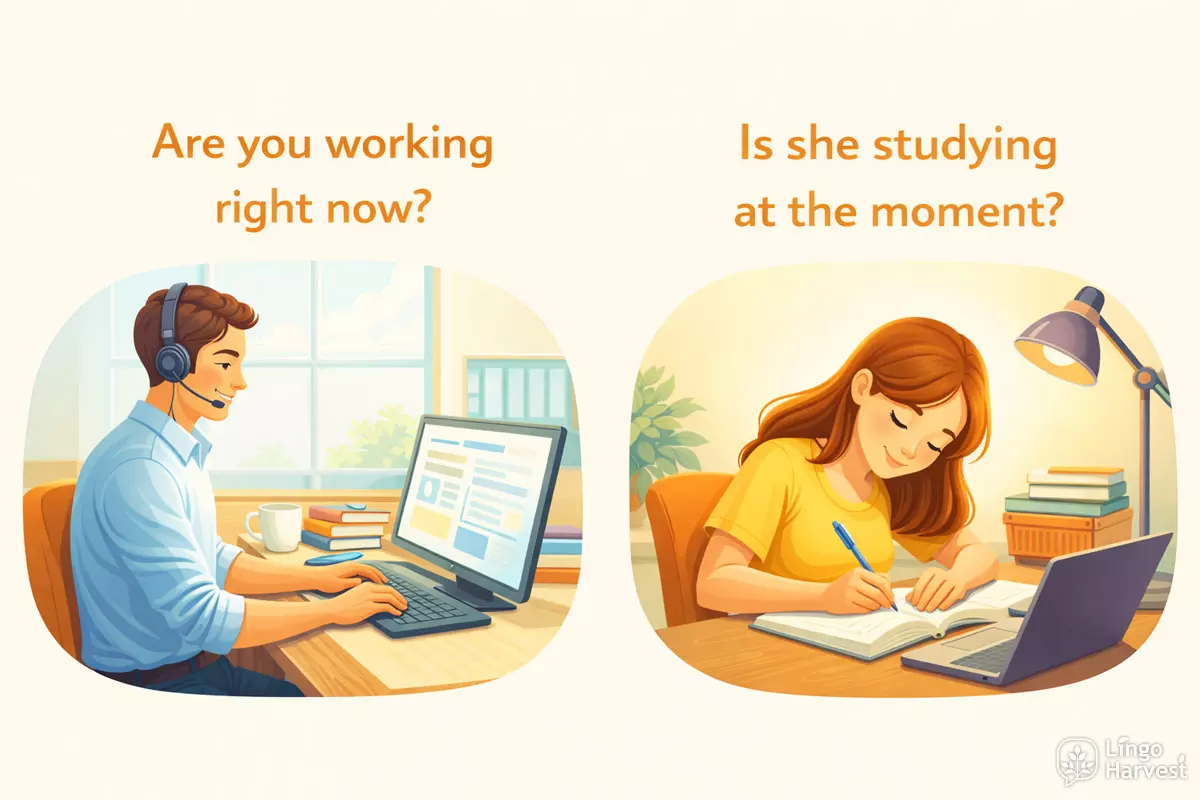
- right now → Are you working right now?
- at the moment → Is she studying at the moment?
- currently → Are they currently living abroad?
- today → Are you meeting your manager today?
- this week → Are we working late this week?
- tonight → Are you going out tonight?
- this morning → Is he feeling better this morning?
- this afternoon → Are you traveling this afternoon?
- this evening → Are they coming over this evening?
- these days → Is she working from home these days?
- still → Are you still waiting for the reply?
- just → Are you just finishing your report?
- at present → Is the company expanding at present?
- for the time being → Are we staying here for the time being?
Where to Place Time Expressions in Present Continuous Questions
Time markers can appear in different positions within a question, but some placements are more natural than others. Usually, these words come at the end of the question, but sometimes they fit naturally after the subject.
| Question Pattern | Example |
|---|---|
| Time expression at the end | Are you studying right now? |
| Time expression after the subject | Is she currently working on the project? |
| Time expression at the start (less common, for emphasis) | This week, are they staying with you? |
| Omitting the time word (if context is clear) | Are you watching TV? |
Tips for Using Time Markers in Questions
- Use specific phrases (like at the moment or right now) when you want to highlight that the action is happening as you speak.
- General time markers (such as these days or this week) are suitable for ongoing or temporary situations.
- Be mindful not to overload your question with too many time expressions—one is usually enough for clarity.
- Context can sometimes make the time clear, so it's fine to leave out a time word if it's already understood.
Choosing the right time expression and placing it naturally in your present continuous questions makes your English sound more fluent and helps listeners understand exactly when an action is taking place.
Present Simple vs Continuous Questions
Understanding the difference between simple and continuous question forms helps you ask the right questions for different situations. Both tenses are used to talk about the present, but they focus on different types of actions and time frames. Recognizing when to use each form can make your English sound more natural and precise.
When to Use Present Simple Questions
Present simple questions are ideal for routines, facts, and things that happen regularly. If you want to ask about habits, schedules, or general truths, this is the form to use. These questions usually start with do/does or a question word (like what, where, why), followed by the subject and the base verb.
- Do you play tennis? → Yes, I do.
- Does she like coffee? → Yes, she does.
- Where do they live? → They live in the city center.
- How often do you read? → I read every day.
- What time does the train arrive? → It arrives at 8:30.
When to Use Present Continuous Questions
Present continuous questions focus on actions happening now or around the current moment. They are useful for asking about temporary activities, things in progress, or changing situations. The structure involves the verb to be (am/are/is), the subject, and a verb ending in -ing.
- Are you watching TV? → Yes, I am.
- Is he working today? → Yes, he is.
- What are they doing? → They are studying.
- Why is she crying? → Because she is upset.
- Who is making that noise? → The children are.
- Are we meeting later? → Yes, we are.
- Is it raining? → No, it isn’t.
- Are you studying English now? → Yes, I am.
- What are you cooking? → I am making dinner.
- Is your brother coming tonight? → Yes, he is.
| Present Simple Question | Present Continuous Question |
|---|---|
| Do you work here? | Are you working here? |
| Does he play football? | Is he playing football? |
| What do you eat for breakfast? | What are you eating? |
| Why do they laugh? | Why are they laughing? |
| Where do you go after school? | Where are you going? |
| Who does she call every day? | Who is she calling? |
Key Differences
- Simple questions ask about regular, repeated, or permanent situations.
- Continuous questions check on actions happening right now or temporary events.
- Use time words like now, at the moment, or currently with continuous forms.
- Use words like usually, often, every with simple forms.
- Continuous questions use am/are/is + -ing; simple questions use do/does + base verb.
Choosing the right question form depends on whether you are talking about something habitual or something happening right now. Being aware of this distinction improves both your speaking and understanding in everyday English conversations.
Common Learner Mistakes
When working with present continuous questions, learners often stumble over certain patterns and word orders. Understanding these recurring issues can help you avoid them and form questions smoothly in English.
Mixing Up Word Order
A frequent error is forgetting to invert the subject and auxiliary verb ("am," "is," or "are"). Instead of "Are you coming?" some might say "You are coming?" which sounds like a statement, not a question.
Confusing Auxiliary Verbs
Choosing the wrong form of "be" (am, is, are) for the subject is another pitfall. For example, "Is you going?" or "Are she working?" are both incorrect. It's important to match the auxiliary verb with the subject.
Omitting the Auxiliary Verb
Some learners leave out "am," "is," or "are" entirely, creating sentences like "You coming to the party?" While this might be heard in casual speech, it’s not correct in standard English.
Incorrect Question Words Position
Placing question words (what, where, why, etc.) in the wrong part of the sentence can confuse the meaning. "What you are doing?" instead of "What are you doing?" is a typical mix-up.
Negative Questions
Forming negative questions in the present continuous can cause confusion. Learners sometimes forget to place "not" after the auxiliary. For example, "Aren't you coming?" is correct, but "Are not you coming?" is not natural in English.
Using Present Simple Instead of Present Continuous
Some people use the present simple structure by mistake, such as "Do you go now?" instead of "Are you going now?"
| ❌ Incorrect Form | ✅ Correct Question |
|---|---|
| You are coming? | Are you coming? |
| Is you working? | Are you working? |
| Where you are going? | Where are you going? |
| He going to school? | Is he going to school? |
| Do you watching TV? | Are you watching TV? |
| Are not you coming? | Aren't you coming? |
| What she is doing? | What is she doing? |
| They is playing football? | Are they playing football? |
| Why you crying? | Why are you crying? |
| He are sleeping? | Is he sleeping? |
Additional Tips
- Remember to always use the "-ing" form of the main verb after the auxiliary verb.
- Double-check that your question starts with the auxiliary verb, not the subject.
- Listen to native speakers and notice how they form questions in real conversations.
- Practice transforming statements into questions to build confidence and accuracy.
By keeping these points in mind, you can develop more natural and correct questions in the present continuous, making your spoken and written English clearer and more effective.
Practice Exercises and Self-Check
Understanding how to ask questions using the present continuous tense takes practice. Here, you’ll find varied exercises to help reinforce the structure, spot common errors, and build confidence for everyday conversation.
1. Make Questions from Statements
Transform the sentences below into questions using the present continuous form. Pay attention to word order and auxiliary verbs.
- She is reading a book.
- They are playing football in the park.
- You are listening to music.
- He is cooking dinner for his family.
- The dog is sleeping on the sofa.
- We are waiting for the bus.
- I am working on a new project.
- She is talking on the phone.
- The children are doing their homework.
- It is raining outside.
Show answers
- Is she reading a book?
- Are they playing football in the park?
- Are you listening to music?
- Is he cooking dinner for his family?
- Is the dog sleeping on the sofa?
- Are we waiting for the bus?
- Am I working on a new project?
- Is she talking on the phone?
- Are the children doing their homework?
- Is it raining outside?
2. Identify the Correct Question
Choose which of the following is the correct way to form a present continuous question. Mark ✅ for correct and ❌ for incorrect.
- Are you working late tonight?
- You are working late tonight?
- Is working you late tonight?
- Are working you late tonight?
Show answers
- ✅ Are you working late tonight?
- ❌ You are working late tonight?
- ❌ Is working you late tonight?
- ❌ Are working you late tonight?
3. Fill in the Blanks
Complete the questions by adding the correct form of to be (am/are/is).
- ______ they coming to the party?
- ______ you watching TV right now?
- ______ she studying for the test?
- ______ we meeting at 6 o’clock?
- ______ it raining outside?
- ______ he working late tonight?
- ______ you listening to me?
- ______ the children playing in the yard?
- ______ I speaking too fast?
- ______ your friend waiting for you?
Show answers
- Are they coming to the party?
- Are you watching TV right now?
- Is she studying for the test?
- Are we meeting at 6 o’clock?
- Is it raining outside?
- Is he working late tonight?
- Are you listening to me?
- Are the children playing in the yard?
- Am I speaking too fast?
- Is your friend waiting for you?
4. Common Question Patterns
The following table summarizes question patterns with different subjects:
| Subject | Present Continuous Question |
|---|---|
| I | Am I speaking too fast? |
| You | Are you coming with us? |
| He/She/It | Is she working today? |
| We/They | Are they waiting for the bus? |
5. Create Your Own Questions
Look at the verbs and subjects below. Make a present continuous question for each pair.
- (you / eat / breakfast)
- (he / study / English)
- (they / travel / by train)
- (it / snow / outside)
- (we / watch / a movie)
- (she / talk / on the phone)
- (I / work / right now)
- (the children / play / in the yard)
- (your friend / wait / for you)
- (the bus / come / now)
Show answers
- Are you eating breakfast?
- Is he studying English?
- Are they traveling by train?
- Is it snowing outside?
- Are we watching a movie?
- Is she talking on the phone?
- Am I working right now?
- Are the children playing in the yard?
- Is your friend waiting for you?
- Is the bus coming now?
Use these exercises as a guide to check your understanding and practice forming questions naturally. The more you experiment with different subjects and verbs, the more fluent your question-making will become.