How to Form Questions in the Past Continuous Tense

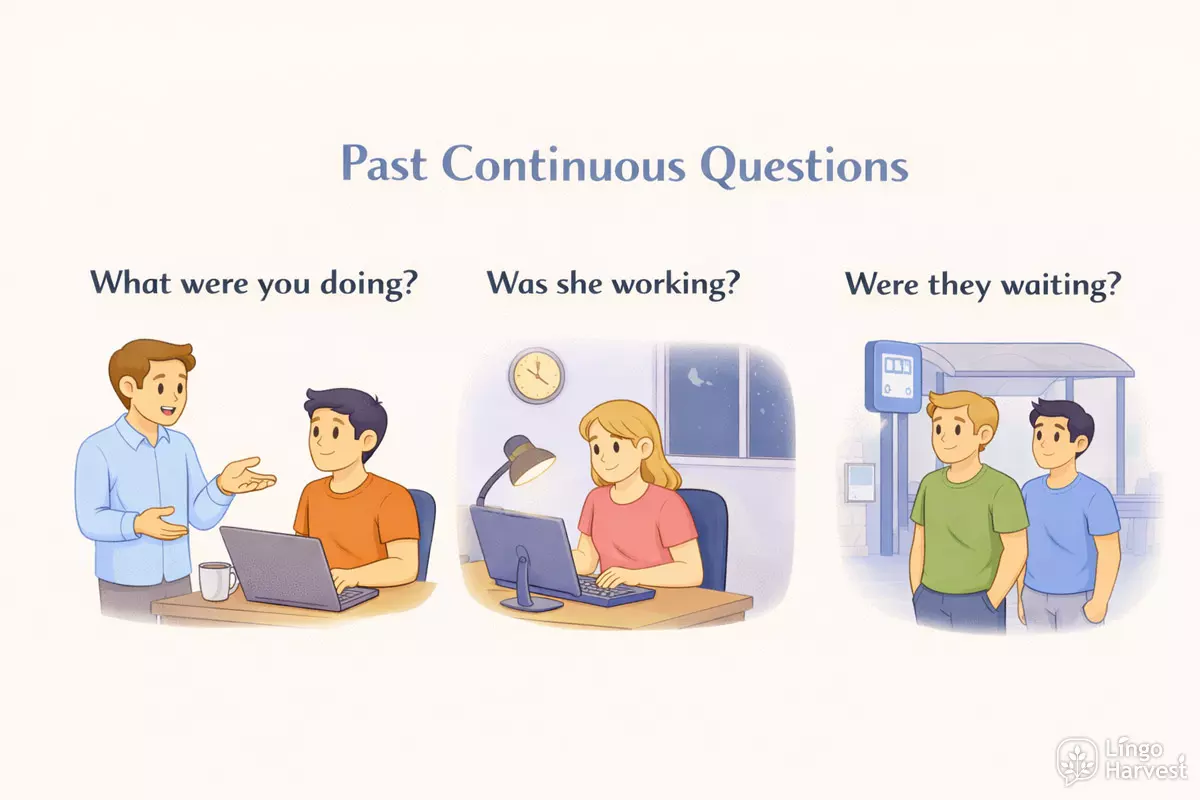 Here we forming past continuous questions, choosing was or were, making yes/no and WH-questions, using time markers, and avoiding common mistakes. It also compares past continuous with past simple and offers practice exercises for self-check.
If you want to ask about actions that were happening at a specific time in the past, you can use the past continuous tense in your questions. This structure helps you inquire about events that were ongoing but not completed at that moment. For example, you might ask, "What were you doing last night?" or "Were they studying when you called?" Using the past continuous tense in questions allows you to focus on the process or duration of an activity rather than just the result, making your conversations about past events more detailed and engaging.
Past Continuous Question Structure
Forming questions in the past continuous tense involves a specific word order. To create a question, start with the correct form of the auxiliary verb "was" or "were," followed by the subject, and then the main verb in its -ing form. This structure allows you to ask about actions that were ongoing at a particular time in the past.
Basic Pattern
The typical question format is:
- Was/Were + subject + verb(-ing) + (rest of sentence)?
For example:
- Was she reading when you called?
- Were they playing football yesterday afternoon?
Choosing Between "Was" and "Were"
Use "was" with singular subjects (I, he, she, it) and "were" with plural subjects (you, we, they). This choice is key to forming correct questions.
| Auxiliary | Subject | Example Question |
|---|---|---|
| Was | I/he/she/it | Was he sleeping at 10 PM? |
| Were | you/we/they | Were they studying together? |
Using Question Words
To ask for specific information, place a question word (who, what, where, when, why, how) at the beginning:
- What were you doing last night? → I was finishing a project at home.
- Where was she going? → She was heading to the airport.
- Why were they laughing? → They were laughing at a joke.
- Who was talking to you? → I was talking to my manager.
- How were you feeling after the game? → I was feeling exhausted but happy.
More Examples
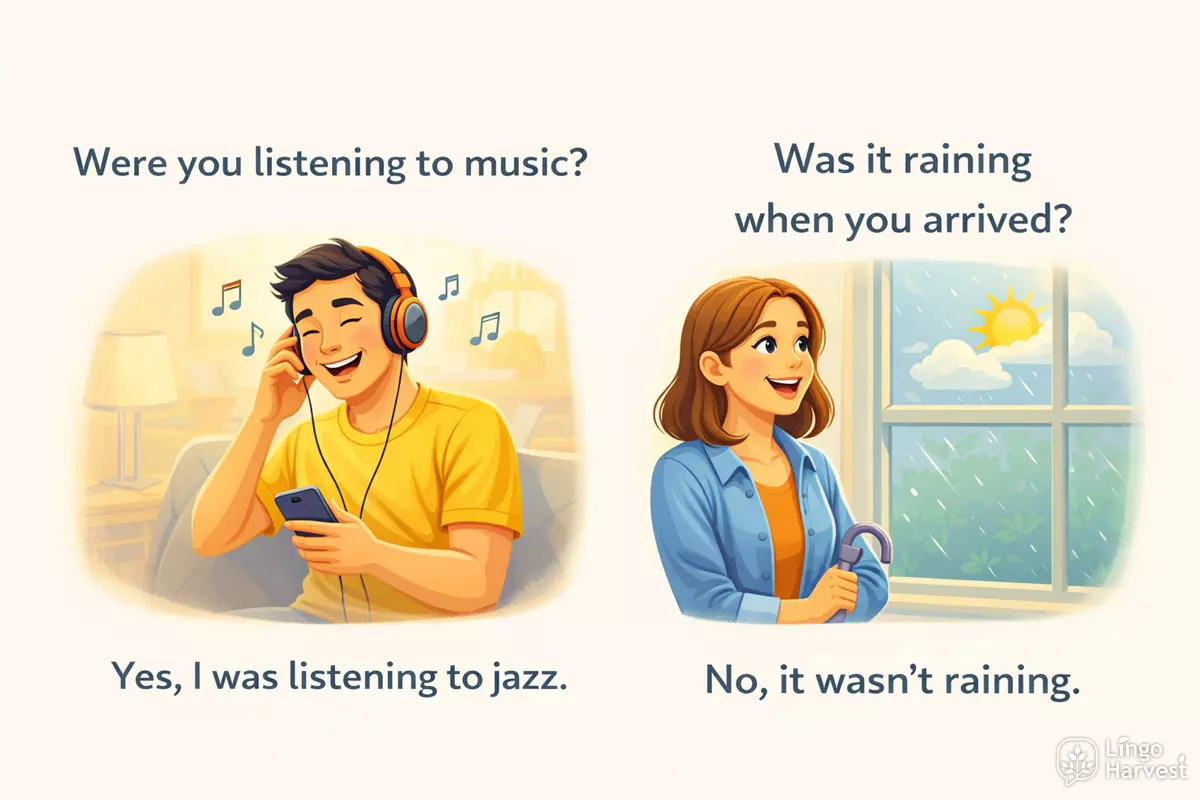
Here are additional sample questions using this tense:
- Were you listening to music? → Yes, I was listening to jazz.
- Was it raining when you arrived? → No, it wasn’t raining.
- Were your friends waiting outside? → Yes, they were waiting for me.
- Was the teacher explaining the lesson? → Yes, she was explaining the rules.
- Were we wearing the right uniforms? → Yes, we were dressed correctly.
- Was I interrupting your work? → No, you weren’t interrupting.
- Were the children playing in the park? → Yes, they were playing football.
- Was your phone ringing? → Yes, it was ringing nonstop.
- Were you planning to join us? → Yes, I was planning to come.
- Was anyone helping you? → Yes, a colleague was helping me.
Mastering this question structure helps you communicate clearly about past events that were in progress, whether you’re asking for details, clarifying a story, or gathering information.
Was vs Were in Questions
Choosing between was and were is essential when forming questions in the past continuous tense. The verb you select depends on the subject of your question. Was is used with singular subjects, while were fits with plural subjects and the pronoun "you."
Which Subject Takes Which Verb?
Here’s a quick overview: use was with "I," "he," "she," and "it." For "you," "we," and "they," use were. This distinction helps keep your questions grammatically correct and clear.
| Subject | Auxiliary Verb | Example Question |
|---|---|---|
| I | was | Was I reading? |
| He / She / It | was | Was she working? |
| You | were | Were you listening? |
| We / They | were | Were they playing? |
Examples of Questions in Context
- Was he studying at the library last night? → Yes, he was studying there.
- Were you watching TV when I called? → Yes, I was watching a movie.
- Was it raining in the morning? → No, it wasn’t raining.
- Were they waiting for the bus? → Yes, they were waiting at the stop.
- Was I talking too loudly? → No, you weren’t talking loudly.
- Were we meeting at 5 PM? → Yes, we were meeting at 5 PM.
- Was she feeling better yesterday? → Yes, she was feeling much better.
- Were the children sleeping? → No, they weren’t sleeping.
- Was the dog barking all night? → Yes, it was barking for hours.
- Were your friends enjoying the party? → Yes, they were enjoying it a lot.
Notice that in each question, the auxiliary verb comes first, followed by the subject and then the main verb with an -ing ending. This pattern remains the same regardless of whether you use was or were; only the subject affects your choice.
Common Mistakes to Avoid
- Using was with plural subjects (❌ Was they playing?)
- Using were with singular subjects (❌ Were she reading?)
- Forgetting to invert the subject and verb in questions (❌ She was reading?)
To sum up, always match your auxiliary verb to your subject, and remember the word order for past continuous questions. With practice, choosing between was and were will become second nature.
Yes/No Questions in Past Continuous
To ask questions that can be answered with "yes" or "no" in the past continuous tense, the usual pattern is to place the auxiliary verb was or were at the start of the sentence, followed by the subject, and then the main verb with an "-ing" ending. This structure helps clarify whether an action was ongoing at a certain time in the past.
Word Order and Structure
The basic formula for these questions is: Was/Were + subject + verb-ing + (rest of sentence)? Choose "was" for singular subjects (I, he, she, it) and "were" for plural subjects (we, you, they).
| Affirmative Statement | Yes/No Question |
|---|---|
| I was reading a book. | Was I reading a book? |
| She was cooking dinner. | Was she cooking dinner? |
| They were playing outside. | Were they playing outside? |
| You were listening to music. | Were you listening to music? |
| We were studying together. | Were we studying together? |
| He was sleeping on the couch. | Was he sleeping on the couch? |
| The dog was barking loudly. | Was the dog barking loudly? |
| It was raining last night. | Was it raining last night? |
| The children were drawing pictures. | Were the children drawing pictures? |
| My parents were watching TV. | Were my parents watching TV? |
Short Answers for Yes/No Questions
When responding to these questions, short answers are common. For example:
- Yes, I was. ✅
- No, she wasn't. ❌
- Yes, they were. ✅
- No, we weren't. ❌
Common Contexts
This type of question is often used to check what someone was doing at a particular moment in the past, verify details, or confirm activities. For example, one might ask, “Were you working at 8 p.m.?” or “Was it snowing when you left?” The focus is always on actions or situations that were in progress at a specific time.
Typical Mistakes to Avoid
- Don’t forget to invert the subject and auxiliary verb (say "Were you...", not "You were...?" for questions).
- Use "was" with singular and "were" with plural subjects.
- Always use the "-ing" form of the main verb.
Mastering this pattern makes it easy to ask about ongoing past actions in English conversation.
WH-Questions in Past Continuous
To ask about past actions in progress, we use specific question words—known as WH-words—combined with the past continuous tense. The structure typically starts with a WH-word (like what, where, who, why, when, or how), followed by was/were, then the subject, and finally the verb’s -ing form. This format helps you find out details about ongoing activities at a particular moment in the past.
How to Structure These Questions
The standard pattern looks like this:
- WH-word + was/were + subject + verb(-ing) + (rest of question)?
For example: What were you doing at 8 pm? or Why was she laughing during the meeting?
Common WH-Words Used
- What
- Where
- Who
- Why
- When
- How
- Which
- Whose
Examples of WH-Questions with Past Continuous
Here are some typical questions you might use to ask about ongoing past events:
- What were they talking about? → They were talking about their travel plans.
- Where was he driving last night? → He was driving to the city center.
- Who was singing at the party? → A local band was singing.
- Why were you crying? → I was crying because I was overwhelmed.
- When were you working on the project? → I was working on it late last night.
- How was she feeling during the exam? → She was feeling nervous but focused.
- Which book were you reading? → I was reading a history book.
- Whose phone was ringing? → It was my colleague’s phone.
- What were you wearing? → I was wearing a jacket and jeans.
- Where were you living in 2015? → I was living in Chicago.
- Who was helping you with your homework? → My older sister was helping me.
- Why were they arguing? → They were arguing about the schedule.
- When was it raining? → It was raining in the early morning.
- How were you getting home? → I was getting home by train.
- Which team was winning? → The home team was winning.
- Whose dog was barking? → It was the neighbor’s dog.
Form Comparison Table
| WH-Word | Example Question |
|---|---|
| What | What were you doing? |
| Where | Where was she going? |
| Who | Who was calling you? |
| Why | Why were they laughing? |
| When | When were you studying? |
| How | How was he traveling? |
| Which | Which song were you listening to? |
| Whose | Whose bag was lying on the floor? |
Remember, not every WH-question needs all parts—sometimes the object or reason is implied. The key is to match the WH-word with the information you want, and to keep the auxiliary verb before the subject. Practicing with different WH-words will help you get comfortable forming these questions about ongoing actions in the past.
Time Markers and Context
When forming questions in the past continuous tense, specific words and phrases help clarify when the action was taking place. These expressions, often called time markers, set the scene and provide context for the action in progress. Recognizing and using these markers not only makes your questions clearer but also helps listeners understand the timeframe you are referring to.
Common Time Expressions with the Past Continuous
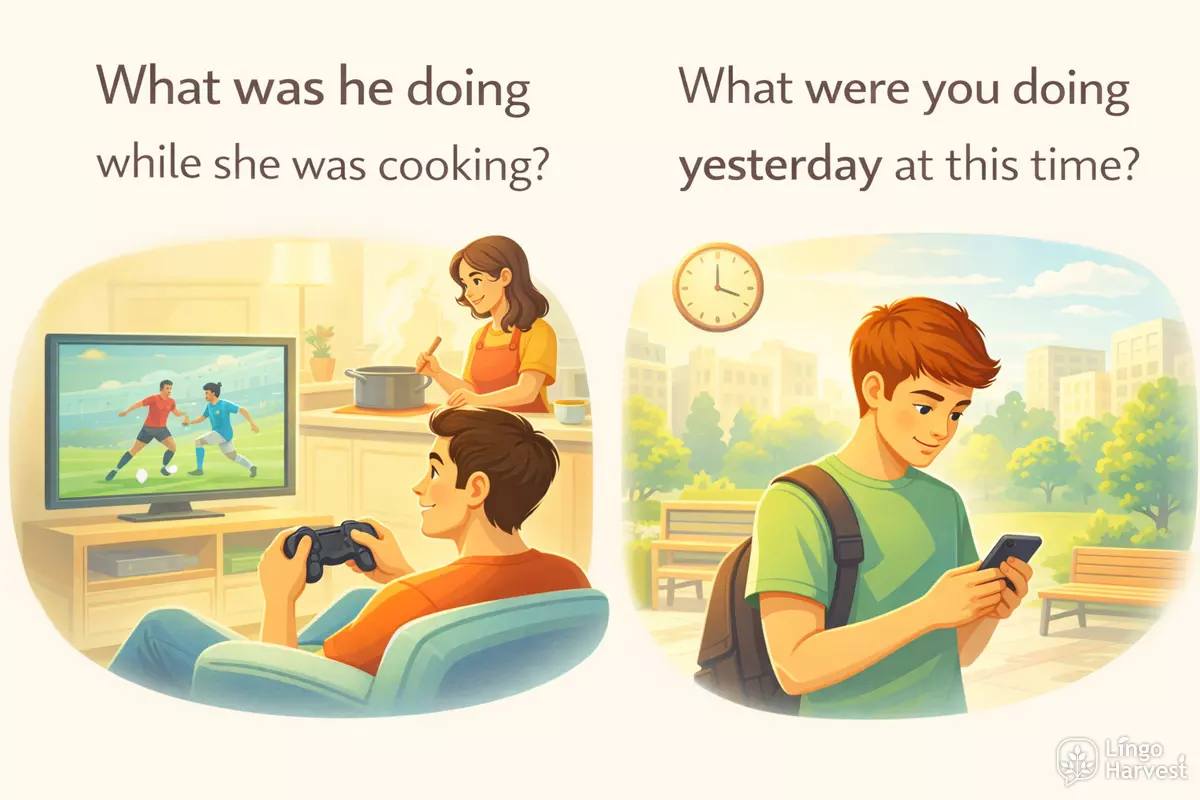
Certain phrases naturally pair with past continuous questions. Here are some of the most frequent time markers you’ll encounter:
- at 7 o’clock last night → What were you doing at 7 o’clock last night?
- when the phone rang → What were you doing when the phone rang?
- while she was cooking → What was he doing while she was cooking?
- yesterday at this time → What were you doing yesterday at this time?
- all afternoon → What were they doing all afternoon?
- during the meeting → What were you discussing during the meeting?
- as it was raining → Where were you going as it was raining?
- last Monday → What were you doing last Monday?
- at that moment → What was happening at that moment?
- when you called → What was I doing when you called?
- while they were driving → What were they talking about while they were driving?
- throughout the day → What was she working on throughout the day?
- for hours yesterday → What were you waiting for hours yesterday?
- when I saw you → What were you doing when I saw you?
- at midnight → What were you doing at midnight?
- just then → What was happening just then?
- earlier that day → What were they preparing earlier that day?
- between 3 and 5 pm → What were you doing between 3 and 5 pm?
Using Context to Form Effective Questions
Questions in the past continuous often depend on background details. These can be a specific time, an event that interrupted the action, or a duration. For example, "What were you doing when the alarm went off?" or "Were they studying all evening?" The context provided by these markers helps to pinpoint the ongoing nature of the activity.
Comparing Time Markers: Past Continuous vs. Simple Past
Some time expressions are more suited to the past continuous than the simple past. Notice how the following markers guide which tense feels natural:
| Typical for Past Continuous | Typical for Simple Past |
|---|---|
| while | then |
| as | after that |
| during | at once |
| at that moment | immediately |
Selecting the right time phrase helps your question sound natural and ensures your meaning is clear. In conversation, it’s common to combine a question word (like "what," "where," or "who") with these markers, for example: "Where were you going when I saw you?" or "Who was she talking to at midnight?" These details anchor your question in a specific moment or period in the past.
Common Learner Mistakes
Learners often find it tricky to construct questions in the past continuous tense. Many errors stem from confusion about auxiliary verbs, word order, and proper verb forms. Recognizing these stumbling blocks can help you avoid them and communicate more clearly.
Mixing Up Auxiliary Verbs
One frequent issue is using the wrong form of "was" or "were." Remember, the subject determines which auxiliary you need. For example, "Was you watching TV?" ❌ is incorrect; it should be "Were you watching TV?" ✅
Incorrect Word Order
Forming questions in English often requires inverting the subject and auxiliary verb. Forgetting this results in statements rather than questions, such as "You were playing football?" instead of "Were you playing football?"
Confusing Past Simple and Past Continuous
Learners sometimes use the base form or past simple instead of the present participle (-ing form). For example, "Were you went home?" is incorrect. The correct form is "Were you going home?"
Common Error Patterns
Here are some typical mistakes students make when forming these questions:
- Using "did" as an auxiliary: "Did you watching TV?" ❌
- Omitting the auxiliary: "You watching TV?" ❌
- Using the base verb instead of the -ing form: "Were you watch TV?" ❌
- Incorrect subject-auxiliary agreement: "Was they playing?" ❌
- Forgetting to invert the subject and auxiliary: "You were playing?" ❌
- Double auxiliary: "Were did you watching?" ❌
- Mixing up tenses: "Were you played football?" ❌
- Wrong auxiliary for subject: "Was we studying?" ❌
- Spelling mistakes with -ing forms: "Were you writting?" ❌
- Using contractions incorrectly: "Weren't you was sleeping?" ❌
Correct vs. Incorrect Forms
To help visualize some of these pitfalls, here's a side-by-side comparison of mistaken patterns and their correct versions:
| Incorrect | Correct |
|---|---|
| Did he playing chess? | Was he playing chess? |
| Was you eating? | Were you eating? |
| Were they play? | Were they playing? |
| You were studying? | Were you studying? |
| Were she going? | Was she going? |
| Were you wrote? | Were you writing? |
Summary of Key Points
- Always use "was" or "were" as the auxiliary, depending on the subject.
- Invert the subject and auxiliary when forming a question.
- Use the verb’s -ing form after the auxiliary.
- Double-check for subject-auxiliary agreement.
- Review spelling of -ing verbs to avoid mistakes.
By keeping these points in mind, you can avoid the most common pitfalls and form accurate questions in the past continuous tense.
Past Simple vs Past Continuous Questions
Understanding how to ask questions in both the past simple and past continuous tenses is key for clear communication about past events. Although both forms refer to the past, they are used for different purposes and have distinct structures. Knowing when and how to use each will help you avoid confusion and express yourself more precisely in English.
Usage Differences
- Past simple questions focus on completed actions or events that happened at a specific time in the past, often with words like "yesterday," "last night," or "in 2010."
- Past continuous questions refer to actions or situations that were ongoing at a particular moment in the past, or to activities that were interrupted by another event.
How to Form Each Type
Let’s look at the typical word order and question patterns for both tenses:
| Past Simple (Did + subject + base verb) | Past Continuous (Was/Were + subject + verb-ing) |
|---|---|
| Did you call her? | Were you calling her? |
| Did they arrive on time? | Were they arriving late? |
| Did he eat breakfast? | Was he eating breakfast? |
| Did it rain last night? | Was it raining when you left? |
| Did she study for the test? | Was she studying when you called? |
| Did you see the movie? | Were you watching the movie? |
Common Contexts
- Use the simple past to ask about single, finished actions: Did you finish your homework?
- Choose the past continuous to focus on what was happening at a certain time: Were you sleeping at midnight?
- For background actions interrupted by another event, the ongoing action uses past continuous and the interrupting event uses past simple: What were you doing when the phone rang?
Examples of Question Words
- What did you do yesterday? → What were you doing yesterday at 8 PM?
- Where did she go? → Where was she going when you saw her?
- Who did they meet? → Who were they meeting at the café?
- Why did he leave? → Why was he leaving so early?
- How did you fix it? → How were you fixing it when the power went out?
In summary, selecting between these two question forms depends on whether you are asking about a finished action or an ongoing one in the past. Practice forming both types of questions to make your English conversations about past events more accurate and natural.
Practice Exercises and Self-Check
Sharpen your understanding of forming questions in the past continuous by working through these targeted exercises and review activities. You'll find sentence transformations, fill-in-the-blank practice, and opportunities to create your own questions. This section is designed to help you recognize patterns and gain confidence with real examples.
Transform Statements into Questions
Change the following statements into yes/no questions using the past continuous form:
- She was watching television.
- They were playing football in the park.
- You were studying for the exam.
- He was driving to work.
- The children were sleeping.
Show answers
- Was she watching television?
- Were they playing football in the park?
- Were you studying for the exam?
- Was he driving to work?
- Were the children sleeping?
Wh- Questions Practice
Rewrite each statement as a Wh- question (who, what, where, when, why, or how) in the past continuous. Choose the most logical question word.
- She was reading in her room.
- They were laughing because of the joke.
- He was eating dinner at 8 PM.
- The dog was barking at the mailman.
- Anna was traveling to Spain last summer.
Show answers
- Where was she reading?
- Why were they laughing?
- What was he eating at 8 PM?
- Who was the dog barking at?
- Where was Anna traveling last summer?
Identify the Error
Each sentence below contains a mistake in forming a past continuous question. Find and correct the errors.
- Was you going to the party last night?
- What were she doing at 9 o'clock?
- Were John and Mike was playing chess?
- Why you were crying?
Show answers
- Were you going to the party last night?
- What was she doing at 9 o'clock?
- Were John and Mike playing chess?
- Why were you crying?
Common Patterns for Past Continuous Questions
Here is a quick reference chart showing typical structures for forming questions in the past continuous tense:
| Type of Question | Structure Example |
|---|---|
| Yes/No Question | Was/Were + subject + verb(-ing)? e.g., Were you listening? |
| Wh- Question | Wh- word + was/were + subject + verb(-ing)? e.g., What were they doing? |
| Question with Time Reference | Was/Were + subject + verb(-ing) + at [time]? e.g., Was she sleeping at midnight? |
| Question with Reason | Why was/were + subject + verb(-ing)? e.g., Why were you crying? |
Create Your Own Questions
Write questions in the past continuous using the prompts below. Use your imagination for the details.
- Ask about what your friend was doing yesterday afternoon.
- Form a question about someone’s activities during last weekend.
- Make a question about why someone was laughing during class.
- Write a question about who was cooking dinner last night.
- Ask about what you were wearing at your last birthday party.
Show answers
- What were you doing yesterday afternoon?
- Were you going anywhere last weekend?
- Why were you laughing during class?
- Who was cooking dinner last night?
- What were you wearing at your last birthday party?
Practicing these exercises regularly will help you master the structure and usage of past continuous questions. For best results, try creating more examples based on your own experiences and check your answers with a teacher or study group.