How to Form Questions in Future Tenses in English

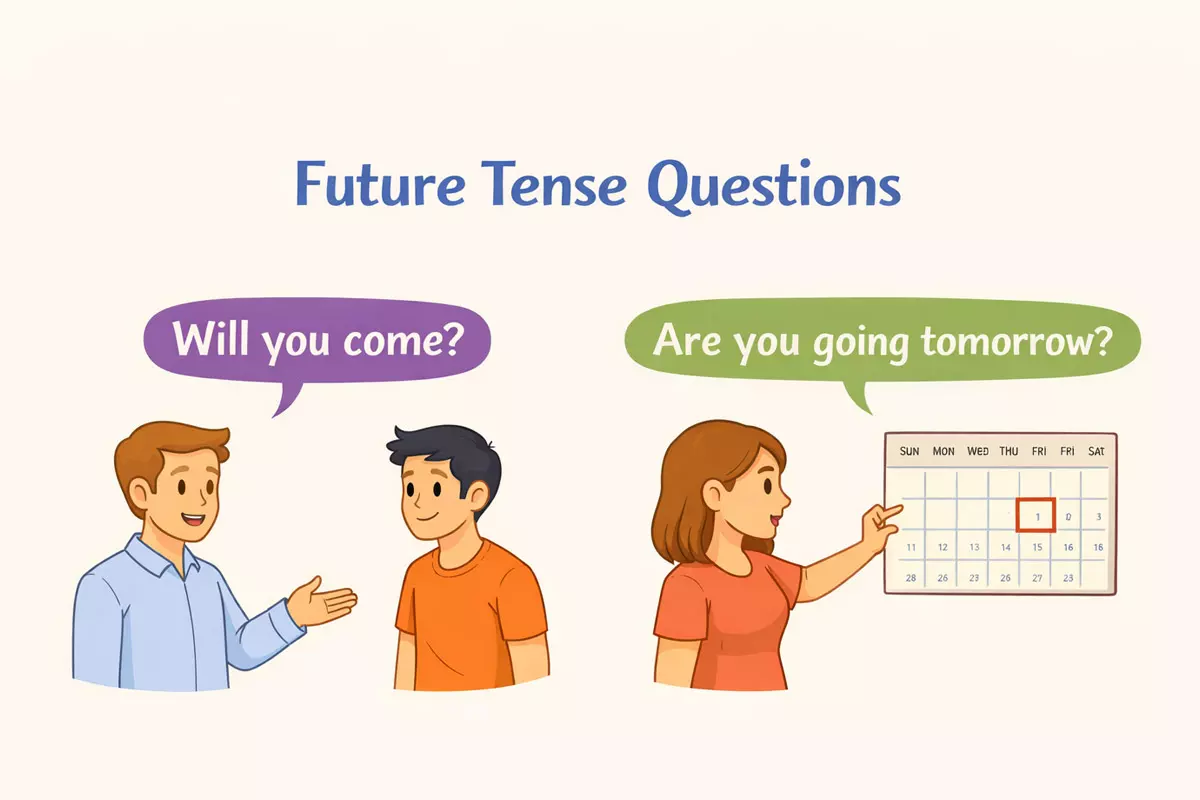 This article explains how to ask future questions in English using will, going to, and present continuous forms. It covers when to use each, common mistakes, real-life examples, and offers practice exercises for self-assessment.
Learning how to ask about events that have not happened yet is an essential skill for engaging in meaningful conversations in English. Whether you are discussing future plans, making predictions, or seeking information about upcoming events, knowing the right way to frame your questions can help you communicate more effectively. By understanding and practicing common structures such as "Will you...?", "Are you going to...?", or "What do you think will happen?", you can participate more confidently in discussions about the future.
Overview of Future Question Forms
When talking about events or actions that have not happened yet, English uses several future tenses. Each future tense has its own way of forming questions, and understanding these structures helps you communicate intentions, predictions, offers, or plans more clearly. The way you phrase a question in the future can depend on how certain the event is, whether it’s scheduled, spontaneous, or conditional.
Common Future Tenses Used in Questions
- Will – Used for predictions, spontaneous decisions, and promises.
- Going to – Indicates plans or intentions and things that seem likely to happen.
- Present Continuous – Describes fixed arrangements, often with a time reference.
- Future Continuous – Focuses on actions that will be ongoing at a specific future moment.
- Future Perfect – Refers to actions that will be completed before a certain time in the future.
Key Question Patterns for Future Tenses
Each future tense follows its own question structure, usually involving an auxiliary verb and the subject. Here are the basic question forms for the most common future tenses:
| Tense | Question Structure | Example |
|---|---|---|
| Will | Will + subject + base verb…? | Will you call me? |
| Going to | Am/Is/Are + subject + going to + base verb…? | Are they going to travel? |
| Present Continuous (future meaning) | Am/Is/Are + subject + verb-ing…? | Is she meeting us at 7? |
| Future Continuous | Will + subject + be + verb-ing…? | Will you be working late? |
| Future Perfect | Will + subject + have + past participle…? | Will they have finished by then? |
Typical Question Words and Examples
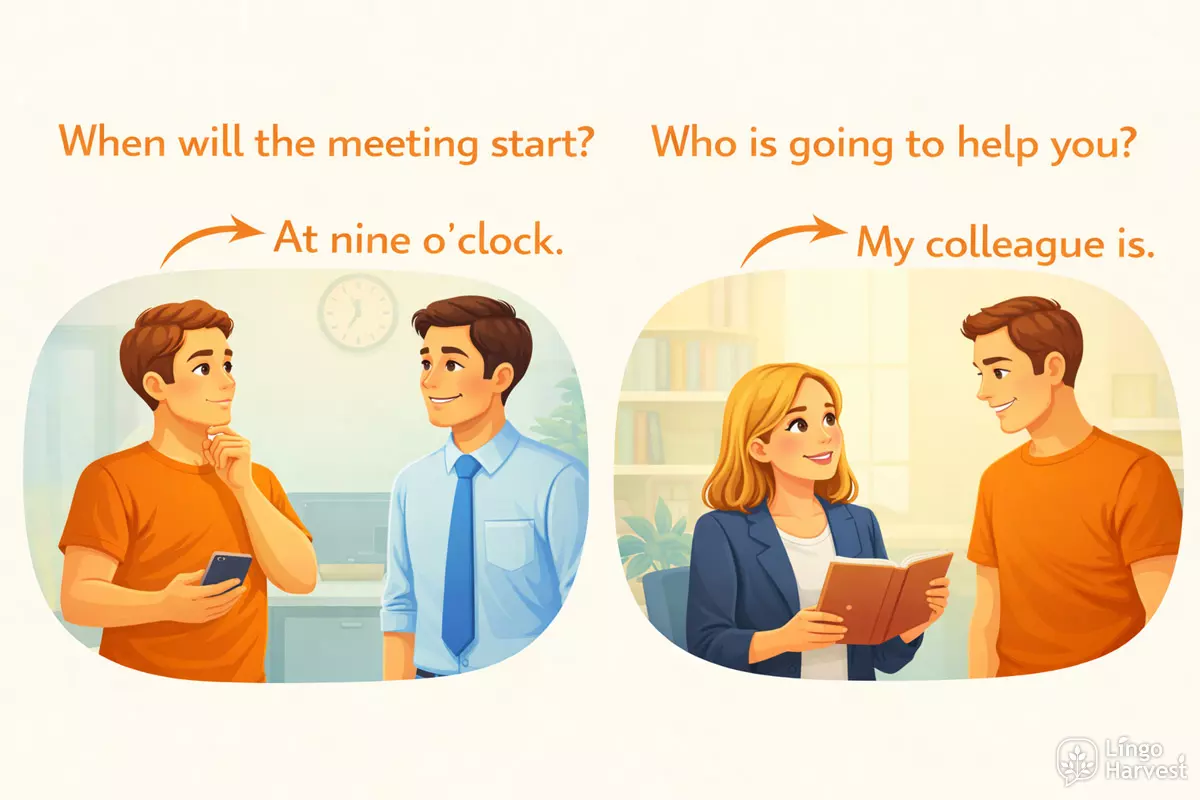
Questions about the future often begin with question words (who, what, where, when, why, how) to gather specific information. Here are some useful examples you might encounter or use:
- When will the meeting start? → At nine o’clock.
- Who is going to help you? → My colleague is.
- Where are you staying next week? → At a hotel downtown.
- Why will they be traveling so late? → Because of their schedule.
- How are you going to solve this problem? → By working with the team.
- Will she attend the conference? → Yes, she will.
- Are we meeting at the usual place? → Yes, we are.
- Will you have completed the project by Friday? → Yes, I will.
- What will you be doing this time tomorrow? → I will be working.
- Is he going to apply for the job? → Yes, he is.
- When are they leaving for Paris? → On Monday.
- Who will be presenting at the seminar? → The guest speaker will.
- How will you know when it’s ready? → You will get a notification.
- Will it rain tomorrow? → Probably.
- Are you going to watch the movie tonight? → Yes, I am.
- Will you have learned enough English by then? → Yes, I will.
Getting comfortable with these patterns will make it easier to ask about future events in different situations, whether you’re making plans, checking schedules, or predicting what might happen.
Questions with Will
To ask about the future in English, “will” is the most direct auxiliary verb used for forming questions. This structure works for all subjects and is common in both spoken and written language when making predictions, offers, promises, or requests. The typical word order starts with “will” followed by the subject and the base form of the main verb. This order does not change for any subject, making it straightforward to use.
How to Build Future Simple Questions
Begin with “will,” add the person or thing you are asking about, and then the main verb (base form). For example, “Will she call?” or “Will they arrive on time?” This structure is consistent whether the subject is “I,” “he,” “we,” or any noun. There is no need to modify “will” or the verb for different people.
| Question | Meaning/Use |
|---|---|
| Will you help me? | Request/offer |
| Will it rain tomorrow? | Prediction |
| Will they come to the party? | Future plan or possibility |
| Will we meet again? | Future possibility |
| Will she finish her homework? | Prediction about someone else |
| Will I need a ticket? | Asking about necessity |
| Will John join us for lunch? | Future arrangement |
| Will the shop be open? | Checking future conditions |
| Will you be late? | Prediction/possibility |
| Will we have enough time? | Concern about future |
Using Question Words
To get more information, start your question with words like what, when, where, who, why, or how, then continue with “will,” the subject, and the verb. For example:
- What will we do next? → We will review the plan.
- When will you arrive? → I will arrive tomorrow morning.
- Where will they stay? → They will stay at a hotel.
- Who will help us? → Our manager will.
- Why will she leave early? → Because she has another meeting.
- How will you get there? → I will take the train.
Negative questions are also possible by placing “not” after the subject, as in “Will you not attend?” or using the contraction “won’t”: “Won’t it be cold tonight?” This form can show surprise or seek confirmation.
Overall, forming future questions with “will” is reliable and flexible for many types of future situations. Remember that “will” is not changed for any subject, and always use the base form of the main verb after the subject.
Questions with Going to
When talking about plans or intentions for the future, English speakers often use the phrase “going to.” Forming questions with this structure is straightforward, but there are a few details to keep in mind. The construction always involves the verb “to be” (am/are/is), followed by “going to,” and then the base form of the main verb.
How to Form
To ask about someone’s future intentions or plans, start with the correct form of “to be,” then add the subject, “going to,” and the base verb. For example, “Are you going to travel this summer?” Notice that the word order is different from statements.
Common Patterns
- Am I going to…? (Am I going to miss the bus?)
- Are you going to…? (Are you going to call her?)
- Is he going to…? (Is he going to finish on time?)
- Is she going to…? (Is she going to join us?)
- Is it going to…? (Is it going to rain?)
- Are we going to…? (Are we going to meet later?)
- Are they going to…? (Are they going to move house?)
Wh- Questions with “Going to”
For more information, start your question with a “wh-” word (such as what, where, when, why, who, or how). The word order stays the same after the question word:
- What are you going to do? → I’m going to finish my work.
- Where is she going to stay? → She’s going to stay with friends.
- When are we going to leave? → We’re going to leave early.
- Why are they going to cancel the event? → Because of the weather.
- How am I going to explain this? → You’re going to explain it calmly.
Quick Reference Table
| Question Form | Example |
|---|---|
| Are you going to + base verb? | Are you going to study tonight? |
| Is he/she/it going to + base verb? | Is it going to snow tomorrow? |
| Are we/they going to + base verb? | Are they going to start early? |
| Wh- + am/are/is + subject + going to + base verb? | What are you going to eat? |
Extra Tips
- Do not use “do/does” when making questions with “going to” — the verb “to be” is always required.
- Short answers echo the verb: “Yes, I am.” / “No, she isn’t.”
- For negative questions, put “not” after the subject: “Isn’t he going to help?”
Mastering these forms will help you ask about future plans and intentions in natural, fluent English.
Questions in Present Continuous for Future
When discussing future plans or arrangements, English often uses the present continuous tense. This structure is especially common for events that are already scheduled or agreed upon, such as meetings, trips, or appointments. Instead of using will or going to, speakers frequently ask about future arrangements with am/is/are + subject + verb-ing.
How to Structure Present Continuous Questions for Future Arrangements
To form a question about a planned future event using the present continuous, follow this pattern:
- Am/Is/Are + subject + verb-ing + (rest of sentence)?
These questions usually refer to something already decided or organized. For example, “Are you meeting Sarah after work?” implies the plan is already in place.
Common Examples of Present Continuous Questions for Future
- Are you coming to the party tonight? → Yes, I am.
- Is she flying to Paris next week? → Yes, she is.
- Are we having a meeting tomorrow morning? → Yes, we are.
- Am I picking you up at 7 o’clock? → Yes, you are.
- Are they moving to a new house soon? → Yes, they are.
- Is he starting his new job on Monday? → Yes, he is.
- Are you joining us for dinner? → Yes, I am.
- Is the train leaving at 6:15? → Yes, it is.
- Are your friends arriving this evening? → Yes, they are.
- Is the restaurant opening early tomorrow? → Yes, it is.
- Are we visiting the museum on Saturday? → Yes, we are.
- Is she seeing the doctor later? → Yes, she is.
- Are the kids playing football after school? → Yes, they are.
- Am I meeting your parents tonight? → Yes, you are.
- Are you working late this Friday? → No, I am not.
- Is it raining tomorrow according to the forecast? → Yes, it is.
Quick Reference: Yes/No and Wh- Questions
| Type | Example Question |
|---|---|
| Yes/No | Are you leaving soon? |
| Wh- | What time are we meeting? |
| Wh- | Where is he staying tonight? |
| Yes/No | Is she coming with us? |
Use the present continuous for future when the arrangement is already decided, not for distant, uncertain, or spontaneous plans. This approach helps clarify your intentions and expectations about upcoming events in natural conversation.
Choosing the Right Future Form
Deciding which future tense to use in English depends on what you want to express: a plan, a prediction, a decision made in the moment, or something scheduled. Each future tense has its own typical context, so understanding the differences helps you create clear and natural-sounding questions.
When to Use Each Future Tense
- Will: Use for spontaneous decisions, predictions, promises, or offers. Example: “Will you help me?”
- Going to: Choose this for plans already made or predictions based on evidence. Example: “Are you going to call her?”
- Present Continuous: Use for arrangements with a specific time or place. Example: “Are you meeting Tom tomorrow?”
- Present Simple: Use for scheduled events, especially timetables. Example: “Does the train leave at 9?”
- Future Continuous: Use to ask about ongoing actions at a future time. Example: “Will you be working at 8 p.m.?”
- Future Perfect: Use to inquire if something will be completed by a certain future point. Example: “Will you have finished by Friday?”
Quick Comparison of Future Forms in Questions
| Future Form | Typical Use in Questions | Example Question |
|---|---|---|
| Will | Predictions, offers, promises, decisions made now | Will you join us for dinner? |
| Going to | Plans, intentions, evidence-based predictions | Are you going to study abroad? |
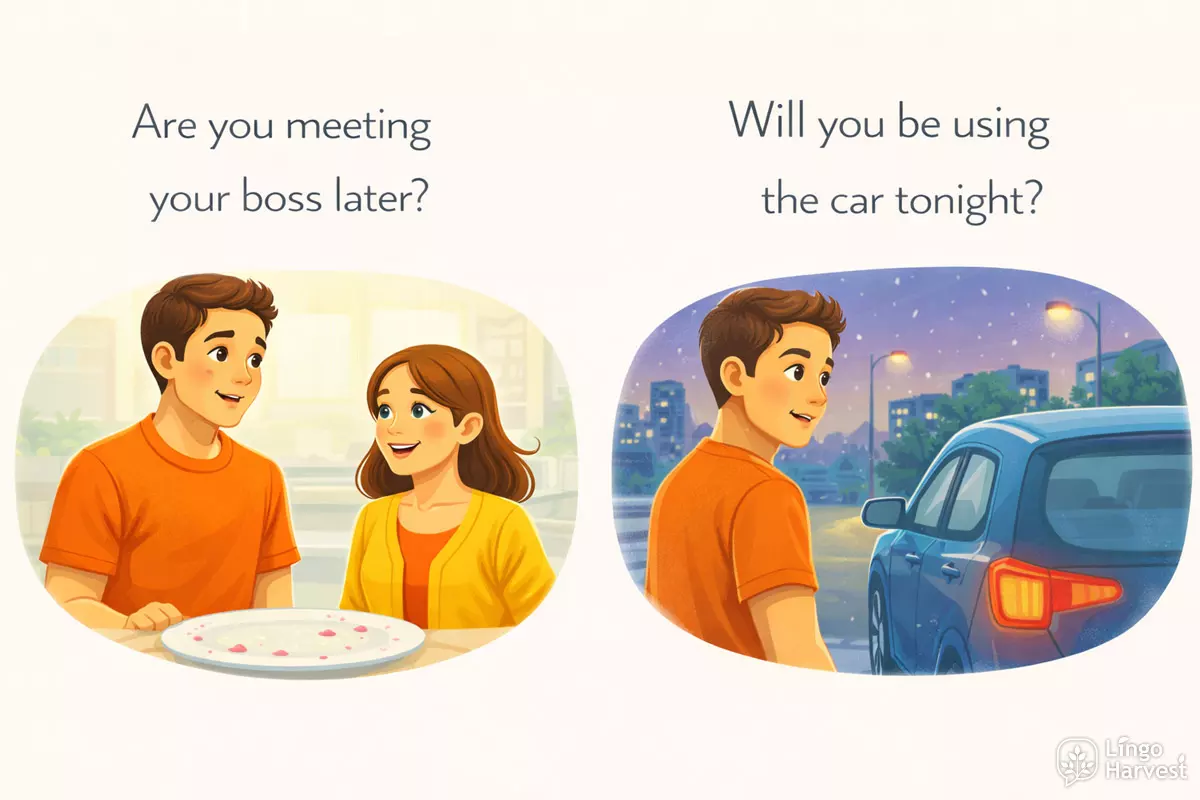
| Present Continuous | Arrangements for the near future | Are you meeting your boss later? |
| Future Continuous | Ongoing actions at a specific future time | Will you be using the car tonight? |
| Future Perfect | Completed actions by a certain future time | Will you have eaten before the meeting? |
Common Triggers for Each Form
Look for time expressions and context clues to help you select the right structure. Here are some examples that often signal which tense is most suitable:
- Tomorrow, next week, in a year (often used with all future forms)
- By the time, by Friday (usually with Future Perfect)
- At 8 p.m., when you arrive (can indicate Future Continuous or Present Continuous)
- I think, I guess, probably (suggests “will” for predictions)
- Already decided, planning, intend (suggests “going to”)
- Arranged with someone, meeting, appointment (present continuous for arrangements)
- Timetable, schedule, opens, closes (present simple for scheduled events)
Choosing between these forms is about matching your meaning to the right grammatical structure. Practice by asking yourself what exactly you want to know about the future: a plan, a prediction, or something already arranged. This will guide you to the most natural and accurate question form in English.
Common Learner Mistakes
When learning how to ask questions using future tenses in English, students often encounter a number of pitfalls. Misplacing auxiliary verbs, confusing word order, and mixing up different future forms are just a few of the stumbling blocks. Understanding these typical errors can help you avoid them and form questions more naturally.
Mixing Up Future Forms
A frequent issue is using the wrong future tense for the intended meaning. English offers several ways to talk about the future—such as will, be going to, and present continuous—and each has its own nuances. Learners sometimes use these forms interchangeably, which can lead to confusion or awkwardness in questions.
| Incorrect Question | Correct Question |
|---|---|
| Will you going to the party? | Are you going to the party? |
| Are you will call me? | Will you call me? |
| Do you will finish soon? | Will you finish soon? |
| Going you to travel next week? | Are you going to travel next week? |
Auxiliary Verb Confusion
Another common trap is forgetting to use the correct auxiliary verb when forming questions. For example, will is used for simple future, while am/is/are is needed for going to and present continuous forms. Omitting or misplacing these can make questions ungrammatical.
- Using "You will come?" instead of "Will you come?"
- Writing "Going you to help me?" instead of "Are you going to help me?"
- Saying "You are meet us later?" instead of "Are you meeting us later?"
Word Order Mistakes
Question word order in English can be tricky, especially for those whose native language places question words differently. Learners often forget to invert the subject and auxiliary, or mistakenly place question words at the end of the sentence.
- Incorrect: "You will where go?" → Correct: "Where will you go?"
- Incorrect: "She is going to when arrive?" → Correct: "When is she going to arrive?"
- Incorrect: "They are traveling where?" → Correct: "Where are they traveling?"
Question Word Omissions
Sometimes, learners leave out the necessary question word (when, where, why, how), resulting in incomplete or unclear questions:
- Incorrect: "Will you arrive?" (when?)
- Incorrect: "Are you going to?" (what?)
- Incorrect: "Will they finish?" (by what time?)
Overusing "Will" for Every Situation
English speakers use several ways to express the future. Over-reliance on "will" is a frequent slip, especially when the context actually calls for "going to" or present continuous for plans and arrangements.
- Incorrect: "Will you coming to the meeting?"
- Incorrect: "Will you play tennis this evening?" (if it’s already arranged, "Are you playing tennis this evening?" is better)
Summary of Frequent Errors
- Confusing "will" and "going to" in questions
- Forgetting to invert subject and auxiliary
- Using statements instead of questions
- Omitting auxiliary verbs
- Leaving out question words
- Misusing present continuous for distant plans
- Placing question words incorrectly
- Repeating auxiliary verbs unnecessarily ("Will will you come?")
- Using incorrect verb forms after auxiliaries ("Will you goes?")
- Mixing up time expressions (e.g., using "yesterday" in a future question)
Paying attention to these patterns and practicing with real examples can help you form future tense questions more accurately and sound more fluent in English.
Future Questions in Real Contexts
Understanding how to ask about upcoming events or plans in English is essential for effective communication. Native speakers often use a range of question forms depending on the context, level of certainty, and what information they want. Let’s look at how these structures appear in daily conversations, work settings, and other realistic scenarios.
Common Situations for Future Questions
- Planning with friends: "Will you come to the party on Saturday?"
- Work and meetings: "Are you going to finish the report by tomorrow?"
- Making appointments: "When will the doctor see me?"
- Travel arrangements: "What time are we leaving for the airport?"
- Weather discussions: "Is it going to rain next week?"
- Predictions: "Will they win the game tonight?"
- Arranging events: "Who will organize the conference?"
- Personal goals: "Are you going to start a new hobby this year?"
- Requests for help: "Will you help me move this weekend?"
- Checking intentions: "Are you going to call her later?"
- Classroom questions: "Will we have a test next Friday?"
- Customer service: "When will my order arrive?"
- Making predictions: "Do you think prices will go up next month?"
- Project deadlines: "How soon are you going to submit the draft?"
- Arranging meetings: "Who is going to attend the meeting?"
- Future offers: "Shall I open the window?"
- Seeking permission: "Can I join you for lunch tomorrow?"
- Discussing schedules: "What time will you finish work?"
Patterns and Variations in Real-Life Use
In practice, English speakers choose between "will," "going to," and present continuous forms based on the situation and certainty. For example, use "going to" for plans already decided, and "will" for spontaneous decisions or predictions. Sometimes, questions are shortened in conversation:
- "You coming tonight?" (present continuous, informal)
- "Will you be needing anything else?" (polite offer, future continuous)
- "Who’s going to pick up the kids?" (decision about responsibility)
Side-by-Side Comparison of Future Question Forms
| Form | Example Question | Typical Use |
|---|---|---|
| Will + subject + base verb | Will you join us later? | Offers, promises, decisions at the moment |
| Be going to + base verb | Are you going to watch the movie? | Plans or intentions decided before speaking |
| Present continuous (am/is/are + verb-ing) | Are you meeting her tomorrow? | Arrangements with a specific time/place |
| Shall + subject + base verb | Shall we start now? | Suggestions, offers (mainly British English) |
When forming questions about the future, context guides the choice of structure. Whether you’re making plans, asking about schedules, or predicting outcomes, selecting the right form helps your meaning come across naturally and clearly.
Practice Exercises and Self-Check
Test your ability to form questions using different future tenses in English. The following activities will help you recognize patterns, practice creating questions, and check your understanding. Work through the tasks at your own pace, and use the answer sections to confirm your responses.
Identify the Future Tense Question Pattern
Match each example question with the correct future tense form. This will help you notice the structure and typical wording for each tense.
| Example Question | Future Tense |
|---|---|
| Will you visit your grandparents this weekend? | |
| Are you going to join the meeting tomorrow? | |
| Will she have finished her homework by 8 PM? | |
| Will they be traveling during the holidays? |
Show answers
- Will you visit your grandparents this weekend? → Simple future (will)
- Are you going to join the meeting tomorrow? → "Be going to" future
- Will she have finished her homework by 8 PM? → Future perfect
- Will they be traveling during the holidays? → Future continuous
Rewrite the Sentences as Future Questions
Change each statement to a question using the future tense indicated in parentheses.
- They will leave for Paris tomorrow. (simple future)
- She is going to bake a cake. ("be going to" future)
- You will be working late tonight. (future continuous)
- He will have completed the project by Friday. (future perfect)
- We will meet the client next week. (simple future)
- I am going to start a new course soon. ("be going to" future)
- They will be waiting for us at the station. (future continuous)
- She will have left by the time we arrive. (future perfect)
- You will finish the report today. (simple future)
- He is going to move to another city. ("be going to" future)
Show answers
- Will they leave for Paris tomorrow?
- Is she going to bake a cake?
- Will you be working late tonight?
- Will he have completed the project by Friday?
- Will we meet the client next week?
- Are you going to start a new course soon?
- Will they be waiting for us at the station?
- Will she have left by the time we arrive?
- Will you finish the report today?
- Is he going to move to another city?
Practice: Create Your Own Questions
Form questions for the situations below using any appropriate future tense. Try to use a variety of structures for more practice:
- You want to know if your friend plans to watch a new movie soon.
- Ask a colleague if they will be attending a conference next month.
- Inquire whether your classmate will have finished reading the book by Monday.
- Check if your sibling is going to start a new hobby this year.
- Ask if your parents will be traveling this summer.
- Find out whether your team will be working late tomorrow.
- Ask if your friend is going to buy a new phone.
- Check whether the train will have arrived by 8 a.m.
- Ask if your teacher will be explaining this topic again.
- Find out if you are going to need extra materials.
Show answers
- Are you going to watch the new movie soon?
- Will you be attending the conference next month?
- Will you have finished reading the book by Monday?
- Is your sibling going to start a new hobby this year?
- Will your parents be traveling this summer?
- Will your team be working late tomorrow?
- Are you going to buy a new phone?
- Will the train have arrived by 8 a.m.?
- Will the teacher be explaining this topic again?
- Are you going to need extra materials?
Quick Self-Check: Spot the Error
One of the following questions contains a mistake. Identify which one is incorrect and correct it.
- Will you be come to the party tomorrow?
- Are you going to travel this summer?
- Will she have finished her assignment by noon?
- Will they be staying at the hotel?
- Will he going to call you later?
- Are we going to meet them tonight?
- Will you have complete the task by Friday?
- Is she going to start her new job soon?
- Will they arrive before noon?
- Will you be working tomorrow morning?
Show answers
- Incorrect. Correct: "Will you come to the party tomorrow?" or "Will you be coming to the party tomorrow?"
- Correct.
- Correct.
- Correct.
- Incorrect. Correct: "Is he going to call you later?"
- Correct.
- Incorrect. Correct: "Will you have completed the task by Friday?"
- Correct.
- Correct.
- Correct.
Keep practicing by forming your own questions about future events, plans, and predictions. Regular review of these patterns will help you use English future tenses confidently in conversations and writing.