Tag Questions in English: Structure and Intonation

 This article explains what tag questions are, their basic structure, and how positive and negative forms work. It covers intonation, using modals and imperatives, common mistakes, and includes practice exercises for self-assessment.
Have you ever noticed how English speakers use short add-on questions at the end of sentences to check information or invite agreement? These are called tag questions, and mastering them is essential if you want to sound natural and engaging in conversation. Tag questions can turn a simple statement into a friendly check or encourage someone to share their opinion. Using the correct structure and intonation helps you connect better with others and makes your speech feel more interactive and approachable.
What Tag Questions Are
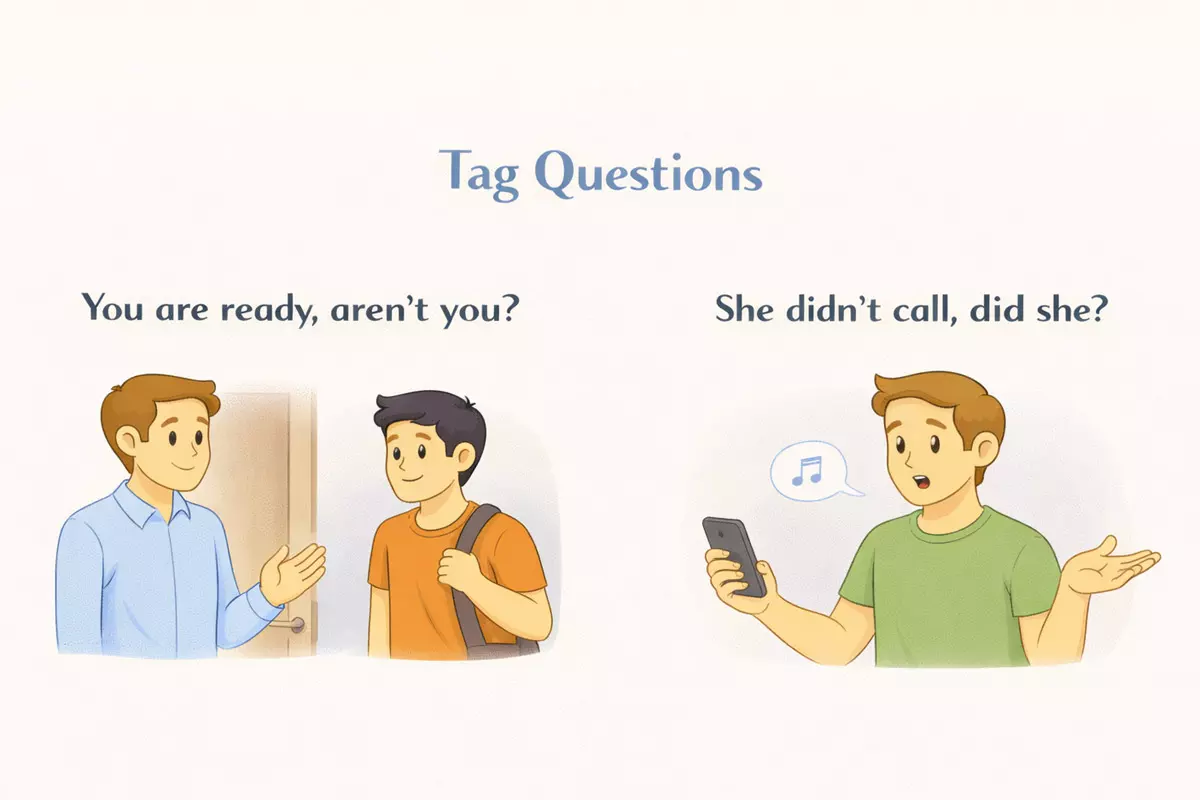
Tag questions are short questions added to the end of a statement. They invite a response or confirmation from the listener, and are common in spoken English for checking information, showing interest, or encouraging agreement. For example, in "You’re coming to the party, aren’t you?", the phrase after the comma is the tag. Most often, these mini-questions mirror the main verb and subject of the statement. They can sound friendly, uncertain, or sometimes challenging, depending on the speaker’s intention and the intonation used.
Purpose and Use
Tag questions serve several practical roles in conversation:
- Confirming information ("You finished the report, didn’t you?")
- Encouraging agreement ("It’s a lovely day, isn’t it?")
- Expressing uncertainty ("She can’t drive, can she?")
- Softening statements ("You don’t mind, do you?")
- Inviting participation ("We’re meeting at six, aren’t we?")
- Checking assumptions ("He’s from Canada, isn’t he?")
- Showing politeness ("You’d like some tea, wouldn’t you?")
- Clarifying facts ("They haven’t left yet, have they?")
- Making suggestions ("Let’s go, shall we?")
- Expressing surprise ("You did it yourself, did you?")
How Tag Questions Are Formed
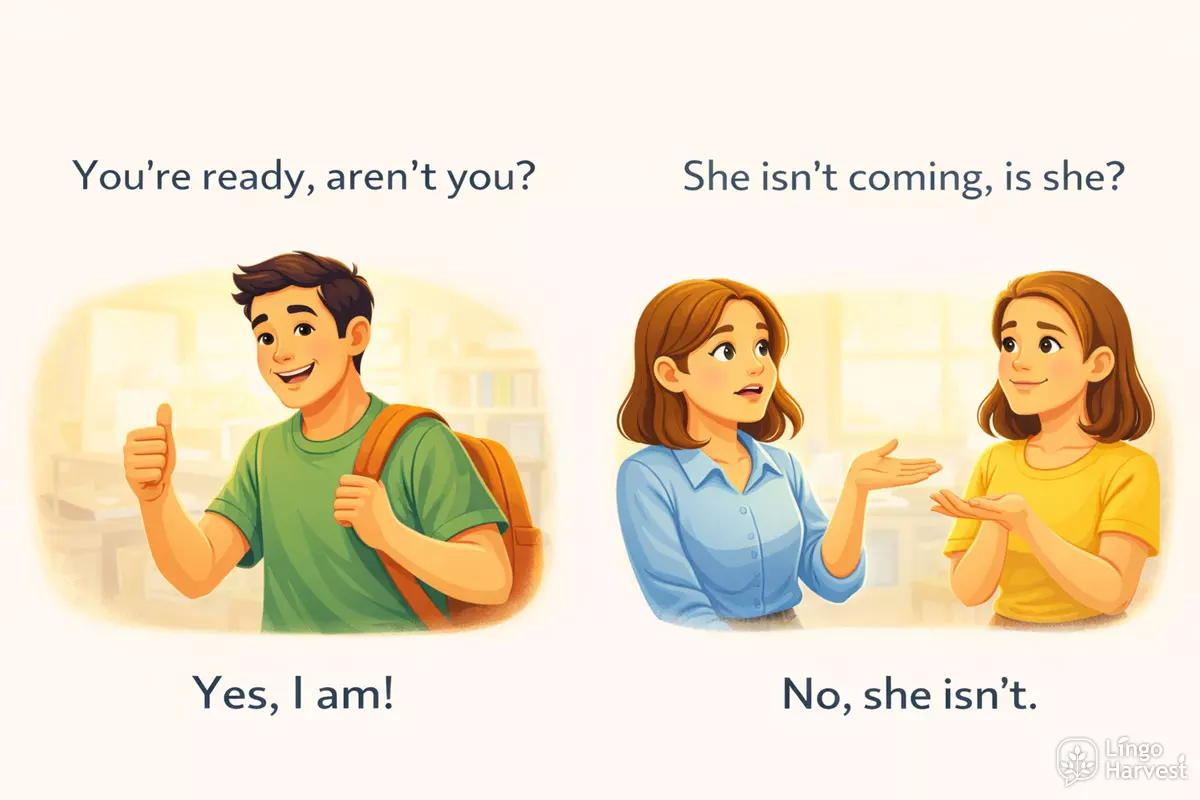
The structure of tag questions typically involves a statement, followed by a short question. The tag usually repeats the auxiliary (helping) verb and subject pronoun from the main clause. If the statement is positive, the tag is negative, and vice versa.
| Statement Type | Tag Question Example |
|---|---|
| Positive statement | You’re ready, aren’t you? |
| Negative statement | She isn’t coming, is she? |
| With modal verb | They can swim, can’t they? |
| With “I am” | I’m late, aren’t I? |
| Imperative | Close the door, will you? |
Common Features
Some patterns are worth noting:
- The pronoun in the tag matches the subject of the main statement.
- The auxiliary verb in the tag echoes the tense and form of the main verb.
- For “I am,” the tag is “aren’t I?”, which is an exception.
- Imperative sentences often use “will you?” or “won’t you?” as tags.
- Intonation changes meaning: rising intonation usually seeks real confirmation, while falling intonation often expects agreement.
In summary, tag questions are a flexible tool for interaction, helping speakers keep conversations smooth and engaging. They adjust the tone of statements, making them more collaborative and less direct.
Basic Tag Question Structure
Tag questions are short questions added to the end of a statement to confirm, check, or clarify information. They are common in spoken English and often reflect the speaker's expectations or invite agreement from the listener. The tag usually mirrors the verb in the main clause and matches the subject.
Typical Pattern
A standard tag question consists of a statement followed by a comma and then a brief question. The structure is generally as follows:
- Positive statement + negative tag: You’re coming, aren’t you?
- Negative statement + positive tag: She isn’t here, is she?
Forming Tag Questions: Key Elements
- Auxiliary verb: Use the auxiliary from the main sentence. If there is no auxiliary, use do/does/did.
- Subject pronoun: The tag uses a pronoun that matches the subject of the sentence.
- Polarity: If the main clause is positive, the tag is negative, and vice versa.
Common Tag Question Patterns
Here are some typical examples using various verbs and subjects:
- You like coffee, don’t you? → Yes, I do.
- She can swim, can’t she? → Yes, she can.
- We have met before, haven’t we? → Yes, we have.
- He isn’t ready, is he? → No, he isn’t.
- They won’t mind, will they? → No, they won’t.
- It’s raining, isn’t it? → Yes, it is.
- You didn’t call, did you? → No, I didn’t.
- She should go, shouldn’t she? → Yes, she should.
- We weren’t late, were we? → No, we weren’t.
- John plays the guitar, doesn’t he? → Yes, he does.
- I am late, aren’t I? → Yes, you are.
- Let’s go, shall we? → Yes, let’s.
- Nobody called, did they? → No, nobody did.
- Nothing happened, did it? → No, nothing happened.
- Open the window, will you? → Sure.
- Don’t be late, will you? → I won’t.
Summary of Tag Forms
| Main Clause Example | Tag Question |
|---|---|
| You’re tired | aren’t you? |
| She doesn’t eat meat | does she? |
| We can go | can’t we? |
| It isn’t far | is it? |
| He finished early | didn’t he? |
| I’m next | aren’t I? |
| Let’s leave | shall we? |
Notice how the auxiliary and subject in the tag reflect those in the main statement. For imperatives or special cases (like I am), certain forms are used by convention. Understanding this pattern helps you use tag questions naturally in everyday conversation.
Positive and Negative Tag Patterns
Understanding how affirmative and negative statements interact with question tags is essential for natural-sounding English. The basic rule is straightforward: a positive statement takes a negative tag, and a negative statement takes a positive tag. This contrast helps turn statements into questions that seek confirmation or agreement.
How Tag Questions Match Statements
The verb form and subject in the tag must match the main sentence. For example, if the statement uses “is,” the tag will also use “is” or “isn’t,” depending on whether the tag is positive or negative. The same goes for tense and modal verbs.
Common Patterns and Examples
- You’re coming to the party, aren’t you? → Yes, I am.
- She can swim, can’t she? → Yes, she can.
- He hasn’t seen this movie, has he? → No, he hasn’t.
- They will help us, won’t they? → Yes, they will.
- It’s raining, isn’t it? → Yes, it is.
- We should leave now, shouldn’t we? → Yes, we should.
- You don’t like coffee, do you? → No, I don’t.
- She won’t be late, will she? → No, she won’t.
- Tom finished his homework, didn’t he? → Yes, he did.
- The children aren’t tired, are they? → No, they aren’t.
- You have met her, haven’t you? → Yes, I have.
- He isn’t your brother, is he? → No, he isn’t.
- We were early, weren’t we? → Yes, we were.
- Nancy can’t drive, can she? → No, she can’t.
- You won’t forget, will you? → No, I won’t.
- They aren’t ready, are they? → No, they aren’t.
- He likes jazz, doesn’t he? → Yes, he does.
- You didn’t see that, did you? → No, I didn’t.
Pattern Overview
| Statement Type | Tag Type | Example |
|---|---|---|
| Positive statement | Negative tag | You’re hungry, aren’t you? |
| Negative statement | Positive tag | She isn’t here, is she? |
| Modal verb (positive) | Negative tag | They can swim, can’t they? |
| Modal verb (negative) | Positive tag | He shouldn’t go, should he? |
Special Considerations
Imperatives, sentences with “I am,” and informal speech can lead to exceptions or variations. For instance, “Let’s go, shall we?” or “I’m late, aren’t I?” are commonly used. Also, contractions are almost always used in tags in spoken English.
To sum up, choosing the correct tag form depends on the polarity of the main statement and matching the verb and subject. Practicing a variety of examples will make using these short questions feel more natural in conversation.
Intonation and Meaning Changes
The way speakers use their voice when finishing a tag question can completely shift the impression it gives. In English, the melody of the tag—whether it rises or falls—does more than just sound different; it signals whether the speaker expects agreement, confirmation, or is genuinely unsure. This subtle difference helps listeners interpret the speaker’s intent, even if the grammar stays the same.
Rising vs. Falling Intonation
A rising tone at the end of a tag question usually means the speaker is uncertain or genuinely wants confirmation. In contrast, a falling tone often signals that the speaker assumes agreement or is simply seeking acknowledgment. These patterns are common in everyday conversation and are key to understanding the nuance behind an otherwise straightforward sentence.
| Intonation | Implied Meaning | Example |
|---|---|---|
| Rising | Uncertainty, seeking confirmation | You're coming, aren't you? → (unsure) |
| Falling | Assumes agreement, rhetorical effect | This is easy, isn't it? → (expects agreement) |
| Rising | Polite invitation or offer | We could start now, couldn't we? → (inviting response) |
| Falling | Checking shared knowledge | It's raining, isn't it? → (expects listener knows) |
Common Functions of Tag Question Intonation
- To request confirmation when unsure (rising): “She lives here, doesn’t she?”
- To invite agreement or sympathy (falling): “That was tough, wasn’t it?”
- To soften criticism or suggestions (rising): “You could try again, couldn’t you?”
- To check shared information (falling): “We met last year, didn’t we?”
- To express surprise or disbelief (rising): “You finished already, did you?”
- To prompt a response in conversation (rising): “It’s beautiful, isn’t it?”
- To reinforce a statement (falling): “He’s the manager, isn’t he?”
- To encourage agreement from a group (falling): “We’re all ready, aren’t we?”
- To signal politeness in requests (rising): “You’ll help me, won’t you?”
- To test assumptions or beliefs (rising): “You’ve done this before, haven’t you?”
Paying attention to the pitch pattern at the end of a tag question can help you interpret whether someone is asking for real input or just expecting you to agree. Even if the words look the same on paper, the speaker’s tone often communicates the real meaning. This feature of English is especially important in spoken interaction, where misunderstanding the intended nuance can lead to confusion or unintended responses.
Tag Questions with Modal Verbs
Modal verbs like can, should, might, and others often appear in tag questions to check information, confirm understanding, or invite agreement. The structure follows the same pattern as with other auxiliary verbs: a positive statement takes a negative tag, and a negative statement takes a positive tag. The modal verb itself is repeated in the tag, matching the tense and form of the main clause.
Common Patterns and Examples
The modal in the main sentence is mirrored in the tag. Here are some typical examples:
- You can swim, can't you?
- She shouldn't be late, should she?
- They could help, couldn't they?
- We mustn't forget, must we?
- He won't mind, will he?
- You would like some tea, wouldn't you?
- She might come, mightn't she?
- He shouldn't worry, should he?
- We must go now, mustn't we?
- You can't drive, can you?
- They won't tell anyone, will they?
- He wouldn't lie, would he?
- You shouldn't smoke here, should you?
- She couldn't believe it, could she?
- We might see him later, mightn't we?
- You must be tired, mustn't you?
Special Cases and Notes
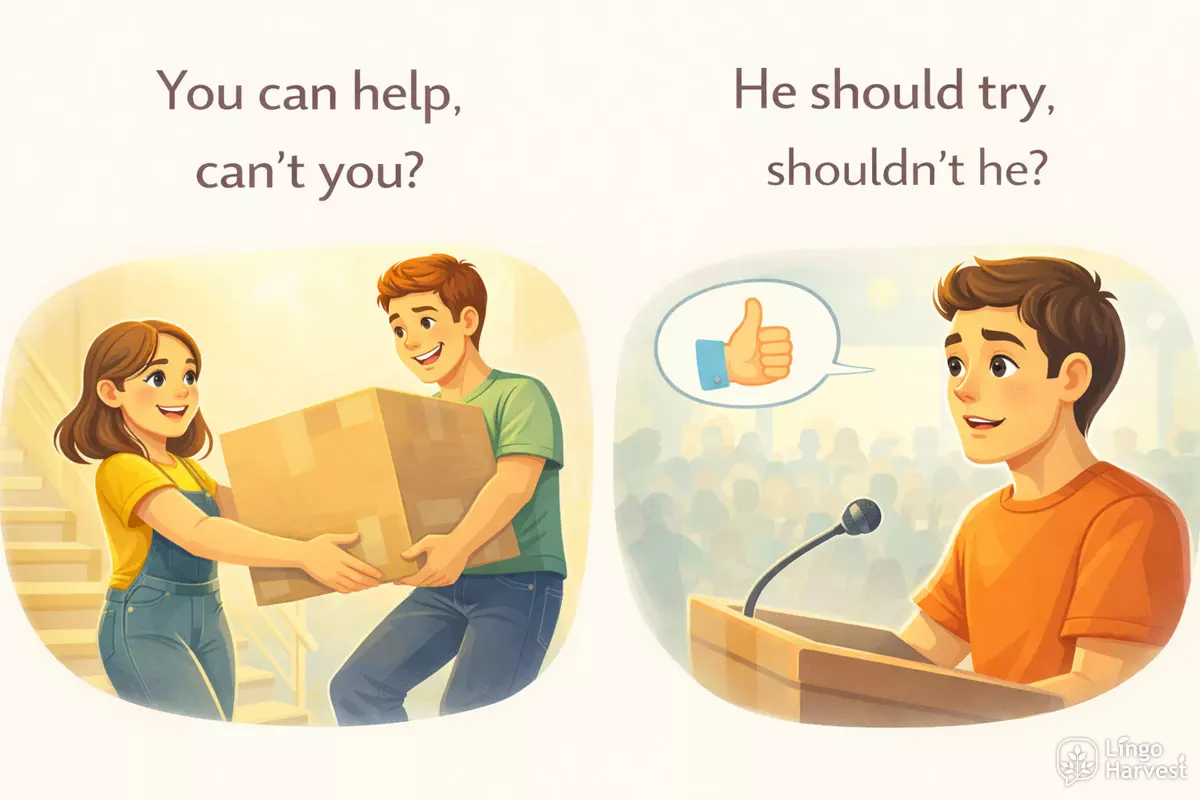
Some modals have irregular or less common negative forms in tags. For example, mustn't is standard in British English, but in American English, shouldn't or don't have to might be used instead, depending on the meaning. Will is frequently used as the tag for requests with let's ("Let's go, shall we?").
| Modal in Statement | Tag Form | Example |
|---|---|---|
| can | can't / can | You can help, can't you? |
| should | shouldn't / should | He should try, shouldn't he? |
| will | won't / will | She will come, won't she? |
| could | couldn't / could | They could join, couldn't they? |
| might | mightn't / might | He might know, mightn't he? |
| must | mustn't / must | We must hurry, mustn't we? |
Intonation Tips
The way you say the tag can change its meaning. A rising intonation is used when you're genuinely unsure and asking a question, while a falling intonation suggests you're seeking confirmation of something you believe to be true. For example: "You can drive, can't you?" with a rise at the end sounds like a real question; with a fall, it sounds more like you expect agreement.
Tag Questions with Imperatives
When giving instructions or commands in English, adding a short question at the end can make the request sound more polite, friendly, or persuasive. These question tags with commands are common in everyday conversation and have their own patterns and uses. Instead of checking for agreement, these endings usually serve to soften the tone or encourage cooperation.
Common Forms with Commands
With requests or instructions, the most typical tag is “will you?” (or sometimes “won’t you?” or “can you?”). The choice of tag can subtly change the mood:
- “will you?” – neutral, polite encouragement
- “won’t you?” – slightly more persuasive, sometimes inviting
- “can you?” – checks ability or willingness
- “would you?” – more formal or polite
- “could you?” – very polite, softer request
- “would you mind?” – extremely polite, less direct
Examples of Imperative Sentences with Tags
- Pass me the salt, will you? → Sure.
- Be quiet, can you? → Yes, of course.
- Open the window, would you? → No problem.
- Help me with this, could you? → Of course.
- Don’t tell anyone, will you? → I won’t.
- Come in, won’t you? → Thank you.
- Have a seat, won’t you? → Thanks.
- Wait here a moment, will you? → All right.
- Don’t forget your keys, will you? → I won’t forget.
- Turn off the lights, would you? → Sure.
- Pass the bread, could you? → Here you go.
- Let me know, will you? → I will.
- Take a look at this, can you? → Sure.
- Don’t be late, will you? → I won’t.
- Try this, won’t you? → Okay.
- Hold this for me, could you? → Sure.
- Read that out loud, will you? → All right.
- Don’t move, can you? → Okay.
Special Notes on Negative Imperatives
When using a negative command (e.g., “Don’t forget”), the tag is still usually positive (“will you?”). This maintains politeness and avoids double negatives.
Comparing Tag Choices
| Imperative Example | Possible Tag(s) |
|---|---|
| Take a seat | will you? / won’t you? |
| Don’t be late | will you? |
| Help me with this | can you? / could you? |
| Open the window | would you? / will you? |
| Wait a moment | can you? / will you? |
Intonation and Meaning
The way you say these tags matters. With imperatives, a rising intonation often signals a genuine request, while a falling intonation can make it sound more like a polite formality. For example, “Pass me the salt, will you?” with a rising tone at the end invites cooperation, while a falling tone may make it sound less like a question and more like a gentle order.
In summary, using a short question after a command can turn a direct order into a more engaging or polite request. This subtlety helps speakers manage social interactions smoothly and shows consideration for the listener.
Common Learner Mistakes
Tag questions often trip up learners due to their unique structure and the way intonation changes meaning. Many struggle with forming the correct auxiliary, matching subject and verb, or using the right rising or falling tone. These slip-ups can lead to misunderstandings or make the speaker sound less natural.
Typical Errors in Structure
Errors frequently occur when choosing the correct auxiliary or pronoun. For example, learners might forget to invert the positive/negative form, or use the wrong subject in the tag. Paying attention to tense and agreement is essential.
- Using the same polarity in both statements and tags: She is coming, is she? ❌ (should be isn't she?)
- Incorrect auxiliary: He plays football, does he? ❌ (should be doesn't he?)
- Mismatched subject: You're ready, aren't it? ❌ (should be aren't you?)
- Forgetting to contract: It's raining, is not it? ❌ (should be isn't it?)
- Using wrong tense: She went home, isn't she? ❌ (should be didn't she?)
- Repeating the main verb: He likes coffee, likes he? ❌ (should be doesn't he?)
- Using "no" or "yes" instead of a tag: You're hungry, no? (may be heard in some dialects, but not standard English)
- Not matching the subject type: Everyone is here, aren't they? (acceptable in spoken English, but can confuse learners)
Problems with Intonation
Intonation can completely change the meaning of a tag question. Learners often use the wrong pitch, making a question sound like a statement or vice versa. This can unintentionally signal confidence, doubt, or even sarcasm.
- Using a rising tone when expecting agreement: It's cold, isn't it?→ (should be falling tone for confirmation)
- Falling tone used when genuinely asking: You haven't seen my keys, have you?→ (should be rising tone if not sure)
- Flat intonation, which sounds unnatural or confusing
Common Tag Patterns
Learners benefit from seeing correct and incorrect forms side by side. Here’s a quick comparison of typical issues:
| Incorrect Form | Correct Tag Question |
|---|---|
| You like tea, don't you? | ✅ Correct |
| She's busy, isn't she? | ✅ Correct |
| He went home, isn't he? | He went home, didn't he? |
| They can swim, can they? | They can swim, can't they? |
| It's raining, is it? | It's raining, isn't it? |
| You don't like pizza, do you? | ✅ Correct |
| We should go, shouldn't we? | ✅ Correct |
| You're a student, isn't it? | You're a student, aren't you? |
Other Pitfalls to Avoid
- Using a tag with imperatives incorrectly: Close the door, will you? (correct), but Close the door, do you? ❌
- Forgetting that "let's" takes "shall we?": Let's go, shall we?
- Misusing tags in formal writing—tag questions are mainly for spoken English.
- Overusing tag questions, which can sound unnatural or hesitant.
By being aware of these frequent slip-ups, learners can build more natural and accurate tag questions, improving both spoken fluency and comprehension.
Practice Exercises and Self-Check
This section offers a range of activities to help you internalize how tag questions work in both structure and intonation. You’ll find fill-in-the-blank prompts, error correction, and opportunities to practice listening for rising and falling tones. Try each task before checking your answers at the end.
Fill in the Blanks
Complete each sentence by adding an appropriate question tag.
- She’s coming to the party, ________?
- You haven’t finished your homework, ________?
- Let’s start the meeting, ________?
- They were at home last night, ________?
- He can speak French, ________?
- Nobody called you, ________?
- It isn’t raining, ________?
- Open the window, ________?
- I am late, ________?
- We should leave now, ________?
Show answers
- isn’t she?
- have you?
- shall we?
- weren’t they?
- can’t he?
- did they?
- is it?
- will you?
- aren’t I?
- shouldn’t we?
Identify the Error
Each of these sentences contains a mistake in the tag. Spot the error and correct it.
- You like coffee, don’t you?
- She can’t drive, can she?
- We are late, aren’t we?
- He’s finished his work, hasn’t he?
- You’re coming tomorrow, isn’t you?
- Let’s go, will we?
- Nobody called you, did you?
- It’s cold today, is it?
- They were ready, weren’t they?
- She didn’t understand the rule, did she?
- I’m your manager, aren’t I?
- Everyone knows the answer, don’t they?
Show answers
- Correct as is.
- Correct as is.
- Correct as is.
- Correct as is.
- Incorrect: isn’t you? → aren’t you?
- Incorrect: will we? → shall we?
- Incorrect: did you? → did they?
- Incorrect: is it? → isn’t it?
- Correct as is.
- Correct as is.
- Correct as is.
- Correct as is.
Tag Question Patterns
Here’s a quick reference for common tag structures. Notice the relationship between the statement and the tag form.
| Statement Type | Example | Correct Tag |
|---|---|---|
| Positive statement | You are tired, | aren’t you? |
| Negative statement | She isn’t here, | is she? |
| With “let’s” | Let’s eat, | shall we? |
| With “nobody”/“nothing” | Nobody saw me, | did they? |
| Imperative | Pass me the salt, | will you? |
| “I am” statement | I’m early, | aren’t I? |
Listening and Intonation Practice
Tag questions can have rising or falling intonation. Rising intonation is often used when you are not sure and expect confirmation; falling intonation is more common when you expect agreement. Try reading these aloud and decide which intonation fits:
- It’s a nice day, isn’t it?
- You don’t like sushi, do you?
- We’re meeting at 6, aren’t we?
- She can’t swim, can she?
- Let’s get started, shall we?
- You’ve finished your homework, haven’t you?
- He won’t be late, will he?
- They were waiting outside, weren’t they?
- It isn’t too expensive, is it?
- You can help me later, can’t you?
- She didn’t call you, did she?
- We shouldn’t stop now, should we?
Show answers
- Falling (expecting agreement)
- Rising (checking, unsure)
- Falling (expecting agreement)
- Rising (checking, unsure)
- Usually falling (suggestion)
- Falling (expecting agreement)
- Falling (expecting agreement)
- Falling (expecting agreement)
- Rising (checking, unsure)
- Falling (expecting agreement)
- Rising (checking, unsure)
- Falling (expecting agreement)
Practicing regularly with real examples and paying attention to both word order and voice pitch will help you use these forms more naturally in conversation.