Questions Ending with Prepositions: Spoken vs Formal Use

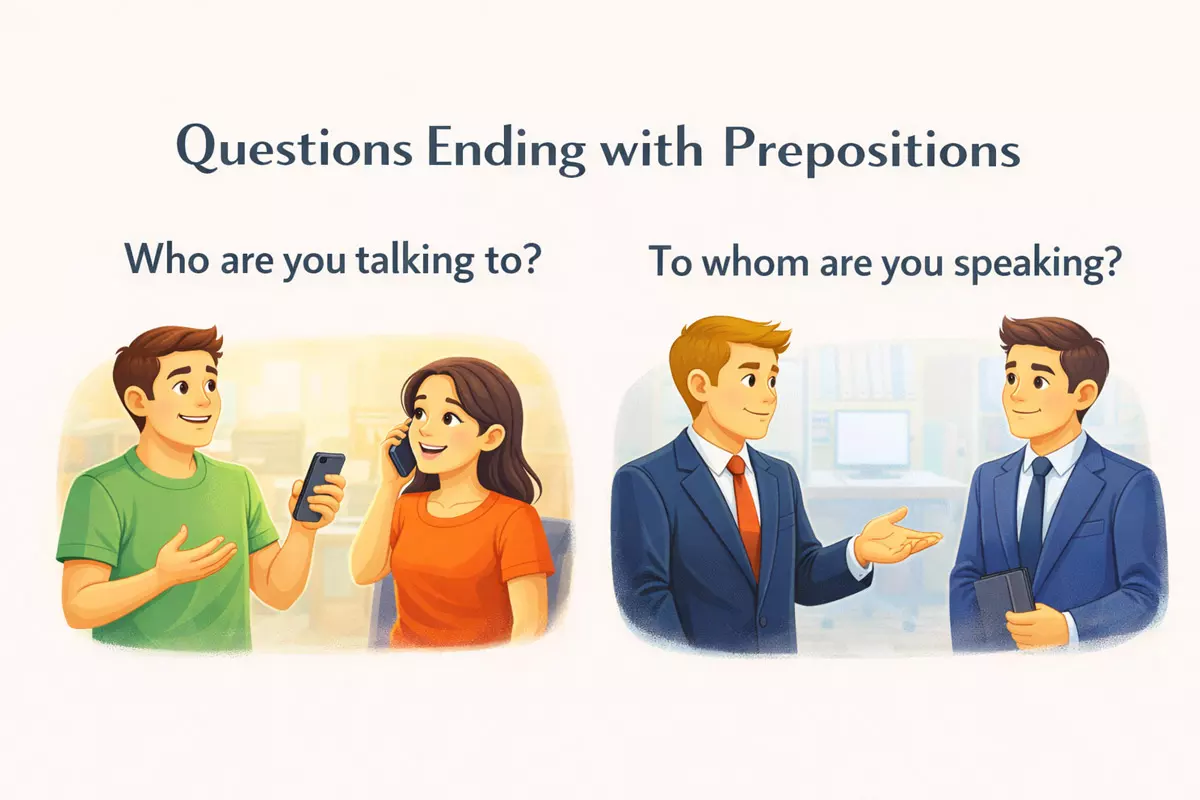 Here we why English questions can end with prepositions, differences between spoken and formal styles, when this sounds natural, and how to rephrase if needed. It also addresses common learner concerns and provides practice exercises.
Have you ever noticed that questions in everyday conversation often sound more relaxed than those in formal writing? This difference usually comes from how we arrange words at the end of our questions. In casual speech, people might leave out auxiliary verbs or let their sentences trail off, creating a friendly or informal tone. In contrast, formal English tends to follow strict grammatical rules, which can make questions seem more precise but less conversational. These subtle shifts highlight how language adapts to different situations and audiences.
Why Questions End with Prepositions
In everyday English, it’s common to hear questions that finish with a preposition. This happens naturally in conversation because English speakers often focus on clarity and flow rather than strict grammar rules. Ending a question this way sounds more relaxed and direct, especially when compared to the more formal structures often taught in classrooms.
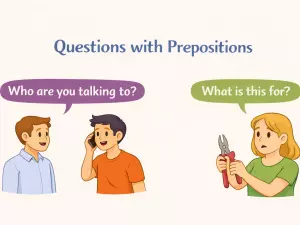
The reason for this pattern lies in how English sentences are formed. Many verbs and expressions in English are closely linked with specific prepositions—think of “talk to,” “look at,” or “depend on.” When we turn these into questions, the preposition tends to stay at the end, making the question sound more natural. For example, “Who are you talking to?” is more commonly used in speech than the formal “To whom are you talking?”
Natural Speech Patterns
English speakers usually prioritize ease of communication. Rearranging a sentence to avoid a final preposition can sound awkward or overly formal. That’s why questions like “What are you waiting for?” or “Where did you come from?” are so prevalent in conversation.
Examples of Question Patterns with Final Prepositions
- Who are you with? → I’m with my friends.
- What are you looking for? → I’m looking for my phone.
- Which team are you rooting for? → I’m rooting for the home team.
- Who did you give it to? → I gave it to my sister.
- What are you afraid of? → I’m afraid of heights.
- Where did this come from? → It came from the front desk.
- What are you talking about? → I’m talking about the new plan.
- Who are you thinking about? → I’m thinking about my family.
- Which book did you take it from? → I took it from a history book.
- Who did you go with? → I went with my coworker.
- What are you going through? → I’m going through a difficult time.
- Who are you waiting for? → I’m waiting for my brother.
- What are you up to? → I’m just working right now.
- Which house did you stay at? → I stayed at my aunt’s house.
- Who are you laughing at? → I’m laughing at a funny video.
- What are you interested in? → I’m interested in photography.
- Who did you buy it for? → I bought it for my mom.
- What are you made of? → I’m made of flesh and bone.
Spoken vs. Formal Usage
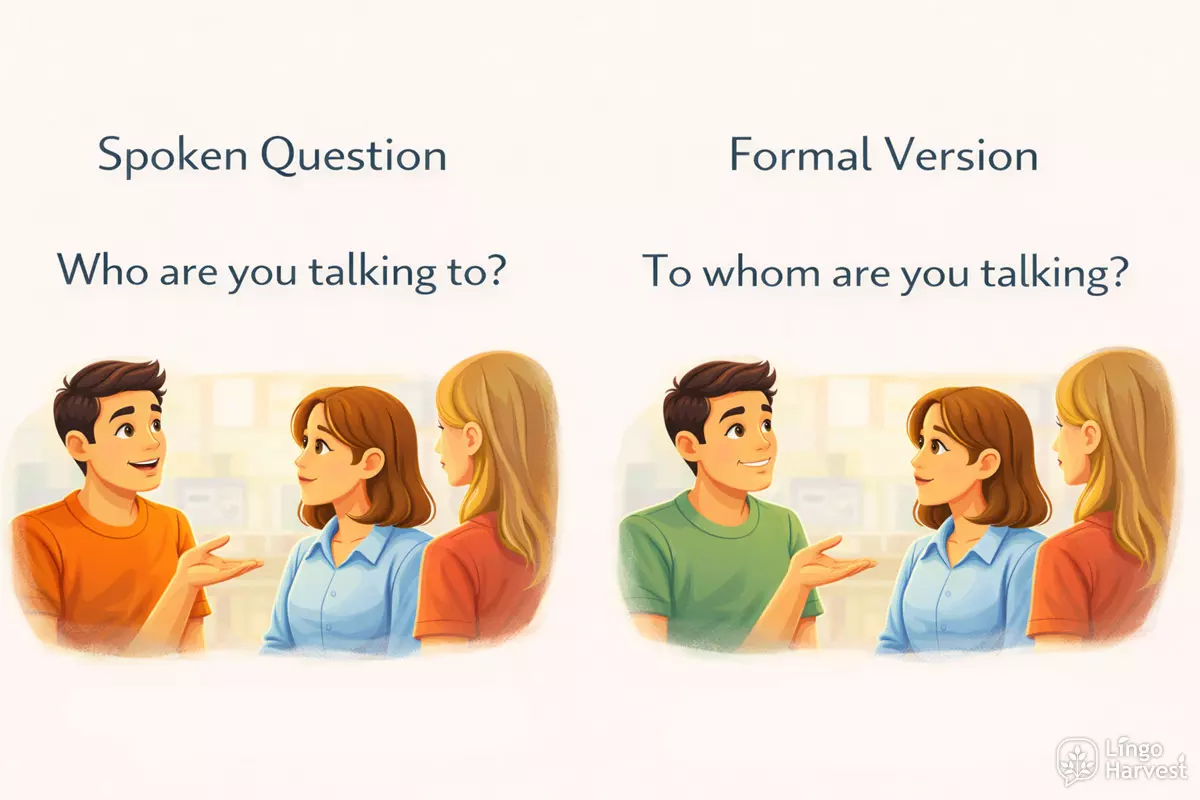
While ending questions with prepositions is standard in everyday speech, more formal writing or traditional grammar sometimes prefers to avoid this structure. However, using the formal version can sound stiff or unnatural outside of academic or professional contexts. For instance, “For whom are you waiting?” is grammatically correct but rarely used in spoken English.
| Spoken Question | Formal Version |
|---|---|
| Who are you talking to? | To whom are you talking? |
| What are you looking for? | For what are you looking? |
| Who did you give it to? | To whom did you give it? |
| Where did you come from? | From where did you come? |
Ultimately, placing prepositions at the end of questions reflects natural English rhythm and idiomatic usage. It’s a pattern deeply embedded in spoken language, signaling a relaxed, conversational tone that connects speakers and listeners.
Ending Prepositions in Spoken English
In everyday conversation, it’s common for questions to finish with prepositions such as at, with, or for. This construction sounds natural to most native speakers and is rarely considered incorrect in spoken settings. While traditional grammar rules may frown on placing prepositions at the end of a sentence, actual usage in speech is far more flexible and relaxed.
People often use questions with final prepositions because they’re direct and easy to understand. For instance, asking “Who are you talking to?” feels much more natural than “To whom are you talking?” in casual dialogue. The latter, while technically correct, can sound overly formal or even awkward in spoken English.
Common Patterns in Everyday Speech
Many question forms end with prepositions when people speak informally. Here are some typical examples you might hear in daily life:
- Who are you going with? → I’m going with my colleagues.
- What are you looking for? → I’m looking for my wallet.
- Where did you come from? → I came from the office.
- Who did you get this from? → I got it from my manager.
- Which team are you rooting for? → I’m rooting for the local team.
- What are you interested in? → I’m interested in design.
- Who are you waiting for? → I’m waiting for a client.
- What are you thinking about? → I’m thinking about the deadline.
- Who is this for? → It’s for you.
- What did you step on? → I stepped on a nail.
- Who are you staying with? → I’m staying with relatives.
- What are you laughing at? → I’m laughing at a joke.
- Who are you texting with? → I’m texting with my friend.
- Which house do you live in? → I live in the blue house.
- What did you sign up for? → I signed up for the workshop.
- Who did you talk with? → I talked with my supervisor.
- Which class are you enrolled in? → I’m enrolled in the evening class.
- What are you worried about? → I’m worried about the results.
- Who are you friends with? → I’m friends with my neighbors.
- What are you up to? → I’m finishing a report.
Why Do We Use Final Prepositions in Conversation?
There are practical reasons for this pattern in spoken language:
- Clarity: Placing the preposition at the end keeps questions short and clear.
- Natural Rhythm: The structure matches how people think, making conversation smoother.
- Informality: Using final prepositions signals a relaxed, friendly tone.
- Efficiency: These forms are quicker to say and process in real time.
Comparison: Spoken vs. Formal Usage
| Spoken (Natural) Question | Formal (Prescriptive) Version |
|---|---|
| Who are you talking to? | To whom are you talking? |
| What are you worried about? | About what are you worried? |
| Which street do you live on? | On which street do you live? |
| Who did you get this from? | From whom did you get this? |
| What are you looking at? | At what are you looking? |
Ultimately, using prepositions at the end of questions is a hallmark of natural, fluent speech in English. Most listeners won’t notice or care, and trying to avoid it can make your language sound forced or stilted. For effective, relaxed conversation, this structure is not only acceptable—it’s preferred.
Formal Alternatives and Rewording
In more formal writing and speech, especially in academic or professional contexts, sentences that end with prepositions are often rephrased to sound more polished. This tendency comes from traditional grammar norms, which recommend keeping prepositions within the sentence rather than at the end. While conversational English frequently allows prepositions at the end of questions (e.g., "Who are you talking to?"), formal alternatives tend to place the preposition earlier in the sentence.
Common Rewording Strategies
To make questions sound more formal, speakers and writers often use these approaches:
- Move the preposition before the question word ("To whom are you speaking?")
- Replace informal phrasal verbs with more formal verbs ("With whom do you agree?")
- Restructure the sentence to avoid the preposition at the end ("About what is this book?")
- Use passive voice or nominalization where appropriate ("By whom was this completed?")
- Choose specific vocabulary that naturally avoids stranded prepositions ("Upon which topic did you focus?")
Examples: Informal vs. Formal Questions
Here are some side-by-side comparisons to illustrate how everyday questions can be transformed into more formal versions by repositioning prepositions or rewording the structure:
| Informal Question | Formal Rewording |
|---|---|
| Who are you going with? | With whom are you going? |
| What are you talking about? | About what are you talking? |
| Which team did you play for? | For which team did you play? |
| What are you looking for? | For what are you looking? |
| Who did you give it to? | To whom did you give it? |
| Who did you hear that from? | From whom did you hear that? |
| What are you interested in? | What is your area of interest? |
| What did you decide on? | On what did you decide? |
| What did you base your answer on? | On what did you base your answer? |
| Who are you waiting for? | For whom are you waiting? |
Tips for Using More Formal Question Patterns
- Consider your audience: Use more formal structures in academic, legal, or professional writing.
- Be mindful of clarity: Sometimes, overly formal phrasing can sound unnatural or confusing.
- Balance: In everyday communication, ending with a preposition is often clearer and more natural.
- Practice with common question patterns to develop a sense for when formal alternatives are expected.
Adapting your questions for formality is less about rigid rules and more about context and audience expectations. Understanding these alternatives helps you communicate confidently in any setting.
WH-Questions with Final Prepositions
In everyday English, it’s common to hear questions where a preposition comes at the end, especially when using WH-words like what, who, or where. This structure frequently appears in spoken language, even though traditional grammar once discouraged it. The conversational tone of these queries often makes them sound more natural and less formal than their reworded, preposition-fronted alternatives.
Why Do Prepositions Appear at the End?
When we ask questions that involve phrasal verbs or certain expressions, the preposition often “strands” at the end. This happens because the WH-word replaces the object of the preposition, and moving the preposition to the end generally feels more idiomatic in speech. Here are some typical situations:
- When the verb naturally takes a preposition: "Who are you talking to?"
- With phrasal verbs: "What are you looking for?"
- When the preposition is part of a fixed expression: "Which room did you sleep in?"
Spoken vs. Formal Patterns
Sometimes, especially in formal writing or traditional grammar instruction, prepositions are moved before the WH-word. This can sound awkward or overly stiff in speech. The table below compares natural, spoken forms with their more formal equivalents.
| Everyday Spoken Form | Formal/Written Alternative |
|---|---|
| Who are you talking to? | To whom are you talking? |
| What are you looking for? | For what are you looking? |
| Which room did you sleep in? | In which room did you sleep? |
| Who did you give it to? | To whom did you give it? |
| What are you afraid of? | Of what are you afraid? |
| Who can you rely on? | On whom can you rely? |
Usage Notes
Ending questions with prepositions is widely accepted in speech and informal writing. In formal contexts—academic writing, business correspondence, or some edited publications—the preposition may be placed before the WH-word, but this is less common in modern usage. For most situations, especially in conversation, it’s both clear and natural to leave the preposition at the end.
Style and Register Differences
How we phrase questions that end with prepositions often reflects the context and level of formality. In casual conversation, it’s common and natural to place prepositions at the end of questions, while formal or academic writing tends to avoid this structure. This distinction is shaped by tradition, prescriptive grammar rules, and evolving usage patterns.
Register and Audience Considerations
Choosing between the two forms depends on your audience and purpose. Using a preposition at the end of a question is widely accepted in spoken English and informal writing such as emails or text messages. However, in legal, academic, or highly professional settings, rephrasing to avoid ending with a preposition may be expected. Being aware of these differences helps ensure your language matches the situation.
- Informal: natural, conversational, and efficient
- Formal: traditional, sometimes more rigid, and may sound stilted if overused
- Some formal environments are now more accepting of conversational forms, especially in digital communication
- Clarity and flow should guide your choice—if a sentence sounds awkward, consider revising it
Ultimately, awareness of these contrasting styles allows speakers and writers to adapt their language for clarity and appropriateness, rather than following prescriptive rules blindly. Context and audience remain the key factors in deciding whether to end a question with a preposition or to use a more formal structure.
Common Learner Concerns
Many language learners wonder whether it is acceptable to end questions with prepositions, especially when comparing casual speech and formal writing. This uncertainty often leads to hesitation when forming questions in English, and learners may feel unsure about what is considered correct or polite in different contexts.
Typical Worries and Misconceptions
- Fear of sounding uneducated: Some believe ending a question with a preposition is always a mistake, fearing judgment from native speakers.
- Confusion about rules: Learners are often taught strict grammar rules that seem to contradict everyday usage.
- Uncertainty in exams or writing: There is anxiety about whether such structures are acceptable in academic or professional settings.
- Difficulty distinguishing context: Many struggle to know when it is natural to end with a preposition and when it is better to avoid it.
Common Question Patterns
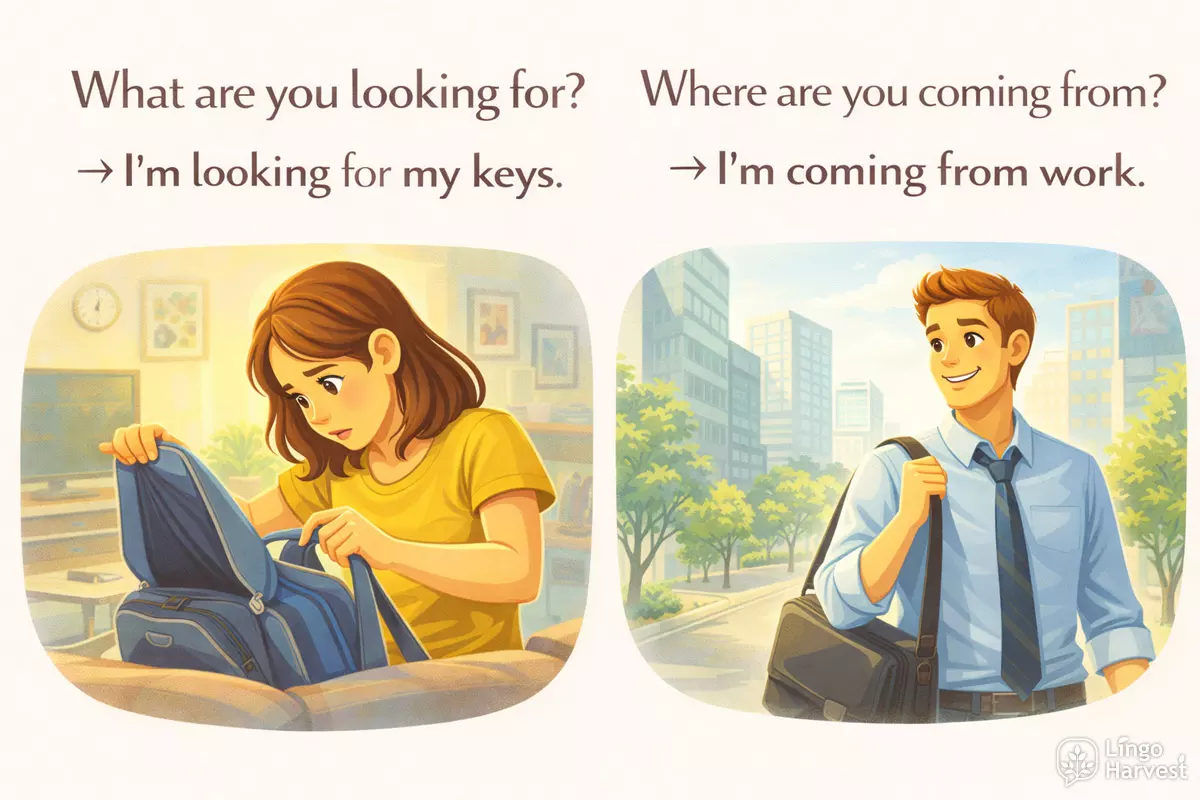
Here are frequent question forms where prepositions appear at the end, especially in spoken English:
- Who are you talking to? → I’m talking to my manager.
- What are you looking for? → I’m looking for my keys.
- Where are you coming from? → I’m coming from work.
- Which team are you rooting for? → I’m rooting for the home team.
- What did you step on? → I stepped on a piece of glass.
- Who are you waiting for? → I’m waiting for a friend.
- What are you interested in? → I’m interested in graphic design.
- Who should I give this to? → You should give it to Sarah.
- What are you worried about? → I’m worried about the deadline.
- Which book did you take it from? → I took it from a science book.
- Who did you get it from? → I got it from my colleague.
- What are you laughing at? → I’m laughing at a funny message.
- Who are you going with? → I’m going with my classmates.
- What are you up to? → I’m preparing for a presentation.
- Who did you send it to? → I sent it to the client.
Tips to Build Confidence
- In casual speech, ending with a preposition is not only accepted but often preferred by native speakers.
- For formal writing, especially in academic or professional contexts, consider rephrasing to avoid ending with a preposition.
- Listen to authentic English conversations to become familiar with how these patterns are used naturally.
- Remember that clarity and naturalness are just as important as correctness.
- Don’t over-correct; sometimes forcing the preposition to the middle of a sentence makes it sound unnatural.
Ultimately, being aware of audience and context helps learners decide which form to use. With practice, choosing between spoken and formal patterns becomes more intuitive and less stressful.
Practice Exercises and Self-Check
Try these activities to reinforce your understanding of how prepositions appear at the end of questions in everyday conversation versus formal English. Focus on the differences in style, appropriateness, and natural usage. Some exercises ask you to decide if a sentence fits spoken or formal contexts, while others encourage you to rewrite questions for practice.
Identifying Appropriate Usage
For each sentence below, decide whether it is more natural in spoken English, formal writing, or both. Reflect on why one version might be preferred in certain settings.
- What are you talking about?
- About what are you talking?
- Who are you going with?
- With whom are you going?
- Which team are you rooting for?
- For which team are you rooting?
- Who are you waiting for?
- For whom are you waiting?
- What did you step on?
- On what did you step?
Show answers
- Spoken
- Formal
- Spoken
- Formal
- Spoken
- Formal
- Spoken
- Formal
- Spoken
- Formal
Transforming Questions
Rewrite each informal question in a more formal way by moving the preposition. Practice forming both versions to build flexibility.
- Who did she give the book to?
- What are you interested in?
- Where did you come from?
- Who will you sit with?
- Who are you talking to?
- What are you worried about?
- Who did you get the message from?
- Which company do you work for?
- Who are you staying with?
- What are you laughing at?
Show answers
- To whom did she give the book?
- In what are you interested?
- From where did you come?
- With whom will you sit?
- To whom are you talking?
- About what are you worried?
- From whom did you get the message?
- For which company do you work?
- With whom are you staying?
- What caused your reaction?
Self-Check: Contextual Appropriateness
Decide if the following questions would be suitable in a job interview, a formal letter, or a casual chat with friends. Choose the most likely context for each.
- To whom should I address this letter?
- Who are you going with?
- For which position are you applying?
- Who are you waiting for?
- About what are you concerned?
- With whom did you speak earlier?
- Which company do you work for?
- From whom did you receive this email?
- To whom was the invitation sent?
- What are you responsible for?
Show answers
- Formal letter or interview
- Casual chat
- Interview
- Casual chat
- Interview or formal letter
- Formal or professional context
- Casual or professional context
- Formal or professional context
- Formal letter
- Interview or workplace discussion