Intonation in English Questions: Rising and Falling Patterns

 Here we why intonation is important in questions, details rising and falling intonation patterns for different question types, explores how intonation reflects speaker attitude, and includes tips, common mistakes, and practice exercises.
The way we change the pitch of our voices at the end of a sentence plays a crucial role in conveying meaning, particularly in English questions. For example, raising your voice at the end of a sentence often indicates you are asking a question, while lowering your voice can signal a statement or certainty. Recognizing these subtle melodic shifts not only helps us express ourselves more clearly but also allows us to better understand others, reducing the chance of confusion or miscommunication in everyday conversations.
Why Intonation Matters in Questions
The way our voice rises or falls at the end of a question can completely change its meaning—or even whether it sounds like a question at all. Intonation isn’t just about pitch; it signals the speaker’s intent, helps listeners interpret what’s being asked, and can convey subtle attitudes like surprise, doubt, or politeness. In English, using the right intonation pattern is crucial for clarity and natural-sounding speech.
Clarity and Understanding
One of the main reasons pitch patterns are so important is that they help listeners distinguish between a question and a statement, especially in cases where the grammatical structure is ambiguous. A rising tone at the end of a sentence almost always signals a yes/no question, while a falling tone is typical for most wh-questions. Without these cues, listeners might misunderstand the speaker’s intent.
Nuances of Meaning
Intonation adds layers of meaning that go beyond the words themselves. A simple question like “You’re coming?” can sound like a confirmation, a genuine inquiry, or even surprise—depending on how it’s said. The right pitch movement helps express these nuances, making communication richer and more precise.
Common Intonation Patterns in English Questions
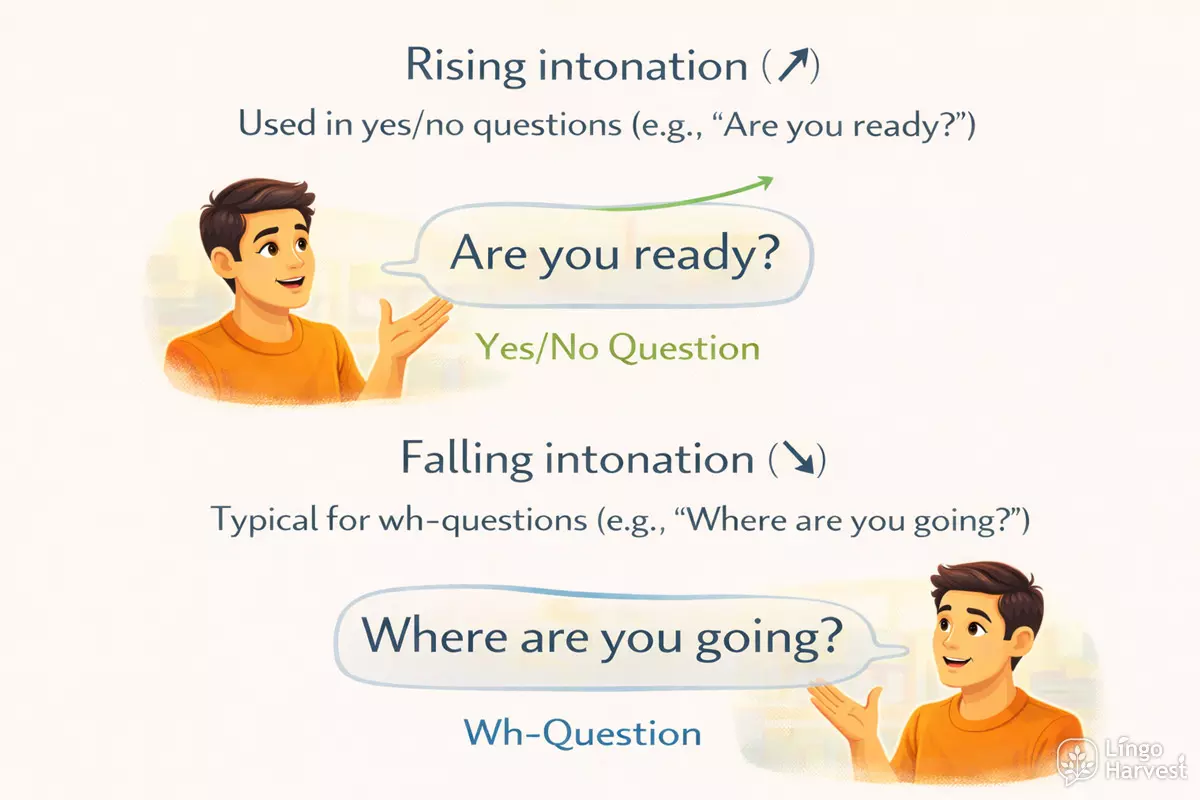
- Rising intonation (↗): Used in yes/no questions (e.g., “Are you ready?”)
- Falling intonation (↘): Typical for wh-questions (e.g., “Where are you going?”)
- Rising-falling (↗↘): Sometimes used for tag questions expecting agreement (“It’s nice out, isn’t it?”)
- Level intonation (→): Can indicate uncertainty or that the speaker is thinking aloud (“Maybe you could help…?”)
- High rising terminal (HRT): Used in some dialects to make statements sound like questions (“You finished your homework?”)
- Politeness or tentativeness often involves softer or more exaggerated rises.
- Surprise or disbelief can be shown with a sharp rise in pitch.
- Commands disguised as questions (“Could you open the window?”) often use a polite rising intonation.
- Checking information (“You said Friday, right?”) may use a slight rise or fall depending on confidence.
- Echo questions (“He did what?”) usually adopt a rising pattern for emphasis.
Comparing Intonation Functions
| Intonation Pattern | Typical Use in Questions |
|---|---|
| Rising (↗) | Yes/no questions, showing uncertainty, seeking confirmation |
| Falling (↘) | Wh-questions, showing certainty, direct inquiries |
| Rising-Falling (↗↘) | Tag questions expecting agreement, polite checks |
| Level (→) | Uncertainty, thinking aloud, informal checks |
Impact on Communication
Getting the intonation right in questions helps avoid misunderstandings and makes conversations smoother. Listeners rely on these pitch cues to interpret whether you’re seeking information, confirming details, or expressing doubt. Mastering these patterns not only improves comprehension but also helps speakers sound more natural and confident in English.
Rising Intonation in Yes/No Questions
When asking questions in English that expect a "yes" or "no" answer, speakers typically use a pitch that rises at the end of the sentence. This upward movement in tone helps signal that a response is required, distinguishing these queries from statements or other types of questions. The shift in intonation is often subtle but plays a crucial role in spoken communication, especially in distinguishing questions from declarative sentences that have the same word order.
How Rising Pitch Signals a Question
A sentence like "You’re coming?" can sound like a statement or a question depending on the intonation. The rising pitch at the end tells listeners that the speaker is uncertain and seeks confirmation. This intonation pattern is consistent across most yes/no questions, regardless of the subject, verb, or tense.
- Is it raining? → Yes, it is.
- Have you finished? → No, not yet.
- Can you help me? → Yes, I can.
- Did she call? → Yes, she did.
- Are they ready? → Almost, they’re getting ready now.
- Will you join us? → Yes, I will.
- Should I wait? → Yes, please wait a moment.
- Do you agree? → Yes, I agree.
- Has he left? → No, he hasn’t left yet.
- Were you there? → Yes, I was.
- Could you repeat that? → Sure, I’ll repeat it.
- Is this your book? → Yes, it’s mine.
- Does she know? → Yes, she knows.
- Would you like some? → Yes, please.
- Must we leave now? → No, we can stay a bit longer.
- Is everything okay? → Yes, everything’s fine.
- Did it work? → Yes, it worked.
- Are you sure? → Yes, I’m sure.
Common Features of Rising Intonation
- Pitch rises at the end of the question, typically on the last stressed syllable.
- Listeners interpret the rising tone as a signal for a response.
- This pattern occurs in both formal and informal contexts.
- Even short questions like "Really?" or "Now?" use the same upward pitch.
Comparison: Statement vs. Question Intonation
| Sentence Type | Intonation Pattern |
|---|---|
| Statement | Pitch falls at the end (e.g., "You’re coming.→") |
| Yes/No Question | Pitch rises at the end (e.g., "You’re coming?→") |
| Wh- Question | Usually falling or level pitch (e.g., "Where are you going?→") |
| Tag Question | Rising or falling, depending on certainty (e.g., "You’re coming, aren’t you?") |
Mastering this pitch pattern helps learners sound more natural and ensures that their questions are easily understood. Paying attention to the melody of spoken English—especially the rise in pitch at the end of yes/no queries—can greatly improve both comprehension and speaking skills.
Falling Intonation in WH-Questions
When English speakers ask questions that begin with words like who, what, where, when, why, or how, the pitch of their voice often drops at the end of the sentence. This downward movement in pitch is called a falling intonation pattern. Unlike yes-no questions, which typically have a rising tone, these information-seeking questions signal that the speaker expects a specific answer, not just a yes or no.
The use of a falling tone in these queries can help listeners distinguish between different types of questions. It also adds a sense of completeness or certainty to the speaker’s request for information. For example, in the sentence “Where are you going?”, the voice usually falls at the end, indicating that the speaker is seeking a direct answer.
Common WH-Question Words and Examples
- Who: Who is coming to the meeting?
- What: What did you see?
- Where: Where did you put my keys?
- When: When does the train leave?
- Why: Why are you late?
- How: How did you solve the problem?
- Which: Which book do you recommend?
- Whose: Whose phone is ringing?
- Whom: Whom did you invite?
- How much: How much does this cost?
- How many: How many people are coming?
- How long: How long will it take?
- How far: How far is the station?
- How old: How old is your brother?
- How often: How often do you exercise?
Why Does the Pitch Fall?
The downward pitch at the end of these questions helps signal that the speaker is not just seeking confirmation but expects a detailed response. Falling intonation marks the end of the question, making the boundary clear for the listener. In contrast, a rising tone might make the question sound unfinished or uncertain.
Contrast with Rising Intonation
It’s useful to compare information questions with yes-no questions, as their intonation patterns differ. Here’s a quick overview:
| Question Type | Typical Intonation |
|---|---|
| WH-Questions (Who, What, Where, etc.) | Falling |
| Yes-No Questions | Rising |
| Tag Questions (seeking confirmation) | Rising |
| Tag Questions (showing certainty) | Falling |
Tips for Learners
- Practice saying information questions with a falling tone at the end.
- Listen to native speakers and notice how their pitch drops for these types of questions.
- Recording yourself and comparing to model sentences can help improve your pronunciation and naturalness.
Understanding how pitch works in English questions can make your speech clearer and help you sound more natural in conversations.
Intonation and Speaker Attitude
The melody of a question in English often signals how the speaker feels or what they intend beyond the words themselves. Listeners pick up on subtle shifts in pitch, which can reveal curiosity, doubt, politeness, surprise, impatience, or even annoyance. Rising and falling intonation patterns are not just about grammar—they actively shape how questions are received and interpreted in conversation.
How Rising and Falling Intonation Affect Perception
A rising tone at the end of a question typically indicates genuine inquiry or uncertainty. It can make the speaker sound open, friendly, or unsure. In contrast, a falling tone may project confidence, expectation of confirmation, or even a challenge. These patterns are especially noticeable in yes/no questions and wh-questions, where the pitch movement can subtly reinforce or undermine the speaker’s attitude.
- Rising intonation often suggests openness, politeness, or a request for information.
- Falling intonation may indicate certainty, finality, or sometimes impatience.
- A level intonation can sound neutral, bored, or disinterested, depending on the context.
- Unexpected intonation choices can create humor, sarcasm, or tension.
Common Attitudes Expressed Through Intonation
Here are frequent speaker attitudes and how they are conveyed by pitch movement in English questions:
- Uncertainty or doubt → rising intonation
- Polite request → gentle rise at the end
- Surprise or disbelief → exaggerated rise
- Confirmation-seeking → slight fall after a rise
- Annoyance or impatience → sharp fall
- Confidence or control → steady fall
- Encouragement to continue speaking → rising or level pitch
- Challenge or confrontation → firm fall
- Formality or detachment → flat, even pitch
- Friendly invitation → gentle rise and fall
- Suspicion → rising intonation, sometimes with a pause
- Surprise (positive) → quick, high rise
- Disbelief (negative) → rising followed by abrupt fall
- Encouragement to answer → rising pitch, held at the end
Comparison of Intonation Patterns and Attitudes
| Pitch Movement | Likely Speaker Attitude |
|---|---|
| Rising (↗) | Curiosity, politeness, uncertainty |
| Falling (↘) | Certainty, finality, impatience |
| Level (→) | Neutrality, disinterest, formality |
| Rise–fall (↗↘) | Friendly invitation, surprise, encouragement |
Understanding these subtle cues helps both speakers and listeners navigate conversations more effectively. By tuning in to pitch movements, you can better interpret what someone really means—and make your own questions sound more natural and appropriate for the situation.
Intonation in Tag Questions
Tag questions in English—those short questions added to the end of statements like “You’re coming, aren’t you?”—use intonation to signal whether the speaker is seeking confirmation or simply making conversation. The melody of your voice at the end of a tag can completely change the meaning or feeling behind what you say.
Generally, a rising intonation on the tag turns it into a genuine question, inviting the listener to confirm or deny. In contrast, a falling intonation indicates that the speaker expects agreement, treating the tag as a rhetorical device. This subtle difference is crucial for clear communication and helps avoid misunderstandings.
Common Intonation Patterns in Tag Questions
- Rising: Used when the speaker is unsure and wants an answer (“It’s raining, isn’t it?” ↗)
- Falling: Used when the speaker is confident and expects agreement (“You finished it, didn’t you?” ↘)
- Tags after positive statements usually expect agreement if pronounced with a fall
- Negative statements with a rising tag sound more like a genuine check (“You don’t like coffee, do you?” ↗)
- Rising tags can also express surprise or doubt
- Falling tags often sound friendlier or more relaxed
Examples of Tag Question Intonation
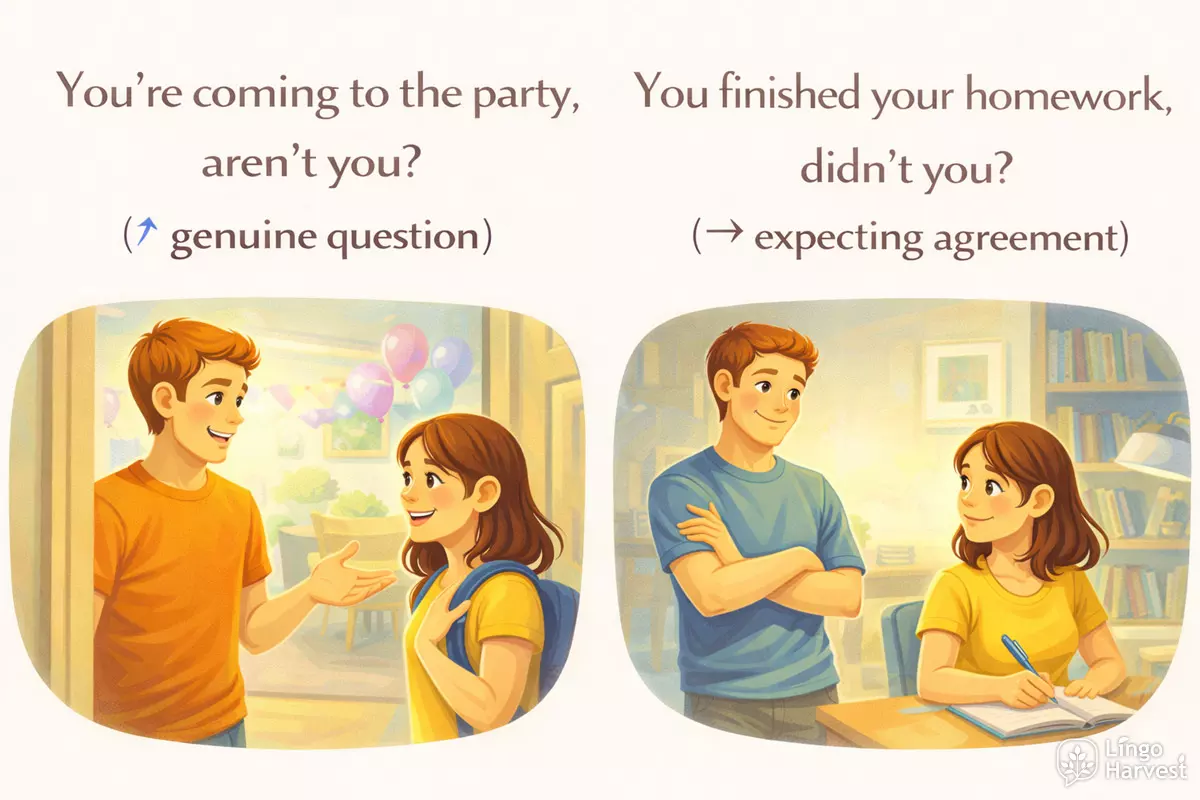
- You’re coming to the party, aren’t you? (↗ genuine question)
- You finished your homework, didn’t you? (↘ expecting agreement)
- She can drive, can’t she? (↘ confident)
- He hasn’t called, has he? (↗ unsure)
- We should leave now, shouldn’t we? (↘ rhetorical)
- They aren’t ready, are they? (↗ checking)
- It’s cold today, isn’t it? (↘ expecting agreement)
- You don’t eat meat, do you? (↗ confirmation)
- She’s coming too, isn’t she? (↘ friendly)
- We haven’t met before, have we? (↗ clarifying)
Summary Table: Intonation Effect in Tag Questions
| Intonation | Speaker’s Intent |
|---|---|
| Rising (↗) | Uncertainty, seeking confirmation, genuine question |
| Falling (↘) | Confidence, expecting agreement, rhetorical or friendly |
Understanding these pitch patterns in tag questions helps listeners interpret the speaker's attitude and intent. Getting the intonation right can make your English sound more natural and avoid confusion in everyday conversations.
Common Intonation Mistakes
English learners often struggle with using the correct intonation patterns when forming questions. This can lead to misunderstandings or make speech sound unnatural. Let's look at the most frequent pitfalls and how to recognize them.
Typical Problems with Question Intonation
- Using falling intonation for yes/no questions: In English, yes/no questions nearly always require a rising pitch at the end. A falling tone can make a question sound like a statement.
- Rising intonation on wh- questions: Questions starting with words like "what," "where," or "how" should usually end with a falling pitch. Using a rising tone can confuse listeners.
- Flat or monotone delivery: Not varying pitch at all can make questions sound robotic, unclear, or even rude.
- Over-exaggerating the rise or fall: Exaggeration can make speech sound unnatural or forced, which may distract from the intended meaning.
- Misplacing the pitch change: Shifting the rise or fall to the wrong word in the sentence can change the focus or meaning.
- Blending question and statement patterns: Using a mix of rising and falling tones in the same question can be confusing.
- Intonation mismatch with question type: For example, using rising intonation on tag questions that are meant to confirm information, when a fall would be more appropriate.
- Echo questions and intonation: Repeating a question with the wrong intonation can make it sound like a statement or an expression of surprise.
- Not signaling uncertainty or politeness: Sometimes, a rising tone is used to soften a request or show politeness. Missing this can make questions seem abrupt.
- Regional influence: Intonation patterns from a learner’s native language can carry over, causing confusion for native English listeners.
Comparing Intonation Patterns
| Question Type | Typical Intonation | Common Error |
|---|---|---|
| Yes/No | Rising (→) | Falling (❌) or flat |
| Wh- Questions | Falling (→) | Rising (❌) |
| Tag Questions (seeking confirmation) |
Falling (→) | Rising or monotone |
| Echo Questions | Rising or emphatic | Statement-like intonation |
How to Avoid These Issues
To improve, pay close attention to native speakers and practice mimicking their pitch patterns. Recording your own questions and comparing them to model examples is a practical way to notice and correct intonation slips. With regular practice and awareness of these pitfalls, your spoken English will sound much more natural and clear.
Listening and Recognition Tips
Understanding the melody of English questions helps you follow conversations and respond naturally. Whether you’re practicing with audio materials or speaking with native speakers, paying attention to pitch changes is essential for recognizing question types. Here are some practical strategies and insights to sharpen your ear for rising and falling intonation patterns.
What to Listen For
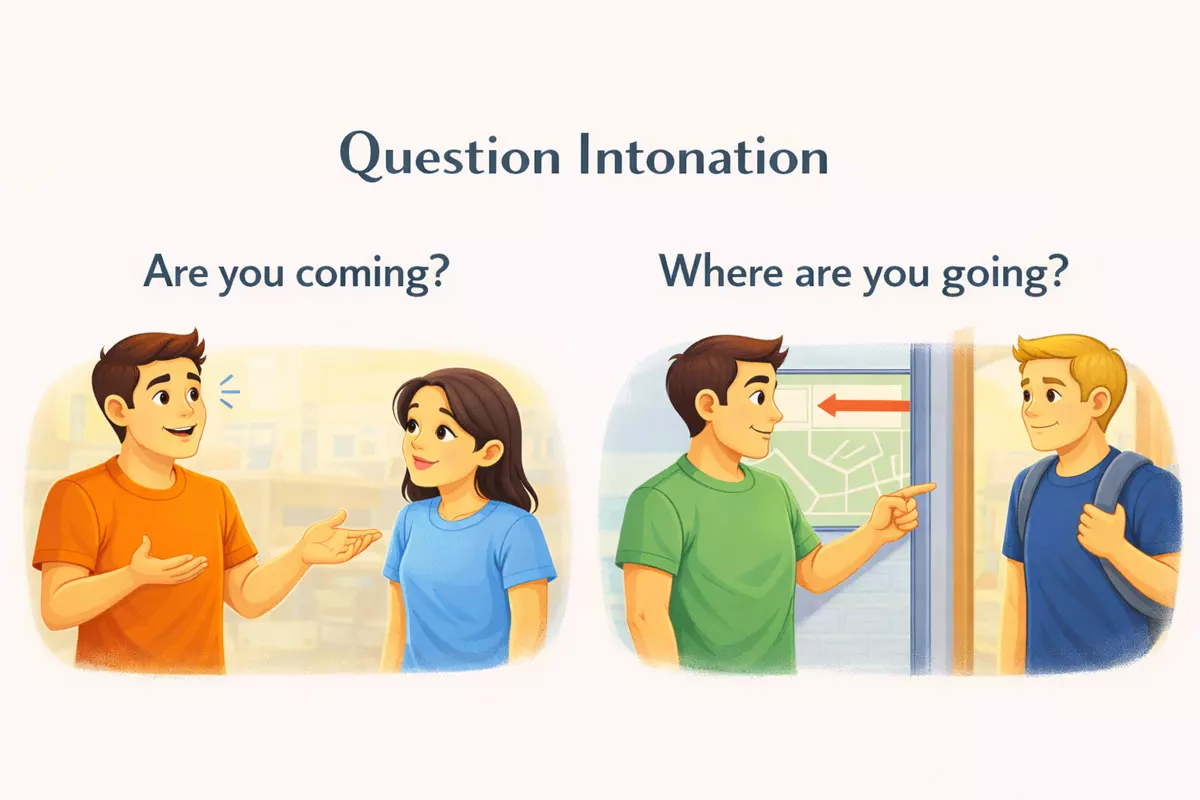
- Pitch rise at the end: Yes-no questions (e.g., “Are you coming?”) typically have a noticeable upward movement in pitch at the end.
- Pitch fall at the end: Wh-questions (“Where are you going?”) usually end with a downward pitch, signaling completion.
- Stress on key words: The important word in a question often receives extra emphasis, which can help you identify the question’s focus.
- Rhythm and pacing: Question intonation often changes the rhythm, especially in longer or more formal questions.
- Pausing: Pay attention to natural pauses, which may signal embedded or tag questions.
Common Patterns in Spoken English
Below is a comparison of how different types of English questions typically sound. Noticing these patterns can make it easier to distinguish between types of questions, even when you don’t catch every word.
| Question Type | Intonation Pattern | Example | Pitch Movement |
|---|---|---|---|
| Yes-No Question | Rising | Did you call? | → Up at the end |
| Wh-Question | Falling | Where is she? | → Down at the end |
| Choice Question | Rise-Fall | Tea or coffee? | Up on first option, down on last |
| Tag Question (expecting agreement) | Falling | It’s late, isn’t it? | → Down at the end |
| Tag Question (uncertain) | Rising | You’re coming, aren’t you? | → Up at the end |
Active Listening Exercises
- Listen to short dialogues and identify whether the speaker’s voice rises or falls at the end of each question.
- Pause recordings after questions and try to repeat them, mimicking the exact pitch pattern.
- Practice with a partner by reading question cards aloud and focusing on the melody of your voice.
- Record yourself asking questions, then compare your intonation to native speakers.
- Use minimal pairs (e.g., “He’s coming?” vs. “He’s coming.”) to notice how intonation alone can change meaning.
Quick Recognition Checks
- If a question ends with a high pitch, it’s likely a yes-no or uncertain tag question.
- If the pitch drops at the end, you’re probably hearing a wh-question or a tag expecting agreement.
- With choices, listen for a rise on the first item and a fall on the last.
By regularly practicing these recognition techniques, you’ll become more comfortable identifying question types through their musical cues, making your English listening skills both sharper and more intuitive.
Practice Exercises and Self-Check
To help you deepen your understanding of how pitch patterns work in English questions, try the following activities. These tasks focus on distinguishing rising and falling intonation, recognizing their functions, and practicing their use in context. Don't hesitate to repeat the exercises until you feel confident about when and why to use each intonation type.
Identify the Intonation Pattern
Read each question below. Decide whether it would typically end with a rising or falling intonation. Consider the question type and the speaker’s intent.
- Are you coming with us?
- Where did you put my keys?
- Can you help me with this?
- Who is at the door?
- Do you like coffee or tea?
- What time does the train leave?
- Did you see that?
- How was your weekend?
- Have they arrived yet?
- Why are you laughing?
- Will you be there tomorrow?
- Which one do you prefer?
Show answers
- Rising
- Falling
- Rising
- Falling
- Rising
- Falling
- Rising
- Falling
- Rising
- Falling
- Rising
- Falling
Practice: Matching Question Types to Intonation
Review the table below. It summarizes typical intonation patterns for common English question types.
| Question Type | Usual Intonation | Example |
|---|---|---|
| Yes/No Question | Rising | Is it raining? |
| Wh- Question | Falling | Where are you going? |
| Choice Question | Rising on options, falling at end | Do you want tea or coffee? |
| Echo Question | Rising | You did what? |
| Tag Question (uncertain) | Rising | You're coming, aren't you? |
| Tag Question (confirming) | Falling | It's cold today, isn't it. |
Self-Check: Intonation in Real-Life Scenarios
Imagine these situations. Decide whether a rising or falling pitch is more natural for the final word of each question:
- A shop assistant asks if you need help.
- You’re asking a friend what happened at the party.
- Someone repeats a surprising statement as a question.
- You're confirming a detail you think is true.
- You’re offering two choices to a colleague.
- You ask a stranger for directions.
- You check if someone heard what you said.
- You react to unexpected news.
- You ask politely if someone is free.
- You clarify information you’re unsure about.
Show answers
- Rising
- Falling
- Rising
- Falling
- Rising on the first option, falling on the last
- Rising
- Rising
- Rising
- Rising
- Rising
Try Saying These Aloud
Practice reading these sentences aloud, focusing on the pitch movement at the end. Mark each with an ↑ (rising) or ↓ (falling) as you read:
- Is this your book? ↑
- Why are you late? ↓
- Would you like some water? ↑
- How did you solve the problem? ↓
- You're joining us, aren't you? ↑
- It's a nice day, isn't it? ↓
- Do you want pizza or pasta? (pizza ↑, pasta ↓)
- He said what? ↑
By practicing these exercises, you'll become more comfortable identifying and producing the natural pitch patterns that signal different types of questions in English conversation.