Short Questions and Echo Questions in Conversation

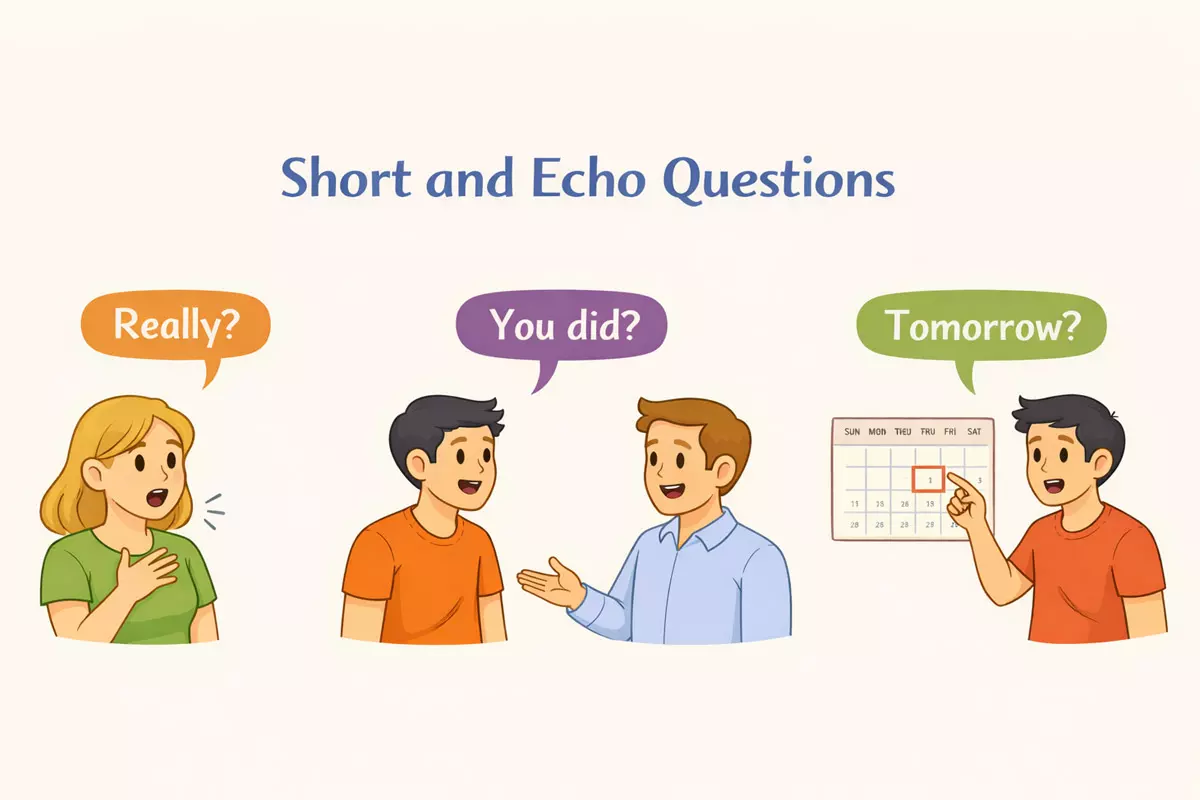 Here we the definitions and spoken formation of short and echo questions, their use for expressing surprise or interest, intonation patterns, common learner mistakes, and offers practice exercises for self-assessment.
Curious moments often emerge in conversation when we seek to clarify information, confirm understanding, or express surprise, and it is in these instances that brief follow-up questions or repeated statements become particularly useful. Such subtle conversational techniques not only help maintain the flow of dialogue but also ensure that both parties are on the same page. By employing these tools, speakers can make interactions more engaging, encourage openness, and prevent misunderstandings, ultimately fostering clearer and more meaningful communication.
What Short Questions Are
Short questions play a unique role in everyday conversation. They are brief queries, often consisting of just a few words, designed to clarify, confirm, or react to something just said. Unlike full interrogative sentences, these compact forms rely on shared context and are typically used for efficiency and fluency in dialogue.
Defining Features of Short Questions
In spoken English, these queries usually repeat an auxiliary (helping) verb and a subject pronoun, rather than restating the full content of the original sentence. This makes them quick to say and easy to understand. For example, after someone says, "You’ve finished your work," a natural response might be, "Have I?" or "Did I?" instead of repeating the whole idea.
Functions in Conversation
Short questions serve several conversational purposes:
- Seeking confirmation or clarification
- Expressing surprise or disbelief
- Encouraging further explanation
- Showing active listening or engagement
They are especially common in informal talk, helping speakers sound natural and responsive.
Common Patterns
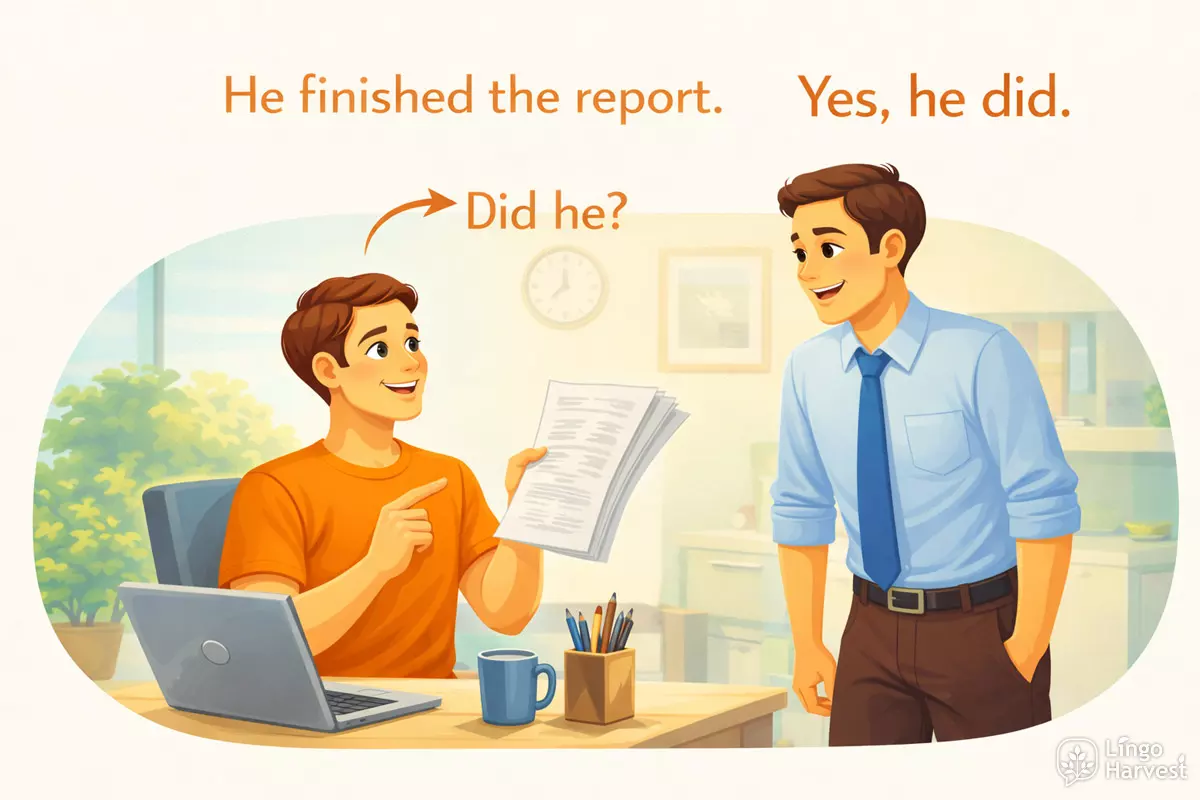
These brief queries follow predictable structures. Most are formed with an auxiliary verb and a pronoun, matching the tense and subject of the previous statement. Here are some typical examples:
| Statement | Short Question | Typical Response |
|---|---|---|
| I like coffee. | Do you? | Yes, I do. |
| He finished the report. | Did he? | Yes, he did. |
| She’s already left. | Has she? | Yes, she has. |
| They will arrive late. | Will they? | Probably. |
| We’re meeting today. | Are we? | Yes, at six. |
| It was difficult. | Was it? | Very. |
| You can drive. | Can you? | Yes, I can. |
| I could help you. | Could I? | Yes, please. |
| We should leave now. | Should we? | Yes, let’s. |
| They might be late. | Might they? | Possibly. |
| He is at home. | Is he? | Yes, he is. |
| You would help me. | Would you? | Of course. |
| It works fine. | Does it? | Yes, it does. |
| They’ve met before. | Have they? | I think so. |
| I must leave now. | Must you? | Yes, unfortunately. |
| You were there yesterday. | Were you? | Yes, I was. |
| We shall start now. | Shall we? | Yes, let’s begin. |
| You called her. | Did you? | Yes, I did. |
| I am late. | Am I? | Just a little. |
| You will be there tomorrow. | Will you? | Yes, I will. |
Using these structures helps keep conversations flowing and avoids unnecessary repetition.
Short Questions vs. Full Questions
Sometimes, it’s helpful to compare concise question forms with their full-length counterparts to see how much information is left out and how much is implied by context.
| Full Question | Short Question |
|---|---|
| Did you see the movie? | Did you? |
| Are they coming to the meeting? | Are they? |
| Has she finished her homework? | Has she? |
| Will we need to call them? | Will we? |
| Can you help me? | Can you? |
| Should I bring my umbrella? | Should I? |
When to Use Short Questions
These compact forms are most effective when the listener can easily infer the full meaning from what was just said. They’re common in friendly exchanges, quick check-ins, or when reacting to unexpected news. Overusing them in formal writing or when context isn’t clear can cause confusion, but in face-to-face conversation, they help keep the interaction smooth and lively.
Forming Short Questions in Speech
Everyday conversation often relies on brief, efficient questions rather than full, formal sentences. Speakers use these shortened forms to check information, express surprise, or confirm details without repeating everything. These concise queries make dialogue flow naturally and keep interactions engaging.
Typical Structures for Short Questions
Short questions in spoken English usually echo part of the previous statement, or ask for clarification, using just a subject and auxiliary verb. Here are some common patterns:
- Auxiliary + Subject? (e.g., “Is he?”, “Did you?”, “Can they?”)
- Modal + Subject? (e.g., “Will she?”, “Should we?”)
- Be + Subject? (e.g., “Are you?”, “Was it?”)
- Do/Does/Did + Subject? (e.g., “Do they?”, “Did he?”)
- Have/Has + Subject? (e.g., “Have you?”, “Has she?”)
These forms avoid repeating the main verb or object unless clarification is needed.
Purposes and Uses
Short questions serve several functions in conversation:
- Confirming information: “You took the train?” “I did.”
- Expressing surprise: “She finished already?” “Yes, she did.”
- Requesting repetition: “He said what?” “He’s moving abroad.”
- Clarifying details: “With Sarah?” “No, with John.”
- Echoing for emphasis: “You’re leaving?” “Just for a week.”
Examples of Short Questions in Speech
Below is a selection of typical short question forms you might hear in conversation:
| Reaction | Statement | Meaning |
|---|---|---|
| “Really?” | I just won a free trip. | Surprise / interest |
| “Did you?” | I got the job! | Confirmation |
| “Is it?” | It’s expensive. | Confirming information |
| “Are they?” | They’re coming later. | Checking a plan |
| “Can I?” | You can take a break now. | Confirming permission |
| “Should we?” | We should leave early. | Asking for agreement |
| “Will she?” | She will call you tonight. | Confirming a future action |
| “Has he?” | He has already paid. | Checking completion |
| “Do you?” | I like spicy food. | Showing interest |
| “Was it?” | The test was hard. | Confirming a past detail |
| “He did?” | He finished it yesterday. | Surprised confirmation |
| “You have?” | I’ve been to Japan. | Surprise / interest |
| “Did she?” | She sent the email. | Confirming an action |
| “It is?” | It’s your turn. | Confirming information |
| “They are?” | They’re ready now. | Checking readiness |
| “You can?” | I can drive. | Surprised confirmation |
| “She will?” | She’ll be here soon. | Confirming a future action |
| “He has?” | He has finished the report. | Checking completion |
Comparison: Full vs. Short Question Forms
| Full Question | Short Question |
|---|---|
| Are you coming to the party? | Are you? |
| Did she finish her homework? | Did she? |
| Have they left already? | Have they? |
| Will he call tonight? | Will he? |
| Is it raining outside? | Is it? |
| Should we try again? | Should we? |
Using these brief forms helps speakers sound natural and responsive. They’re especially useful in fast-paced exchanges, where clarity and efficiency matter. With practice, these patterns become second nature in conversation.
What Echo Questions Are
Echo questions are a type of response in conversation where the listener repeats all or part of what the previous speaker said, often with rising intonation, to confirm, clarify, or express surprise. Rather than introducing new information, these questions reflect the speaker’s words back, typically to check understanding or request repetition. They are common in everyday English and help maintain the flow of a dialogue by showing active engagement.
How Echo Questions Work
When someone hears something unexpected, unclear, or surprising, they may respond by echoing the main information and turning it into a question. This can involve repeating just the key word, a phrase, or the entire statement, but with question intonation. This pattern is especially useful for confirming details or prompting the original speaker to elaborate.
- Repeating a single word: “You saw what?”
- Echoing a phrase: “She’s moving to Paris?”
- Repeating the whole sentence: “He quit his job?”
- Using question words: “You met who?”
- Expressing surprise: “You did what?”
- Confirming details: “They’re arriving when?”
- Clarifying names: “You’re seeing Anna?”
- Checking numbers: “You bought how many?”
- Verifying places: “He’s going where?”
- Asking about reasons: “You left because why?”
- Echoing for repetition: “Sorry, you said what?”
- Repeating for disbelief: “You won the lottery?”
- Confirming events: “The meeting’s canceled?”
- Checking times: “We’re meeting at eight?”
- Echoing unusual words: “You bought a what?”
- Clarifying plans: “You’re going on vacation?”
- Reiterating choices: “You chose which one?”
- Confirming offers: “You’re giving me a ride?”
- Echoing instructions: “I should do what?”
Function and Intonation in Conversation
The main function of such questions is to keep communication clear and interactive. Intonation plays a crucial role: echo questions usually have a rising pitch at the end, signaling that the speaker is seeking confirmation or clarification. This intonation distinguishes them from statements, even when the words are nearly identical.
Echo questions differ from standard questions in that they do not change the original sentence structure with auxiliary verbs or inversion; instead, they closely mirror the prior utterance. This makes them an efficient tool for immediate feedback and managing conversational flow.
Echo Questions for Surprise or Interest
Echo questions play a key role in spoken English, especially when people want to show surprise, disbelief, or genuine interest in what someone has just said. Rather than simply responding with "Really?" or "Wow," repeating part of the previous statement as a question can keep a conversation lively and engaging. These responses help clarify what was heard and encourage the speaker to elaborate.
How Echo Questions Work
When reacting to unexpected or intriguing information, listeners often repeat the main verb or auxiliary verb from the original sentence, raising their intonation at the end. This signals that they are both surprised and seeking confirmation. For example, if someone says, "I won the lottery," a natural reply might be, "You won the lottery?" This echoes the key information and invites further explanation.
Common Forms of Echo Questions
There are a few typical structures used when echoing in conversation:
- Repeating the auxiliary/modal verb and subject: "She can dance?"
- Repeating the subject and main verb: "He quit his job?"
- Echoing the whole statement with rising intonation: "They're moving to Japan?"
Uses and Nuances
Echoing is not just for surprise; it can also express doubt, confirmation, or interest. The tone of voice is crucial—rising intonation usually signals surprise or disbelief, while a more neutral tone may just check understanding.
Examples of Echo Questions in Context
Below is a list of common echo question patterns and sample responses that show how these questions function in real-life exchanges:
- "I finished the marathon." → "You finished it?"
- "We’re going on vacation next week." → "You’re going next week?"
- "She speaks five languages." → "She speaks five?"
- "They sold their house." → "They sold it?"
- "He got the promotion." → "He did?"
- "My phone broke again." → "Again?"
- "I met the president." → "You met the president?"
- "She’s moving to Canada." → "She’s moving?"
- "We missed the train." → "You missed it?"
- "They’re twins." → "They are?"
- "I can’t swim." → "You can’t?"
- "He’s allergic to cats." → "He’s allergic?"
- "She’s never flown before." → "Never?"
- "The show starts at midnight." → "At midnight?"
- "I lost my keys." → "You lost them?"
- "We already ate." → "You did?"
- "She forgot her passport." → "She forgot?"
- "They’re engaged." → "Engaged?"
Echo Questions vs. Simple Clarification
Sometimes, echoing contrasts with other ways of showing interest or confirming information. The following table highlights differences between echoing and alternative responses:
| Echo Question | Alternative Response |
|---|---|
| "You ran a marathon?" | "Really?" |
| "She’s leaving tomorrow?" | "Are you sure?" |
| "They bought a new car?" | "Wow, that’s surprising." |
| "He quit his job?" | "No way!" |
Summary
Using echo questions enriches conversation by actively engaging with what others say, showing not just that you heard, but that you care or are genuinely surprised. This simple technique can make interactions feel more natural and dynamic.
Intonation in Echo Questions
How we say an echo question can change its meaning or emotional tone. In conversation, people often repeat part or all of what they just heard, but their pitch and stress patterns shift based on their reaction—such as surprise, doubt, or clarification. These subtle shifts in speech melody help listeners understand whether someone is genuinely confused, seeking confirmation, or simply echoing for effect.
Common Intonation Patterns
Echo questions typically use rising intonation, especially when the speaker is unsure or needs confirmation. However, the melody can vary:
- High rising: Signals surprise or disbelief (e.g., "You saw who?")
- Mid-rise: Indicates a request for repetition or clarification ("He bought what?")
- Level or slightly falling: Suggests mild interest or rhetorical repetition ("So, you’re going where.")
Functions Expressed Through Tone
The way a speaker uses pitch in these questions can convey various intentions. Some common functions include:
- Expressing surprise or disbelief
- Requesting confirmation
- Showing a need for clarification
- Highlighting a particular word or phrase
- Reacting with irony or skepticism
- Signaling partial understanding
- Inviting the other speaker to elaborate
- Echoing for humor or emphasis
- Expressing doubt or questioning accuracy
- Checking for shared information
Examples of Echo Question Intonation
Let’s look at several scenarios and how the pitch might shift:
- You met who? → Rising intonation, surprise
- He’s moving to where? → Rising, disbelief
- They finished already? → High rise, incredulity
- She said what? → Mid-rise, clarification
- It costs how much? → Rising, shock
- You’re going when? → Rising, request for repetition
- He passed the test? → Level, mild surprise
- We’re meeting where? → Rising, double-checking
- They want which one? → Mid-rise, clarification
- You bought that? → Rising, incredulity
Comparing Intonation: Echo vs. Regular Questions
| Regular Yes/No Question | Echo Question | Typical Intonation |
|---|---|---|
| Did you call her? | You called who? | High rising, especially on the final word |
| Is he leaving now? | He’s leaving now? | Rising or mid-rise, with stress on the repeated info |
| Are we late? | We’re late? | Rising, signaling doubt or surprise |
| Did she say yes? | She said yes? | High rising, disbelief or confirmation |
| Do they know? | They know? | Level or slightly rising, often with emphasis |
Noticing these pitch changes is key for both understanding and producing echo questions naturally in conversation. The melody and emphasis chosen by the speaker help listeners interpret the speaker’s stance and emotional response, making echo questions a dynamic tool for real-time interaction.
Common Spoken Patterns
In everyday conversation, people often use brief questions—sometimes called short or echo questions—to clarify, confirm, or show interest. These patterns keep dialogues flowing naturally and help speakers check information without repeating entire sentences. Understanding the typical structures and contexts for these quick questions can make interactions smoother and more engaging.
Typical Forms of Short Questions
Short questions usually repeat the auxiliary or modal verb of the previous statement, often combined with the subject. They quickly check details or express surprise. For example, if someone says, "She’s coming," a listener might ask, "Is she?" These are common in spoken English and help maintain a conversational rhythm.
- Is he? (after "He’s here.")
- Did you? (after "I saw the movie.")
- Can they? (after "They can help.")
- Will we? (after "We’ll meet later.")
- Has she? (after "She’s finished.")
- Do they? (after "They like pizza.")
- Did she? (after "She called.")
- Should I? (after "You should go.")
- Are we? (after "We’re leaving now.")
- Does it? (after "It works.")
Echo Questions for Clarification
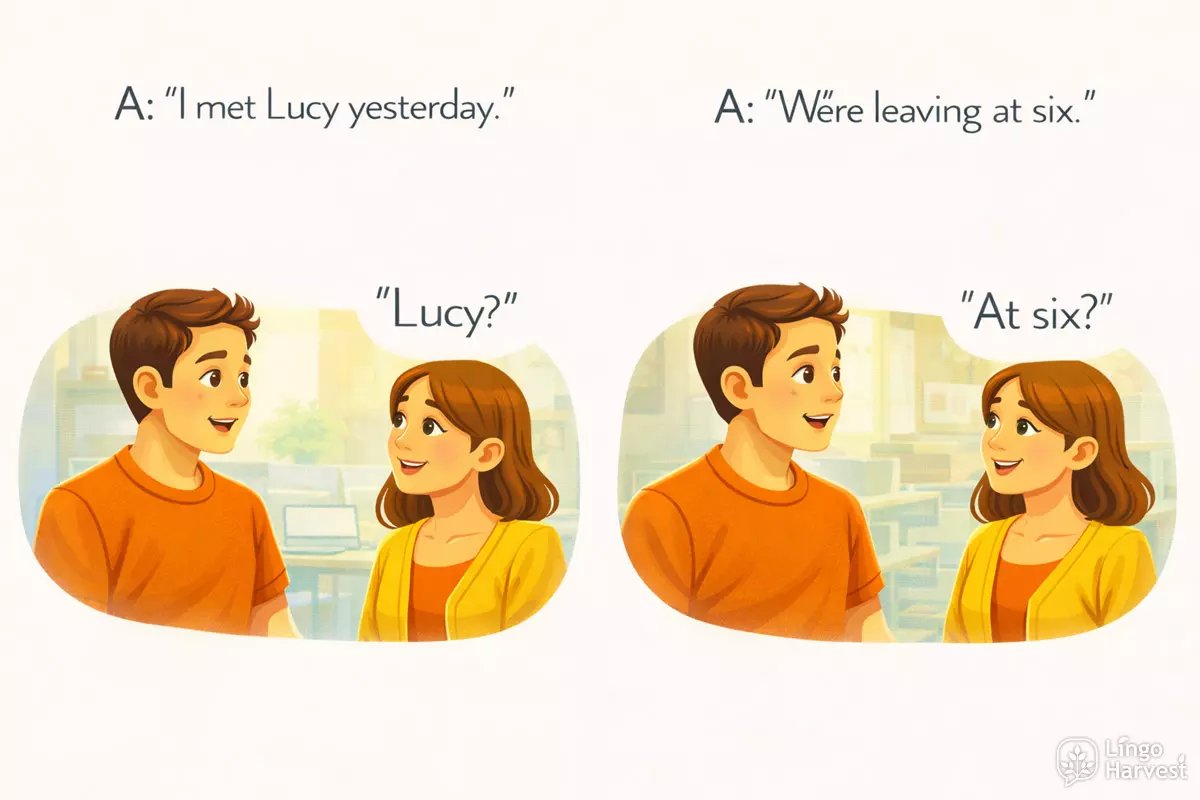
Echo questions repeat part or all of what the speaker just said, often with a rising intonation. They are useful when the listener did not hear or understand something, or wants confirmation. These patterns range from repeating a single word to echoing the whole statement.
- A: "I met Lucy yesterday." B: "Lucy?" (clarifying the name)
- A: "We’re leaving at six." B: "At six?" (checking the time)
- A: "He bought a Tesla." B: "A Tesla?" (confirming the object)
- A: "She moved to Canada." B: "She moved?" (surprise or seeking confirmation)
- A: "I lost my keys." B: "You lost them?" (echoing the action)
Comparison Table: Short vs. Echo Questions
| Type | Example | Typical Use |
|---|---|---|
| Short Question | — "You finished?" → "Did I?" |
Checking or confirming information |
| Echo Question | — "He’s traveling to Peru." → "Peru?" |
Clarification or surprise |
| Short Question | — "They can help." → "Can they?" |
Expressing doubt or interest |
| Echo Question | — "She got promoted." → "Promoted?" |
Seeking confirmation or details |
When to Use These Patterns
Short and echo questions are most common in informal exchanges, phone calls, or whenever speakers want to be sure about details without sounding too formal. They help keep the conversation natural and interactive. Avoid overusing them, as this can make dialogue seem repetitive or insincere.
Typical Learner Mistakes
Learners often mix up how to use short questions and echo questions, especially in natural conversation. Confusion can arise from word order, intonation, or even misunderstanding the purpose behind each type. Knowing where these forms go wrong can help you avoid awkward or unclear exchanges.
Common Errors with Short Questions
Short questions are often used for checking, clarifying, or confirming information. However, students sometimes struggle with the following:
- Using the wrong auxiliary verb (e.g., “You like coffee, is it?” instead of “do you?”)
- Repeating the main verb instead of using an auxiliary (“You went to the party, went you?”)
- Forgetting subject-auxiliary inversion (“She is coming, she is?” instead of “is she?”)
- Using a full question instead of a short one (“You finished your homework. Did you finish it?” instead of “Did you?”)
- Choosing the wrong pronoun (“Mark called, did she?” instead of “did he?”)
Echo Question Pitfalls
Echo questions are meant to show surprise or clarify what was just heard. Learners frequently make these mistakes:
- Echoing with the wrong tense (“She left yesterday?” instead of “She left yesterday?” with rising intonation, or “She left yesterday, did she?”)
- Changing the word order (“You are going where?” instead of “You’re going where?” with the correct stress)
- Using echo questions for confirmation instead of clarification (“You’re coming to the party, are you?” instead of “Are you coming to the party?”)
- Adding unnecessary information (“He bought a car? When did he buy it?” instead of simply echoing, “He bought a car?”)
Short Questions vs. Echo Questions: Confusion
It’s easy to mix up these two forms, as both respond to previous statements. Here’s a breakdown to help clarify the differences and avoid mix-ups:
| Short Questions | Echo Questions |
|---|---|
| Used to confirm or check information | Used to show surprise or clarify what was just heard |
| Uses auxiliary verbs (“do you?”, “is it?”) | Repeats part or all of the original statement (“He did what?”) |
| Often follows a statement (“You saw it, did you?”) | Often follows something unexpected (“You quit your job?”) |
| Intonation usually falls at the end | Intonation usually rises, showing surprise |
Additional Tricky Areas
Other frequent mistakes include:
- Using echo questions too often, making the conversation sound unnatural
- Not using intonation correctly, so the meaning is lost
- Forgetting to match pronouns and tense to the original statement
- Responding with a full question when a short or echo question is more natural
- Confusing echo questions with tag questions (“You’re leaving, aren’t you?” instead of “You’re leaving?”)
Understanding these stumbling blocks will help you use short and echo questions more naturally and effectively in real conversations.
Practice Exercises and Self-Check
Understanding the use of short questions and echo questions is easier when you practice recognizing and constructing them in context. Below, you'll find a variety of exercises designed to help you apply these conversational patterns naturally. Try each task before checking the answers revealed at the end.
Recognizing Short and Echo Questions
Read the following exchanges. Decide whether the response is a short question, an echo question, or something else.
- A: "I saw a fox in the garden."
B: "A fox?" - A: "She’s moving to Canada next month."
B: "Is she?" - A: "They’ve already left, haven’t they?"
B: "Have they?" - A: "I passed the exam!"
B: "You passed?" - A: "We’re meeting at six, right?"
B: "Are we?" - A: "He bought a new car."
B: "A new car?" - A: "You’re working late tonight."
B: "Am I?" - A: "She knows the answer."
B: "She does?" - A: "They can’t come today."
B: "They can’t?" - A: "I forgot my keys again."
B: "You forgot?"
Show answers
- Echo question
- Short question
- Short question
- Echo question
- Short question
- Echo question
- Short question
- Short question
- Echo question
- Echo question
Forming Short and Echo Questions
Transform the statements into natural short or echo questions as you might use in conversation.
- Statement: "He’s coming to the party."
- Statement: "You got a new job."
- Statement: "It’s raining again."
- Statement: "They’re moving to Spain."
- Statement: "You finished already."
- Statement: "She called you yesterday."
- Statement: "We’re late."
- Statement: "He can drive."
- Statement: "They’ve met before."
- Statement: "You don’t like coffee."
Show answers
- "Is he?" or "He’s coming?"
- "Did you?" or "You got a new job?"
- "Is it?" or "It’s raining again?"
- "Are they?" or "They’re moving to Spain?"
- "Did you?" or "You finished already?"
- "Did she?" or "She called you?"
- "Are we?" or "We’re late?"
- "Can he?" or "He can drive?"
- "Have they?" or "They’ve met before?"
- "Don’t I?" or "I don’t like coffee?"
Common Patterns: Short vs. Echo Questions
The table below compares typical forms of short questions and echo questions, helping you spot the differences in structure and usage.
| Short Question | Echo Question |
|---|---|
| Is he? | He is? |
| Did you? | You did? |
| Are they? | They are? |
| Will she? | She will? |
| Has it? | It has? |
| Can we? | We can? |
| Was he? | He was? |
| Do they? | They do? |
| Should I? | I should? |
| Would you? | You would? |
Self-Check: When to Use Each Type
For each scenario below, decide whether a short question or echo question would sound more natural. Briefly explain your choice.
- Your friend tells you some surprising news, and you want to confirm you heard correctly.
- Your colleague makes a statement, and you want to show polite interest or mild surprise.
- Someone gives you information, and you want to ask for confirmation using the auxiliary verb.
- You didn’t catch exactly what was said, so you repeat the main information with a rising tone.
Show answers
1. Echo question – to check you understood (e.g. "He did?")2. Short question – to politely show interest ("Did you?")
3. Short question – confirmation with auxiliary ("Has she?")
4. Echo question – repeating for clarity ("They left?")
Review your responses and compare them with the provided solutions to strengthen your confidence using these conversational patterns in real situations.