Yes/No Questions in English: Simple Rules and Examples

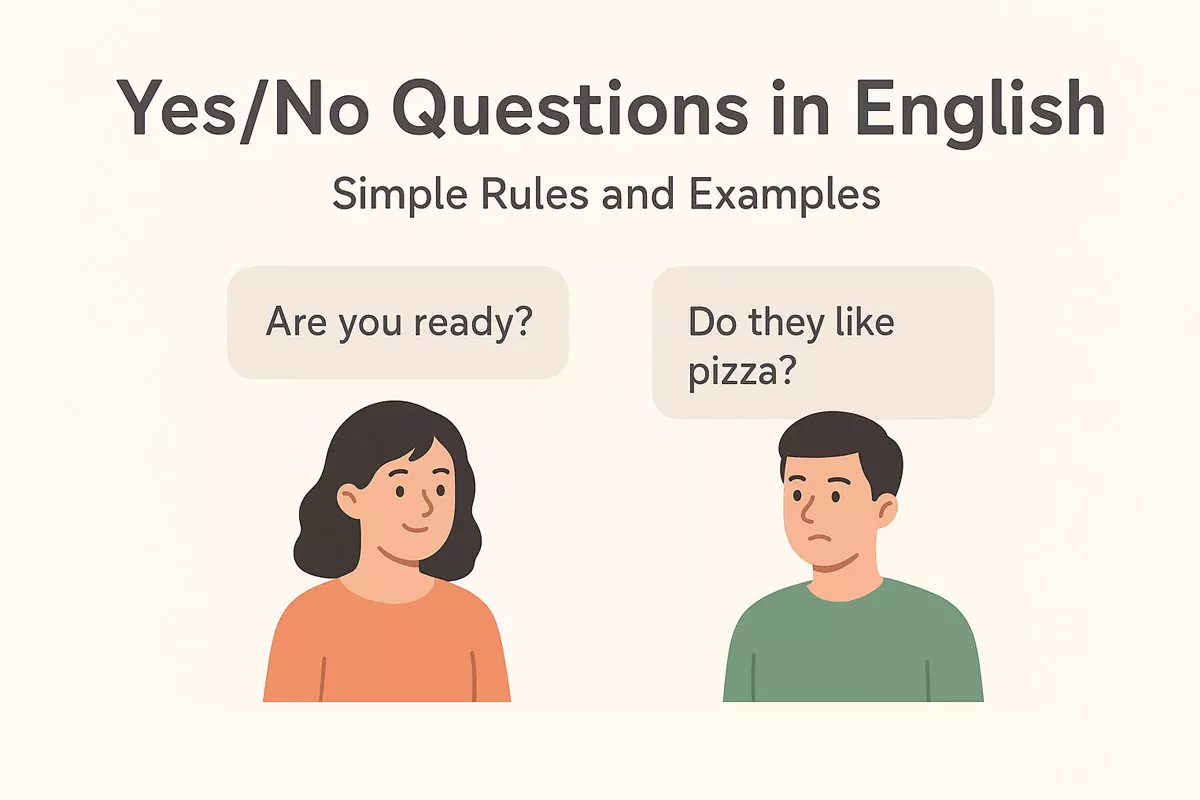 The article explains what yes/no questions are, covers their word order, and details when to use do, does, is, or are. It also provides practice in forming these questions and answering them with short, natural replies.
Learning how to ask clear yes-or-no questions in English is important for effective communication. These questions typically start with words like do, does, is, are, or can, and they allow the listener to respond simply with yes or no. For example, you might ask, Do you like coffee? or Is it raining outside? By practicing and using these question forms, you can make your conversations more direct and easier to follow, which is especially helpful when you want quick and unambiguous answers.
What Are Yes/No Questions?
Yes/no questions are a common type of inquiry in English that can be answered simply with “yes” or “no.” These questions usually ask for confirmation, agreement, or a basic fact, rather than open-ended information. They are often used to check facts, clarify details, or confirm plans in everyday conversation.
How Yes/No Questions Work
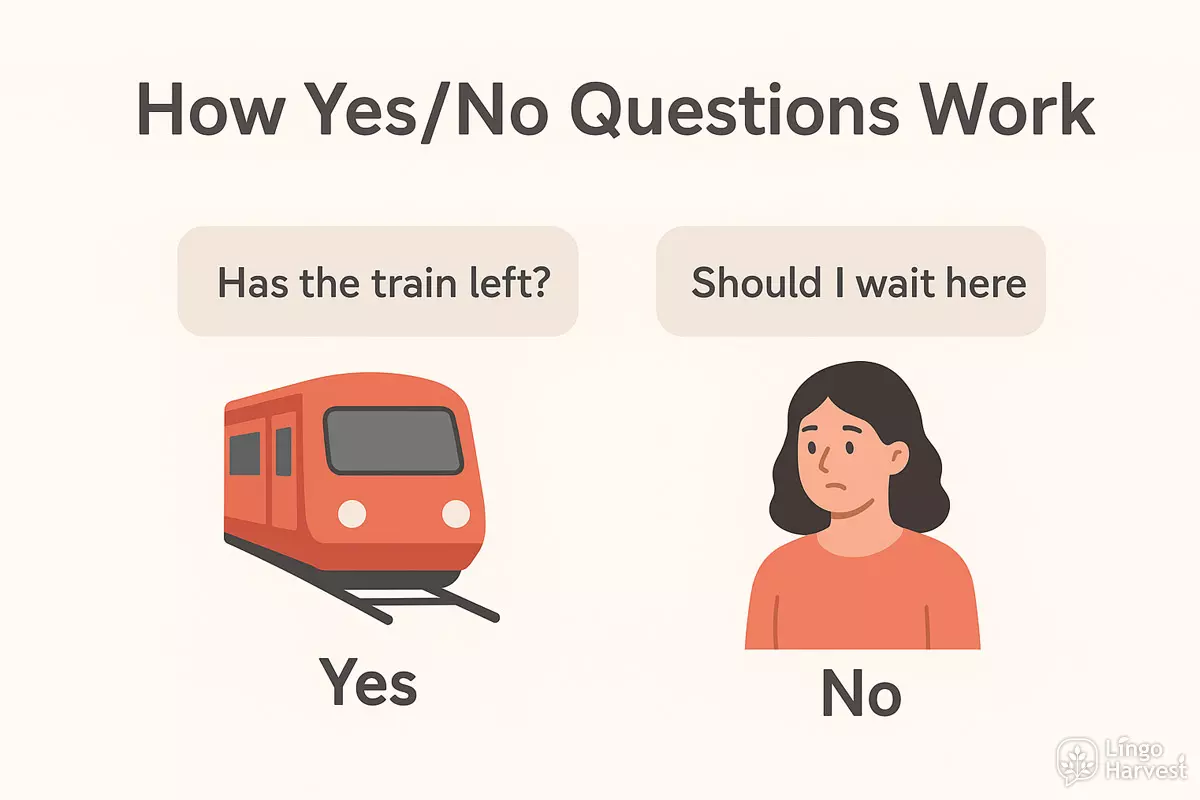
To form this kind of question, English typically uses an auxiliary (helping) verb at the beginning of the sentence, followed by the subject and then the main verb. The word order is different from regular statements—this is what signals to the listener that a question is being asked.
- Are you ready?
- Do they like pizza?
- Can she swim?
- Is it raining?
- Will you join us?
- Did he call?
- Has the train left?
- Should I wait here?
- Was the movie good?
- Have you finished?
Key Features
- Starts with a helping verb (be, do, have, can, will, etc.)
- Gives a choice: answer is either “yes” or “no”
- Does not require detailed information in the response
- Used in many situations: making offers, checking facts, requesting permission, confirming plans
Statement vs. Yes/No Question: Structure Comparison
| Statement | Yes/No Question |
|---|---|
| You are tired. | Are you tired? |
| They can drive. | Can they drive? |
| She has finished. | Has she finished? |
| He likes coffee. | Does he like coffee? |
Common Uses in Conversation
People use these questions to:
- Check understanding (e.g., “Do you understand?”)
- Offer help (“Can I help you?”)
- Make suggestions (“Shall we go?”)
- Confirm arrangements (“Will you be there?”)
- Ask for permission (“May I come in?”)
Mastering yes/no question forms is essential for clear, effective communication in English, especially in daily interactions.
Word Order in Questions
Forming yes/no questions in English usually means changing the order of the subject and the auxiliary (helping) verb. This is different from statements, where the subject comes before the verb. In questions, the auxiliary verb comes first, followed by the subject, then the main verb and the rest of the sentence. If there is no auxiliary verb in the statement, "do/does/did" is added at the beginning.
Basic Structure for Yes/No Questions
- Auxiliary verb + subject + main verb + (rest of sentence)?
Here are some examples to illustrate the pattern:
- Are you ready?
- Do they play tennis?
- Has she finished her work?
- Did it rain yesterday?
- Can we start now?
Comparing Statements and Questions
To see the difference clearly, compare how the same idea looks as a statement versus a yes/no question:
| Statement | Yes/No Question |
|---|---|
| She is a teacher. | Is she a teacher? |
| They have finished. | Have they finished? |
| You can swim. | Can you swim? |
| He likes coffee. | Does he like coffee? |
| We went yesterday. | Did we go yesterday? |
Common Auxiliary Verbs in Yes/No Questions
These are the most frequent auxiliaries that start yes/no questions:
- Do / Does / Did
- Is / Are / Am / Was / Were
- Have / Has / Had
- Can / Could
- Will / Would
- Shall / Should
- May / Might
- Must
Negative Yes/No Questions
To make a negative yes/no question, add "not" after the auxiliary (sometimes as a contraction):
- Isn't he coming?
- Didn't you see her?
- Haven't they arrived?
- Can't we go?
Mastering the typical word order for questions is essential for clear, correct communication in English. Remember: auxiliary first, then the subject, followed by the main verb. Practice with a variety of verbs and subjects to become more comfortable with this structure.
Do, Does, and Is/Are
Understanding how to form yes/no questions in English often centers on choosing the right auxiliary verb. The most common options—“do,” “does,” “is,” and “are”—depend on both the subject and the verb type in your sentence. Using the correct helping word is essential for clear, correct questions.
When to Use “Do” and “Does”
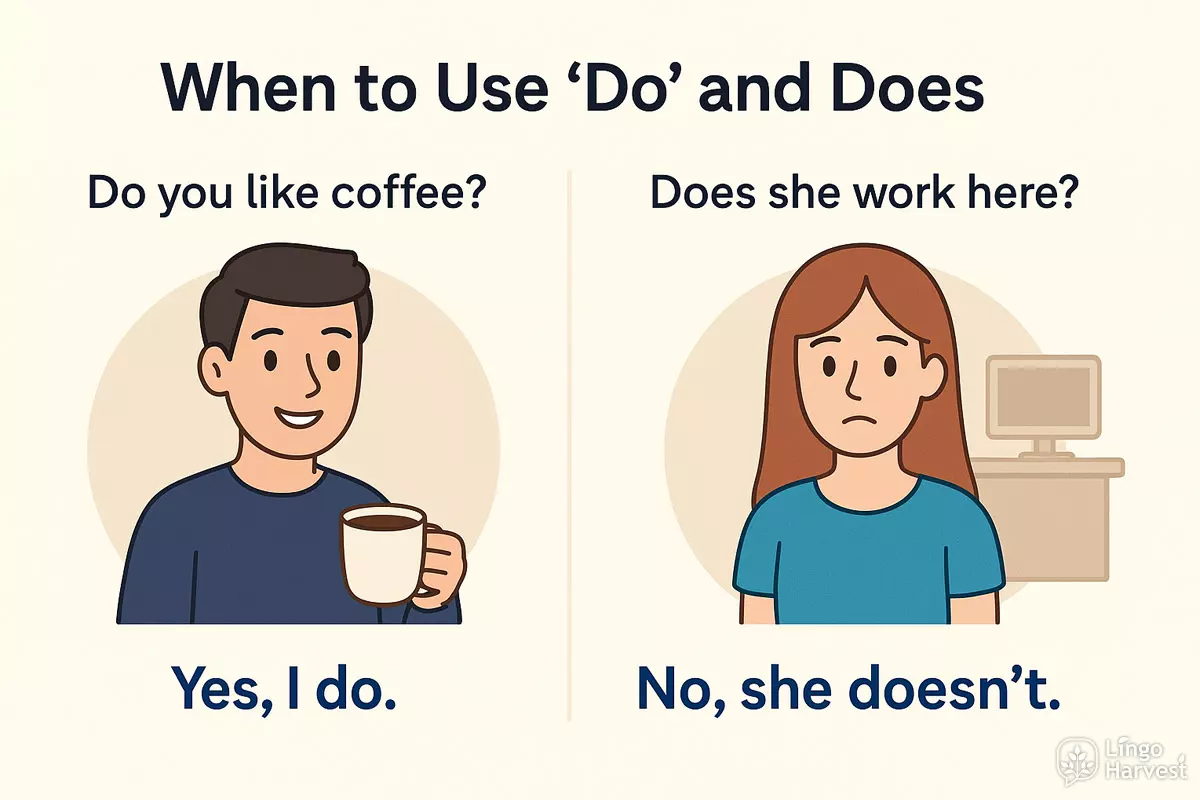
Use “do” and “does” with most action verbs (except “be” and modals), especially in the present simple tense. “Do” matches plural subjects and “I/you,” while “does” fits singular third-person subjects (he, she, it).
- Do you like coffee?
- Does she work here?
- Do they play soccer?
- Does it rain often?
- Do we need tickets?
Notice that after “do” or “does,” the main verb stays in its base form. This pattern makes English questions predictable, so you can quickly check if your structure is correct.
How “Is” and “Are” Work
“Is” and “are” are forms of the verb “to be” and are used with continuous tenses, passive voice, or when “be” is the main verb. “Is” pairs with singular subjects (he, she, it), and “are” with plural subjects (we, you, they).
- Is he ready?
- Are you coming?
- Is it raining?
- Are the keys on the table?
- Is this your book?
The word order for these questions is always: [Is/Are] + [subject] + [rest of sentence]?
Quick Comparison Table
| Auxiliary | Example Question | Used With |
|---|---|---|
| Do | Do you understand? | I, you, we, they (present simple, action verbs) |
| Does | Does she drive? | He, she, it (present simple, action verbs) |
| Is | Is he sleeping? | He, she, it (be verbs, continuous, passive) |
| Are | Are they finished? | We, you, they (be verbs, continuous, passive) |
Common Mistakes to Avoid
- ❌ Does he likes pizza? → Does he like pizza?
- ❌ Is she likes music? → Does she like music?
- ❌ Are he tired? → Is he tired?
Choosing the right auxiliary verb in questions becomes natural with practice. Pay close attention to your subject and verb type, and you’ll form clear, grammatical yes/no questions every time.
Answering with Short Replies
When someone asks a yes/no question in English, it’s common to respond with a brief answer instead of repeating the whole question. These quick responses are called short replies, and they help keep conversations smooth and natural. The structure is simple: use “Yes” or “No” followed by the subject and the auxiliary or modal verb from the question.
Basic Structure of Short Replies
- Yes + subject + auxiliary/modal.
- No + subject + auxiliary/modal + not.
The auxiliary verb (do/does/did, am/is/are, have/has, will, can, etc.) should match the form used in the original question. If the question uses “Do you like apples?”, the short reply is “Yes, I do” or “No, I don’t.”
Examples of Short Replies
- Are you ready? → Yes, I am. / No, I’m not.
- Do they play football? → Yes, they do. / No, they don’t.
- Can she swim? → Yes, she can. / No, she can’t.
- Will it rain today? → Yes, it will. / No, it won’t.
- Have you finished? → Yes, I have. / No, I haven’t.
- Did you call him? → Yes, I did. / No, I didn’t.
- Is he coming? → Yes, he is. / No, he isn’t.
- Was it expensive? → Yes, it was. / No, it wasn’t.
- Has she arrived? → Yes, she has. / No, she hasn’t.
- Should we start? → Yes, we should. / No, we shouldn’t.
- Must I go now? → Yes, you must. / No, you mustn’t.
- Could you help? → Yes, I could. / No, I couldn’t.
- Would you like some tea? → Yes, I would. / No, I wouldn’t.
Common Patterns and Tips
- Don’t repeat the main verb — use only the auxiliary/modal.
- The subject can be replaced with a pronoun (“I,” “he,” “they,” etc.).
- Use contractions in negative replies for natural speech: “No, I’m not,” “No, he isn’t,” “No, we haven’t.”
- Politeness can be added: “Yes, I am, thank you.”
- For emphasis, stress the auxiliary/modal: “Yes, she does!”
Short Reply Paradigms
| Question | Positive Reply | Negative Reply |
|---|---|---|
| Do you like coffee? | Yes, I do. | No, I don’t. |
| Is it raining? | Yes, it is. | No, it isn’t. |
| Have they arrived? | Yes, they have. | No, they haven’t. |
| Will you come? | Yes, I will. | No, I won’t. |
| Can she drive? | Yes, she can. | No, she can’t. |
Mastering these brief responses will make your English sound more fluent and help you participate in conversations more naturally. Practice with different verbs and subjects to become comfortable with the pattern.
Practice: Form and Answer Questions
Working with yes/no questions in English is all about recognizing patterns and using the right auxiliary verbs. Below, you'll find practical exercises that help you form, identify, and respond to such questions confidently.
Exercise 1: Complete the Questions
Fill in the blanks with the correct auxiliary verb (do/does, is/are, was/were, have/has, etc.) to form a yes/no question.
- ______ you like coffee?
- ______ she coming to the party?
- ______ they finished the project?
- ______ it raining outside?
- ______ he work here?
- ______ you seen this movie before?
- ______ your friends at home now?
- ______ we need to bring anything?
- ______ the train leave at 8:00?
- ______ he born in 1990?
Show answers
- Do you like coffee?
- Is she coming to the party?
- Have they finished the project?
- Is it raining outside?
- Does he work here?
- Have you seen this movie before?
- Are your friends at home now?
- Do we need to bring anything?
- Does the train leave at 8:00?
- Was he born in 1990?
Exercise 2: Short Answers Practice
Answer each question with a short response (Yes, I do / No, I don't, etc.).
- Do you play tennis?
- Is your phone on the table?
- Was the meeting long?
- Have you finished your homework?
- Are they ready?
Show answers
- Yes, I do. / No, I don't.
- Yes, it is. / No, it isn't.
- Yes, it was. / No, it wasn't.
- Yes, I have. / No, I haven't.
- Yes, they are. / No, they aren't.
Common Patterns for Yes/No Questions
Here are some typical structures you can use to form yes/no questions in different tenses:
| Question Pattern | Example |
|---|---|
| Do/Does + subject + base verb | Do you speak English? |
| Is/Are/Am + subject + verb-ing | Are they coming? |
| Was/Were + subject + verb-ing | Was she sleeping? |
| Have/Has + subject + past participle | Has he eaten yet? |
| Will + subject + base verb | Will you call me? |
| Can/Could + subject + base verb | Can you help me? |
| Should + subject + base verb | Should I go now? |
| Is/Are/Was/Were + subject + noun/adjective | Is this your book? |
Exercise 3: Make Questions from Statements
Rewrite each sentence as a yes/no question.
- She is at home.
- They can swim.
- You have finished.
- He went to the store.
- We will meet tomorrow.
Show answers
- Is she at home?
- Can they swim?
- Have you finished?
- Did he go to the store?
- Will we meet tomorrow?
Apply these patterns and practice forming both the questions and short answers. This hands-on approach will help you feel more confident using yes/no structures in real conversations.