How to Report Statements Correctly in English Grammar

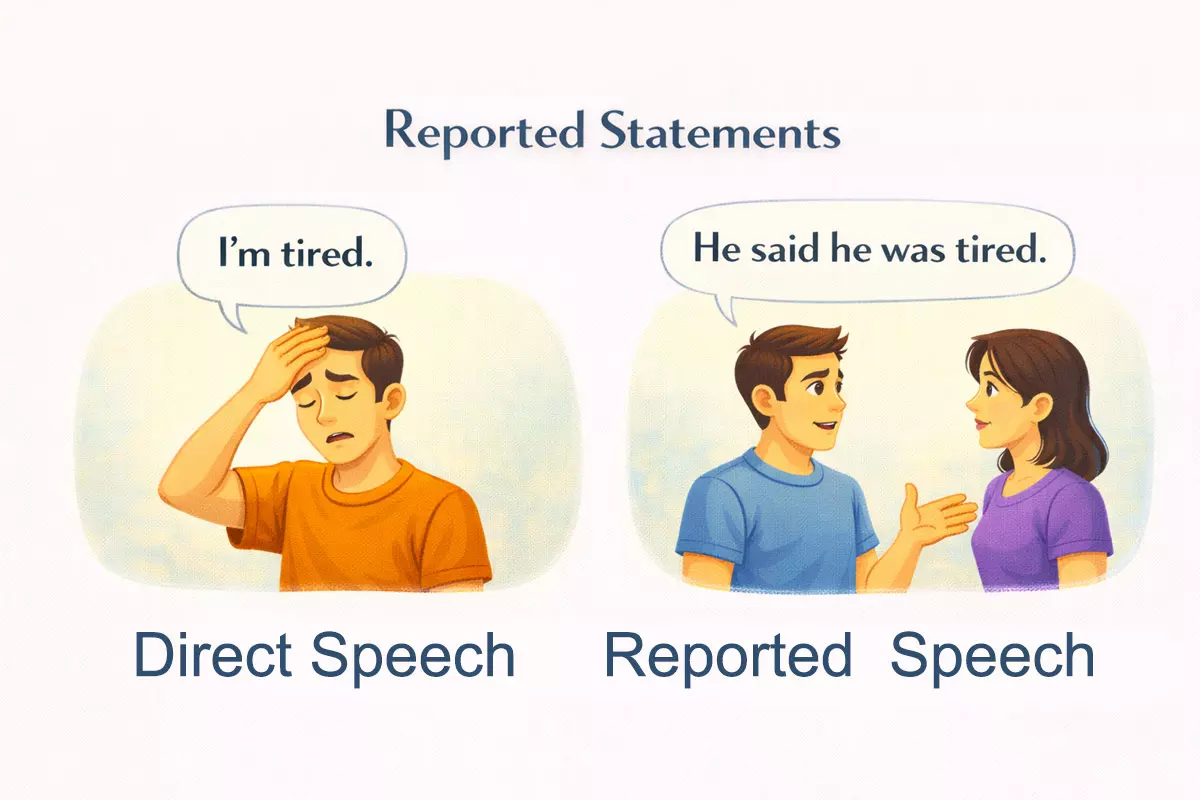 The article defines reported statements, explains their basic structure, and lists common reporting verbs. It covers changes in word order, pronouns, and tenses, and points out frequent mistakes learners make with reported statements.
Conveying what someone else has said can be challenging, particularly when dealing with the subtleties of English grammar and expression. Developing this skill is important because it allows you to communicate information accurately and ensures that the original speaker's meaning is preserved. By paying close attention to details such as word choice, verb tense, and context, you can relay messages in a way that is both clear and respectful to the source. This ability helps prevent misunderstandings and promotes effective, reliable communication in both personal and professional settings.
What reported statements are
When someone shares what another person has said without quoting their exact words, they're using a reported (or indirect) statement. This approach is common in both spoken and written English, helping us convey information, retell conversations, or summarize what others have mentioned. Instead of repeating the original speaker’s words exactly, the sentence is changed to fit into the flow of the reporting person's statement.
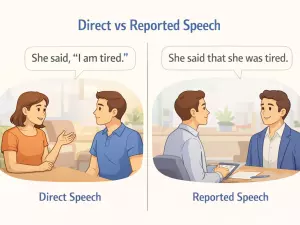
Direct vs. Indirect Speech
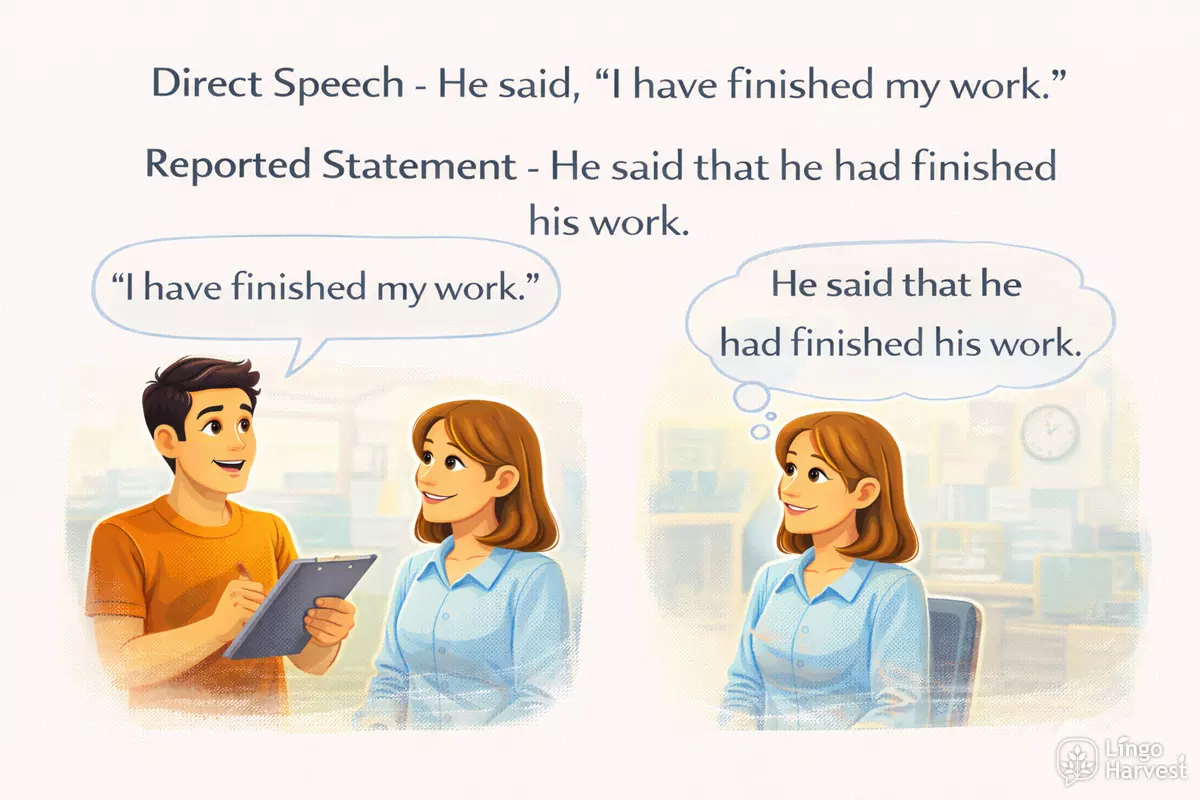
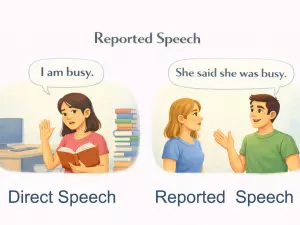
To understand this, it helps to compare direct speech—which uses the speaker’s original words, usually inside quotation marks—with indirect speech, which involves reporting those words in a different structure. In indirect speech, pronouns, verb tenses, and sometimes time expressions are usually changed to suit the new context.
| Direct Speech | Reported (Indirect) Statement |
|---|---|
| She said, "I am tired." | She said that she was tired. |
| Tom said, "We will go later." | Tom said that they would go later. |
| He said, "I have finished my work." | He said that he had finished his work. |
| Anna said, "I can't come." | Anna said that she couldn't come. |
Key Features of Reported Statements
- They often begin with verbs like say, tell, mention, or explain.
- The word that is commonly used (but sometimes omitted, especially in speech): “He said (that) he was busy.”
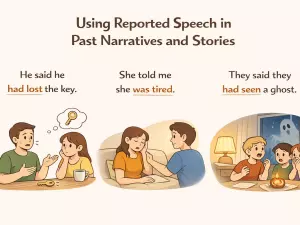
- Verb tenses usually shift back: present becomes past, past simple becomes past perfect, etc.
- Pronouns are changed to match the perspective of the person reporting: “I” becomes “he” or “she,” for example.
- Time and place expressions may also change: “today” might become “that day,” “here” becomes “there.”
Common Reporting Verbs
- say → He said (that) he was busy.
- tell → She told me (that) she couldn’t come.
- mention → They mentioned (that) the meeting was canceled.
- state → The manager stated (that) the deadline was Friday.
- explain → He explained (that) the train had been delayed.
- admit → She admitted (that) she had made a mistake.
- announce → They announced (that) the store would close early.
- remark → He remarked (that) it was unusually quiet.
- claim → She claimed (that) she had seen the email.
- insist → He insisted (that) he was right.
- declare → The coach declared (that) the team was ready.
- reply → She replied (that) she didn’t know.
- promise → He promised (that) he would call later.
- inform → They informed us (that) the flight had been delayed.
- add → She added (that) we could ask questions at the end.
- suggest → He suggested (that) we take a break.
- remind → She reminded me (that) I had an appointment.
- complain → He complained (that) the room was too noisy.
Why Use Indirect Speech?
Using indirect statements makes it easier to summarize conversations, report news, or keep a narrative flowing smoothly. It also helps when the exact words aren’t as important as the information itself. Mastering this skill is essential for clear communication in both formal and informal contexts.
Basic structure of reported statements
When you change direct speech into reported speech in English, the key is to adjust the sentence so it fits naturally into the flow of another sentence, typically after a reporting verb like say, tell, or explain. The process usually involves shifting pronouns, making verb tense changes (backshifting), and sometimes modifying time expressions.
Essential components
- Reporting verb: Common choices include say, tell, ask, explain.
- Connector: Often that (can be omitted in informal speech).
- Reported clause: The statement itself, adjusted for pronouns, tense, and time words.
Typical transformation steps
- Remove quotation marks.
- Shift pronouns to match the perspective of the sentence.
- Backshift tenses if the reporting verb is in the past (e.g., present simple → past simple).
- Change time and place expressions as needed (e.g., today → that day).
- Insert that after the reporting verb if appropriate.
Common patterns and examples
Below is a table showing typical transformations from direct to reported speech, highlighting the structural changes that often take place.
| Direct Speech | Reported Speech |
|---|---|
| "I am hungry," she said. | She said (that) she was hungry. |
| "We will go tomorrow," they told me. | They told me (that) they would go the next day. |
| "He has finished the work," John said. | John said (that) he had finished the work. |
| "You can call me later," Anna said. | Anna said (that) I could call her later. |
| "I saw them here," Mark said. | Mark said (that) he had seen them there. |
Key points to remember
- Backshifting is not always required if the reporting verb is in the present or if the statement is still true.
- Pronoun changes depend on the speakers and listeners in the context.
- Time and place words must reflect the new point of view.
- Omitting that is common in spoken English, but including it can make sentences clearer in writing.
- Some reporting verbs require an object (e.g., tell), while others do not (e.g., say).
Understanding these basic patterns makes it easier to convert direct statements into reported forms accurately and naturally.
Common reporting verbs for statements
When expressing what someone else has said, English speakers use a variety of verbs to introduce reported statements. These verbs help clarify the speaker’s attitude, the accuracy of the information, or the way the statement was delivered. Choosing the right reporting verb can provide extra nuance, such as whether something was explained, claimed, or simply mentioned.
How reporting verbs affect meaning
The verb you choose can subtly change the listener’s understanding. For example, claim indicates doubt, while confirm suggests verification. Verbs like explain or add show how the information was presented or expanded upon. Selecting the right verb makes your reported speech more precise and accurate.
| Reporting Verb | Typical Usage & Meaning | Example Sentence |
|---|---|---|
| say | General reporting; does not require an object | She said she was tired. |
| tell | Used with an object (the person addressed) | He told me he would be late. |
| claim | Implies doubt or lack of proof | They claimed the product was safe. |
| explain | Gives more detail or clarification | She explained how the system works. |
| insist | Shows strong belief or emphasis | He insisted that he was innocent. |
| admit | Conveys acknowledgment, often of something negative | She admitted that she made a mistake. |
| deny | Indicates rejection of a statement or accusation | He denied breaking the window. |
| confirm | Verifies or supports previous information | The manager confirmed the meeting time. |
To summarize, choosing among these verbs allows you to reflect the original speaker’s intention and the context of what was said. Being familiar with their subtle differences helps you report statements more accurately and naturally in English.
Word order changes in reported statements
When transforming direct speech into indirect or reported speech, the sequence of words in the sentence often shifts to fit grammatical rules and create clarity. English generally moves from the subject-verb-object word order in direct speech to a more flexible arrangement in reported statements, but some patterns are important to remember.
Basic word order adjustments
In most cases, statements that are reported maintain the subject before the verb, but the reporting verb (such as "said" or "told") comes first, followed by the conjunction "that" (often optional in informal speech). Pronouns, tense, and time expressions also frequently change.
- Direct: "I am tired," she said. → Reported: She said (that) she was tired.
- Direct: "We will help you," they promised. → Reported: They promised (that) they would help me.
- Direct: "You have finished the work," he noted. → Reported: He noted (that) I had finished the work.
Common patterns and changes
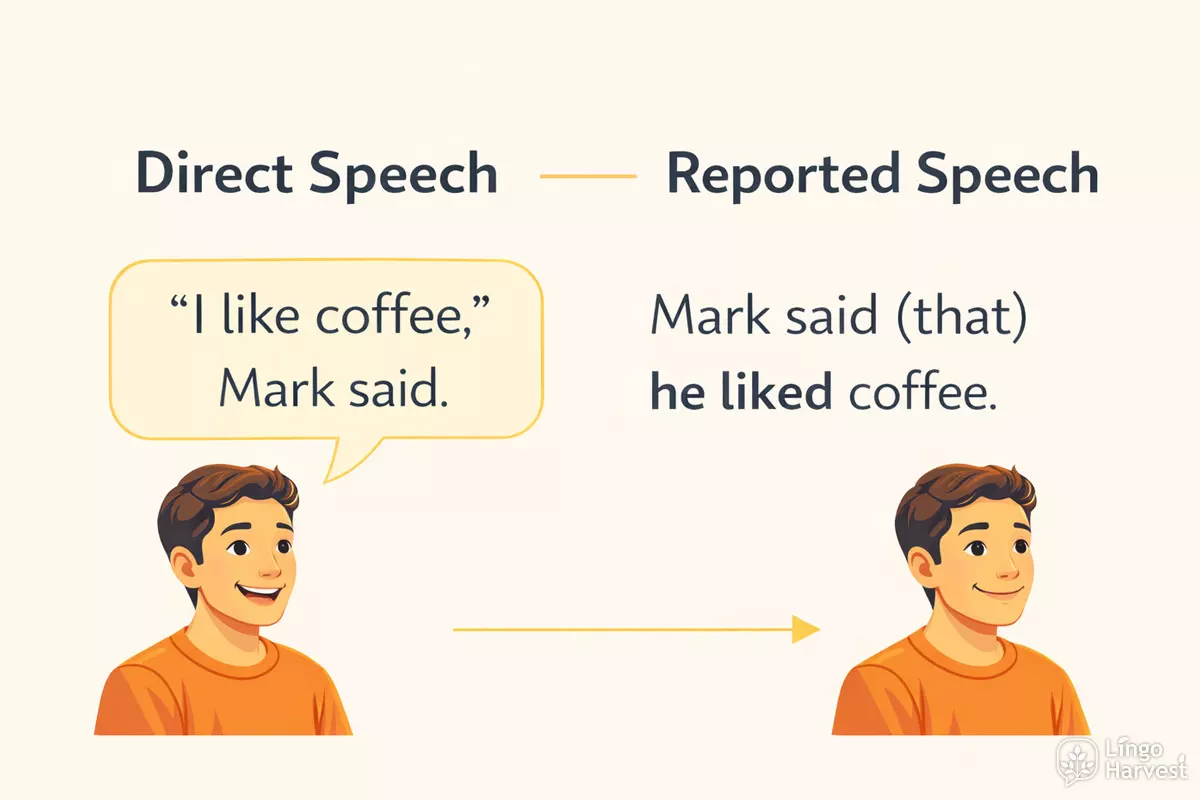
Some shifts are particularly common when converting statements. For example, questions and commands require additional changes, but for statements, the main focus is on tense, pronoun, and adverb adjustments. The basic order is: reporting verb + (that) + subject + verb + rest of the sentence.
| Direct Speech | Reported Speech |
|---|---|
| "I like coffee," Mark said. | Mark said (that) he liked coffee. |
| "She is coming," Tom said. | Tom said (that) she was coming. |
| "We saw the movie," they reported. | They reported (that) they had seen the movie. |
| "You can go now," the teacher told me. | The teacher told me (that) I could go then. |
Key points to remember
- The subject usually stays before the verb in reported statements.
- Place the reporting verb (e.g., "said," "told," "explained") at the start, followed by the rest of the statement.
- Use "that" after the reporting verb if needed for clarity, but it is often optional.
- Change pronouns and time words to fit the speaker’s perspective and context.
- Verb tense often shifts one step back (present to past, past to past perfect, etc.).
Examples of word order in reported statements
- Direct: "It is raining," she said. → Reported: She said it was raining.
- Direct: "My friends are arriving," he explained. → Reported: He explained (that) his friends were arriving.
- Direct: "You did a great job," the coach told me. → Reported: The coach told me I had done a great job.
- Direct: "I will be late," Anna said. → Reported: Anna said she would be late.
- Direct: "This is my book," John said. → Reported: John said that was his book.
- Direct: "We have finished," they said. → Reported: They said they had finished.
- Direct: "I am leaving now," he stated. → Reported: He stated he was leaving then.
- Direct: "She can help us," Paul said. → Reported: Paul said she could help them.
- Direct: "I saw him yesterday," she said. → Reported: She said she had seen him the day before.
- Direct: "We are ready," the team announced. → Reported: The team announced they were ready.
By following these patterns, reported statements stay clear and grammatically correct, even as word order and other elements shift to suit indirect speech.
Pronoun and reference changes
When transforming direct speech into reported speech in English, words that refer to people, places, or things often need to be adjusted. This helps the listener understand who or what is being talked about, especially when the speaker and the listener are not the same as in the original statement. Adjusting these referring words is key to keeping the meaning clear and accurate.
Why do we change pronouns and references?
In direct speech, pronouns like "I" or "you" refer to the people actually speaking. But when reporting someone’s words, those references shift. For example, "I" might become "she" or "he," and "my" could change to "her" or "his," depending on who is reporting and who originally spoke. The same principle applies to words that indicate place or time, such as "here" or "now."
Common changes when reporting statements
It's not just personal pronouns that change; possessive pronouns, demonstratives, and some adverbs also need adjustment. Here are typical shifts you’ll need to watch out for:
- I → he/she
- me → him/her
- my → his/her
- we → they
- us → them
- our → their
- you (singular/plural) → he/she/they
- your (singular/plural) → his/her/their
- this → that
- these → those
- here → there
- now → then
- today → that day
- tomorrow → the next day
- yesterday → the day before
- next week → the following week
- last year → the previous year
Examples: Direct vs. Reported Speech
Let’s look at how these shifts work in practice. Notice how the pronouns and references are adjusted to fit the new context:
| Direct Speech | Reported Speech |
|---|---|
| She said, "I lost my keys here." | She said that she had lost her keys there. |
| He said, "We will finish this tomorrow." | He said that they would finish that the next day. |
| Tom said to me, "You need to do your work now." | Tom told me that I needed to do my work then. |
| They said, "Our teacher is absent today." | They said that their teacher was absent that day. |
Tips for making reference changes smoothly
- Always identify who the original speaker is and who is reporting.
- Consider the perspective: Is the statement being reported by someone involved or by a third party?
- Adjust possessives and demonstratives to match the new context.
- Update time and place references based on when and where the statement is reported.
By carefully adapting pronouns and other referring words, you can ensure your reported speech is clear and accurate, reflecting the true meaning of the original statement.
Simple tense adjustments overview
When reporting statements in English, shifting verb tenses is a key skill. This process, known as backshifting, usually happens when the reporting verb is in the past tense. Understanding which tense changes to make, and when exceptions apply, helps you produce clear, accurate reported speech.
How tenses typically change in reported statements
Reported speech often requires changes to the verb tense to reflect the time difference between the original statement and the report. The most common pattern is to shift each tense "back" one step into the past. However, if the reporting verb is in the present or the original statement is still true, tense changes may not be needed.
| Direct Speech | Reported Speech |
|---|---|
| Simple Present "I eat breakfast." |
Simple Past He said he ate breakfast. |
| Present Continuous "She is reading." |
Past Continuous He said she was reading. |
| Simple Past "They visited Paris." |
Past Perfect She said they had visited Paris. |
| Present Perfect "We have finished." |
Past Perfect He said they had finished. |
| Will "I will call you." |
Would She said she would call me. |
| Can "He can swim." |
Could She said he could swim. |
| May "It may rain." |
Might He said it might rain. |
Common patterns for tense changes
- Simple present → simple past
- Present continuous → past continuous
- Present perfect → past perfect
- Simple past → past perfect
- Will → would
- Can → could
- May → might
- Past perfect → (usually remains past perfect)
- Would, could, might, should, ought to → (usually unchanged)
Key points and exceptions
- If the reporting verb is present (e.g., "He says"), tenses usually do not shift.
- Universal truths and facts generally stay in the present tense.
- No tense change is needed when reporting something that is still true or relevant.
- Modal verbs like "would," "could," and "might" typically remain the same.
- Time expressions may also change (e.g., "today" → "that day").
Mastering these adjustments will help you accurately transform direct speech into indirect speech, making your English sound more natural and clear in both writing and conversation.
Frequent learner mistakes with reported statements
Many English learners encounter problems when turning direct speech into reported speech. Some issues come from uncertainty about changes in verb tense, word order, or the correct use of pronouns. Others involve confusion about punctuation or mixing up reporting verbs. Understanding these pitfalls can make it easier to report what others have said accurately and naturally.
Common errors in tense changes
One of the most frequent difficulties is remembering when and how to change the tense in reported speech. Learners often forget to shift the tense back, especially after reporting verbs in the past. Here are some typical mistakes:
- Not changing the present tense to past tense (e.g., “He says, ‘I am tired.’” → Incorrect: He said he is tired. Correct: He said he was tired.)
- Leaving modal verbs unchanged when they should shift (e.g., “can” to “could,” “will” to “would”)
- Using past perfect unnecessarily (over-applying the rule)
Pronoun and possessive confusion
Changing pronouns and possessives can be tricky, especially when the subject of the reporting verb is different from the speaker in the original statement.
- Failing to change “I” to “he/she” or “we” to “they”
- Mixing up “my” and “his/her”
- Keeping “you” when it should become “me/him/her/us/them” depending on context
Reporting verb and punctuation mistakes
Learners sometimes use the wrong reporting verb or forget to remove quotation marks. Here are some examples:
- Using “say” instead of “tell” with an object (e.g., Incorrect: He said me… Correct: He told me…)
- Leaving in quotation marks in indirect speech
- Adding a comma before the reported clause (not needed in indirect speech)
Word order and question structure
Reporting questions can cause confusion, particularly with word order and question words. Many learners keep the direct question structure or forget to use “if/whether” for yes/no questions.
- Not switching to statement word order (e.g., Incorrect: She asked where is the bank. Correct: She asked where the bank was.)
- Omitting “if” or “whether” in yes/no questions
Summary of typical transformations
The table below highlights some of the most common tense and modal changes learners often miss when reporting statements:
| Direct Speech | Reported Speech |
|---|---|
| Present Simple: “I eat.” | Past Simple: He said he ate. |
| Present Continuous: “I am eating.” | Past Continuous: He said he was eating. |
| Present Perfect: “I have eaten.” | Past Perfect: He said he had eaten. |
| Will: “I will go.” | Would: He said he would go. |
| Can: “I can swim.” | Could: He said he could swim. |
| Must: “I must leave.” | Had to: He said he had to leave. |
Other pitfalls to watch for
- Forgetting time and place word changes (e.g., “today” → “that day,” “here” → “there”)
- Using “say” with an object instead of “tell”
- Reporting commands or requests as statements instead of using the infinitive (e.g., “He told me to sit down”)
- Overusing “that” (it is sometimes optional in reported speech)
- Not adjusting the meaning for context or speaker/listener relationship
Practicing these common trouble spots can help you avoid mistakes and report what others say more naturally and accurately in English.