Reporting Commands and Instructions in Reported Speech

 This article explains how to report commands and instructions in English. It covers using tell and ask, forming object plus infinitive structures, reporting negative commands, changing pronouns and references, and avoiding common mistakes.
Transforming direct orders and instructions into indirect language is a valuable skill that enhances clarity and accuracy in communication. By learning to express someone’s requests or advice in reported speech, you can convey information more smoothly and respectfully. This approach not only helps avoid misunderstandings but also ensures that the original intent of the message is preserved. Mastering indirect language is especially important in professional and academic settings, where clear and tactful communication fosters better relationships and more effective collaboration.
What commands and instructions are
Commands and instructions are types of direct speech that tell someone to do (or not do) something. They’re usually short, clear sentences that give orders, directions, or advice. In English, these are most often formed using the imperative mood—meaning the verb appears at the start of the sentence without a subject. This form is used to address the listener directly, making it ideal for giving orders, requests, or guidance.
Common features of commands and instructions
- Use of the base form of the verb (e.g. Open the window.)
- Often no subject is stated, but “you” is implied.
- Can be positive (telling someone what to do) or negative (telling someone what not to do).
- Sometimes include polite words like “please” to soften the tone.
- May be strengthened with words like “always” or “never”.
- Sometimes include additional details or context (e.g. Turn left at the corner.)
- Frequently used in recipes, instructions, manuals, and spoken requests.
Examples of direct commands and instructions
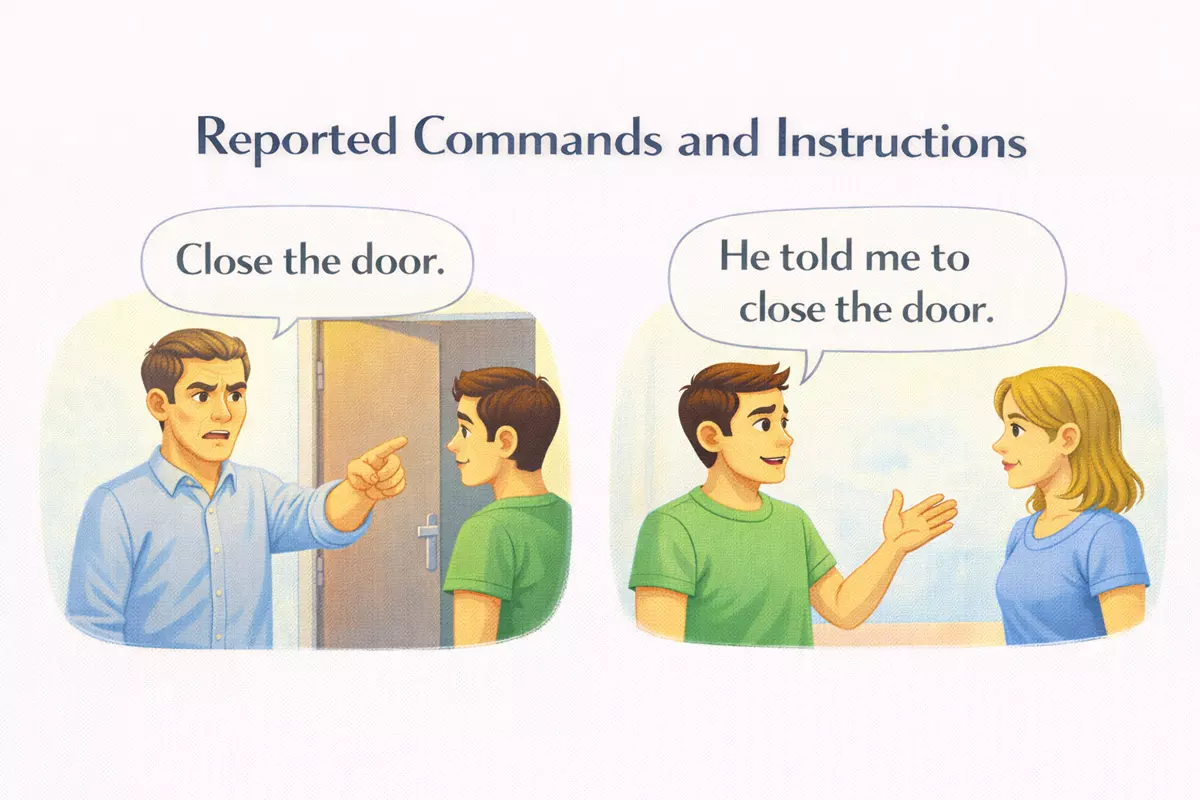
- Close the door.
- Please sit down.
- Don’t touch that!
- Be quiet.
- Write your name here.
- Wash your hands before eating.
- Never mix these chemicals.
- Take a seat.
- Read the instructions carefully.
- Always check your work.
- Do not enter.
- Press the red button to start.
- Remember to lock the door.
- Don’t forget your keys.
- Keep off the grass.
Types of imperatives
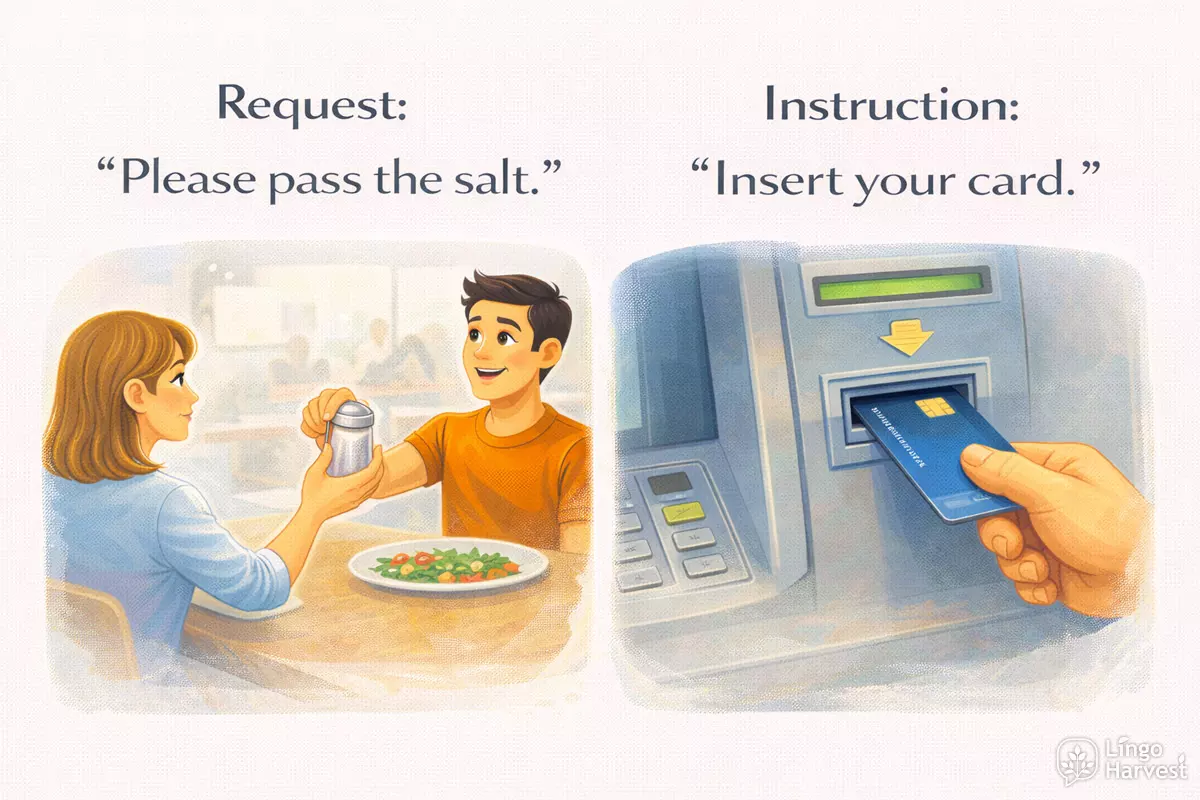
Imperatives come in a few varieties, depending on the speaker’s intent. Some are strict orders, while others are gentle suggestions or warnings. Here’s how they might differ:
- Direct order: “Stand up.”
- Request: “Please pass the salt.”
- Instruction: “Insert your card.”
- Warning: “Don’t touch the wire.”
- Advice: “Always wear a helmet.”
Positive vs. negative imperatives
| Type | Example |
|---|---|
| Positive (do something) | Turn off the lights. |
| Negative (do not do something) | Don’t run in the hallways. |
| Polite imperative | Please take your seats. |
| Emphatic imperative | Do be careful! |
Understanding the structure and function of these sentences is key when learning how to report them in indirect speech. Each type of command or instruction may require a different reporting verb or structure, depending on the original intent and formality.
Using tell and ask in reported commands
When changing direct commands and requests into reported speech, English speakers commonly use the verbs tell and ask to indicate who is being instructed or requested. These reporting verbs help clarify both the meaning and the tone of the original command. Tell is typically used for direct orders or instructions, while ask is more polite, often introducing requests.
How to Form Reported Commands
To report a command, the structure usually follows this pattern: Subject + told/asked + object + (not) + to-infinitive
- Direct: "Close the window." → Reported: She told him to close the window.
- Direct: "Please help me." → Reported: He asked her to help him.
- Direct: "Don't be late." → Reported: They told us not to be late.
Choosing Between "Tell" and "Ask"
The choice depends on the type of command or request:
- Tell is used for firm or direct instructions, often from someone in authority.
- Ask is preferred for polite requests or when the original speech is more gentle.
Examples of Reported Commands and Requests
| Direct Speech | Reported Speech |
|---|---|
| "Turn off your phone." | She told him to turn off his phone. |
| "Please sit down." | The teacher asked the students to sit down. |
| "Don't touch that!" | He told her not to touch that. |
| "Can you help me with this?" | She asked him to help her with that. |
| "Remember to call me." | He told her to remember to call him. |
| "Don't forget your homework." | The teacher told the class not to forget their homework. |
| "Please be quiet." | He asked everyone to be quiet. |
| "Stop talking!" | The coach told them to stop talking. |
| "Don't worry." | She told him not to worry. |
| "Could you pass the salt?" | He asked her to pass the salt. |
Key Patterns and Notes
- Negative commands use not to: "Don't run." → She told him not to run.
- With ask, the request is usually more polite or indirect.
- The object (person being told/asked) is necessary: He told Mary to wait (not just "He told to wait").
- When the original command uses "please," it often becomes ask in reported speech.
Understanding when to use tell or ask helps convey the speaker’s intention and the level of formality in reported instructions or requests. This distinction is important for accurate and natural-sounding reported speech.
Object plus infinitive structure explained
When reporting commands and instructions, English often uses a pattern that includes an object followed by an infinitive verb. This structure helps clarify who is expected to perform the action. Instead of quoting the speaker directly, we rephrase the original directive using verbs like tell, order, ask, or warn plus an object (the person receiving the command) and the infinitive form of the main verb.
How the structure works
The formula is straightforward: reporting verb + object + to-infinitive. This pattern is especially common when changing direct speech into reported speech for instructions and orders. It makes the meaning clear and avoids ambiguity about who should act.
- She said, "Close the window." → She told him to close the window.
- The teacher said, "Finish your homework." → The teacher ordered the students to finish their homework.
- He said, "Please be quiet." → He asked us to be quiet.
- Dad said, "Don’t touch that!" → Dad warned me not to touch that.
- The officer said, "Stand up." → The officer commanded them to stand up.
- "Don’t forget to call me," she said. → She reminded me to call her.
- "Leave the room," the guard said. → The guard told us to leave the room.
- "Wait here," my friend said. → My friend asked me to wait there.
- "Drive carefully," the instructor said. → The instructor advised us to drive carefully.
- "Don’t talk during the exam," the teacher said. → The teacher told us not to talk during the exam.
Affirmative and Negative Forms
To report negative commands or instructions, insert not before the infinitive. For example, "Don’t open the door" becomes "She told him not to open the door."
Common Reporting Verbs
Some verbs are frequently used in this pattern. Here are common options:
- request → She requested him to send the file by email.
- recommend → The doctor recommended her to rest for a few days.
- beg → He begged her to give him another chance.
- forbid → The sign forbade visitors to enter the area.
- alert → They alerted staff to evacuate the building.
- notify → The company notified customers to update their passwords.
- direct → The manager directed employees to follow the new procedure.
- authorize → She authorized him to sign the documents.
- invite → They invited us to attend the conference.
- encourage → The teacher encouraged students to ask questions.
- urge → He urged her to apply before the deadline.
- persuade → She persuaded him to change his mind.
| Direct Command/Instruction | Reported Speech (Object + Infinitive) |
|---|---|
| "Sit down," the teacher said. | The teacher told us to sit down. |
| "Don’t be late," Mom said. | Mom warned me not to be late. |
| "Please help me," he said. | He asked her to help him. |
| "Remember to lock the door," she said. | She reminded him to lock the door. |
This structure is useful for clear and polite indirect speech, especially when the action is directed at a specific person. Adjust the reporting verb and the pronouns as needed for the situation.
Reporting negative commands correctly
When changing direct negative commands into reported speech, the structure changes slightly compared to positive commands. In direct speech, negative commands often use "don't" or "do not" before the verb. However, in reported speech, we typically use the verb "tell," "order," or similar reporting verbs, followed by the object, and then "not to" plus the base form of the verb. This pattern helps convey that the instruction was specifically to avoid doing something.
How to form reported negative commands
To turn a negative imperative into reported speech, follow this general structure:
- Reporting verb (told, ordered, warned, etc.) + object + not to + base verb
For example, "Don't touch that!" becomes "She told me not to touch that."
Common reporting verbs for negative instructions
- tell → She told him not to touch the equipment.
- order → The officer ordered them not to enter the area.
- warn → He warned us not to be late.
- advise → The doctor advised her not to skip meals.
- ask → She asked me not to share the information.
- instruct → The teacher instructed the students not to use their phones.
- remind → He reminded me not to forget my passport.
Examples: Direct to reported negative commands
- "Don't be late." → He told me not to be late.
- "Do not open the window." → She asked him not to open the window.
- "Don't forget your keys." → They reminded us not to forget our keys.
- "Don't make a noise." → The teacher ordered the students not to make a noise.
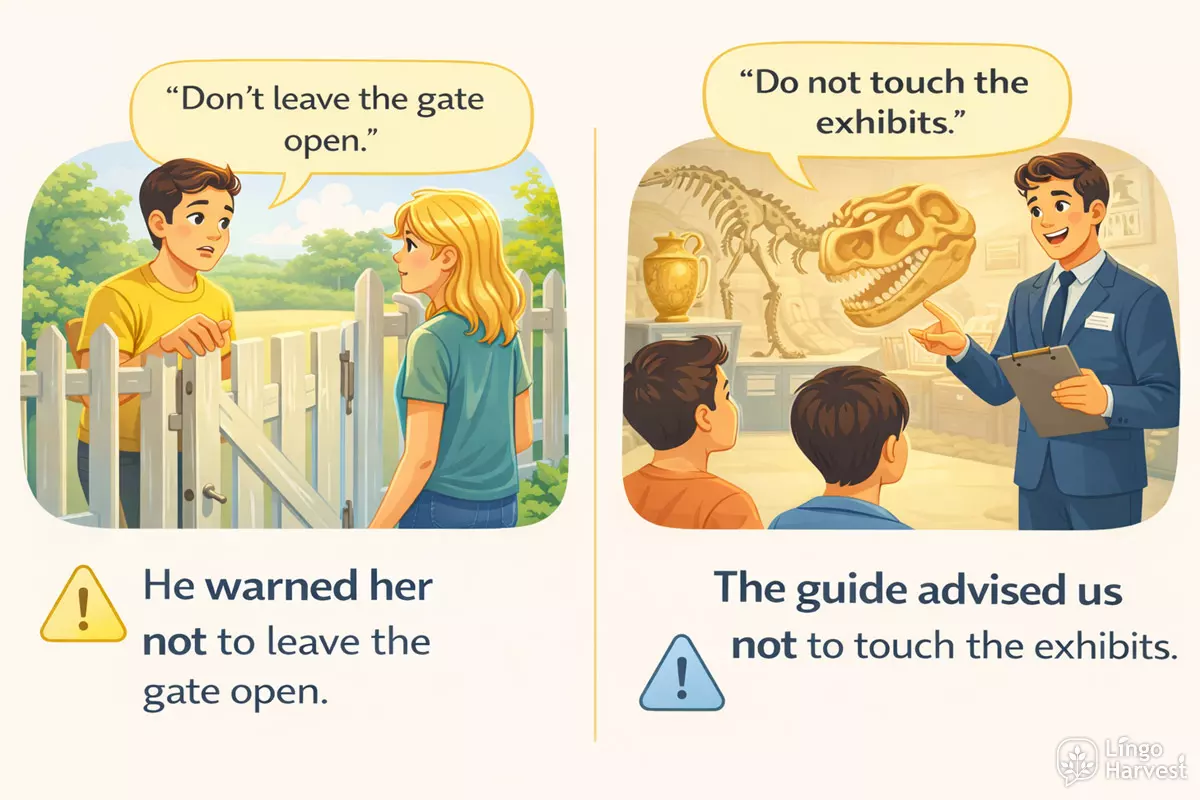
- "Don't leave the gate open." → He warned her not to leave the gate open.
- "Do not touch the exhibits." → The guide advised us not to touch the exhibits.
- "Don't run in the hallways." → The principal told the children not to run in the hallways.
- "Don't tell anyone." → She asked me not to tell anyone.
- "Don't eat that cake." → My mother warned me not to eat that cake.
- "Do not use your phones." → The invigilator instructed the students not to use their phones.
- "Don't forget to lock the door." → He reminded me not to forget to lock the door.
- "Don't interrupt." → The manager told us not to interrupt.
Pattern comparison: Positive vs. negative commands
| Direct Command | Reported Speech |
|---|---|
| "Open the door." | He told me to open the door. |
| "Don't open the door." | He told me not to open the door. |
| "Finish your homework." | She ordered him to finish his homework. |
| "Do not finish your homework now." | She ordered him not to finish his homework now. |
Notice how the word "not" is placed before "to" and the verb in the reported form. This pattern is consistent regardless of which reporting verb you use. Practicing with a range of reporting verbs and various negative imperatives helps reinforce the correct structure.
Changes in pronouns and references
When reporting commands and instructions, it’s important to adjust pronouns and references so the meaning stays clear for the new context. The speaker’s original words may use “you,” “me,” “my,” or other references that need to reflect who is being addressed or spoken about in the reported version. This shift ensures the reported speech accurately represents the intended recipient and speaker, and avoids confusion.
How pronouns shift in reported commands
Pronouns change based on the perspective of the reporting speaker and the original speaker. Here are some common adjustments:
- “You” (addressed person) often becomes “he,” “she,” “they,” or the person’s name.
- “Me” (original speaker) typically changes to “him,” “her,” “them,” or the name of the original speaker.
- “My,” “your,” “our,” and similar possessive pronouns are adjusted to match the new perspective (e.g., “my” may become “his” or “her”).
- Demonstratives like “this” and “that” may also change to “the” or a more specific noun.
Common patterns for reference changes
The table below shows typical shifts in pronouns and references when reporting instructions, helping clarify who is involved in the action.
| Direct Speech | Reported Speech |
|---|---|
| “You must finish your work.” | He told me that I must finish my work. |
| “Give me your notebook.” | She asked him to give her his notebook. |
| “Help us with our project.” | They instructed them to help them with their project. |
| “Call me when you arrive.” | He told her to call him when she arrived. |
| “Don’t forget your keys.” | She reminded me not to forget my keys. |
| “Tell them the truth.” | He ordered her to tell them the truth. |
| “Send us the files.” | They asked him to send them the files. |
| “Don’t touch this.” | He warned her not to touch it. |
Tips for accurate reference changes
- Always identify who is speaking and to whom the command is directed.
- Adjust possessive adjectives and pronouns for clarity.
- Replace demonstratives like “this” or “these” with more neutral terms if needed.
- Double-check that the reported version makes sense in the new context.
By carefully shifting pronouns and references, you ensure that the reported instructions and commands are clear, accurate, and easy to understand for the listener or reader.
Typical mistakes when reporting commands
When changing direct commands into reported speech, learners often run into predictable problems. These errors can make sentences confusing or grammatically incorrect. Understanding the most frequent pitfalls is key to mastering this aspect of indirect speech.
Omitting the Correct Reporting Verb
A common error is using “say” instead of verbs like “tell,” “order,” or “ask” when reporting instructions or requests. “Say” does not take an object, so it cannot introduce a reported command directly. For example, He said me to sit down is incorrect.
Forgetting to Use the Infinitive Form
Commands in reported speech are usually structured with “to” + base verb. Learners sometimes leave out “to,” or use the present tense instead of the infinitive.
Maintaining Imperative Word Order
A mistake is to keep the imperative structure (“Open the door!”) instead of changing it to the infinitive (“to open the door”) in indirect speech.
Incorrect Pronoun or Time Reference Changes
Pronouns and time expressions must often be adjusted when reporting. Students sometimes forget to change “me” to “him/her,” or “today” to “that day,” which can cause confusion.
Neglecting Negative Commands
Reporting negative commands requires “not to” + verb. Many learners omit “not,” or place it incorrectly.
| Direct Command | Incorrect Reporting ❌ | Correct Reporting ✅ |
|---|---|---|
| "Sit down!" | He said me sit down. | He told me to sit down. |
| "Don’t touch that!" | She told him not touch that. | She told him not to touch that. |
| "Please help me." | He asked to help him. | He asked me to help him. |
| "Finish this today." | The boss ordered finish this today. | The boss ordered us to finish that that day. |
Other Frequent Issues
- Forgetting to change the reporting verb tense when required.
- Using “that” instead of “to” when reporting commands.
- Mixing up reported requests and commands (e.g., using “ask” for orders).
- Reporting “let’s” incorrectly (should be “suggested that we should…” or “proposed that we…”).
- Not specifying the person who receives the command (missing object).
- Confusing “tell” and “say” in reported imperatives.
- Leaving out politeness markers like “please” in appropriate forms.
- Misreporting commands with modal verbs (e.g., “can,” “must”).
- Failing to backshift time expressions where necessary.
- Omitting indirect speech markers (e.g., “to,” “not to”).
Careful attention to reporting verbs, the infinitive structure, pronoun changes, and negative forms will help avoid these errors. Practice and awareness of these typical mistakes will improve both accuracy and clarity in reported speech.