Reporting Suggestions and Advice in English Grammar

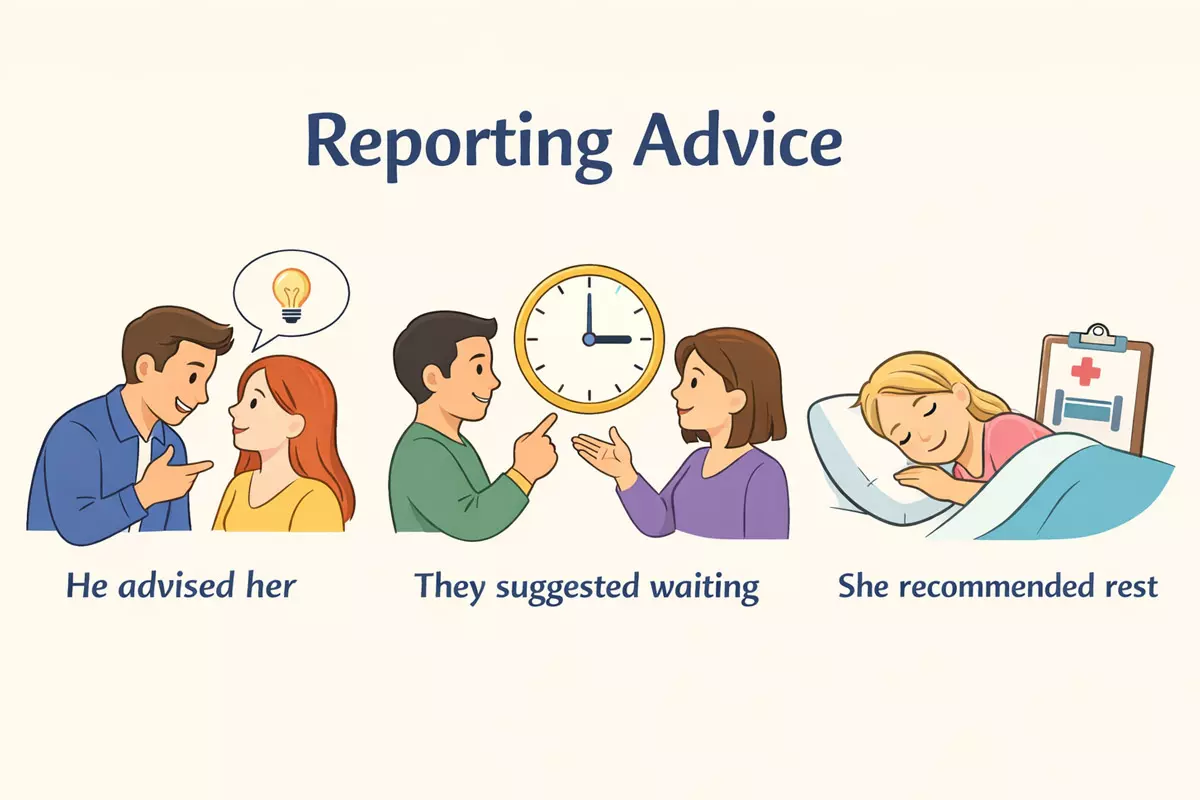 This article explains how to express and report suggestions and advice in English. It covers common reporting verbs, using infinitives or gerunds, making polite or indirect suggestions, pronoun changes, and frequent learner errors.
Expressing recommendations or guidance in English, particularly when communicating what someone else has suggested, can be challenging. Mastering the correct grammar for relaying advice or proposals not only helps you avoid misunderstandings but also ensures your message is clear and effective. By learning the appropriate structures and phrases, such as using reported speech or modals like should and could, you can accurately convey suggestions and advice, making your communication more precise and professional.
How suggestions and advice are expressed
English speakers have several ways to give suggestions or offer advice, depending on the situation, relationship, and level of formality. The most common structures use modal verbs, imperative sentences, or specific phrases. These patterns help speakers soften their tone, sound polite, or make their recommendations more direct.
Common language patterns for giving advice
Advice is often introduced with modals like should, ought to, or had better. Other times, phrases such as If I were you or Why don’t you…? are used to make the advice feel less forceful.
- You should see a doctor.
- You ought to try restarting your computer.
- You had better leave now if you want to catch the bus.
- If I were you, I’d call her.
- Why don’t you talk to your manager?
- How about joining us for dinner?
- Maybe you could look for another job.
- It might be a good idea to check your email.
- Have you thought about taking a break?
- I suggest you read the instructions first.
- I recommend visiting the museum.
- Consider updating your password.
- Try asking for help.
- Don’t forget to lock the door.
- Remember to call your parents.
- Be sure to double-check your answers.
Ways to express suggestions
When making suggestions, speakers often use forms that invite participation or present ideas as options rather than commands. This approach helps the listener feel comfortable responding or declining.
- Let’s order pizza tonight.
- Shall we meet at six?
- Why don’t we try a new restaurant?
- How about going for a walk?
- We could watch a movie.
- Would you like to join us?
- What about inviting Jane?
- Maybe we can finish it later.
Comparing advice and suggestion forms

The structures used for suggestions and advice can overlap, but there are differences in tone and intent. The table below summarizes some common forms and their typical uses.
| Form | Example | Type | Typical Use |
|---|---|---|---|
| Should | You should see a dentist. | Advice | General recommendations |
| Let’s | Let’s start the meeting. | Suggestion | Group actions |
| If I were you | If I were you, I’d apologize. | Advice | Personalized advice |
| How about…? | How about taking a break? | Suggestion | Offering options |
| Could | You could try again. | Suggestion/Advice | Polite recommendations |
| Try + verb-ing | Try rebooting your phone. | Advice | Encouraging action |
| Why don’t you…? | Why don’t you ask for help? | Suggestion | Inviting action |
| Had better | You had better hurry. | Advice | Warning or urgency |
Choosing the right form depends on how direct or soft you want your message to be. Modals like should or had better are more direct, while questions such as Why don’t you…? or Could you…? sound more polite and less forceful.
Common verbs for reporting suggestions
When we share advice or suggestions from others, English offers several verbs to clearly show that the idea comes from someone else. These reporting verbs help us accurately reflect the original speaker’s intention and tone. The verb you choose often depends on whether the suggestion was direct, indirect, formal, or casual.
Typical verbs used for relaying suggestions
Here are some of the most widely used reporting verbs and phrases when passing on recommendations or advice:
- Suggest → She suggested taking a short break.
- Recommend → The doctor recommended drinking more water.
- Advise → He advised me to leave a little earlier.
- Propose → They proposed meeting online instead.
- Urge → She urged him to apply before the deadline.
- Encourage → The teacher encouraged students to speak more in class.
- Warn → He warned us not to share the password.
- Insist → She insisted on checking the details first.
- Remind → He reminded me to submit the form today.
- Persuade → They persuaded her to join the project.
- Invite → She invited us to try the new course.
- Motivate → The coach motivated the team to keep practicing.
- Prompt → The message prompted me to update the app.
- Point out → He pointed out that the example was unclear.
- Emphasize → She emphasized the importance of regular practice.
- Request → He requested that we arrive on time.
- Advocate → She advocated using simpler language for beginners.
- Appeal → They appealed to everyone to stay calm.
Comparing reporting verbs
Different reporting verbs can change the nuance of the suggestion. Some are neutral, while others imply urgency or a stronger opinion. The table below compares the meaning and construction of several frequent verbs for reporting advice or suggestions.
| Verb | Typical Structure | Example Sentence | Nuance |
|---|---|---|---|
| Suggest | that + clause / -ing form | He suggested that we leave early. | Neutral, indirect |
| Recommend | that + clause / -ing form | She recommended trying the new restaurant. | Polite, positive |
| Advise | object + to + verb | The doctor advised him to rest. | Authoritative, caring |
| Urge | object + to + verb | They urged us to reconsider. | Strong, urgent |
| Warn | object + not to + verb | She warned me not to touch it. | Caution, negative consequence |
| Encourage | object + to + verb | He encouraged her to apply. | Supportive, positive |
| Insist | that + clause | I insisted that they take a break. | Firm, strong recommendation |
| Remind | object + to + verb | She reminded me to call him. | Helpful, polite |
Choosing the most appropriate reporting verb helps you convey the original intent more accurately, whether you are sharing a casual tip, a formal suggestion, or a strong piece of advice. Understanding these distinctions allows for clearer, more effective communication in both spoken and written English.
Using infinitives and gerunds in reported advice
When reporting advice or suggestions in English, choosing between infinitives and gerunds can change the structure of the sentence. The form depends on the original verb and the intended meaning. After verbs like advise, recommend, or suggest, different patterns may be used, and the choice can affect how natural the sentence sounds.
Infinitive structures in reported advice
Infinitives are often used after certain verbs when reporting what someone recommended or told another person to do. This is common with verbs such as advise, encourage, invite, remind, tell, and warn. Typically, the pattern is: verb + object + to-infinitive.
- She advised him to rest.
- The doctor told me to drink more water.
- They encouraged us to try again.
- He reminded her to bring her ID.
- The teacher warned the students to be careful.
Gerund structures in reported suggestions
Gerunds are often used after verbs such as suggest and recommend when no object is mentioned. The usual pattern is: verb + gerund.
- She suggested taking a break.
- He recommended checking the details first.
- They suggested meeting earlier.
- My friend recommended visiting the museum.
- The manager suggested postponing the meeting.
Comparing patterns for advice and suggestions
Some verbs allow both gerunds and infinitives in reported advice, but the structure changes depending on whether an object is present. Notice the difference in these patterns:
| Verb | Pattern Example | Notes |
|---|---|---|
| advise | advised taking a break advised her to take a break |
Gerund (no object), Infinitive (with object) |
| recommend | recommended seeing a doctor recommended them to see a doctor (less common) |
Gerund is preferred; infinitive possible but rare |
| suggest | suggested leaving early suggested (that) she leave early |
Gerund or that-clause (no infinitive with object) |
| tell | told him to wait | Infinitive with object only |
| encourage | encouraged her to apply | Infinitive with object only |
Key tips for choosing between forms
- Use to-infinitive after advice verbs when there is a direct object (the person being advised).
- Use a gerund when there is no object, especially after suggest and recommend.
- Avoid using an infinitive with suggest; it is not standard.
- That-clauses are possible alternatives for reporting suggestions (e.g., "He suggested that I rest").
Understanding when to use an infinitive or a gerund helps make reported advice clear and grammatically correct. Practice with different verbs will help you recognize which form sounds natural in English.
Reporting polite and indirect suggestions
When sharing what someone suggested in a polite or indirect way, English often uses modal verbs and softened phrases. These forms help maintain a respectful tone, especially when retelling advice or proposals from others. Instead of direct commands, speakers frequently use phrases like “might want to,” “could consider,” or “it would be a good idea if…” to keep the suggestion gentle and less forceful.
Common structures for indirect suggestions

Several patterns are typical when reporting polite recommendations or ideas. Here are some of the most frequent ways to rephrase them:
- She suggested that I might want to check the schedule.
- He advised that we could consider a different approach.
- They mentioned it would be helpful if we arrived early.
- My friend said I should probably take an umbrella.
- The teacher recommended that I try reviewing the notes again.
- She thought it might be a good idea to call ahead.
- He suggested maybe looking for alternatives.
- She pointed out that I could always ask for help.
- He wondered if I wanted to join the meeting.
- They proposed that we think about rescheduling.
- She implied I might benefit from more practice.
- He hinted that it wouldn’t hurt to double-check.
- They encouraged me to consider other options.
- My colleague remarked that it might help to clarify our goals.
- She suggested that we look into new software.
- He commented that I could try a different strategy.
- They observed that it might be worth discussing further.
Comparing direct and indirect reporting
The difference between direct and indirect forms can be subtle but important for tone. The table below shows how direct advice or suggestions are transformed when reported more politely or indirectly.
| Direct Suggestion | Polite/Indirect Reported Form |
|---|---|
| “You should take a break.” | She suggested that I might want to take a break. |
| “Why don’t you call him?” | He recommended that I could consider calling him. |
| “Let’s try a new method.” | They proposed that we think about trying a new method. |
| “Maybe ask for help.” | She said I could always ask for help. |
| “You might want to bring an umbrella.” | He mentioned it would be a good idea to bring an umbrella. |
Tips for reporting tactful suggestions
Maintaining a courteous tone is especially important in professional or sensitive contexts. When rephrasing someone’s advice, consider the following:
- Use modal verbs (might, could, should) for softer effect.
- Introduce suggestions as possibilities, not obligations.
- Attribute advice to the original speaker; avoid making it sound like a command.
- Choose phrases like “it might help to…” or “it could be worth…” for extra politeness.
- Remember that indirect suggestions often sound more diplomatic and considerate.
Selecting the right structure when relaying advice can make your speech or writing more nuanced and respectful. This is key for maintaining positive communication, especially when the suggestion might be sensitive or unwelcome.
Pronoun and context changes
When reporting suggestions or advice, it’s important to consider not just the words but also the point of view. This often means changing pronouns or adjusting details related to time, place, or people, so the reported statement makes sense in its new context. These modifications help the listener or reader understand who is being referred to and when the original advice was given.
Shifting pronouns for clarity
Direct speech usually uses pronouns like “I,” “you,” “we,” or “my.” When these statements are reported, pronouns must be adapted to fit the perspective of the reporter and the audience. This ensures the message remains accurate and easy to follow.
- “I think you should rest.” → She said she thought I should rest.
- “We ought to talk to them.” → He suggested they ought to talk to them.
- “You need to finish your work.” → The teacher advised me to finish my work.
- “Don’t forget your umbrella.” → He reminded me not to forget my umbrella.
- “We should check our answers.” → She suggested they should check their answers.
- “You must see this movie.” → He insisted I should see that movie.
- “I recommend you try the soup.” → The chef recommended I try the soup.
- “You shouldn’t worry so much.” → She advised me not to worry so much.
- “Let’s meet here tomorrow.” → He suggested they meet there the next day.
- “Remember to call your mother.” → She reminded me to call my mother.
Contextual adjustments: time and place
Reporting sometimes requires changing words related to time and location to match the new situation. For example, “today” often becomes “that day,” and “here” becomes “there.” This way, the advice or suggestion remains meaningful outside the original conversation.
- “Come here now.” → He told me to go there then.
- “We should meet tomorrow.” → She suggested they meet the next day.
- “Finish this by tonight.” → He advised me to finish that by that night.
- “I’ll help you next week.” → He promised he would help me the following week.
Summary of common changes
| Original Pronoun/Context | Reported Form |
|---|---|
| I / we | he / she / they |
| you | I / me / us / them |
| my / your / our | his / her / their / my |
| here / now / today | there / then / that day |
| tomorrow / yesterday | the next day / the day before |
Adapting pronouns and context when reporting suggestions or advice is essential for clear communication. Paying attention to these shifts prevents confusion and helps the listener understand exactly who is involved and when the advice applies.
Common learner mistakes with reported advice
When students try to report suggestions or advice in English, certain errors come up again and again. These mistakes can make your meaning unclear or even change what was originally said. Below, you'll find some of the most frequent problems learners encounter along with examples to help you avoid them.
Mixing up verb forms
One of the biggest difficulties is choosing the right verb form when reporting advice. For example, learners often use the base form instead of the correct infinitive or gerund. This can happen with verbs like suggest, recommend, advise, and tell.
- Incorrect: She suggested to go to the doctor. ❌
- Correct: She suggested going to the doctor. ✅
- Incorrect: He advised me go home early. ❌
- Correct: He advised me to go home early. ✅
Confusing “say,” “tell,” and “advise”
Another common confusion is using say or tell in place of advise or suggest. Each reporting verb has its own structure, and mixing them up can lead to awkward or incorrect sentences.
- Incorrect: She said me to study harder. ❌
- Correct: She told me to study harder. ✅
- Incorrect: He told that I should rest. ❌
- Correct: He advised that I should rest. ✅
Forgetting to change pronouns and time expressions
When reporting advice, it’s important to adjust pronouns and sometimes time words to fit the new context. Learners often forget this, making the reported sentence confusing or incorrect.
- Incorrect: My teacher advised you to review your notes. (talking about yourself) ❌
- Correct: My teacher advised me to review my notes. ✅
Direct speech instead of reported speech
Some learners simply repeat the advice as a quote rather than reporting it, which misses the point of indirect speech. This usually happens when students are unsure how to transform the sentence.
- Incorrect: He said, “You should try yoga.” ❌
- Correct: He suggested that I try yoga. ✅
Incorrect use of “should,” “ought to,” and modals in reported speech
Advice with modals like should or ought to can be tricky to report. Learners sometimes leave them unchanged when a transformation is needed, or they use the wrong reporting verb pattern.
| Direct Advice | Reported Advice |
|---|---|
| You should eat less sugar. | She advised me to eat less sugar. |
| You ought to take a break. | He suggested taking a break. |
| Why don’t you call him? | She suggested that I call him. |
| Let’s watch a movie. | He suggested watching a movie. |
Overusing “that” clauses
Many learners try to use “that” after every reporting verb, but some verbs do not take a “that” clause. For example, “advise” and “recommend” usually require “to + verb” or a gerund, not “that”.
- Incorrect: She advised that me to rest. ❌
- Correct: She advised me to rest. ✅
Summary of other typical errors
- Using the wrong tense when reporting advice from the past.
- Leaving out necessary objects (e.g. “advised to leave” instead of “advised me to leave”).
- Mixing up “suggest” + gerund with “suggest” + that clause.
- Not changing word order or sentence structure when necessary.
- Confusing advice with instructions or orders in reported speech.
Being aware of these pitfalls will help you report suggestions and advice more clearly and accurately in English.
1. Find and Correct the Mistake
Each sentence below contains a common learner mistake with reported advice. Find the error and rewrite the sentence correctly.
- She suggested to take a short break.
- He advised me go to bed earlier.
- The doctor said me to drink more water.
- She told that I should study harder.
- My manager advised you to finish the report. (talking about yourself)
- He suggested that me to call the client.
- She recommended that I to rest for a few days.
- He said, “You should try this method.”
- The teacher advised to review the notes.
- She suggested me to join the course.
Show answers
- She suggested taking a short break.
- He advised me to go to bed earlier.
- The doctor told me to drink more water.
- She advised that I should study harder.
- My manager advised me to finish the report.
- He suggested that I call the client.
- She recommended resting for a few days.
- He suggested that I try this method.
- The teacher advised me to review the notes.
- She persuaded me to join the course.
2. Choose the Correct Reporting Structure
Choose the best way to report the advice or suggestion in each sentence.
- She said: “You should leave earlier.”
- He said: “Let’s check the instructions again.”
- The doctor said: “Don’t skip breakfast.”
- My friend said: “Why don’t you apply for the job?”
- The teacher said: “Review this chapter carefully.”
- She said: “You ought to save some money.”
- He said: “Try restarting the computer.”
- The coach said: “You should practice every day.”
- She said: “Don’t tell anyone about this.”
- He said: “Let’s take a short break.”
Show answers
- She advised me to leave earlier.
- He suggested checking the instructions again.
- The doctor warned me not to skip breakfast.
- My friend suggested that I apply for the job.
- The teacher instructed us to review the chapter carefully.
- She advised me to save some money.
- He suggested restarting the computer.
- The coach encouraged us to practice every day.
- She told me not to tell anyone about it.
- He suggested taking a short break.