Reporting Promises, Offers, and Warnings Explained

 This article explains how to tell apart and report promises, offers, and warnings in English. It covers common reporting verbs, sentence patterns, pronoun and time shifts, reporting styles, and frequent learner mistakes.
Learning to express commitments, proposals, and cautions in reported speech can be challenging for English learners, but mastering these skills is essential for effective communication. This article simplifies the process by outlining key rules and offering clear examples, helping readers accurately report promises, suggestions, and warnings in everyday conversation. By practicing these structures, learners can improve their fluency and ensure their intended meaning is understood, making interactions smoother and more precise.
Difference between promises, offers, and warnings
Understanding how to report what someone said—especially when it comes to commitments, suggestions, or cautions—can be tricky. Each type carries a different intention and structure. Let’s break down how promises, offers, and warnings differ in meaning and reporting, and look at how they’re typically expressed in English.
Intent and Function
- Promises signal a commitment to do (or not do) something in the future. The speaker assures the listener of a future action.
- Offers show willingness to help, provide, or give something. The speaker proposes to do something for someone else, often as a polite gesture.
- Warnings are used to alert someone about possible danger or negative consequences. The speaker advises caution or highlights a risk.
Common Reporting Patterns
When reporting these statements, the verbs and structures change depending on the original meaning:
- Promises: report with verbs like promise, assure, guarantee.
- Offers: report using offer, suggest, propose.
- Warnings: use warn, advise, alert.
Typical Reporting Examples

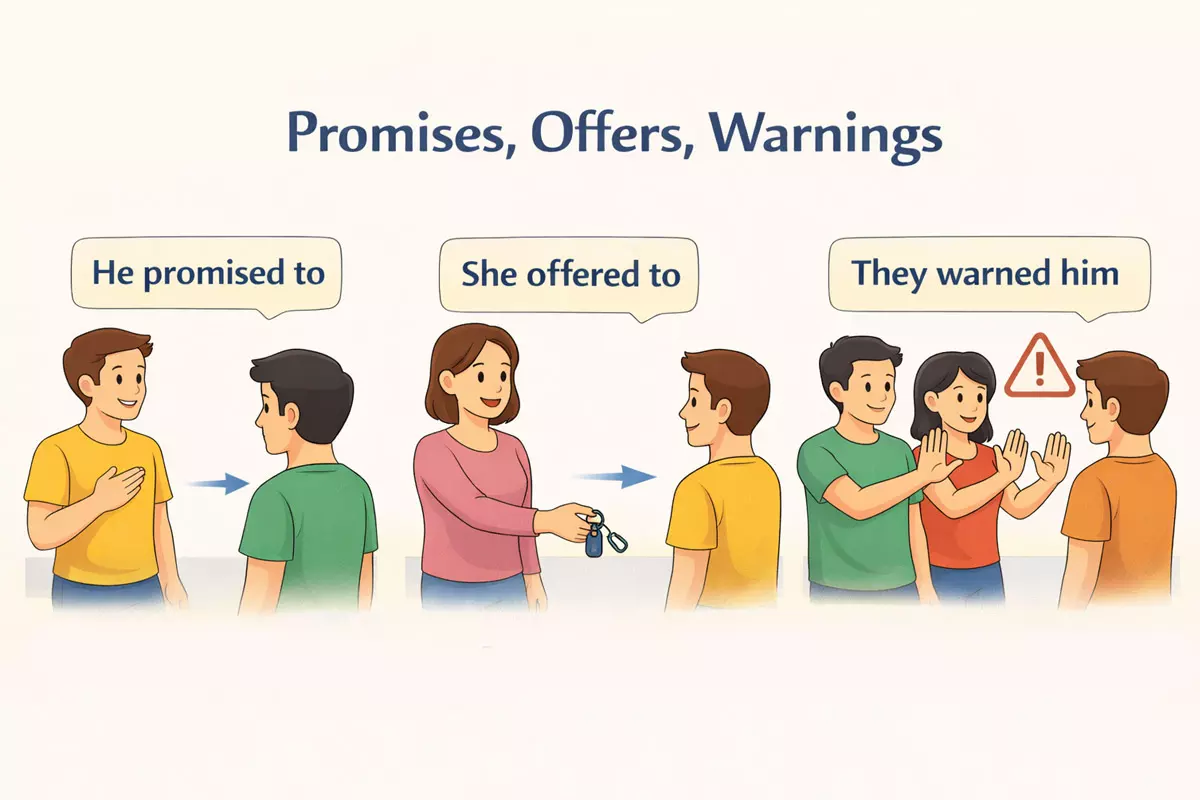
- Promise: “I’ll help you tomorrow.” → She promised to help me the next day.
- Offer: “Shall I carry that for you?” → He offered to carry it for me.
- Warning: “Don’t touch that, it’s hot!” → She warned me not to touch it because it was hot.
Key Differences at a Glance
| Type | Purpose | Reporting Verbs | Typical Example |
|---|---|---|---|
| Promise | To assure someone of a future action | promise, assure, guarantee | He promised to call me. |
| Offer | To propose help or a service | offer, suggest, propose | She offered to drive me home. |
| Warning | To alert about risk or danger | warn, caution, advise | They warned us not to go there. |
Common Sentence Patterns
- Promise: Subject + promised + (object) + to + base verb
- Offer: Subject + offered + (object) + to + base verb
- Warning: Subject + warned + (object) + not to + base verb
- Warning: Subject + warned + (object) + that + clause
Summary List: Reporting Verbs and Triggers
- promise → She promised that she would call later.
- offer → He offered that he would help with the project.
- warn → They warned that the weather might get worse.
- assure → She assured me that everything was under control.
- guarantee → The company guaranteed that the product would last for years.
- suggest → He suggested that we leave a bit earlier.
- propose → They proposed that the meeting be postponed.
- caution → The doctor cautioned that too much stress could be harmful.
- advise → She advised me that I should take a short break.
- alert → The system alerted users that an update was available.
- threaten (sometimes used similarly to warnings) → He threatened that he would report the problem.
- guarantee → They guaranteed that a refund would be issued.
In summary, the main distinctions among these reported speech types are the intention behind the original statement and the reporting verb or structure used. Recognizing these differences helps you accurately convey what someone said, intended, or cautioned about.
Common reporting verbs for each type
When we share what someone else said, especially regarding promises, offers, or warnings, we often rely on specific reporting verbs. Each category tends to use its own set of verbs, which help listeners or readers understand the speaker’s intention. Let’s break down the most frequent verbs used for reporting each type, along with notes on how they’re typically structured in sentences.
Reporting Promises
To express that someone has made a commitment, we use verbs that emphasize intention and assurance. These verbs are often followed by that-clauses or infinitives, depending on the structure.
- promise → She promised that she would finish the work on time.
- swear → He swore that he had never seen the document.
- vow → She vowed that she would never make the same mistake again.
- guarantee → They guaranteed that the service would be reliable.
- assure → He assured me that everything was under control.
- undertake → She undertook to complete the project by Friday.
- pledge → The company pledged that it would reduce emissions.
- commit → He committed himself to improving his results.
- declare → She declared that she was innocent.
- affirm → He affirmed that the agreement was still valid.
Reporting Offers
- offer → He offered to help me with the presentation.
- volunteer → She volunteered to organize the meeting.
- propose → They proposed to meet online instead.
- suggest → He suggested that I take a short break.
- agree → She agreed to drive us to the airport.
- invite → They invited me to join them for dinner.
- consent → He consented to share the information.
- promise → She promised to send the files later.
- recommend → The teacher recommended trying a different method.
- suggest → She suggested helping with the preparations.
Reporting Warnings
- warn → He warned me not to touch the equipment.
- advise → The doctor advised her to avoid heavy exercise.
- alert → The system alerted users that a problem had occurred.
- caution → She cautioned that the road might be slippery.
- remind → He reminded me to lock the door.
- threaten → They threatened to cancel the contract.
- forbid → The sign forbade visitors to enter the area.
- urge → She urged him to leave immediately.
- recommend → The guide recommended that we wear warm clothes.
- notify → The company notified customers that their order was ready.
Comparison of Typical Reporting Verb Patterns
It can be helpful to see how different verbs are structured in context. Here’s a table comparing some common reporting verbs and their usual grammatical patterns:
| Reporting Verb | Typical Structure | Example |
|---|---|---|
| promise | to + base verb / that + clause | She promised to help. / He promised that he would call. |
| offer | to + base verb | He offered to carry the bags. |
| warn | object + to + base verb / that + clause | They warned us to be careful. / She warned that it might rain. |
| advise | object + to + base verb / that + clause | The doctor advised him to rest. / She advised that we wait. |
| threaten | to + base verb / that + clause | He threatened to quit. / She threatened that she would call the police. |
Choosing the right reporting verb makes your meaning clear, so it’s worth paying attention to the specific verbs that fit each context. Each group—whether you’re sharing a promise, offer, or warning—has a set of verbs that carry the intended nuance and are accepted in standard English. Practicing these patterns helps you report speech more naturally and accurately.
Sentence patterns used in reported forms
When you need to report promises, offers, or warnings made by someone else, English uses specific structures to convey the original meaning accurately. The choice of reporting verb and the pattern that follows can change depending on the intention—whether someone is making a promise, offering help, or warning about something.
Common reporting verbs and structures
Reporting these speech acts typically involves verbs like promise, offer, and warn. Each verb often uses its own pattern, especially when followed by an object or a verb phrase. Here are some of the most frequent sentence patterns:
- promised to + verb (no object): She promised to call.
- promised (that) + clause: He promised that he would help.
- promised + object + (that) + clause: They promised us that they would arrive early.
- offered to + verb: He offered to carry my bag.
- warned + object + (not) to + verb: She warned me not to touch the stove.
- warned (that) + clause: The teacher warned that the exam would be difficult.
- offered + object + noun: She offered him a seat.
- promised + object + to + verb: He promised her to return soon. (less common but possible)
- warned + object + about + noun/gerund: He warned us about driving too fast.
- warned + object + against + gerund: She warned them against swimming at night.
Comparing direct and reported forms
Transforming direct speech into a reported version often requires changes in pronouns, verb forms, and sometimes time expressions. The table below illustrates how spoken promises, offers, and warnings are commonly reported.
| Direct Speech | Reported Form |
|---|---|
| "I will help you." | She promised to help me. |
| "Shall I open the window for you?" | He offered to open the window for me. |
| "Don't forget to lock the door." | She warned me to lock the door. |
| "You shouldn't touch that!" | He warned me not to touch that. |
| "Let me carry your bag." | She offered to carry my bag. |
| "We promise we won't be late." | They promised that they wouldn't be late. |
Notes on usage
While promise, offer, and warn are the most common reporting verbs for these situations, others like assure, guarantee, or threaten may also be used, sometimes with slightly different patterns. The verb tense in the reported clause usually shifts back (e.g., "will" becomes "would"), and pronouns change as needed.
Choosing the right pattern depends on the meaning you want to convey and the original sentence. Reviewing these structures can help you report speech accurately in both writing and conversation.
Changes in pronouns and time references
When promises, offers, and warnings are reported (for example, when shifting from direct to indirect speech), both pronouns and references to time often need to be adjusted. This helps maintain clarity and accuracy, especially when the perspective or context has changed. Paying attention to these shifts is crucial for reporting what someone said, offered, or warned about correctly.
Adjusting Pronouns in Reported Speech
Pronouns in direct statements usually refer to the speaker or listener in the original context. When reporting, these pronouns must be changed to fit the new perspective. For instance, "I will help you" becomes "He said he would help me." The pronouns 'I' and 'you' change according to the new speaker and listener.
- "I" (speaker) often becomes "he" or "she" in reported speech.
- "You" (listener) typically changes to "me," "him," "her," or "them," depending on context.
- "We" can become "they" or stay as "we," based on who is included in the reporting.
- "My," "your," "our," and other possessives shift in the same way as subject/object pronouns.
Shifting Time References
Alongside pronouns, time expressions also need adjustment. This is because the moment of speaking is now different, and references like "today" or "tomorrow" may no longer be accurate. For example, "I will do it tomorrow," when reported later, becomes "He said he would do it the next day."
- "Today" becomes "that day"
- "Tomorrow" changes to "the next day" or "the following day"
- "Yesterday" becomes "the day before" or "the previous day"
- "Now" changes to "then" or "at that moment"
- "Next week/month/year" becomes "the following week/month/year"
- "Last week/month/year" turns into "the previous week/month/year"
- "Here" is often changed to "there"
- "Ago" becomes "before"
- "This" may become "that"
- "These" can become "those"
Examples: From Direct to Reported Speech
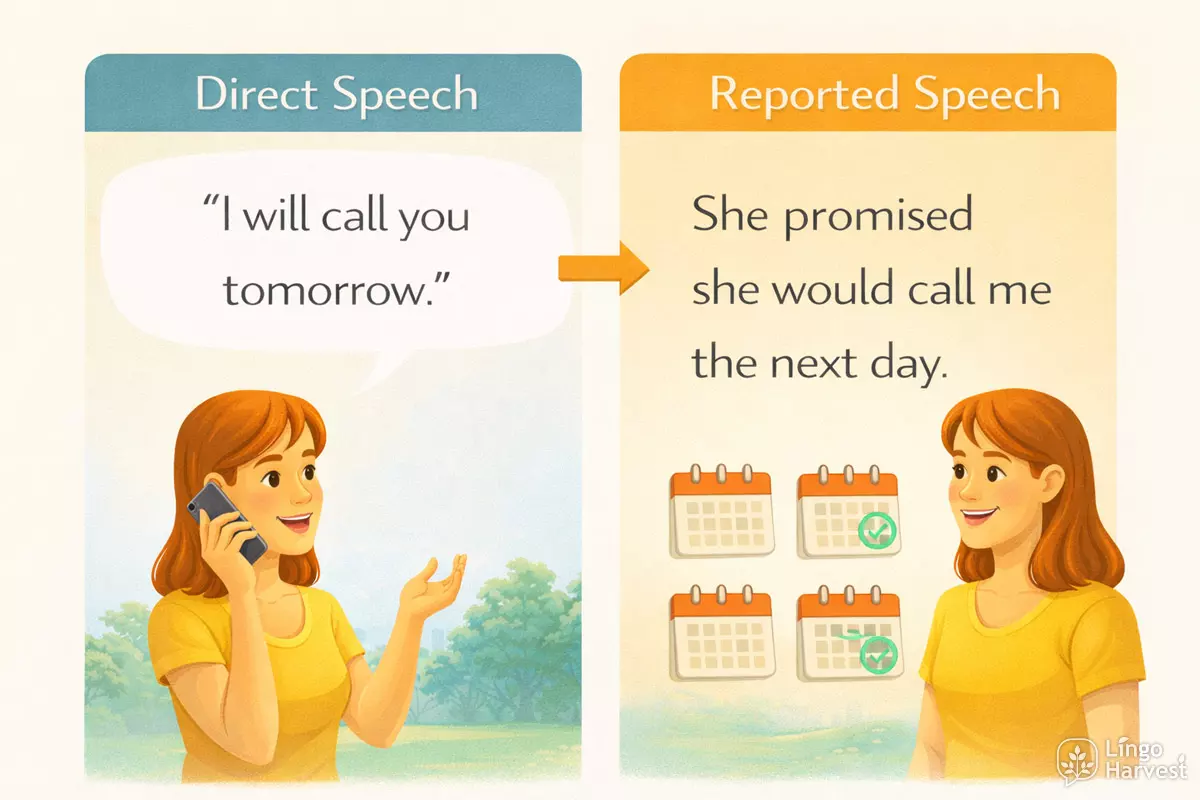
Let’s see how these changes appear in practice when promises, offers, and warnings are reported:
| Direct Speech | Reported Speech |
|---|---|
| "I will call you tomorrow." | She promised she would call me the next day. |
| "We can help you today." | They offered that they could help me that day. |
| "You must finish this by next week." | He warned me that I had to finish that by the following week. |
| "I won't forget your birthday." | She promised that she wouldn’t forget my birthday. |
| "Don't go there now!" | He warned me not to go there then. |
Quick Reference: Common Pronoun and Time Adjustments
- I → he/she
- We → they
- You → me/him/her/them
- My → his/her
- Your → my/his/her/their
- Today → that day
- Tomorrow → the next day
- Yesterday → the day before
- Now → then
- Here → there
By carefully adapting pronouns and time markers, reported versions of promises, offers, and warnings remain clear and true to the original meaning, even as the context changes.
Formal and informal reporting styles
Reporting promises, offers, and warnings can be done in more than one way, depending on the context and the relationship between speakers. The language you choose will reflect the level of formality required. In business, academic, or official settings, people often use precise, indirect structures. In everyday conversations, however, the language can be more relaxed and direct.
Key differences between formal and informal approaches
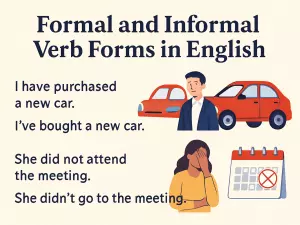
Formal speech tends to use indirect forms, modal verbs, and passive constructions. You’ll also see more complete sentences and polite expressions. On the other hand, informal language is more direct, uses contractions, and often includes phrasal verbs or casual expressions.
| Aspect | Formal Reporting | Informal Reporting |
|---|---|---|
| Typical verbs | stated, promised, offered, warned | said, told, offered, warned |
| Indirectness | He stated that he would… | He said he’d… |
| Modal verbs | would, should, might | will, can, might |
| Structure | “He promised that he would…” | “He said he’ll…” |
| Politeness markers | kindly, please, would you | just, can you |
| Contractions | rarely used | commonly used |
Common patterns in reported promises, offers, and warnings
- He promised that he would finish the work. ✅ (formal)
- She said she’ll send the file tomorrow. (informal)
- They offered to help with the project. ✅ (neutral/formal)
- He said he could give me a lift. (informal)
- The manager warned that delays might happen. ✅ (formal)
- She warned me not to open the email. (neutral/informal)
- He stated he would attend the meeting. ✅ (formal)
- She told me she’d call later. (informal)
- They assured us they would resolve the issue. ✅ (formal)
- He said he’ll take care of it. (informal)
Choosing the right style
Selecting between formal and informal reporting often depends on your audience. For colleagues, clients, or superiors, stick to more formal expressions. When speaking with friends or family, a relaxed tone is usually best. The main goal is to convey the original meaning accurately while matching the tone to the situation.
Typical mistakes learners make
Misreporting promises, offers, and warnings often causes confusion or changes the intended meaning. Many English learners struggle with the correct reporting verbs, tense shifts, and pronoun changes when rephrasing what someone said. Below are some frequent issues and misunderstandings that occur when handling these indirect speech patterns.
Common errors in reporting structures
- Using the wrong reporting verb (e.g., using "said" instead of "promised," "offered," or "warned").
- Forgetting to adjust pronouns to fit the reported context.
- Failing to shift verb tenses appropriately in reported speech.
- Omitting necessary connectors like "to" or "that" after reporting verbs.
- Confusing direct and indirect speech forms.
- Mixing up the person or subject in the reported clause.
- Misreporting modal verbs (e.g., using "will" instead of "would" after a reporting verb).
- Leaving out important information, such as what was promised or warned about.
- Incorrectly reporting offers using the wrong structure (e.g., "He offered that he would help" instead of "He offered to help").
- Using "warned" without specifying the potential consequence or action.
- Reporting promises as statements of fact instead of commitments.
- Failing to use infinitives where required (e.g., "offered help" vs. "offered to help").
Confusing reporting verbs and their patterns
Learners often mix up which verbs are followed by infinitives and which by clauses. The table below illustrates these differences:
| Reporting Verb | Correct Pattern |
|---|---|
| Promise | verb + to-infinitive (She promised to call.) |
| Offer | verb + to-infinitive (He offered to help.) |
| Warn | verb + object + (not) to-infinitive (They warned us not to go.) |
| Say/Tell | verb + (that) clause (She said that she would come.) |
Examples of incorrect vs. correct forms
- ❌ She promised that she will help. → ✅ She promised to help.
- ❌ He offered me that he would drive. → ✅ He offered to drive me.
- ❌ They warned not go there. → ✅ They warned us not to go there.
- ❌ She said me that she promises help. → ✅ She told me she promised to help.
Tips to avoid these pitfalls
- Always check which structure (infinitive, clause, object) each reporting verb requires.
- Change pronouns and time expressions to fit the new context.
- Practice with common reporting verbs and their patterns.
- Review modal verb changes in reported speech (will → would, can → could, etc.).
- Remember to state the action or consequence when reporting a warning.
Paying attention to these common pitfalls can greatly improve accuracy and clarity when reporting what someone has promised, offered, or warned.
Homework
Complete the exercises below to practice reporting promises, offers, and warnings correctly. Pay special attention to pronoun changes, time references, verb patterns, and the level of formality in each sentence.
1. Rewrite the Sentences in Reported Speech
Rewrite each sentence using an appropriate reporting verb and correct pronoun and time changes.
- “I will help you tomorrow,” she said.
- “We can finish this today,” they said.
- “Don’t touch this now,” he said to me.
- “I promise I won’t be late,” Anna said.
- “I can drive you home,” he said.
- “You must leave here immediately,” the guard said.
- “I’ll send you the file next week,” she said.
- “We won’t forget your birthday,” they said.
- “Don’t open this email,” she said to him.
- “I can explain this to you later,” the teacher said.
Show answers
- She promised that she would help me the next day.
- They offered that they could finish it that day.
- He warned me not to touch that then.
- Anna promised that she wouldn’t be late.
- He offered to drive me home.
- The guard warned me to leave there immediately.
- She promised that she would send me the file the following week.
- They promised that they wouldn’t forget my birthday.
- She warned him not to open that email.
- The teacher offered to explain that to me later.
2. Choose the Correct Reporting Form
Rewrite each sentence using the correct reporting verb and structure. Decide whether to use a that-clause or a to-infinitive.
- “I will fix the problem,” he said. (promise)
- “Can I carry your bag?” she said. (offer)
- “Don’t be late again,” the manager said. (warn)
- “I will never tell anyone,” she said. (swear)
- “Let me help you with this,” he said. (offer)
- “You should save some money,” my father said. (advise)
- “I’ll stay and wait with you,” they said. (promise)
- “Please don’t go there alone,” she said. (warn)
- “I can send the report tonight,” he said. (offer)
- “I won’t make the same mistake again,” Anna said. (vow)
Show answers
- He promised to fix the problem.
- She offered to carry my bag.
- The manager warned us not to be late again.
- She swore that she would never tell anyone.
- He offered to help me with that.
- My father advised me to save some money.
- They promised that they would stay and wait with me.
- She warned me not to go there alone.
- He offered to send the report that night.
- Anna vowed that she would never make the same mistake again.