Reporting Opinions, Beliefs, and Thoughts in English

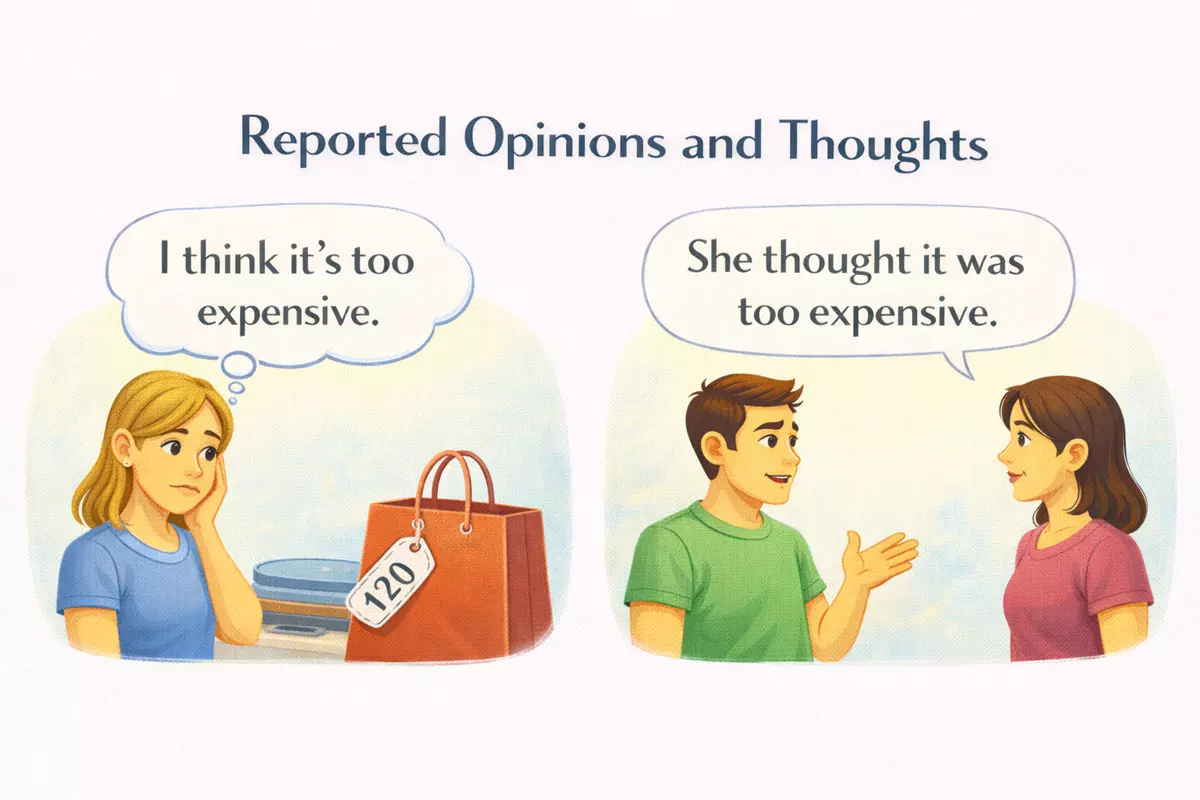 Here we how to express and report opinions and beliefs in English. It explains the use of reporting verbs, that-clauses, pronoun and perspective shifts, tense choices, and highlights common mistakes in reporting thoughts and beliefs.
Expressing someone else's thoughts or feelings is a regular aspect of everyday conversation, yet it can be challenging to do so accurately in English. To communicate more clearly, it is important to use the right language structures when sharing other people's perspectives. Mastering these techniques not only helps you avoid misunderstandings but also ensures that you represent their ideas faithfully. By practicing and becoming familiar with common phrases and reporting verbs, you can improve your ability to convey what others think or feel in a natural and precise way.
How opinions and beliefs are expressed
In English, people use a variety of language structures to share their personal views, judgments, and convictions. These can range from direct statements to more nuanced or tentative forms. The choice often depends on how certain the speaker feels and how formal or informal the context is.
Common Expressions for Sharing Opinions
To communicate personal perspectives, speakers often rely on specific verbs and introductory phrases. These help signal that what follows is a subjective viewpoint rather than a fact.
- I think this option is the most practical.
- I believe we should start earlier tomorrow.
- In my opinion this explanation is clear enough.
- It seems to me the instructions are missing one step.
- As far as I'm concerned the deadline should stay the same.
- I feel this exercise is a bit too difficult for beginners.
- To my mind the second example sounds more natural.
- If you ask me we should double-check the numbers.
- From my perspective the main problem is the lack of time.
- Personally, I think this topic needs more practice.
- I would say that his answer was probably correct.
- I guess we can finish it by Friday.
- My impression is that she didn’t understand the question.
- I suppose they will agree with the new plan.
- I suspect the email went to the wrong address.
- I have a feeling that something will change soon.
- I’m convinced that regular practice will help you improve.
- I doubt that this method will work for everyone.
Reporting Others’ Thoughts and Beliefs
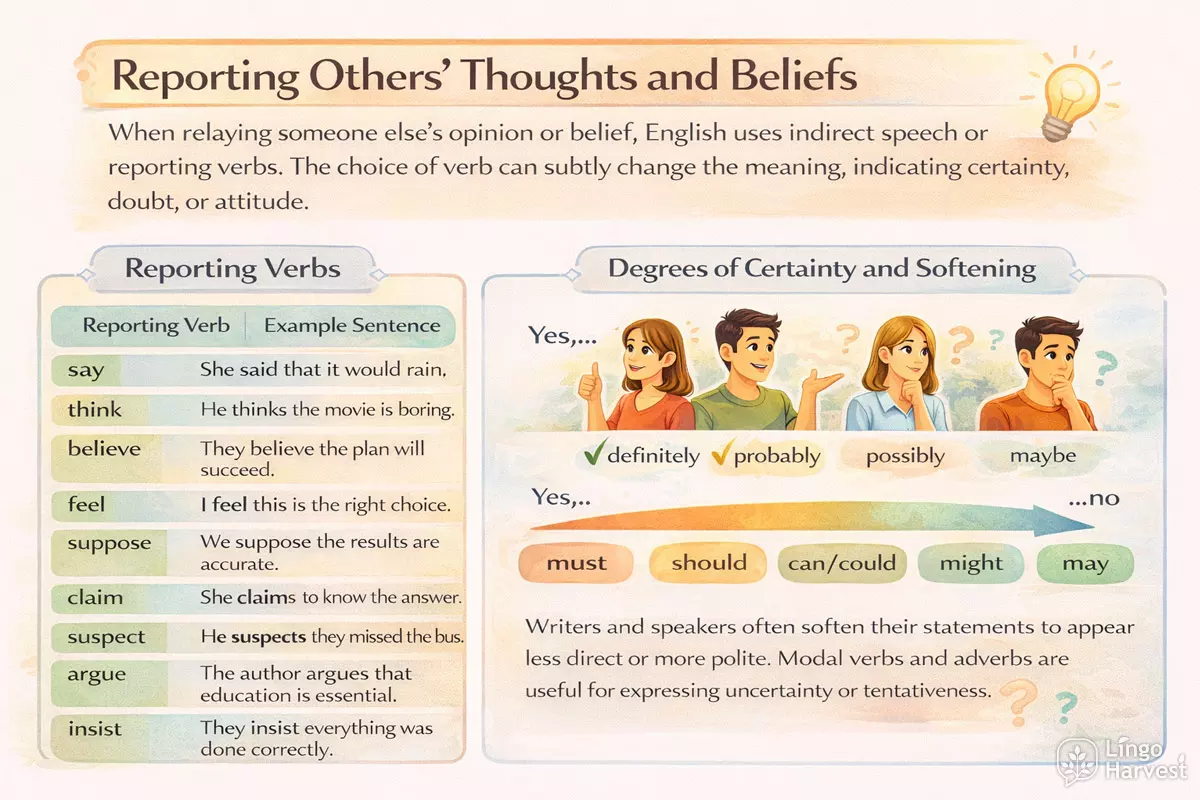
When relaying someone else’s opinion or belief, English uses indirect speech or reporting verbs. The choice of verb can subtly change the meaning, indicating certainty, doubt, or attitude.
| Reporting Verb | Example Sentence |
|---|---|
| say | She said that it would rain. |
| think | He thinks the movie is boring. |
| believe | They believe the plan will succeed. |
| feel | I feel this is the right choice. |
| suppose | We suppose the results are accurate. |
| claim | She claims to know the answer. |
| suspect | He suspects they missed the bus. |
| argue | The author argues that education is essential. |
| insist | They insist everything was done correctly. |
| assume | I assume he will be late. |
Degrees of Certainty and Softening
Writers and speakers often soften their statements to appear less direct or more polite. Modal verbs and adverbs are useful for expressing uncertainty or tentativeness.
- Might, may, could (e.g., "It might be true.")
- Probably, possibly, perhaps (e.g., "Perhaps she forgot.")
- Seem, appear (e.g., "It seems unlikely.")
- Apparently, reportedly (e.g., "Apparently, it was delayed.")
Choosing the right expression depends on how strongly you hold the belief, your relationship with the listener, and the context. Using hedging language or direct statements can change the tone and clarity of your communication.
Reporting verbs for thoughts and beliefs
When you want to share what someone thinks, believes, or feels about a topic, English offers many specific verbs to express these mental states. These verbs help indicate that the information is not a fact, but rather an opinion, assumption, or belief. Choosing the right verb can clarify the speaker's attitude and the strength of their conviction.
Common verbs to express thoughts and beliefs
Writers and speakers often use a variety of verbs to introduce opinions or mental processes. Here are some of the most frequently used ones:
- think → I think this plan will work.
- believe → I believe he is telling the truth.
- suppose → I suppose we can meet tomorrow.
- assume → I assume the meeting starts at 10.
- guess → I guess she forgot about it.
- imagine → I can’t imagine him saying that.
- consider → I consider this option the best.
- reckon (mainly British English) → I reckon it’ll rain later.
- suspect → I suspect something went wrong.
- feel → I feel this answer is more natural.
- presume → I presume you’ve already seen the email.
- conclude → I conclude that the results are reliable.
- estimate → I estimate it will take two hours.
- predict → I predict sales will increase next month.
- expect → I expect him to arrive soon.
- judge → I judge this to be a fair decision.
- view → I view this as a good opportunity.
- regard → I regard her as an expert.
- maintain → I maintain that we need more evidence.
- hold (a belief) → I hold the belief that practice makes progress.
Patterns and usage
Most of these verbs can be followed by a that-clause to report the content of the thought. For example: She believes that the meeting will be short. Some can also be followed by an object + to-infinitive structure, especially in more formal writing: They considered him to be honest.
| Verb | Typical Structure | Example |
|---|---|---|
| think | that-clause | I think that she is right. |
| suspect | that-clause | They suspect that he lied. |
| consider | object + to-infinitive | We consider her to be reliable. |
| imagine | that-clause | He imagined that he would win. |
| assume | that-clause | I assume that you agree. |
| regard | object + as + noun/adjective | Many regard him as a genius. |
Choosing the right verb
The verb you select can indicate how strong or tentative the opinion is. For example, believe and maintain often show a firmer stance, while guess or suppose suggest uncertainty. Understanding these subtle differences helps you communicate both your message and your attitude more precisely.
That-clauses in reported opinions
When sharing what someone thinks, believes, or feels, English often uses a specific sentence structure: a reporting verb followed by a that-clause. This pattern lets speakers communicate another person’s opinion or belief in an indirect, polite, or formal way. The that introduces the content of the opinion, but it can sometimes be omitted, especially in informal speech.
Examples of usage
Consider how the structure works in practice. The following examples show how a variety of reporting verbs combine with that-clauses to convey someone’s viewpoint or belief:
- She thinks (that) it will rain tomorrow.
- They believe (that) the show is cancelled.
- I suppose (that) you’re right.
- He claims (that) he saw the accident.
- We hope (that) things improve soon.
- You know (that) I’m telling the truth.
- She insists (that) she paid the bill.
- They argue (that) stricter laws are needed.
- I understand (that) the meeting is postponed.
- He predicts (that) the team will win.
Omitting "that" in conversation
In everyday English, the word that is frequently left out after reporting verbs, especially in speech. Both forms are correct, but omitting that often sounds more natural and less formal. For example:
- She thinks (that) it’s too late.
- He believes (that) this is the best option.
Word order and tense changes
When reporting opinions, the subject and verb order remains the same as in a statement (subject + verb + object), even if the reporting verb is in the past. However, tense changes (backshifting) may occur when reporting in the past. The table below illustrates typical forms:
| Direct Statement | Reported Opinion |
|---|---|
| I am tired. | She said (that) she was tired. |
| We will win. | They believed (that) they would win. |
| He likes pizza. | I thought (that) he liked pizza. |
| You can help. | She felt (that) you could help. |
This structure is invaluable for expressing attitudes, relaying information, and discussing viewpoints in both spoken and written English. Understanding how to use these clauses helps ensure clarity and nuance when conveying what others think or believe.
Pronoun and perspective changes
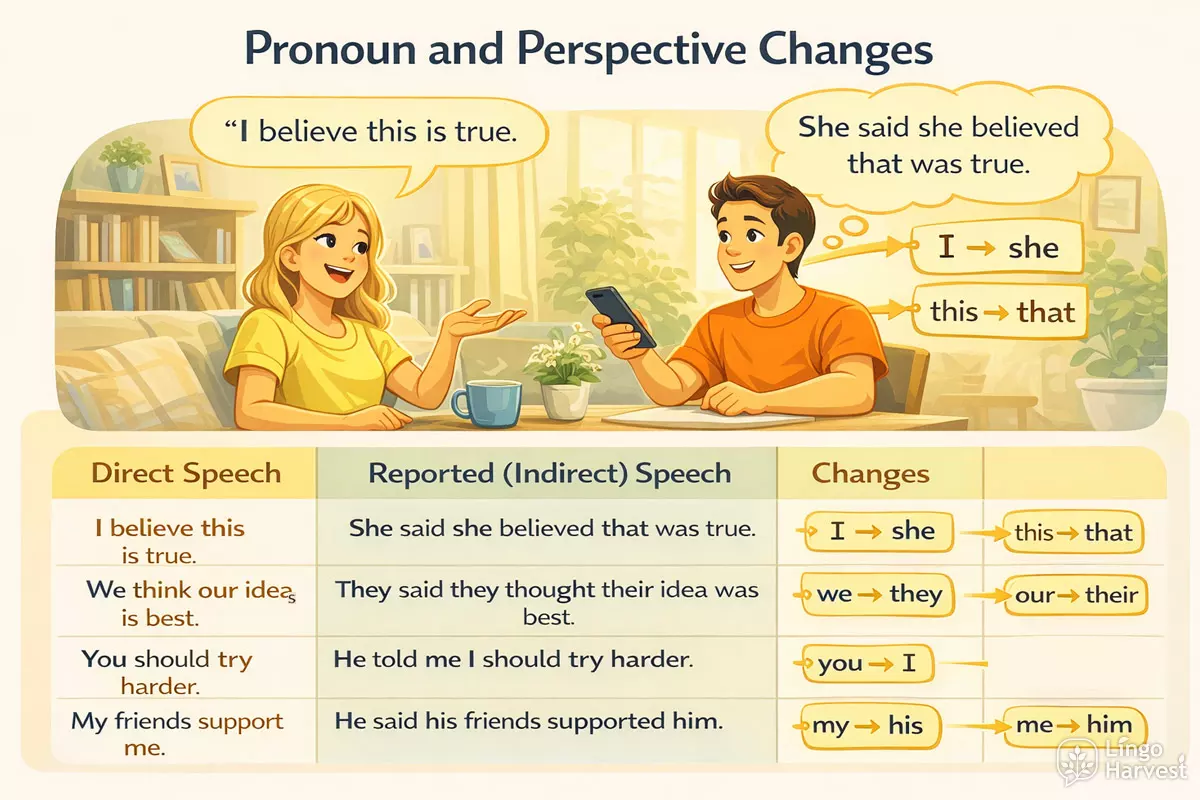
When you report someone’s opinions, beliefs, or thoughts, it’s important to consider how pronouns and the speaker’s point of view shift in indirect speech. This helps make the statement clear and accurate from the perspective of the person reporting, rather than the original speaker.
Why do pronouns and perspective shift?
Direct speech uses the original speaker’s point of view, but indirect speech adapts that perspective to fit the new context. This often means changing pronouns like “I” to “he” or “she,” and adjusting possessive forms such as “my” to “his,” “her,” or “their.” These shifts prevent confusion about who is being referred to.
Common changes in reported speech
The table below gives a structured look at how pronouns and perspectives are typically altered when converting direct statements into indirect ones:
| Direct Speech | Reported (Indirect) Speech | Explanation |
|---|---|---|
| I believe this is true. | She said she believed that was true. | “I” becomes “she”; “this” becomes “that”. |
| We think our idea is best. | They said they thought their idea was best. | “We” and “our” change to “they” and “their”. |
| You should try harder. | He told me I should try harder. | “You” becomes “I” if the reporter is the listener. |
| My friends support me. | He said his friends supported him. | “My” and “me” shift to “his” and “him”. |
| This is our problem. | She said that was their problem. | “This” becomes “that”; “our” becomes “their”. |
Guidelines for shifting perspective
- Change first-person pronouns (“I,” “we,” “my,” “our”) to reflect the original speaker’s identity from the reporter’s perspective.
- Switch second-person pronouns (“you,” “your”) based on who is addressed in the reporting context.
- Adjust demonstratives (“this,” “these,” “here”) to match the new point of reference, often becoming “that,” “those,” or “there.”
- Reflect changes in tense if needed, especially when the reporting verb is in the past.
Examples of common changes
- “I am tired.” → He said he was tired.
- “You need help.” → She told me I needed help.
- “My book is on the table.” → Tom said his book was on the table.
- “We will win.” → They believed they would win.
- “Our team played well.” → The coach said their team had played well.
- “This is easy.” → She thought that was easy.
- “Are you coming with us?” → They asked if I was coming with them.
- “I can do it myself.” → Jane said she could do it herself.
- “You should see my house.” → He told me I should see his house.
- “We lost our keys.” → They said they had lost their keys.
- “I want your advice.” → She said she wanted my advice.
- “These are my shoes.” → He said those were his shoes.
Adapting pronouns and viewpoint is essential for clarity and accuracy in reported speech. This helps avoid ambiguity and ensures the listener or reader knows exactly whose thoughts or beliefs are being described.
Tense choices in reported thoughts
When expressing someone’s inner opinions or beliefs indirectly, the selection of verb tense can change the nuance or meaning. English speakers often shift tenses in reported speech to match the context, the time of the original thought, and whether the idea still feels true or relevant at the time of reporting. Understanding these tense patterns helps make your writing and speaking clearer and more precise.
Backshifting: When and Why It Happens
In many cases, reporting thoughts involves “backshifting”—moving the verb one step back in time. This is common when the reporting verb is in the past:
- Direct: I am tired.
- Reported: She thought she was tired.
Backshifting isn’t always required, though. If the idea is still true, the present tense may be kept:
- She thought she is right. (still true now)
Common Patterns in Reporting Thoughts
Writers and speakers use a variety of forms to relay opinions, beliefs, or mental states. Here are typical reporting patterns:
- She believed (that) the test would be easy.
- He felt (that) he was making progress.
- They assumed (that) the meeting had been cancelled.
- I figured (that) nobody would mind.
- We suspected (that) she knew the answer.
- He wondered if he could finish on time.
- She remembered (that) he was allergic to nuts.
- He realized (that) it was late.
- They expected (that) help would arrive soon.
- I imagined (that) the weather would be better.
- She doubted (that) the plan would work.
- He considered (that) moving was a good idea.
Comparing Tense Choices
Context matters: sometimes keeping the present tense signals that the thought is still valid, while using the past can imply it was only true before. Here’s a comparison:
| Original Thought | Reported (Backshifted) | Reported (No Backshift) |
|---|---|---|
| “I am hungry.” | She thought she was hungry. | She thought she is hungry. (still hungry) |
| “I believe it’s true.” | He believed it was true. | He believed it is true. (still true) |
| “I will win.” | She thought she would win. | She thinks she will win. (present reporting) |
| “I have finished.” | He thought he had finished. | He thinks he has finished. |
Practical Tips
- Use backshifting when reporting a thought from the past and the situation has changed or is uncertain.
- Keep the present tense if the reported belief or opinion is still relevant now.
- Modal verbs like can, will, and must typically shift to could, would, and had to in indirect statements.
- Always consider your time frame and the current truth of what you’re reporting.
By mastering these tense choices, you’ll report thoughts, beliefs, and opinions more accurately, reflecting both the timing and the current status of the ideas.
Common errors in reporting opinions
When sharing what someone thinks, feels, or believes, people often make mistakes that can change the meaning or cause confusion. These issues usually come from grammar errors, unclear reporting structures, or using the wrong reporting verbs. Understanding where these slip-ups happen can help you avoid them and communicate more accurately.
Misusing Reporting Verbs
Choosing the correct verb is important. For example, "say," "think," "believe," "suggest," and "claim" are not always interchangeable. Each verb introduces a different nuance or emphasis. Using "say" when "think" is needed can make the reported statement sound like a fact rather than an opinion.
- Incorrect: She said that pizza is the best food. (Sounds like a fact.)
- Better: She thinks that pizza is the best food. (Shows it’s her opinion.)
Confusing Direct and Indirect Speech
Learners sometimes mix up direct and indirect speech. Direct speech quotes the person’s exact words, while indirect speech summarizes or paraphrases the idea.
- Direct: He said, "I don’t like coffee."
- Indirect: He said that he didn’t like coffee.
- Error: He said, he didn’t like coffee. (Mixes the two forms.)
Incorrect Tense Shifts
When reporting opinions, especially in indirect speech, it's important to adjust tenses correctly. Forgetting to shift the tense can make sentences look odd or unclear.
- Incorrect: She said she likes chocolate. (If the reporting verb is in the past, the tense should shift.)
- Correct: She said she liked chocolate.
Omitting "That" or Using It Unnecessarily
While "that" is often optional in spoken English, omitting or including it at the wrong time can make sentences awkward or ambiguous.
- Natural: He believes (that) it will rain tomorrow.
- Awkward: He believes it will rain tomorrow. (Acceptable, but sometimes less clear in complex sentences.)
- Incorrect: He believes that to rain tomorrow. (Incorrect use of "that.")
Confusing Subject Pronouns
Reporting opinions often requires changing pronouns to fit the new context. Failing to do this can lead to confusion about whose opinion is being reported.
- Incorrect: Maria said I should study more. (Did Maria say you or herself?)
- Clear: Maria said she should study more.
Using the Wrong Reporting Structure
Some reporting verbs require specific structures. For example, "suggest" is often followed by a gerund or a "that"-clause with a subjunctive verb.
| Verb | Correct Structure | Common Error | Example |
|---|---|---|---|
| suggest | suggest (that) + clause / suggest + gerund | suggest + infinitive | ❌ She suggested to go. ✅ She suggested going. ✅ She suggested (that) we go. |
| recommend | recommend (that) + clause / recommend + gerund | recommend + infinitive | ❌ He recommended to try. ✅ He recommended trying. ✅ He recommended (that) I try. |
| advise | advise + object + to + verb | advise + gerund | ❌ She advised going. ✅ She advised me to go. |
| say | say + (that) + clause | say + infinitive | ❌ He said to go. ✅ He said (that) we should go. |
Overusing "According to"
"According to" is used to report information from a source, but it’s not always appropriate for personal opinions or beliefs. Using it in the wrong context can make the sentence sound unnatural.
- Incorrect: According to me, this is a good idea.
- Correct: In my opinion, this is a good idea.
Summary
Many common mistakes in reporting what people think or believe can be avoided by paying attention to verb choice, sentence structure, tense consistency, and pronoun use. Being aware of these typical pitfalls will help you express opinions, beliefs, and thoughts more clearly and accurately in English.