Reporting Verbs in English: Meaning and Usage Rules

 The article explains what reporting verbs are and compares pairs like say and tell. It covers how to use reporting verbs with objects and clauses, discusses meaning differences, guides verb choice for context, and points out typical learner mistakes.
Learning to express what others say or think is crucial for effective communication in English, as choosing the right reporting verbs can greatly impact clarity and accuracy. By understanding how to use these verbs correctly, you can convey information reliably and ensure your message reflects the original intent. Developing this skill not only improves your language proficiency but also enhances your ability to participate in discussions, share ideas, and report on events or opinions with confidence and precision.
What reporting verbs are
In English, reporting verbs are used to describe or report what someone else has said, thought, or written. Rather than simply repeating someone’s words, these verbs allow us to add detail about how something was communicated—whether it was suggested, claimed, admitted, warned, or questioned. They help convey the speaker’s attitude or the context of the original statement.
Why use reporting verbs?
These verbs play a crucial role in both spoken and written English. They help avoid monotonous repetition of “say” and “tell,” making language richer and more precise. By choosing the right reporting verb, a speaker or writer can express subtle differences in meaning, such as doubt, certainty, suggestion, or accusation.
- Suggest: implies offering an idea or possibility.
- Insist: shows firmness or determination.
- Warn: indicates alerting someone to danger or a problem.
- Admit: reveals acceptance or acknowledgment, often of something negative.
- Promise: expresses commitment to do something.
- Complain: conveys dissatisfaction or annoyance.
- Advise: gives a recommendation or guidance.
- Deny: expresses rejection or refusal of something.
- Claim: asserts something as true, often without proof.
- Agree: shows shared opinion or consent.
- Recommend: suggests something as a good choice.
- Remind: helps someone remember something.
- Encourage: gives support or confidence.
- Order: gives a command or instruction.
- Threaten: expresses intention to cause harm if conditions aren’t met.
- Suggest: proposes an idea or course of action.
- Explain: makes something clear or easy to understand.
- Report: gives information about something observed or heard.
How reporting verbs work in sentences

Reporting verbs are usually followed by a clause or an object, and the structure depends on the verb itself. Some are followed by “that” clauses (She admitted that she was wrong), others by infinitives (He promised to help), and some by gerunds (They denied breaking the rules).
| Verb | Common Structure | Example |
|---|---|---|
| Advise | advise + object + to-infinitive | The doctor advised her to rest. |
| Promise | promise + to-infinitive | He promised to call me. |
| Deny | deny + gerund | They denied stealing the money. |
| Suggest | suggest + (that) + clause / suggest + gerund | She suggested that we leave early. He suggested taking a taxi. |
| Warn | warn + object + (not) to-infinitive | The teacher warned the students not to cheat. |
Choosing the right reporting verb depends on the intention behind the original statement and the message you want to convey. Understanding their usage helps you report speech more accurately and express subtle meanings in English communication.
Say vs tell and similar verb pairs
Choosing between reporting verbs like say and tell can be tricky, since each verb follows its own grammatical rules and is used in different contexts. Understanding the distinction helps you make your English sound more natural and precise. Let’s break down the differences and look at other commonly confused verb pairs used when reporting speech or information.
How "say" and "tell" differ
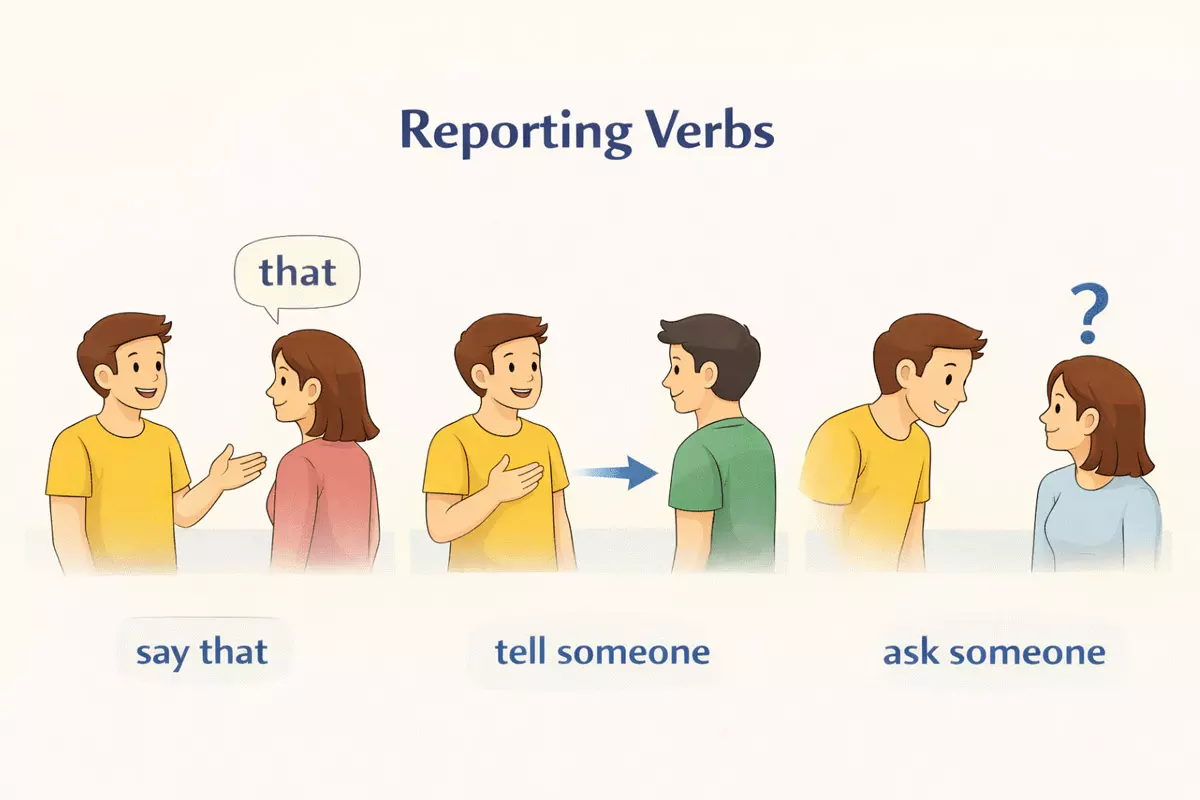
Say is usually followed by the words spoken or a clause, without mentioning the listener directly. In contrast, tell almost always requires an object (the person who is being spoken to) and is often followed by what was said, usually as an object clause or with instructions.
| Verb | Typical Structure & Example |
|---|---|
| say |
|
| tell |
|
Other reporting verb pairs to watch
English includes several pairs of verbs with subtle differences in reporting style, grammar, or meaning. Here are some of the most common:
- Ask vs. inquire – "Ask" is more common and informal; "inquire" is formal and often used in writing.
- Advise vs. suggest – "Advise" implies giving a recommendation with authority; "suggest" is more neutral and less forceful.
- Inform vs. notify – Both mean to give information, but "notify" is often official or written.
- Order vs. instruct – "Order" is stronger, often used in military or strict settings; "instruct" is more neutral, used in education or formal contexts.
- Remind vs. warn – "Remind" is to help someone remember; "warn" is to tell someone about possible danger or problems.
- Promise vs. assure – "Promise" is to commit to do something; "assure" is to make someone feel certain or confident.
- Explain vs. describe – "Explain" is to make something clear; "describe" is to give details about what something is like.
- Announce vs. report – "Announce" is to make something known publicly; "report" can be both public or private and is often factual.
- Reply vs. respond – Both mean to answer, but "reply" is often direct and brief, while "respond" can be more formal or detailed.
- Complain vs. protest – "Complain" is to express dissatisfaction; "protest" is to express strong objection, often publicly.
Tips for choosing the right reporting verb
- Check if the verb needs a direct object (e.g., "tell" needs a person, "say" does not).
- Consider formality: Some verbs sound more formal or official.
- Think about the intent: Are you giving information, instructions, or expressing an opinion?
- Watch for typical grammatical patterns (e.g., "ask someone to do," "inform someone that").
Mastering these distinctions helps you report speech and information more accurately. Using the right verb not only clarifies your meaning but also improves the flow and professionalism of your English communication.
Reporting verbs with objects and clauses
Many reporting verbs in English can be followed by both a direct object (the person being spoken to) and a clause (the reported speech or information). This structure allows for more precise communication about who said what and to whom. Instead of simply using “say” or “tell,” English offers a wide range of verbs that can take an object and a following clause, often with specific patterns or meanings.
Common verbs that take an object and clause
Below are some verbs frequently used in this pattern. Notice how the object (the listener) comes between the verb and the clause, with various connecting words such as “that,” “to,” or “if/whether.”
- Tell – She told me that she would be late.
- Remind – He reminded us to lock the door.
- Inform – They informed the team that the meeting was canceled.
- Warn – The doctor warned him not to eat too much sugar.
- Advise – She advised me to take a break.
- Assure – He assured her that everything was fine.
- Convince – We convinced them that it was a good idea.
- Persuade – I persuaded my friend to join the club.
- Promise – She promised him that she would help.
- Remind – He reminded us to check the results.
- Accuse – She accused him of lying.
- Warn – They warned us that the road was slippery.
- Notify – The company notified the employees that changes were coming.
- Convince – He convinced her to apply for the job.
Patterns and connectors
The choice of connector (such as “that,” “to,” or “of”) depends on the verb. Some verbs require “that” before the clause, while others use “to + verb” or “of + -ing.” Understanding these patterns helps avoid common mistakes.
| Verb | Pattern | Example |
|---|---|---|
| Tell | object + that-clause | She told me that she was leaving. |
| Advise | object + to-infinitive | They advised us to wait. |
| Remind | object + to-infinitive | He reminded her to call. |
| Accuse | object + of + -ing | She accused him of lying. |
| Warn | object + (not) to-infinitive / object + that-clause | The teacher warned us not to cheat. The guide warned them that the trail was dangerous. |
| Convince | object + to-infinitive / object + that-clause | We convinced him to try. They convinced her that it was safe. |
| Assure | object + that-clause | He assured me that all was well. |
Tips for accurate use
- Always check which connector is required after the verb.
- Some verbs can be followed by more than one pattern (e.g., “warn” can take both “to-infinitive” and “that-clause”).
- Omitting the object often changes the meaning or makes the sentence ungrammatical (e.g., “She told that she was tired” ❌ vs. “She told me that she was tired” ✅).
- Practice with real examples to get comfortable with these structures.
Mastering these reporting structures will make both your spoken and written English clearer and more nuanced, especially when you want to specify who was involved in the conversation and what was communicated.
Meaning differences between common reporting verbs
Reporting verbs express how someone communicates information, but each verb carries its own nuance. Choosing the right verb helps clarify whether the speaker is simply repeating, giving an opinion, making a suggestion, or expressing doubt. Understanding these distinctions is essential for accurate and natural English.
Key distinctions in usage and meaning
Many verbs used for reporting—such as say, tell, ask, advise, claim, and suggest—differ not only in grammar but also in the attitude or certainty they convey. For example, say is neutral, while claim implies doubt about truth. Some verbs require direct objects; others do not. These small differences can change the whole meaning of a sentence.

| Reporting Verb | Typical Use & Meaning | Example |
|---|---|---|
| say | Neutral; used for reporting speech without a listener | He said he was tired. |
| tell | Requires a listener (object); often used for instructions or information | She told me to wait. |
| ask | Used for questions or requests | They asked if I could help. |
| advise | Suggests giving recommendations | The doctor advised him to rest. |
| claim | Implies doubt or lack of proof | He claimed he had met the president. |
| suggest | Proposes an idea or action indirectly | She suggested going for a walk. |
| promise | Expresses a commitment or guarantee | I promised to call her. |
| deny | States something is not true | He denied breaking the window. |
| admit | Confesses or acknowledges something | She admitted making a mistake. |
| insist | Shows strong persistence or emphasis | He insisted that he was right. |
Common nuances and contexts
- Say is the most general, often used when the listener is not specified.
- Tell always needs a person as the object (e.g., “She told him”).
- Ask is only for questions or requests, never for statements.
- Advise and suggest both offer recommendations, but advise is more formal and direct.
- Claim hints at possible disbelief or lack of evidence.
- Deny and admit are opposites: one rejects, the other accepts responsibility or truth.
- Promise and insist both show strong intention, but promise is about future action, while insist is about emphasizing a point.
Being aware of these subtle distinctions helps you select the most accurate verb, making your communication clearer and more precise. Experimenting with different reporting verbs in context will deepen your understanding and confidence in using them.
Choosing the right verb for context
Selecting the most appropriate reporting verb depends on both the meaning you wish to convey and the situation in which you are using it. Different verbs reflect not only the content of what is reported, but also the speaker’s attitude, the level of certainty, and whether the information is direct or indirect. Using the wrong reporting verb can subtly (or not so subtly) change the meaning of a statement.
Consider the intention and strength
Some reporting verbs indicate a strong commitment to the truth of the information, while others express uncertainty, suggestion, or even disagreement. For example, “state” and “insist” imply confidence and authority, while “suggest” or “speculate” introduce doubt or possibility.
- State – to express something clearly and firmly
- Suggest – to put forward an idea for consideration
- Argue – to present reasons in support of an idea
- Deny – to say that something is not true
- Claim – to assert something, often without proof
- Admit – to acknowledge something as true, often reluctantly
- Announce – to make something known publicly
- Warn – to alert others to possible danger or problem
- Promise – to assure someone that something will happen
- Complain – to express dissatisfaction
- Recommend – to advise that something is good or suitable
- Insist – to demand something forcefully
- Report – to relay information, often neutrally
- Explain – to make something clear by describing in detail
- Suggest – to propose an idea or plan
Matching verbs to context
When you want to reflect the speaker's attitude or the reliability of the information, carefully choose a verb that fits. For example, “allege” implies doubt or a lack of proof, while “confirm” means the information is certain. The nuance between “advise,” “recommend,” and “urge” is also important. “Advise” is neutral, “recommend” is slightly stronger, and “urge” is much more forceful.
| Reporting Verb | Typical Use/Implication |
|---|---|
| Allege | Used when something is claimed without proof |
| Confirm | Used when something is verified or made certain |
| Advise | Giving neutral recommendations |
| Urge | Strongly encouraging action |
| Suggest | Offering a possibility or idea softly |
| Insist | Expressing something forcefully or with emphasis |
| Complain | Expressing dissatisfaction or a problem |
| Promise | Assuring an action or result will occur |
Tips for accurate verb choice
- Think about the speaker’s intention: Are they neutral, persuasive, doubtful, or emotional?
- Consider the strength of the information: Is it a fact, a suggestion, or an accusation?
- Ask if the verb fits the level of formality required by the situation.
- Be mindful of subtle differences—“say” is neutral, while “insist” is forceful.
- Review the context: Academic writing often prefers precise verbs like “argue” or “demonstrate.”
Choosing reporting verbs carefully allows you to reflect the original speaker’s meaning and your own attitude accurately, making your writing clear and nuanced.
Typical learner mistakes with reporting verbs
English learners often encounter challenges when using reporting verbs, especially with grammar patterns, verb choices, and indirect speech. Many errors arise from confusion between similar verbs, incorrect verb patterns after reporting verbs, or translating directly from a learner’s native language. Recognizing these pitfalls can help you communicate more accurately.
Confusing Reporting Verb Patterns
Each reporting verb is followed by a specific grammatical structure. Using the wrong pattern is a very common issue. For example, "say" is not usually followed by an object, while "tell" is. Learners often mix these up, leading to sentences that sound unnatural or incorrect.
- Incorrect: She said me she was tired. ❌
- Correct: She told me she was tired. ✅
- Incorrect: He suggested me to go. ❌
- Correct: He suggested going. ✅
Choosing the Wrong Reporting Verb
Some verbs have similar meanings but different uses. Learners sometimes use "say," "tell," "ask," and "advise" interchangeably, which changes the meaning or makes the sentence ungrammatical. Paying attention to the context and the required structure is essential.
Incorrect Verb Tense Shifts
When turning direct speech into reported speech, the verb tense usually needs to change. Forgetting to shift the tense, or doing it incorrectly, is a frequent mistake:
- Direct: "I am hungry," she said.
- Reported (correct): She said (that) she was hungry. ✅
- Reported (incorrect): She said (that) she is hungry. ❌
Misuse of Reporting Verb + Object + Infinitive/Gerund
Certain verbs require an object and an infinitive, while others take a gerund. Learners often confuse these forms. Here’s a helpful comparison:
| Reporting Verb | Correct Pattern | Example |
|---|---|---|
| advise | object + to + base verb | She advised him to wait. |
| suggest | verb + gerund | She suggested waiting. |
| ask | object + to + base verb | He asked me to leave. |
| recommend | verb + gerund | I recommend trying this. |
| tell | object + to + base verb | They told us to hurry. |
| deny | verb + gerund | He denied breaking the vase. |
Omitting or Misusing "That" in Reported Speech
Another common issue is forgetting to use "that" (optional but common) after certain reporting verbs, or adding it where it doesn’t belong. For example:
- Correct: She said (that) she would come.
- Incorrect: She suggested that to go. ❌
List of Common Reporting Verb Mistakes
- Using "say" with an object: He said me instead of He told me
- Incorrect verb pattern: She suggested me to try instead of She suggested trying
- Not shifting the tense in reported speech
- Using "ask" without an object: She asked to leave instead of She asked me to leave
- Confusing "advise" and "suggest": He advised to go instead of He advised us to go
- Adding "that" where it is not needed: He told that he was late
- Leaving out "to" after some verbs: She told me wait
- Using gerunds incorrectly: He denied to come instead of He denied coming
- Direct translation from native language structure
- Not using an object with "tell" or "ask" when required
- Confusing "explain" and "tell": She explained me instead of She explained to me
- Incorrect question forms: He asked me where do I live instead of He asked me where I lived
By noticing these patterns and practicing the correct structures, you can avoid the most typical slip-ups and use reporting verbs with confidence.
Homework
Complete the exercises below to practice choosing the right reporting verb, using the correct grammar pattern, and keeping the meaning clear. Focus on nuance (neutral vs doubtful vs strong), and watch for object use, gerunds, and infinitives.
1. Choose the Best Reporting Verb
Rewrite each sentence using the most appropriate reporting verb in brackets. Keep the meaning as close as possible.
- He said he didn’t break the phone. (deny / admit)
- She said it was a great idea to leave early. (suggest / promise)
- The doctor said he should rest for a few days. (advise / claim)
- He said he had met a famous actor, but nobody believed him. (claim / confirm)
- She said she was sorry and that it was her fault. (admit / insist)
- He said he was definitely right and refused to change his opinion. (insist / suggest)
- She said she would call me after the meeting. (promise / deny)
- They said the train was delayed after checking the schedule. (confirm / claim)
- He said we should take a break and get some water. (suggest / deny)
- She said it wasn’t true that she had copied the homework. (deny / admit)
Show answers
- He denied that he had broken the phone.
- She suggested leaving early.
- The doctor advised him to rest for a few days.
- He claimed that he had met a famous actor.
- She admitted that it was her fault.
- He insisted that he was right.
- She promised that she would call me after the meeting.
- They confirmed that the train was delayed.
- He suggested taking a break and getting some water.
- She denied that she had copied the homework.
2. Fix the Reporting Verb Pattern
Each sentence below contains a mistake with reporting verb structure (object use, infinitive/gerund, or clause form). Rewrite each one correctly.
- She said me that she was tired.
- He told that he would be late.
- They suggested me to study more.
- He advised to take a break.
- She asked to open the window.
- He explained me that the rule was simple.
- They recommended to try the new app.
- She denied to cheat on the test.
- He promised me that he will call later.
- She asked if do I like coffee.
Show answers
- She told me (that) she was tired.
- He said (that) he would be late.
- They suggested studying more.
- He advised me to take a break.
- She asked me to open the window.
- He explained that the rule was simple.
- They recommended trying the new app.
- She denied cheating on the test.
- He promised me that he would call later.
- She asked if I liked coffee.