Attitude Verbs in Reported Speech: Admit, Deny, Insist

 The article explains how attitude verbs such as admit, deny, and insist express a speaker’s stance and emotion. It covers differences in meaning, grammar patterns, formality, tone, and common mistakes in their use.
Examining how we express personal beliefs and reactions through indirect speech highlights the importance of verbs such as acknowledge, reject, and persist. These words allow us to convey not only the content of what someone else has said but also the attitude or stance taken by the original speaker. Developing skill with these expressions enables us to accurately represent others' statements and feelings, ensuring our communication remains both precise and respectful of the original intent.
What attitude verbs express
Attitude verbs, such as admit, deny, and insist, play a crucial role in showing the speaker’s perspective or emotional stance toward the information they report. These verbs help clarify whether someone accepts responsibility, rejects a claim, or firmly maintains a position. When used in reported speech, they do more than just relay facts—they also reveal how the speaker feels about what is being said.
How attitude verbs shape meaning
Using these verbs adds layers of meaning to indirect statements. For example, admit often signals acceptance of something negative or previously hidden, while deny shows rejection or contradiction. Insist conveys determination or emphasis. The verb chosen can change how listeners interpret the entire sentence, affecting whether the information comes across as reluctant, defensive, or assertive.
- Admit: Indicates agreement that something is true, often after initial reluctance.
- Deny: Expresses disagreement or rejection of a statement or accusation.
- Insist: Shows persistence in one’s opinion or claim, regardless of opposition.
- Agree: Signals harmony or shared opinion.
- Claim: Presents information as fact, sometimes without proof.
- Suggest: Offers an idea or proposal without forcefulness.
- Promise: Commits to a future action or outcome.
- Warn: Alerts someone to potential danger or consequences.
- Advise: Recommends a course of action.
- Accuse: Attributes blame or responsibility.
- Apologize: Expresses regret for an action.
- Predict: Foresees or anticipates a future event.
- Complain: Expresses dissatisfaction or annoyance.
- Boast: Talks with excessive pride.
- Confess: Admits to a wrongdoing or secret.
- Assure: Attempts to give confidence or certainty.
- Remind: Brings something to someone’s attention again.
- Propose: Puts forward a suggestion or plan.
Influence on reported speech
When reporting what another person said, the choice of attitude verb is not neutral. It colors the message with the reporter’s understanding of the original speaker’s intentions and feelings. For instance, “She admitted she was late” suggests acceptance of fault, while “She insisted she was on time” highlights determination. These distinctions help listeners grasp not just the content, but also the dynamics behind the conversation.
Selecting the right verb is essential for accuracy and nuance in communication. Some verbs require specific patterns (such as insist on + -ing or deny + -ing), while others can be followed by clauses or objects. Recognizing these patterns supports clear and effective reporting of attitudes in speech.
Admit, deny, and insist compared
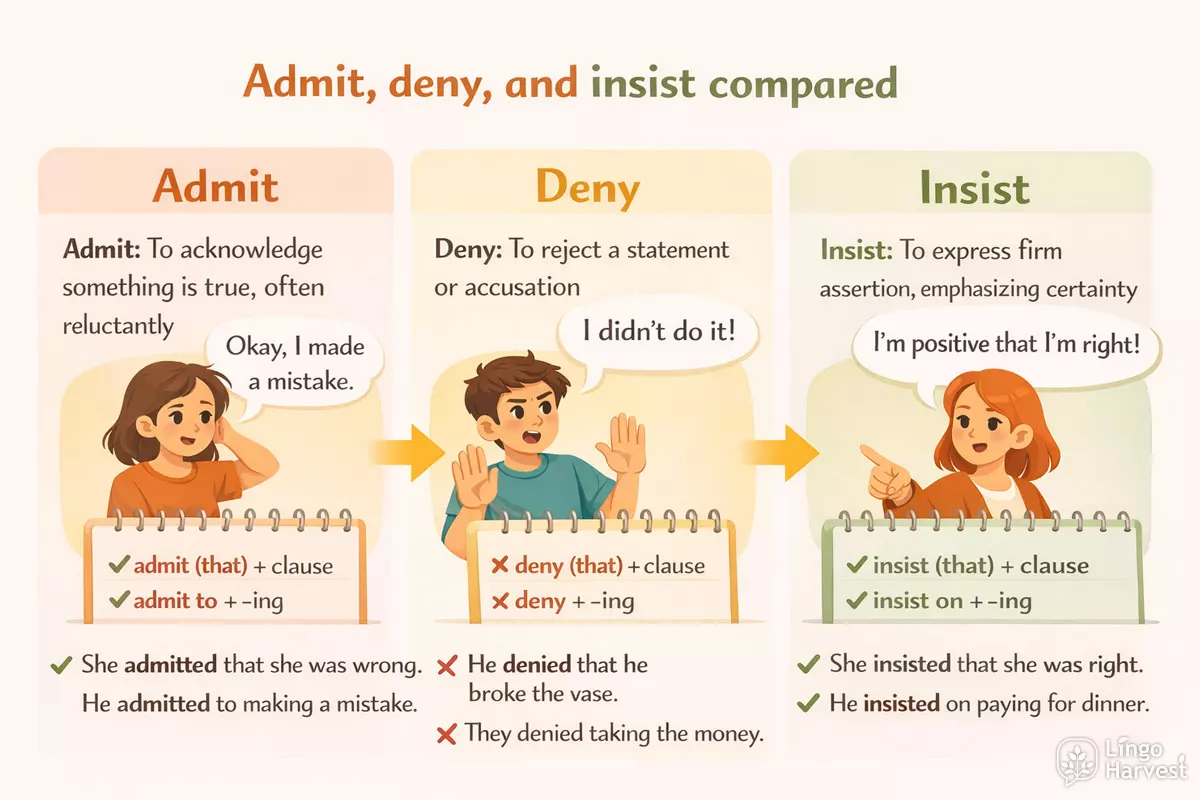
Understanding how admit, deny, and insist function in reported speech helps learners accurately convey attitudes and intentions. Although all three verbs express a speaker’s stance or reaction, they differ in meaning, grammatical patterns, and common usage contexts.
Meaning and Typical Use
- Admit is used when the speaker acknowledges something as true, often reluctantly.
- Deny serves to reject a statement or accusation, indicating the speaker claims something is not true.
- Insist expresses firm assertion, often against doubt or opposition, emphasizing the speaker’s certainty.
Grammatical Patterns
These verbs have distinct patterns in indirect speech. The most common structures are summarized below:
| Verb | Reported Speech Pattern | Example |
|---|---|---|
| admit | admit (that) + clause admit to + -ing |
She admitted that she was wrong. He admitted to making a mistake. |
| deny | deny (that) + clause deny + -ing |
He denied that he broke the vase. They denied taking the money. |
| insist | insist (that) + clause insist on + -ing |
She insisted that she was right. He insisted on paying for dinner. |
Nuances and Typical Contexts
While these verbs may sometimes appear in similar contexts, their nuances are important:
- Admit is often used in confessions, apologies, or when revealing information previously hidden.
- Deny frequently appears in legal, formal, or confrontational situations where someone rejects an accusation or rumor.
- Insist is common in arguments, negotiations, or situations where someone wants to emphasize their position or viewpoint.
Reporting Examples
- “I took the book.” → She admitted taking the book.
- “I didn’t break the window.” → He denied breaking the window.
- “I am telling the truth!” → She insisted that she was telling the truth.
- “We didn’t see anything.” → They denied seeing anything.
- “I need to help.” → He insisted on helping.
- “I made a mistake.” → She admitted to making a mistake.
- “I must go now.” → He insisted that he had to go.
- “I didn’t take your keys.” → She denied taking the keys.
- “Let me pay!” → He insisted on paying.
- “It was my fault.” → She admitted it was her fault.
Summary of Key Differences
In summary, admit involves accepting something as true (often reluctantly), deny means rejecting or refusing to accept a claim, and insist expresses firm or repeated assertion. Their reporting patterns and the nuances of meaning distinguish them in both formal and everyday contexts.
Grammar patterns with attitude verbs
Attitude verbs like admit, deny, and insist are common in reported speech. Each verb tends to follow specific grammatical structures, which can change slightly depending on the meaning or emphasis you want. Understanding these typical patterns helps you report conversations and opinions more naturally.
Common structures with attitude verbs
These verbs often introduce what someone said, thought, or claimed. Here are the most frequent ways they are used:
- Verb + (that) clause: She admitted (that) she was wrong.
- Verb + to + -ing: He denied taking the money.
- Verb + preposition + noun/pronoun: They insisted on their innocence.
- Verb + preposition + -ing: She insisted on coming with us.
- Verb + direct speech (less formal): "I didn't do it," he insisted. (Usually in stories or quotes.)
Comparing admit, deny, and insist
While these verbs all express a speaker’s attitude, their grammatical patterns differ. Here is a comparison of the most typical forms:
| Verb | Common Patterns |
|---|---|
| admit | admit (that) + clause admit + -ing admit to + -ing |
| deny | deny (that) + clause deny + -ing |
| insist | insist (that) + clause insist on + noun/-ing |
Examples in context
- He admitted (that) he broke the vase. ✅
- She admitted to making a mistake. ✅
- They deny (that) they were involved. ✅
- He denied taking the files. ✅
- Maria insisted (that) she was right. ✅
- We insisted on waiting for everyone. ✅
- He insisted on his innocence. ✅
- She denied (that) she had lied. ✅
- I admit lying to you. ✅
- They insisted (that) we join them. ✅
Choosing the correct pattern depends on the verb and the exact message. Some structures are interchangeable, but others are not. For example, “admit to -ing” and “admit -ing” are both correct, while “deny to do” is not. Mastering these forms makes your reported speech more accurate and natural.
Strength of meaning and speaker stance
Attitude verbs like admit, deny, and insist play a crucial role in expressing how speakers position themselves toward the content of reported speech. Each verb signals a different level of certainty, agreement, or opposition, reflecting both the strength of the statement and the speaker's emotional or evaluative stance. Recognizing these nuances helps readers and listeners interpret not just what is said, but how it is meant.
Comparing attitude verbs: Degrees of commitment
The verbs admit, deny, and insist each communicate a distinct type of commitment or resistance toward the proposition in reported speech. For example, admit often implies a reluctant or pressured acceptance of something that may have previously been concealed or denied. In contrast, deny marks strong opposition or rejection of an accusation or assumption. Insist shows a high degree of certainty and determination, emphasizing the speaker's unwillingness to back down.
| Verb | Typical Speaker Stance | Implication for Strength | Example |
|---|---|---|---|
| admit | Reluctant acceptance, concession | Moderate strength (accepting, sometimes unwillingly) | She admitted that she broke the vase. |
| deny | Firm rejection, opposition | Strong (clear refusal, distancing) | He denied that he was involved. |
| insist | Emphatic assertion, certainty | Very strong (assertiveness, persistence) | They insisted that they were right. |
Common patterns and subtle differences
- Admit often accompanies confessions or acknowledgments after questioning.
- Deny is typically used to refute allegations or rumors.
- Insist highlights unwavering belief or repeated assertion, sometimes despite disagreement or doubt from others.
- Context and tone can shift the perceived force: quietly admitting is not the same as reluctantly admitting.
- Insisting can border on being argumentative, while denying may be defensive or cautious.
- Admitting may carry undertones of guilt, whereas denying may imply innocence or defiance.
- Insist is often paired with direct speech or clear declaratives: "He insisted, 'I did nothing wrong.'"
- Admit and deny are frequently followed by that-clauses or gerunds: "She admitted lying."
- Insist sometimes introduces commands or requests, especially with "on": "He insisted on paying."
- Degree adverbs (firmly, repeatedly, reluctantly) modify the verbs to show intensity: "firmly denied," "reluctantly admitted," "repeatedly insisted."
Practical examples: admit vs deny vs insist

Use these examples to see how attitude verbs change the strength and tone of reported speech. Notice how admit often sounds reluctant, deny sounds defensive or firm, and insist sounds emphatic and unwavering.
| Verb | Direct Speech | Reported Speech |
|---|---|---|
| admit | "I deleted the email by mistake," she said. | She admitted that she had deleted the email by mistake. |
| admit | "I wasn’t completely honest about the timeline," he said. | He admitted that he hadn’t been completely honest about the timeline. |
| deny | "I never shared the files with anyone," he said. | He denied that he had ever shared the files with anyone. |
| deny | "We didn’t approve that payment," they said. | They denied that they had approved that payment. |
| insist | "I followed the instructions exactly," she said. | She insisted that she had followed the instructions exactly. |
| insist | "This is the only workable solution," he said. | He insisted that it was the only workable solution. |
| insist on | "Let me pay for dinner," he said. | He insisted on paying for dinner. |
| admit + -ing | "I copied the paragraph without citing the source," she said. | She admitted copying the paragraph without citing the source. |
| deny + -ing | "I broke the rule," he said. | He denied breaking the rule. |
- admit often suggests a concession after pressure: She admitted that she had underestimated the workload.
- deny signals rejection of an accusation: He denied that he had been aware of the issue.
- insist emphasizes certainty or persistence: They insisted that the report was accurate.
Speaker stance in context
The selection of these verbs by a speaker or writer is rarely random. It reflects both the factual content and the speaker's attitude toward it—whether accepting responsibility, distancing themselves, or emphasizing their view. Interpreting these cues is essential for understanding the underlying dynamics in reported speech, such as power relations, emotional involvement, and intended persuasion.
Formality and tone considerations
Choosing the right level of formality and tone is essential when using attitude verbs like “admit,” “deny,” and “insist” in reported speech. These verbs can subtly influence how a message is perceived, signaling degrees of politeness, directness, or emotional involvement. The context—whether academic, professional, or casual—often determines which verb and reporting structure fit best.
Verb choice and perceived attitude
Each of these attitude verbs carries its own implications. For instance, “admit” often suggests a concession or reluctant acknowledgment, while “insist” shows firmness and determination. “Deny” can sound defensive or neutral depending on the context. Selecting among these verbs shapes the perceived stance of the speaker in your report.
| Attitude Verb | Typical Tone | Formality Level |
|---|---|---|
| Admit | Cautious, apologetic, honest | Neutral to formal |
| Deny | Defensive, factual, firm | Neutral to formal |
| Insist | Emphatic, assertive, strong-willed | Neutral to formal |
| Claim | Assertive, potentially doubtful | Neutral |
| Suggest | Polite, tentative, indirect | Formal to informal |
| Concede | Reluctant, diplomatic | Formal |
Formality in reporting structures
The structure you use to report speech can also adjust the tone. More formal writing often prefers indirect speech, such as “He denied that he was involved,” while informal contexts might use direct quotations: “He said, ‘I wasn’t involved.’” In professional or academic writing, indirect reporting is generally favored for its objectivity and distance.
- Direct speech: Often used in narratives or casual conversation. Example: She said, “I admit I made a mistake.”
- Indirect speech: More common in formal or academic contexts. Example: She admitted that she had made a mistake.
- Neutral reporting: Avoids emotional coloring, suitable for objective or factual accounts.
- Marked reporting: Highlights the speaker’s emotions or stance, often through adverbs or additional phrases (e.g., “He firmly insisted…”).
Common patterns for neutral and formal tone
- Admit (to) + verb-ing: “He admitted to cheating on the test.”
- Deny + verb-ing: “She denied knowing anything about the matter.”
- Insist + (that) clause: “They insisted that everything was fine.”
- Admit + (that) clause: “He admitted that he was late.”
- Deny + (that) clause: “She denied that she had lied.”
- Insist + on + verb-ing: “He insisted on helping.”
- Use of modals for softening: “She would admit…” or “He might insist…”
- Passive forms: “It was admitted that mistakes were made.”
- Reporting with hedging: “He reportedly denied involvement.”
- Adverbial emphasis: “She strongly denied the allegations.”
Being mindful of these patterns and the context in which you are reporting speech helps ensure that your writing or conversation is appropriate for your audience. The balance between directness and politeness, as well as the choice between direct and indirect forms, can subtly shift the impression your words leave.
Common misuse of attitude verbs
Learners often run into trouble when using verbs like admit, deny, and insist in reported speech. Mistakes usually happen with sentence structure, verb patterns, and sometimes with the meaning itself. Below are some of the most frequent pitfalls, along with tips on how to avoid them.
Confusing verb patterns
Each attitude verb has specific reporting patterns. Using the wrong structure can change the meaning or make the sentence ungrammatical. For example, admit is usually followed by a gerund or a that-clause, while insist is commonly followed by a that-clause or on + gerund.
| Verb | Correct Patterns | Common Errors |
|---|---|---|
| admit | admit (that) + clause admit + -ing |
admit + to + infinitive admit + object + infinitive |
| deny | deny (that) + clause deny + -ing |
deny + to + infinitive deny + object + infinitive |
| insist | insist (that) + clause insist on + -ing |
insist + to + infinitive insist + object + infinitive |
Mixing up meanings
It is easy to confuse the intent behind these verbs. For example, insist does not mean to “demand” directly, and deny is not interchangeable with “refuse.” Understanding the nuance helps avoid miscommunication.
Common mistakes with admit, deny, and insist (and the correct forms)
This checklist shows the most frequent errors learners make with admit, deny, and insist. Each item includes a clear ✅ correct version and a ❌ incorrect version, so you can see the exact pattern you should use.
- Admit + -ing: “He admitted stealing the money.” ✅ / “He admitted to steal the money.” ❌
- Admit + that-clause: “He admitted (that) he had stolen the money.” ✅ / “He admitted he steals the money.” ❌
- Deny + -ing: “She denied breaking the vase.” ✅ / “She denied to break the vase.” ❌
- Deny + that-clause: “She denied that she had broken the vase.” ✅ / “She denied that she broke the vase yesterday.” ❌
- Insist + that-clause: “They insisted that we stay.” ✅ / “They insisted us to stay.” ❌
- Insist on + -ing: “He insisted on paying.” ✅ / “He insisted paying.” ❌
- Insist + on + noun: “She insisted on an apology.” ✅ / “She insisted an apology.” ❌
- Wrong verb choice (deny vs refuse): “He refused to help.” ✅ / “He denied to help.” ❌
- Deny + -ing (correct alternative): “He denied helping.” ✅ / “He denied to help.” ❌
- Reported speech subject (pronouns): “She insisted that I come.” ✅ / “She insisted me to come.” ❌
- Object placement (avoid this structure): “She admitted that he was wrong.” ✅ / “She admitted him to be wrong.” ❌
- Passive structure (use a that-clause): “It was admitted that mistakes had been made.” ✅ / “It was admitted by him to steal.” ❌
- Avoid redundancy: “He admitted that he was wrong.” ✅ / “He admitted that he admitted he was wrong.” ❌
- Clean reported structure (avoid mixed quoting): “He admitted that he had taken it.” ✅ / “He said, he admitted, ‘I took it.’” ❌
Summary
Awareness of these typical errors can greatly improve the clarity and accuracy of reporting attitudes in English. Paying attention to verb patterns, connectors, and subtle differences in meaning will help you convey reported speech more effectively.
Homework
This homework reinforces how attitude verbs shape meaning in reported speech. Focus on the verb pattern (that-clause vs -ing vs insist on), the strength of stance (accepting vs rejecting vs emphasizing), and clean reported structures without awkward objects or unnecessary repetition.
Task 1. Rewrite using the correct attitude verb and structure
- Rewrite using admit (+ -ing or that-clause):
Direct: "I changed the numbers to make the results look better," he said. - Rewrite using deny (+ -ing or that-clause):
Direct: "I never leaked the screenshots," she said. - Rewrite using insist (+ that-clause):
Direct: "I followed the protocol exactly," the technician said. - Rewrite using insist on (+ -ing):
Direct: "Let me pay for the tickets," he said. - Rewrite using admit (+ that-clause):
Direct: "I was wrong about the deadline," she said. - Rewrite using deny (+ -ing):
Direct: "I broke the printer," he said. - Rewrite using insist (+ that-clause):
Direct: "The decision was fair," they said. - Rewrite using admit (+ -ing):
Direct: "I copied a paragraph without citing the source," she said. - Rewrite using deny (+ that-clause):
Direct: "We approved that payment," the finance team said. - Rewrite using insist on (+ -ing):
Direct: "I’ll handle the presentation myself," she said.
Show answers
- He admitted that he had changed the numbers to make the results look better.
- She denied that she had leaked the screenshots.
- The technician insisted that he had followed the protocol exactly.
- He insisted on paying for the tickets.
- She admitted that she had been wrong about the deadline.
- He denied breaking the printer.
- They insisted that the decision had been fair.
- She admitted copying a paragraph without citing the source.
- The finance team denied that they had approved that payment.
- She insisted on handling the presentation herself.
Task 2. Spot and correct the mistake
- Correct the sentence:
He admitted to change the data. - Correct the sentence:
She denied to send the message. - Correct the sentence:
They insisted us to stay for the meeting. - Correct the sentence:
He insisted paying for everything. - Correct the sentence:
She admitted him to be wrong. - Correct the sentence:
He denied to help with the report. - Correct the sentence:
They admitted they steals the documents. - Correct the sentence:
She insisted me to come earlier. - Correct the sentence:
It was admitted by him to steal the files. - Correct the sentence (remove redundancy):
He admitted that he admitted he had made a mistake.
Show answers
- He admitted changing the data. / He admitted that he had changed the data.
- She denied sending the message. / She denied that she had sent the message.
- They insisted that we stay for the meeting.
- He insisted on paying for everything.
- She admitted that he was wrong.
- He refused to help with the report. / He denied helping with the report.
- They admitted they had stolen the documents.
- She insisted that I come earlier.
- It was admitted that he had stolen the files.
- He admitted that he had made a mistake.