Reporting Verbs with That-Clauses in English Grammar

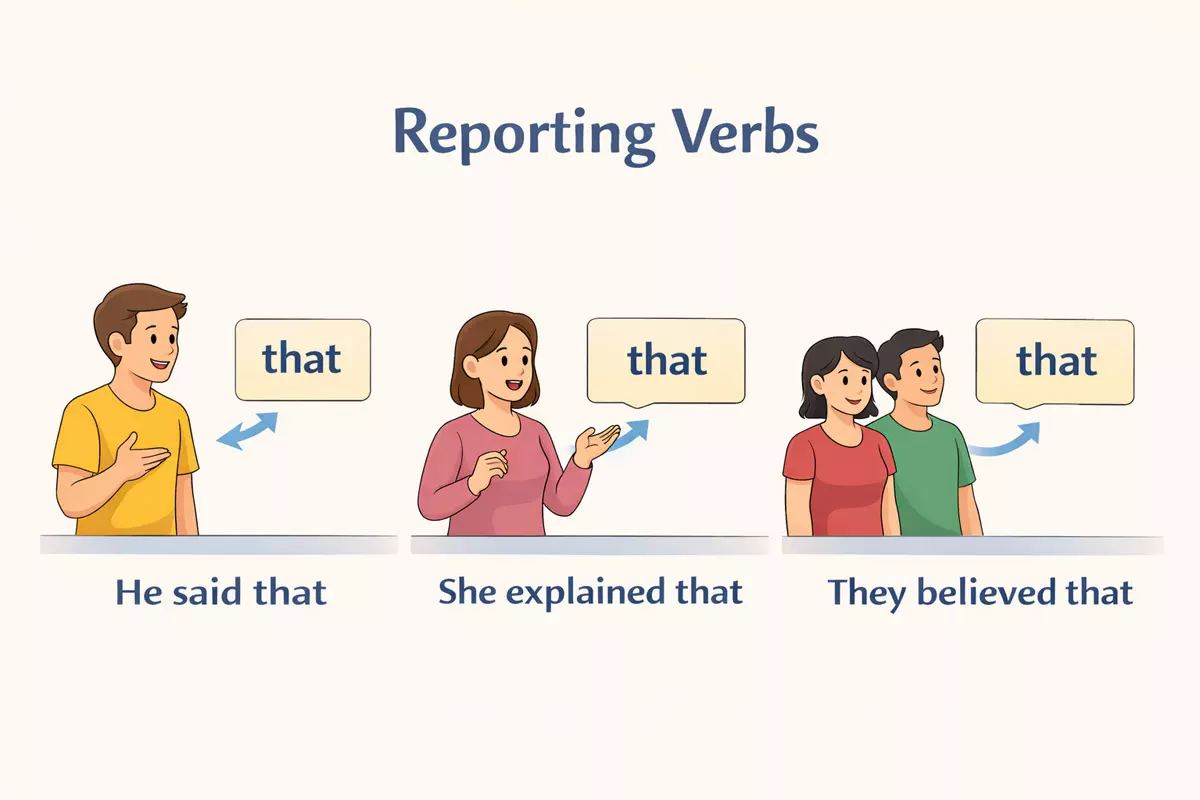 Here we the use of that-clauses in reported speech, including which verbs take them, when that is optional or required, how to structure these clauses, their effect on meaning and emphasis, and common mistakes learners make.
If you want to express what someone else says or thinks in English, it's important to use reporting verbs like say, tell, or believe, which are typically followed by clauses that convey the reported statement or thought. Mastering these structures allows you to share information from other sources clearly and accurately, whether you are writing or speaking. Developing this skill will improve your ability to communicate complex ideas, summarize conversations, and present information in a precise and natural way.
What that-clauses are in reported speech
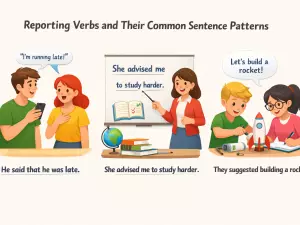
In English, a that-clause is often used to report what someone said, thought, or believed. These clauses allow us to convey information indirectly, without quoting the exact words. Instead of repeating someone’s statement word for word, we can use a reporting verb followed by a clause introduced by that to summarize or paraphrase the original message.
Structure and Function
A typical that-clause in indirect speech follows a reporting verb (such as say, think, believe, know, explain, or admit). The word that introduces the clause, but it is often optional in everyday spoken English. The main purpose is to report ideas, facts, or statements in a more formal or indirect way.
- He said that he was tired.
- She believes that they will succeed.
- I know that you’re right.
- We heard that the concert was cancelled.
- They admitted that the mistake was theirs.
- The teacher explained that the exam would be next week.
- He thought that nobody cared.
- She mentioned that she had already finished.
- Doctors agree that exercise is important.
- He warned that it might rain.
- My friend insisted that everything was fine.
- The manager confirmed that the meeting was at 10 a.m.
- They reported that the road was blocked.
- She promised that she would call.
- The scientist concluded that the results were accurate.
- He confessed that he forgot the appointment.
- We discovered that the answer was incorrect.
- The newspaper claims that prices are rising.
When “that” is omitted
While that is grammatically correct and often used in formal writing, it can be left out in speech or informal writing, especially when the meaning remains clear. For example: “She said she was coming” instead of “She said that she was coming.” However, including that can make sentences clearer, especially when the sentence gets longer or more complex.
Common reporting verbs with that-clauses
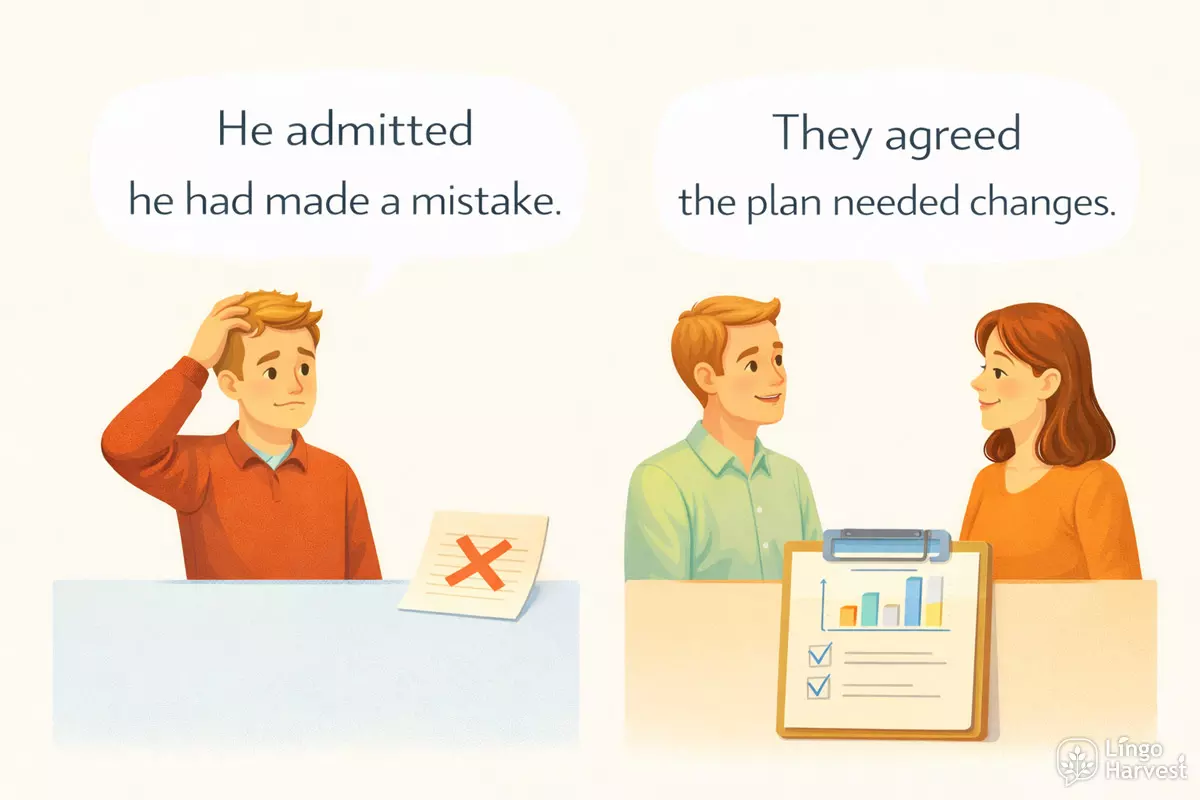
Many verbs are frequently followed by a that-clause in indirect speech. Here is a quick overview:
- say → He said (that) he was busy.
- think → She thought (that) the task was easy.
- believe → They believed (that) everything would be fine.
- know → I knew (that) he had already left.
- explain → She explained (that) the system wasn’t working.
- admit → He admitted (that) he had made a mistake.
- agree → They agreed (that) the plan needed changes.
- announce → The company announced (that) prices would increase.
- complain → She complained (that) the room was too cold.
- confirm → He confirmed (that) the meeting was canceled.
- deny → She denied (that) she had seen the document.
- insist → He insisted (that) he was right.
- promise → She promised (that) she would call later.
- realize → He realized (that) it was already late.
- remember → She remembered (that) she had locked the door.
- report → The news reported (that) the storm had caused damage.
- suggest → He suggested (that) we take a break.
- warn → They warned (that) the road might be icy.
Examples: Direct Speech vs. Reported Speech with That-Clauses
| Direct Speech | Reported Speech (with that-clause) |
|---|---|
| "I’m tired," he said. | He said that he was tired. |
| "We will come tomorrow," they promised. | They promised that they would come the next day. |
| "You are right," I know. | I know that you are right. |
| "The results are accurate," the scientist concluded. | The scientist concluded that the results were accurate. |
| "It might rain," he warned. | He warned that it might rain. |
Using that-clauses in reported speech is an essential skill for expressing information clearly and indirectly. It allows speakers and writers to reference what others have said or thought, while often making the message more concise and formal.
Common verbs followed by that-clauses
Many verbs in English are frequently used with that-clauses to introduce reported information, thoughts, beliefs, or statements. This structure is especially common in both spoken and written language when relaying what someone else has said or thought. Using a that-clause after certain verbs helps clarify the content of the reporting verb, making communication clearer and more precise.
How these verbs work in sentences
When using these verbs, the that introducing the clause is often optional, especially in informal speech. For example, both “She said she was tired” and “She said that she was tired” are correct. However, including that can make sentences clearer, particularly in complex or formal writing.
Examples of verbs with that-clauses
| Verb | Example sentence |
|---|---|
| say | He said (that) he would arrive soon. |
| believe | I believe (that) this is the best solution. |
| know | We know (that) the results were positive. |
| suppose | They suppose (that) the event will be cancelled. |
| promise | She promised (that) she would call. |
| realize | He didn’t realize (that) it was so late. |
| insist | They insisted (that) everything was fine. |
| suggest | She suggested (that) we start early. |
Notes on usage
Some verbs can be followed by either a that-clause or other structures, but the that-clause is the most direct way to report statements or beliefs. It’s also important to note that certain verbs like suggest and insist are often used with a subjunctive structure in the that-clause (“She suggested that he go home”).
Overall, using these verbs with a that-clause is a fundamental tool for reporting, explaining, and discussing ideas in English.
Optional and required use of that
In English grammar, some reporting verbs allow you to leave out the word that before a subordinate clause, while others require it. Whether that is necessary can depend on the verb itself, the formality of the context, and sometimes the complexity of the sentence. Knowing when you can omit that and when you must include it helps make your writing and speech both accurate and natural.
When that is optional
Many common reporting verbs let you choose whether to include that before the clause. Omitting it can make sentences sound more conversational, while including it may add clarity, especially in longer or more complex sentences.
- I think (that) we should leave now.
- She said (that) she would arrive at noon.
- They believe (that) the meeting is canceled.
- He claims (that) he has finished the work.
- We know (that) the store opens at nine.
- She hopes (that) you can join us.
- I suppose (that) he’s right.
- He feared (that) nobody would listen.
- They admitted (that) the results were late.
- I hear (that) it’s going to rain tomorrow.
In these examples, removing that does not change the meaning or grammatical correctness of the sentence.
When that is required
Some verbs or sentence structures require that to connect the reporting verb to the clause. This is especially true when omitting that would cause confusion or ambiguity, or when certain verbs are used in passive forms or formal contexts.
- It is essential that everyone attends.
- The law stipulates that all vehicles must be insured.
- He insisted that he was innocent.
- The contract provides that payment shall be made monthly.
- The report concluded that the policy had failed.
- The rules specify that students must register in advance.
- She was informed that her application was successful.
- It is recommended that you consult a doctor.
- The evidence suggests that he left early.
- The findings indicate that changes are needed.
Verbs where usage varies
Some reporting verbs allow both options, but the use of that may depend on style, clarity, or formality. In spoken English, omitting that is more frequent, while in formal writing, including it is often preferred.
| Verb | That Optional | That Required |
|---|---|---|
| Say | He said (that) he was tired. | It was said that the event would be canceled. |
| Suggest | She suggested (that) we go out. | It is suggested that you arrive early. |
| Insist | They insisted (that) everything was fine. | He insisted that we stay. |
| Report | They reported (that) the system failed. | It is reported that the storm is approaching. |
Summary tips
- Omitting that is common with verbs like think, say, believe in informal speech.
- Formal writing or complex sentences often require that for clarity.
- Some verbs and passive structures need that to avoid ambiguity.
- When in doubt, including that is rarely incorrect and can make your sentences clearer.
Understanding these patterns helps you use reporting verbs more flexibly and appropriately in both spoken and written English.
Word order and clause structure
When using reporting verbs followed by that-clauses, the arrangement of words generally mirrors the typical English sentence pattern: subject + reporting verb + (optional object) + that + reported clause. This sequence keeps the meaning clear and helps listeners or readers identify the main speaker and the information being reported.
Basic construction patterns

In most cases, the structure is straightforward. Many reporting verbs (such as "say," "think," "believe," "admit") simply take a that-clause as their complement. If the reporting verb is transitive, it may require an object indicating who receives the information.
- She said that she was tired.
- They believe that the project will succeed.
- We heard that the concert was canceled.
- He admitted that he made a mistake.
- I think that this is a good idea.
- The manager explained that the meeting was postponed.
- She insisted that she was right.
- He mentioned that he would be late.
- The teacher confirmed that the exam was next week.
- The witness claimed that he saw nothing.
- They reported that the road was blocked.
- My friend agreed that the film was exciting.
- The spokesperson announced that the results would be published soon.
- Doctors warned that the virus could spread quickly.
- She replied that she was busy.
- The guide explained that photography was not allowed.
Optional use of the conjunction "that"
The word "that" is often used to introduce the reported clause, but it can sometimes be omitted, especially in informal speech and writing. However, with some reporting verbs, omitting "that" may make the sentence less clear or natural.
- She said (that) she was tired. ✅
- I think (that) this is a good idea. ✅
- The spokesperson announced (that) the results would be published soon. ✅
- He explained (that) the meeting was postponed. ✅
Position of the reporting verb and clause
While the most common pattern is reporting verb + that-clause, sometimes the order can be rearranged for emphasis or stylistic reasons, especially in literary or formal writing. However, placing the that-clause before the reporting verb is rare and usually reserved for special effect.
- She said that she was tired. ✅ (standard order)
- That she was tired, she said. ❌ (rare, formal or literary)
Comparing verbs with and without objects
Some reporting verbs can take an object, while others cannot. The presence or absence of the object can affect the meaning and clarity. Below is a comparison of reporting verbs that do and do not require an object when followed by a that-clause:
| With Object | Without Object |
|---|---|
| She told him that she was leaving. | She said that she was leaving. |
| The teacher reminded us that homework was due. | The teacher explained that homework was due. |
| He informed them that the event was canceled. | He admitted that he was wrong. |
| She assured me that all was well. | She claimed that all was well. |
Negation and tense in that-clauses
The verb inside the that-clause follows normal rules for tense and negation. The reporting verb and the reported clause may use different tenses, depending on the context and the speaker's intention.
- He said that he was not coming.
- They think that the team will win.
- She believes that it doesn't matter.
- I heard that they had arrived early.
In summary, reporting verbs with that-clauses typically follow a predictable structure, but slight variations in word order, the use of objects, and the optional use of "that" can all influence the tone and clarity of the sentence.
Meaning and emphasis in that-clauses
Reporting verbs followed by that-clauses allow speakers and writers to convey not just information, but also their attitude, certainty, or doubt about what’s being reported. The choice of verb and the way the clause is constructed can subtly shift the focus or highlight a particular aspect of the message.
Expressing certainty, doubt, or attitude
Some reporting verbs indicate a high degree of certainty or commitment to the truth of what follows, while others introduce uncertainty, distance, or subjectivity. The verb selected often sets the tone for the entire statement.
- Assert: suggests confidence in the statement (“She asserted that the results were accurate.”)
- Claim: can imply a lack of proof or possible dispute (“He claimed that he saw nothing.”)
- Admit: often expresses reluctance or confession (“They admitted that they were mistaken.”)
- Deny: clearly rejects what follows (“He denied that he broke the vase.”)
- Suggest: introduces an idea without force (“She suggested that we leave early.”)
- Insist: emphasizes determination or strong belief (“He insisted that he was right.”)
- Reveal: highlights new or previously hidden information (“She revealed that the plan had failed.”)
- Agree: signals consensus or acceptance (“They agreed that changes were needed.”)
- Predict: expresses expectation about the future (“Experts predict that prices will rise.”)
- Warn: draws attention to possible danger or risk (“They warned that the weather could worsen.”)
- Prove: emphasizes demonstration of truth (“He proved that his theory worked.”)
- Complain: shows dissatisfaction (“She complained that her order was late.”)
- Promise: expresses commitment to future action (“He promised that he would return.”)
- Confirm: verifies or validates information (“The manager confirmed that the meeting was postponed.”)
- Recommend: gives advice or guidance (“She recommended that we try again.”)
- Report: presents information in a neutral way (“They reported that the event was successful.”)
- Announce: makes information public (“He announced that he was retiring.”)
- Concede: admits something, often reluctantly (“She conceded that the results were disappointing.”)
- Explain: clarifies reasons or causes (“He explained that the delay was unavoidable.”)
- Assure: gives confidence or reassurance (“She assured them that help was on the way.”)
Shifting emphasis within the clause
Writers and speakers can adjust the focus by reordering elements, adding adverbs, or choosing more forceful reporting verbs. For example, including adverbs like clearly, undoubtedly, or allegedly before the that-clause can further affect how the information is perceived.
- “He firmly stated that he would not resign.” ✅
- “They allegedly claimed that the results were manipulated.”
- “She openly admitted that she was wrong.”
Comparing reporting verbs and their effects
| Reporting Verb | Effect on Meaning | Example with That-Clause |
|---|---|---|
| State | Neutral, factual | He stated that he would attend. |
| Suggest | Implied, indirect | She suggested that we leave early. |
| Deny | Rejects or contradicts | He denied that he broke the rule. |
| Insist | Strong emphasis, determination | She insisted that it was true. |
| Admit | Reluctant confession | They admitted that they were wrong. |
| Warn | Highlights risk/danger | They warned that it might rain. |
Summary
The selection and arrangement of verbs, adverbs, and other elements in these clauses enable speakers to express shades of meaning, from certainty to doubt or even urgency. Understanding these nuances can make communication clearer and more precise, especially in formal writing and reporting.
Frequent mistakes learners make
Many English learners find reporting verbs with that-clauses confusing, especially when it comes to verb choice, tense consistency, and sentence structure. These challenges can lead to awkward or incorrect sentences. Below are some common pitfalls and misunderstandings that often cause problems.
Mixing up reporting verbs
Choosing the wrong reporting verb can change the meaning of a sentence or make it sound unnatural. For example, using tell instead of say or vice versa, especially when a direct object is involved, is a frequent error.
- Incorrect: She told that she was tired. ❌
- Correct: She said that she was tired. ✅
- Incorrect: He said me that he would call. ❌
- Correct: He told me that he would call. ✅
Omitting "that" unnecessarily
While "that" can often be dropped in informal speech, sometimes its omission leads to confusion or ungrammatical sentences, especially with certain reporting verbs.
- Correct: She admitted that she was wrong.
- Acceptable (informal): She admitted she was wrong.
- Incorrect: She admitted was wrong. ❌
Tense consistency issues
Learners sometimes forget to adjust tenses appropriately when moving from direct to reported speech, particularly after reporting verbs with that-clauses.
- Original: "I am leaving now."
- Incorrect: He said that he is leaving now. ❌
- Correct: He said that he was leaving then. ✅
Confusing direct and indirect objects
Some reporting verbs require an object before the that-clause, while others do not. Learners frequently mix these up.
| Verb | Typical Structure | Example | Common Error |
|---|---|---|---|
| say | say (that) + clause | She said (that) she was coming. | She said me that... ❌ |
| tell | tell + object + (that) + clause | He told me (that) he was late. | He told that... ❌ |
| admit | admit (that) + clause | They admitted (that) they forgot. | They admitted us that... ❌ |
| promise | promise (that) + clause | She promised (that) she would help. | She promised me that... (only if promising to someone) |
Using the wrong reporting verb form
Another issue is using the base form instead of the correct tense or participle, leading to grammatical mistakes.
- Incorrect: He say that he is ready. ❌
- Correct: He said that he is ready. ✅
Neglecting subject-verb agreement
Sometimes, learners forget to match the subject and verb in the that-clause, especially with complex sentences or unfamiliar verbs.
- Incorrect: She said that her friends was late. ❌
- Correct: She said that her friends were late. ✅
Summary list of typical problems
- Using "say" with an object before the that-clause
- Leaving out "that" in formal writing when it aids clarity
- Confusing verb patterns (e.g., "explain me that")
- Maintaining the original tense when backshifting is needed
- Forgetting to include necessary indirect objects
- Overusing direct speech instead of reported structures
- Unnecessary repetition of the subject in the that-clause
- Using reporting verbs that do not take that-clauses (e.g., "ask" in "He asked that...")
- Omitting the subject after reporting verbs that require it
- Incorrect word order, especially in longer clauses
By being aware of these common traps, learners can improve their accuracy and confidence when using reporting verbs with that-clauses in both spoken and written English.
Homework
Complete the exercises below to practice correct word order, clause structure, and verb choice when using reporting verbs with that-clauses. Pay close attention to objects, tense consistency, and whether the conjunction that is needed.
1. Rewrite Using a That-Clause
Rewrite each sentence in reported speech using an appropriate reporting verb and a that-clause.
- She said, “I am too tired to continue.”
- He said to me, “I will call you later.”
- They said, “We don’t agree with the decision.”
- The manager said, “The meeting has been postponed.”
- Anna said, “I didn’t break the phone.”
- The teacher said, “Homework is due tomorrow.”
- He said, “I didn’t understand the instructions.”
- They said, “The road is closed.”
- She said, “I was late because of traffic.”
- The spokesperson said, “The results will be announced soon.”
Show answers
- She said that she was too tired to continue.
- He told me that he would call me later.
- They said that they didn’t agree with the decision.
- The manager explained that the meeting had been postponed.
- Anna denied that she had broken the phone.
- The teacher confirmed that homework was due the next day.
- He admitted that he hadn’t understood the instructions.
- They reported that the road was closed.
- She explained that she had been late because of traffic.
- The spokesperson announced that the results would be announced soon.
2. Correct or Incorrect?
Decide whether each sentence is correct. If it is incorrect, rewrite it.
- She told that she was busy.
- He said me that he was leaving.
- They admitted that they were wrong.
- The teacher explained us that the test was difficult.
- She promised that she would help.
- He insisted that he is right.
- The manager informed the staff that the office would close early.
- She said that her friends was late.
- They denied that they broke the rules.
- He explained that the delay was unavoidable.
Show answers
- Incorrect. She said that she was busy.
- Incorrect. He told me that he was leaving.
- Correct.
- Incorrect. The teacher explained that the test was difficult.
- Correct.
- Incorrect. He insisted that he was right.
- Correct.
- Incorrect. She said that her friends were late.
- Correct.
- Correct.