Time Expression Changes in Reported Speech Explained

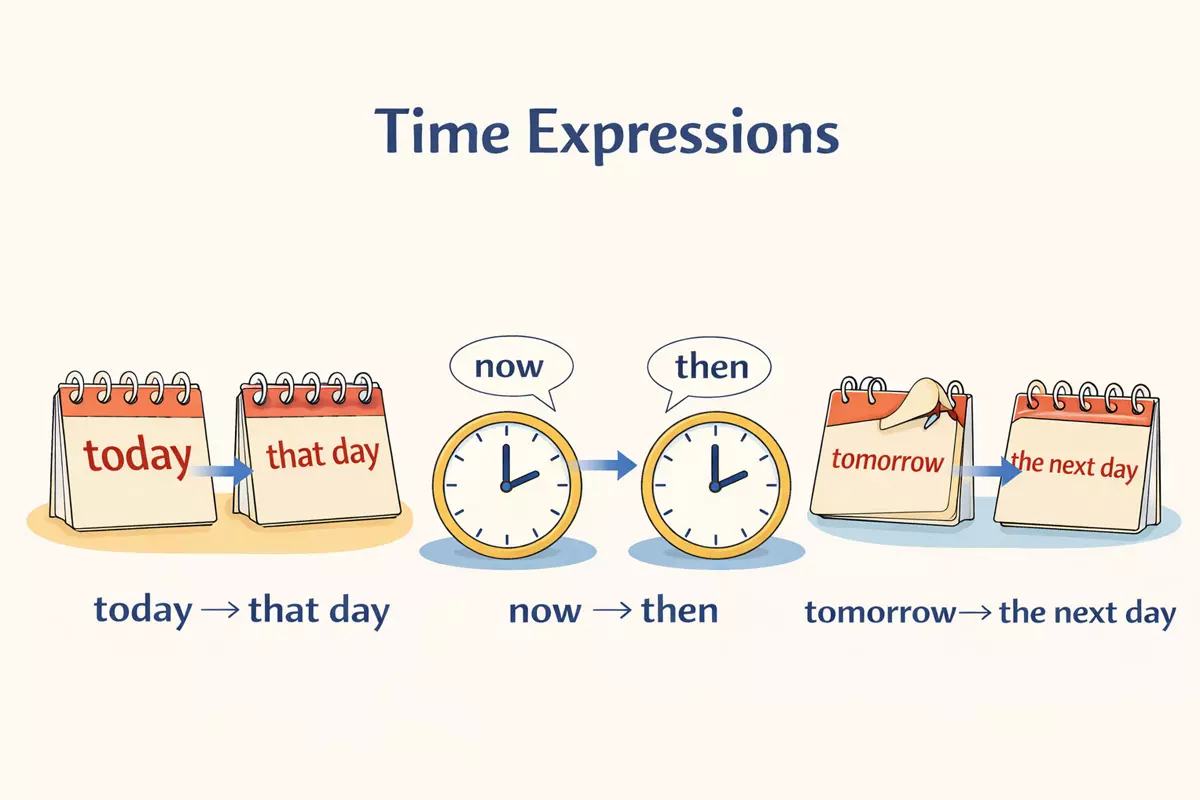 Here we why time expressions change in reported speech, lists typical direct and reported forms, and explains the difference between direct and indirect time references.
When we report what someone else said, the way we mention times and dates usually changes to fit the context of our retelling. This adjustment is important because it helps listeners understand when events happened relative to the moment of speaking. For example, if someone originally said, "I will call you tomorrow," and you report it the next day, you would say, "He said he would call me the next day." Recognizing how time references shift in indirect speech can make your English sound more natural and clear in everyday conversations.
Why time expressions change in reported speech
When we shift from direct to reported speech, time expressions often need to be adjusted to reflect the new context. This is because the timing of the original statement is usually relative to when it was said, not when it is being reported. If you repeat someone's words at a later date, their "today" might not match your "today" anymore, so the expression must shift accordingly.
Context Shifts and Reference Points
The main reason for altering time-related words is the change in point of reference. In direct speech, time expressions like “now” or “tomorrow” refer to the moment of speaking. However, once you report the statement, your reference point becomes the moment of reporting, which can be a different day or even a different week. To keep the meaning clear, expressions are updated to match this new context.
Common Time Expression Changes
Transferring statements into indirect speech requires speakers to update words that indicate time. Here are some of the most frequent transformations:
- now → then
- today → that day
- tonight → that night
- yesterday → the day before / the previous day
- tomorrow → the next day / the following day
- this week → that week
- last week → the week before / the previous week
- next week → the week after / the following week
- ago → before
- here → there
- just → a moment before
- the day after tomorrow → in two days' time / two days later
- the day before yesterday → two days before
Illustrating the Shift: Direct vs. Reported Speech
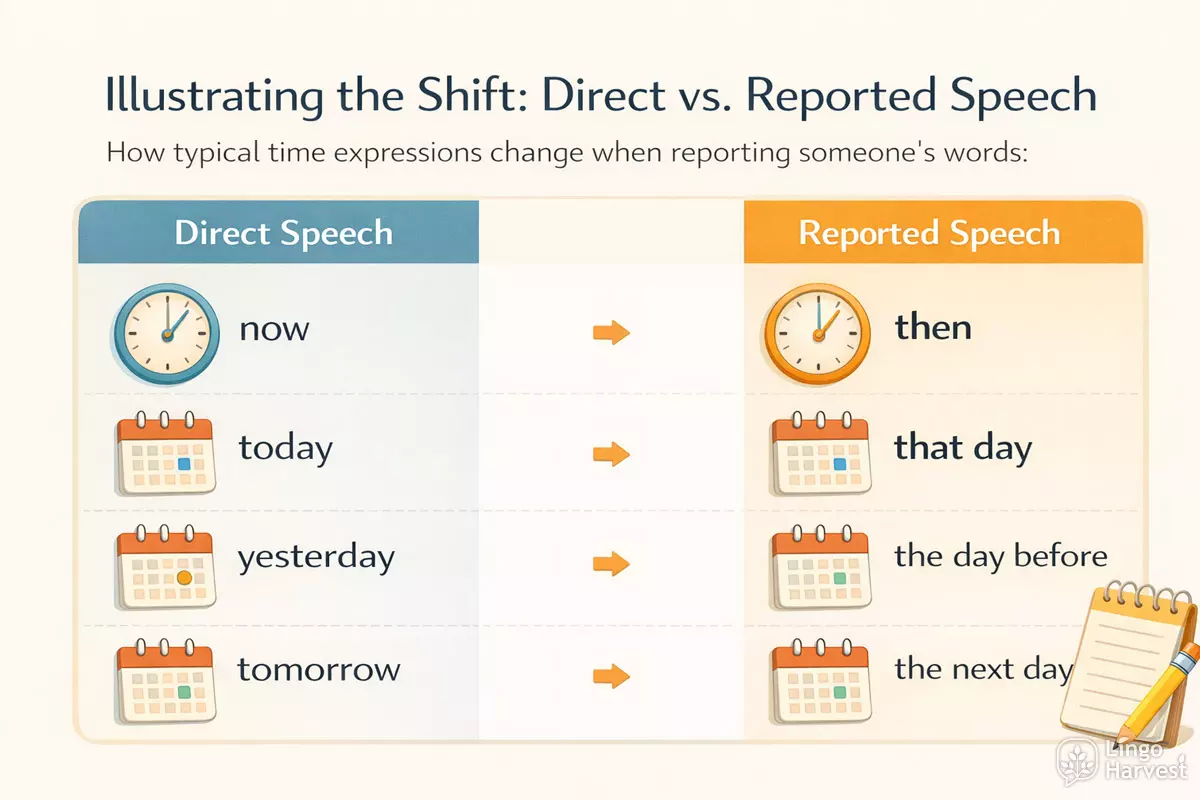
To make these changes clearer, here’s a comparison of how typical time expressions are transformed when reporting someone’s words:
| Direct Speech | Reported Speech |
|---|---|
| now | then |
| today | that day |
| yesterday | the day before |
| tomorrow | the next day |
| last week | the week before |
| next year | the following year |
| here | there |
| ago | before |
Why Accuracy Matters
Accurately shifting time expressions ensures your listener understands exactly when actions or events occurred relative to the present. Failing to update these words can cause confusion about the timing or sequence of events. This adjustment is especially important in storytelling, journalism, or any situation where precise communication is needed.
Common time expressions and their reported forms
Understanding how references to time shift when moving from direct to reported speech is essential for clear communication in English. When someone repeats what another person said, words like “today,” “now,” or “yesterday” often need to change to fit the new context. These shifts help avoid confusion and keep the meaning accurate, especially when the reporting happens at a different time than the original statement.
Typical changes in time-related words
Below is a quick overview of how certain words or phrases indicating time usually transform when sentences are reported. These conversions are not random; they follow predictable patterns that reflect the distance in time or context between the original statement and the reporting moment.
| Direct Speech | Reported Speech |
|---|---|
| today | that day |
| tonight | that night |
| tomorrow | the next day / the following day |
| yesterday | the day before / the previous day |
| now | then / at that time |
| ago | before |
| this (week, month, year, etc.) | that (week, month, year, etc.) |
| last (night, week, year, etc.) | the previous / the last (night, week, year, etc.) |
| next (week, month, year, etc.) | the following / the next (week, month, year, etc.) |
| here | there |
Additional points to remember
- Some expressions, like “in two days,” may shift to “two days later” in indirect speech.
- If the reporting and original speech occur at the same time, these changes might not be necessary.
- Context can affect the choice between alternatives (for example, “the next day” or “the following day”).
- Demonstratives such as “this” and “these” often become “that” and “those.”
Recognizing these typical patterns makes it easier to report statements accurately. For learners, practicing with real examples and paying attention to the time context helps reinforce the correct usage of these shifting expressions.
Direct vs indirect time reference
When reporting speech, how we refer to time can change the meaning or clarity of our statements. In direct speech, the time expressions used are the exact words spoken by the original speaker, often reflecting their immediate context—such as “today,” “now,” or “yesterday.” Indirect, or reported, speech typically requires us to shift these time markers so they make sense from the perspective of the reporter, not the original speaker.
How context affects time expressions
If you quote someone directly, you maintain the original time reference. But when you report what someone said, you need to adapt time phrases so the listener understands when events occurred relative to the reporting moment. This shift helps prevent confusion, especially when the reporting happens later or in a different place.
Common shifts in reported speech
Here are some typical changes to temporal expressions when moving from a direct to an indirect context:
- “now” → “then”
- “today” → “that day”
- “yesterday” → “the day before” / “the previous day”
- “tomorrow” → “the next day” / “the following day”
- “tonight” → “that night”
- “last week” → “the week before” / “the previous week”
- “next year” → “the following year” / “the year after”
- “ago” → “before”
- “this” (as in “this morning”) → “that” (as in “that morning”)
- “here” → “there” (place reference, but often linked to time context)
Key differences at a glance
| Direct speech example | Indirect speech equivalent |
|---|---|
| “I’m leaving now.” | He said he was leaving then. |
| “We met yesterday.” | She said they had met the day before. |
| “I’ll do it tomorrow.” | He said he would do it the next day. |
| “The event is next week.” | They said the event was the following week. |
When do you change time references?
Time references are usually shifted only if the reporting verb is in the past tense. If the reporting verb is present or if the reported event is still true or relevant, these shifts may not be needed. Always consider the context and whether a change will make the sentence clearer.
Tips for mastering time reference shifts
- Identify the original time context of the speaker.
- Think about when you are reporting the speech—has time passed?
- Choose the time expression that makes the sequence of events clear to your listener.
- Practice with varied examples to get comfortable with common changes.
In summary, understanding how to adjust temporal language in reported speech helps you communicate more precisely and avoids misunderstandings about when things happened.
Context-dependent time changes
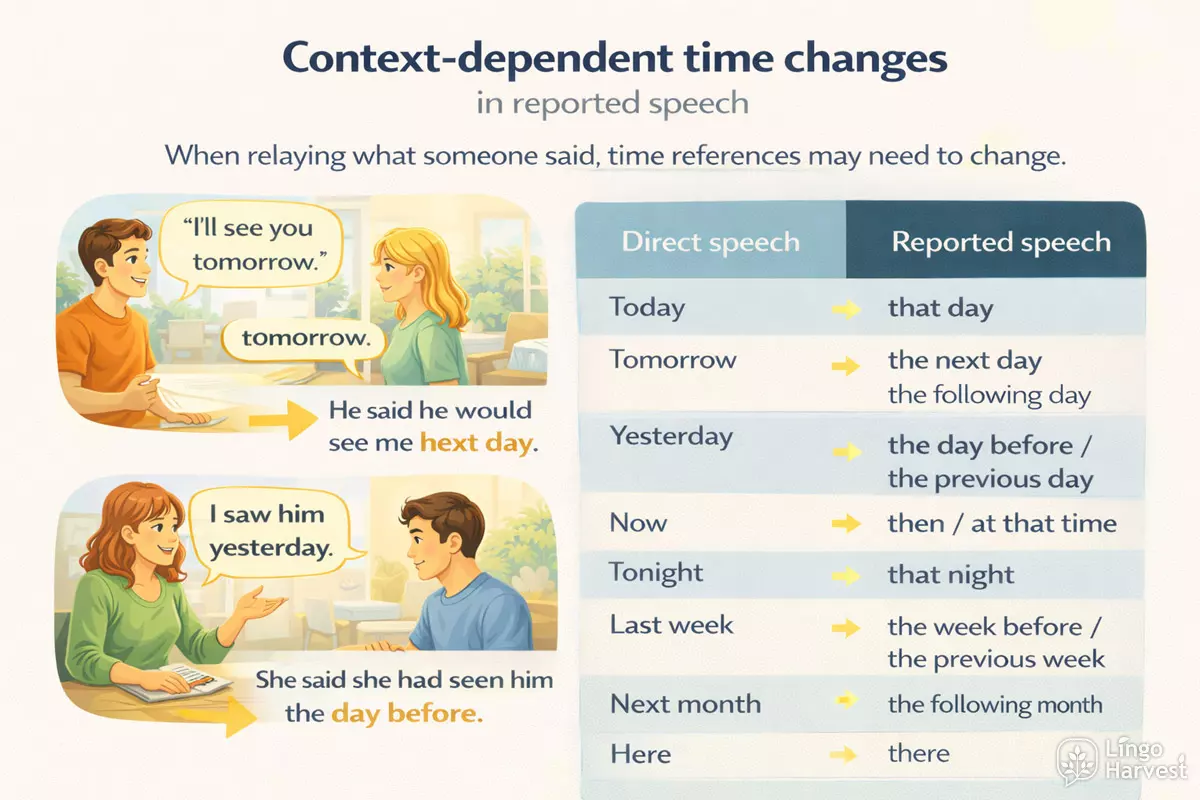
How time expressions shift in reported speech depends largely on the situation and the speaker’s perspective. When relaying what someone else said, the original time references may need to be adjusted to reflect the new context. This often happens when the reporting verb is in the past, and the time of reporting differs from the time of the original statement.
For example, if someone says, “I will see you tomorrow,” and you report this later, “tomorrow” no longer refers to the same day. Instead, you need to update the time reference to match the moment of reporting. The new term could be “the next day” or “the following day,” depending on the context and clarity needed.
Common shifts in time expressions
When converting direct speech to indirect speech, certain words and phrases often change meaning based on when and where the reporting happens. These modifications help listeners understand the timing relative to the reporting moment.
- Today → that day
- Tomorrow → the next day / the following day
- Yesterday → the day before / the previous day
- Now → then / at that time
- Tonight → that night
- Last week → the week before / the previous week
- Next month → the following month
- Here → there
- This (day/week/etc.) → that (day/week/etc.)
- These (days/nights/etc.) → those (days/nights/etc.)
- Ago → before / earlier
- Just → just / recently (context-dependent)
Examples of time reference changes
The following table shows how direct speech time expressions are commonly transformed when reporting in the past. These shifts ensure the reported message stays accurate for the listener.
| Direct Speech | Reported Speech |
|---|---|
| today | that day |
| yesterday | the day before |
| tomorrow | the next day |
| last year | the year before |
| next week | the following week |
| now | then |
| ago | before |
| this morning | that morning |
| here | there |
| tonight | that night |
Situations where time expressions do not change
Not every reported statement requires a shift in time reference. If the reporting verb is in the present or future, or if the context remains unchanged, the original expressions might stay the same. For example, in live commentary or when reporting something that is still true, terms like “today” or “now” can be kept without adjustment.
- Reporting current events: “She says, ‘I am leaving now.’” → She says she is leaving now.
- Timeless truths: “He says, ‘The sun rises in the east.’” → He says the sun rises in the east.
In summary, adapting time words in indirect speech is all about clarity for the new audience. Checking the time frame and the reporting context helps ensure your message is precise and easily understood.
Cases with no time change
Not every reported speech sentence requires a shift in time words. There are several situations where time expressions remain the same when converting direct speech into reported speech. Understanding these exceptions is essential for using indirect speech accurately and naturally.
When no time change is needed
Certain scenarios allow you to keep time expressions unchanged. These occur mostly when the reporting verb is in the present, when the situation described is still true, or when the reported statement is a universal truth. Here are the most common occasions:
- The reporting verb is in the present, present perfect, or future tense (e.g., "He says," "She has said," "They will say").
- The original statement refers to a fact that is still valid at the time of reporting.
- Universal truths, scientific facts, or proverbs are reported.
- The context makes the time reference clear and unchanged.
- Reported questions and commands often keep the time reference if the situation is unchanged.
- When the reporting and reported times are very close or simultaneous.
- Expressions like "today," "tomorrow," or "yesterday" are kept when the reporting happens on the same day as the original statement.
- In news headlines or live commentary, time markers usually remain the same.
- Personal routines or schedules that haven't changed since the original statement.
- Instructions or directions that are meant to be followed immediately.
Examples of unchanged time expressions
Here are some examples demonstrating when time markers do not shift in indirect speech:
- Direct: He says, "I will call you tonight."
Indirect: He says he will call me tonight. - Direct: The teacher says, "The sun rises in the east."
Indirect: The teacher says the sun rises in the east. - Direct: She says, "I am going to the gym today."
Indirect: She says she is going to the gym today. - Direct: They say, "We leave tomorrow."
Indirect: They say they leave tomorrow. - Direct: He has just said, "The meeting starts at 3 pm."
Indirect: He has just said the meeting starts at 3 pm. - Direct: The guide says, "Turn left at the next street."
Indirect: The guide says to turn left at the next street. - Direct: She told me, "I'm busy now," (if reporting immediately).
Indirect: She told me she is busy now. - Direct: The announcer says, "The train departs in ten minutes."
Indirect: The announcer says the train departs in ten minutes. - Direct: The professor says, "Water boils at 100°C."
Indirect: The professor says water boils at 100°C. - Direct: He says, "We meet here every Friday."
Indirect: He says they meet here every Friday.
Summary of common triggers
For quick reference, here are some triggers that typically prevent time expression changes in indirect speech:
- Present or future reporting verbs
- Statements about facts or routines
- Universal truths or scientific facts
- Immediate or simultaneous reporting
Common learner mistakes with time expressions
Many English learners find it tricky to adjust time expressions correctly when changing direct speech into reported speech. This often leads to confusion or sentences that sound unnatural. Let’s look at the most frequent pitfalls and how to avoid them.
1. Forgetting to change the time reference
A common problem is not updating time words to match the new context. For example, saying He said, "I will do it tomorrow" as He said he would do it tomorrow instead of the next day. The listener may misunderstand when the action actually happens.
2. Overusing "yesterday" and "tomorrow"
Learners sometimes leave time words unchanged, especially "yesterday," "today," and "tomorrow," when these should shift to "the day before," "that day," or "the next day."
3. Mixing up verb tense and time word changes
It’s easy to focus on backshifting the verb tense and forget to update the time marker. For instance, in She said, "I finished my homework yesterday." the correct reported version is She said she had finished her homework the day before (not "yesterday").
4. Using "ago" incorrectly
"Ago" refers to time counted from the moment of speaking, not from the reporting moment. Learners often say, He said he finished it two days ago instead of He said he had finished it two days before.
5. Overlooking context
Sometimes, the original time expression is still correct in the reported version, especially if the reporting is immediate or the context is shared. However, many learners apply changes automatically when they aren’t needed, or forget them in situations where they are essential.
6. Inconsistent reporting in longer sentences
When reporting longer or more complex sentences, it’s easy to correct some time expressions but leave others unchanged, causing inconsistency and confusion.
7. Tips to avoid mistakes
- Always check if the time expression needs to shift based on the reporting context.
- Memorize the most common changes using tables or lists.
- Practice turning direct speech into reported speech with a focus on time words.
- Listen for these changes in native speaker conversations or reading materials.
Practice: Time Expressions in Reported Speech
The exercises below will help you practice how time expressions change (or stay the same) when direct speech is turned into reported speech. Focus on the context and the moment of reporting to decide whether words like today, tomorrow, or now need to be adjusted.
1. Rewrite the Sentences with Correct Time Expressions
Rewrite each sentence in reported speech. Change the time expressions where necessary.
- Direct: “I’ll call you tomorrow,” he said.
- Direct: “I met her yesterday,” Maria said.
- Direct: “We are busy now,” they said.
- Direct: “I’m leaving tonight,” James said.
- Direct: “I finished it two days ago,” she said.
- Direct: “We started this morning,” they said.
- Direct: “I’ll see you next week,” he said.
- Direct: “I was here last year,” Anna said.
- Direct: “We will submit it this week,” they said.
- Direct: “I’m meeting him the day after tomorrow,” she said.
Show answers
- He said that he would call me the next day.
- Maria said that she had met her the day before.
- They said that they were busy then.
- James said that he was leaving that night.
- She said that she had finished it two days before.
- They said that they had started that morning.
- He said that he would see me the following week.
- Anna said that she had been there the year before.
- They said that they would submit it that week.
- She said that she was meeting him in two days’ time.
2. Decide: Change the Time Expression or Keep It?
For each item, decide whether the time expression should change in reported speech. Write the reported sentence.
- (Reporting immediately) He says, “I’m leaving now.”
- (Reporting a scientific fact) The professor says, “Water boils at 100°C.”
- (Reporting later) She said, “I’m busy today.”
- (Reporting on the same day) He said, “I’ll email you tonight.”
- (Reporting later) They said, “We will start tomorrow.”
- (Live announcement) The announcer says, “The train leaves in ten minutes.”
- (Reporting later) Anna said, “I met him yesterday evening.”
- (Reporting immediately) She told me, “I need your answer now.”
- (Reporting later) He said, “I’ll see you next Friday.”
- (A routine that is still true) He says, “We meet here every Friday.”
Show answers
- He says that he is leaving now.
- The professor says that water boils at 100°C.
- She said that she was busy that day.
- He said that he would email me tonight.
- They said that they would start the next day.
- The announcer says that the train leaves in ten minutes.
- Anna said that she had met him the previous evening.
- She told me that she needs my answer now.
- He said that he would see me the following Friday.
- He says that they meet here every Friday.