How to Report Yes or No Questions in Reported Speech

 Here we how to report yes or no questions, including when to use if or whether, changes to word order, pronoun and tense adjustments, distinctions between formal and informal reporting, and common mistakes learners should watch for.
Transforming direct yes-or-no questions into indirect statements can be challenging, but it is an important skill for achieving clarity and precision in writing. By mastering this technique, you can report what someone asked in a way that sounds natural and avoids ambiguity. Indirect statements allow your writing to flow more smoothly and help ensure that your readers understand the original intent behind the question without being distracted by awkward phrasing or unnecessary repetition.
What yes or no questions are
Yes or no questions are a specific type of question that can be answered simply with “yes” or “no.” Unlike open-ended questions, which require more detailed responses, these questions are designed to confirm information, check facts, or clarify details. They often begin with auxiliary verbs or modal verbs, such as “do,” “does,” “did,” “is,” “are,” “can,” or “will.” This structure makes them quick and direct, which is why they are common in both spoken and written English.
How to recognize yes or no questions
It’s easy to spot this question type by looking for a verb at the beginning of the sentence. The typical word order switches the subject and the auxiliary/modal verb:
- Do you like coffee? → Yes, I do.
- Is she coming to the party? → Yes, she is.
- Can they help us? → Yes, they can.
- Will it rain tomorrow? → No, it won’t.
- Did you finish your homework? → Yes, I did.
- Are we late? → No, we aren’t.
- Have you seen my keys? → Yes, I have.
- Should I call her? → Yes, you should.
- Was the movie good? → Yes, it was.
- Has he arrived yet? → No, he hasn’t.
- Could you open the window? → Yes, I could.
- Were you at home last night? → Yes, I was.
- Would you like some tea? → Yes, I would.
- Do they speak English? → Yes, they do.
- Is this your bag? → No, it isn’t.
- Have they left already? → Yes, they have.
- Can she drive? → Yes, she can.
- Will you join us? → Yes, I will.
Comparison: Yes/no questions vs. other question types

While these questions expect a straightforward confirmation or denial, other question forms—like “wh-” questions—seek more information. Here’s a quick comparison:
| Question Type | Example |
|---|---|
| Yes/No Question | Are you ready? |
| Wh- Question | Where are you going? |
| Choice Question | Do you want tea or coffee? |
| Tag Question | You’re coming, aren’t you? |
Key features of yes or no questions
- Begin with an auxiliary or modal verb
- Word order: verb + subject + main verb (if any)
- Can often be answered with a single word: “yes” or “no”
- Used for confirmation, checking facts, or seeking agreement
Understanding how these questions function is essential, especially when you need to convert them into reported speech. Their direct structure makes them easy to recognize and transform.
Using if and whether in reported questions
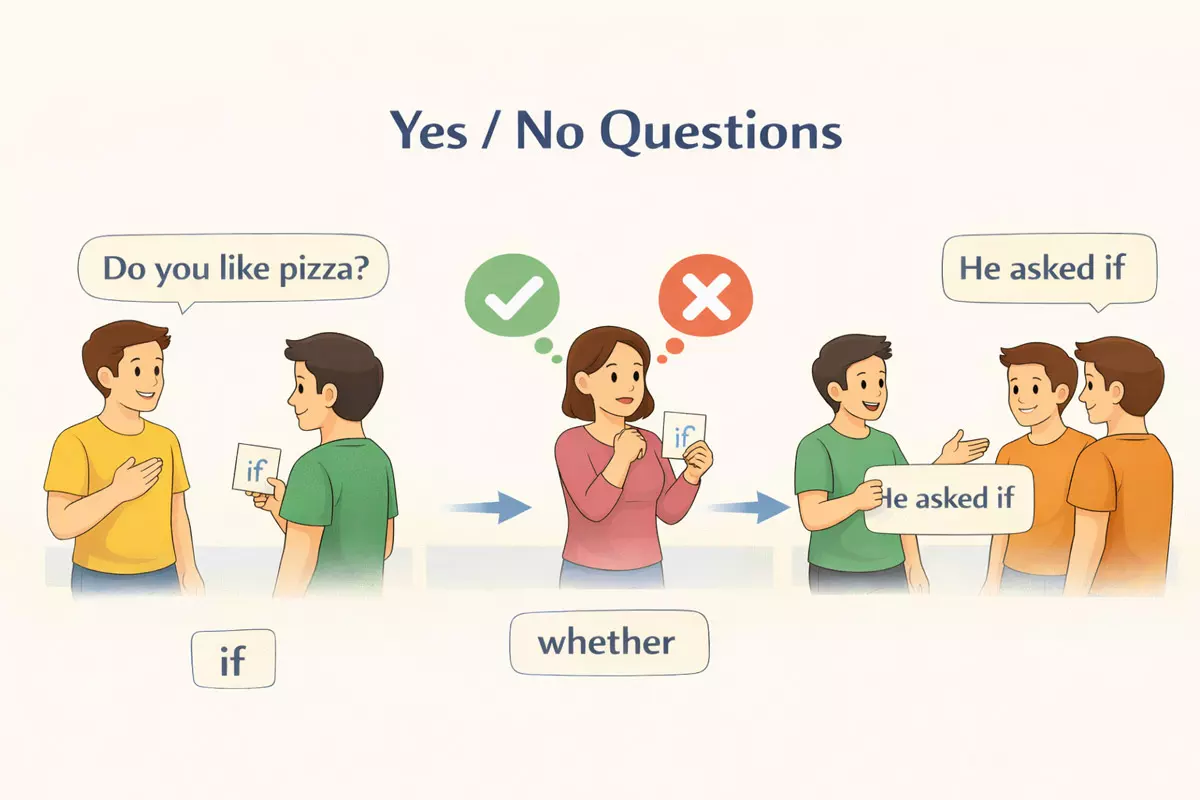
When turning yes/no questions into reported speech, English uses the words if and whether to introduce the reported question. These words both serve a similar purpose: they show that the original question could be answered with “yes” or “no.” Choosing between “if” and “whether” is often a matter of style, but there are some subtle differences.
Basic structure of reported yes/no questions
To report a yes/no question, start with a reporting verb (like ask, want to know, or wonder), then follow with if or whether, and finally change the word order to a normal statement (subject + verb). The auxiliary verb (do/does/did) is not needed.
- Direct: “Are you coming?”
Reported: She asked if I was coming. - Direct: “Did he finish his homework?”
Reported: They wanted to know whether he had finished his homework. - Direct: “Can you help me?”
Reported: He asked if I could help him.
When to use “if” and when to use “whether”
Both “if” and “whether” are generally interchangeable for most yes/no reported questions. However, “whether” is preferred in more formal writing and in specific cases:
- When there are two alternatives: “She asked whether I wanted tea or coffee.”
- Before “or not”: “He asked whether or not I was ready.”
- After prepositions: “There was a discussion about whether we should continue.”
- At the beginning of a sentence, especially in formal contexts: “Whether we stay or go is up to you.”
“If” is more common in everyday speech and is almost always correct when you are simply reporting a yes/no question without alternatives.
Common verbs used in reporting yes/no questions
- ask → She asked if I was ready.
- want to know → He wanted to know whether the train had arrived.
- wonder → She wondered if they were coming later.
- inquire → He inquired whether the office was open.
- question → She questioned if the decision was final.
- request → He requested to know if the documents were complete.
- check → She checked whether the door was locked.
- find out → He tried to find out if she had finished the task.
- see (e.g., “to see if…”) → She went to see if the manager was available.
- know → He wanted to know if I had already called.
Examples: Direct vs. Reported Yes/No Questions
| Direct Question | Reported Question |
|---|---|
| “Are you free tonight?” | He asked if I was free that night. |
| “Will it rain tomorrow?” | She wondered whether it would rain the next day. |
| “Do they understand the instructions?” | He wanted to know if they understood the instructions. |
| “Have you seen my phone?” | She asked whether I had seen her phone. |
| “Did you lock the door?” | They asked if I had locked the door. |
| “Can we start now?” | He inquired whether we could start then. |
Summary tips
- Use if or whether after reporting verbs for yes/no questions.
- Change the question word order to a statement.
- Omit “do/does/did” when reporting.
- Prefer “whether” for alternatives, “or not,” or after prepositions.
- In most everyday cases, “if” is natural and correct.
Mastering these patterns helps you report yes/no questions accurately and naturally in both spoken and written English.
Word order changes in reported questions
When transforming yes or no questions into reported speech, the structure of the sentence shifts from a question format to a statement format. This adjustment is essential for clarity and accuracy. Unlike direct questions, which often involve subject-auxiliary inversion (like "Are you coming?"), reported yes/no questions use the normal subject-verb order, and the question mark is dropped.
Key features of word order changes
- No inversion: The auxiliary verb does not precede the subject in reported speech. For example, "Is she happy?" becomes "He asked if she was happy."
- Use of 'if' or 'whether': These words introduce the reported question, replacing the need for direct question structure.
- No question mark: The sentence becomes a statement, so the punctuation changes accordingly.
- Tense backshift: In most cases, the verb tense shifts back (present to past, will to would, etc.).
- Pronoun and time expression changes: Adjust pronouns and time references to fit the reporting context (e.g., "today" to "that day").
Common transformations in reported yes/no questions
| Direct Question | Reported Speech |
|---|---|
| Are you coming? | She asked if I was coming. |
| Did he finish the work? | They wondered whether he had finished the work. |
| Will they arrive on time? | He asked if they would arrive on time. |
| Can you help me? | She wanted to know if I could help her. |
| Is it raining? | He asked whether it was raining. |
| Has she left? | They asked if she had left. |
| Do you like coffee? | He wondered whether I liked coffee. |
| Were they at home? | She asked if they had been at home. |
| Should I call you? | He asked whether he should call me. |
| Would you go with me? | She wanted to know if I would go with her. |
Notice how the auxiliary verb moves after the subject in each transformed sentence. This switch from question to statement order is a core feature of reported yes/no questions. Using if and whether is optional in most cases, but both are correct. Always check for tense and pronoun changes to keep your reported speech accurate and natural.
Pronoun and tense adjustments
When turning yes or no questions into reported speech, the pronouns and verb tenses often need to be changed to match the perspective of the reporting speaker. This makes the sentence clear and accurate for the listener or reader, keeping the meaning consistent even though the structure changes.
Changing pronouns in reported questions
Pronouns in the original question refer to the speaker and listener. Once reported, those references usually shift to reflect the new speaker and subject. For example, “Do you like pizza?” becomes “She asked if I liked pizza.” Here, “you” (addressing the listener) changes to “I” (referring to the person being asked in reported speech).
- “Are you coming?” → She asked if I was coming.
- “Did he call you?” → She asked if he had called me.
- “Will they help us?” → He wanted to know if they would help them.
- “Can I join?” → He asked if he could join.
- “Do we have to go?” → He asked if they had to go.
Verb tense shifts in reported yes/no questions

The verb tense in the original question usually shifts back one step in reported speech, especially if the reporting verb is in the past. This is called backshifting. For example, present simple often becomes past simple, and will becomes would. Modal verbs like “could” or “should” usually stay the same.
| Direct Question | Reported Speech |
|---|---|
| “Are you ready?” | He asked if I was ready. |
| “Do they play chess?” | She asked if they played chess. |
| “Will she come?” | He wanted to know if she would come. |
| “Can you swim?” | She asked if I could swim. |
| “Did you finish?” | He asked if I had finished. |
| “Is he working?” | She asked if he was working. |
| “Has it started?” | He asked if it had started. |
| “Were they late?” | She asked if they had been late. |
| “Should I wait?” | He asked if he should wait. |
| “May I go?” | She asked if she might go. |
Tips for smooth conversion
- Always check who is speaking and who is being referred to before changing pronouns.
- If the reporting verb is in the present, you may not need to change the tense.
- Modal verbs like “could,” “might,” and “should” often remain unchanged.
- Use “if” or “whether” to introduce the reported yes/no question—never use the original question word order.
Adjusting pronouns and tenses carefully ensures reported yes/no questions are clear, accurate, and grammatically correct.
Formal vs informal reporting
When reporting yes or no questions, the level of formality affects not just word choice but also sentence structure and the reporting verb you might use. In more official or academic contexts, you'll notice indirect speech is often preferred, with careful use of grammar and minimal contractions. In everyday conversation, however, people tend to take shortcuts, use contractions, and sometimes even omit reporting verbs if the context is clear.
Key differences in style and structure
- Reporting verbs: Formal language often uses verbs like inquire, want to know, or ask whether. Informal contexts stick with ask or even drop the verb if the situation is obvious.
- Contractions: Formal speech avoids contractions (e.g., did not), while informal speech uses them freely (didn't).
- Question word order: In both registers, indirect questions drop the auxiliary inversion, but informal speech might be more tolerant of minor errors.
- Directness: Formal reporting is typically more indirect and polite; informal reporting is more direct and relaxed.
Common reporting patterns
| Formal Example | Informal Example |
|---|---|
| He inquired whether she had finished her homework. | He asked if she finished her homework. |
| The manager wanted to know whether the report was ready. | The boss asked if the report was ready. |
| She asked whether he would be attending the meeting. | She asked if he was coming to the meeting. |
| They requested to know whether the form had been submitted. | They wanted to know if the form was in yet. |
| He questioned whether the data were accurate. | He asked if the data was right. |
Typical features in informal reporting
- Use of if instead of whether in almost all cases
- Frequent use of contractions ("wasn't," "didn't")
- Shorter sentences, sometimes omitting the reporting verb
- Colloquial expressions ("wanna know if," "asked if")
- Relaxed attitude toward tense backshifting, especially in spoken English
- Less concern for exact grammar, more focus on meaning
When to choose each style
Choose a formal style when writing reports, academic papers, or official correspondence. Opt for informal language in casual conversations, messaging, or everyday storytelling. Being aware of these differences helps you sound natural and appropriate in any context.
Common mistakes in reported yes or no questions
Reporting yes/no questions often leads to errors because the structure changes from direct to indirect speech. Unlike direct questions, reported forms lose their question word order and usually require changes in tense, pronouns, and auxiliary verbs. Overlooking these differences can make reported sentences confusing or grammatically incorrect.
Typical errors when reporting yes/no questions
- Forgetting to use “if” or “whether”: Many learners omit the introductory word, resulting in incomplete indirect questions.
- Keeping question word order: Direct questions invert the subject and auxiliary (e.g., "Are you ready?"), but reported speech uses statement order ("He asked if I was ready.").
- Not shifting tenses: Failing to change the verb tense when needed (e.g., from "Do you like coffee?" to "She asked if I liked coffee.").
- Incorrect pronoun changes: Not adapting pronouns to fit the new speaker and listener (e.g., "you" to "he/she/I").
- Leaving out reporting verbs: A reporting verb like "ask" or "wonder" is essential for clarity.
- Using question marks: Indirect questions do not end with a question mark but with a period.
- Mixing up “if” and “whether”: These can often be used interchangeably, but “whether” is preferred when there are two alternatives.
- Omitting necessary changes to time expressions: Words like "today" or "tomorrow" may need to be changed ("that day", "the next day") in reported speech.
- Using “that” instead of “if” or “whether”: “That” is not appropriate for reporting yes/no questions.
- Repeating “do/does/did” in indirect speech: These auxiliaries are dropped and the verb is conjugated appropriately.
Direct vs. Reported Forms: Common Patterns
| Direct Question | Reported Speech |
|---|---|
| “Are you coming?” | He asked if I was coming. |
| “Did she finish her homework?” | They wanted to know if she had finished her homework. |
| “Will it rain tomorrow?” | She wondered whether it would rain the next day. |
| “Do you like pizza?” | He asked if I liked pizza. |
| “Have you seen my keys?” | She asked if I had seen her keys. |
| “Can we start now?” | They asked whether they could start then. |
How to avoid these pitfalls
To report yes/no questions accurately, always begin with a reporting verb, use “if” or “whether,” and remember to shift word order, tense, and pronouns as needed. Double-check for statement rather than question structure, and avoid using question marks. With practice, these patterns will become more natural and mistakes less frequent.
Homework
Complete the exercises below to practice reporting yes or no questions correctly. Focus on word order, tense backshifting, pronoun changes, and the correct use of if or whether.
1. Rewrite the Questions in Reported Speech
Turn each direct yes/no question into reported speech using an appropriate reporting verb.
- “Are you ready?” he asked.
- “Do they live nearby?” she asked.
- “Will you call me later?” Anna asked.
- “Can she drive?” he wanted to know.
- “Did you see my message?” she asked.
- “Have they finished the test?” the teacher asked.
- “Is he working today?” she wondered.
- “Should I wait here?” he asked.
- “Were you at home last night?” she asked.
- “Will it snow tomorrow?” he wanted to know.
Show answers
- He asked if I was ready.
- She asked if they lived nearby.
- Anna asked if I would call her later.
- He wanted to know if she could drive.
- She asked if I had seen her message.
- The teacher asked if they had finished the test.
- She wondered if he was working that day.
- He asked if he should wait there.
- She asked if I had been at home the night before.
- He wanted to know whether it would snow the next day.
2. Correct or Incorrect?
Decide whether each reported question is correct. If it is incorrect, rewrite it correctly.
- He asked did I like coffee.
- She asked if he was tired.
- They wanted to know will we arrive on time.
- He wondered if she had finished.
- She asked that I was coming.
- The manager asked if the report was ready.
- He asked whether had I called her.
- She wanted to know if they could help.
- They asked if is it expensive.
- He asked if I had seen his keys.
Show answers
- Incorrect. He asked if I liked coffee.
- Correct.
- Incorrect. They wanted to know if we would arrive on time.
- Correct.
- Incorrect. She asked if I was coming.
- Correct.
- Incorrect. He asked whether I had called her.
- Correct.
- Incorrect. They asked if it was expensive.
- Correct.