How to Report Wh-Questions in English Grammar

 This article explains what wh-questions are, how to report them by changing word order, removing auxiliary verbs, and adjusting pronouns and tenses. It also covers formal English usage and highlights common learner mistakes.
Learning how to change direct questions into reported statements in English is a valuable skill that can improve both your spoken and written communication. By transforming questions that begin with words like who, what, or where into indirect speech, you can present information more smoothly and professionally. For example, instead of saying, "Where did she go?" you could report, "He asked where she had gone." This approach not only clarifies the message but also helps maintain a formal tone when sharing information from conversations or interviews.
What wh-questions are
Wh-questions are a type of question in English that begin with a word containing the letters "wh," such as what, where, when, which, who, whom, whose, and why. These questions are designed to gather specific information rather than just a yes or no answer. They are fundamental in everyday communication, helping speakers request details, clarification, or explanations.
Common wh-question words and their uses
- What – used to ask about things or information (e.g., What is your name?)
- Where – used to ask about places or locations (e.g., Where do you live?)
- When – used to inquire about time (e.g., When is your birthday?)
- Which – used to ask about choices among a set (e.g., Which color do you prefer?)
- Who – used for people as the subject (e.g., Who called you?)
- Whom – used for people as the object (e.g., Whom did you see?)
- Whose – used to ask about possession (e.g., Whose book is this?)
- Why – used to ask about reasons or causes (e.g., Why are you late?)
- How – although it doesn’t start with "wh," it’s often grouped with these because it functions similarly (e.g., How did you do that?)
Typical sentence structure
Wh-questions generally follow a pattern: the wh-word comes first, followed by an auxiliary verb (if needed), then the subject, and finally the main verb and the rest of the sentence. For example: Where (wh-word) are (auxiliary) you (subject) going (main verb)? This structure helps the listener quickly identify the focus of the question.
| Wh-word | Example Question | Typical Information Sought |
|---|---|---|
| What | What are you doing? | Thing, action, or idea |
| Where | Where is my bag? | Place or location |
| When | When did you arrive? | Time or date |
| Which | Which route is faster? | Choice among options |
| Who | Who made this cake? | Person (subject) |
| Whom | Whom did you meet? | Person (object) |
| Whose | Whose keys are these? | Ownership or possession |
| Why | Why was he absent? | Reason or explanation |
| How | How did you fix it? | Manner or process |
Key features of wh-questions
- They demand more detailed answers than a simple yes or no.
- Each wh-word targets a different type of information (place, time, person, etc.).
- Some wh-questions require auxiliary verbs, especially in the present and past simple tenses.
- Intonation typically falls at the end of the sentence, unlike yes/no questions where it often rises.
Being able to recognize and form these questions is essential for clear and precise communication in English. Mastery of their structure and purpose is a foundation for both speaking and understanding more complex sentence patterns.
Word order in reported wh-questions
When you change a direct wh-question into reported speech, the structure of the sentence shifts. The main change is that the word order becomes that of a statement, not a question. In other words, after the reporting verb (like asked or wondered), the subject comes before the verb, and there is no auxiliary verb inversion. The original question mark is also dropped.
Basic pattern
To report a wh-question, start with the reporting verb and the person being addressed (if needed), followed by the wh-word (such as what, where, when, why, who, how), and then a statement order for the rest of the clause.
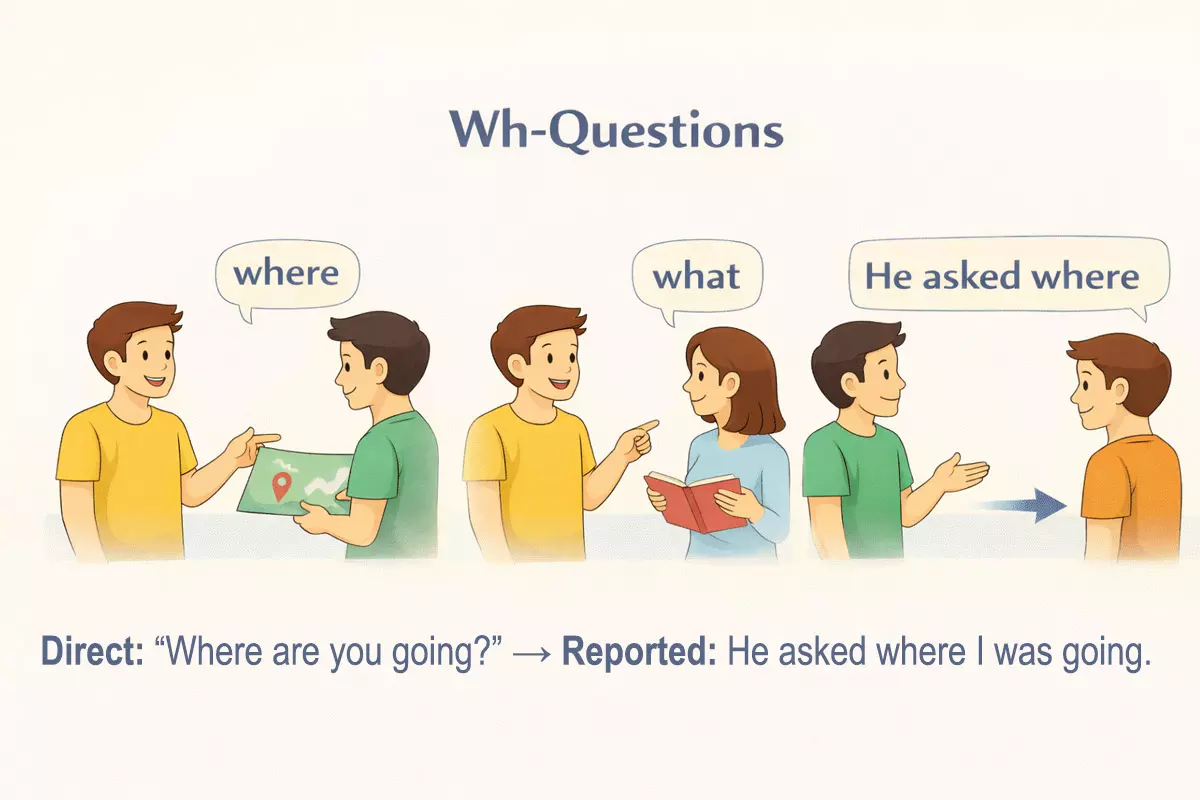
- Direct: “Where are you going?” → Reported: He asked where I was going.
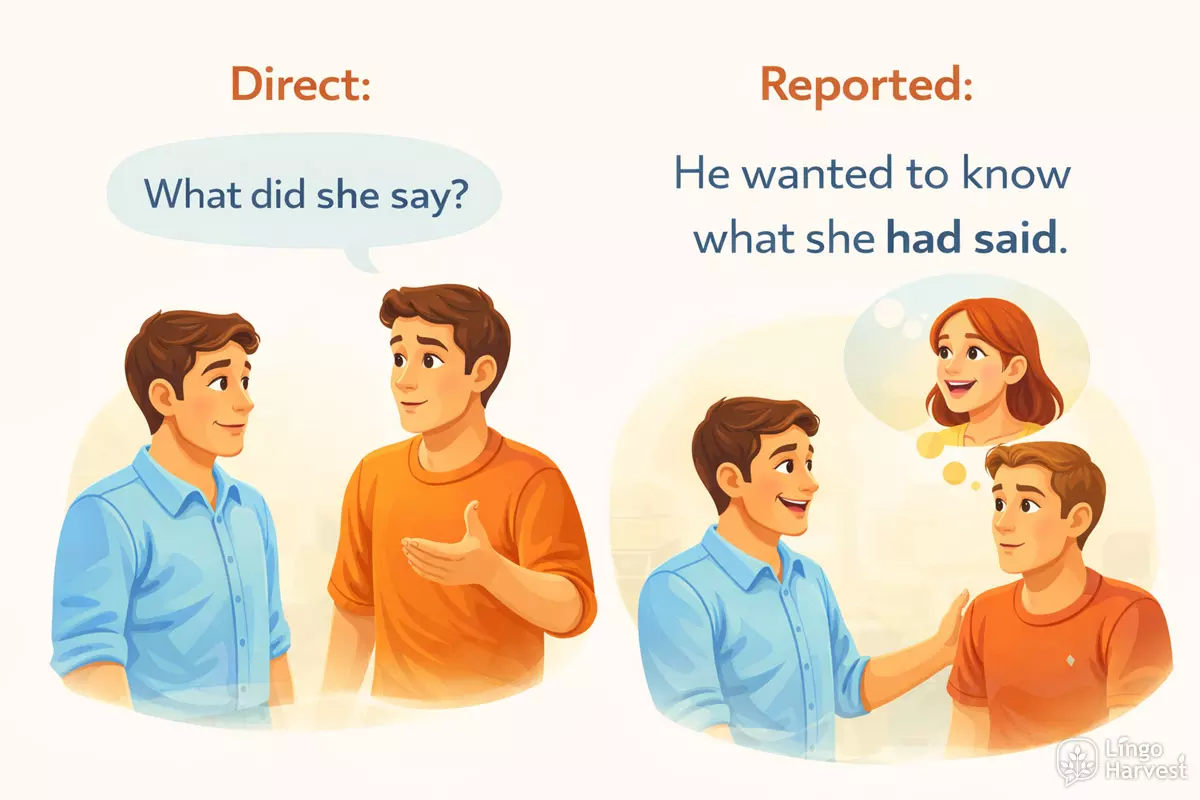
- Direct: “What did she say?” → Reported: He wanted to know what she had said.
- Direct: “How does this work?” → Reported: She asked how it worked.
- Direct: “Why are they late?” → Reported: He wondered why they were late.
- Direct: “Who will come to the party?” → Reported: She asked who would come to the party.
- Direct: “When can we leave?” → Reported: They asked when they could leave.
- Direct: “Which book did you choose?” → Reported: He asked which book I had chosen.
- Direct: “Whose keys are these?” → Reported: She asked whose keys those were.
- Direct: “How many people came?” → Reported: He wanted to know how many people had come.
- Direct: “What time does the train leave?” → Reported: She asked what time the train left.
Common mistakes to avoid
- Do not use question word order: In reported speech, say She asked where he was, not She asked where was he. ❌
- Drop the auxiliary 'do/does/did': In statements, you don’t need these. For example, He asked what she wanted (not what did she want).
- No question mark at the end: Reported wh-questions are statements, so they end with a period. ✅
Summary of changes
| Direct Wh-Question | Reported Speech Form |
|---|---|
| Where are you going? | He asked where I was going. |
| What did she say? | He wanted to know what she had said. |
| How does this work? | She asked how it worked. |
| Why are they late? | He wondered why they were late. |
| Who will come to the party? | She asked who would come to the party. |
By keeping these patterns in mind, your reported questions will sound natural and correct. Focus on transforming the question structure into a statement, and always remember to adjust the verb tense and pronouns as needed.
Removing auxiliary verbs in indirect questions
When you turn direct wh-questions into reported speech, one important step is to adjust the word order and eliminate auxiliary verbs like do, does, or did if they are only there for question formation. In direct questions, auxiliaries help form the question structure, but in indirect speech, the sentence follows standard statement word order, and these helping verbs are usually not needed.
Why auxiliaries are dropped
Auxiliary verbs such as do, does, and did are used in direct questions to create the question form. However, when reporting the question indirectly, these auxiliaries become unnecessary because the clause is no longer a question but a statement. The main verb then takes its regular form, and the sentence structure becomes subject + verb + object.
Examples of transformation
- Direct: Where did she go? → Indirect: He asked where she went.
- Direct: What does he want? → Indirect: She wondered what he wanted.
- Direct: Why do they leave early? → Indirect: I asked why they left early.
- Direct: How did you find it? → Indirect: She asked how I found it.
- Direct: When does the train arrive? → Indirect: He wanted to know when the train arrived.
- Direct: Where do you live? → Indirect: She asked where I lived.
- Direct: Why did he leave? → Indirect: They wondered why he left.
- Direct: What did you say? → Indirect: He asked what I said.
- Direct: How do you cook this? → Indirect: She asked how I cooked it.
- Direct: When did you arrive? → Indirect: He wanted to know when I arrived.
Common patterns and reminders
- Auxiliaries are dropped only when they serve no grammatical function beyond question formation.
- If an auxiliary is part of a tense (like have in present perfect: "Where have you been?"), it stays in the indirect question ("He asked where I had been.").
- Word order changes from question format (auxiliary before subject) to statement format (subject before verb).
- No question mark is used in the indirect version.
- Reporting verbs like asked, wondered, wanted to know introduce the indirect question.
| Direct Wh-Question | Indirect Reported Version |
|---|---|
| Where did you go? | He asked where I went. |
| What does she want? | They wondered what she wanted. |
| Why do they leave? | I asked why they left. |
| How did you do that? | She asked how I did that. |
| When does it start? | He wanted to know when it started. |
By recognizing when to omit these helping verbs, you can accurately report wh-questions in English and ensure your indirect speech sounds natural and correct.
Pronoun and tense changes
When turning wh-questions into reported speech, both pronouns and verb tenses often need to be adjusted. This helps the reported question match the new context and speaker perspective. These shifts are crucial for clarity and accuracy.
How pronouns change in reported wh-questions
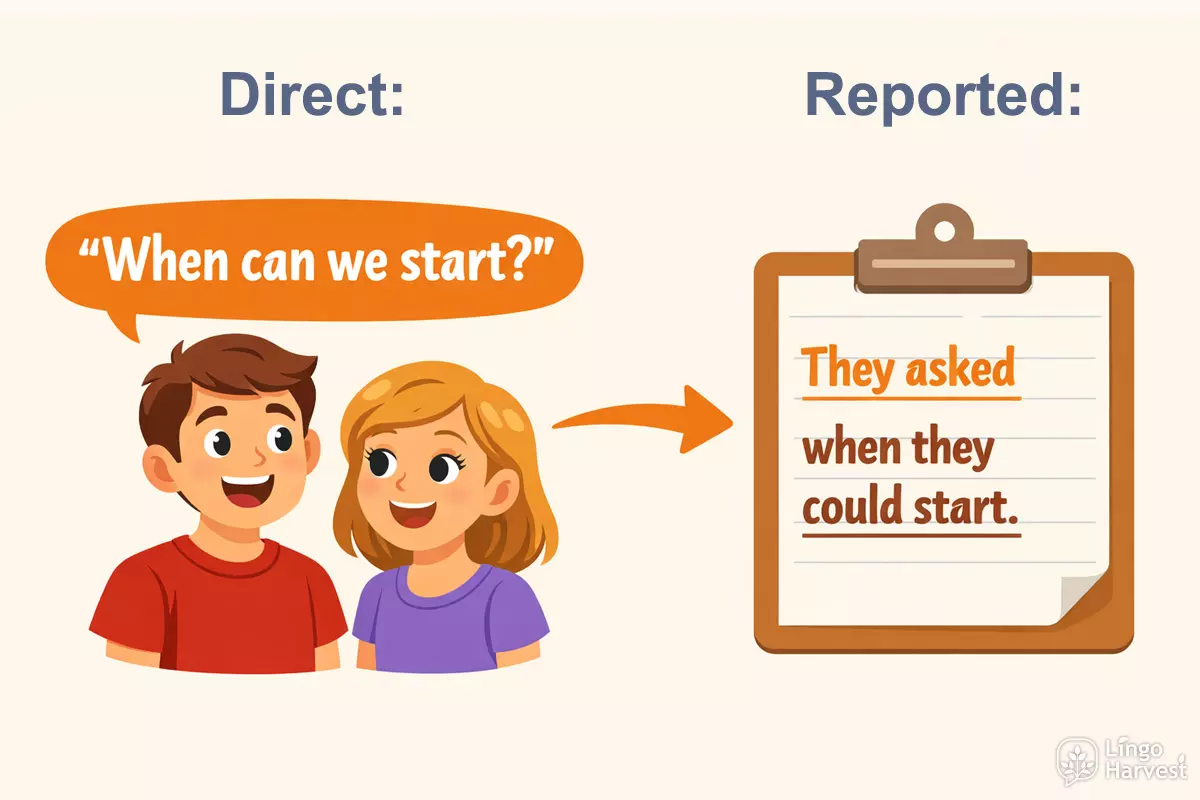
Pronouns must reflect the new speaker and listener. For example, "you" in a direct question may become "he," "she," or "they" in reported form. The right choice depends on who originally asked and who is being referred to.
- "Where are you going?" → He asked where I was going. (if reporting your own words)
- "Why did she leave?" → He wondered why she had left.
- "What does he want?" → She asked what he wanted.
- "When can we start?" → They asked when they could start.
- "Who will help me?" → He asked who would help him.
Verb tense adjustments
Tenses in reported questions usually move one step back into the past. This is called "backshifting." However, if the reporting verb is in the present, or if the information is still true, you might not need to change the tense.
| Direct Question | Reported Speech |
|---|---|
| “Where is she?” | He asked where she was. |
| “What are they doing?” | She wanted to know what they were doing. |
| “Why did you leave?” | He asked why I had left. |
| “When will we meet?” | She asked when we would meet. |
| “How can you help?” | He wondered how I could help. |
Other important shifts
- Possessives may also need to change: "my" becomes "his," "her," "their," etc.
- Time expressions often shift: "today" becomes "that day," "tomorrow" becomes "the next day," and so on.
- Modal verbs change too: "can" becomes "could," "will" becomes "would," "may" becomes "might."
Paying attention to these details ensures your reported questions are both natural and grammatically correct.
Reported wh-questions in formal English
When transforming direct wh-questions into indirect or reported speech, especially in a formal context, certain rules help maintain clarity and correctness. The structure changes notably from direct questions, and attention to verb tense, word order, and punctuation is essential.
Key features of reporting wh-questions
- No question mark: Reported questions become statements, so they end with a period.
- Subject-verb order: The word order shifts to that of a statement, not a question.
- Wh-word retention: The original question word (who, what, when, where, why, how) is kept at the start of the reported clause.
- Backshifting tenses: Verb tenses often move one step back (e.g., present to past), unless the reporting verb is in the present or the information is still current.
- Reporting verbs: Common choices include "asked," "inquired," "wondered," "wanted to know," and "requested."
Examples of formal reporting patterns
Let’s look at how direct wh-questions are reported. Notice the change in word order and tense:
| Direct Question | Reported Speech (Formal) |
|---|---|
| Where are the documents? | He inquired where the documents were. |
| Why did she leave early? | The manager asked why she had left early. |
| How will we solve this problem? | They wondered how they would solve that problem. |
| What does this term mean? | The professor wanted to know what that term meant. |
| Who is responsible for the report? | The director asked who was responsible for the report. |
Common reporting verbs for formal contexts
- inquired → He inquired where the documents were.
- asked → She asked why the meeting had been postponed.
- wondered → They wondered how the problem could be solved.
- wanted to know → The manager wanted to know when the report would be ready.
- requested → She requested whether the form had been submitted.
- questioned → The lawyer questioned why the witness had changed his story.
- consulted → He consulted what options were available.
- enquired → She enquired where the conference would take place.
- pressed → The journalist pressed why the decision had been delayed.
- investigated → The committee investigated how the error had occurred.
For formal writing, choosing precise reporting verbs and maintaining the correct sequence of tenses and word order ensures your reported questions sound polished and clear. Remember, the tone is more neutral and objective, aiming for accuracy over expressiveness.
Typical learner mistakes
Many students find it challenging to correctly report wh-questions in English, often because the word order and verb tense rules differ from direct questions. It’s easy to make errors with auxiliary verbs, pronoun changes, and the overall sentence structure when turning questions into reported speech.
Common errors with word order and auxiliaries
One frequent issue is keeping the direct question word order, instead of switching to a statement structure. Learners also often forget to drop auxiliary verbs like do, does, or did when they are no longer needed.
- ❌ She asked where does he live.
- ✅ She asked where he lived.
Confusing tense changes
Another stumbling block is applying the correct backshift in tense, especially after reporting verbs in the past. Learners sometimes keep the tense from the original question, leading to grammatically incorrect sentences.
- ❌ He asked what is she doing.
- ✅ He asked what she was doing.
Misusing or omitting the wh-word
It’s also common to omit the wh-word or to incorrectly replace it with if or whether, which is only appropriate for yes/no questions.
- ❌ She asked if he was coming (for: Where was he going?)
- ✅ She asked where he was going.
Pronoun and time reference mistakes
Reporting wh-questions often requires changing pronouns and time expressions. Forgetting these shifts can lead to confusion or ambiguity.
- ❌ He asked what are you doing now.
- ✅ He asked what I was doing then.
Summary of frequent problem areas
| Direct Question | Incorrect Reported Form | Correct Reported Form |
|---|---|---|
| Where did she go? | He asked where did she go. | He asked where she had gone. |
| What is he eating? | She asked what is he eating. | She asked what he was eating. |
| When will they arrive? | He wanted to know when will they arrive. | He wanted to know when they would arrive. |
| Who are you meeting? | She asked who are you meeting. | She asked who I was meeting. |
| Why did you leave? | He asked why did I leave. | He asked why I had left. |
Other pitfalls to avoid
- Using if/whether with wh-questions (only for yes/no questions).
- Repeating the subject unnecessarily (e.g., “He asked me that where I was”).
- Forgetting to change adverbs of time and place when needed (e.g., now → then, here → there).
- Mixing direct and reported speech elements in the same sentence.
By being aware of these slip-ups, learners can focus on the specific aspects of reporting wh-questions that need extra attention and practice.
Homework
Complete the exercises below to practice reporting wh-questions correctly. Focus on word order, tense backshifting, pronoun changes, and choosing the correct structure for indirect questions.
1. Turn Direct Wh-Questions into Reported Speech
Rewrite each direct question as reported speech using a suitable reporting verb.
- “Where are you going?”
- “Why did she leave early?”
- “What does he want?”
- “When will they arrive?”
- “How can I fix this problem?”
- “Who is calling you?”
- “What are they talking about?”
- “Where did you buy this jacket?”
- “Why are we waiting here?”
- “How long have you lived here?”
Show answers
- He asked where I was going.
- He asked why she had left early.
- She asked what he wanted.
- He wanted to know when they would arrive.
- She wondered how she could fix that problem.
- He asked who was calling me.
- She asked what they were talking about.
- He asked where I had bought that jacket.
- They asked why they were waiting there.
- She asked how long I had lived there.
2. Correct the Mistakes in Reported Wh-Questions
Each sentence below contains an error. Rewrite each one correctly.
- She asked where does he work.
- He asked what is she doing now.
- They wanted to know when will the train arrive.
- She asked who are you meeting.
- He wondered why did I leave early.
- She asked where did we park the car.
- He asked what do they want.
- They asked how can we solve this.
- She wondered who will help her.
- He asked when did she finish the test.
Show answers
- She asked where he worked.
- He asked what she was doing then.
- They wanted to know when the train would arrive.
- She asked who I was meeting.
- He wondered why I had left early.
- She asked where we had parked the car.
- He asked what they wanted.
- They asked how they could solve that.
- She wondered who would help her.
- He asked when she had finished the test.