Mixed Tenses in Reported Speech and How to Use Them

 Here we what mixed tenses mean in reported speech and why keeping tenses consistent is not always possible. It covers combining past and present references, choosing tenses logically, context, and frequent learner mistakes.
Mastering the shifts between past, present, and future verb forms when reporting what others have said can be challenging for English learners. It is important to understand how to correctly use and blend different tenses in indirect statements to ensure clear and accurate communication. By practicing reported speech and paying attention to verb tense changes, learners can become more confident in conveying messages from one person to another without confusion or misunderstandings.
What mixed tenses mean in reported speech
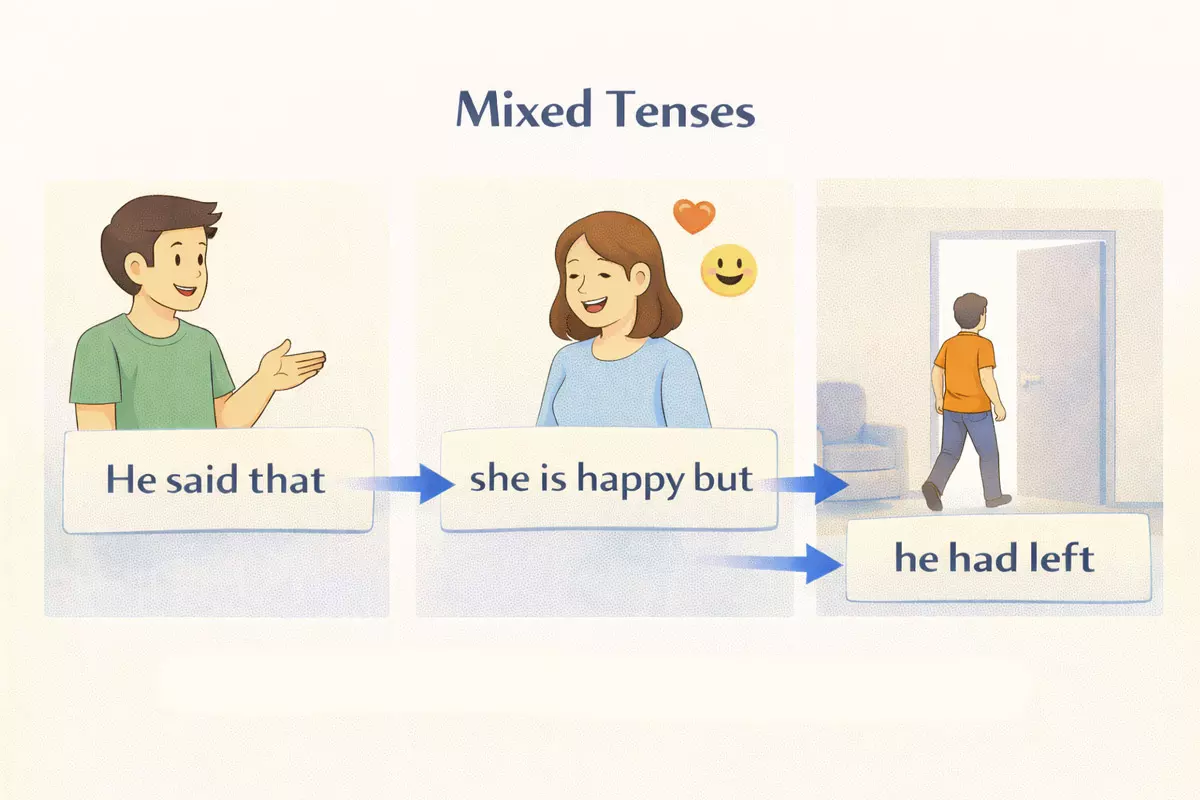
Understanding how different verb tenses interact is key to accurately reporting speech. In English, “mixed tenses” describes situations where the tense in the reporting clause and the reported clause do not match in a simple backshift, but instead reflect the original context, sequence of events, or speaker’s intent. This often happens when the time of speaking and the time of the reported action are different, or when facts, habits, or universal truths are involved.
Why do speakers mix tenses when reporting?
Writers and speakers sometimes use a blend of tenses to show relationships between events, to keep facts current, or to clarify that some information remains true regardless of when it was said. This can make reported statements clearer and more precise, especially in complex narratives.
Common reasons for using mixed tenses
- Reporting general truths or permanent facts
- Describing actions that happened before the reporting verb
- Referring to ongoing or repeated actions
- Expressing hypothetical or unreal situations
- Showing that information is still true at the time of reporting
- Maintaining clarity in sequences of events
- Reporting future intentions or plans made in the past
- Reflecting changes in the situation since the original speech
- Preserving the original tense for emphasis or style
- Reporting requests, advice, or instructions
Examples of mixed tense use in indirect speech
Consider these typical scenarios:
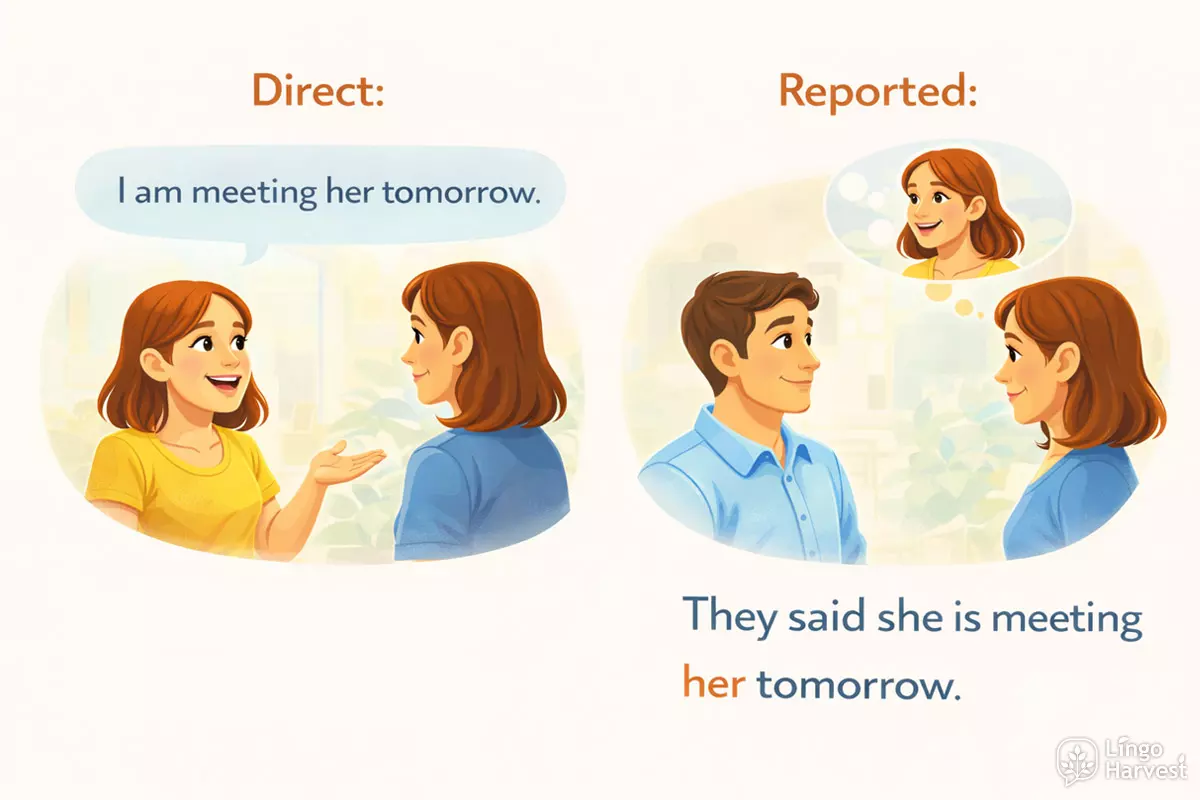
- Direct: “The Earth orbits the sun.”
Reported: He said that the Earth orbits the sun. (Present tense kept for a general truth) - Direct: “I am meeting her tomorrow.”
Reported: She said she is meeting her tomorrow. (Present continuous to indicate a fixed future plan) - Direct: “I have finished my work.”
Reported: He said he had finished his work. (Present perfect shifts to past perfect) - Direct: “If I win, I will buy a car.”
Reported: She said that if she won, she would buy a car. (Conditional structures)
How different tenses combine: overview
| Direct Speech Tense | Reported Speech Tense (Typical) | When Mixed Tenses Are Used |
|---|---|---|
| Present Simple | Past Simple | Unchanged for facts (He said the sun rises in the east.) |
| Present Continuous | Past Continuous | Unchanged for scheduled events (She said she is leaving tomorrow.) |
| Past Simple | Past Perfect | Sometimes stays Past Simple if sequence is clear (He said he went home.) |
| Will (Future) | Would | Can stay “will” for future still true (She said she will call later.) |
| Present Perfect | Past Perfect | Mixed if outcome is still relevant (He said he has finished.) |
Key points to remember
- Not all verbs need to shift back; context and meaning matter.
- Universal truths and facts often keep their original tense.
- Mixed tenses can clarify timelines and prevent confusion.
- Using the correct combination helps the listener or reader understand what has changed and what remains true.
In summary, blending tenses in indirect speech is a strategic choice to convey accuracy and nuance. By mastering mixed tense patterns, you can report information more naturally and precisely.
Why tense consistency is not always possible
Maintaining the same tense throughout reported speech is not always realistic or necessary. Real-life conversations and reports often involve a mixture of time frames, intentions, and established facts. These shifting contexts mean that rigidly following tense backshifting rules can sometimes lead to confusion or even misrepresentation of meaning.
Shifting time frames in speech
People often refer to events in the past, present, and future all within a single statement. When reporting such speech, it becomes awkward or even misleading to force every verb into the same tense. For example, if the original speaker uses the present tense for a general truth and the past tense for a personal experience, the reported version should reflect those distinctions.
- General truths: "The sun rises in the east," she said. (No need to change the tense.)
- Ongoing situations: "I am working on the project," he explained. (May need adjustment based on context.)
- Future intentions: "I will call you tomorrow," she promised. (Typically backshifted, but not always.)
- Past experiences: "I visited Rome last year," he recalled. (Usually reported in the past perfect.)
When tense consistency breaks down
Certain situations make it impossible or awkward to keep all verbs in a single tense:
- Universal truths: Facts that remain true regardless of when they are reported should stay in the present tense.
- Unchanged situations: If the condition or situation hasn’t changed, the original tense may remain.
- Mixed content: When a speaker refers to different times or hypothetical situations, a single tense cannot represent every idea accurately.
- Direct quotations: Sometimes, reported speech includes direct quotes where the original tense is preserved for clarity.
Examples of mixed tense usage
Here are several ways mixed verb forms naturally arise in indirect speech:
- She said that she loves Paris and visited last summer.
- He mentioned that he had finished his work and is waiting for feedback.
- They told us that water boils at 100°C and that they learned this in school.
- I heard that she will arrive tomorrow but was delayed today.
- He explained that the meeting is every Monday, though he missed the last one.
- She said she believes in hard work and has always tried her best.
- The teacher said that light travels faster than sound and that we should remember this.
- My friend said he couldn’t come last night but hopes to see us soon.
- She told me that she will study abroad if she gets the scholarship.
- He said that he feels better and had taken his medicine.
Comparing tense usage in reported speech
| Original Statement | Reported Speech |
|---|---|
| "I am tired and I will go home." | He said he was tired and would go home. |
| "The earth orbits the sun." | She said the earth orbits the sun. ✅ |
| "I finished my work and I feel good." | He said he had finished his work and feels good. |
| "Water boils at 100°C." | They said water boils at 100°C. ✅ |
These examples show that context and meaning often require a mix of verb forms. Rather than forcing uniformity, effective reported speech focuses on clarity and accuracy. That’s why you’ll frequently encounter mixed tenses, especially when reporting facts, ongoing situations, and multiple time frames within the same sentence.
Combining past and present references
When reporting speech, it’s quite common to encounter situations where both past and present ideas need to be conveyed in the same sentence. This often happens when the original statement includes facts that are still true (general truths or current realities), alongside events that occurred in the past. Understanding how to mix verb tenses in reported speech allows you to express these nuances clearly and accurately.
When to Keep the Present Tense
Some statements include information that remains true, such as scientific facts, universal truths, or ongoing situations. In these cases, it's appropriate to keep the present tense even when the reporting verb is in the past. Here are common cases:
- General truths: "The Earth orbits the Sun."
- Permanent states: "She lives in London."
- Current facts: "Water boils at 100°C."
- Ongoing habits: "He always drinks coffee in the morning."
Shifting Past Actions
Past actions, intentions, or completed events reported from a previous time are usually shifted further back in tense. For example, present simple becomes past simple, and present perfect becomes past perfect. But, if the reported idea is still true or relevant, the tense may remain unchanged.
Examples of Mixed Tenses in Context
To illustrate how these combinations work, consider these examples:
- Direct: "I know that the sun rises in the east and I finished my homework yesterday."
Reported: She said that she knows the sun rises in the east and she had finished her homework the day before. - Direct: "They believe climate change is real and they saw its effects last year."
Reported: They said they believe climate change is real and they saw its effects the previous year. - Direct: "My brother lives in Paris and he graduated in 2015."
Reported: She told me her brother lives in Paris and graduated in 2015. - Direct: "Our company is expanding and we launched a new product."
Reported: They announced their company is expanding and they had launched a new product. - Direct: "The museum opens at 10, and I visited it last weekend."
Reported: He said the museum opens at 10 and he had visited it the previous weekend. - Direct: "Cats hate water and my cat escaped the bath."
Reported: She mentioned that cats hate water and her cat had escaped the bath. - Direct: "He works from home and he moved last month."
Reported: She stated he works from home and moved last month. - Direct: "We always meet on Fridays and we met last Friday."
Reported: They said they always meet on Fridays and met last Friday. - Direct: "Sugar dissolves in water and I dissolved some yesterday."
Reported: He explained that sugar dissolves in water and he dissolved some the day before. - Direct: "The train arrives at 9, but yesterday it was late."
Reported: She said the train arrives at 9, but it was late the previous day.
Quick Reference Table
| Original Statement | Reported Speech (Mixed Tenses) |
|---|---|
| "Water boils at 100°C and I tested it yesterday." | He said water boils at 100°C and he had tested it the day before. |
| "The office closes at 6 and I left at 7 last week." | She mentioned the office closes at 6 and she left at 7 the previous week. |
| "Dogs bark and my dog barked at the mailman." | He stated dogs bark and his dog barked at the mailman. |
| "My sister speaks French and she started learning it in school." | She told me her sister speaks French and started learning it in school. |
| "The shop opens at 9, but I arrived at 8." | He explained the shop opens at 9, but he had arrived at 8. |
Mixing time references in reported speech allows for more precise communication, especially when describing a blend of ongoing truths and past actions. Practicing these patterns helps you report complex statements naturally and accurately.
Logical tense choice over mechanical rules
Choosing which tense to use in reported speech is less about memorizing rigid formulas and more about reflecting what makes sense in context. Instead of always backshifting tenses because a textbook says so, skilled speakers and writers often consider the timing, relevance, and perceived truth of the original statement. This approach helps keep the meaning clear and accurate, especially when reporting recent events, general truths, or ongoing situations.
When strict rules don't fit real communication
In practice, sticking to mechanical backshift can create awkward or misleading sentences. For example, reporting universal facts or current realities using past tenses can sound odd or even change the intended meaning. It’s important to match the tense to the situation—sometimes the present or present perfect works better, even in indirect speech.
- General truths: She said that water boils at 100°C.
- Still-true situations: He told me he lives in Paris.
- Recent news: They said they have just finished the project.
- Future plans: She mentioned she will call tomorrow.
- Unchanged facts: The teacher explained that the Earth orbits the Sun.
- Ongoing actions: He said he is working late this week.
- Reported questions: She asked if I am coming to the party.
- Advice or instructions: He advised that we keep our receipts.
- Hypotheticals: She said she would help if she could.
- Past events (where timing matters): He said he met her yesterday.
Comparing logical and mechanical tense use
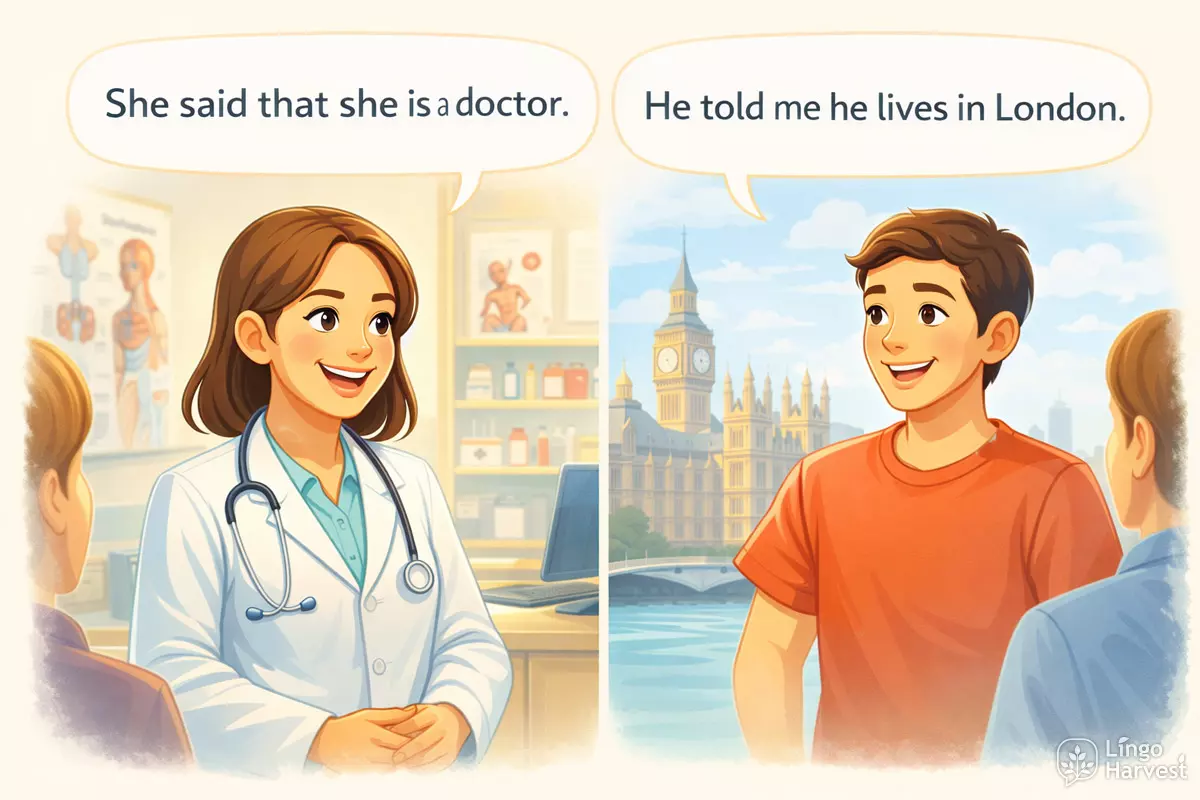
| Mechanical Rule Example | Logical/Contextual Choice |
|---|---|
| She said that she was a doctor. ❌ | She said that she is a doctor. ✅ |
| He told me he lived in London. ❌ | He told me he lives in London. ✅ |
| They said they had finished the work. (when just completed) ❌ | They said they have finished the work. ✅ |
| She explained the Earth orbited the Sun. ❌ | She explained the Earth orbits the Sun. ✅ |
Adapting tense for meaning keeps reported speech clear and natural. Use context and logic as your guide, not just default rules.
Context and speaker perspective
Understanding how context and the speaker’s point of view influence tense choices is essential when transforming direct statements into reported speech. The selection of tense isn’t random; it often depends on when the reporting happens, the speaker’s relationship to the original event, and the relevance of the information at the time of reporting.
Why context matters in tense selection
When someone relays what another person said, the timing of both the original statement and the reporting moment shapes which verb forms are appropriate. For example, if the information is still true or relevant, the present tense may be kept. If the context has shifted or the information is no longer current, a shift to past tenses is common. This is why sometimes reported speech uses a mix of tenses within a single sentence or paragraph.
Speaker perspective and tense shifts
The speaker’s perspective affects whether they choose to backshift tenses or keep them unchanged. This decision can reflect certainty, emotional distance, or the desire to emphasize ongoing relevance. The following list shows how these factors play out:
- If the speaker believes the original statement is still true, they may keep the present tense. Example: She said that Paris is beautiful.
- When reporting past events or completed actions, speakers typically shift to the past tense. Example: He said he had finished the report.
- For universal truths or scientific facts, the original tense is often retained. Example: The teacher said that water boils at 100°C.
- Personal involvement or emotional connection might lead to less tense shifting, especially in informal contexts.
- When the reporting verb is in the present or future, tense shifts are less likely. Example: She says she feels ill.
- Conditional or hypothetical statements can result in more complex tense mixing, depending on what is being reported.
- Reported questions sometimes combine past and present forms, especially if the answer is still pending.
- Time expressions like "yesterday," "now," or "next year" may change to fit the perspective of the reporter (e.g., "the day before," "then," "the following year").
- Speakers may adjust tenses to clarify chronology or sequence of events.
- In narratives, mixing tenses can help distinguish between background and foreground actions.
Examples: How context and viewpoint shape tense use
| Original Statement | Reported Speech (with context) |
|---|---|
| “I am leaving now.” | He said he was leaving then. (Action in the past, context has changed) |
| “The Earth orbits the sun.” | She said the Earth orbits the sun. (General truth, tense unchanged) |
| “I will call you tomorrow.” | He said he would call me the next day. (Future reference, time adjusted) |
| “I have finished my work.” | She said she had finished her work. (Present perfect → past perfect for completed action) |
| “Can you help me?” | He asked if I could help him. (Modal shifts to past form) |
| “I’m going to the party tonight.” | She said she was going to the party that night. (Present continuous → past continuous; time reference changed) |
| “They are working on the project.” | He said they were working on the project. (Present continuous → past continuous) |
| “I saw her at the store.” | He said he had seen her at the store. (Past simple → past perfect) |
| “You must finish it today.” | She said I had to finish it that day. (Modal must → had to, time reference changed) |
| “We will have finished by Monday.” | They said they would have finished by Monday. (Future perfect → would have + past participle) |
In summary, the relationship between the reporting moment, the original utterance, and the speaker’s intention determines which tenses are used. Awareness of these factors helps learners make more natural choices when using mixed tenses in indirect speech.
Frequent learner mistakes
When working with mixed tenses in reported speech, English learners often run into similar trouble spots. These typically involve confusion about which tense to use, incorrect shifting of verb forms, or misunderstanding how context influences the changes. Recognizing these common pitfalls can help you avoid them in your own writing and speaking.
Confusing Direct and Indirect Speech Tenses
- Using the same tense as the original speaker instead of adjusting it.
- Forgetting to shift the tense when reporting something from the past.
- Applying backshifting when it is not needed (e.g., when reporting universal truths).
Incorrect Backshifting Patterns
Verb tense changes can be tricky, especially when the reporting verb is in the past. Many students struggle with remembering which tense the original statement should shift to. The table below summarizes the most common tense changes:
| Direct Speech | Reported Speech |
|---|---|
| Present Simple (“I go”) |
Past Simple (he said he went) |
| Present Continuous (“I am going”) |
Past Continuous (he said he was going) |
| Present Perfect (“I have gone”) |
Past Perfect (he said he had gone) |
| Past Simple (“I went”) |
Past Perfect (he said he had gone) |
| Will (“I will go”) |
Would (he said he would go) |
Overlooking Time Expressions
- Leaving time markers unchanged (e.g., “today” instead of “that day”).
- Forgetting to update words like “tomorrow” to “the next day.”
- Using expressions that no longer make sense after the shift.
Mixing Tenses within the Same Sentence
Another stumbling block is inconsistent tense use, especially when reporting several actions or thoughts together. Learners may start with the correct tense but switch mid-sentence, leading to confusion for listeners or readers.
Examples of Typical Errors
- “He said he is tired.” ❌ (should be “was tired” if reporting in the past)
- “She said she will come.” ❌ (should be “would come”)
- “They said they have finished.” ❌ (should be “had finished”)
- “He told me he go to school.” ❌ (should be “went to school”)
- “She said she was go to the store.” ❌ (should be “was going”)
- “He said, ‘I will help you tomorrow.’” ✅ (direct, but for reported: “He said he would help me the next day.”)
- “She said she will call me the next day.” ❌ (should be “would call”)
- “He said he had went home.” ❌ (should be “had gone”)
- “They said they saw her yesterday.” ❌ (should be “the day before” or “the previous day”)
- “I told her I am busy.” ❌ (should be “was busy”)
Neglecting Exceptions
Some learners apply backshifting rules too rigidly. Remember, if the reporting verb is in the present or if the statement is still true, you may not need to change the tense. For example, “He says he likes pizza” stays in the present.
By focusing on these patterns, you can avoid many of the traps that make reported speech challenging. Practice and careful attention to context are key to mastering mixed tenses in this area.
Reported Speech Tense Practice
These exercises help you choose tenses in reported speech based on meaning and context, not just automatic backshifting. Pay attention to what is still true, what is a general fact, and what has clearly changed.
Exercise 1: Choose the best reported version (A, B, or C)
- Direct: "I live in Berlin," he said. (He still lives there.)
A) He said he lived in Berlin.
B) He said he lives in Berlin.
C) He said he had lived in Berlin. - Direct: "Water boils at 100°C," the teacher said. (A scientific fact.)
A) The teacher said water boiled at 100°C.
B) The teacher said water boils at 100°C.
C) The teacher said water had boiled at 100°C. - Direct: "We have just finished the report," they said. (They finished a minute ago.)
A) They said they had just finished the report.
B) They said they have just finished the report.
C) They said they finished the report just now. - Direct: "I am working late this week," she said. (It is still the same week.)
A) She said she was working late that week.
B) She said she is working late this week.
C) She said she had been working late that week. - Direct: "The Earth orbits the Sun," he explained. (General truth.)
A) He explained that the Earth orbited the Sun.
B) He explained that the Earth orbits the Sun.
C) He explained that the Earth had orbited the Sun. - Direct: "I can’t talk now," he said. (You are reporting later.)
A) He said he can’t talk now.
B) He said he couldn’t talk then.
C) He said he wasn’t able talk then. - Direct: "I will call you tomorrow," she said. (You report it the next day.)
A) She said she will call me tomorrow.
B) She said she would call me the next day.
C) She said she would call me tomorrow. - Direct: "I have a meeting at 3," he said. (The meeting is still at 3 today.)
A) He said he had a meeting at 3.
B) He said he has a meeting at 3.
C) He said he would have a meeting at 3. - Direct: "I’m hungry," she said. (You report it much later.)
A) She said she is hungry.
B) She said she was hungry.
C) She said she had been hungry. - Direct: "Prices usually rise in December," he said. (A general pattern.)
A) He said prices usually rose in December.
B) He said prices usually rise in December.
C) He said prices had usually risen in December.
Show answers
- B
- B
- A
- B
- B
- B
- B
- B
- B
- B
Exercise 2: Pick the best reporting option (A or B)
- Context: You are reporting immediately after he speaks.
Direct: "I’m leaving now," he said.
A) He said he was leaving then.
B) He said he is leaving now. - Context: The information is still true today.
Direct: "I work for Google," she said.
A) She said she worked for Google.
B) She said she works for Google. - Context: You are writing a formal report about yesterday’s meeting.
Direct: "We are behind schedule," the manager said.
A) The manager said they were behind schedule.
B) The manager said they are behind schedule. - Context: A scientific lecture (universal truth).
Direct: "Light travels faster than sound," the lecturer said.
A) The lecturer said light traveled faster than sound.
B) The lecturer said light travels faster than sound. - Context: They finished the task earlier and it is completed now.
Direct: "We have completed the audit," they said.
A) They said they had completed the audit.
B) They said they have completed the audit. - Context: You are telling the story a week later.
Direct: "I’m seeing Anna tomorrow," he said.
A) He said he was seeing Anna the next day.
B) He said he is seeing Anna tomorrow. - Context: The plan is still in the future and unchanged.
Direct: "We start on Monday," she said.
A) She said they started on Monday.
B) She said they start on Monday. - Context: You are reporting what he said earlier today; it is still relevant.
Direct: "I don’t feel well," he said.
A) He said he didn’t feel well.
B) He said he doesn’t feel well. - Context: A past event with clear past timing.
Direct: "I met him yesterday," she said.
A) She said she had met him the day before.
B) She said she met him yesterday. - Context: A standing rule that is always true in the company.
Direct: "Employees submit timesheets on Fridays," HR said.
A) HR said employees submitted timesheets on Fridays.
B) HR said employees submit timesheets on Fridays.
Show answers
- B
- B
- A
- B
- A
- A
- B
- B
- A
- B